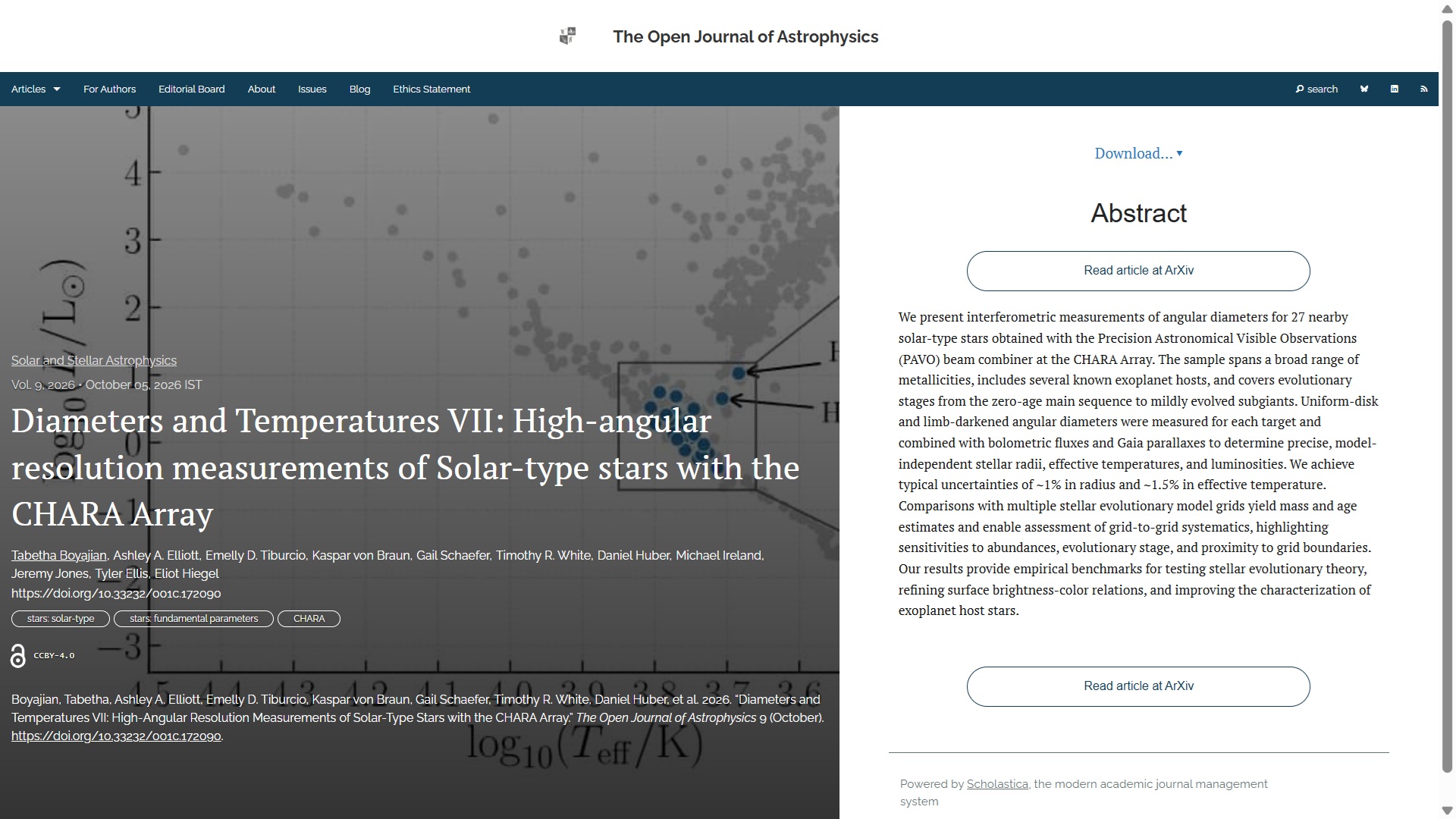
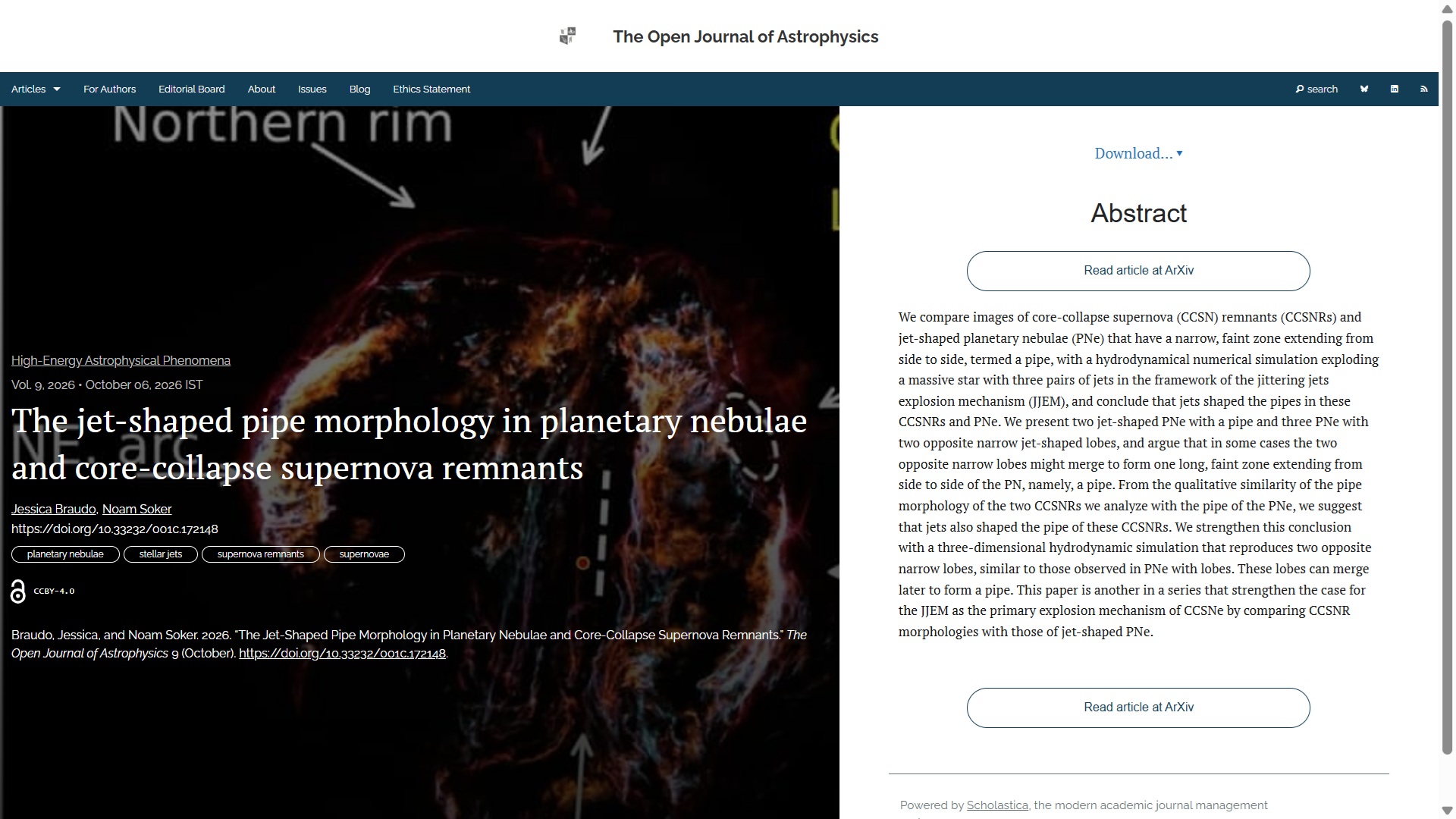
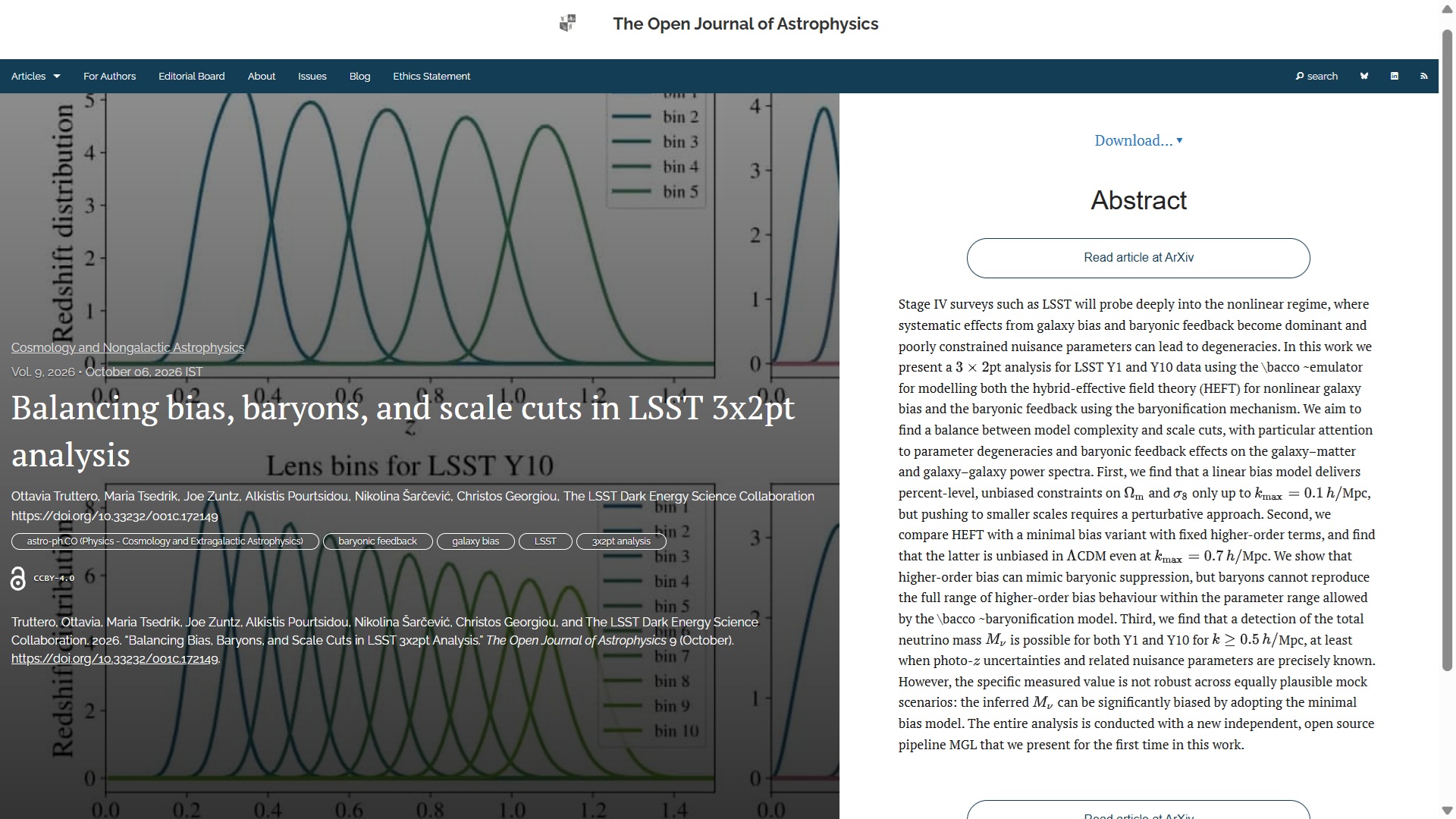
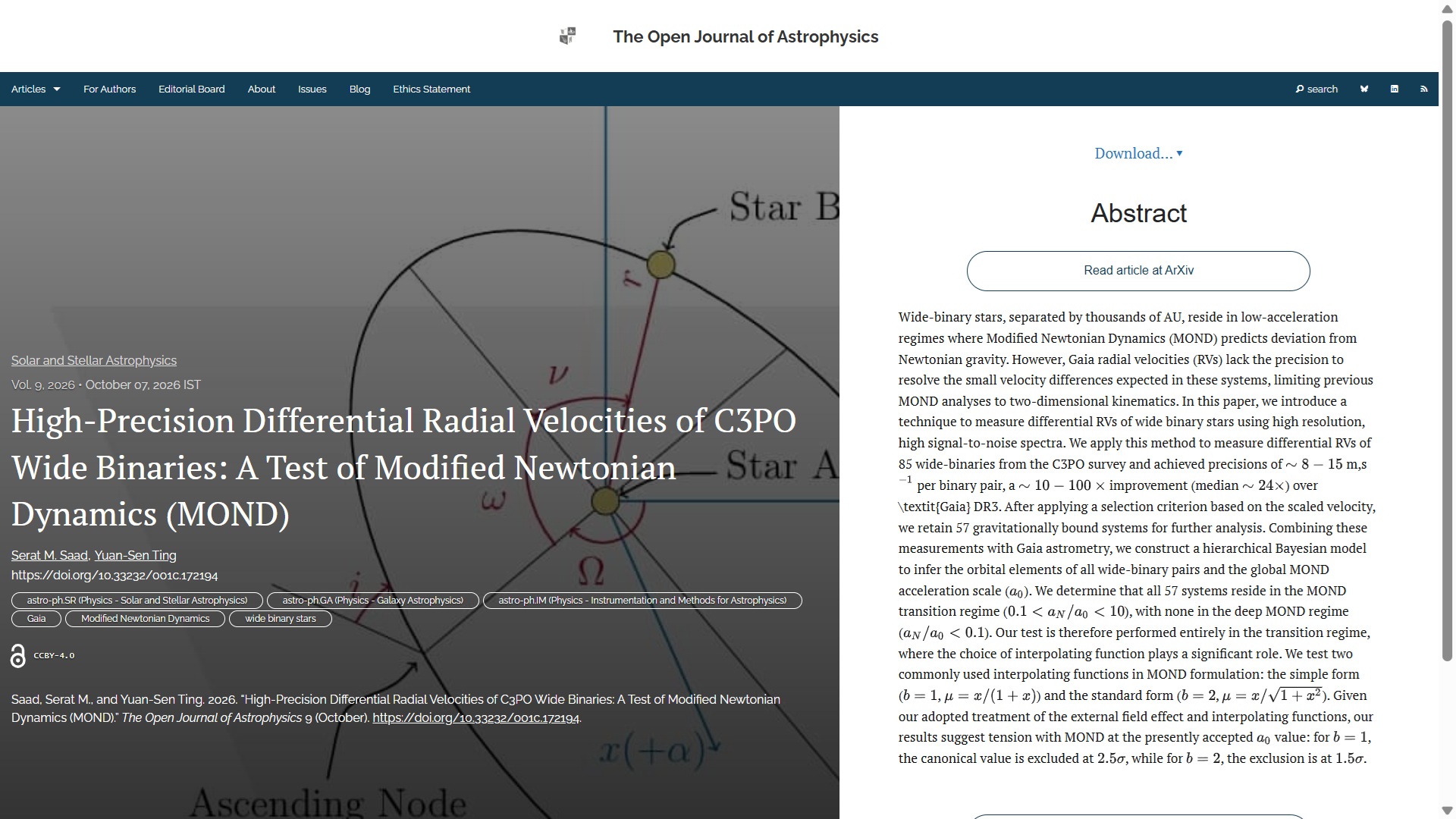
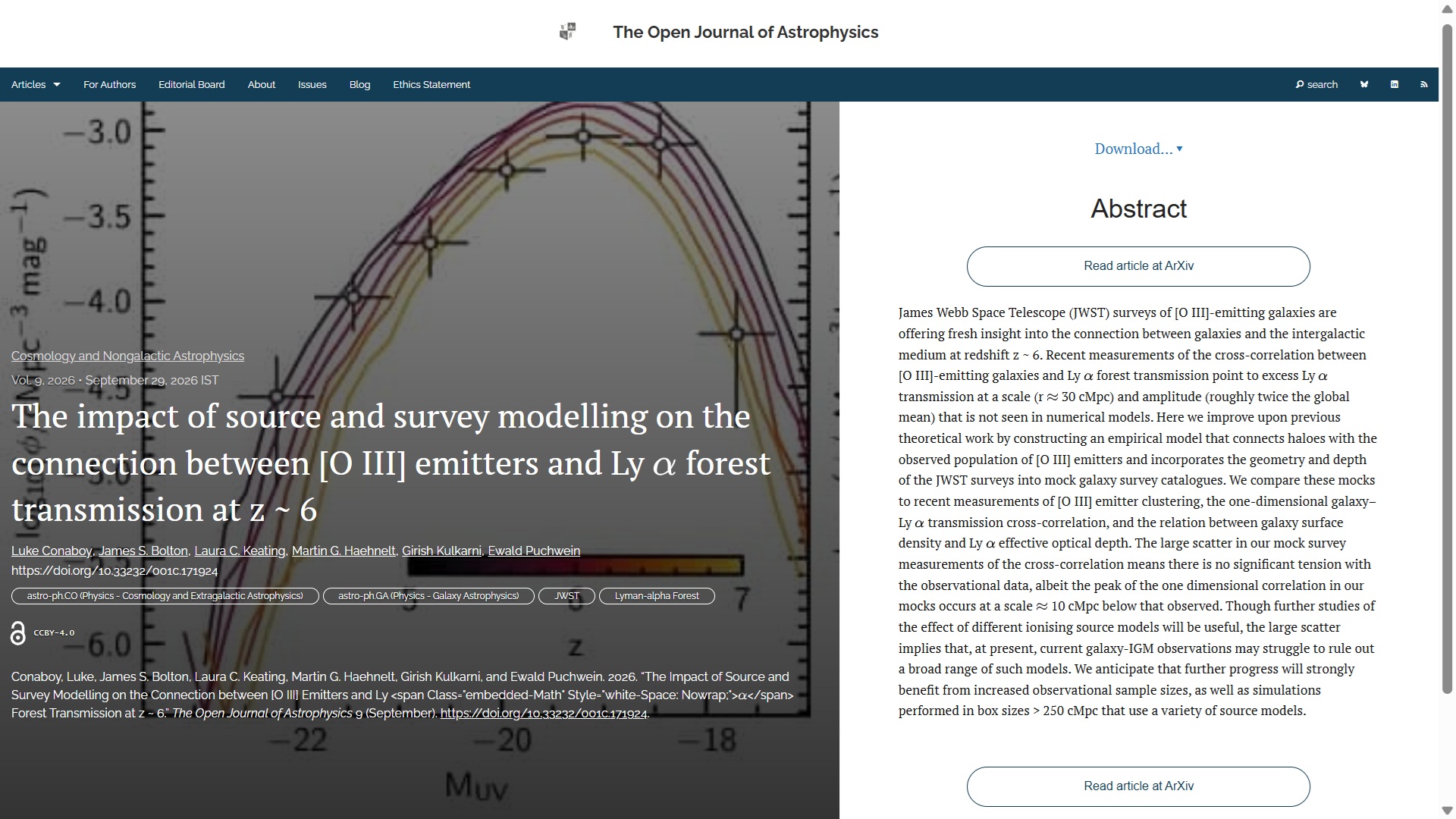
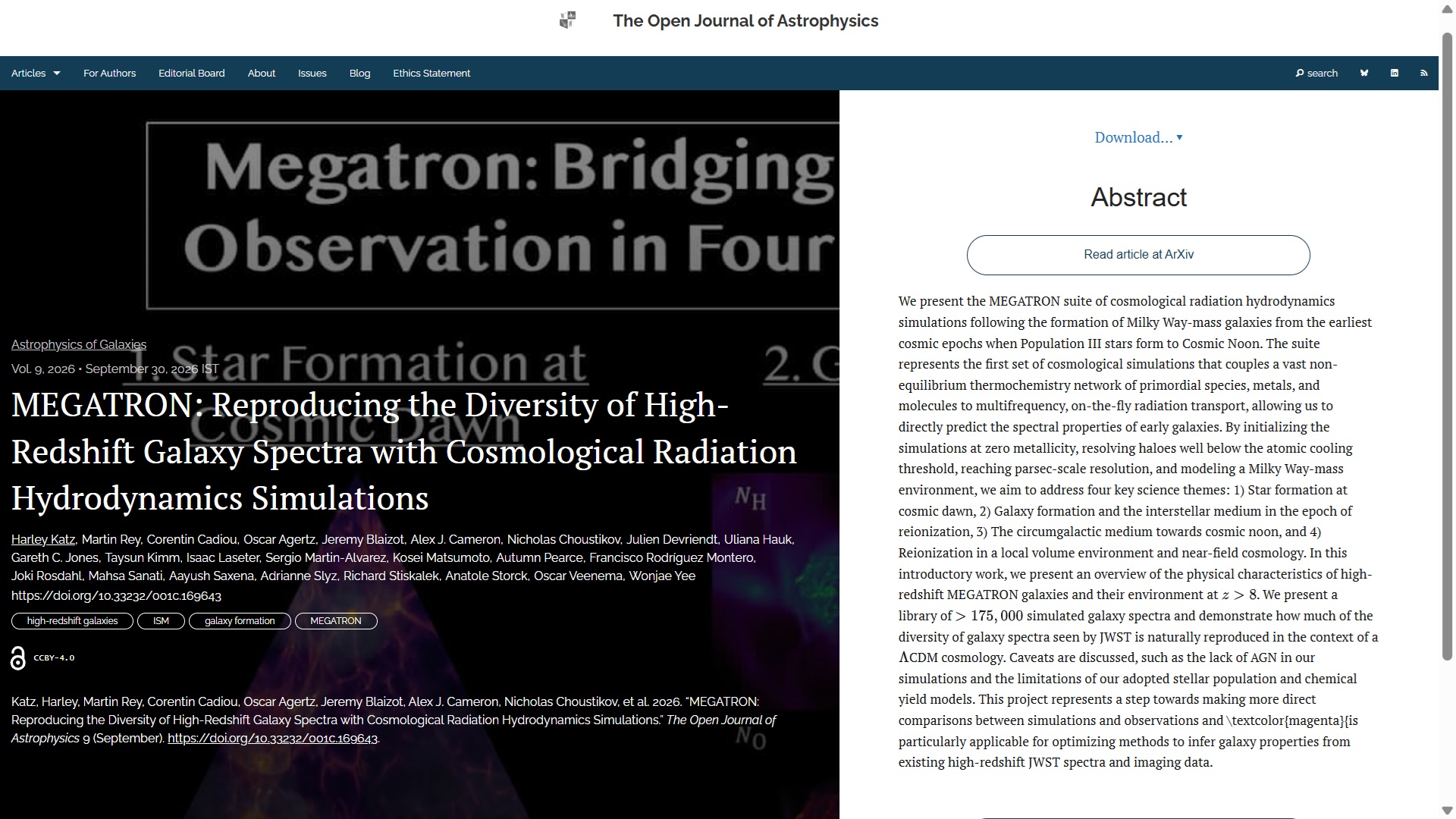
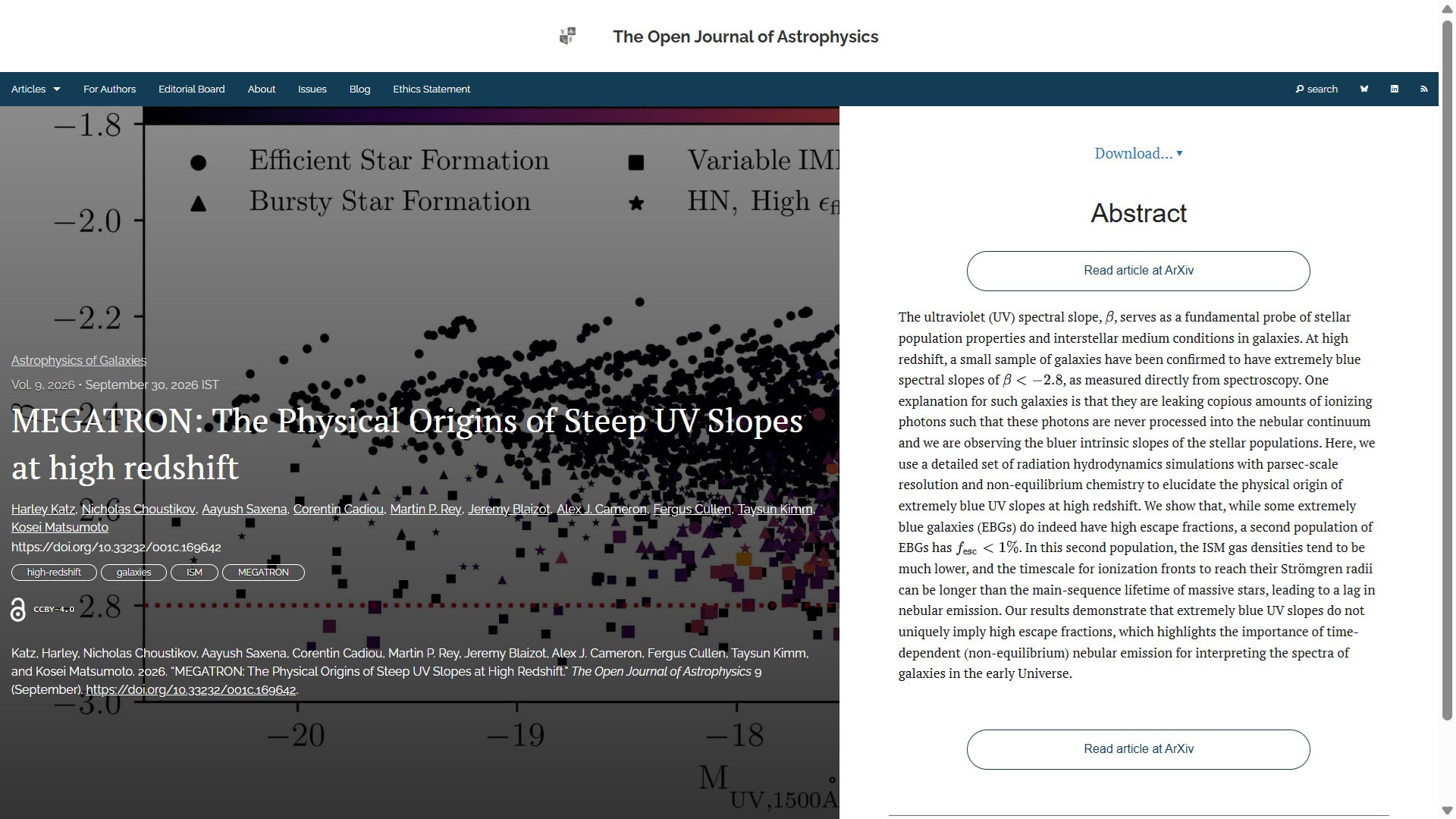
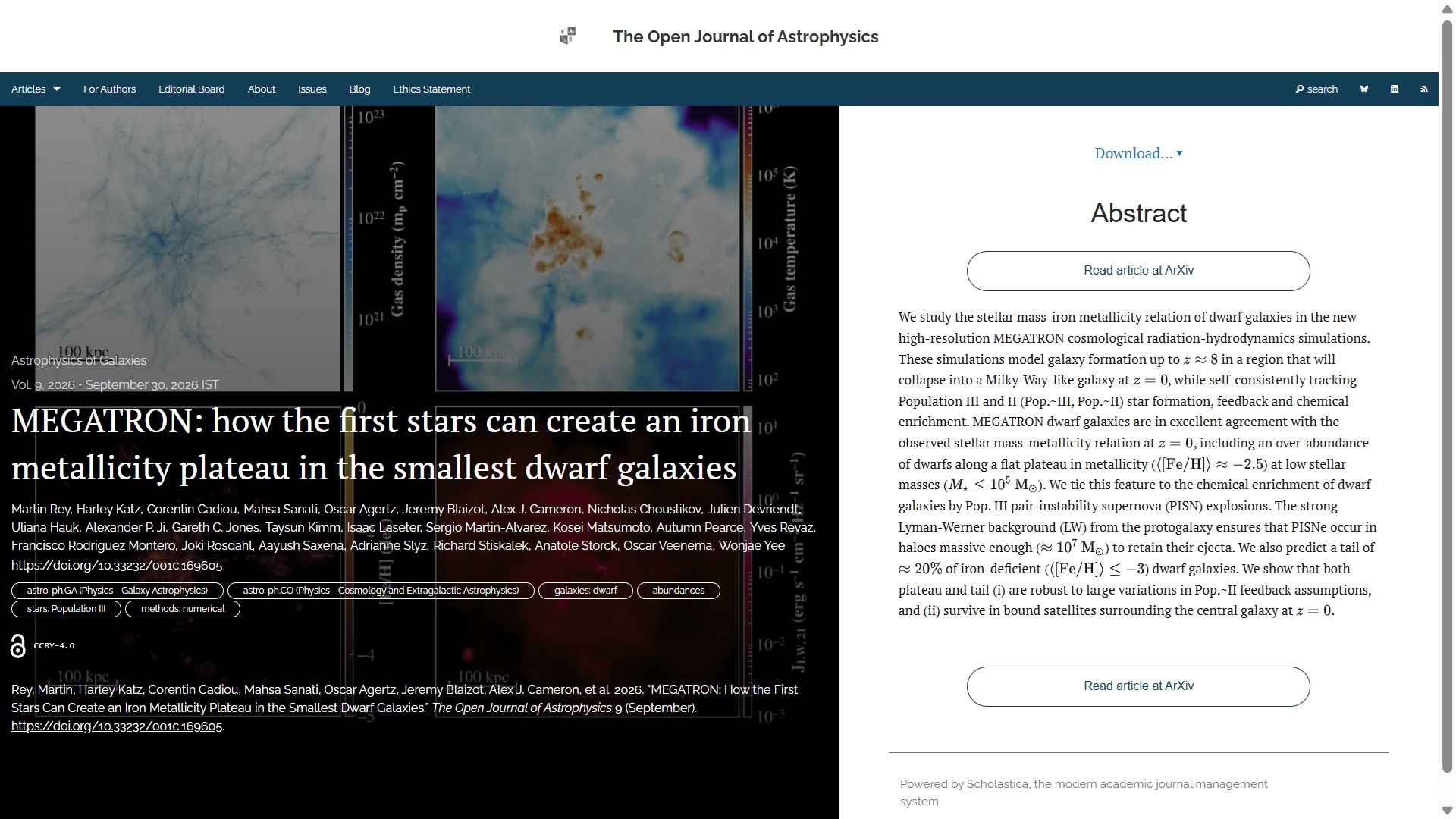
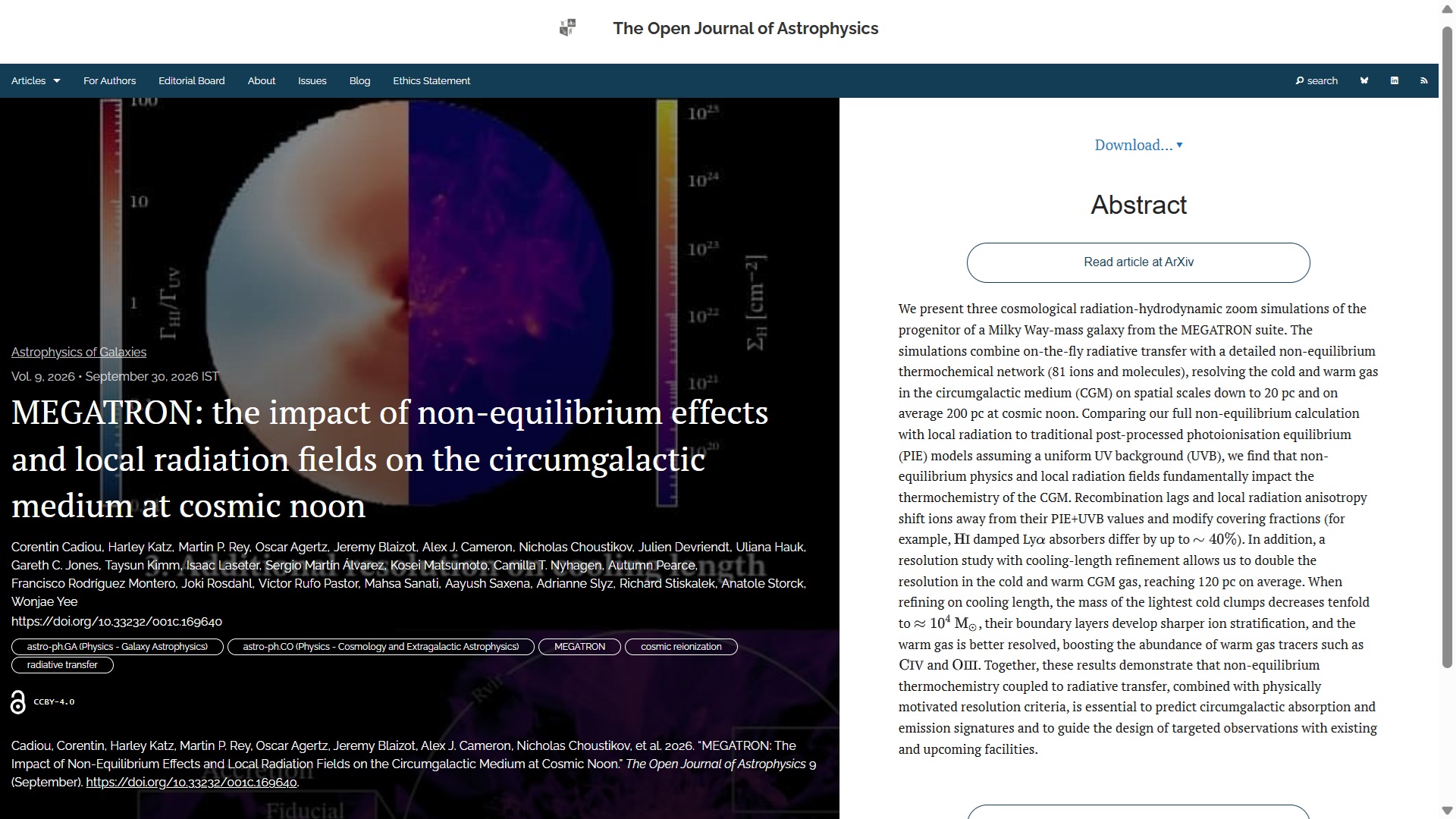
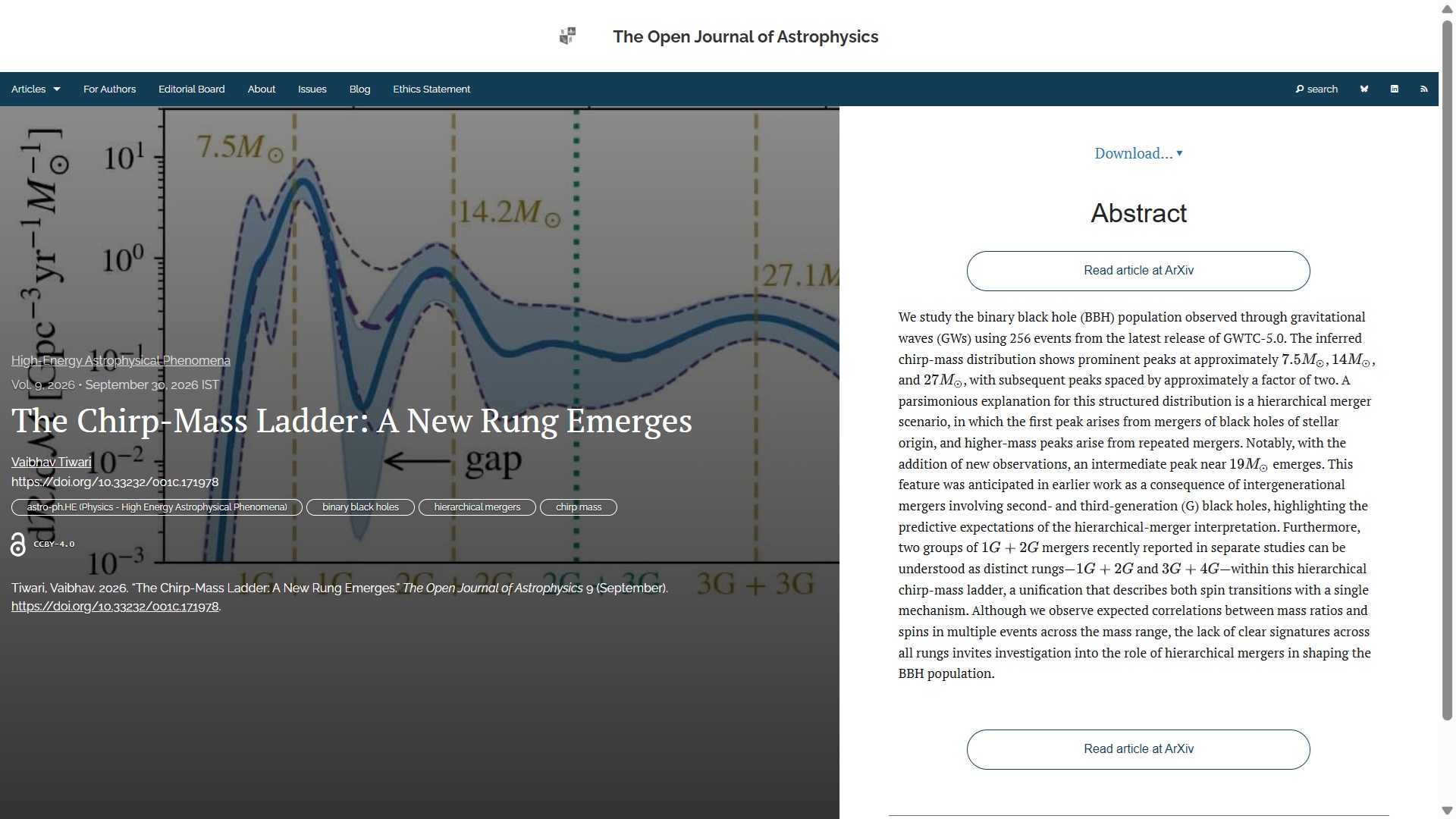
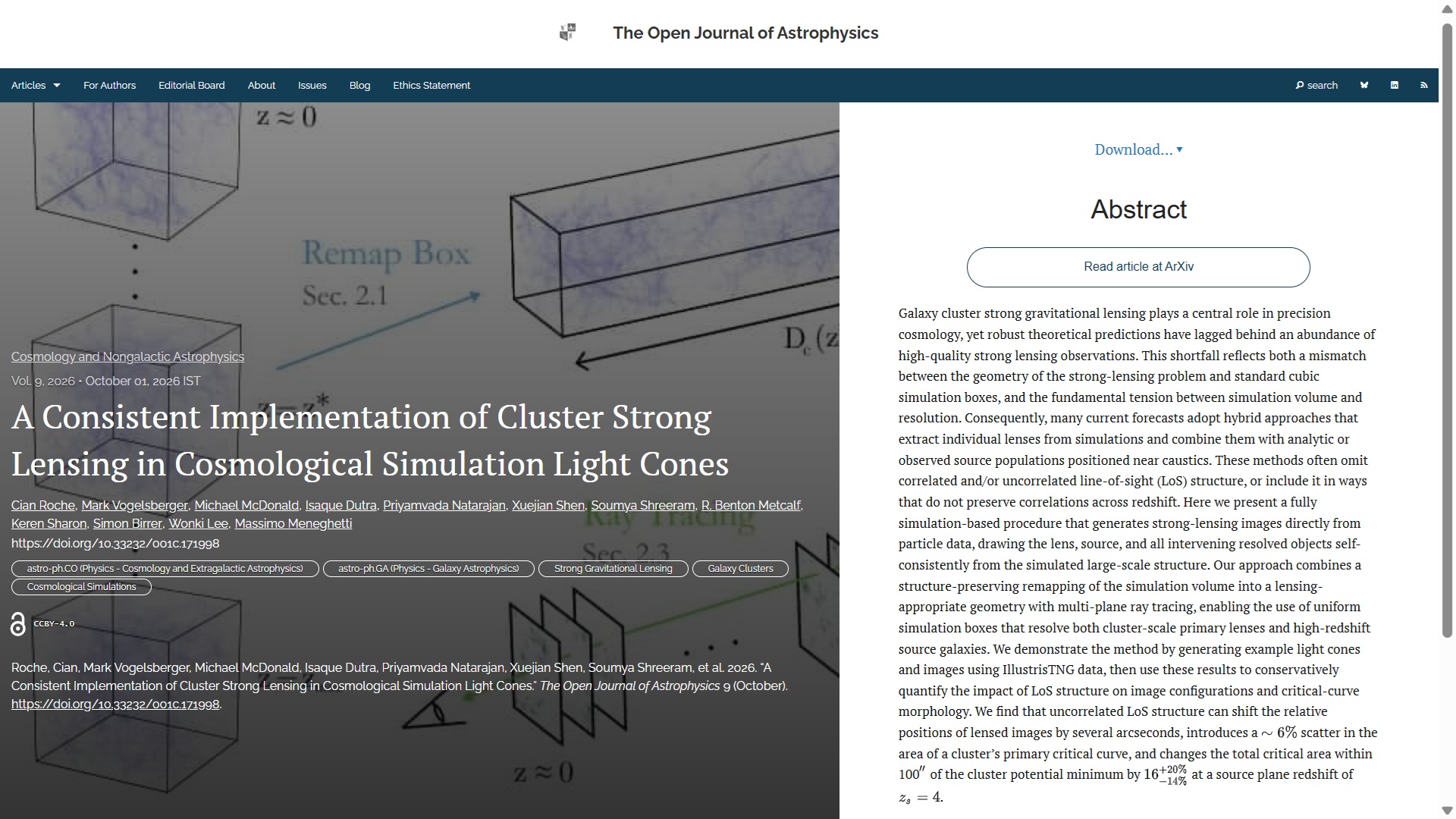
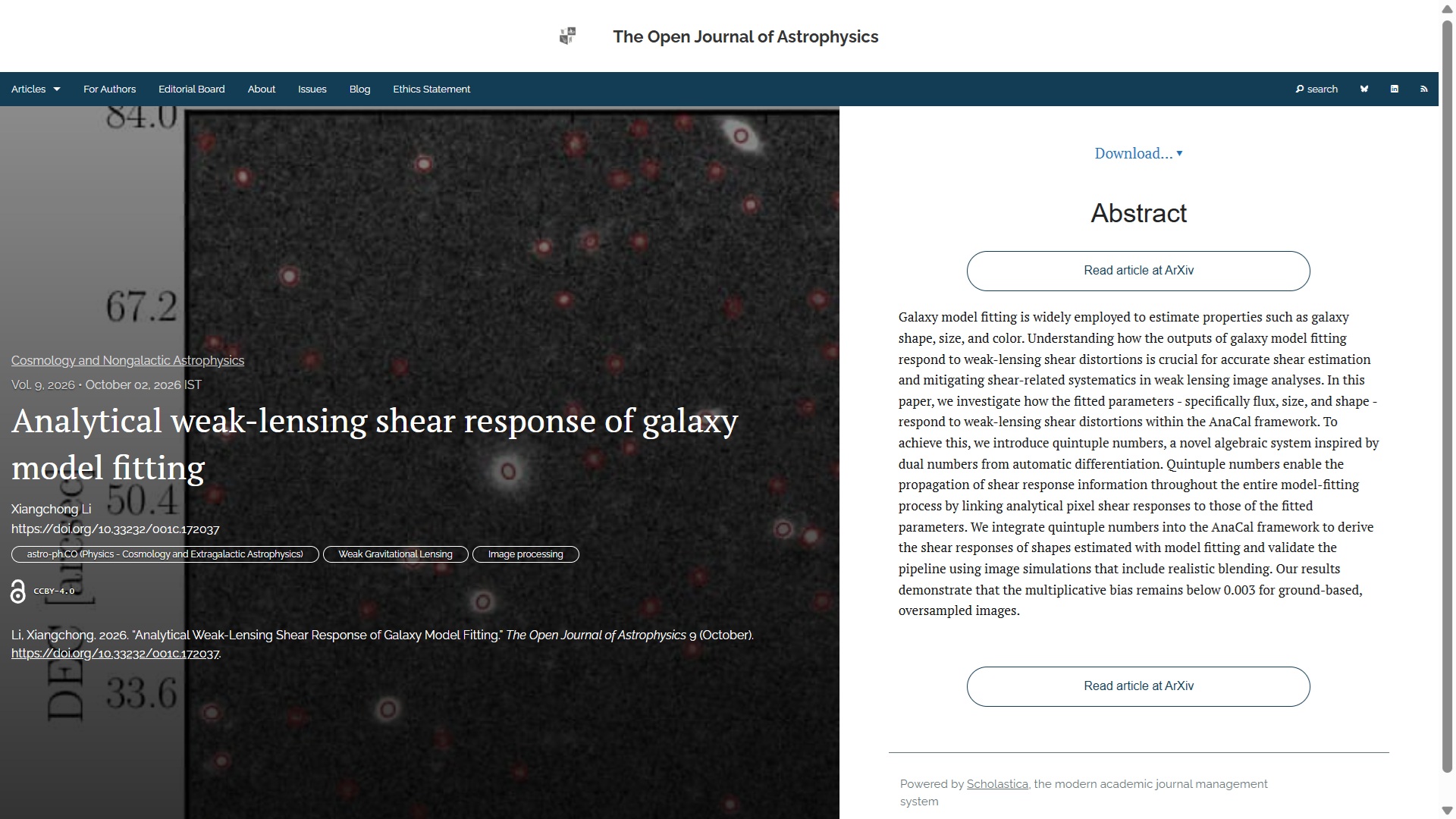
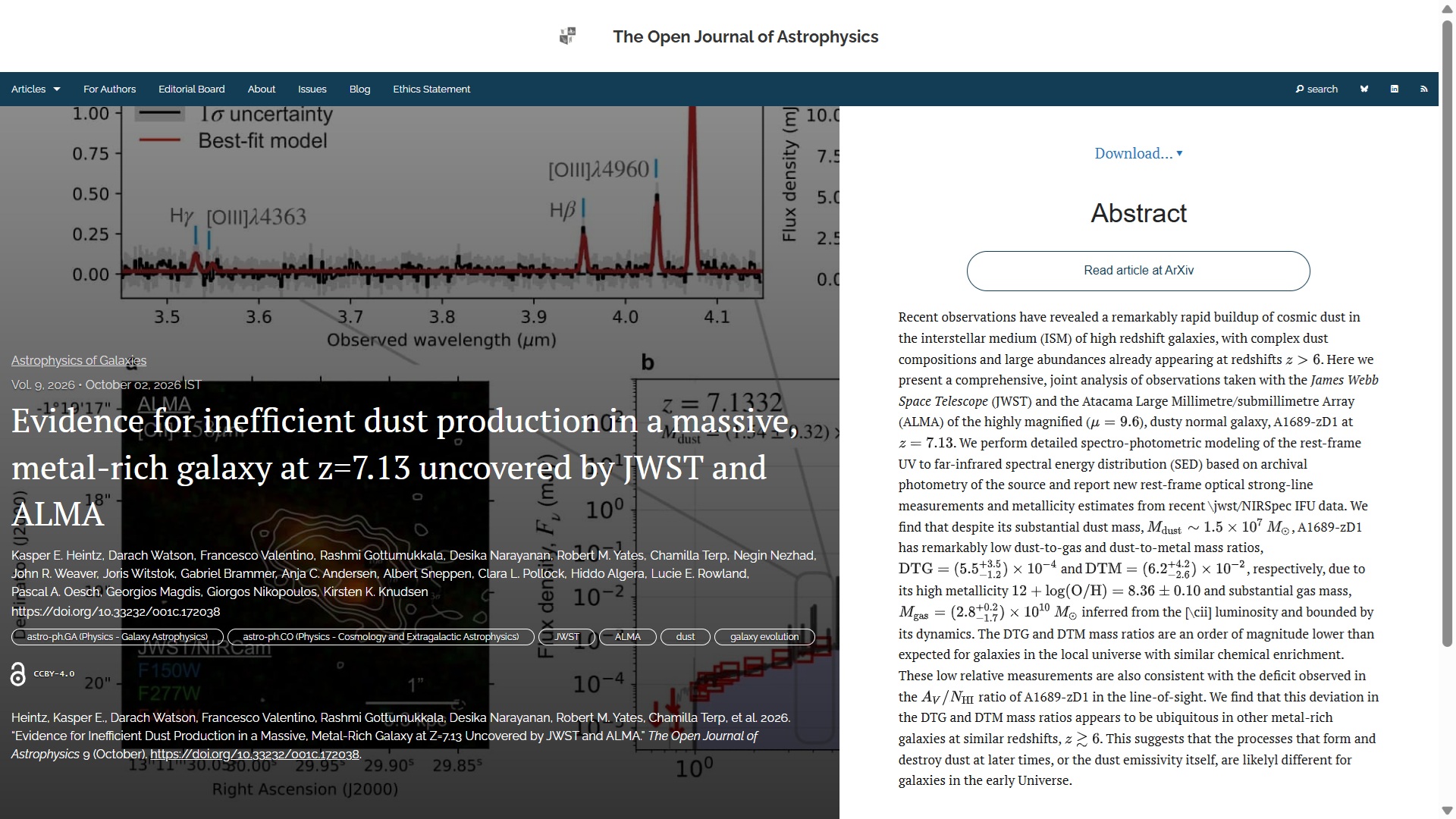
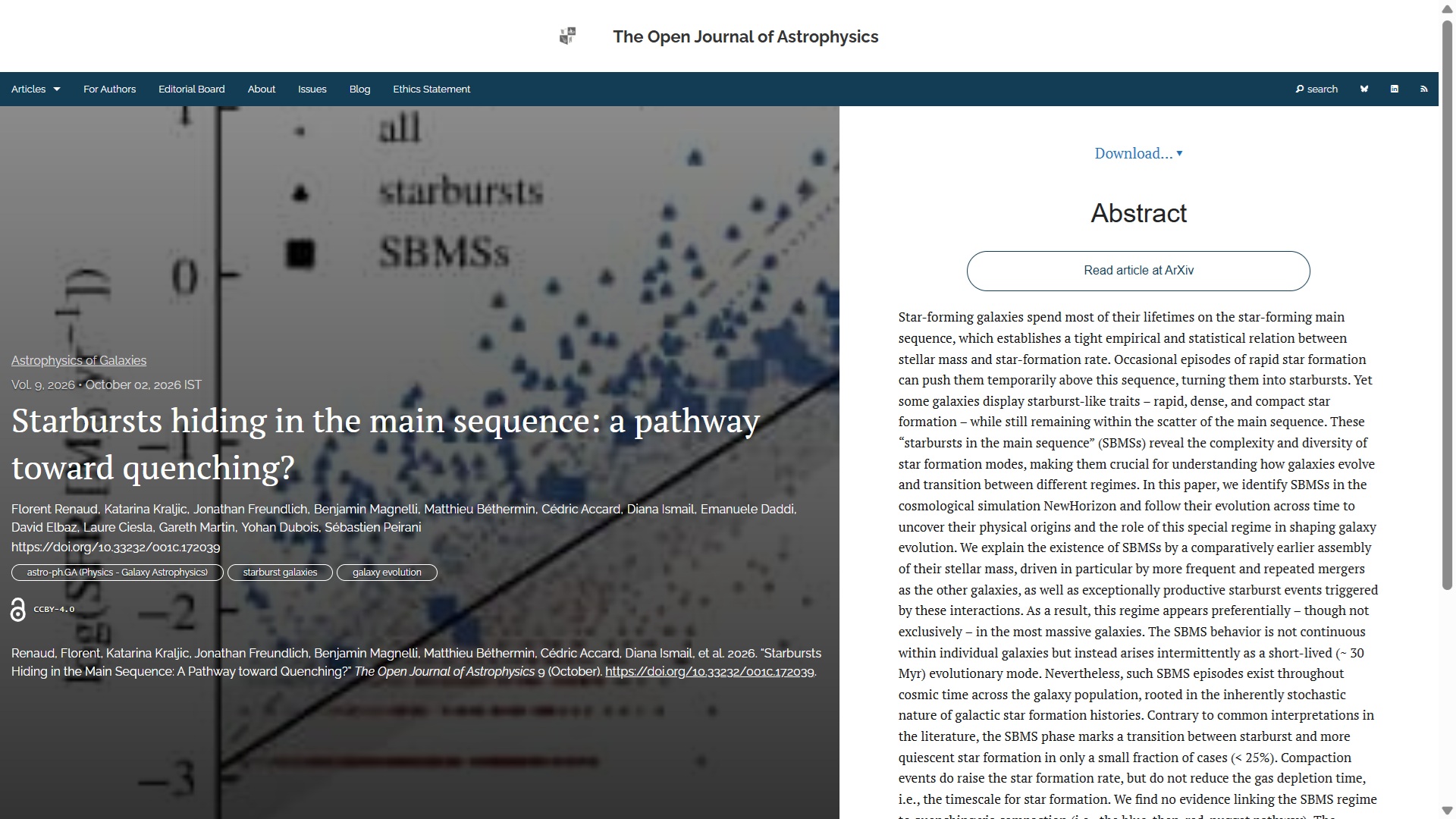
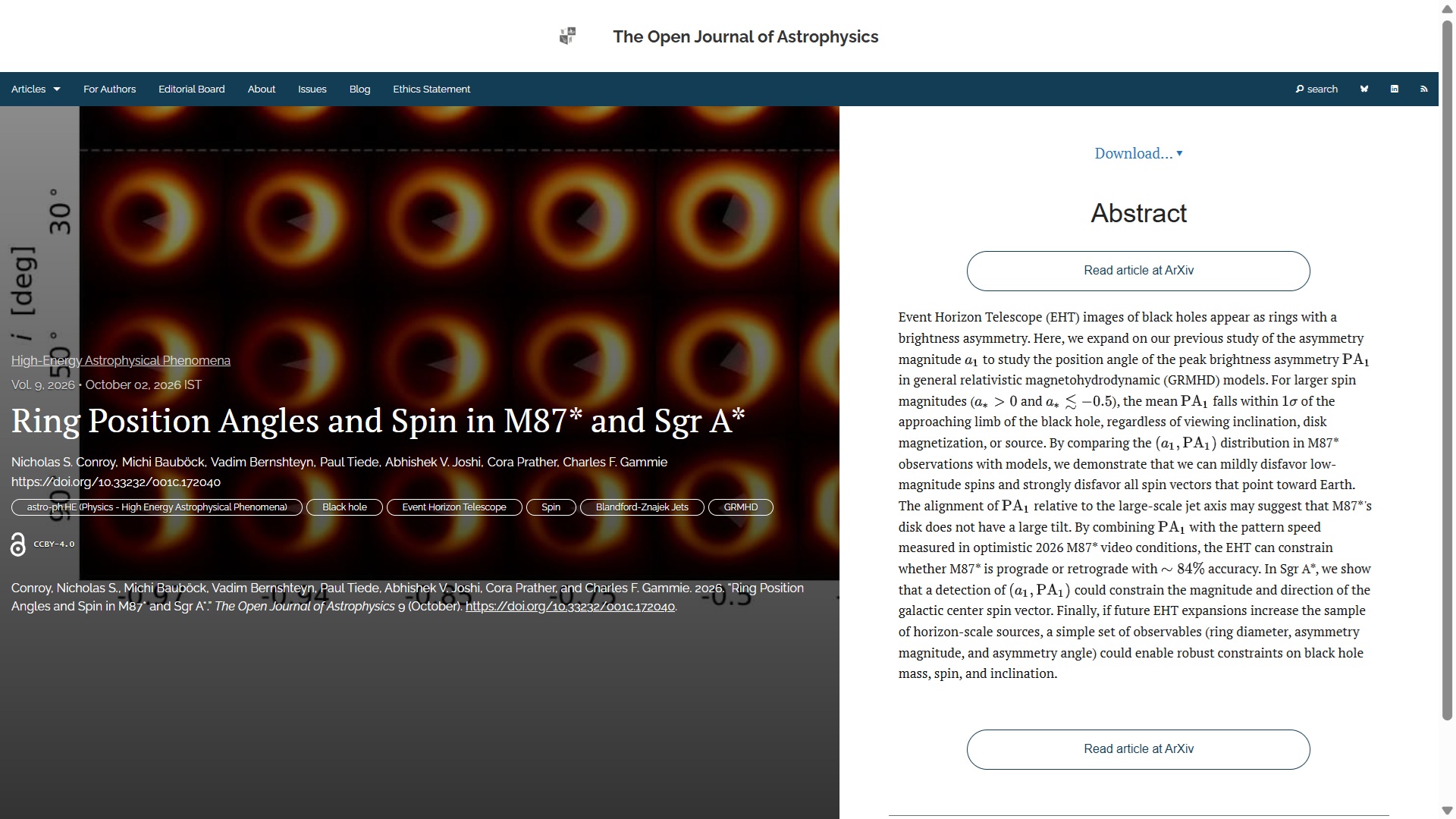
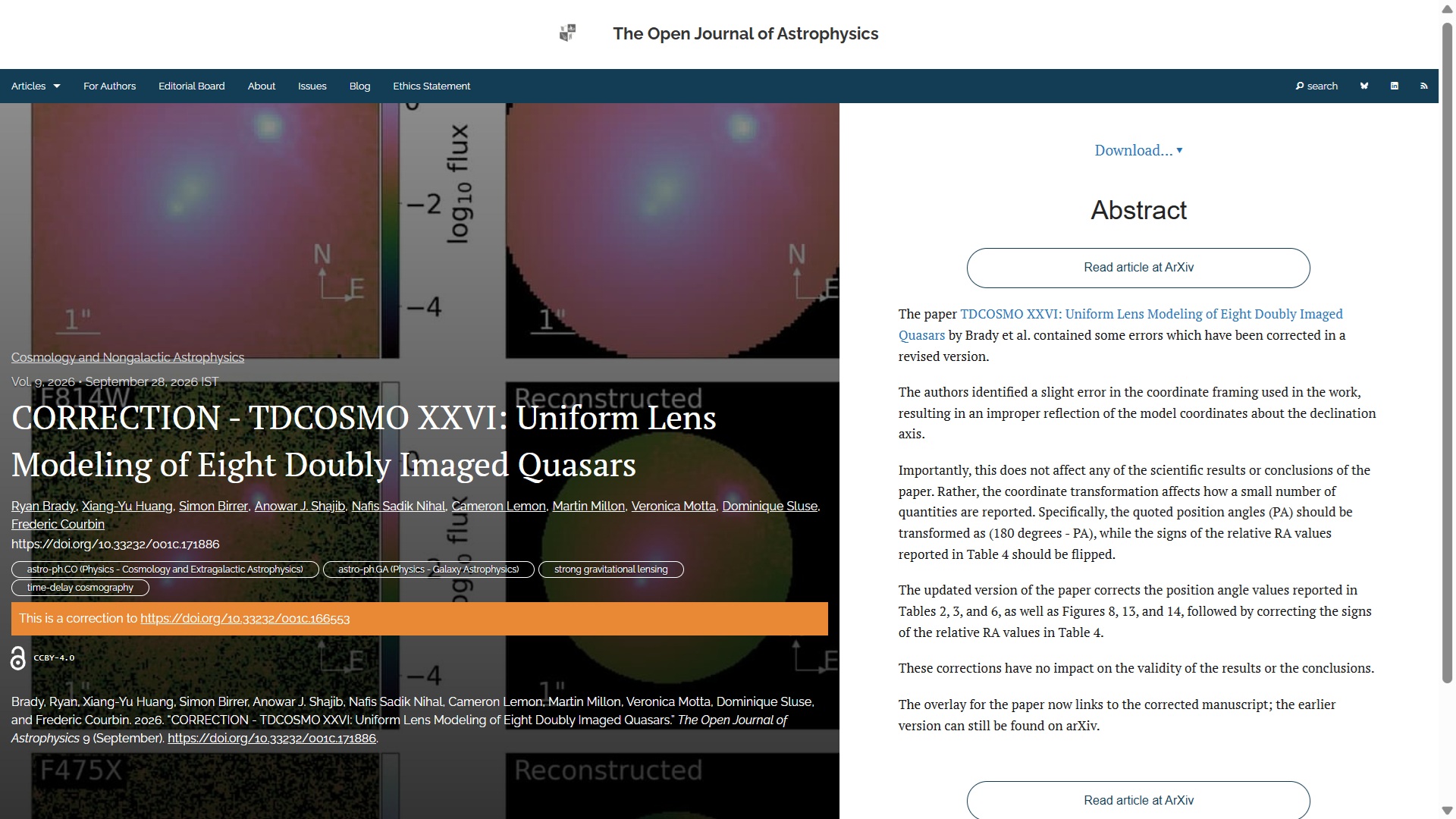
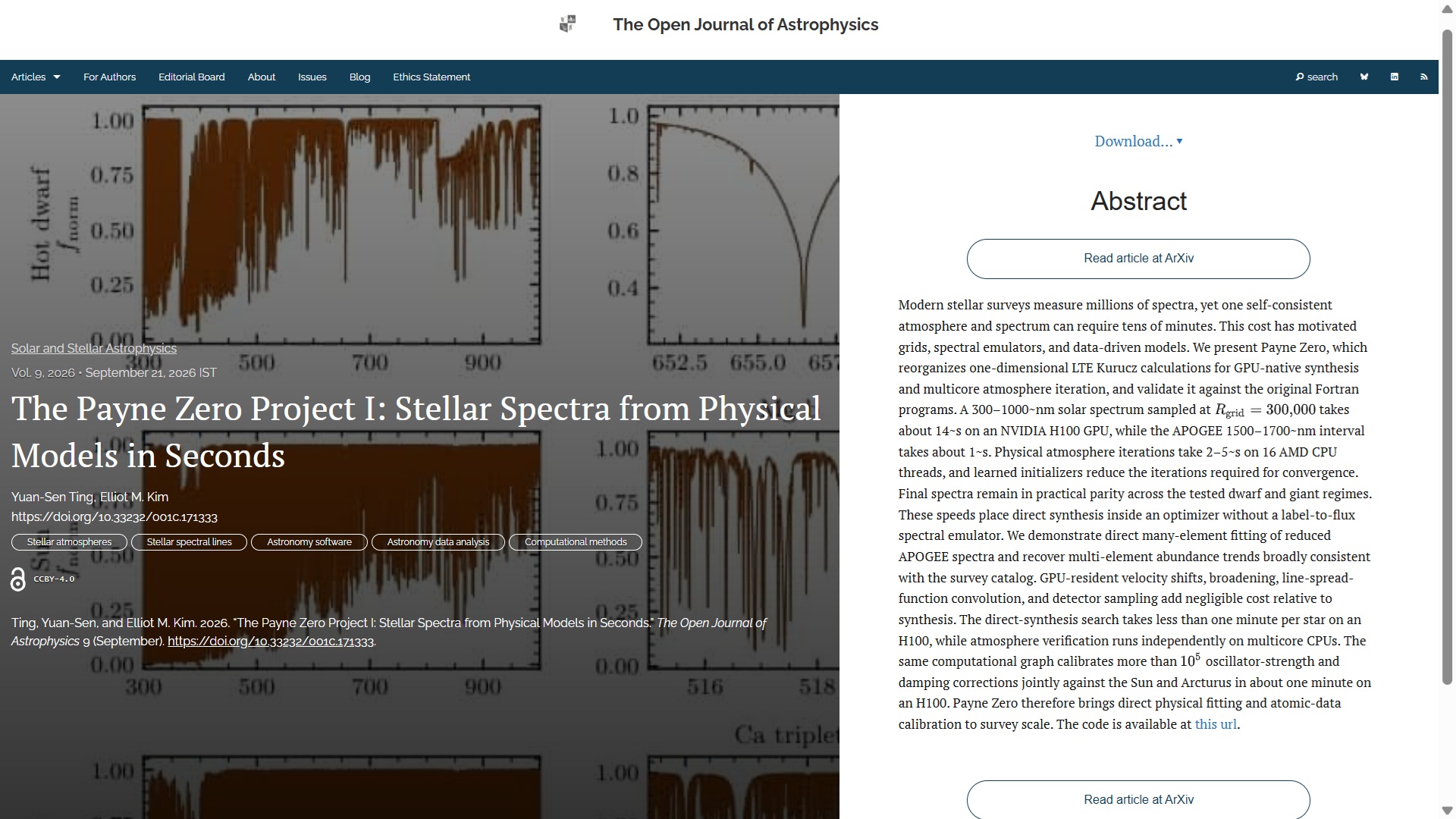
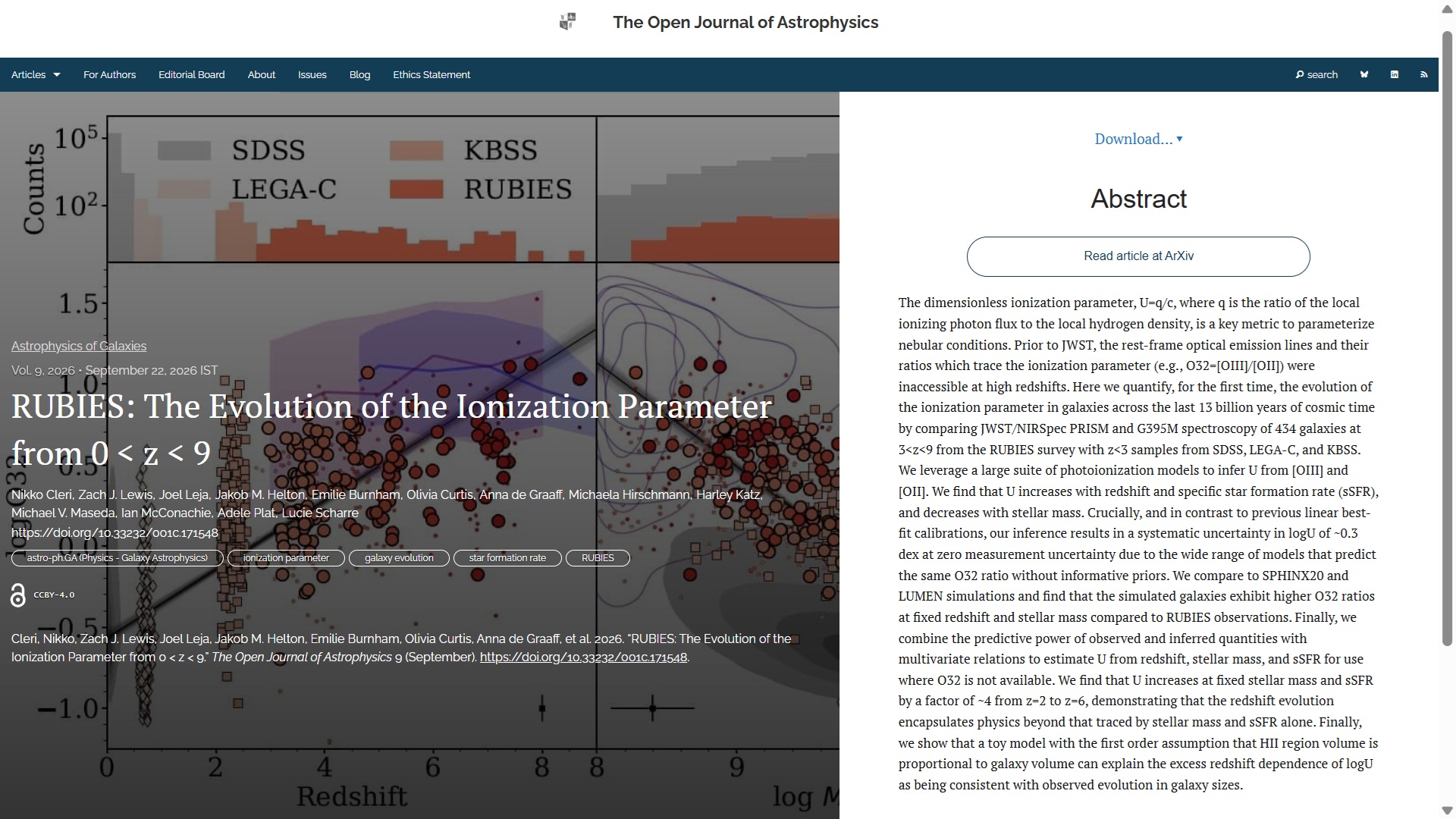
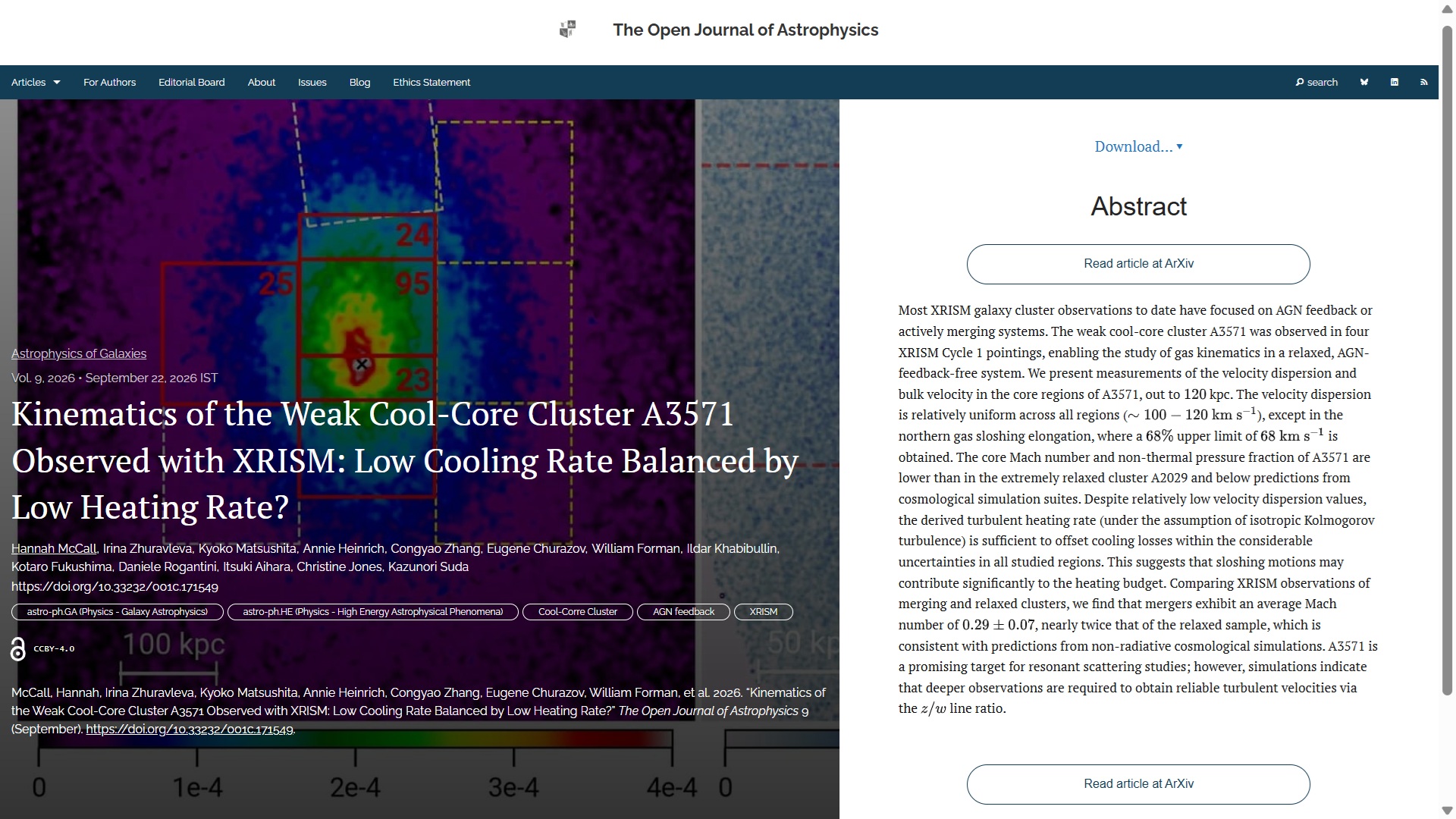
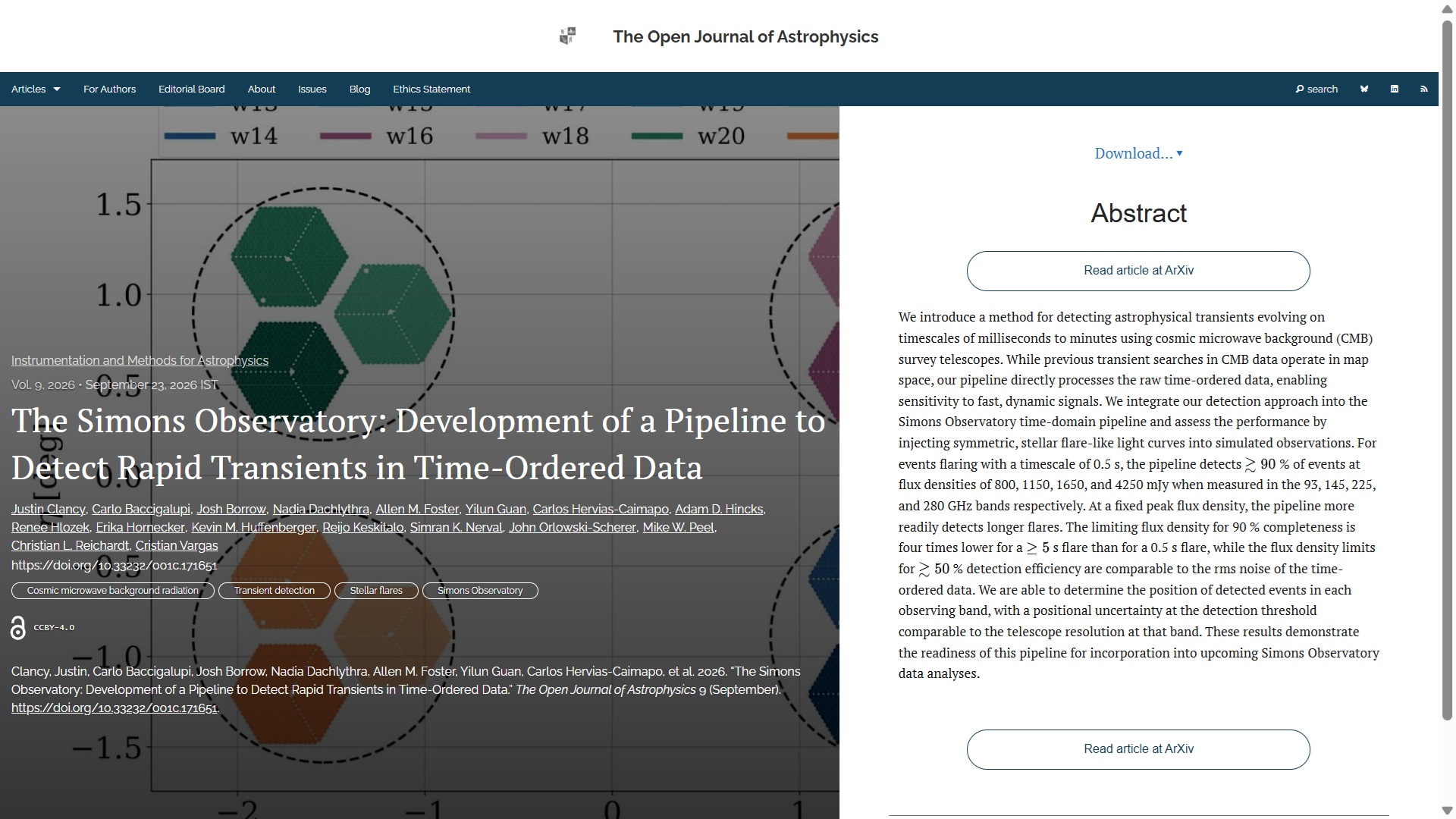
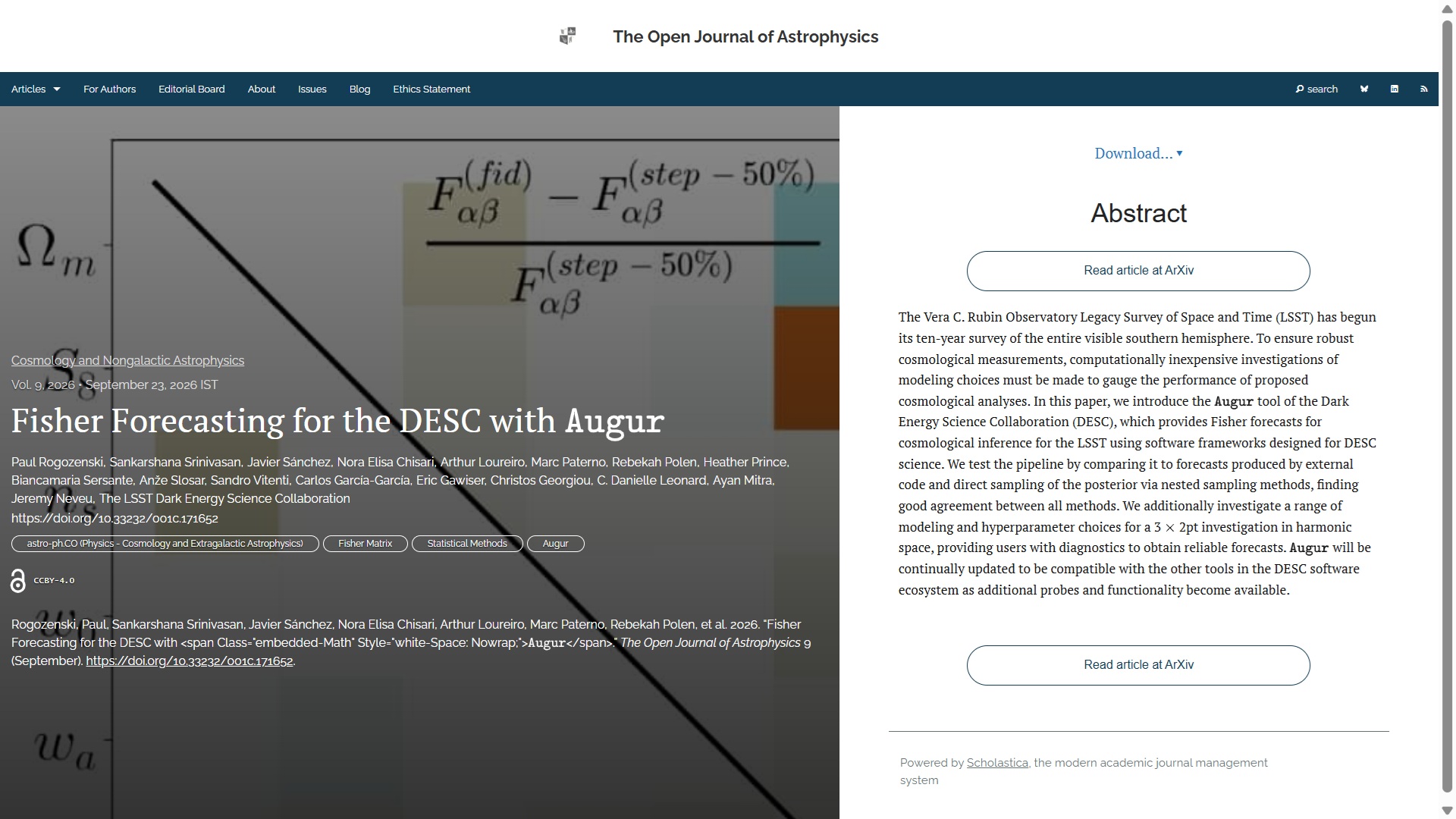
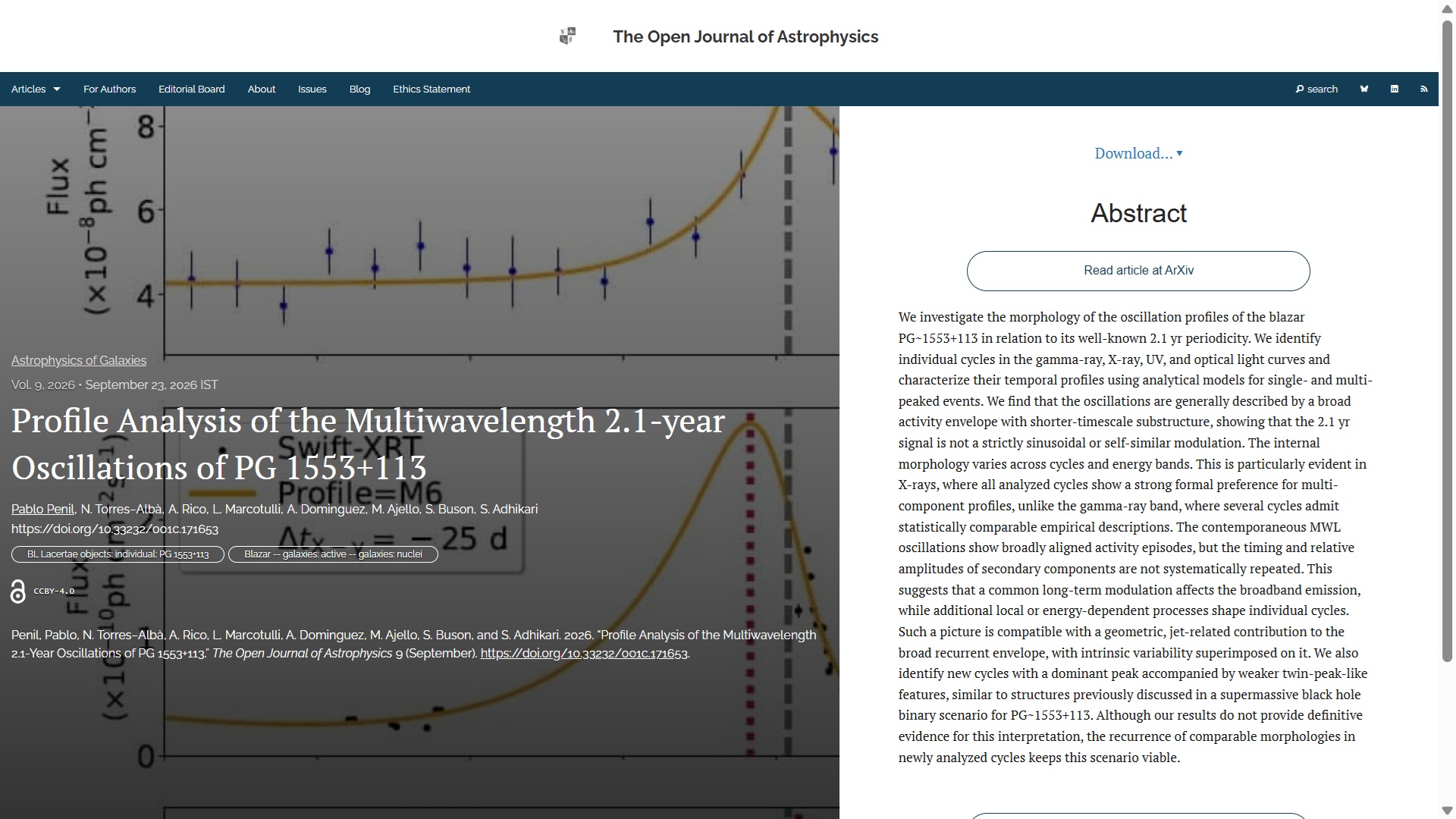
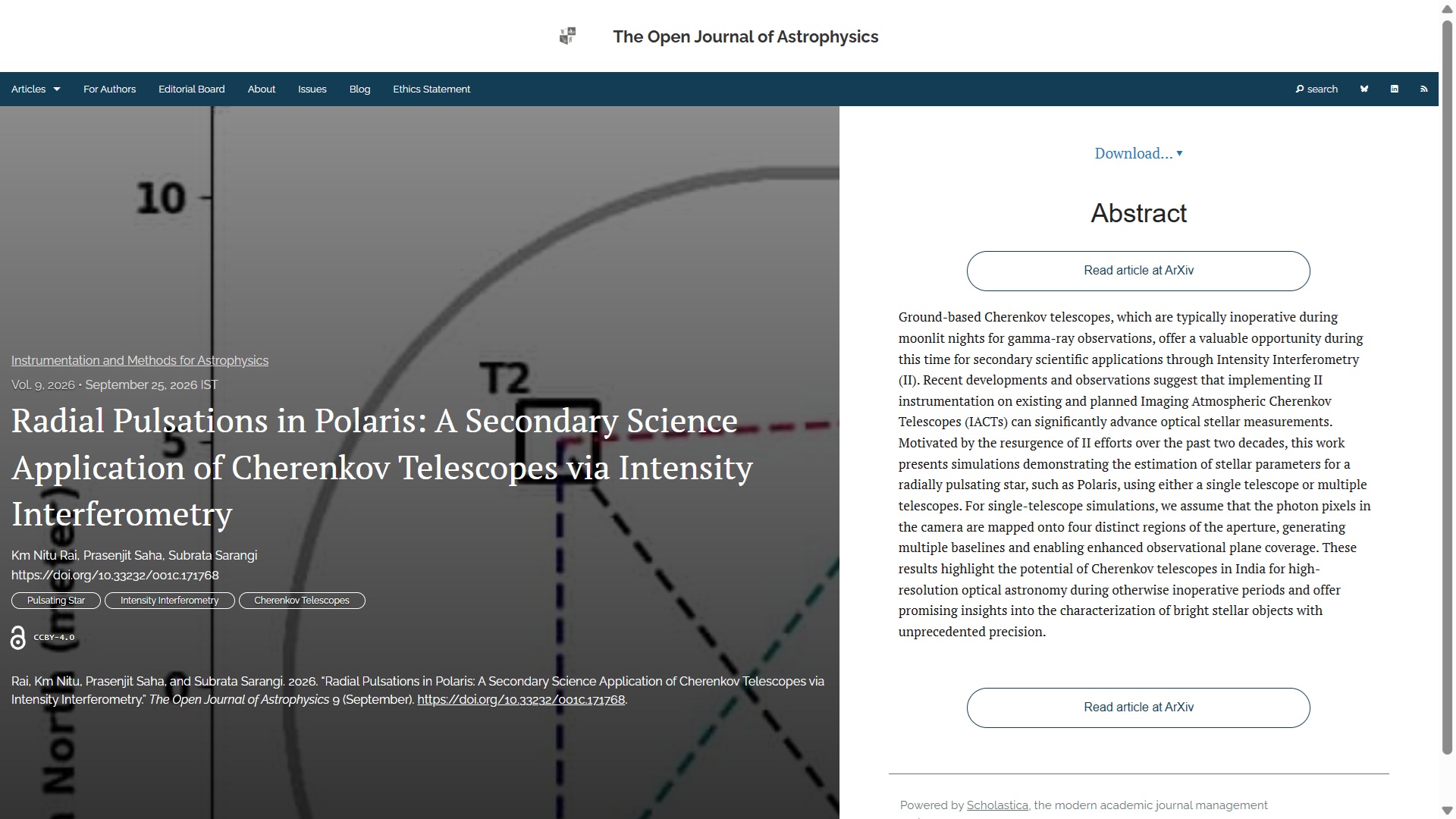
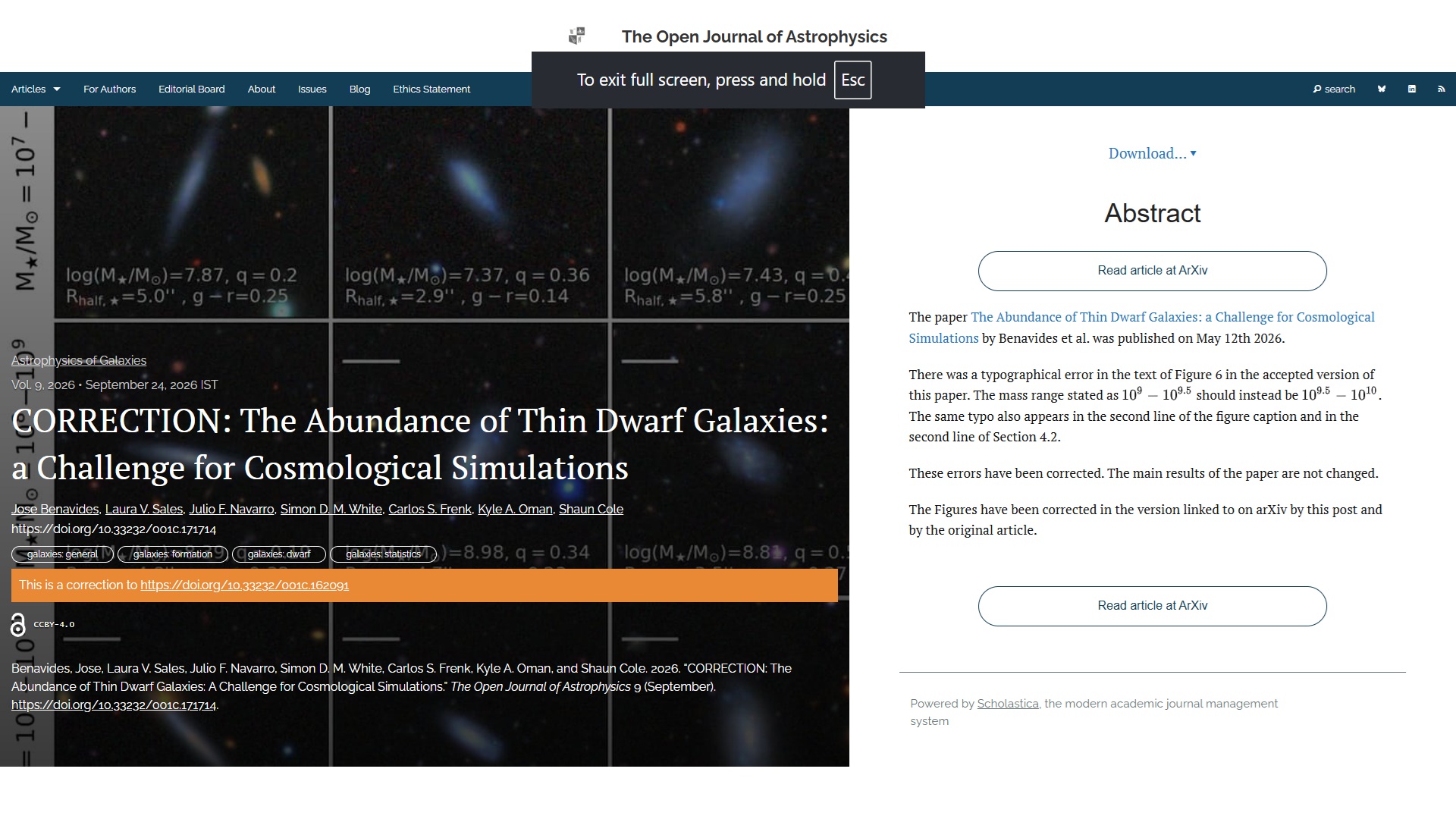
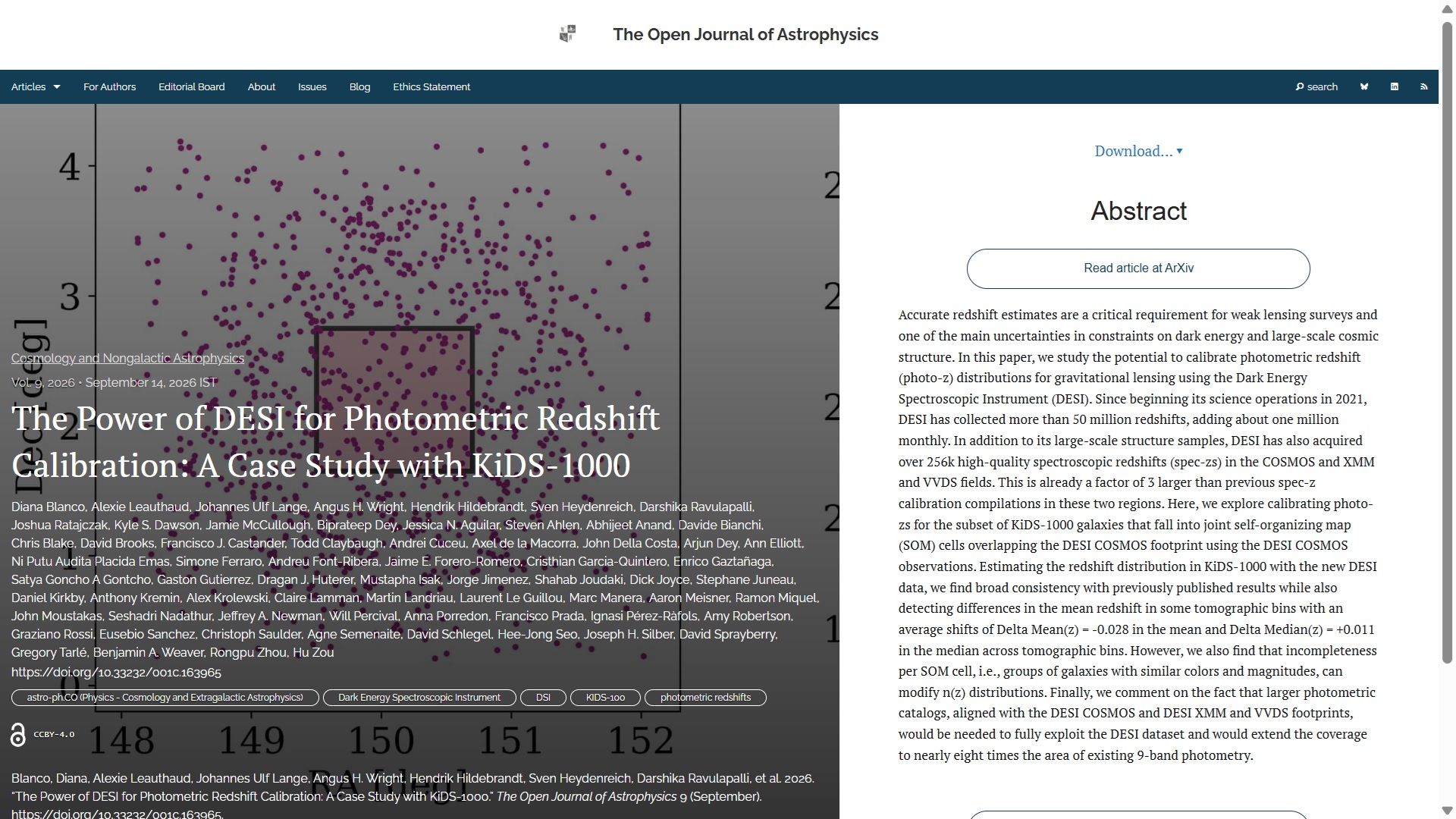
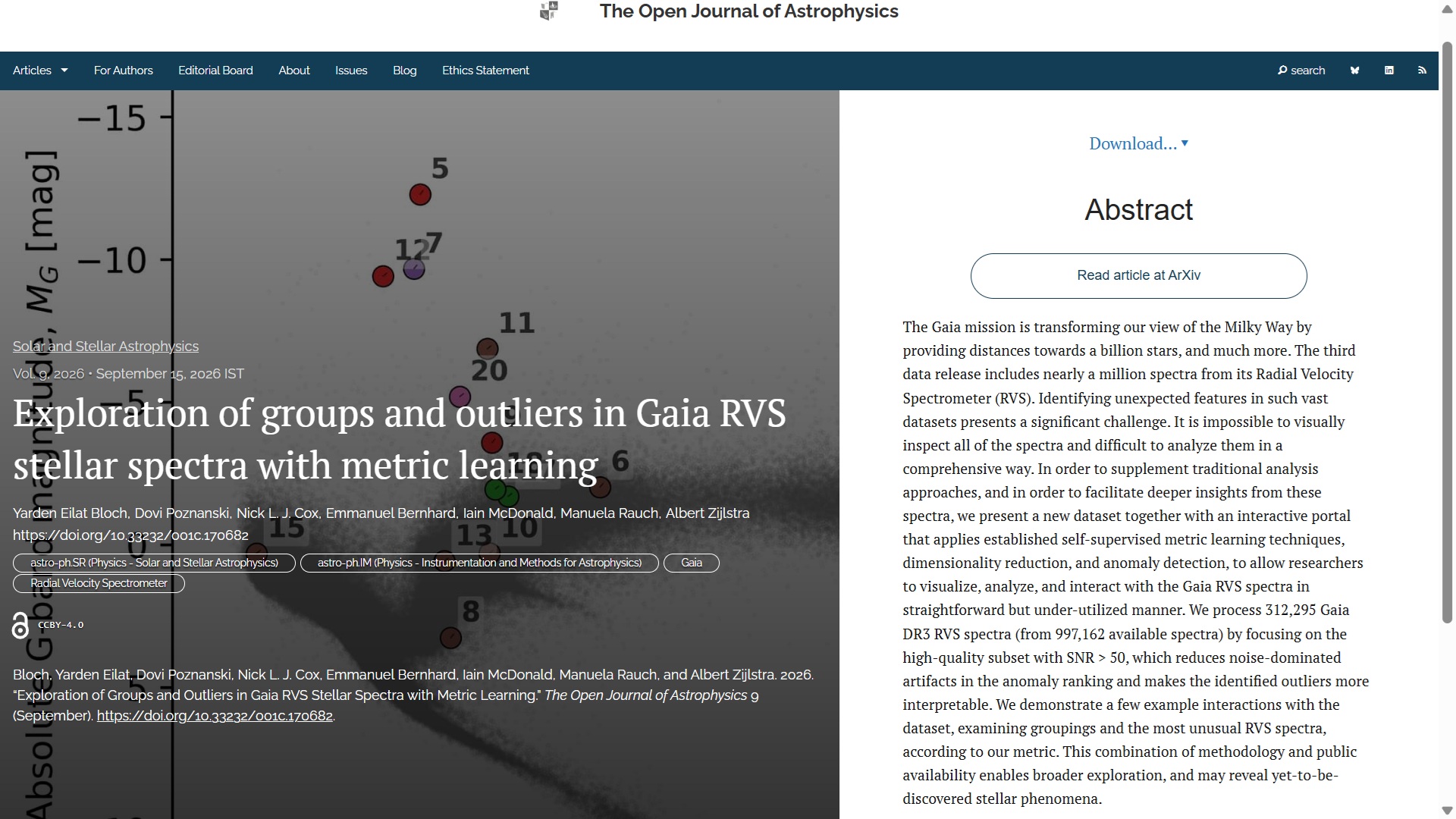
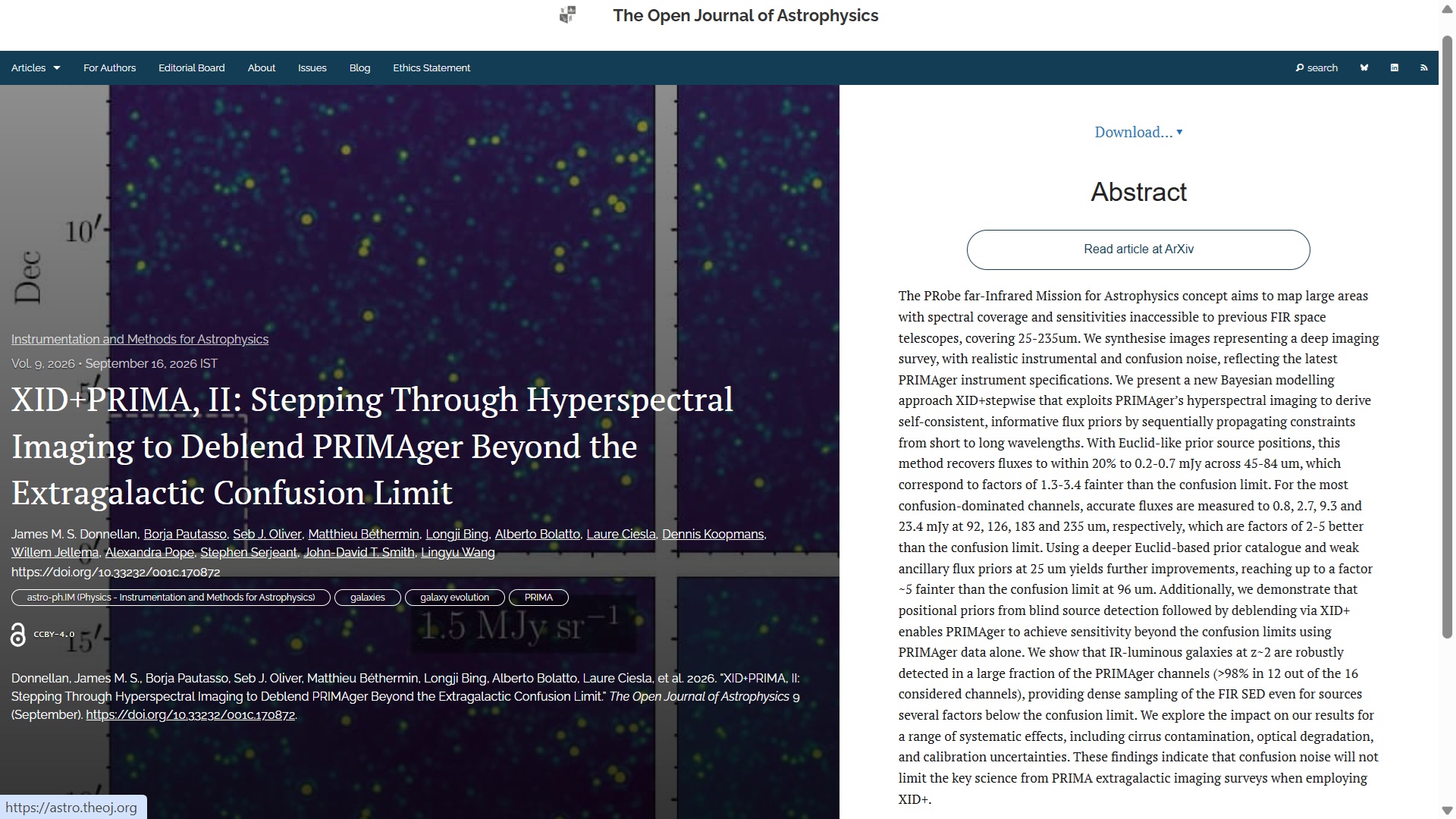
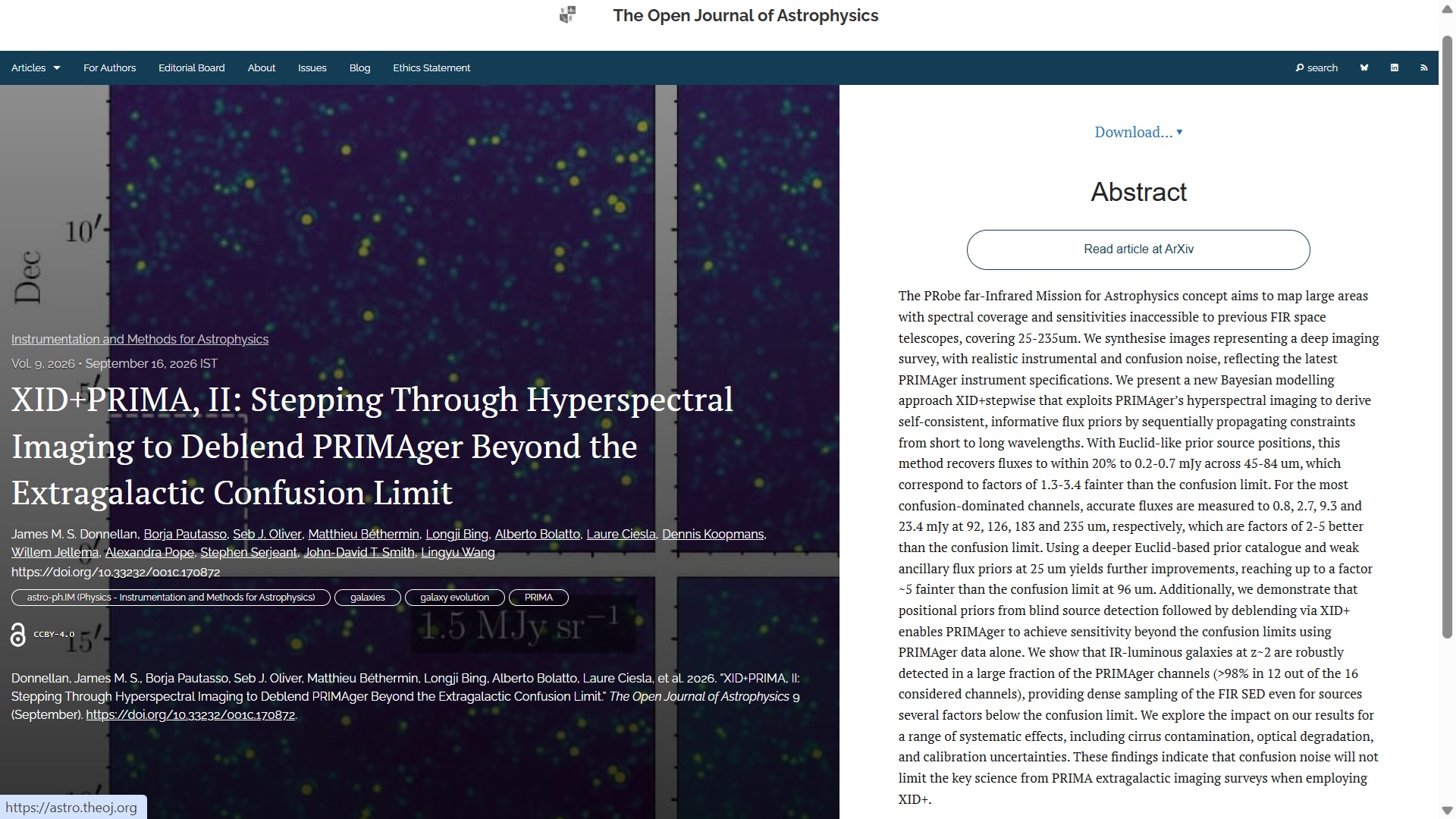
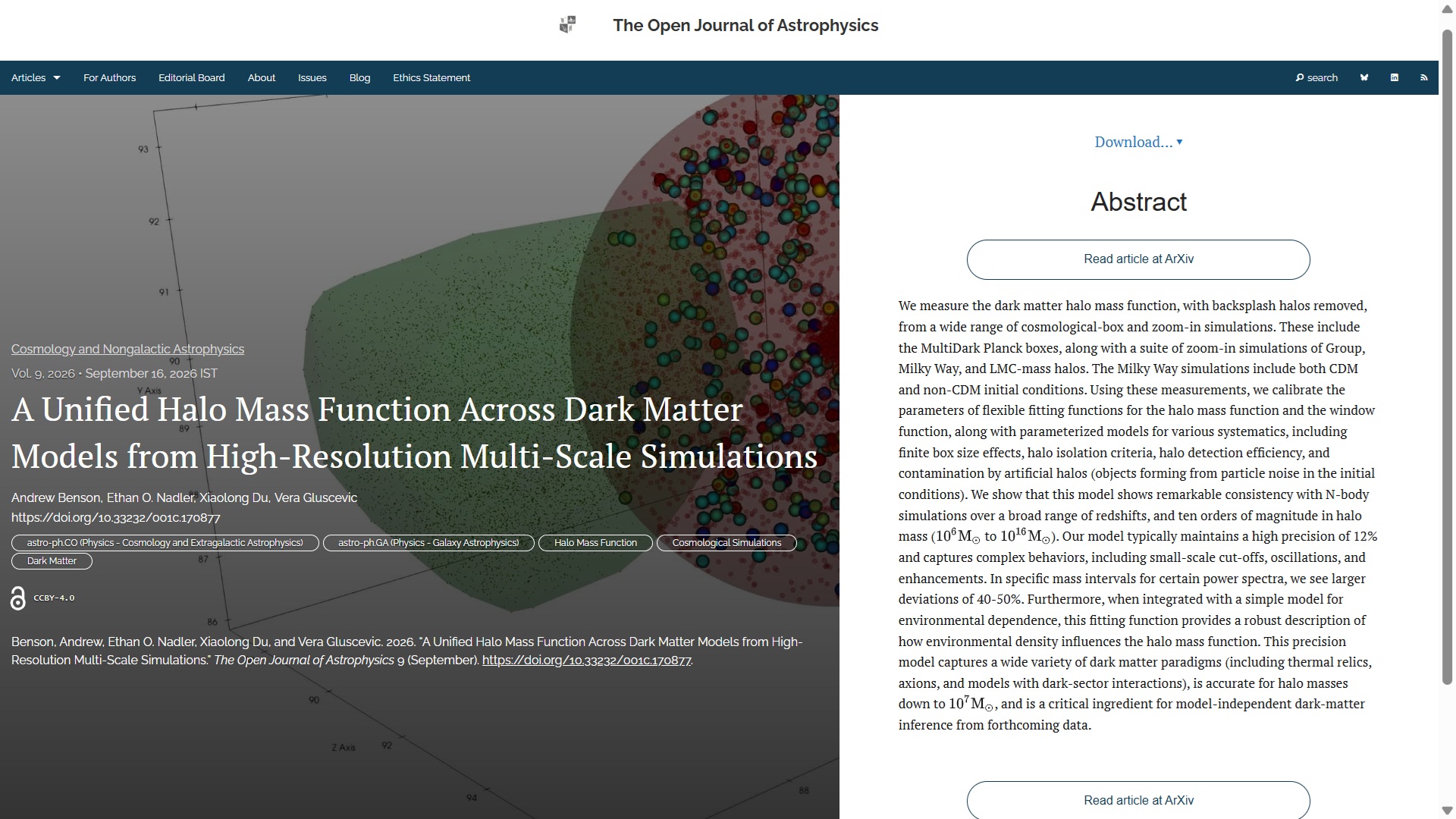
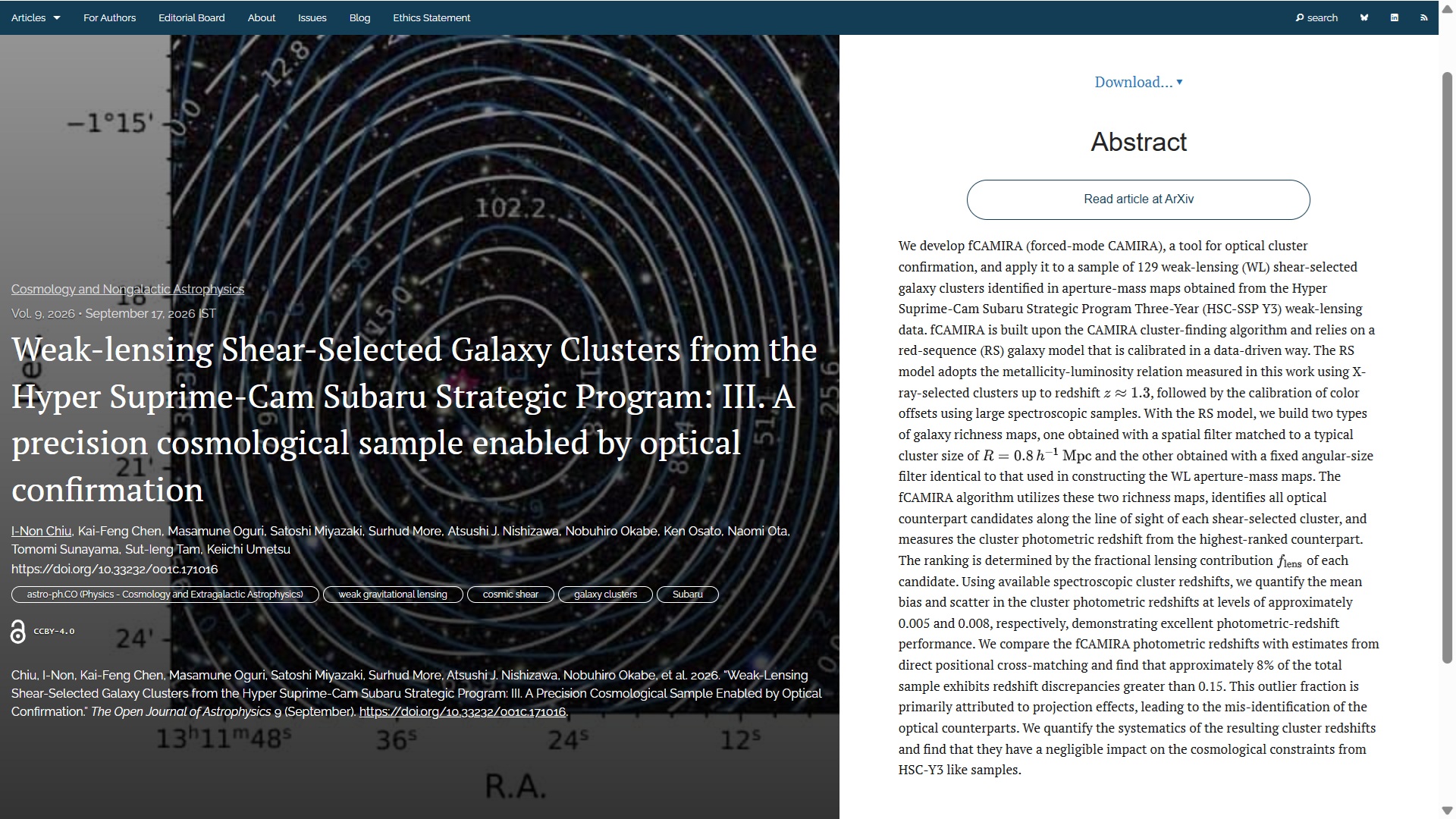
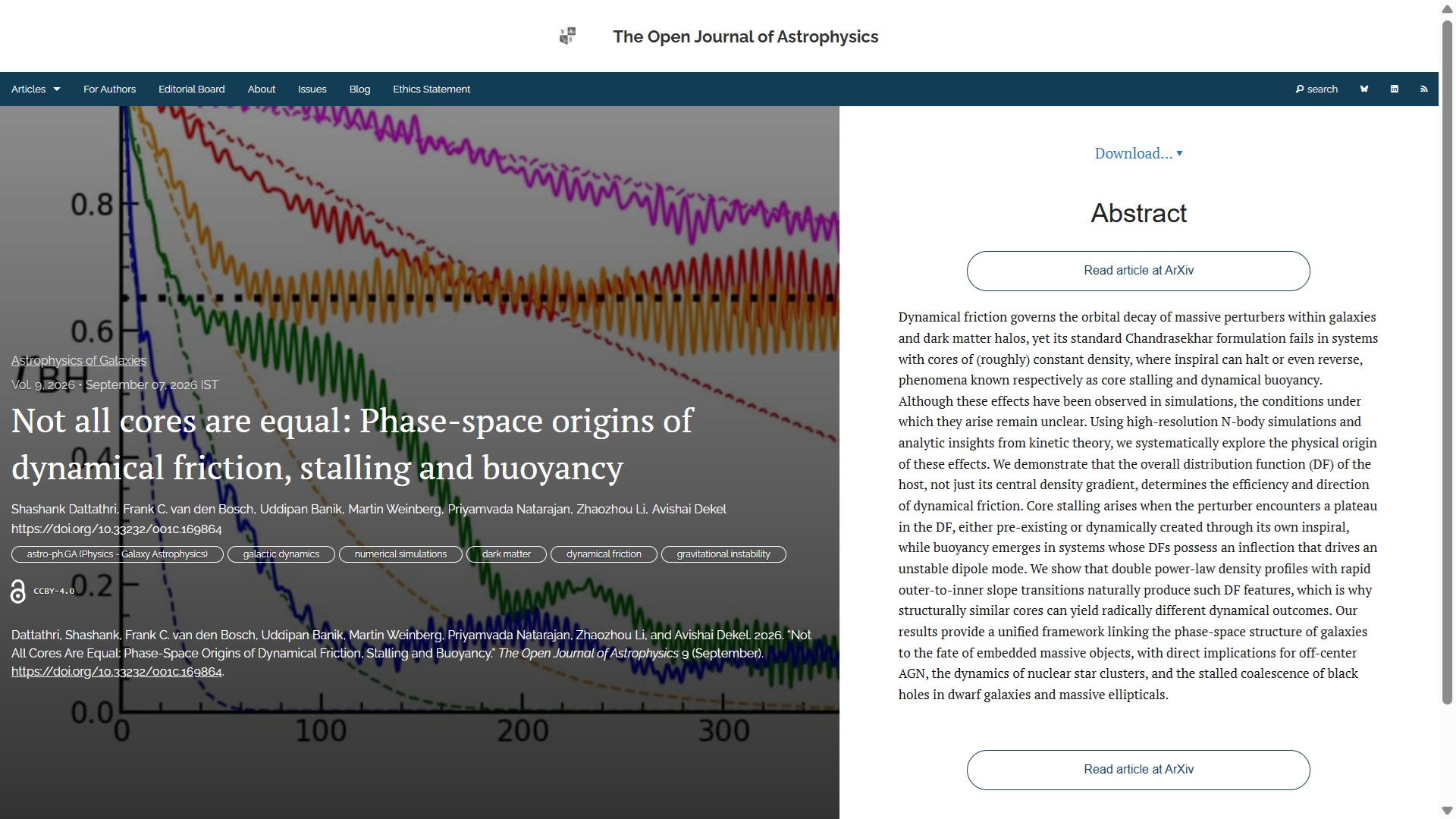
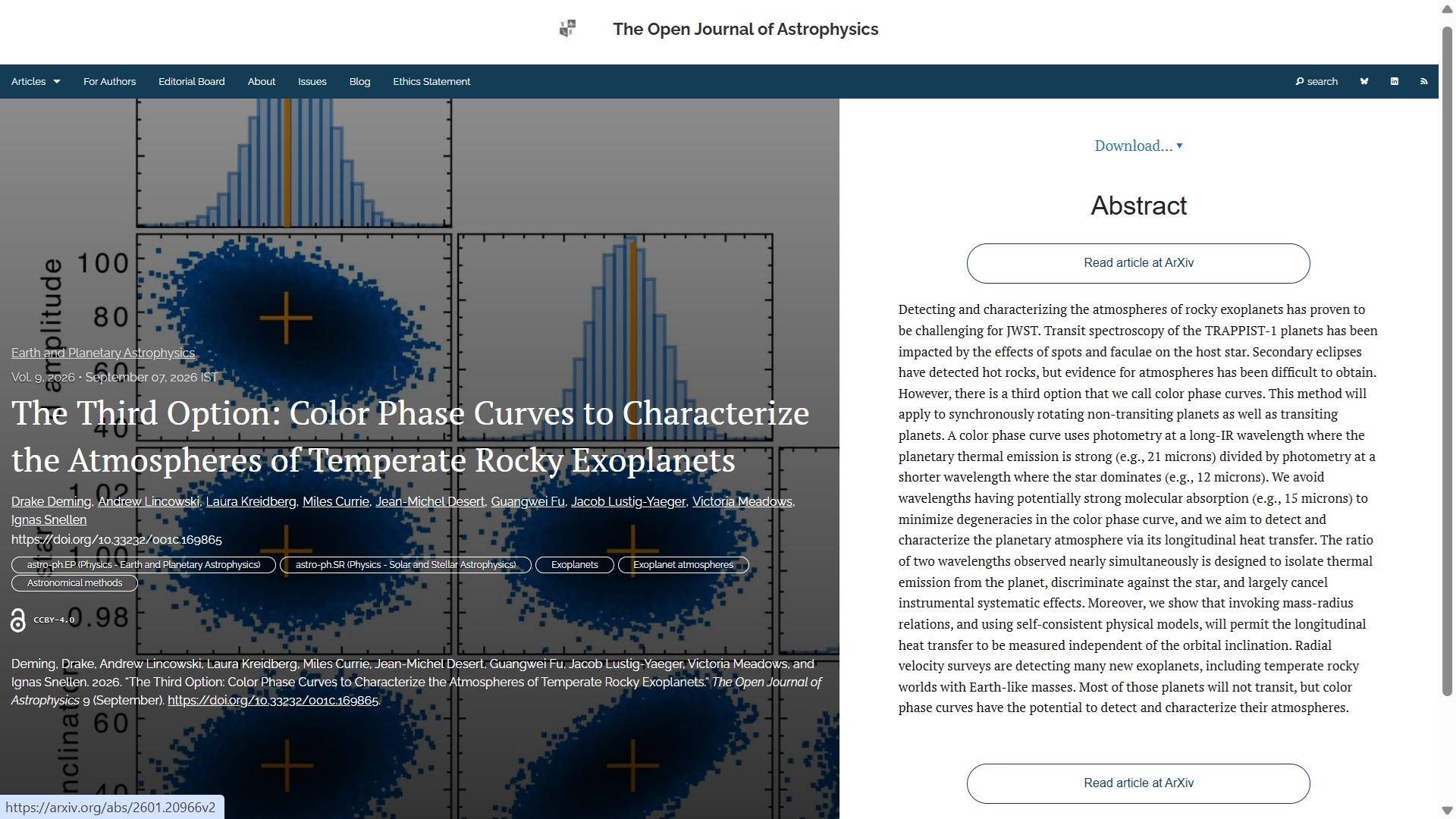
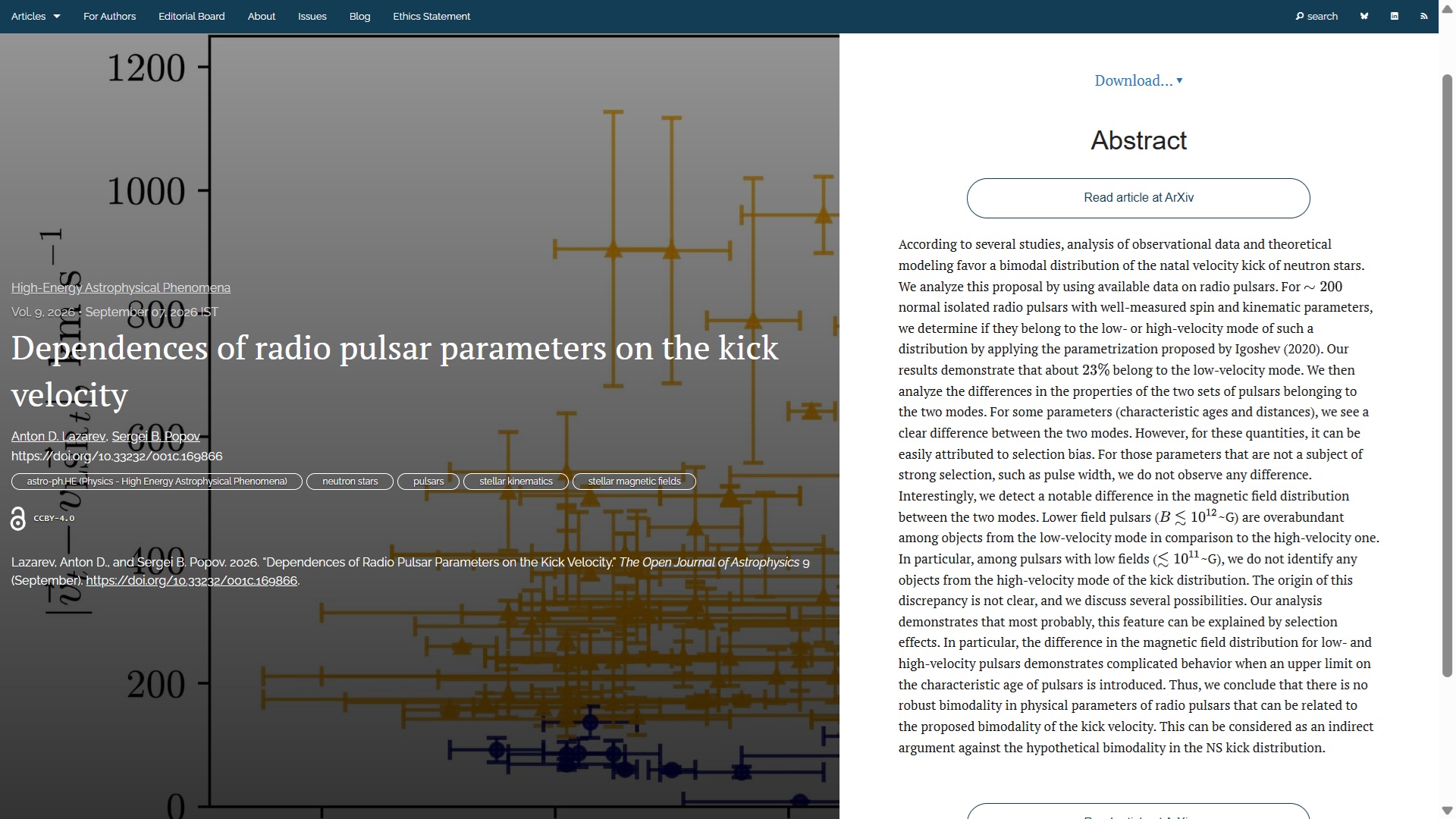
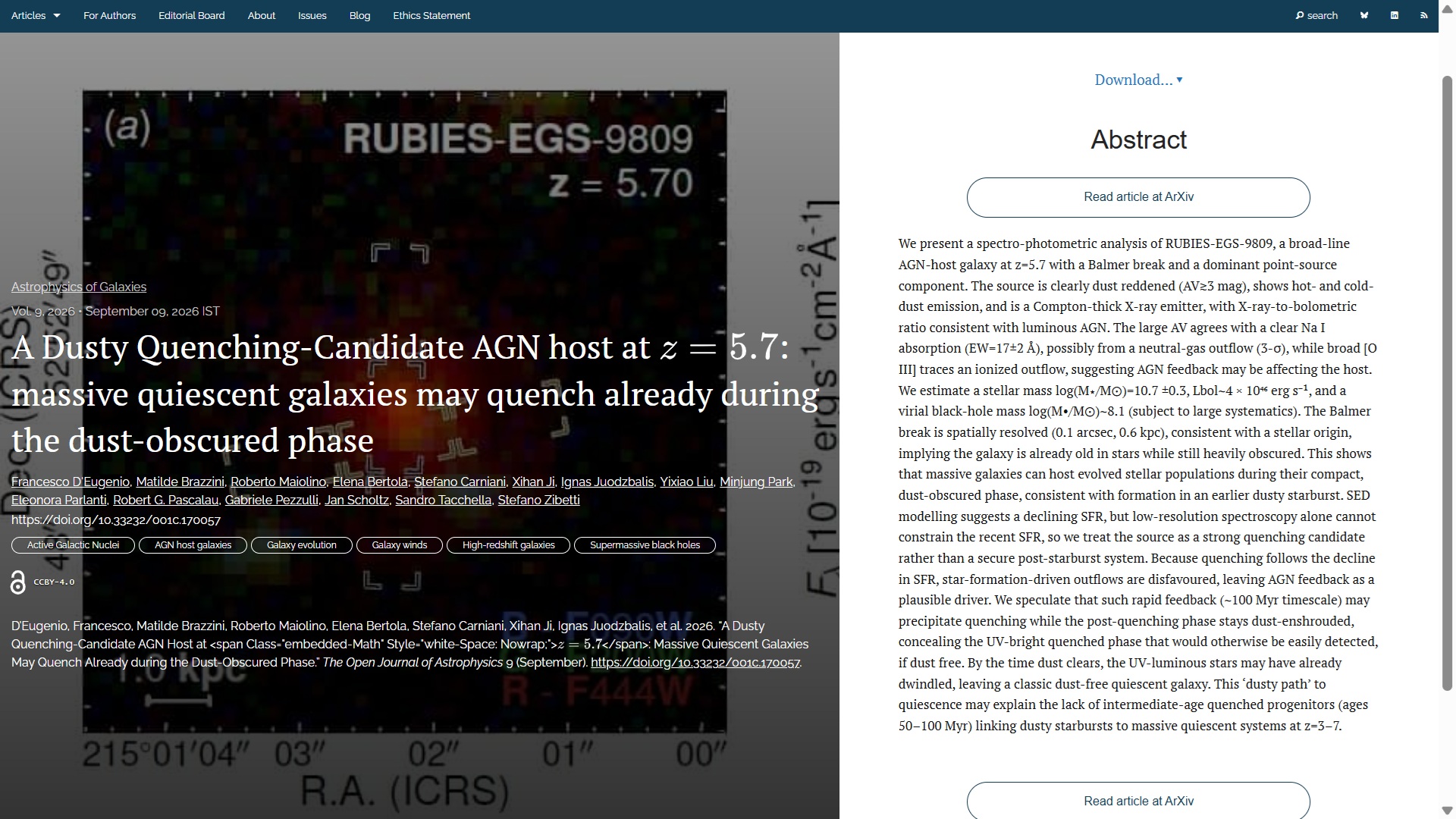
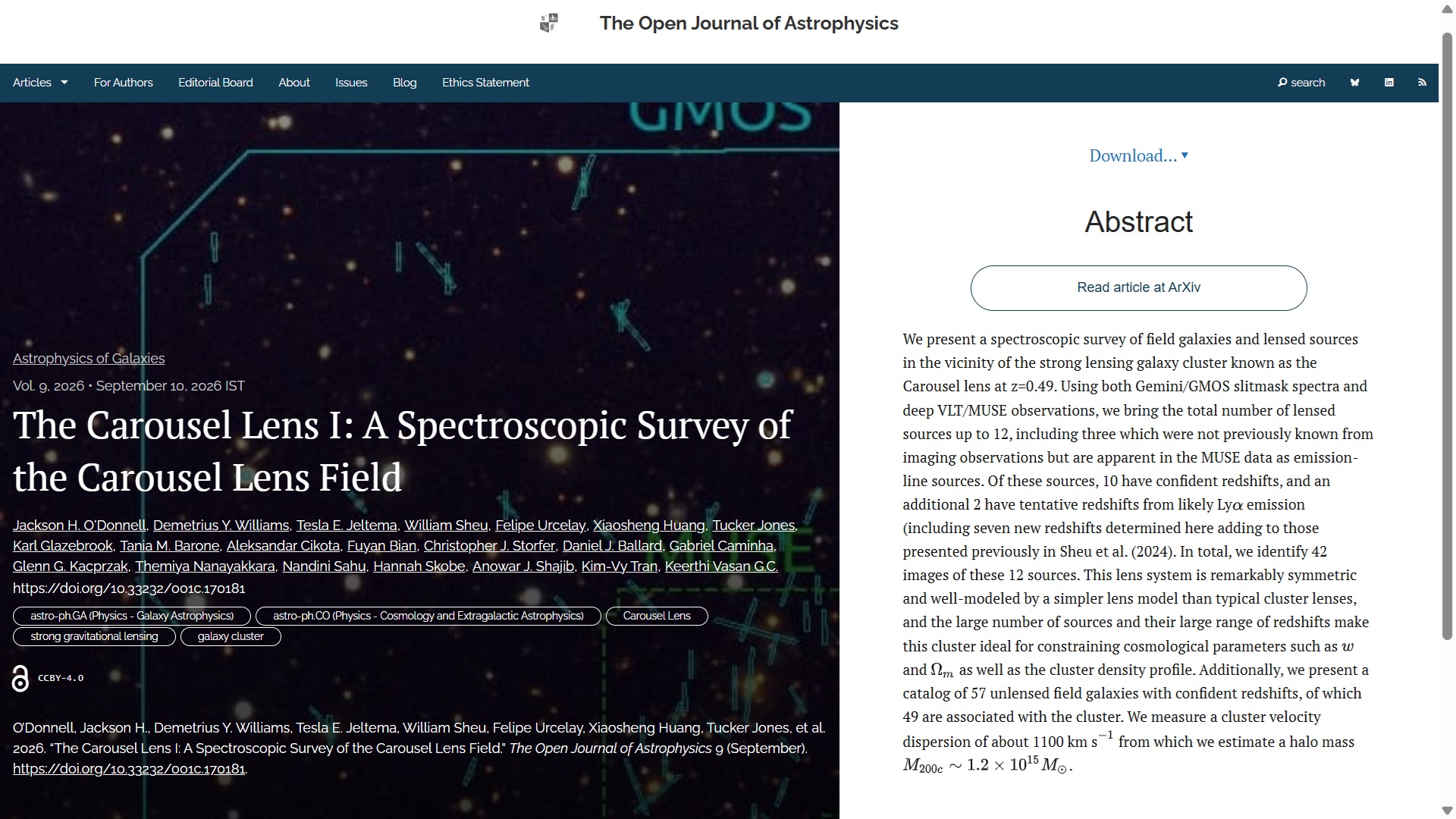
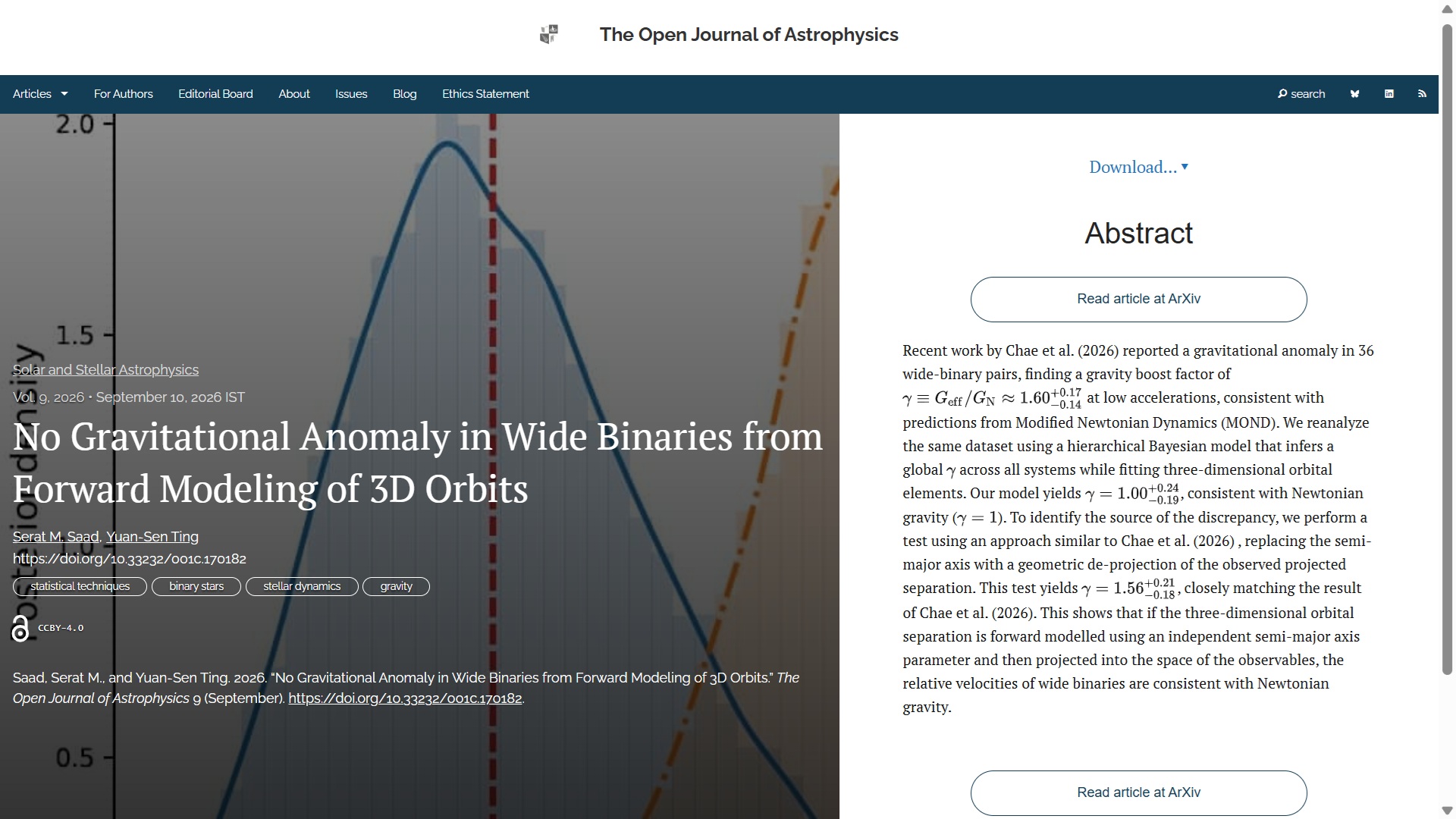
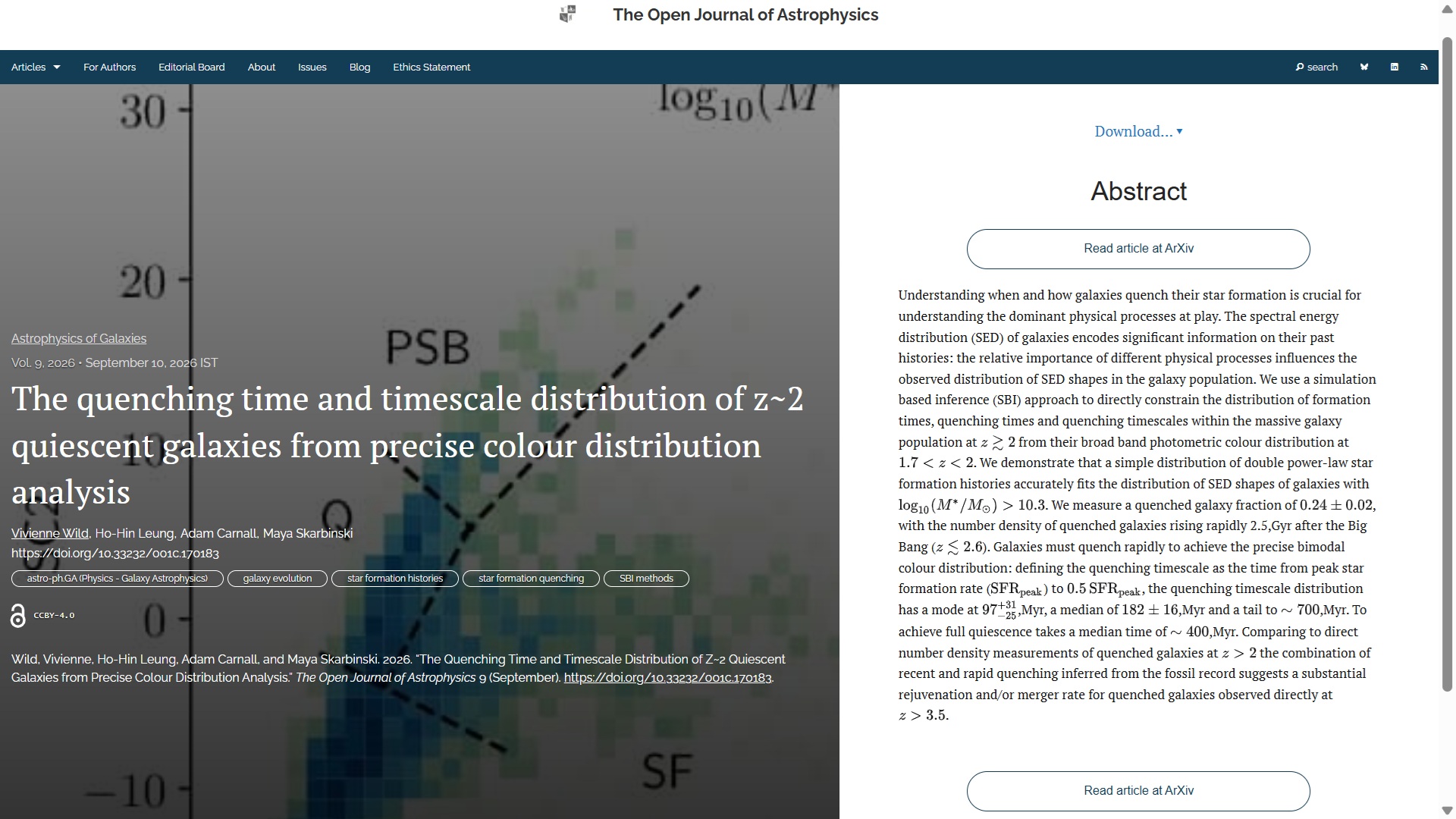
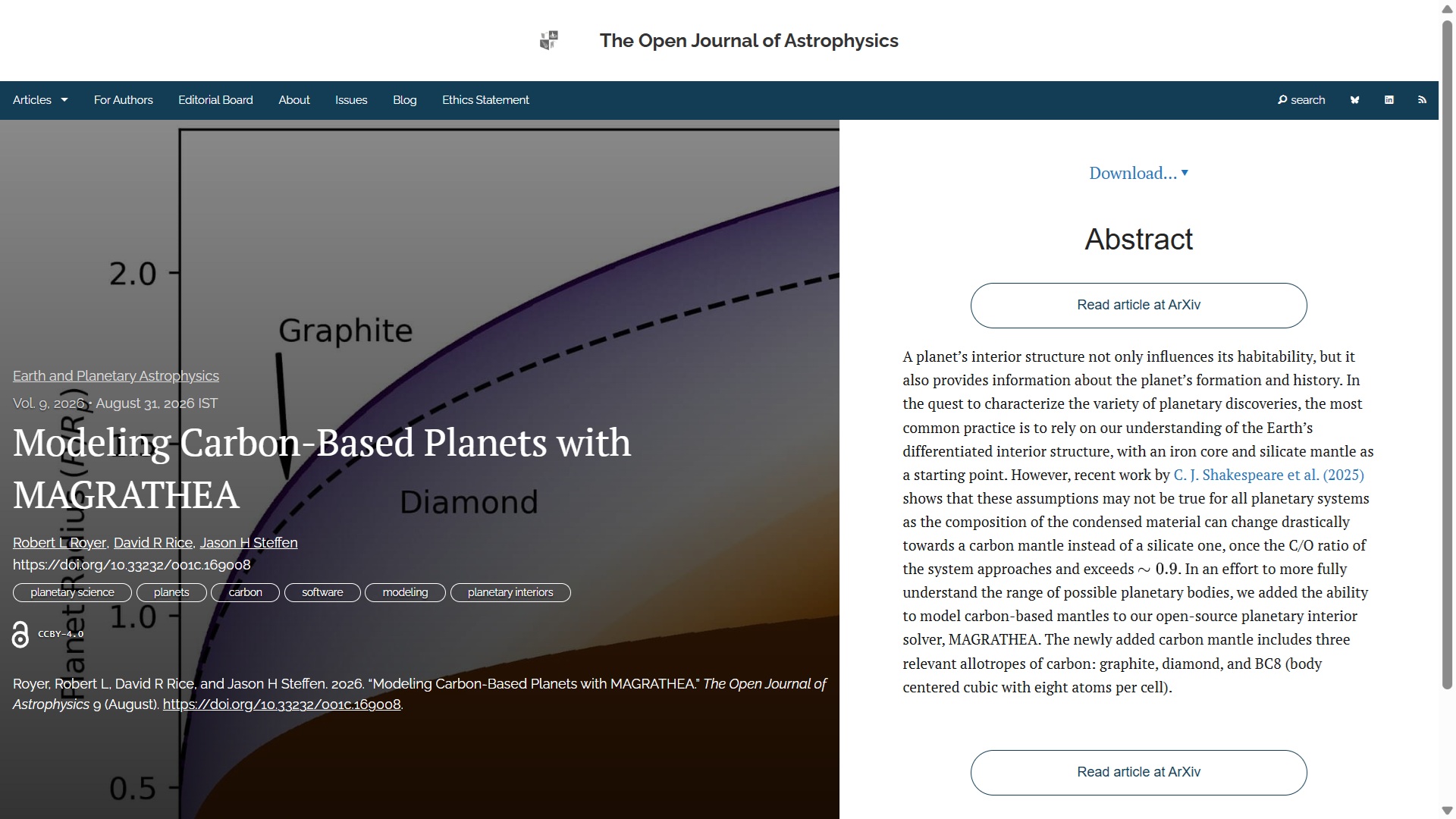
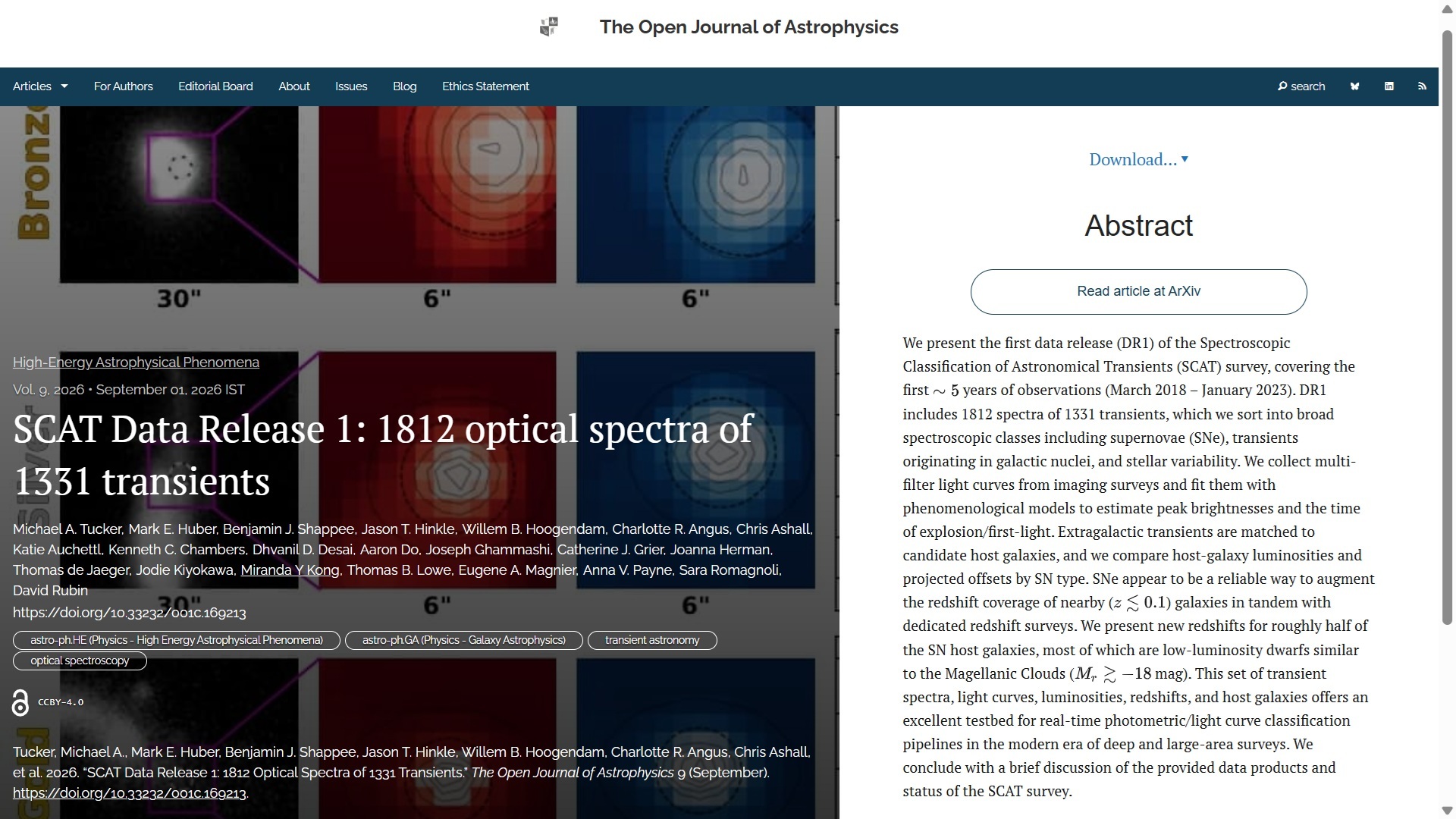
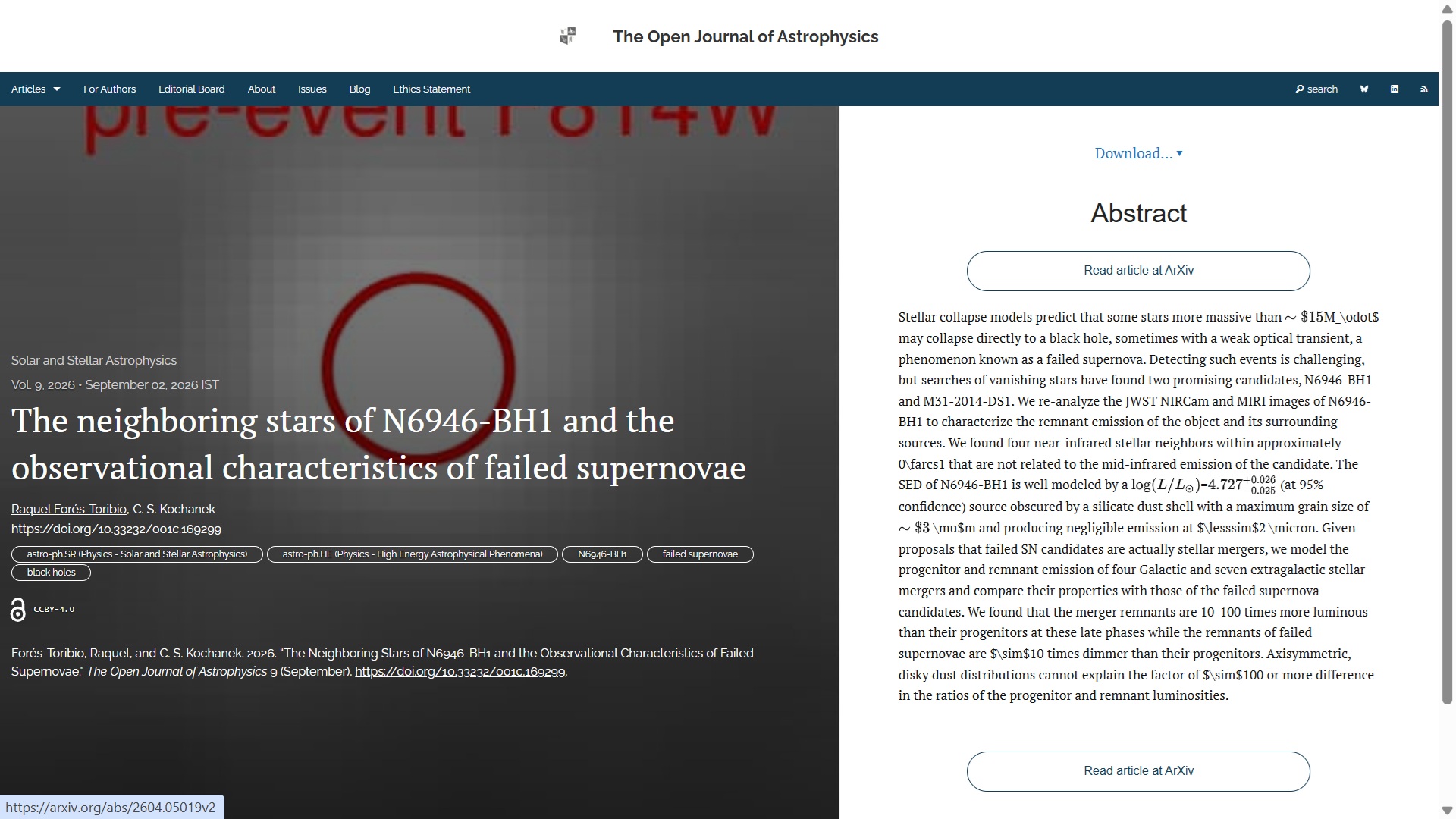
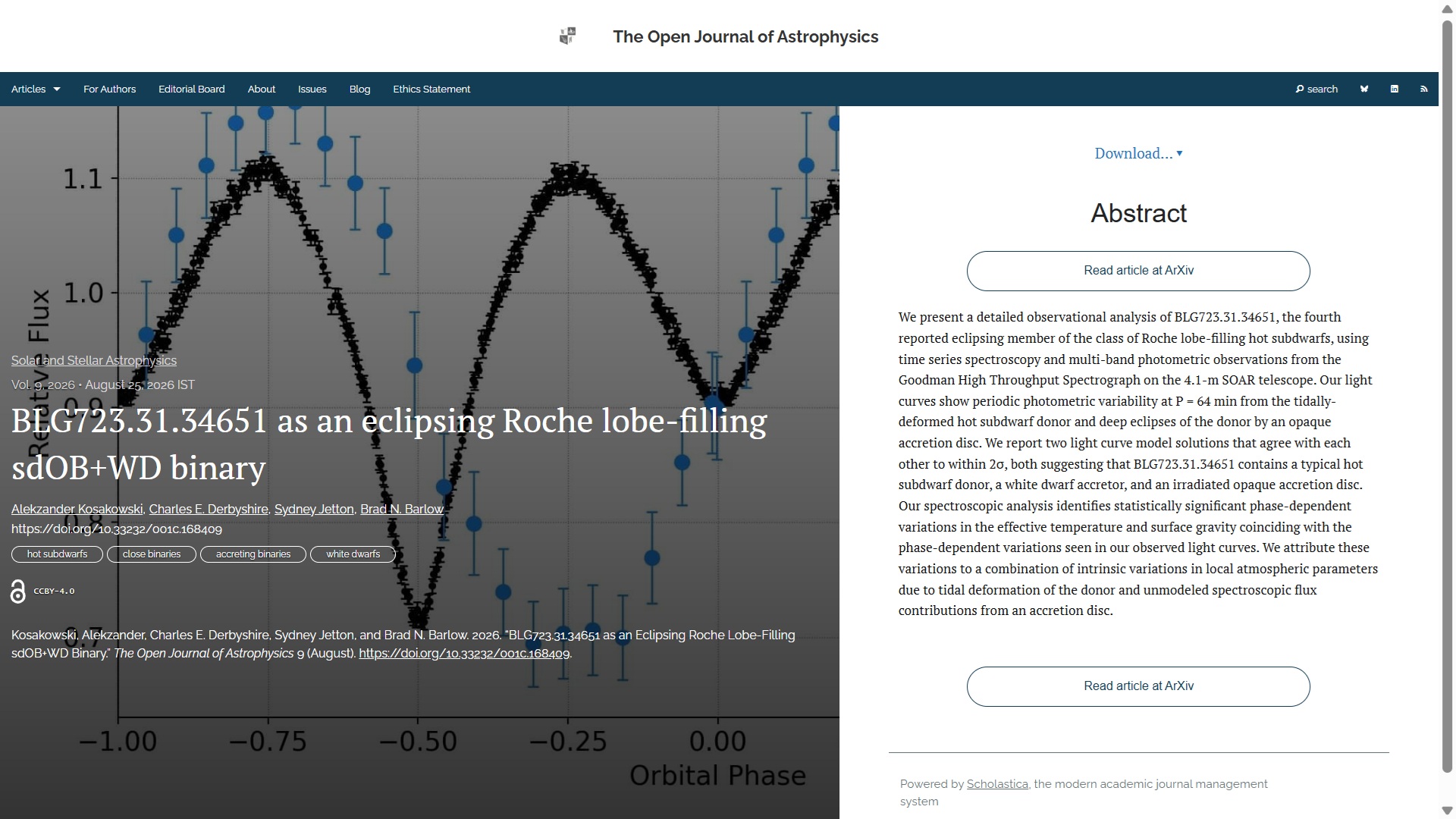
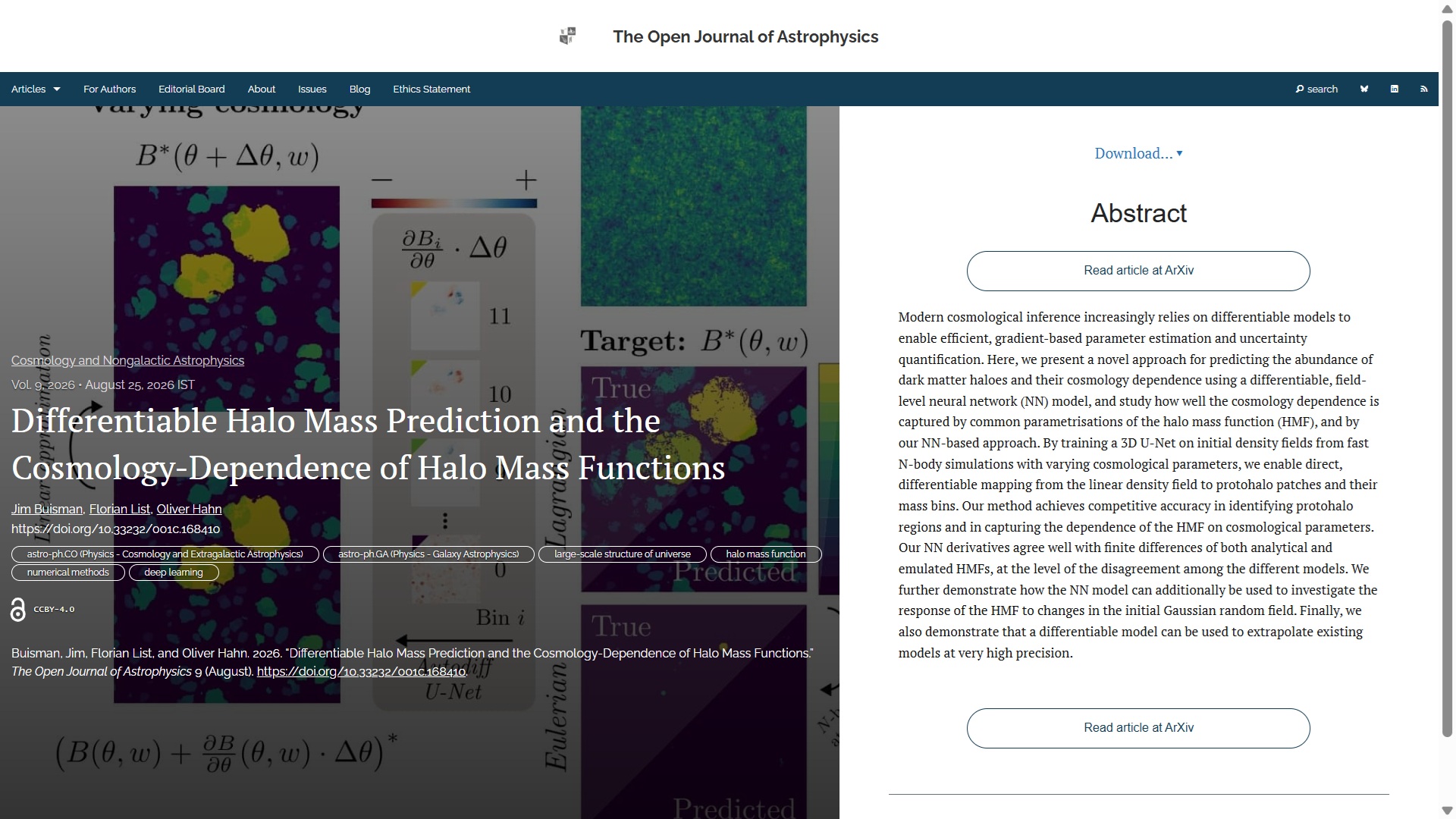
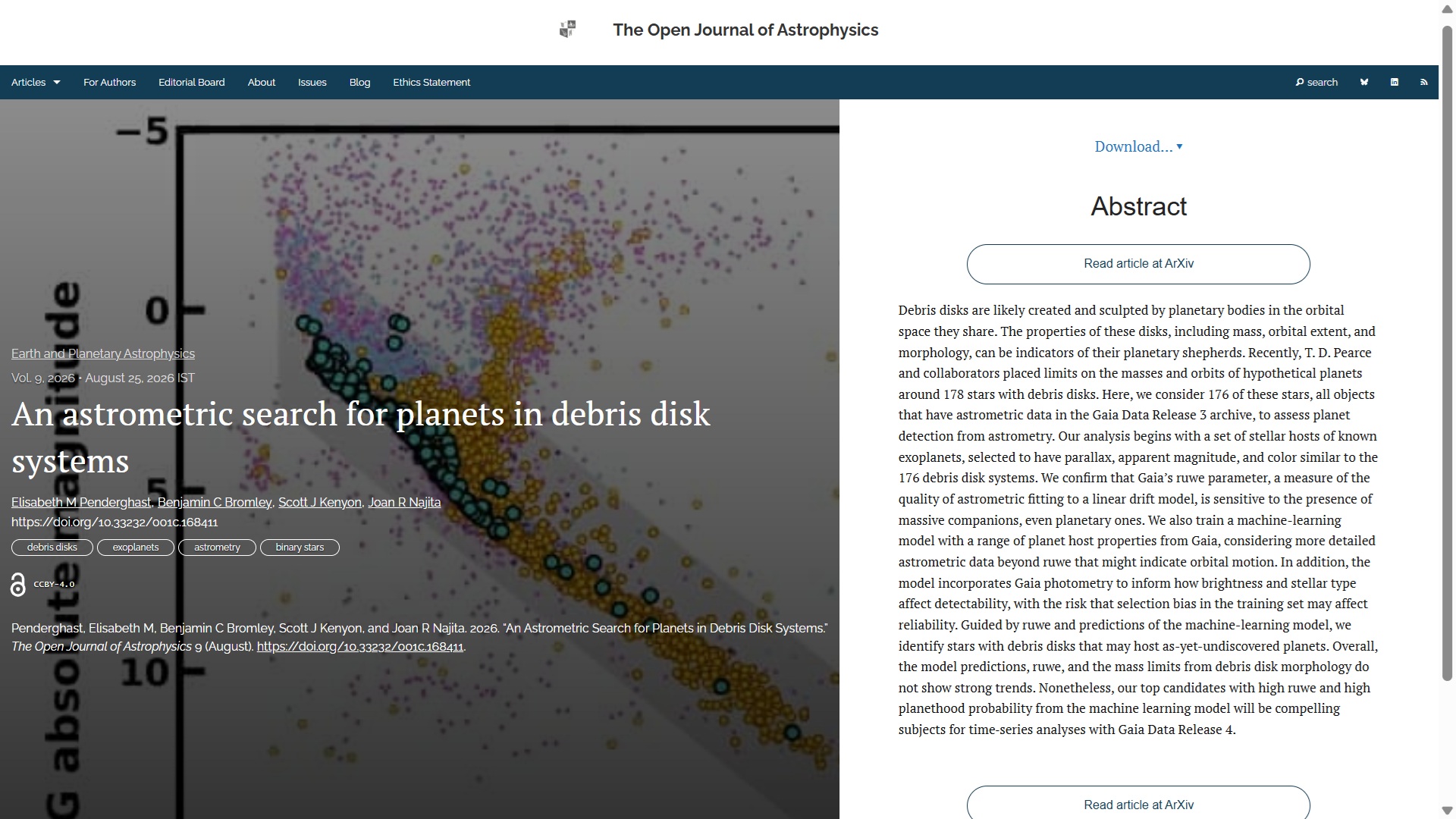
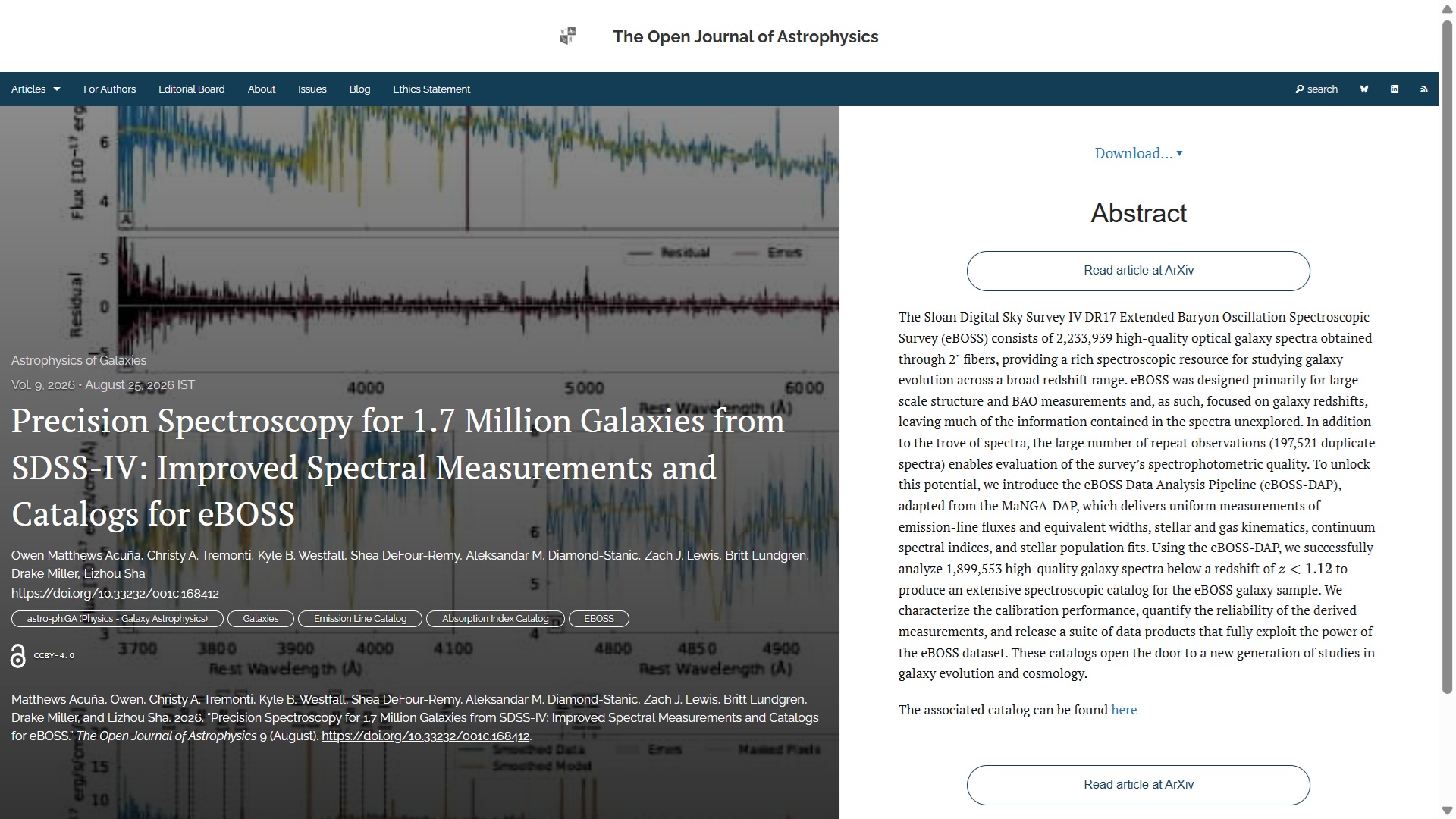
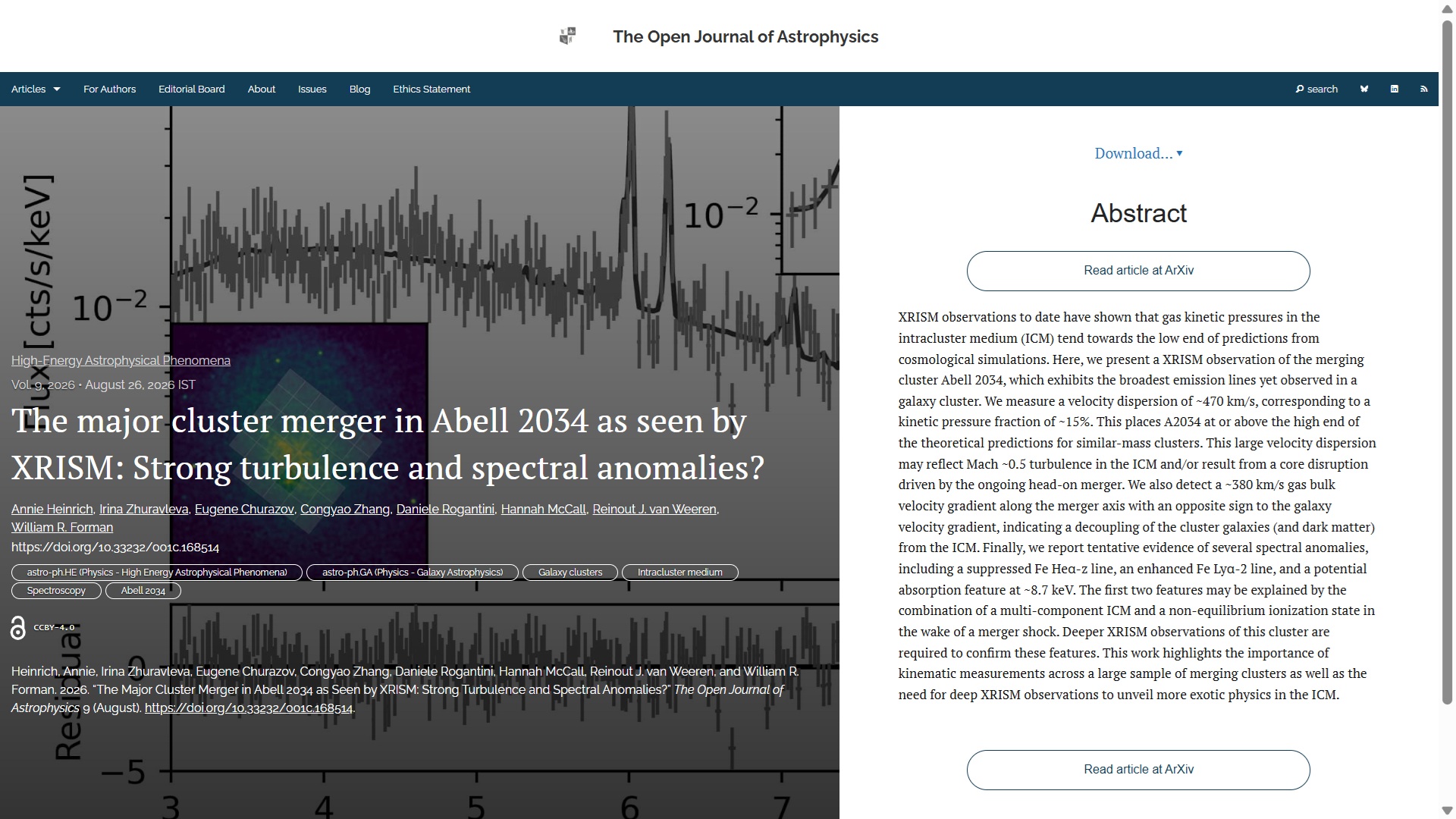
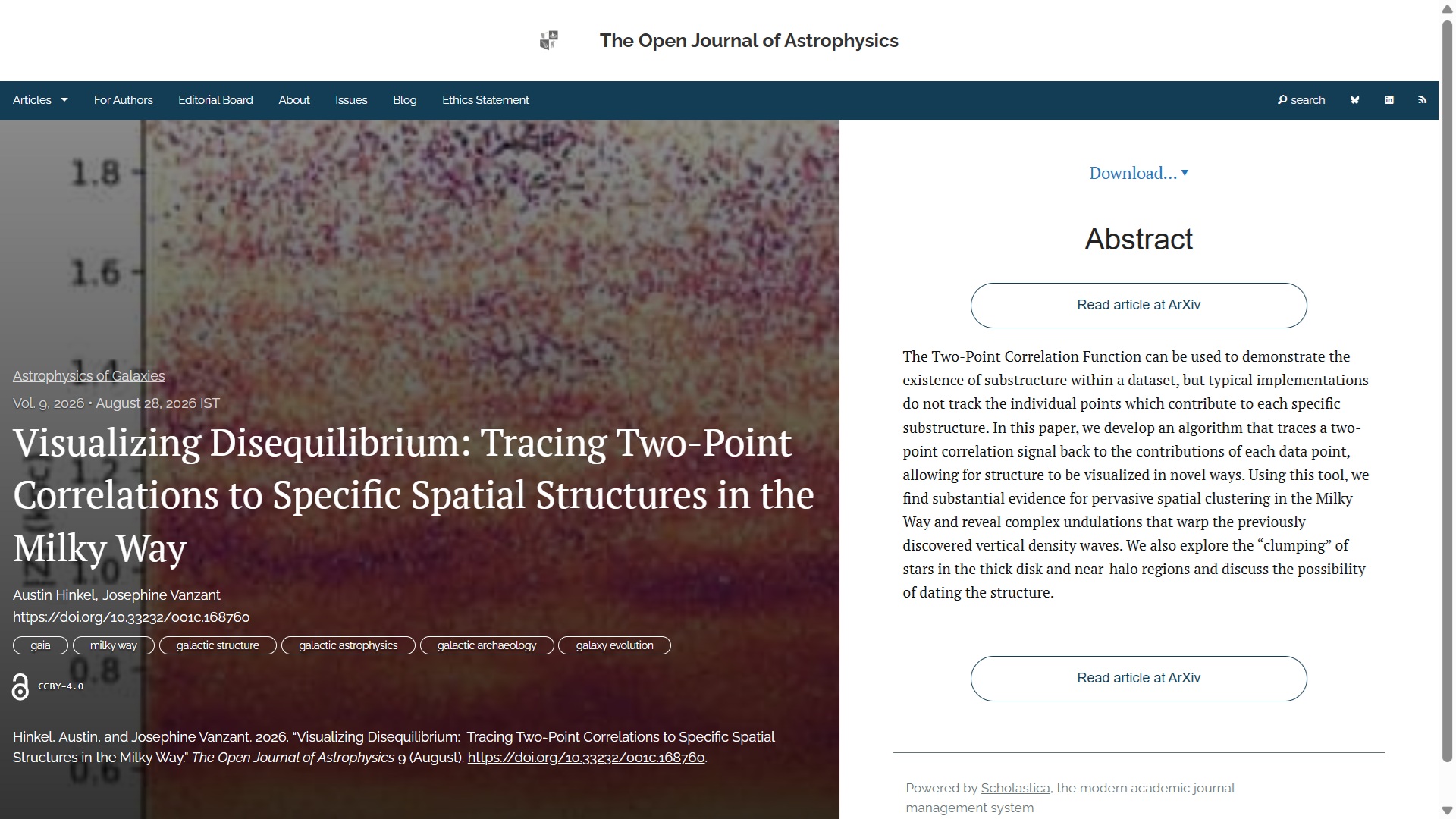
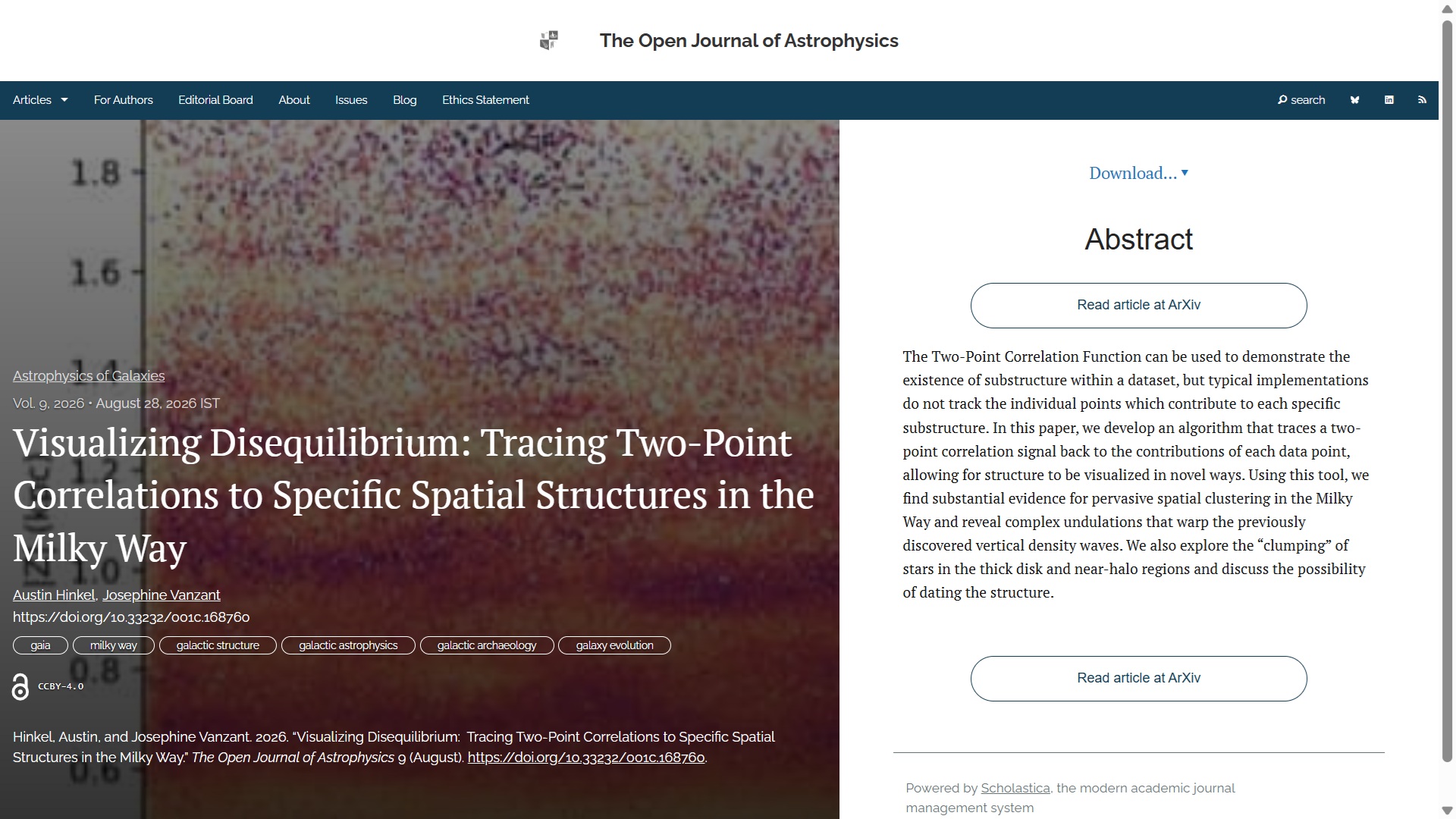
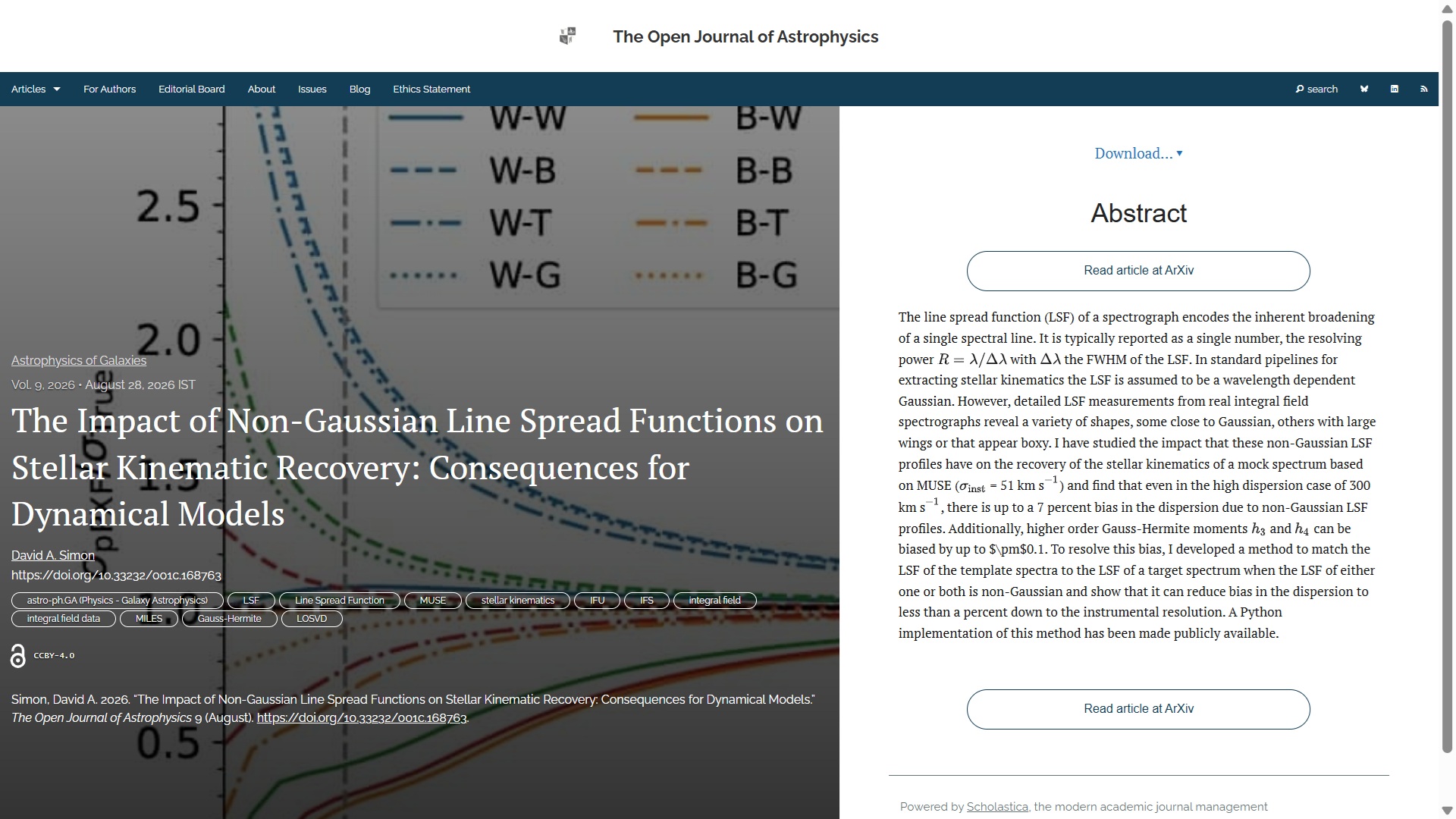
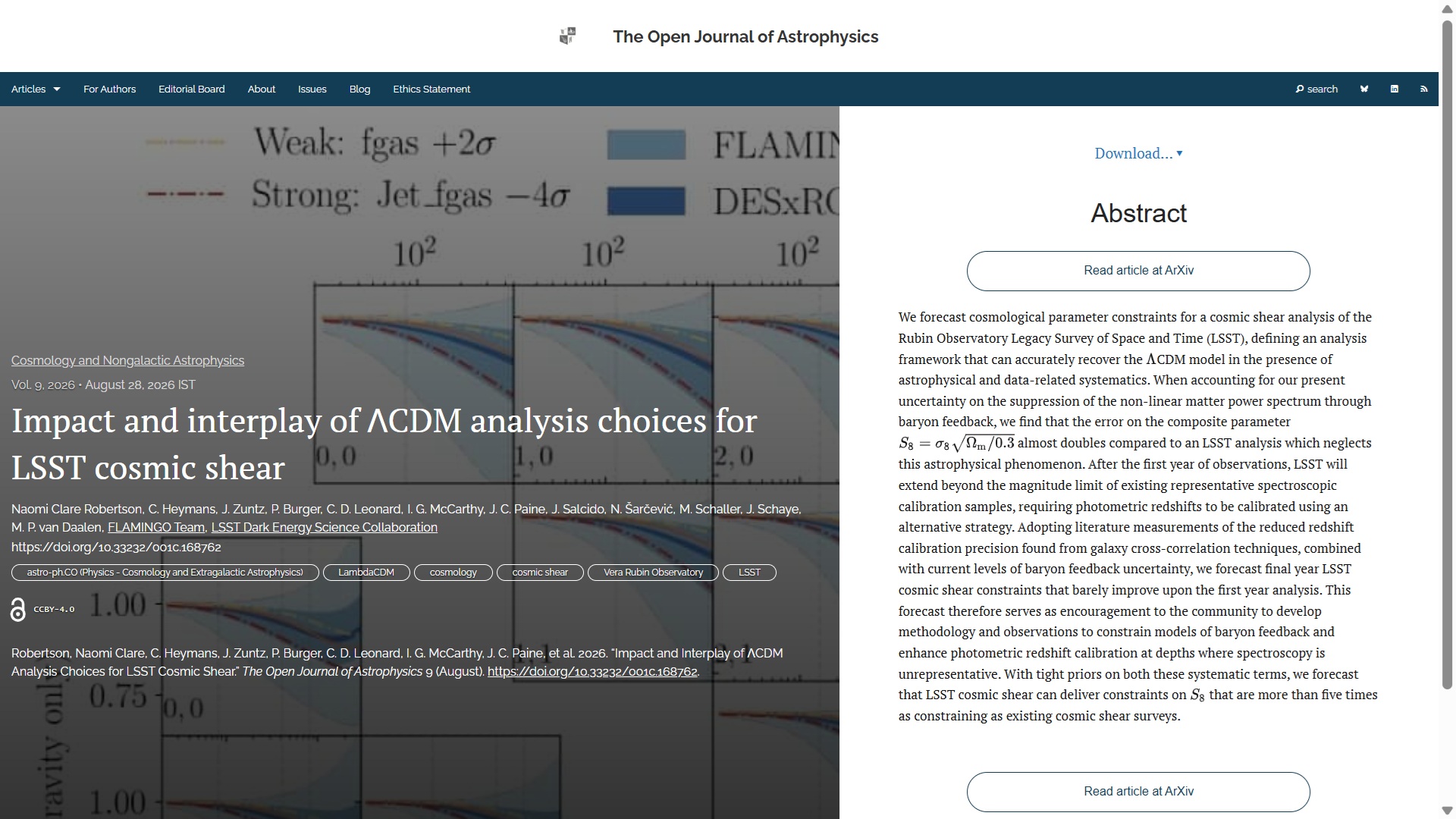
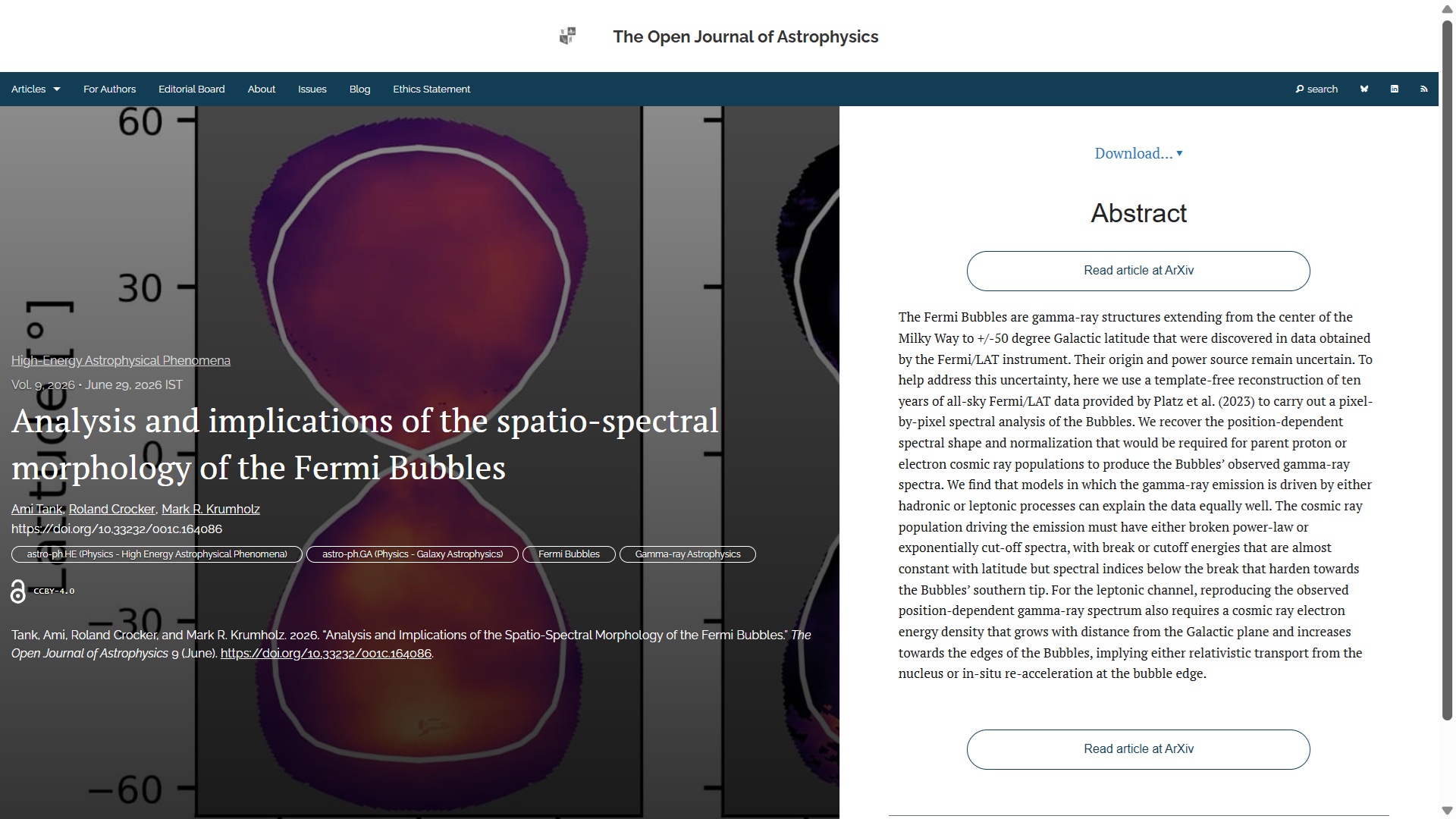
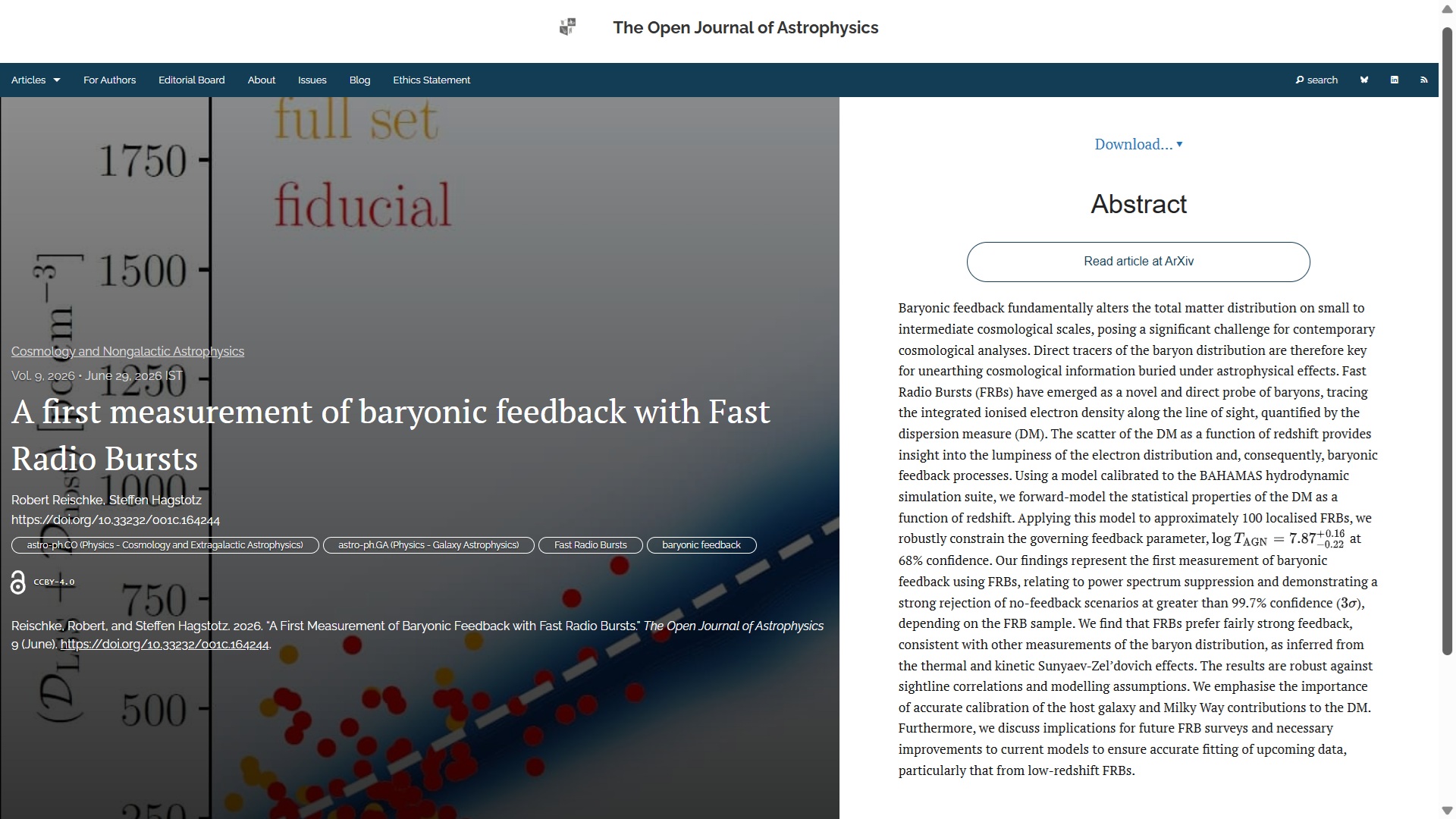
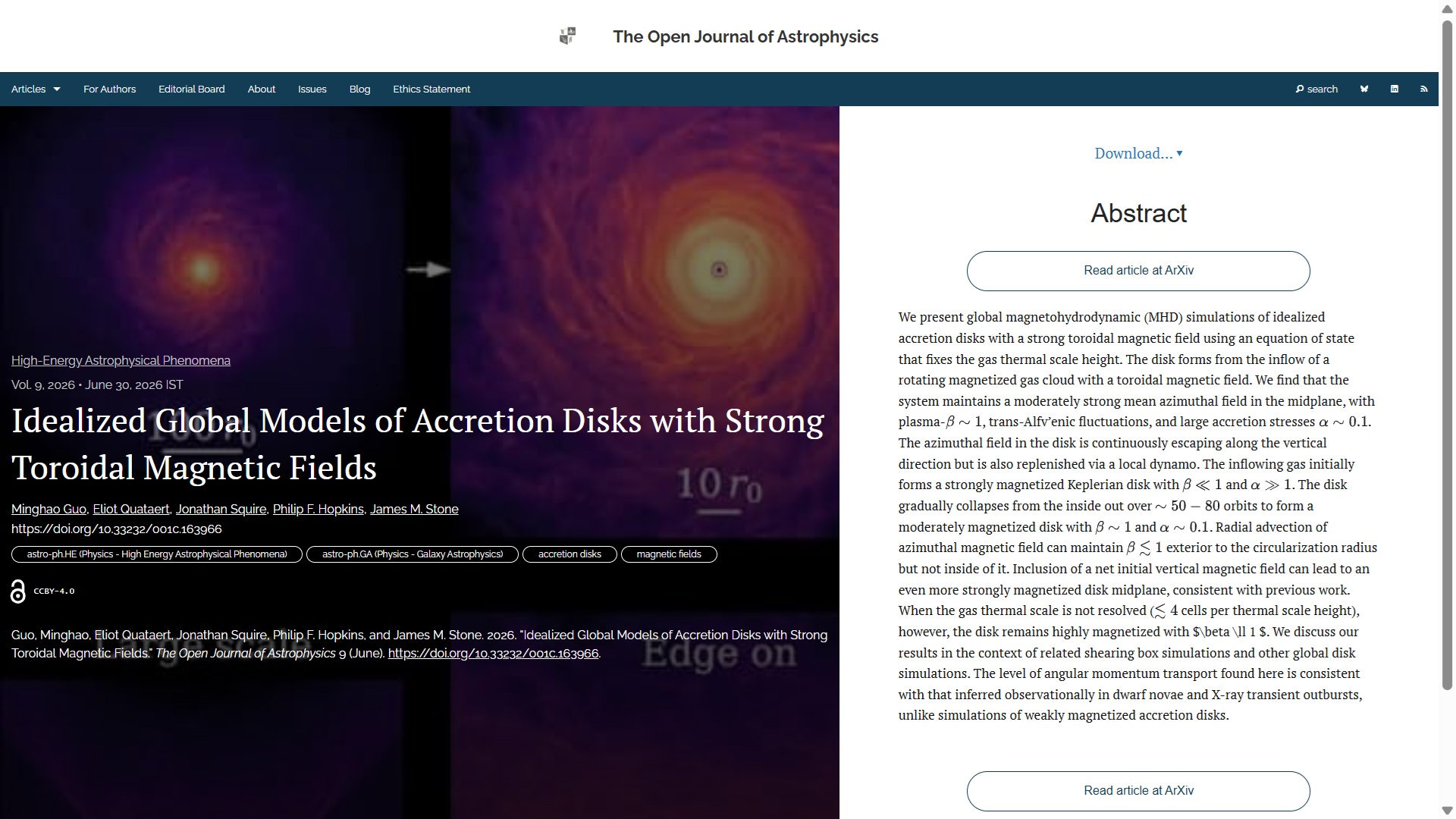
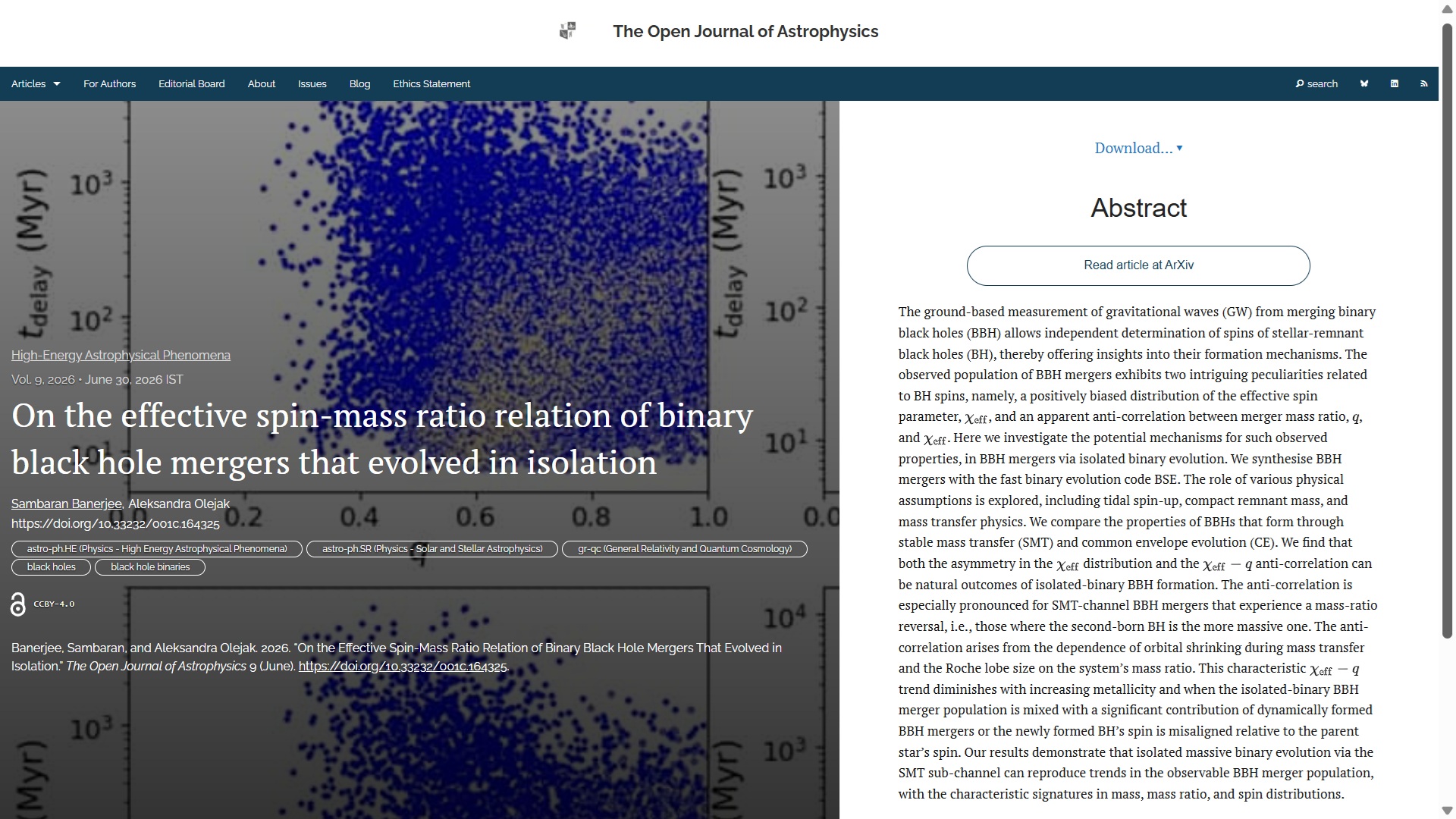
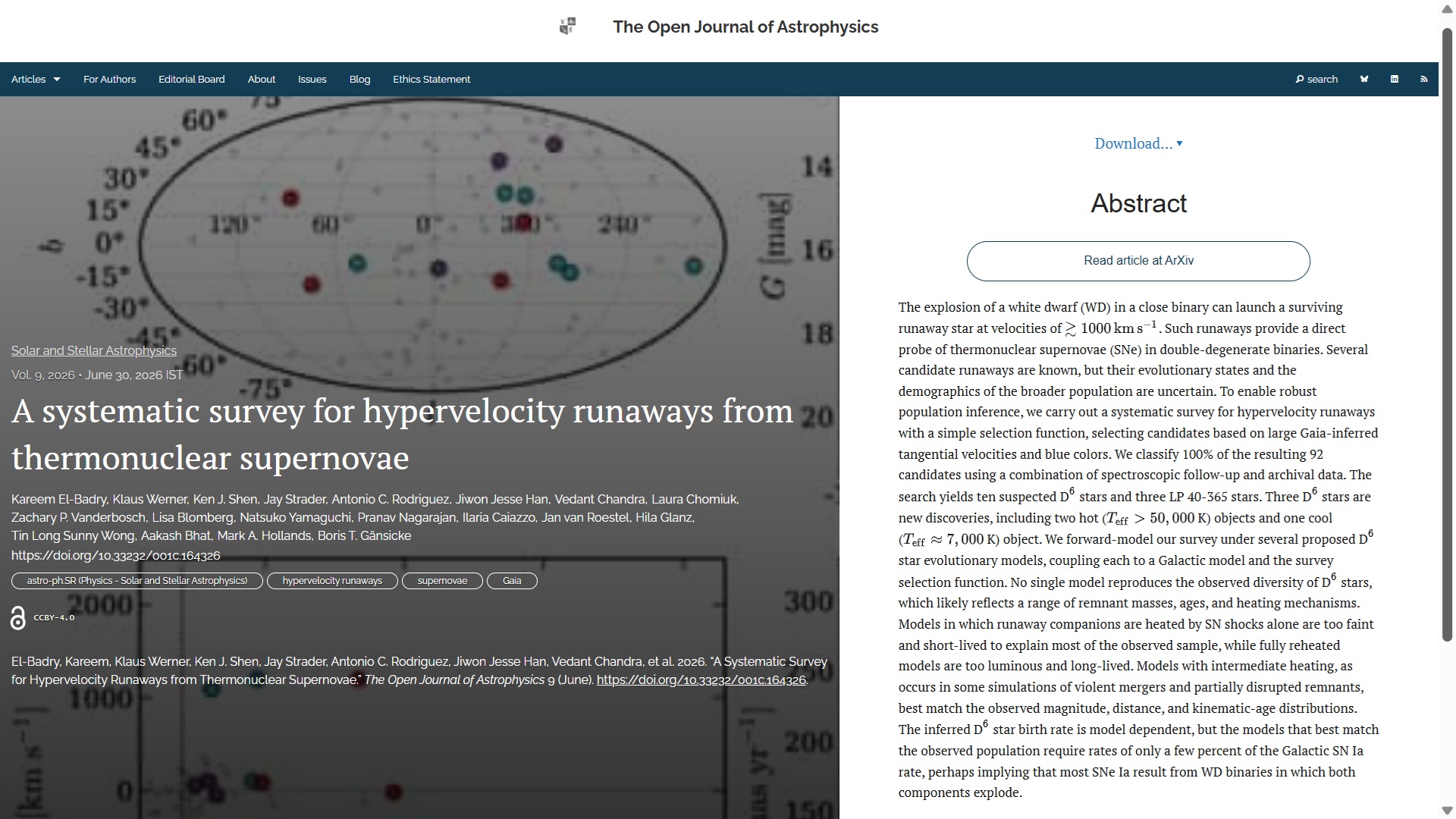
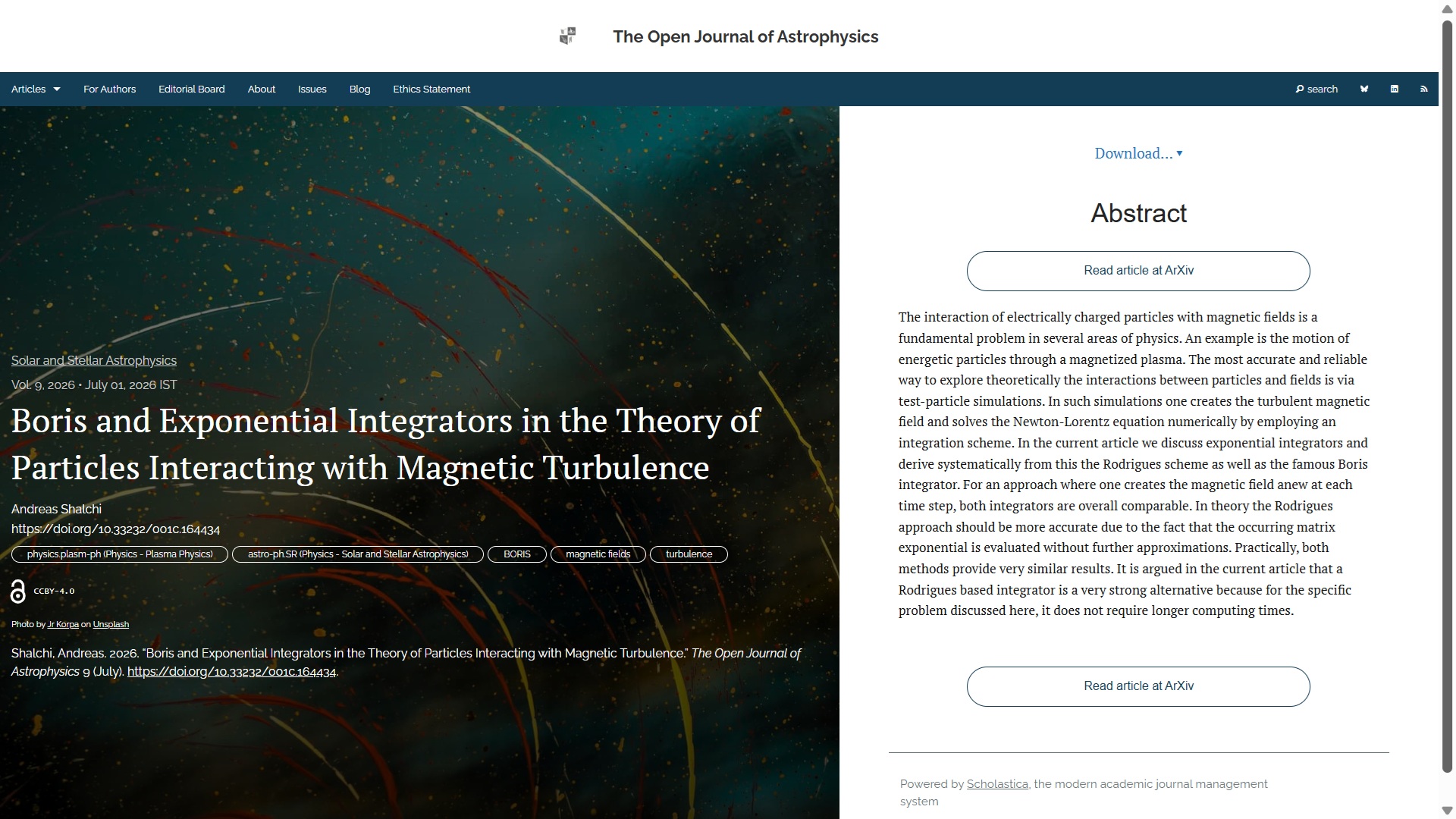
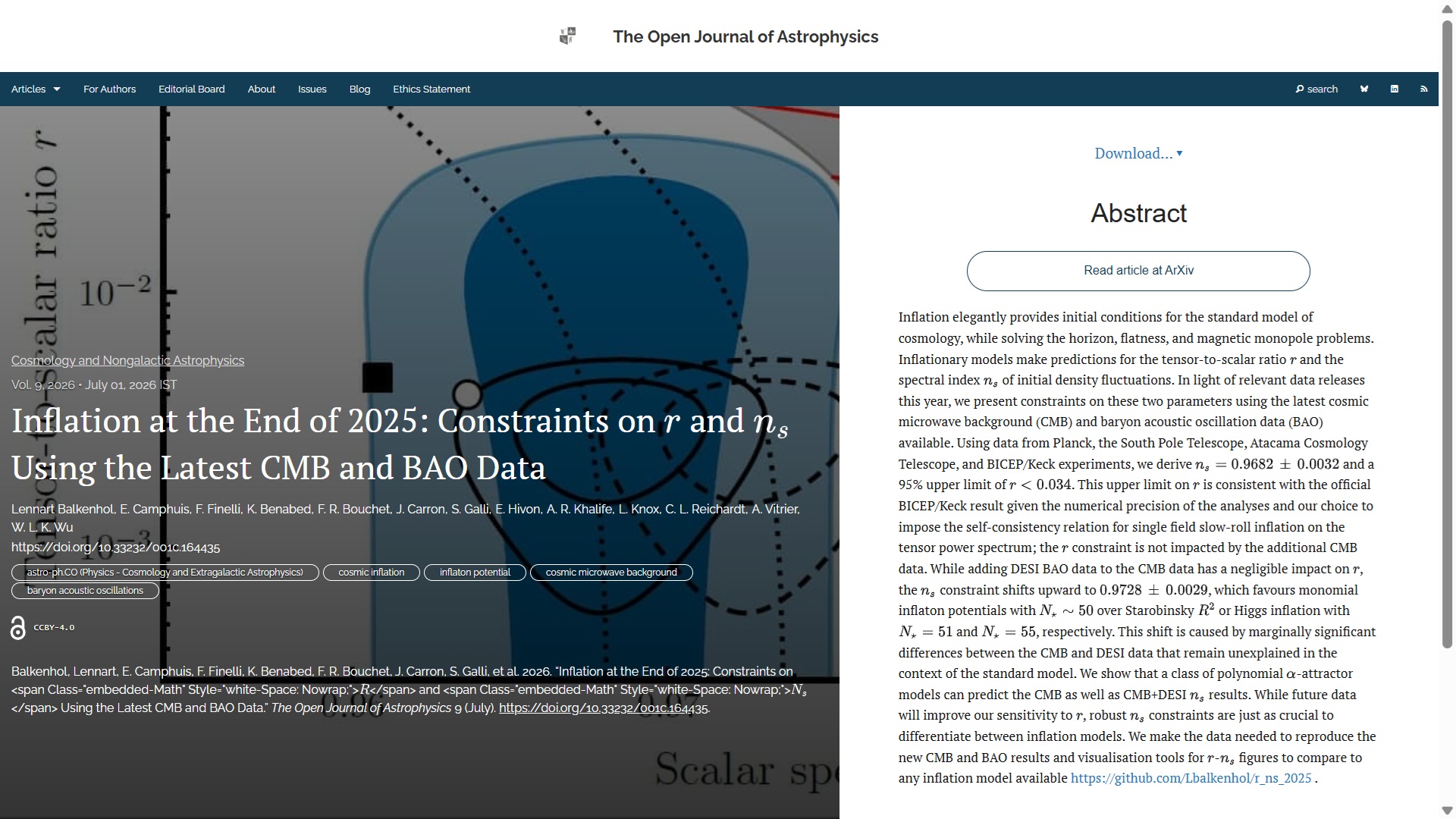
It’s Saturday once again, so it’s time for another update of activity at the Open Journal of Astrophysics. Since the last update we have published a further four papers, bringing the number in Volume 9 (2026) to 114 and the total so far published by OJAp up to 562.
I will continue to include the posts made on our Mastodon account (on Fediscience); these announcements also show the DOI for each paper.
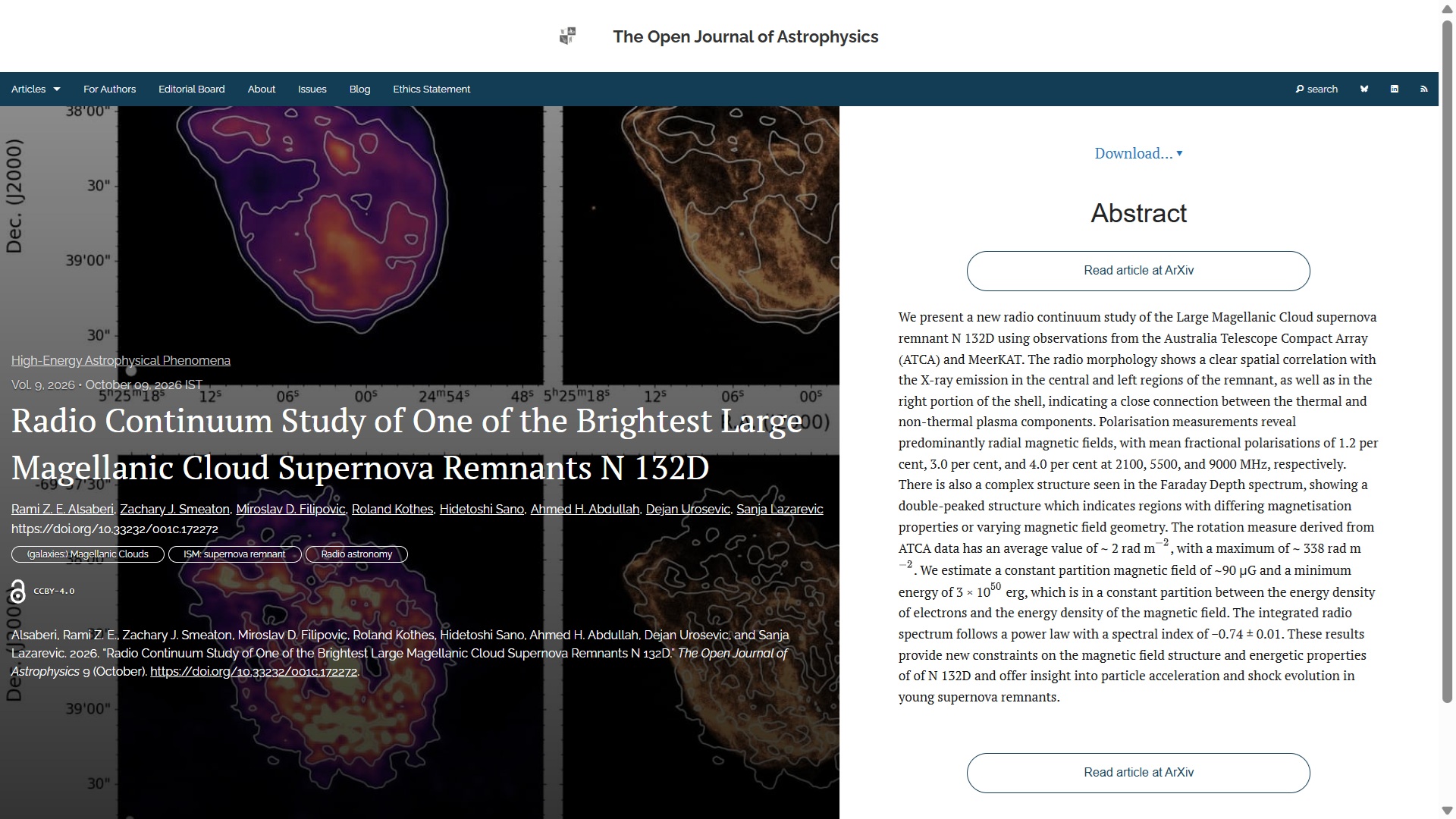
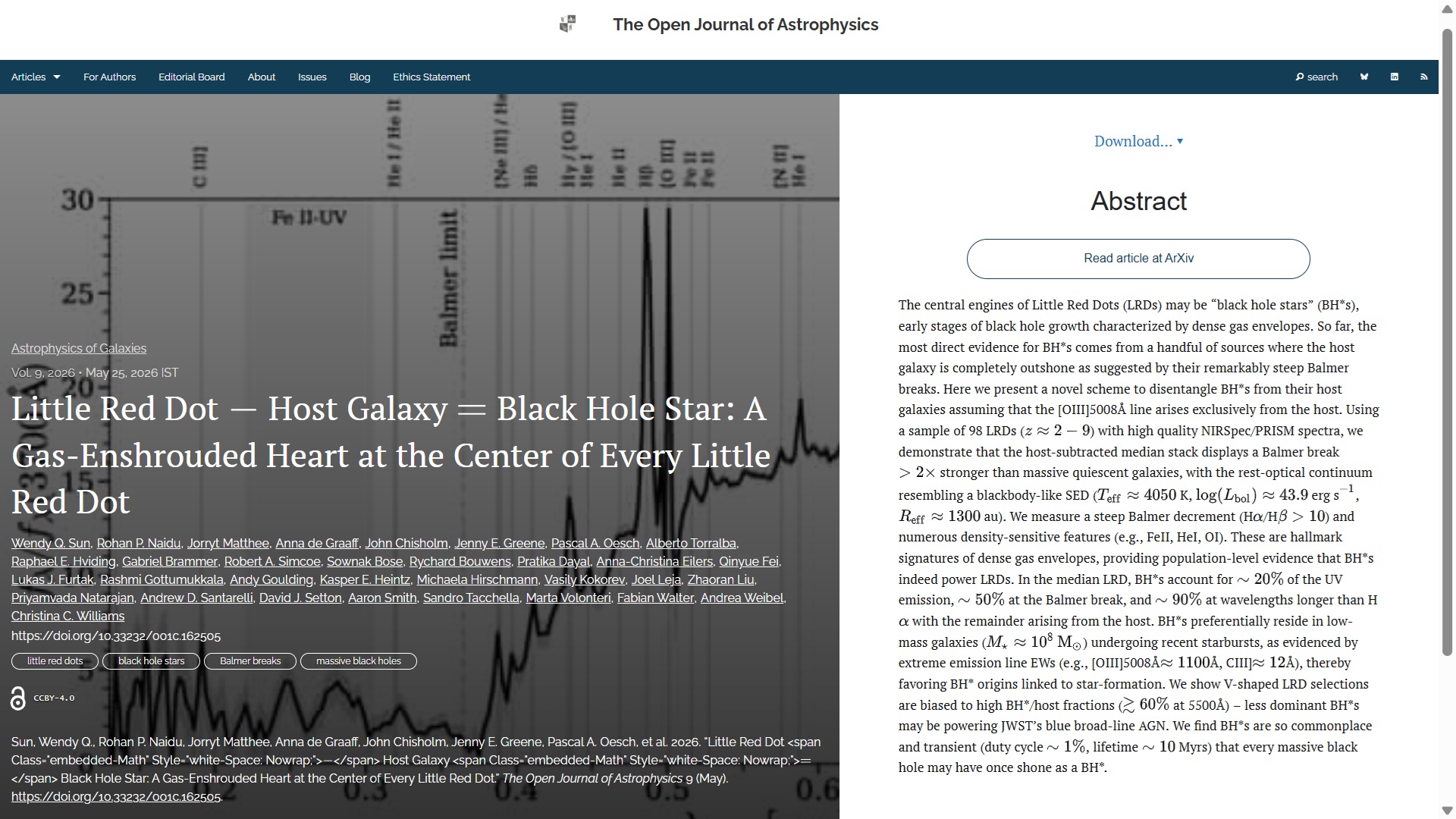
New Publication at the Open Journal of Astrophysics: "Little Red Dot – Host Galaxy = Black Hole Star: A Gas-Enshrouded Heart at the Center of Every Little Red Dot" by Wendy Q. Sun (MIT, USA) and 32 others from around the world.
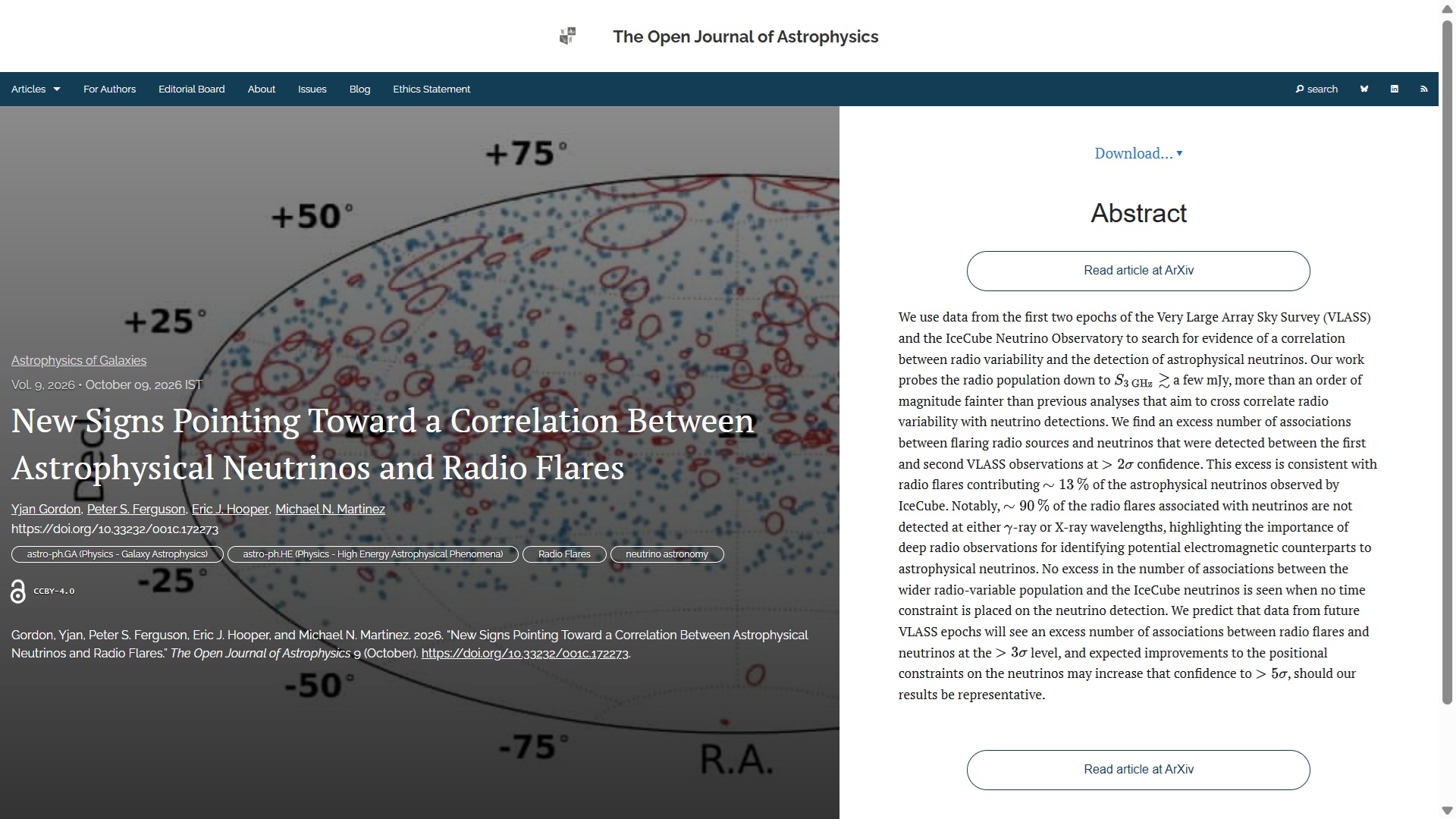
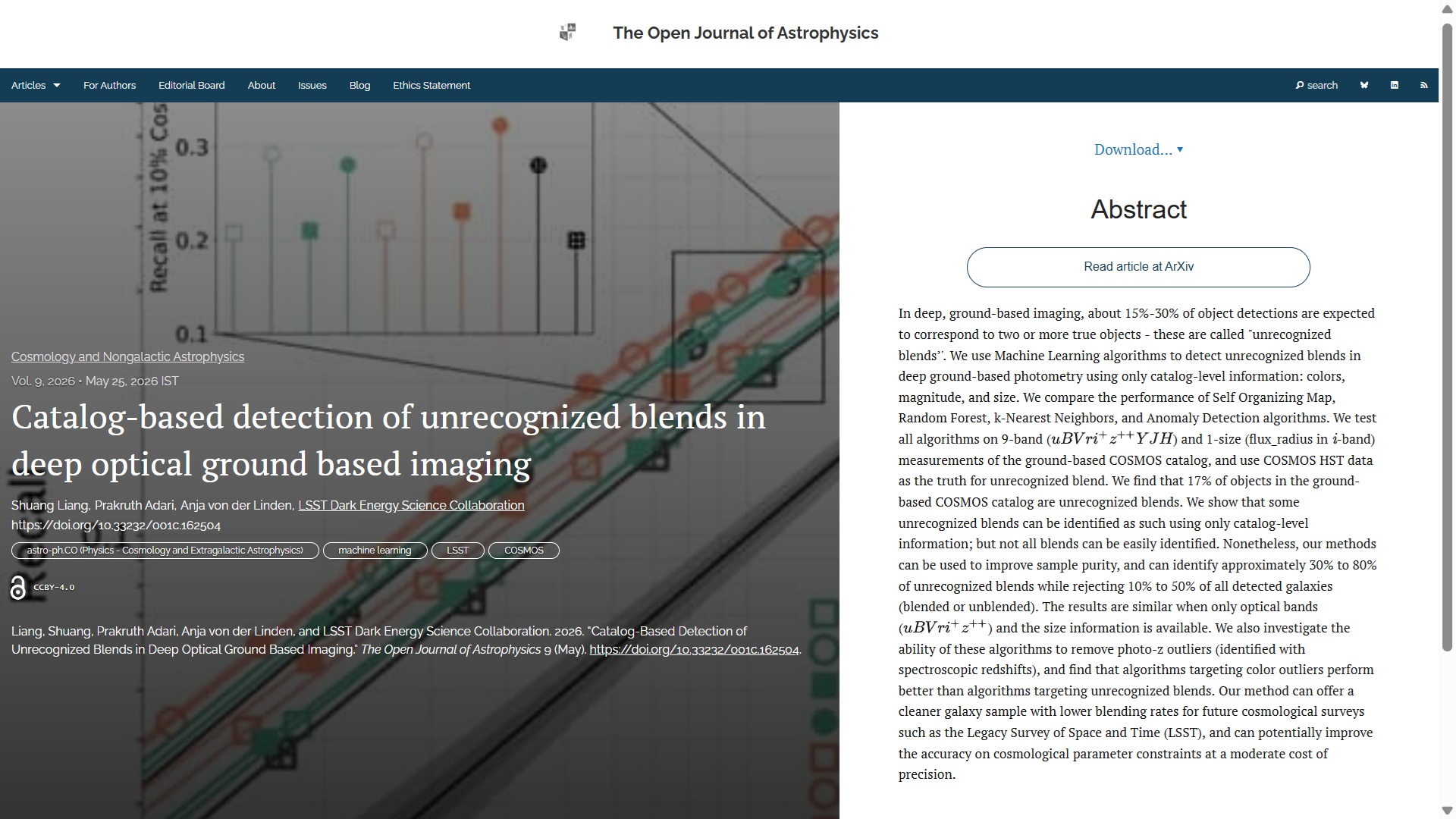
New Publication at the Open Journal of Astrophysics: "Catalog-based detection of unrecognized blends in deep optical ground based imaging" by Shuang Liang (Stanford U., USA) and Prakruth Adari & Anja von der Linden (Stony Brook U., USA) on behalf of the LSST Dark Energy Science Collaboration
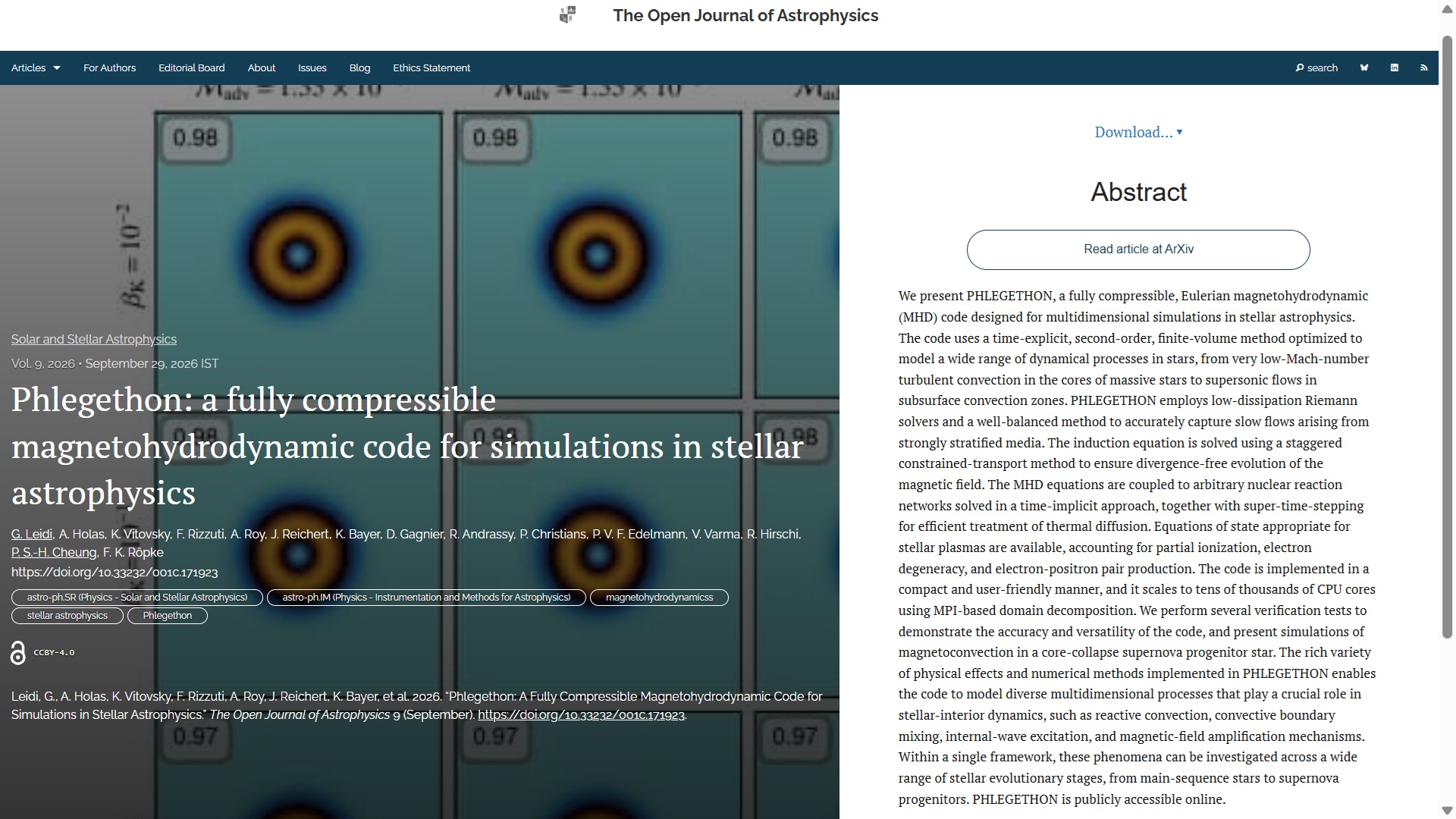
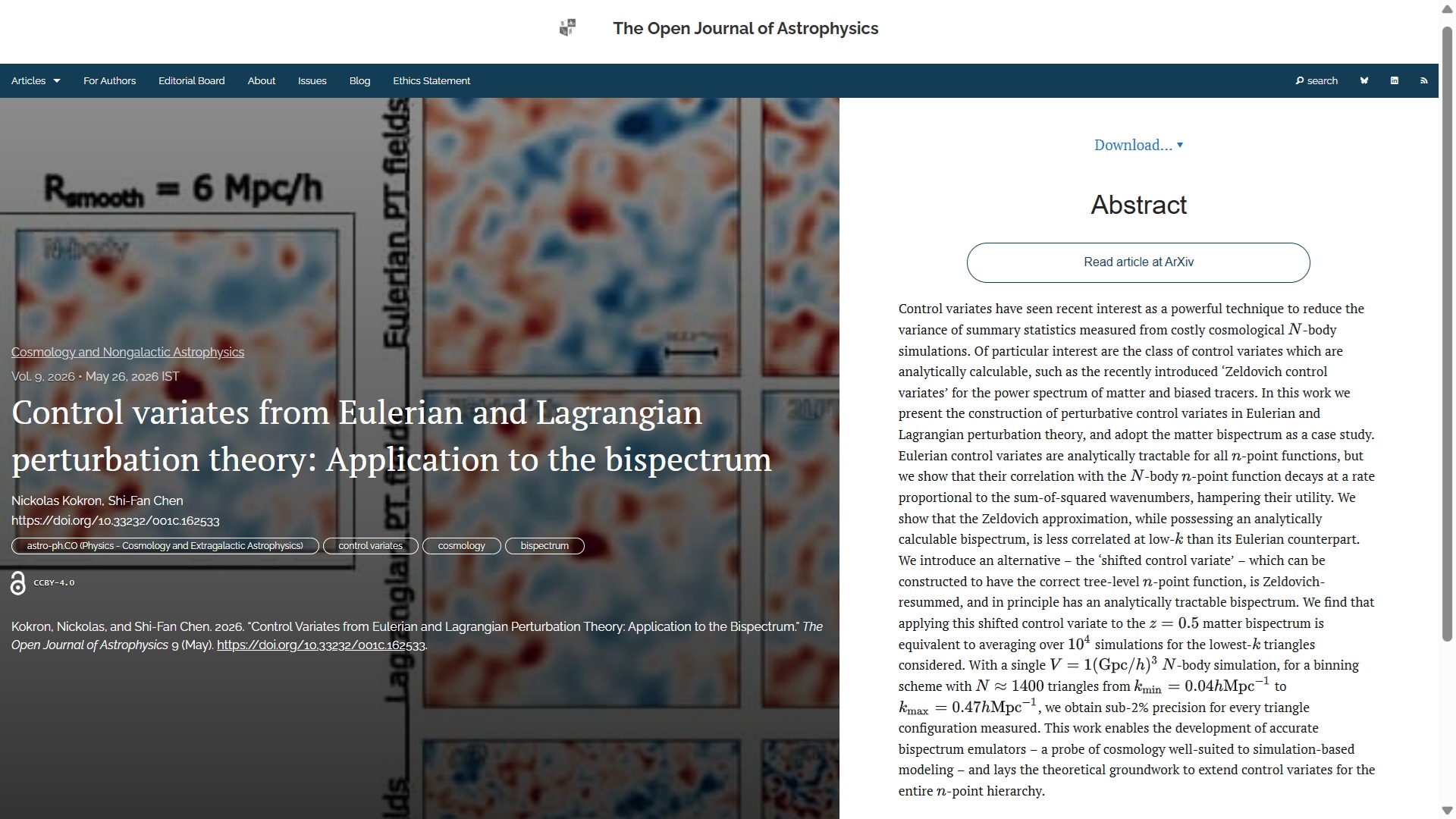
Next one up, the third paper of the week, published on Tuesday 26th May in the folder Cosmology and Nongalactic Astrophysics is “Control variates from Eulerian and Lagrangian perturbation theory: Application to the bispectrum” by Nickolas Kokron and Shi-Fan Chen (Institute for Advanced Study, Princeton, USA). This paper hexplores the use of control variates in cosmological simulations, introducing a new ‘shifted control variate’ that improves precision and enables accurate bispectrum emulators, aiding in cosmology modeling.
The overlay for this one is here:
The final, accepted version can be found on arXiv here and the Mastodon announcement is here:
New Publication at the Open Journal of Astrophysics: "Probing Dark Energy Microphysics with kSZ Tomography" by Julius Adolff, Selim Hotinli and Neal Dalal (Perimeter Institute, Canada)
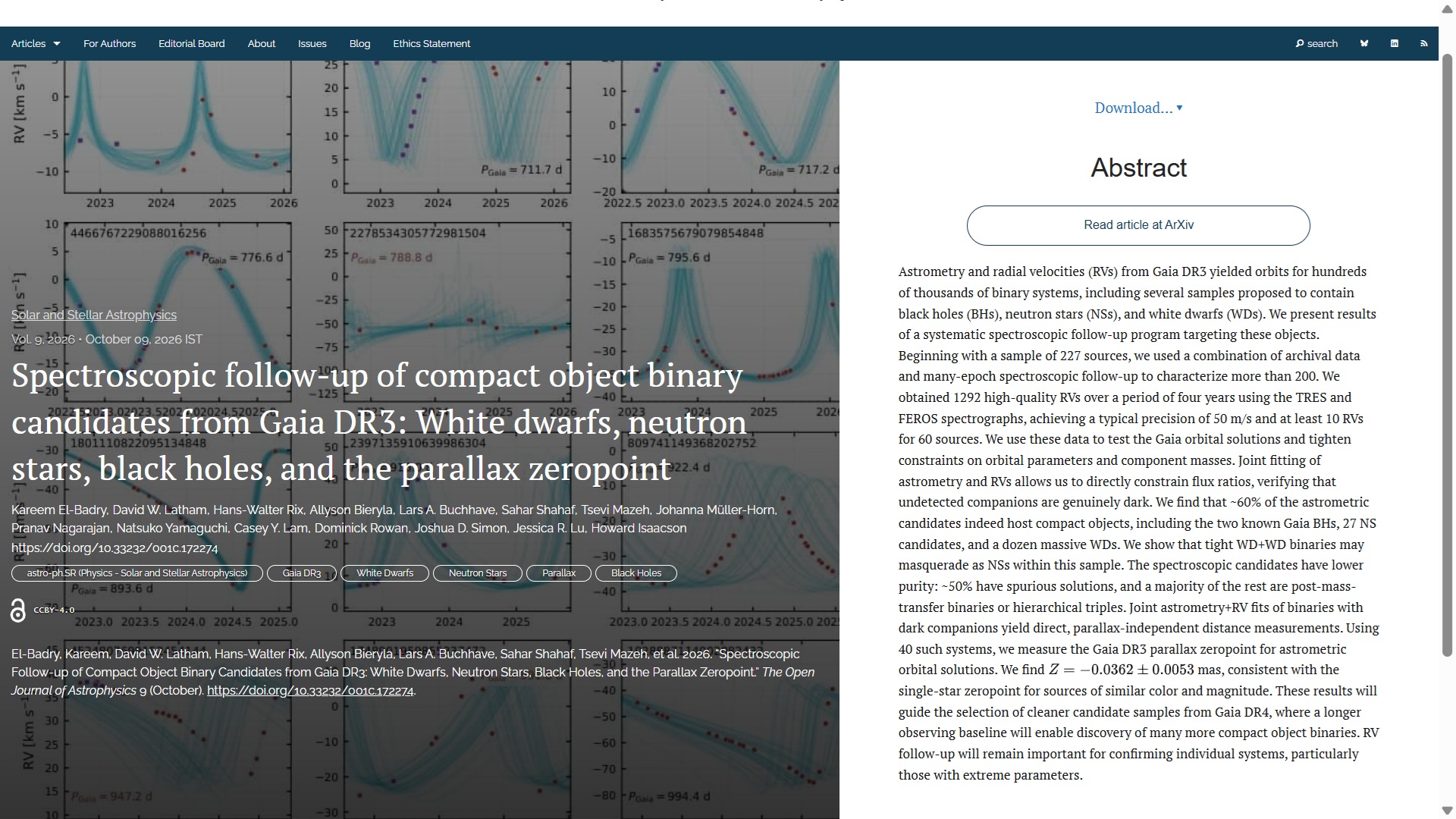
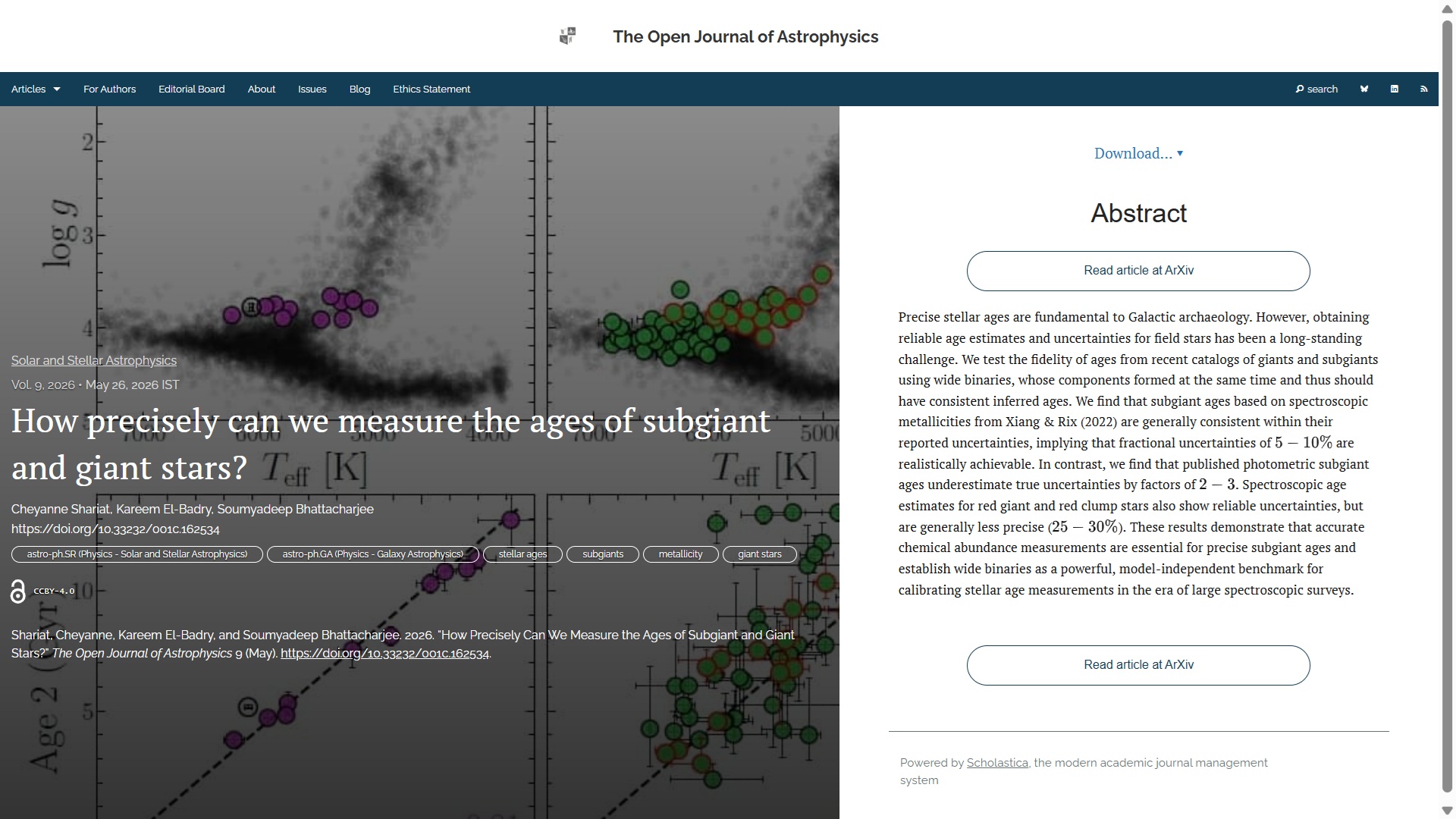
The fourth and final paper this week, also published on Tuesday 26th May is “How precisely can we measure the ages of subgiant and giant stars?” by Cheyanne Shariat, Kareem El-Badry and Soumyadeep Bhattacharjee (California Institute of Technology, USA). This article, published in the folder Solar and Stellar Astrophysics, is about testing the accuracy of stellar age estimates from recent catalogs, finding that spectroscopic metallicities provide reliable subgiant ages, while photometric ages underestimate uncertainties. Accurate chemical abundance measurements are essential.
The overlay is here:
The officially accepted version can be found on arXiv here and here is the Mastodon announcement:
New Publication at the Open Journal of Astrophysics: "How precisely can we measure the ages of subgiant and giant stars?" by Cheyanne Shariat, Kareem El-Badry and Soumyadeep Bhattacharjee (California Institute of Technology, USA)
Here we are, on schedule, with another update of activity at the Open Journal of Astrophysics. Since the last update we have published a further seven papers, bringing the number in Volume 9 (2026) to 94 and the total so far published by OJAp up to 542. I checked the corresponding update for last year (on 3rd May 2025), and we’ve had an increase from 54 to 94 in papers published (about 74%) between the first four months of 2025 and the first four months of 2026.
I will continue to include the posts made on our Mastodon account (on Fediscience) to encourage you to visit it. Mastodon is a really excellent service, and a more than adequate replacement for X/Twitter (which nobody should be using); these announcements also show the DOI for each paper.
The first paper to report this week is “DESI-DR1 3 × 2-pt analysis: consistent cosmology across weak lensing surveys” by Anna Porredon (CIEMAT, Madrid, Spain) and 72 others (DESI Colllaboration). This paper was published on Tuesday 28th April in the folder Cosmology and Nongalactic Astrophysics. This paper presents a joint cosmological analysis of galaxy clustering and gravitational lensing observations, providing consistent constraints on cosmological parameters. The analysis also introduces a new blinding procedure to prevent confirmation bias. See this post for news of an important DESI milestone.
The overlay for this paper is here
You can find the officially accepted version on arXiv here and the announcement on Fediverse here:
New Publication at the Open Journal of Astrophysics: "DESI-DR1 3 × 2-pt analysis: consistent cosmology across weak lensing surveys" by Anna Porredon (CIEMAT, Madrid, Spain) and 72 others (DESI Colllaboration)
The second paper for this week, also published on Tuesday 28th April but in the folder High-Energy Astrophysical Phenomena is “Masers and Broad-Line Mapping Favor Magnetically-Dominated AGN Accretion Disks” by Philip F. Hopkins (Caltech, USA), Dalya Baron (Stanford U., USA) and Joanna M. Piotrowska (Caltech). This one presents a new constraint on supermassive black hole accretion disks physics, suggesting that outer regions are likely in a ‘hyper-magnetized’ state, as thermal or radiation pressure models appear inconsistent.
The overlay for this one is here:
The official version of the paper can be found on arXiv here and the Fediverse announcement here:
New Publication at the Open Journal of Astrophysics: "Masers and Broad-Line Mapping Favor Magnetically-Dominated AGN Accretion Disks" by Philip F. Hopkins (Caltech, USA), Dalya Baron (Stanford U., USA) and Joanna M. Piotrowska (Caltech)
Next one up, the third paper of the week, is “Galaxy mergers and disk angular momentum evolution: stellar halos as a critical test” by Eric F. Bell (U. Michigan, Ann Arbor, USA), Richard D’Souza (Vatican Observatory), Monica Valluri & Katya Gozman (U. Michigan). This was published on Wednesday 29th April in the folder Astrophysics of Galaxies. The paper argues that satellite accretion impacts the angular momentum evolution of galaxies, often causing significant reorientation. This process is detectable in Milky Way-mass galaxies so the idea is testable observationally.
The overlay for this one is here:
The final, accepted version can be found on arXiv here and the Mastodon announcement is here:
New Publication at the Open Journal of Astrophysics: "Galaxy mergers and disk angular momentum evolution: stellar halos as a critical test" by Eric F. Bell (U. Michigan, Ann Arbor, USA), Richard D'Souza (Vatican Observatory), Monica Valluri & Katya Gozman (U. Michigan)
The fourth paper this week, published on Thursday April 30th, is “Time-Dilation Methods for Extreme Multiscale Timestepping Problems” by Philip F. Hopkins and Elias R. Most (Caltech, USA). This paper is in the folder Instrumentation and Methods for Astrophysics: it presents a new method for astrophysical simulations that modulates time evolution with a variable dilation/stretch factor, improving efficiency and accuracy in modeling processes across different scales.
The overlay is here:
The finally accepted version of this paper can be found here and the Mastodon announcement follows:
New Publication at the Open Journal of Astrophysics: "Time-Dilation Methods for Extreme Multiscale Timestepping Problems" by Philip F. Hopkins and Elias R. Most (Caltech, USA)
The fifth article of this week was also published on Thursday 30th April, but in the folder Astrophysics of Galaxies. The title is “Cosmic Rays on Galaxy Scales: Progress and Pitfalls for CR-MHD Dynamical Models” and the author is Philip F. Hopkins (Caltech, USA) who has three papers featured this week. The paper presents an overview of cosmic ray (CR) modeling, highlighting its influence on galactic physics and star formation. It addresses previous modeling errors and presents new methods for full-spectrum dynamics.
The overlay is here:
You can find the authorized version of this paper on arXiv here and the Fediverse announcement is here:
New Publication at the Open Journal of Astrophysics: "Cosmic Rays on Galaxy Scales: Progress and Pitfalls for CR-MHD Dynamical Models" by Philip F. Hopkins (Caltech, USA)
New Publication at the Open Journal of Astrophysics: "Baryonification III: An accurate analytical model for the dispersion measure probability density function of fast radio bursts" by MohammadReza Torkamani (Universität Bonn, Germany) and 8 others based in Germany, Switzerland, UK and Sweden
New Publication at the Open Journal of Astrophysics: "The stellar and dark matter distributions in early-type galaxies measured by stacked weak gravitational lensing" by Momoka Fujikawa & Masamune Oguri (Chiba University, Japan)
So here we are again, on a Saturday morning, with another update of activity at the Open Journal of Astrophysics. Since the last update we have published a further five papers, bringing the number in Volume 9 (2026) to 87 and the total so far published by OJAp up to 535.
I will continue to include the posts made on our Mastodon account (on Fediscience) to encourage you to visit it. Mastodon is a really excellent service, and a more than adequate replacement for X/Twitter (which nobody should be using); these announcements also show the DOI for each paper.
The first paper to report this week is “Bayesian Cosmic Void Finding with Graph Flows” by Leander Thiele (U. Tokyo, Japan). This was published on Monday 20th April in the folder Cosmology and Nongalactic Astrophysics. The paper presents a method using a deep graph neural network to identify cosmic voids in sparse galaxy surveys, improving upon traditional deterministic algorithms by considering the problem’s probabilistic nature. The overlay is here:
You can find the officially accepted version on arXiv here and the announcement on Fediverse here:
The second paper for this week, published on Wednesday 22nd April in the folder Astrophysics of Galaxies, is “Sifting for a Stream: The Morphology of the 300S Stellar Stream” by Benjamin Cohen (U. Chicago, USA) and 20 others distributed around the world. This study analyzes the morphology of the $300S$ stellar stream, revealing three density peaks, a possible gap, and a kink, suggesting significant influence from the Large Magellanic Cloud on its structure.
The overlay for this one is here:
The official version of the paper can be found on arXiv here and the Fediverse announcement here:
New Publication at the Open Journal of Astrophysics: "Sifting for a Stream: The Morphology of the 300S Stellar Stream" by Benjamin Cohen (U. Chicago, USA) and 20 others distributed around the world.
New Publication at the Open Journal of Astrophysics: "IRMaGiC: Extending Luminous Red Galaxy Selection into the Infrared with Joint Rubin Observatory’s Large Survey of Space Time and Roman’s High Latitude Imaging Survey" by Zhiyuan Guo & Chris. W. Walter (Duke U., USA) and Eli S. Rykoff (Stanford U., USA) on behalf of the LSST Dark Energy Science Collaboration
New Publication at the Open Journal of Astrophysics: "The Diagnostic Temperature Discrepancy as Evidence for Non-Maxwellian Coronal Electrons" by Victor Edmonds (Final Stop Consulting, USA)
The fifth and final paper for this week was published on Friday 24th April in the folder Astrophysics of Galaxies. The title is “Galaxy evolution in the post-merger regime. IV – The long-term effect of mergers on galactic stellar mass growth and distribution” by Sara L. Ellison (U. Victoria, Canada) and Leonardo Ferreira (Universidade Federal do Rio Grande, Brazil). This study uses a large sample of post-merger galaxies to demonstrate that galaxy mergers trigger significant and extended stellar mass growth in their central regions, independent of stellar population modelling.
The overlay is here:
You can find the authorized version of this paper on arXiv here and the Fediverse announcement is here:
New Publication at the Open Journal of Astrophysics: "Galaxy evolution in the post-merger regime. IV – The long-term effect of mergers on galactic stellar mass growth and distribution" by Sara L. Ellison (U. Victoria, Canada) and Leonardo Ferreira (Universidade Federal do Rio Grande, Brazil)
It is Saturday morning, and therefore time for yet another update of activity at the Open Journal of Astrophysics. Since the last update we have published a further six papers, bringing the number in Volume 9 (2026) to 82 and the total so far published by OJAp up to 530.
I will continue to include the posts made on our Mastodon account (on Fediscience) to encourage you to visit it. Mastodon is a really excellent service, and a more than adequate replacement for X/Twitter (which nobody should be using); these announcements also show the DOI for each paper.
New Publication at the Open Journal of Astrophysics: "Beyond Spherical geometry: Unraveling complex features of objects orbiting around stars from its transit light curve using deep learning" by Ushasi Bhowmick & Shivam Kumaran (ISRO, Ahmedabad, India)
The second paper for this week, also published on Monday 13th April but in the folder Astrophysics of Galaxies, is “statmorph-lsst: Quantifying and correcting morphological biases in galaxy surveys” by Elizaveta Sazonova (U. Waterloo, Canada) and an international cast of 18 others. This paper presents an investigation of potential biases in quantitative morphology metrics used in galaxy evolution studies, proposing two new measurements to resolve biases, and provides a related Python package (statmorph-lsst), which can be found here on github.
The overlay for this one is here:
The official version of the paper can be found on arXiv here and the Fediverse announcement here:
New Publication at the Open Journal of Astrophysics: "statmorph-lsst: Quantifying and correcting morphological biases in galaxy surveys" by Elizaveta Sazonova (U. Waterloo, Canada) and an international cast of 18 others.
Next one up, the third paper of the week, one of four published on Friday 17th April, is “Disentangling the galactic and intergalactic components in 313 observed Lyman-alpha line profiles between redshift 0 and 5” by Siddhartha Gurung-López (Universitat de València, Spain) and 7 others based in Spain and Germany. Published in the folder Astrophysics of Galaxies, this paper uses the zELDA package to analyze Lyman-alpha photons from star-forming galaxies, revealing IGM effects dominate Lyman-alpha observability at high redshifts, while galactic outflows become more important at lower z.
The overlay for this one is here:
The final, accepted version can be found on arXiv here and the Mastodon announcement is here:
New Publication at the Open Journal of Astrophysics: "Disentangling the galactic and intergalactic components in 313 observed Lyman-alpha line profiles between redshift 0 and 5" by Siddhartha Gurung-López (Universitat de València, Spain) and 7 others based in Spain and Germany.
New Publication at the Open Journal of Astrophysics: "Using Symbolic Regression to Emulate the Radial Fourier Transform of the Sérsic Profile for Fast, Accurate and Differentiable Galaxy Profile Fitting" by Tim B. Miller (Northwestern University, USA) and Imad Pasha (Yale University, USA)
The fifth paper for this week is “The THESAN project: Lyman-alpha emitters as probes of ionized bubble sizes” by Meredith Neyer (MIT, USA) and 6 others based in the USA, Colombia, Canada, Japan and UK. The study uses THESAN simulations to explore how Lyman-alpha emitters (LAEs) trace ionized bubble sizes during the Epoch of Reionization, providing a framework for interpreting LAE surveys. This was published on Friday 17th April in the folder Astrophysics of Galaxies.
The overlay for this one is here:
You can find the authorized version of this paper on arXiv here and the Fediverse announcement is here:
New Publication at the Open Journal of Astrophysics: "The THESAN project: Lyman-alpha emitters as probes of ionized bubble sizes" by Meredith Neyer (MIT, USA) and 6 others based in the USA, Colombia, Canada, Japan and UK.
New Publication at the Open Journal of Astrophysics: "Closed-Form Statistical Relations Between Projected Separation, Semimajor Axis, Companion Mass, and Host Acceleration" by Timothy D Brandt (Space Telescope Science Institute, USA)
It’s Saturday once more, so it’s time for another update of activity at the Open Journal of Astrophysics. It has been a busy week. Since the last update we have published a further nine papers, bringing the number in Volume 9 (2026) to 45 and the total so far published by OJAp up to 493.
I will continue to include the posts made on our Mastodon account (on Fediscience) to encourage you to visit it. Mastodon is a really excellent service, and a more than adequate replacement for X/Twitter (which nobody should be using); these announcements also show the DOI for each paper.
The first four papers this week were all published on Monday 23rd February.
New Publication at the Open Journal of Astrophysics: "A Bayesian Exploration of The Mass of the Ursa Major III: Kinematics, Rotation and their influence on the Mass to Light Ratio" by Tim R. Adams (U. Sydney, Australia), Brendon J. Brewer (U. Auckland, New Zealand) and Geraint F. Lewis (Sydney)
The second paper is “The Impact of Baryonic Effects on the Dynamical Masses Inferred Using Satellite Kinematics” by Josephine F.W. Baggen, Frank C. van den Bosch, and Kaustav Mitra (Yale U., USA). This paper, also in the folder Astrophysics of Galaxies, presents a model to assess the impact of stars and gas on satellite kinematics, showing that these baryonic effects can reduce the satellite velocity dispersion and increase inferred central galaxy masses.
The overlay for this one is here:
The official version of the paper can be found on arXiv here and the Fediverse announcement here:
New Publication at the Open Journal of Astrophysics: "The Impact of Baryonic Effects on the Dynamical Masses Inferred Using Satellite Kinematics" by Josephine F.W. Baggen, Frank C. van den Bosch, and Kaustav Mitra (Yale U., USA)
The third paper this week, and the third published on Monday 23rd February, and the third in the folder Astrophysics of Galaxies, is “MEGATRON: Disentangling Physical Processes and Observational Bias in the Multi-Phase ISM of High-Redshift Galaxies” by Nicholas Choustikov (U. Oxford, UK) and 12 others based in UK, USA, France, Korea and Belgium. The study uses MEGATRON simulations to analyze the interstellar medium (ISM) of high-redshift galaxies, finding it denser and less metal-enriched than local galaxies with implications for line ratios as diagnostics
The overlay is here:
The official version can be found on arXiv here and the Fediverse announcement is here:
New Publication at the Open Journal of Astrophysics: "MEGATRON: Disentangling Physical Processes and Observational Bias in the Multi-Phase ISM of High-Redshift Galaxies" by Nicholas Choustikov (U. Oxford, UK) and 12 others based in UK, USA, France, Korea and Belgium
New Publication at the Open Journal of Astrophysics: "Redshift Assessment Infrastructure Layers (RAIL): Rubin-era photometric redshift stress-testing and at-scale production" by the RAIL Team (31 authors) and the Dark Energy Science Collaboration
Moving on to Tuesday 24th February, the fifth paper this week, is “Feedback shaped the galaxy morphological sequence in presence of mergers” by Masafumi Noguchi (Tohoku University, Japan). This article was published in the folder Astrophysics of Galaxies. This study suggests that galaxy morphology, specifically the mass ratios of bulges and disks, is influenced by galaxy mergers and feedback processes from active galactic nuclei and supernovae.
The overlay is here:
The accepted version can be found on arXiv here, and the fediverse announcement is here:
New Publication at the Open Journal of Astrophysics: "Feedback shaped the galaxy morphological sequence in presence of mergers" by Masafumi Noguchi (Tohoku University, Japan)
The sixth paper this week is “HelioSpectrotron 5000: an interactive solar atlas” by Alexander G.M. Pietrow (AIP Potsdam, Germany). This was published on Tuesday 24th February in the folder Solar and Stellar Astrophysics. This describes HelioSpectrotron~5000 (HS5000), which is an interactive solar spectral atlas that allows comparison between high-resolution spectra and ground-based instrument observations, aiding in wavelength calibration and line identification. The software can be found here; I had a play with it yesterday and it’s very easy to use!
The overlay is here:
You can find the officially accepted version on arXiv here and the Mastodon announcement is here:
New Publication at the Open Journal of Astrophysics: "HelioSpectrotron 5000: an interactive solar atlas" by Alexander G.M. Pietrow (AIP Potsdam, Germany)
The seventh paper of this week was published on Thursday 26th February is “The Rise of Ionized Gas Filaments in Early-Type Galaxies” by Ryan Eskenasy (U. Kentucky, USA), Valeria Olivares (Universidad de Santiago de Chile) and Yuanyuan Su (U. Kentucky, USA). This article, in the folder Astrophysics of Galaxies, is an exploration of the formation of multiphase filamentary nebulae in early-type galaxies (ETGs), using VLT-MUSE IFU observations of 126 non-central ETGs, focussing on the hot gas components thereof.
The overlay is here:
The officially accepted version of this paper can be found on the arXiv here and the Mastodon announcement is here:
New Publication at the Open Journal of Astrophysics: "The Rise of Ionized Gas Filaments in Early-Type Galaxies" by Ryan Eskenasy (U. Kentucky, USA), Valeria Olivares (Universidad de Santiago de Chile) and Yuanyuan Su (U. Kentucky, USA)
New Publication at the Open Journal of Astrophysics: "Relationship Between Major Stellar Physical Parameters and Normal Mode Frequencies in Accreting White Dwarf Stars" by Praphull Kumar, Dean M. Townsley and Hunter Anz (U. Alabama, USA)
The ninth, and final, paper for this week is “A Semi-Supervised Learning Method for the Identification of Bad Exposures in Large Imaging Surveys” by Yufeng Luo (U. Wyoming, USA) and 8 others from the DESI Legacy Imaging Surveys Team. This was published on Friday 27th February, i.e yesterday, in the folder Instrumentation and Methods for Astrophysics. The paper describes a machine-learning approach for detecting poor-quality exposures in large astronomical imaging surveys, proving efficient and accurate in identifying problematic exposures.
The overlay is here:
The official version on arXiv can be found here and the Mastodon announcement follows:
New Publication at the Open Journal of Astrophysics: "A Semi-Supervised Learning Method for the Identification of Bad Exposures in Large Imaging Surveys" by Yufeng Luo (U. Wyoming, USA) and 8 others from the DESI Legacy Imaging Surveys Team
And that concludes this week’s update. We have now published 45 papers in two complete months of 2026, on which basis we can estimate about 270 papers in the year. For the record, in the first two months of 2025 we published 21 papers.
P.S. Thank you to the many people who responded to the latest call for editors. I’ve been sending out invitations and getting people onboard as quickly as I can, but I still have a number to get to so please bear with me!
It’s Saturday once more so time for another update of activity at the Open Journal of Astrophysics. Since the last update we have published a further six papers, bringing the number in Volume 9 (2026) to 36 and the total so far published by OJAp up to 484.
I will continue to include the posts made on our Mastodon account (on Fediscience) to encourage you to visit it. Mastodon is a really excellent service, and a more than adequate replacement for X/Twitter (which nobody should be using); these announcements also show the DOI for each paper.
The first paper to report this week is “SKA-Low simulations for a cosmic dawn/epoch of reionisation deep field” by Anna Bonaldi, Philippa Hartley, Simon Purser & Omkar Bait (SKAO, UK), Eunseong Lee (U. Manchester, UK), Robert Braun (SKAO), Florent Mertens (Sorbonne Université, France), Andrea Bracco (Osservatorio Astrofisico di Arcetri, IT), Wendy Williams (SKAO) and Cath Trott (Curtin U., Australia). This paper presents a simulation of an SKA-Low cosmic dawn/epoch of reionisation observation to advance foreground-mitigation approaches: the simulation includes various sky components and modelled errors, allowing for efficacy assessment. It was published on Monday 16th February in the folder Cosmology and Nongalactic Astrophysics.
The overlay is here:
You can find the officially accepted version on arXiv here and the announcement on Fediverse here:
New Publication at the Open Journal of Astrophysics: "SKA-Low simulations for a cosmic dawn/epoch of reionisation deep field" by Anna Bonaldi, Philippa Hartley, Simon Purser & Omkar Bait (SKAO, UK), Eunseong Lee (U. Manchester, UK), Robert Braun (SKAO), Florent Mertens (Sorbonne Université, France), Andrea Bracco (Osservatorio Astrofisico di Arcetri, IT), Wendy Williams (SKAO) and Cath Trott (Curtin U., Australia)
The second paper is “V717 Andromedae: An Active Low Mass Ratio Contact Binary” by Surjit S. Wadhwa (Western Sydney U. Australia), Marko Grozdanovic (Astronomical Observatory Belgrade, Serbia), and Nicholas F.H Tothill, Miroslav D. Filipovic, Ain Y. De Horta (Western Sydney U.). This was also published on Monday 1th February, but in the folder Solar and Stellar Astrophysics. The article discusses the contact binary V717 Andromedae, an extreme low mass ratio system with high inclination and moderate contact, showing signs of chromospheric activity but stable and not a merger candidate
The overlay for this one is here:
The official version of the paper can be found on arXiv here and the Fediverse announcement here:
New Publication at the Open Journal of Astrophysics: "V717 Andromedae: An Active Low Mass Ratio Contact Binary" by Surjit S. Wadhwa (Western Sydney U. Australia), Marko Grozdanovic (Astronomical Observatory Belgrade, Serbia), and Nicholas F.H Tothill, Miroslav D. Filipovic, Ain Y. De Horta (Western Sydney U.)
New Publication at the Open Journal of Astrophysics: "DIPLODOCUS II: Implementation of transport equations and test cases relevant to micro-scale physics of jetted astrophysical sources" by Christopher N Everett (Oxford U., UK), Marc Klinger-Plaisier (U. Amsterdam, NL) and Garret Cotter (Oxford)
The fourth paper this week, also published on Tuesday 17th February, but in the folder Cosmology and Nongalactic Astrophysics is “Revisiting the Great Attractor: The Local Group’s streamline trajectory, cosmic velocity and dynamical fate” by Richard Stiskalek (Oxford U., UK), Harry Desmond (U. Portsmouth, UK), Stuart McAlpine (Stockholm, SE), Guilhem Lavaux (Sorbonne Université, FR), Jens Jasche (Stockholm) and Michael J. Hudson (U. Waterloo, Canada). This paper revisits the so-called “Great Attractor” concept, finding that it doesn’t dominate the Local Group’s cosmic velocity; multiple structures contribute to the motion, with no single attractor accounting for the flow.
Here is the overlay:
The official version can be found on arXiv here and the Fediverse announcement is here:
New Publication at the Open Journal of Astrophysics: "Revisiting the Great Attractor: The Local Group’s streamline trajectory, cosmic velocity and dynamical fate" by Richard Stiskalek (Oxford U., UK), Harry Desmond (U. Portsmouth, UK), Stuart McAlpine (Stockholm, SE), Guilhem Lavaux (Sorbonne Université, FR), Jens Jasche (Stockholm) and Michael J. Hudson (U. Waterloo, Canada)
The fifth paper this week, is “JWST observations of three long-period AM CVn binaries: detection of the donors and hints of magnetically truncated disks” by Kareem El-Badry (Caltech), Antonio C. Rodriguez (CfA Harvard), Matthew J. Green (U. Oklahoma) & Kevin B. Burdge (MIT); all based in the USA. The article was published on Thursday 19th February 2026 in the folder Solar and Stellar Astrophysics. The paper describes high-cadence infrared spectroscopy used to analyze three long-period, eclipsing AM CVn (AM Canum Venaticorum) binaries; findings suggest the presence of magnetized white dwarf accretors, with surface magnetic fields of 30-100 kG.
The overlay is here:
The accepted version can be found on arXiv here, and the fediverse announcement is here:
New Publication at the Open Journal of Astrophysics: "JWST observations of three long-period AM CVn binaries: detection of the donors and hints of magnetically truncated disks" by Kareem El-Badry (Caltech), Antonio C. Rodriguez (CfA Harvard), Matthew J. Green (U. Oklahoma) & Kevin B. Burdge (MIT); all in USA
Finally for this week we have “Ultra-long Gamma-ray Bursts from Micro-Tidal Disruption Events: The Case of GRB 250702B” by Paz Beniamini (Open University, IL), Hagai B. Perets (Technion, IL) and Jonathan Granot (Open University, IL); all based in Israel. The paper was published on Friday 18th February 2026 in the folder High-Energy Astrophysical Phenomena.
The overlay is here:
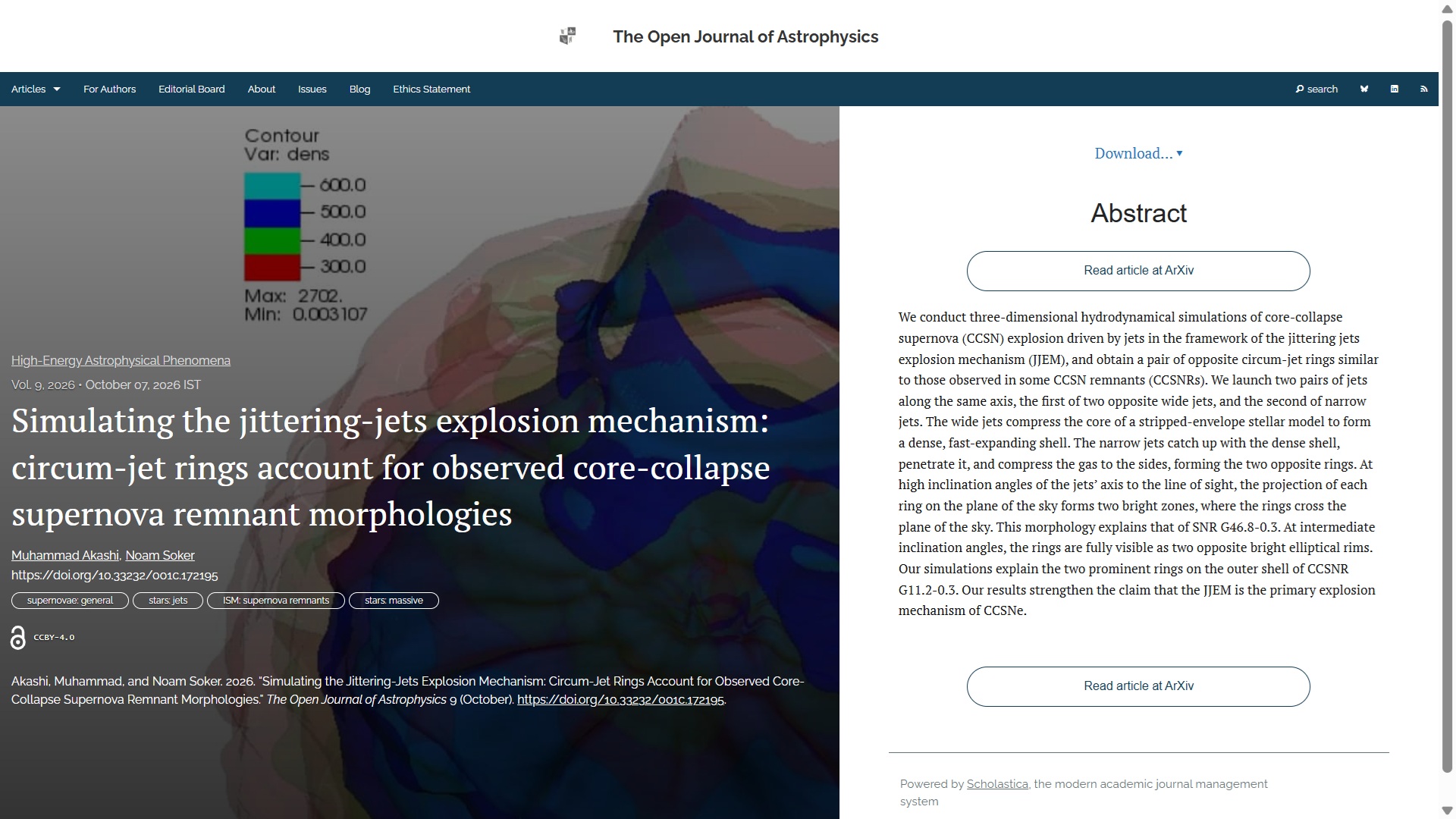
You can find the officially accepted version on arXiv here and the Mastodon announcement is here:
New Publication at the Open Journal of Astrophysics: "Ultra-long Gamma-ray Bursts from Micro-Tidal Disruption Events: The Case of GRB 250702B" by Paz Beniamini (Open University, IL), Hagai B. Perets (Technion, IL) and Jonathan Granot (Open University, IL)
And that concludes this week’s update. I will do another next Saturday, by which time I expect we will have published a similar number of papers to this week.
It’s Saturday once more so time for another update of activity at the Open Journal of Astrophysics. Since the last update we have published a further six papers, bringing the number in Volume 9 (2026) to 24 and the total so far published by OJAp up to 472.
I will continue to include the posts made on our Mastodon account (on Fediscience) to encourage you to visit it. Mastodon is a really excellent service, and a more than adequate replacement for X/Twitter which nobody should be using; these announcement also show the DOI for each paper.
The first paper to report this week is “The Impact of Star Formation and Feedback Recipes on the Stellar Mass and Interstellar Medium of High-Redshift Galaxies” by Harley Katz (U. Chicago, USA), Martin P. Rey (U. Oxford, UK), Corentin Cadiou (Lund U., Sweden) Taysun Kimm (Yonsei U., Korea) and Oscar Agertz (Lund). This paper was published on Monday 2nd February 2026 in the folder Astrophysics of Galaxies. It introduces MEGATRON, a new model for galaxy formation simulations, highlighting that feedback energy controls star formation at high redshift and highlighting the importance of the interstellar medium.
The overlay is here:
You can find the officially accepted version on arXiv here and the announcement on Fediverse here:
New Publication at the Open Journal of Astrophysics: "The Impact of Star Formation and Feedback Recipes on the Stellar Mass and Interstellar Medium of High-Redshift Galaxies" by Harley Katz (U. Chicago, USA), Martin P. Rey (U. Oxford, UK), Corentin Cadiou (Lund U., Sweden) Taysun Kimm (Yonsei U., Korea) and Oscar Agertz (Lund)
The second paper is “Photometric Redshifts in JWST Deep Fields: A Pixel-Based Alternative with DeepDISC” by Grant Merz (U. Illinois at Urbana-Champaign) and 6 others, all based in the USA. This paper was published on Monday February 2nd 2026 in the folder Instrumentation and Methods for Astrophysics. This paper explores the effectiveness of the DeepDISC machine learning algorithm in estimating photometric redshifts from near-infrared data, demonstrating its potential for larger image volumes and spectroscopic samples
The overlay for this one is here:
The official version of the paper can be found on arXiv here and the Fediverse announcement here:
New Publication at the Open Journal of Astrophysics: "Photometric Redshifts in JWST Deep Fields: A Pixel-Based Alternative with DeepDISC" by Grant Merz (U. Illinois at Urbana-Champaign) and 6 others, all based in the USA
Next, published on Wednesday 4th February in the folder Astrophysics of Galaxies, is “Inferring Interstellar Medium Density, Temperature, and Metallicity from Turbulent H II Regions” by Larrance Xing (U. Chicago, USA), Nicholas Choustikov (U. Oxford, UK), Harley Katz (U. Chicago) and Alex J. Cameron (DAWN, Denmark). This paper argues that supersonic turbulenc affects the interpretation of H II region properties, potentially impacting inferred metallicity, ionization, and excitation from in nebular emission lines, motivating more extensive modelling.
The overlay is here:
The official version can be found on arXiv here and the Fediverse announcement is here:
New Publication at the Open Journal of Astrophysics: "Inferring Interstellar Medium Density, Temperature, and Metallicity from Turbulent H II Regions" by Larrance Xing (U. Chicago, USA), Nicholas Choustikov (U. Oxford, UK), Harley Katz (U. Chicago) and Alex J. Cameron (DAWN, Denmark)
The fourth paper this week, also published on Wednesday 4th February, but in the folder Solar and Stellar Astrophysics, is “A Systematic Search for Big Dippers in ASAS-SN” by B. JoHantgen, D. M. Rowan, R. Forés-Toribio, C. S. Kochanek, & K. Z. Stanek (Ohio State University, USA), B. J. Shappee (U. Hawaii, USA), Subo Dong (Peking University), J. L. Prieto Universidad Diego Portales, Chile) and Todd A. Thompson (Ohio State). This study identifies 4 new dipper stars and 15 long-period eclipsing binary candidates using ASAS-SN light curves and multi-wavelength data, categorizing them based on their characteristics.
Here is the overlay:
The official version can be found on arXiv here and the Fediverse announcement is here:
New Publication at the Open Journal of Astrophysics: "A Systematic Search for Big Dippers in ASAS-SN" by B. JoHantgen , D. M. Rowan, R. Forés-Toribio, C. S. Kochanek, & K. Z. Stanek (Ohio State University, USA), B. J. Shappee (U. Hawaii, USA), Subo Dong (Peking University), J. L. Prieto Universidad Diego Portales, Chile) and Todd A. Thompson (Ohio State)
Fifth, and next to last this week we have “Unveiling the drivers of the Baryon Cycles with Interpretable Multi-step Machine Learning and Simulations” by Mst Shamima Khanom, Benjamin W. Keller and Javier Ignacio Saavedra Moreno (U. Memphis, USA). This paper was published on Thursday 5th February 2026 in the folder Astrophysics of Galaxies. This study uses machine learning methods to understand how galaxies lose or retain baryons, highlighting the relationship between baryon fraction and various galactic measurements.
The overlay is here:
The accepted version can be found on arXiv here, and the fediverse announcement is here:
New Publication at the Open Journal of Astrophysics: "Unveiling the drivers of the Baryon Cycles with Interpretable Multi-step Machine Learning and Simulations" by Mst Shamima Khanom, Benjamin W. Keller and Javier Ignacio Saavedra Moreno (U. Memphis, USA)
Finally for this week we have “The Bispectrum of Intrinsic Alignments: II. Precision Comparison Against Dark Matter Simulations” by Thomas Bakx (Utrecht U., Netherlands), Toshiki Kurita (MPA Garching, Germany), Alexander Eggemeier (U. Bonn, Germany), Nora Elisa Chisari (Utrecht) and Zvonimir Vlah (Ruđer Bošković Institute, Croatia). This paper was accepted in December, but publication got delayed by the Christmas effect so was published on February 6th 2026, in the folder Cosmology and Nongalactic Astrophysics. This study uses N-body simulations to accurately measure three-dimensional bispectra of halo intrinsic alignments and dark matter overdensities, providing a method to determine higher order shape bias parameters.
The overlay is here:
You can find the published version of the article here, and the Mastodon announcement is here:
New Publication at the Open Journal of Astrophysics: "The Bispectrum of Intrinsic Alignments: II. Precision Comparison Against Dark Matter Simulations" by Thomas Bakx (Utrecht U., Netherlands), Toshiki Kurita (MPA Garching, Germany), Alexander Eggemeier (U. Bonn, Germany), Nora Elisa Chisari (Utrecht) and Zvonimir Vlah (Ruđer Bošković Institute, Croatia)
It’s Saturday once more so time for another update of activity at the Open Journal of Astrophysics. Since the last update we have published a further three papers, bringing the number in Volume 9 (2026) to 14 and the total so far published by OJAp up to 462. This week was slightly affected by a Federal holiday in the USA on January 19th; there were no arXiv announcements the following day.
I will continue to include the posts made on our Mastodon account (on Fediscience) to encourage you to visit it. Mastodon is a really excellent service, and a more than adequate replacement for X/Twitter which nobody should be using.
The first paper to report this week is “The Properties of Little Red Dot Galaxies in the ASTRID Simulation” by Patrick LaChance, Rupert A. C. Croft, Tiziana Di Matteo & Yihao Zhou (Carnegie Mellon U.), Fabio Pacucci (Harvard-Smithsonian CfA), Yueying Ni (U. Michigan Ann Arbor), Nianyi Chen (Princeton U.) and Simeon Bird (UC Riverside), all based in the USA. This paper was published on Monday 19th January 2026 in the folder Cosmology and Nongalactic Astrophysics; the study analyses mock observations of “Little Red Dot” galaxies created from the ASTRID simulation, having high stellar masses and containing massive black holes; not all features match real observations.
The overlay is here:
You can find the officially accepted version on arXiv here and the announcement on Fediverse here:
New Publication at the Open Journal of Astrophysics; "The Properties of Little Red Dot Galaxies in the ASTRID Simulation" by Patrick LaChance, Rupert A. C. Croft, Tiziana Di Matteo & Yihao Zhou (Carnegie Mellon U.), Fabio Pacucci (Harvard-Smithsonian CfA), Yueying Ni (U. Michigan Ann Arbor), Nianyi Chen (Princeton U.) and Simeon Bird (UC Riverside), all based in the USA
The second paper is “Angular bispectrum of matter number counts in cosmic structures” by Thomas Montandon (U. Montpellier, France), Enea Di Dio (U. Genève, Switzerland), Cornelius Rampf (Ruđer Bošković Institute, Croatia) and Julian Adamek (U. Zürich, Switzerland). This was published on Wednesday January 21st, also in the folder Cosmology and Nongalactic Astrophysics. This paper presents thee first full-sky computation of the angular bispectrum in second-order perturbation theory, offering insights into the Universe’s initial conditions, gravity, and cosmological parameters. The results align well with simulations.
The overlay for this one is here:
The official version of the paper can be found on arXiv here and the Fediverse announcement here:
New Publication at the Open Journal of Astrophysics: "Angular bispectrum of matter number counts in cosmic structures" by Thomas Montandon (U. Montpellier, France), Enea Di Dio (U. Genève, Switzerland), Cornelius Rampf (Ruđer Bošković Institute, Croatia) and Julian Adamek (U. Zürich, Switzerland)
Next, and last for this week, we have “The Kinematic Properties of TŻO Candidate HV 11417 with Gaia DR3” by Anna J. G. O’Grady (Carnegie Mellon University, USA). This was published on Wednesday 21st January 2026 in the folder Solar and Stellar Astrophysics. This work uses updated data to confirm that HV 11417, a potential Thorne-Żytkow Object, is probably part of the Small Magellanic Cloud and qualifies as a runaway star.
The overlay is here:
The official version can be found on arXiv here and the Fediverse announcement is here:
New Publication at the Open Journal of Astrophysics: "The Kinematic Properties of TŻO Candidate HV 11417 with Gaia DR3" by Anna J. G. O'Grady (Carnegie Mellon University, USA)
It’s time once again for the usual Saturday morning update of the week’s new papers at the Open Journal of Astrophysics. Since the last update we have published a further five papers, which brings the number in Volume 8 (2025) up to 195, and the total so far published by OJAp up to 430.
The first paper this week is “Cosmic Rays Masquerading as Cool Cores: An Inverse-Compton Origin for Cool Core Cluster Emission” by Philip F. Hopkins (Caltech), Eliot Quataert (Princeton), Emily M. Silich, Jack Sayers, Sam B. Ponnada and Isabel S. Sands (Caltech). This was published on Tuesday 9th December 2025 in the folder marked High-Energy Astrophysical Phenomena. It presents an argument that cosmic-ray inverse-compton emission could contribute significantly to the X-ray surface brightness (SB) in cool-corre clusters, implying that gas densities may have been overestimated therein.
The overlay is here:
You can find the officially accepted version on arXiv here and the Fediverse announcement is here:
New Publication at the Open Journal of Astrophysics: "Cosmic Rays Masquerading as Cool Cores: An Inverse-Compton Origin for Cool Core Cluster Emission" by
Philip F. Hopkins (Caltech), Eliot Quataert (Princeton), Emily M. Silich, Jack Sayers, Sam B. Ponnada and Isabel S. Sands (Caltech)
New Publication at the Open Journal of Astrophysics: "Detecting False Positives With Derived Planetary Parameters: Experimenting with the KEPLER Dataset" by Ayan Bin Rafaih (Aitchison College, Lahore, Pakistan) and Zachary Murray (Université Côte d’Azur, France)
New Publication at the Open Journal of Astrophysics: "The role of peculiar velocity uncertainties in standard siren cosmology" by Chris Blake and Ryan J. Turner (Swinburne, Australia)
The fourth article of the week is “Transient QPOs of Fermi-LAT blazars with Linearly Multiplicative Oscillations” by P. Penil (Clemson University, USA) and 7 others based in the USA, Italy and Germany. This was published on Thursday 10th December in the folder High-Energy Astrophysical Phenomena. This paper presents an investigation of patterns of quasi-periodic oscillations in observed blazar systems characterized by periodic multiplicative amplitudes including both the periodicities and long-term variations. The overlay is here:
You can find the official published version on arXiv here. The Fediverse announcement follows:
New Publication at the Open Journal of Astrophysics: "Transient QPOs of Fermi-LAT blazars with Linearly Multiplicative Oscillations" by P. Penil (Clemson University, USA) and 7 others based in the USA, Italy and Germany
The last paper for this week is “Tidally Delayed Spin-Down of Very Low Mass Stars” by Ketevan Kotorashvili and Eric G. Blackman (U. Rochester, USA). This was published on Friday 12th December (yesterday) in the folder Solar and Stellar Astrophysics. It discusses the effect of tides from sub-stellar companions on rotational evolution of very low-mass stars, suggesting that these may explain the dearth of field, late-type M dwarfs with intermediate rotation periods.
The overlay is here:
You can find the officially-accepted version on arXiv here, and the Mastodon announcement is here:
New Publication at the Open Journal of Astrophysics: "Tidally Delayed Spin-Down of Very Low Mass Stars" by Ketevan Kotorashvili and Eric G. Blackman (U. Rochester, USA)
And that concludes the update for this week. I will do another of these regular announcements next Saturday, which will be the last such update for 2025. Will we make it past 200 for the year? Tune in next week to find out!
It’s time once again for the usual Saturday update of the week’s new papers at the Open Journal of Astrophysics (although a bit later in the day than usual). Since the last update we have published another two papers, which brings the number in Volume 8 (2025) up to 163, and the total so far published by OJAp up to 398.
The first paper this week is “Instability and vertical eccentricity variation in global hydrodynamic disk simulations” by Janosz W Dewberry (U. Mass. Amherst, USA), Henrik N. Latter and Gordon I. Ogilvie (U. Cambridge, UK) and Sebastien Fromang (U. Paris Saclay, France). This article was published in the folder Solar and Stellar Astrophysics on Tuesday 28th October 2025; it discusses the instabilities and eccentricity variations generated in numerical hydrodynamic simulations of accretion disks.
The overlay is here:
You can find the officially accepted version on arXiv here.
New Publication at the Open Journal of Astrophysics: "Instability and vertical eccentricity variation in global hydrodynamic disk simulations" by Janosz W Dewberry (U. Mass. Amherst, USA), Henrik N Latter and Gordon I Ogilvie (U. Cambridge, UK) & Sebastien Fromang (U. Paris Saclay, France)
The second (and last) paper of the week is “Fast X-ray Transient Detection with AXIS: application to Magnetar Giant Flares” by Michela Negro (Louisiana State University, USA) and 8 others based in the USA and Canada. This one was also published on Tuesday 28th October, but in the folder High-Energy Astrophysical Phenomena. It presents a feasibility study of detecting Magnetar Giant Flares with the Advanced X-ray Imaging Satellite (AXIS). The overlay is here:
You can find the official version of this one on arXiv here. The announcement on Mastodon is here:
New Publication at the Open Journal of Astrophysics: "Fast X-ray Transient Detection with AXIS: application to Magnetar Giant Flares" by Michela Negro (Louisiana State University, USA) and 8 others based in the USA and Canada
It being a relatively slow week we didn’t reach the 400 mark as I thought we might, but we will probably get there next week. After 10 months of the year 2025, in which we have published 163 papers, a rough projection for the 2025 total is 195. We do have some extra papers up our sleeve, however, so we might well reach 200 for the year. We will find out soon enough!
The views presented here are personal and not necessarily those of my employer (or anyone else for that matter).
Feel free to comment on any of the posts on this blog but comments may be moderated; anonymous comments and any considered by me to be vexatious and/or abusive and/or defamatory will not be accepted. I do not necessarily endorse, support, sanction, encourage, verify or agree with the opinions or statements of any information or other content in the comments on this site and do not in any way guarantee their accuracy or reliability.