It’s time once more for another Saturday update of activity at the Open Journal of Astrophysics. Since the last update we have published a further seven papers, bringing the number in Volume 9 (2026) to 209 and the total so far published by OJAp up to 656. This is the second week running that we have published 7 papers.
I continue to include the posts made on our Mastodon account (on Fediscience); these announcements also contain a clickable form of the DOI for each paper. Our Mastodon account has regular updates and other announcements from OJAp too.
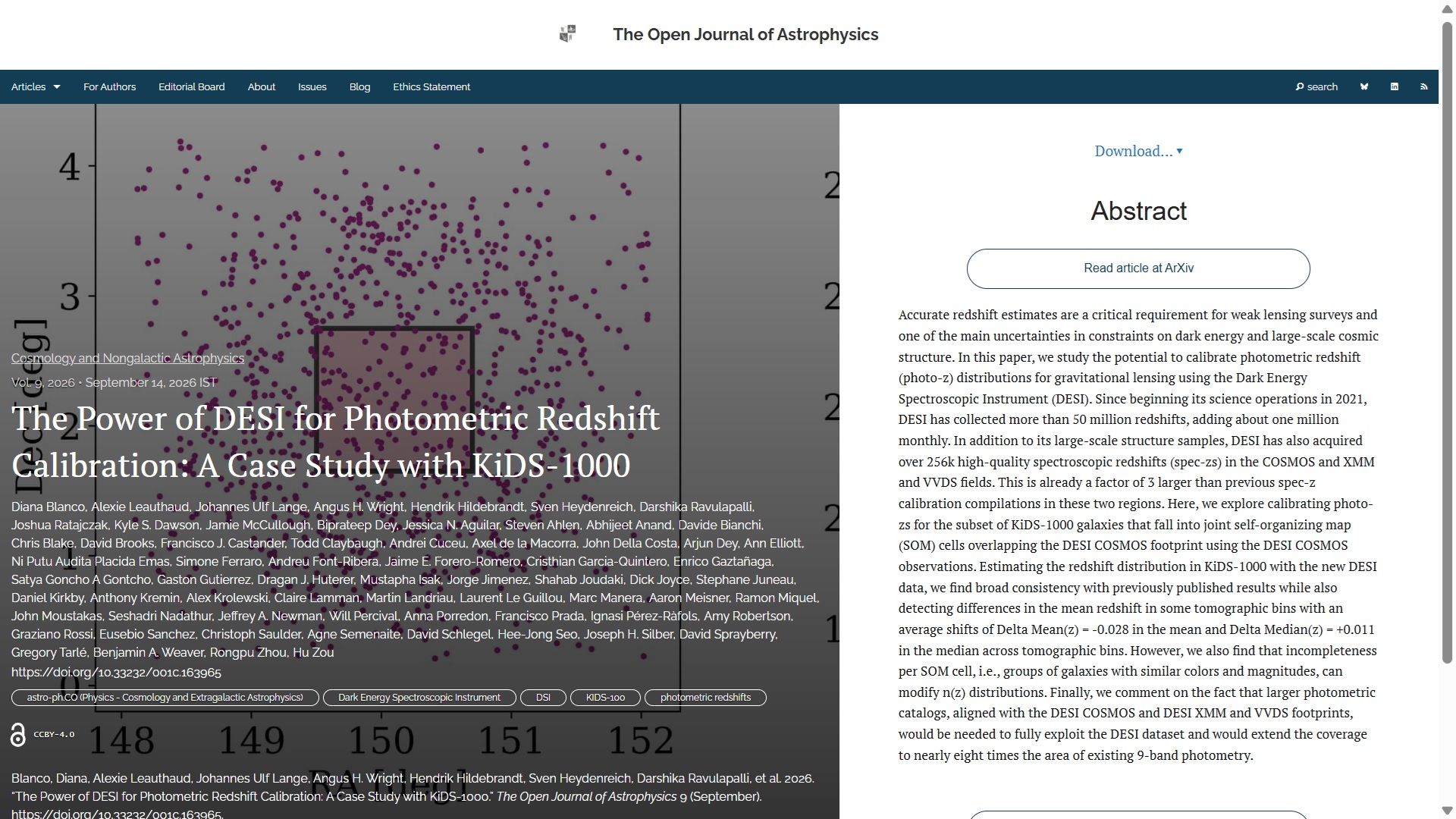
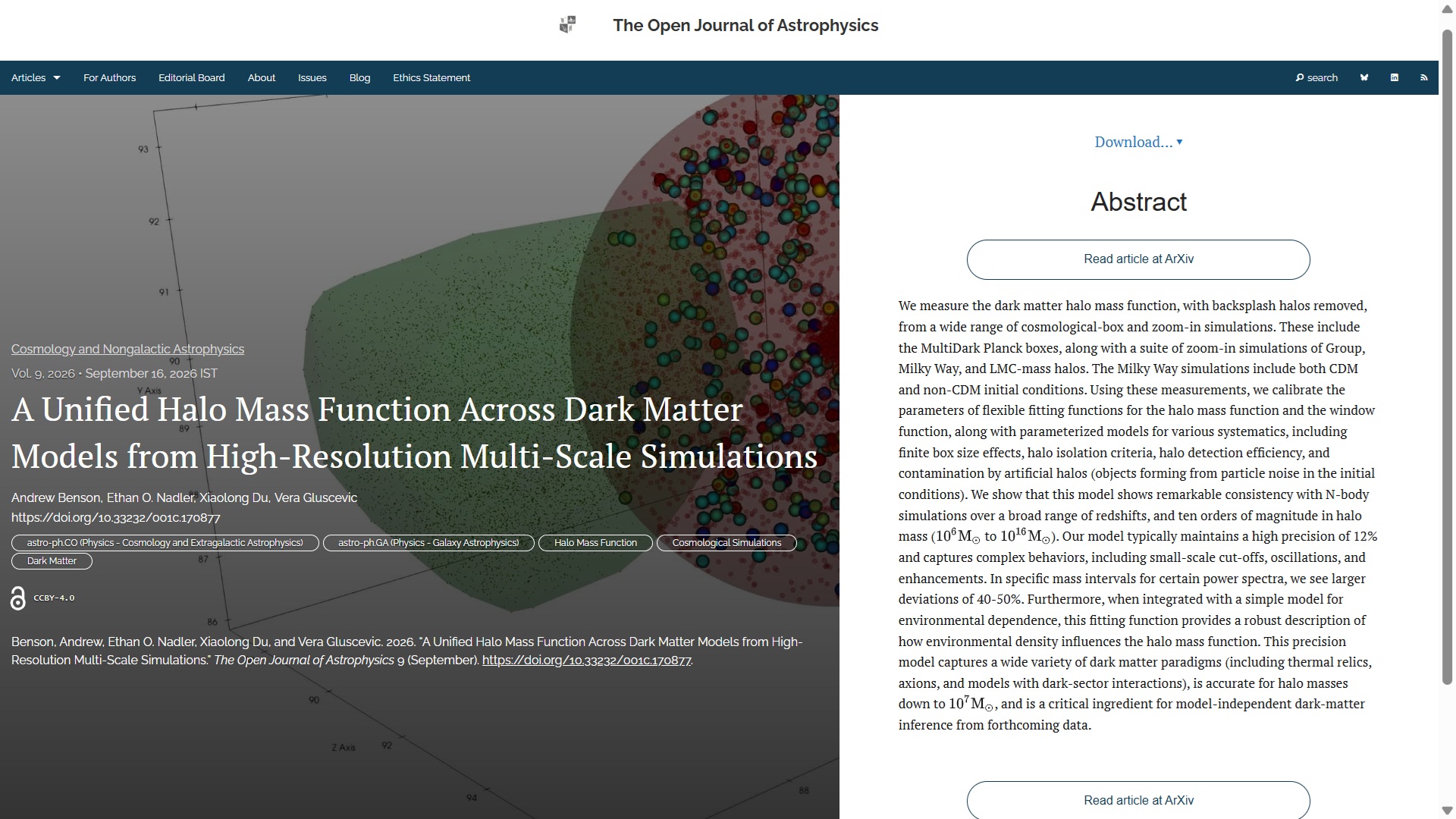
The first paper this week was published on Monday 14th September in the folder Cosmology and Nongalactic Astrophysics. The title is “The Power of DESI for Photometric Redshift Calibration: A Case Study with KiDS-1000” and it is by Diana Blanco (UC Santa Cruz, USA) and 66 others distributed internationally. This study explores using the Dark Energy Spectroscopic Instrument (DESI) to calibrate photometric redshift distributions for gravitational lensing, which could improve understanding of dark energy and cosmic structure. In fact this paper was ready for publication a few months ago, but the first author left for another job before putting the final version on arXiv so it took a while to finish it.
The overlay for this one is here:
You can find the officially accepted version on arXiv here and the announcement on Fediverse here:
New Publication at the Open Journal of Astrophysics: "The Power of DESI for Photometric Redshift Calibration: A Case Study with KiDS-1000" by Diana Blanco (UC Santa Cruz, USA) and 66 others distributed internationally.
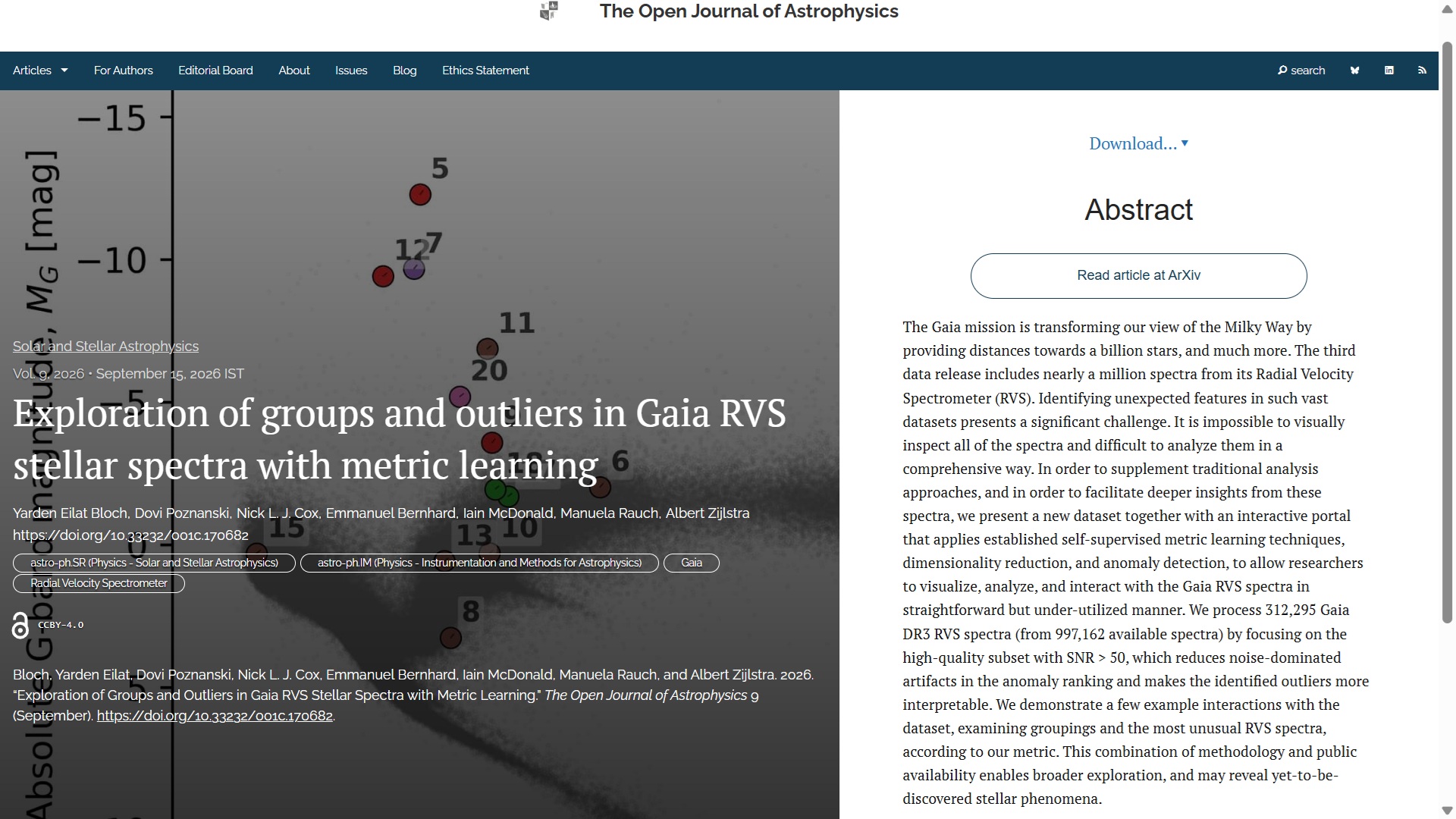
The second paper for this week, published on Tuesday 15th September in the folder Solar and Stellar Astrophysics, is “Exploration of groups and outliers in Gaia RVS stellar spectra with metric learning” by Yarden Eilat Bloch & Dovi Poznanski (Tel-Aviv U., Israel), Nick L. J. Cox & Emmanuel Bernhard (ACRI-ST, Grasse, France), Iain McDonald (U. Manchester, UK), Manuela Rauch (Know Center, GmbH, Graz, Austria), and Albert Zijlstra (Manchester). This article presents a new dataset and interactive portal that applies advanced techniques to analyze and visualize nearly a million spectra from the Gaia mission, potentially revealing undiscovered stellar phenomena.
The overlay looks like this:
The official version of the paper can be found on arXiv here and the Fediverse announcement here:
New Publication at the Open Journal of Astrophysics: "Exploration of groups and outliers in Gaia RVS stellar spectra with metric learning" by Yarden Eilat Bloch & Dovi Poznanski (Tel-Aviv U., Israel), Nick L. J. Cox & Emmanuel Bernhard (ACRI-ST, Grasse, France), Iain McDonald (U. Manchester, UK), Manuela Rauch (Know Center, GmbH, Graz, Austria), and Albert Zijlstra (Manchester)
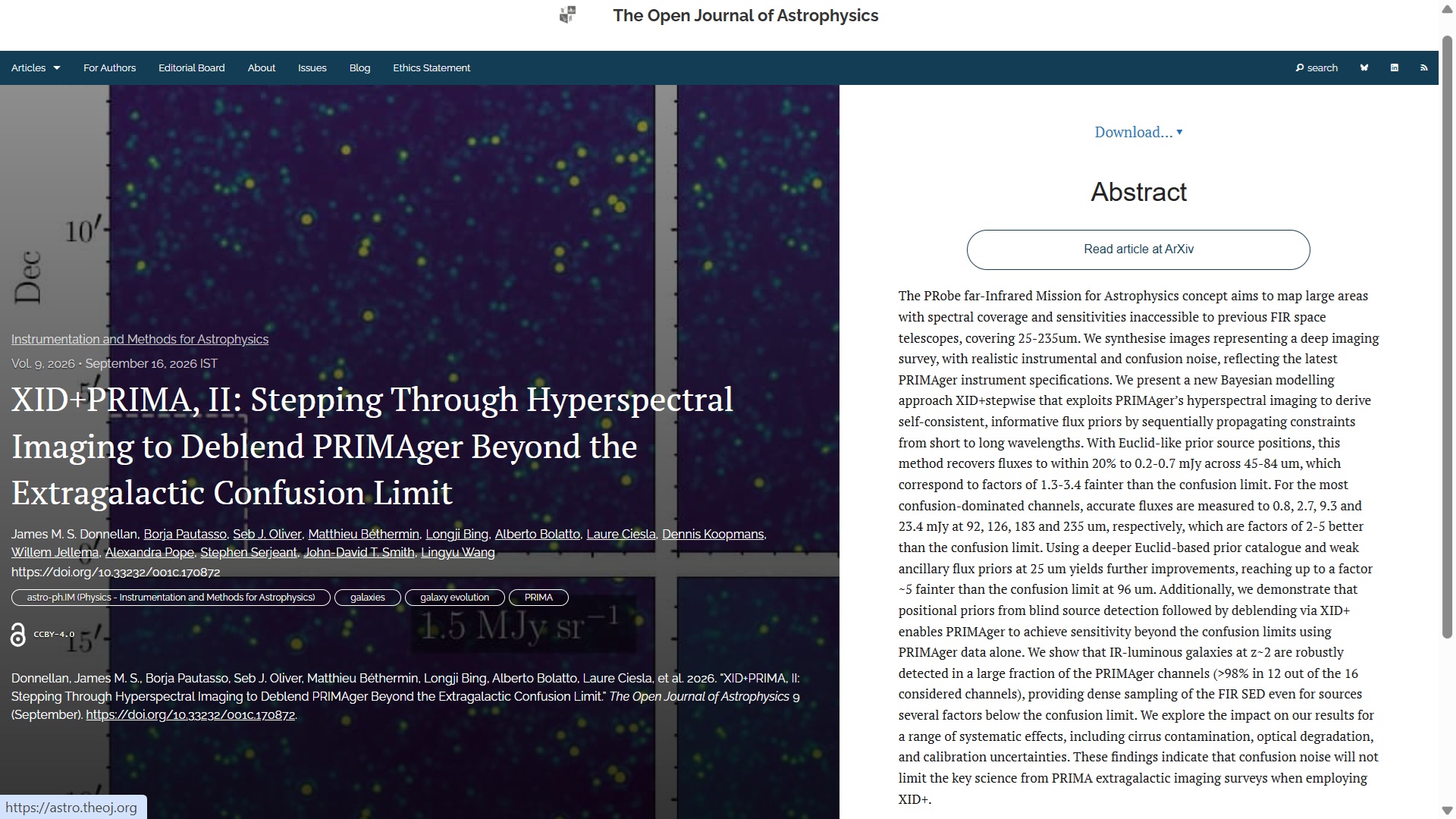
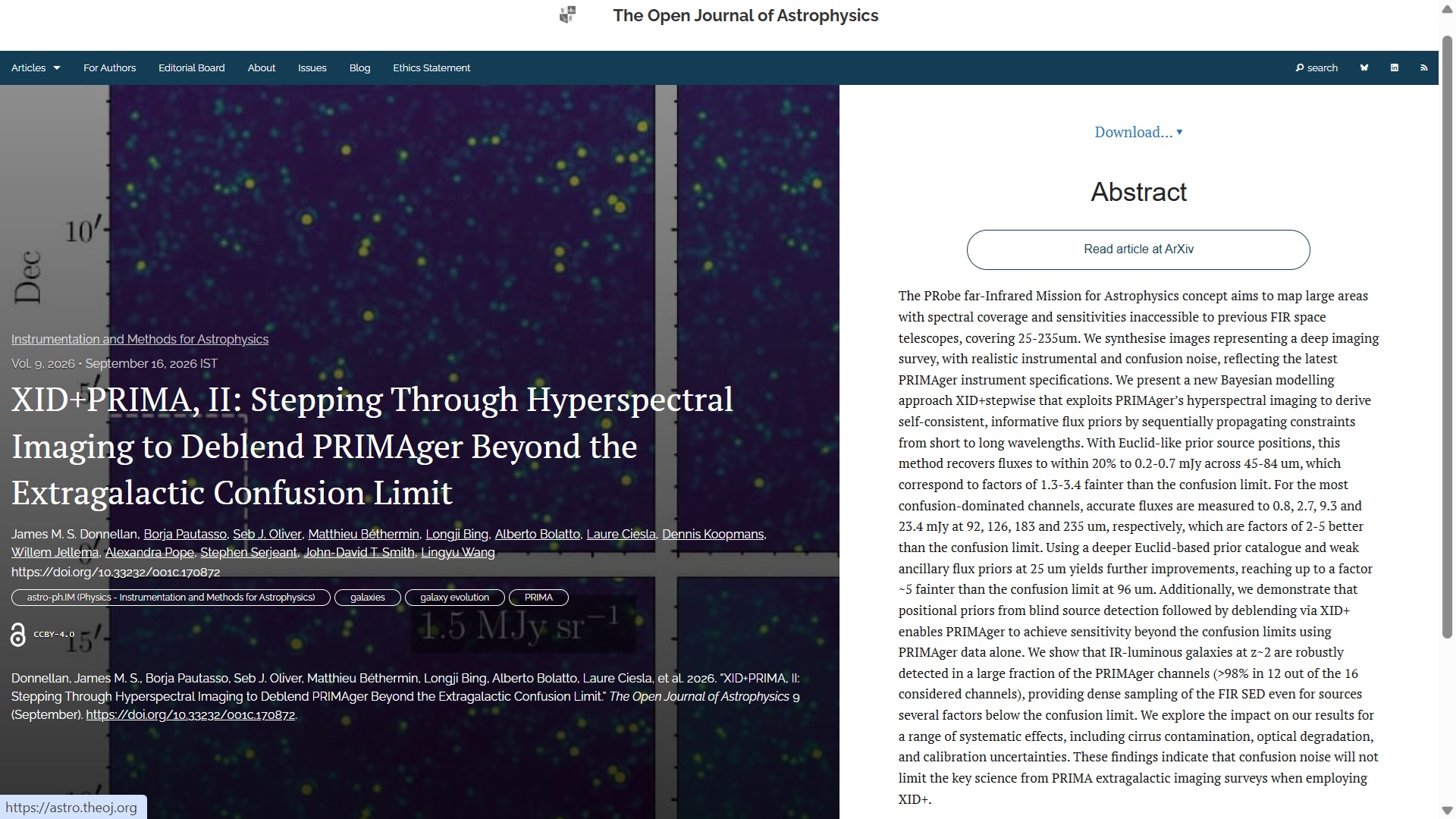
New Publication at the Open Journal of Astrophysics: "XID+PRIMA, II: Stepping Through Hyperspectral Imaging to Deblend PRIMAger Beyond the Extragalactic Confusion Limit" by James M. S. Donnellan (U. Sussex, UK) and 12 others based in the UK, France, USA, and The Netherlands
The fourth paper of the week, also published on Wednesday 16th September but in the folder Astrophysics of Galaxies is “The Curious Case of Centaurus A: On the Subject of the Quenched satellites” by Sachi Weerasooriya (Carnegie Obs., USA) and 8 others based in the USA and Canada. This study investigates the lack of luminous satellite galaxies in Centaurus A’s inner regions, suggesting that AGN-driven thermal feedback could suppress star formation, affecting the survival and evolution of satellites
The overlay is here:
The officially-accepted version of the paper can be found on arXiv here and the Fediverse announcement here:
New Publication at the Open Journal of Astrophysics: "The Curious Case of Centaurus A: On the Subject of the Quenched satellites" by Sachi Weerasooriya (Carnegie Obs., USA) and 8 others based in the USA and Canada
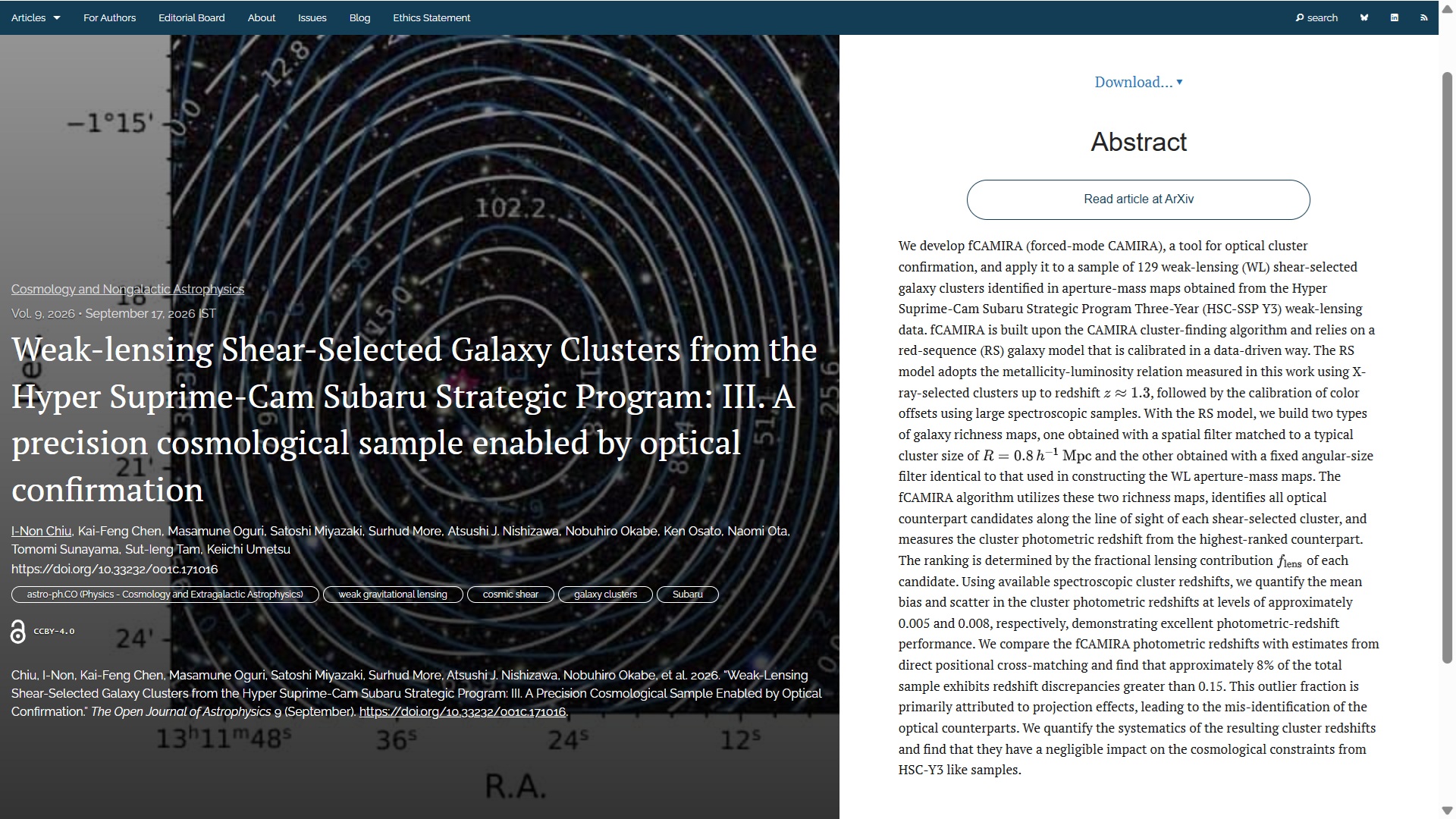
New Publication at the Open Journal of Astrophysics: "Weak-lensing Shear-Selected Galaxy Clusters from the Hyper Suprime-Cam Subaru Strategic Program: III. A precision cosmological sample enabled by optical confirmation" by I-Non Chiu (National Cheng Kung U., Taiwan) and 11 others from around the world.
Last, but by no means least, we have our seventh paper of the week: “The Cosmological Simulation Code OpenGadget3 – Implementation of Self-Interacting Dark Matter” by Moritz S. Fischer (Donastia International Physics Center, Spain) and 9 others based in Germany, Italy, USA , Sweden and Denmark. This was published on Friday 18th September (i.e. yesterday) in the folder Instrumentation and Methods for Astrophysics. This paper discusses the use of OpenGadget3, a tool for simulating self-interacting dark matter (SIDM), and highlights its capabilities, performance, and areas for improvement.
The overlay is here:
The final version of this paper is on the arXiv here and the Mastodon announcement here:
That concludes this week’s update. At the rate we’re going we could well reach 300 by the end of the year, but we’ll just have to wait and see about that. I’ll do another next weekend.
It’s time once more for another Saturday update of activity at the Open Journal of Astrophysics. Since the last update we have published a further seven papers, bringing the number in Volume 9 (2026) to 202 and the total so far published by OJAp up to 649. This means that the total in Vol. 9 (2026) has now passed that of Vol. 8 (2025), with more than three months to go.
I continue to include the posts made on our Mastodon account (on Fediscience); these announcements also contain a clickable form of the DOI for each paper. Our Mastodon account has regular updates and other announcements from OJAp too.
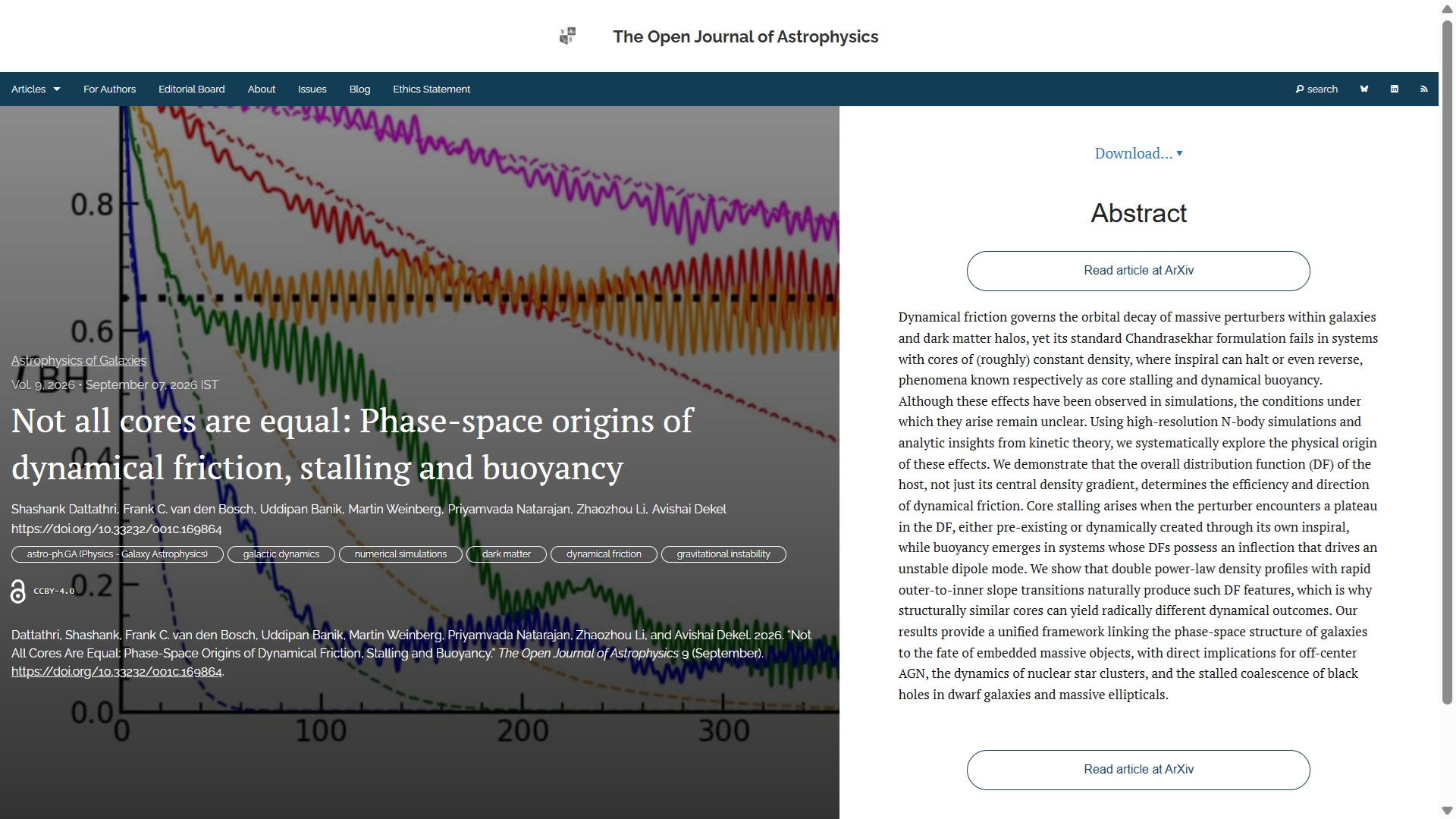
The first paper this week was published on Monday 7th September in the folder Astrophysics of Galaxies. The title is “Not all cores are equal: Phase-space origins of dynamical friction, stalling and buoyancy” and the authors are Shashank Dattathri & Frank C. van den Bosch (Yale U., USA), Uddipan Banik (Princeton U., USA), Martin Weinberg (U. Mass., USA), Priyamvada Natarajan (Yale U., USA), Zhaozhou Li (Nanjing U., China) and Avishai Dekel (The Hebrew U., Israel). The paper describes how the distribution function of a galaxy, not just its central density gradient, influences the efficiency and direction of dynamical friction, affecting the movement of massive objects within it.
The overlay is here:
You can find the officially accepted version on arXiv here and the announcement on Fediverse here:
New Publication at the Open Journal of Astrophysics: "Not all cores are equal: Phase-space origins of dynamical friction, stalling and buoyancy" by Shashank Dattathri & Frank C. van den Bosch (Yale U., USA), Uddipan Banik (Princeton U., USA), Martin Weinberg (U. Mass., USA), Priyamvada Natarajan (Yale U., USA), Zhaozhou Li (Nanjing U., China) and Avishai Dekel (The Hebrew U., Israel)
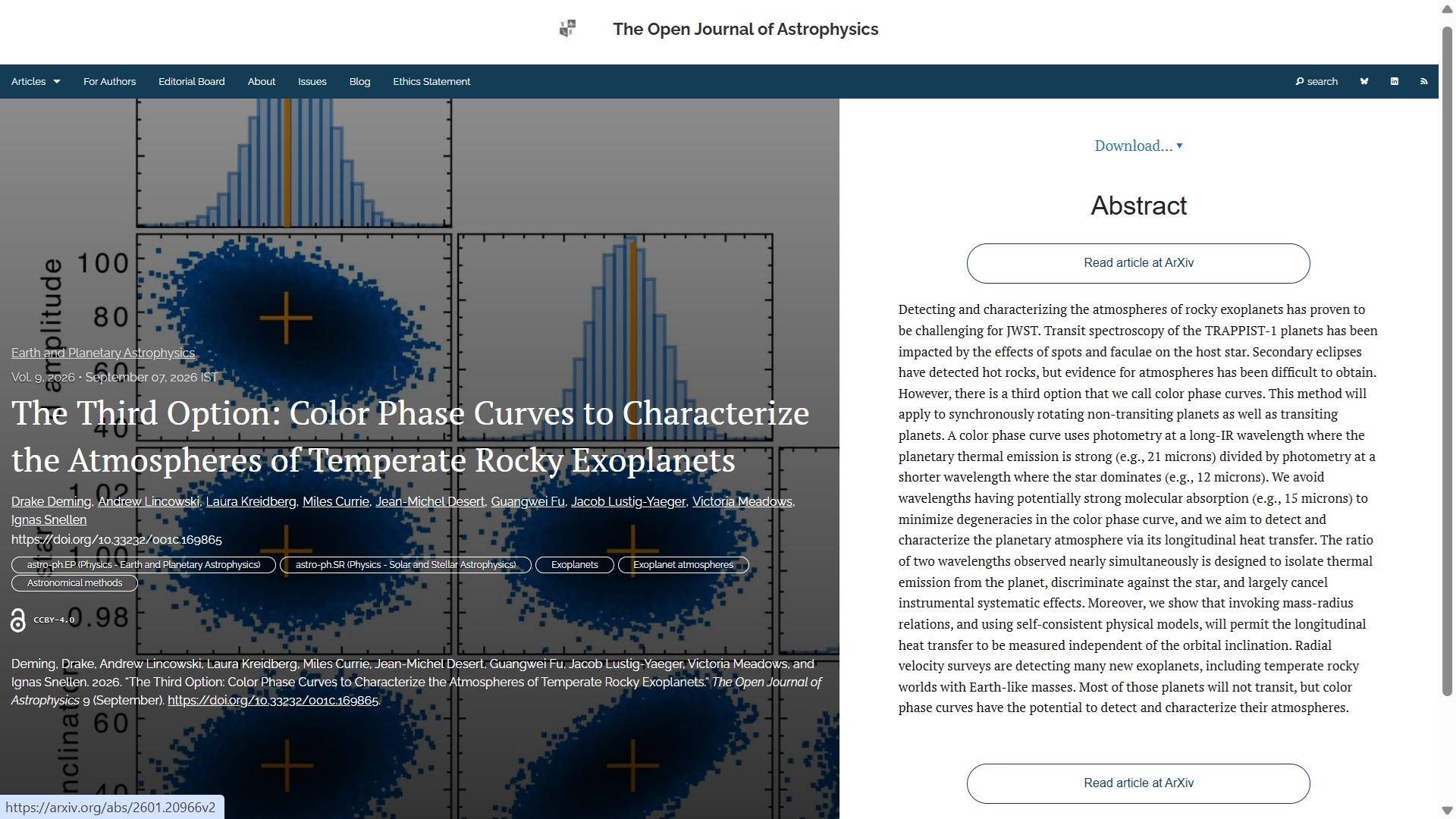
The second paper for this week, also published on Monday 7th September, but in the folder Earth and Planetary Astrophysics, is “The Third Option: Color Phase Curves to Characterize the Atmospheres of Temperate Rocky Exoplanets” by Drake Deming (U. Maryland, USA) and 8 others based in the USA, Germany and The Netherlands. This article presents a A spectroscopic survey of the Carousel lens galaxy cluster, identifying 12 lensed sources and 57 unlensed field galaxies. The findings could help constrain cosmological parameters and cluster properties.
The overlay looks like this:
The official version of the paper can be found on arXiv here and the Fediverse announcement here:
New Publication at the Open Journal of Astrophysics: "The Third Option: Color Phase Curves to Characterize the Atmospheres of Temperate Rocky Exoplanets" by Drake Deming (U. Maryland, USA) and 8 others based in the USA, Germany and The Netherlands.
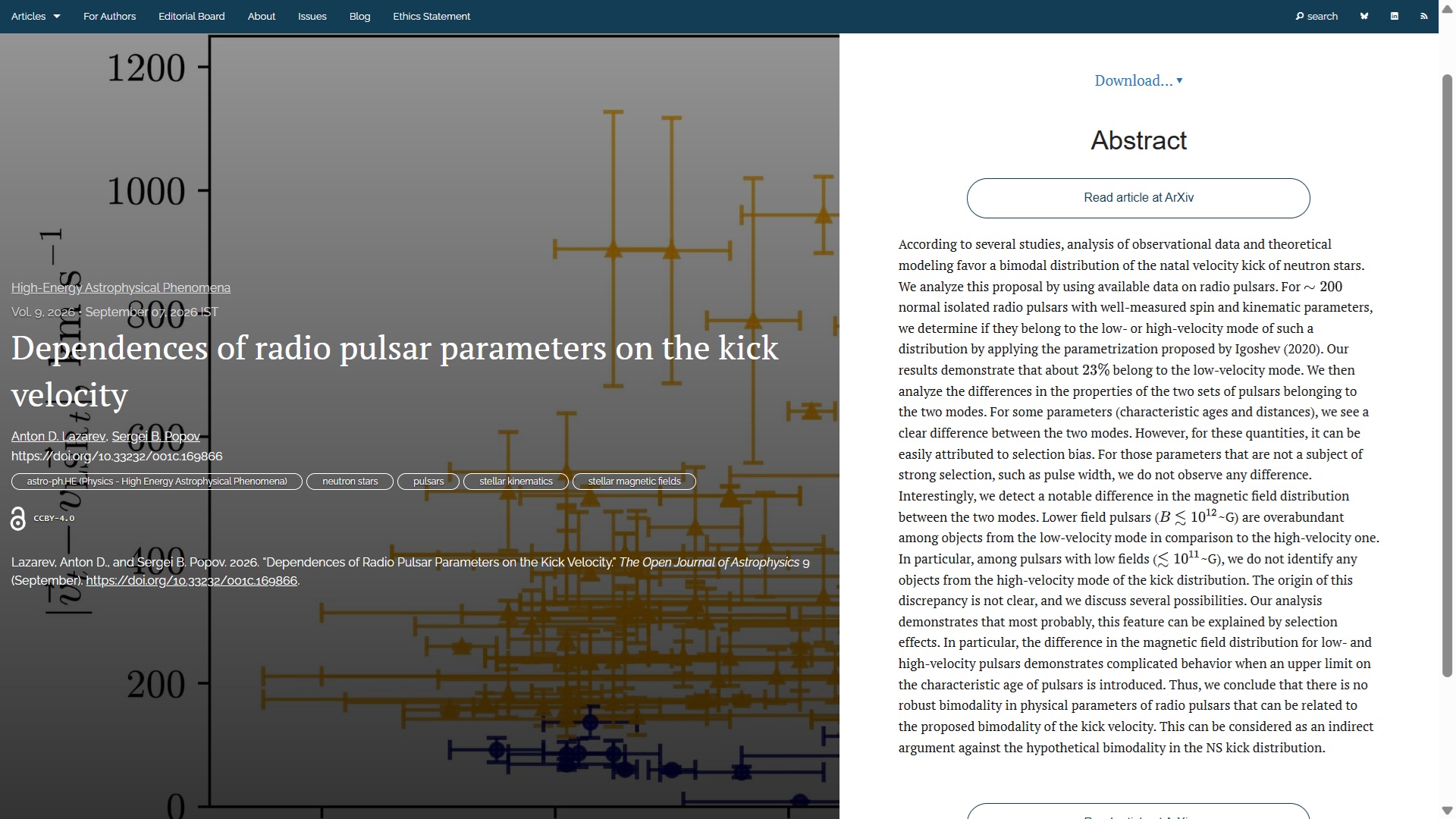
The third paper of the week, also published on Monday 7th September but in the folder High-Energy Astrophysical Phenomena, is “Dependences of radio pulsar parameters on the kick velocity” by Anton D. Lazarev and Sergei B. Popov (Moscow State U., Russia). This study analyzes the velocity kick of neutron stars, finding that 23% belong to the low-velocity mode. Differences in magnetic field distribution emerge, but no significant bimodality in physical parameters.
The overlay is here:
The official version of the paper can be found on arXiv here and the Fediverse announcement here:
New Publication at the Open Journal of Astrophysics: "Dependences of radio pulsar parameters on the kick velocity" by Anton D. Lazarev and Sergei B. Popov (Moscow State U., Russia)
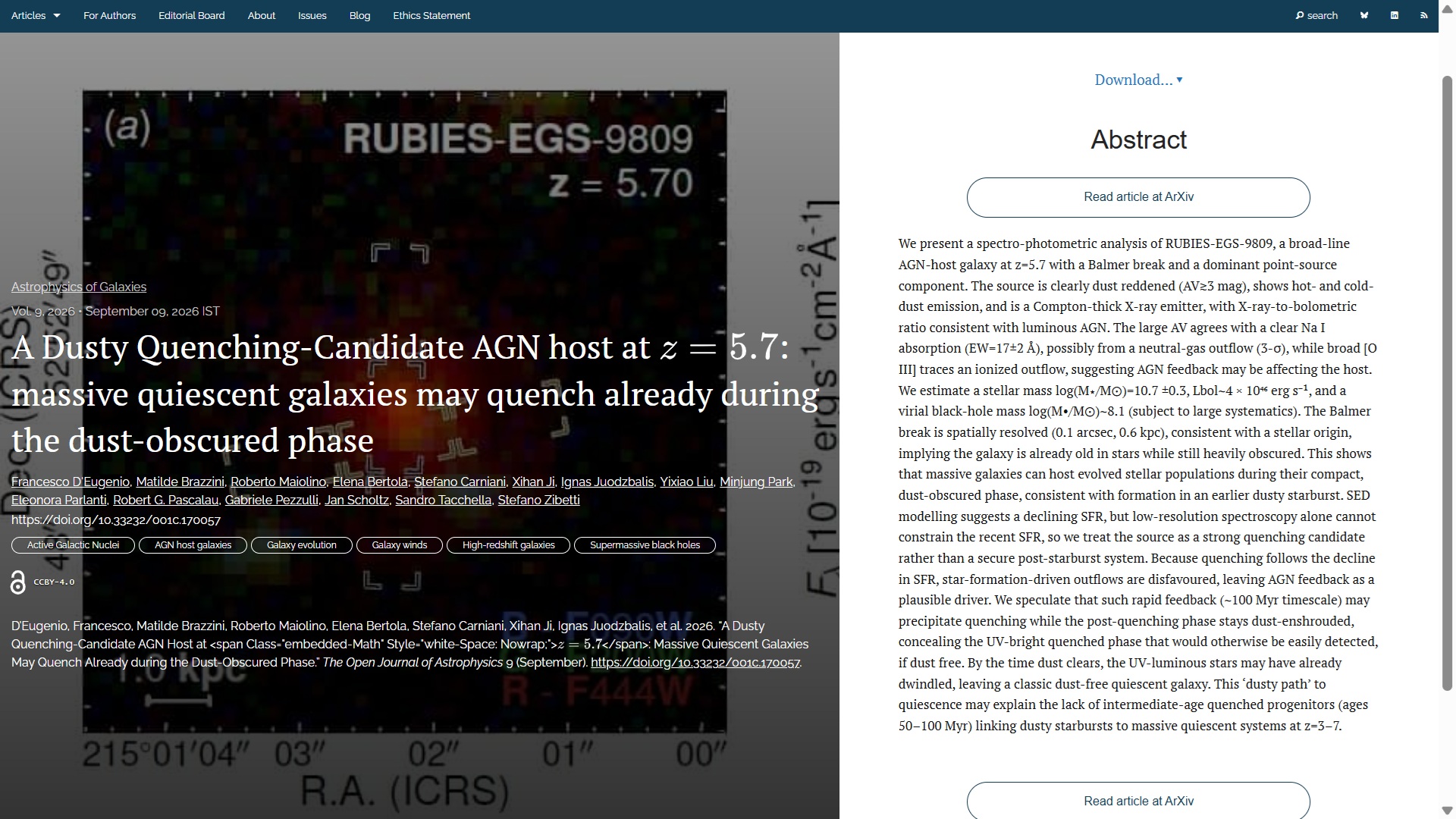
The fourth paper of the week is “A Dusty Quenching-Candidate AGN host at z=5.7: massive quiescent galaxies may quench already during the dust-obscured phase” by Francesco D’Eugenio (U. Cambridge, UK) and 14 others from the UK, Italy, China and The Netherlands. It was published on Wednesday 8th September in the folder Astrophysics of Galaxies. This article concerns RUBIES-EGS-9809, a dust-reddened galaxy with a dominant point-source component, suggests that AGN feedback may influence its host., indicating that massive galaxies can host evolved stellar populations during their dust-obscured phase.
The overlay is here:
The officially-accepted version of the paper can be found on arXiv here and the Fediverse announcement here:
New Publication at the Open Journal of Astrophysics: "A Dusty Quenching-Candidate AGN host at z=5.7: massive: quiescent galaxies may quench already during the dust-obscured phase" by Francesco D'Eugenio (U. Cambridge, UK) and 14 others from the UK, Italy, China and The Netherlands.
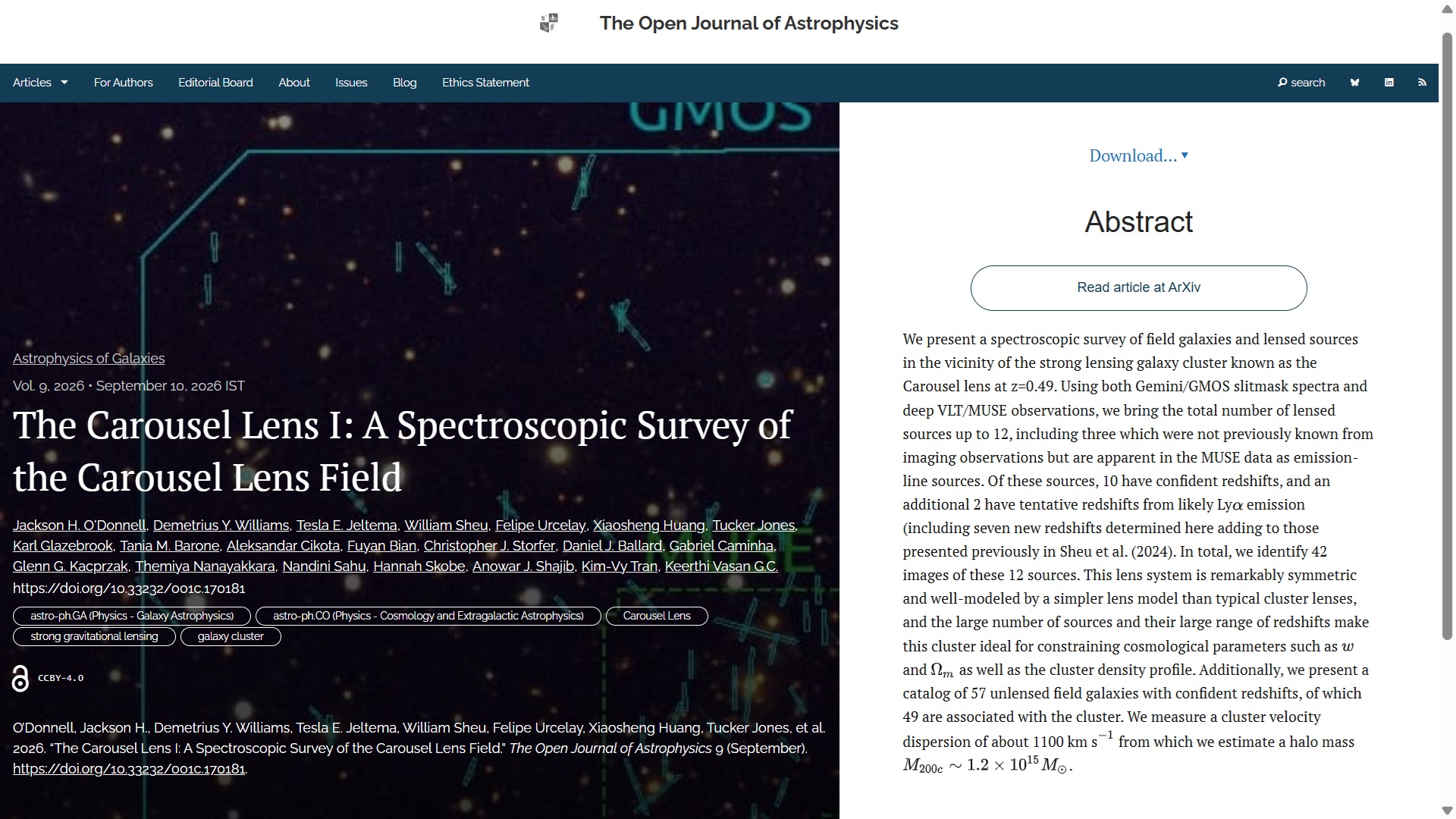
The fifth paper of the week is “The Carousel Lens I: A Spectroscopic Survey of the Carousel Lens Field” by Jackson H. O’Donnell (U.C. Santa Cruz, USA) and 22 others from around the world. This was published in the folder Astrophysics of Galaxies on Thursday 10th September 2026. This paper presents a spectroscopic survey of the Carousel lens galaxy cluster, identifying 12 lensed sources and 57 unlensed field galaxies. The findings could help constrain cosmological parameters and cluster properties.
The overlay for this one looks like this:
The officially-accepted version of this paper is on arXiv here and the Mastodon announcement on the fediverse here:
New Publication at the Open Journal of Astrophysics: "The Carousel Lens I: A Spectroscopic Survey of the Carousel Lens Field" by Jackson H. O'Donnell (U.C. Santa Cruz, USA) and 22 others from around the world.
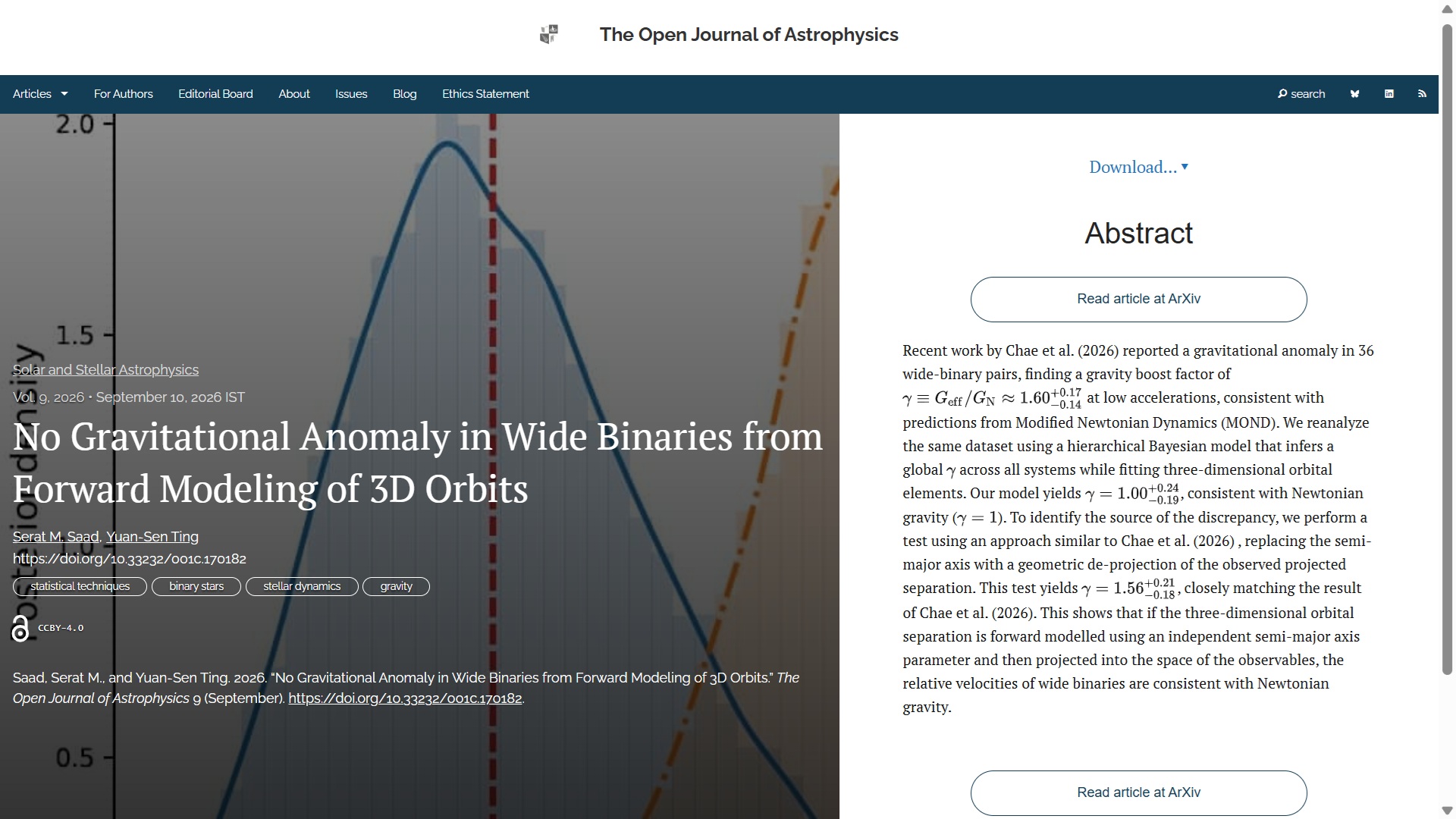
The penultimate, sixth, paper of the week is “No Gravitational Anomaly in Wide Binaries from Forward Modeling of 3D Orbits” by Serat M. Saad and Yuan-Sen Ting (Ohio State U., USA). This was also published on Thursday 10th September, but in the folder Solar and Stellar Astrophysics. The study reanalyzes a dataset on gravitational anomalies, finding results consistent with Newtonian gravity, contrary to previous findings that suggested Modified Newtonian Dynamics. The overlay for this one is here:
The officially accepted version is on arXiv here and the Mastodon announcement here:
New Publication at the Open Journal of Astrophysics: "No Gravitational Anomaly in Wide Binaries from Forward Modeling of 3D Orbits" by Serat M. Saad and Yuan-Sen Ting (Ohio State U., USA)
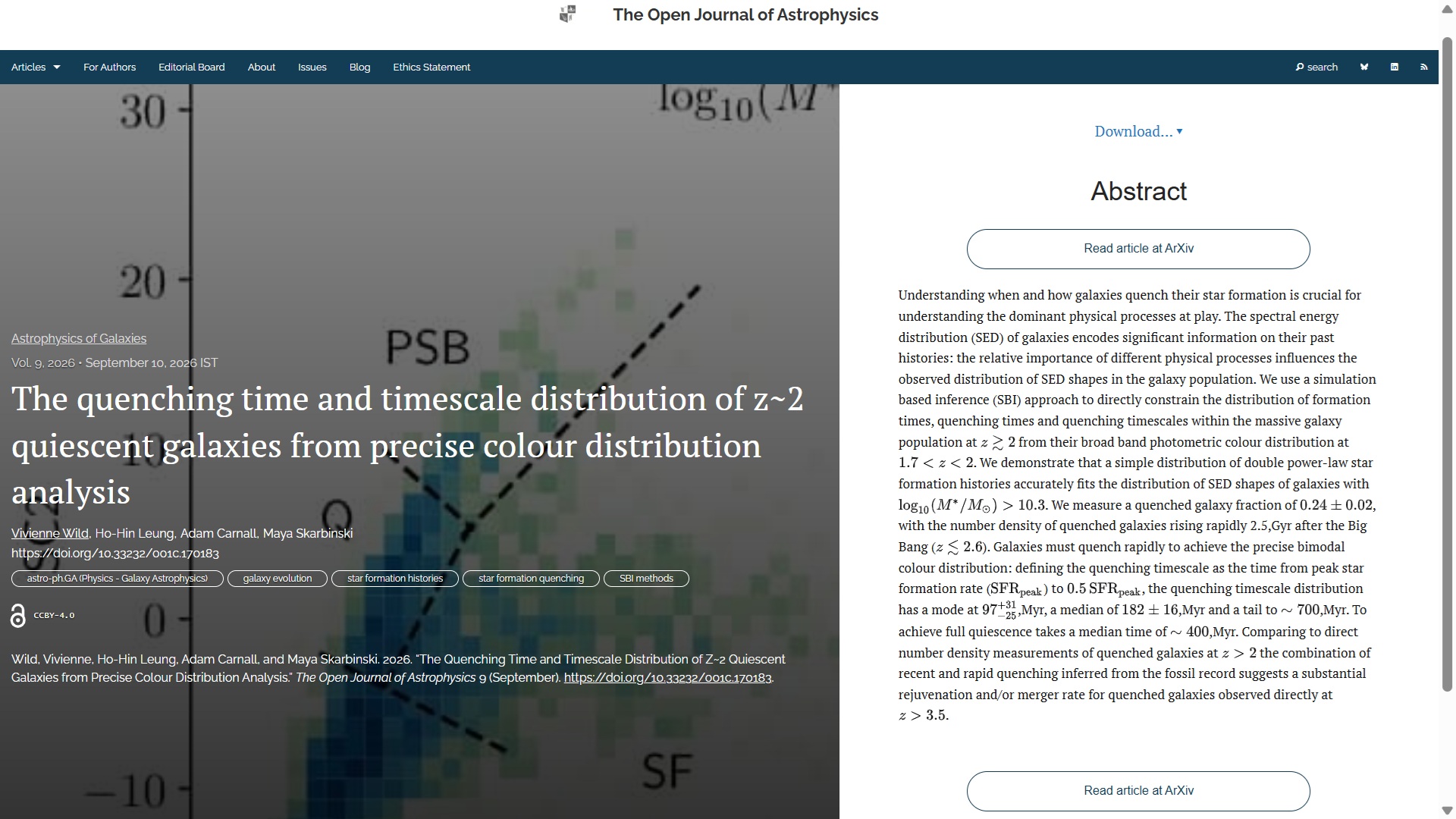
Last but by no means least we have “The quenching time and timescale distribution of z~2 quiescent galaxies from precise colour distribution analysis” by Vivienne Wild (U. St Andrews, UK), Ho-Hin Leung & Adam Carnal (U. Edinburgh, UK) and Maya Skarbinski (Johns Hopkins U., USA). This paper was published on Thursday 10th September in the folder Astrophysics of Galaxies. It describes a study that uses simulation-based inference to analyze galaxy formation and quenching times, revealing that galaxies must quench rapidly post-Big Bang to achieve a specific color distribution.
The overlay is here:
The final version of this paper is on the arXiv here and the Mastodon announcement here:
New Publication at the Open Journal of Astrophysics: "The quenching time and timescale distribution of z~2 quiescent galaxies from precise colour distribution analysis" by Vivienne Wild (U. St Andrews, UK), Ho-Hin Leung & Adam Carnal (U. Edinburgh, UK) and Maya Skarbinski (Johns Hopkins U., USA)
It is worth mentioning that there was one deferred arXiv mailing this week, due to the Labor Day holiday in the USA, so some papers were therefore published a day later than usual.
That concludes this week’s update. I’ll do another next weekend.
After a very busy week, it’s time once more for another Saturday update of activity at the Open Journal of Astrophysics. Since the last update we have published a further five papers, bringing the number in Volume 9 (2026) to 194 and the total so far published by OJAp up to 642. As explained at the end of this post, one of the five publications is a correction of an earlier paper.
I continue to include the posts made on our Mastodon account (on Fediscience); these announcements also show the DOI for each paper. The Mastodon account has regular updates and other announcements from OJAp too.
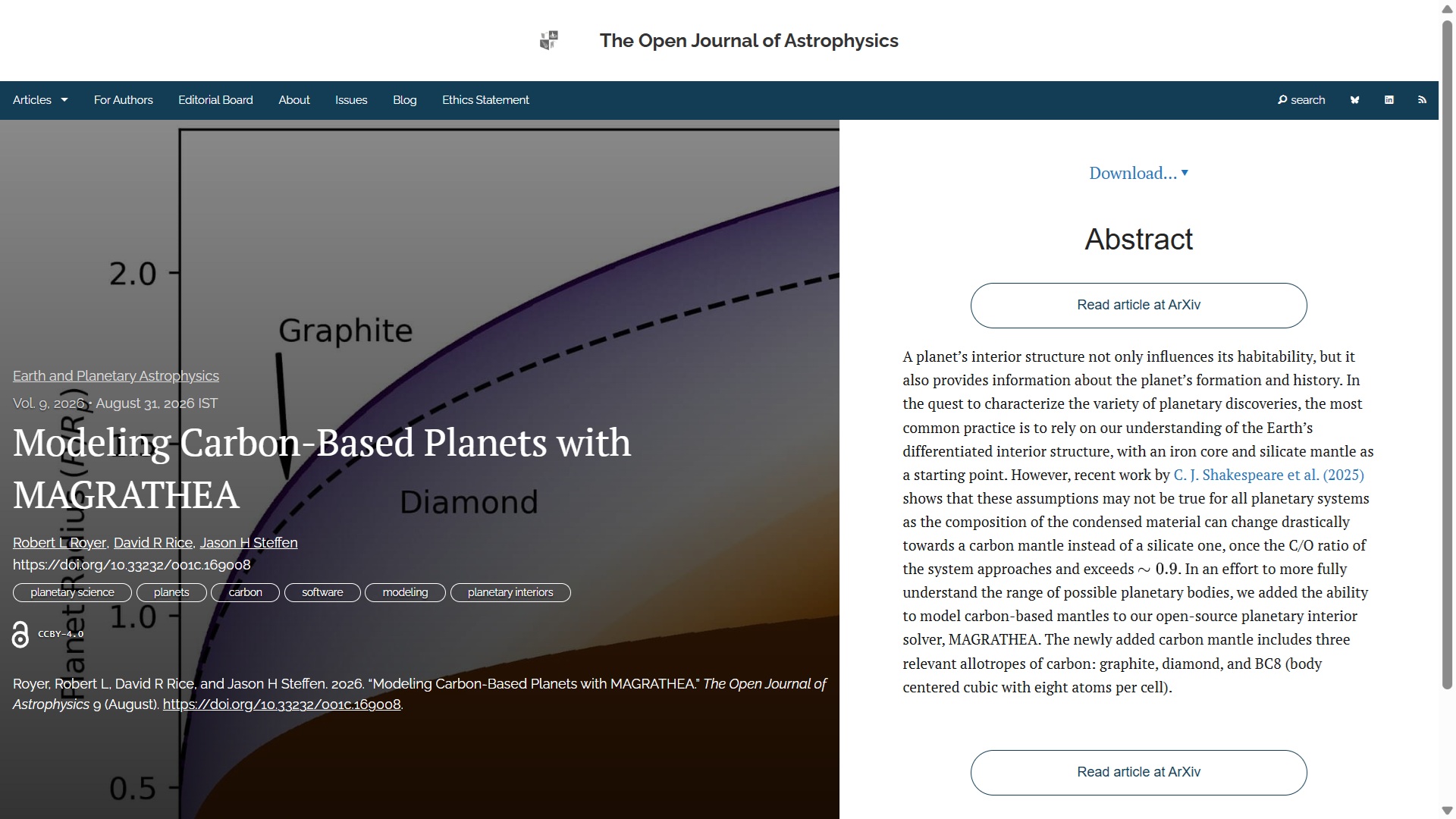
The first paper this week was published on Monday 31st August 2026 in the folder Earth and Planetary Astrophysics: “Modeling Carbon-Based Planets with MAGRATHEA” by Robert L Royer (U. Nevada, USA), David R Rice (U. Wisconsin-Madison, USA) and Jason H Steffen (U. Nevada, USA). This describes a modification of the planetary interior solver MAGRATHEA to include Carbon-based mantles to enable it to understand more fully the range of possible planet structures.
The overlay is here:
You can find the officially accepted version on arXiv here and the announcement on Fediverse here:
New Publication at the Open Journal of Astrophysics: "Modeling Carbon-Based Planets with MAGRATHEA" by Robert L Royer (U. Nevada, USA), David R Rice (U. Wisconsin-Madison, USA) and Jason H Steffen (U. Nevada, USA)
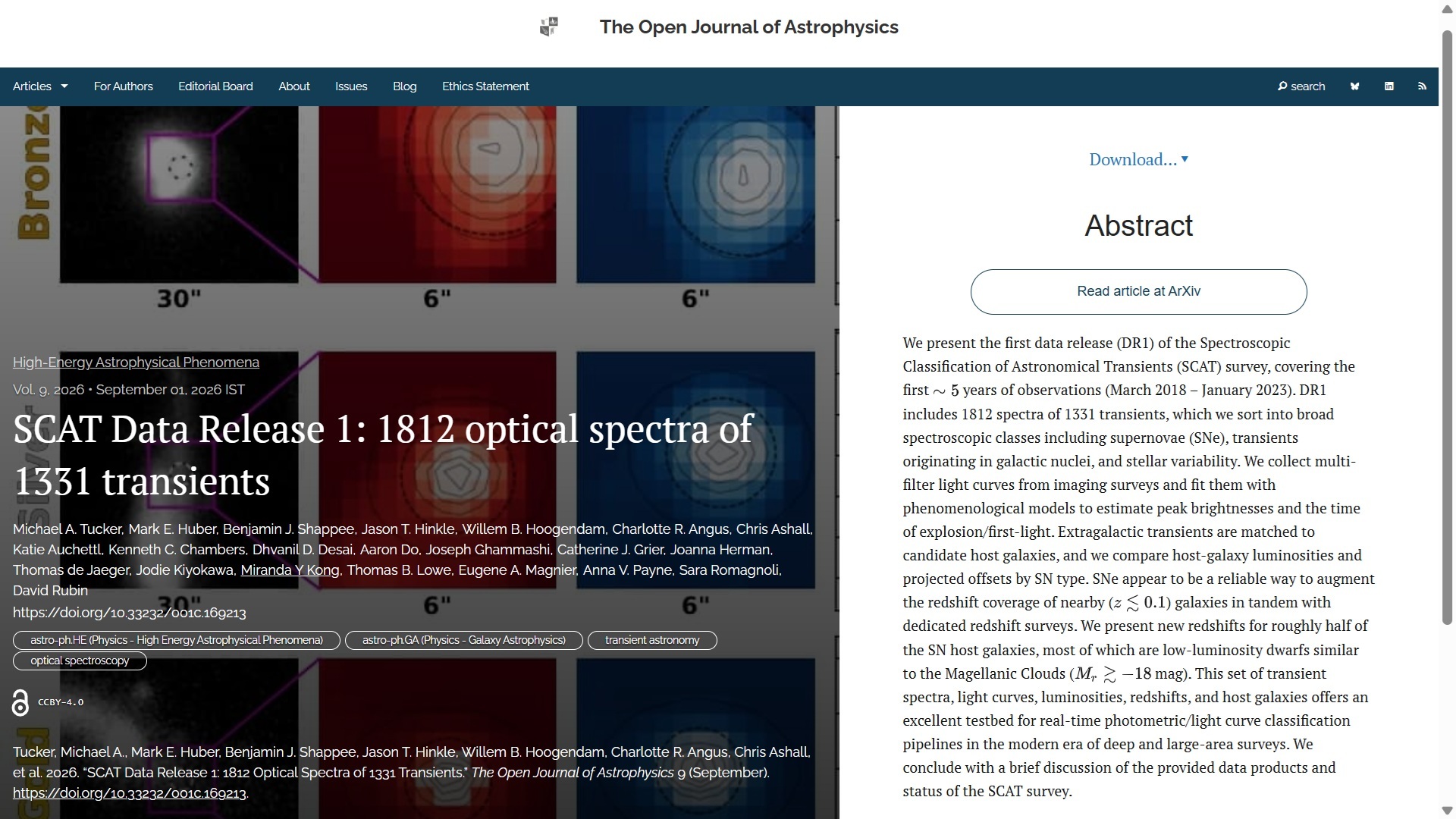
The second paper for this week, published on Tuesday 1st September in the folder High-Energy Astrophysical Phenomena is “SCAT Data Release 1: 1812 optical spectra of 1331 transients” by Michael A Tucker (Ohio State University, USA) and 21 others from around the world. This is the first data release of the Spectroscopic Classification of Astronomical Transients survey includes 1812 spectra of 1331 transients, offering valuable insights for photometric/light curve classification pipelines.
The overlay looks like this:
The official version of the paper can be found on arXiv here and the Fediverse announcement here:
New Publication at the Open Journal of Astrophysics: "SCAT Data Release 1: 1812 optical spectra of 1331 transients" by Michael A Tucker (Ohio State University, USA) and 21 others from around the world.
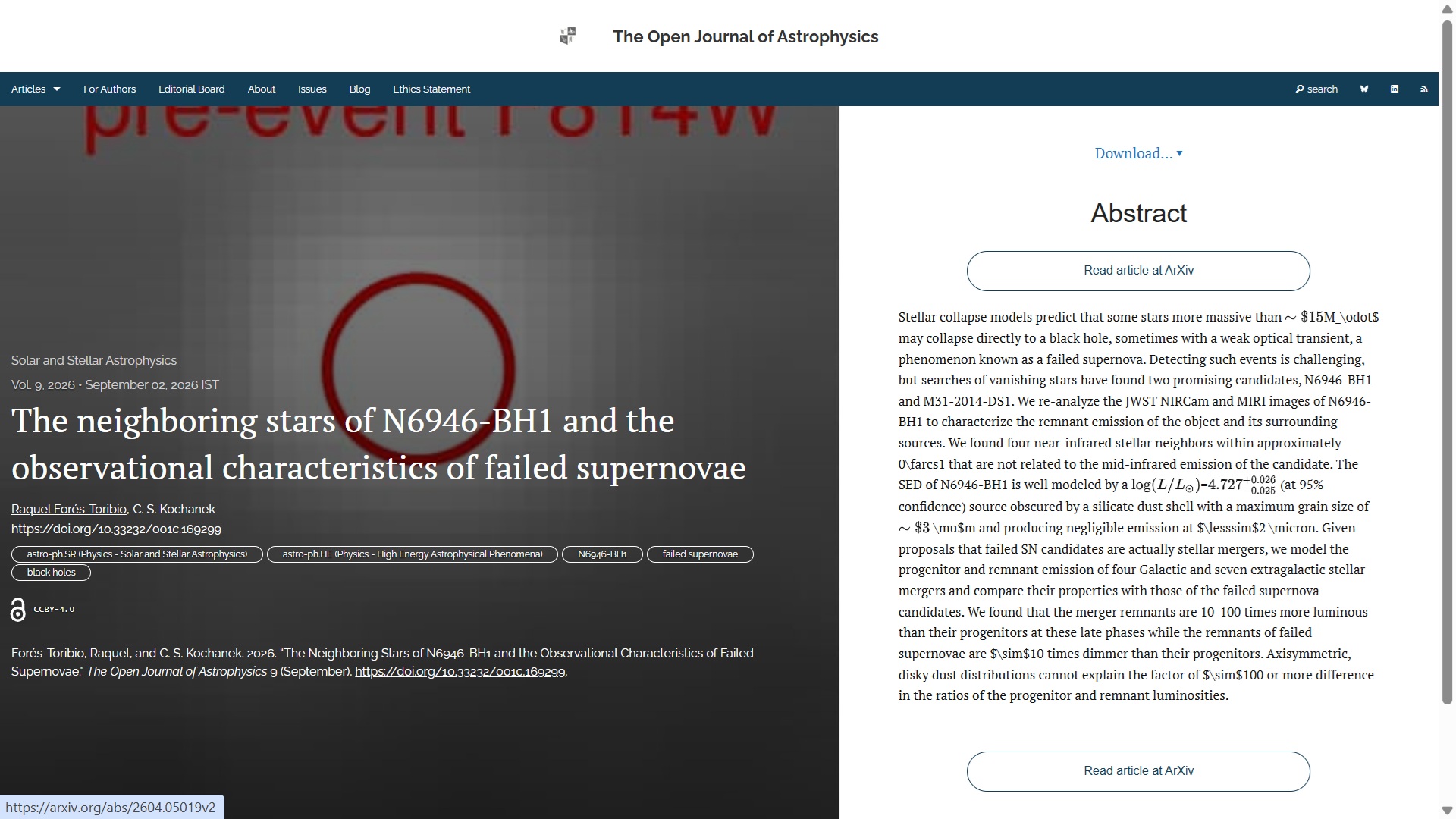
The third paper of the week is “The neighboring stars of N6946-BH1 and the observational characteristics of failed supernovae” by Raquel Forés-Toribio and C. S. Kochanek (Ohio State University, USA). This study, published on Wednesday 2nd September 2026 in the folder Solar and Stellar Astrophysics, re-analyzes images of potential failed supernova N6946-BH1, finding four unrelated near-infrared neighbors. It also compares the luminosity of failed supernova remnants to stellar merger remnants, noting significant differences.
The overlay is here:
The official version of the paper can be found on arXiv here and the Fediverse announcement here:
New Publication at the Open Journal of Astrophysics: "The neighboring stars of N6946-BH1 and the observational characteristics of failed supernovae" by Raquel Forés-Toribio and C. S. Kochanek (Ohio State University, USA)
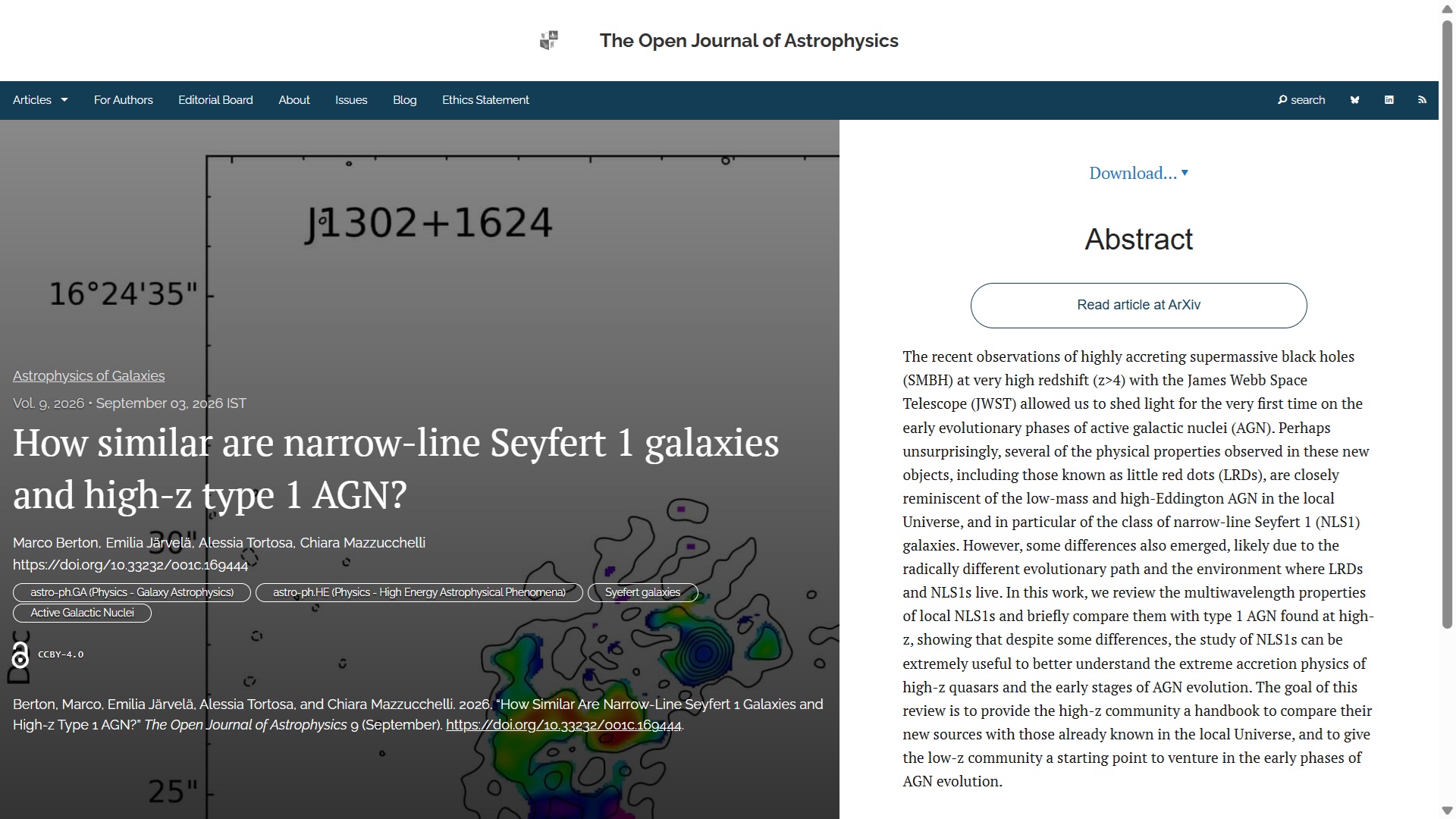
The fourth paper of the week is “How similar are narrow-line Seyfert 1 galaxies and high-z type 1 AGN?” by Marco Berton (ESO, Chile), Emilia Järvelä (Texas Tech. U., USA), Alessia Tortosa (INAF – Osservatorio Astronomico di Roma, Italy) and Chiara Mazzucchelli (Universidad Diego Portales, Chile). This was published on Thursday 3rd September 2026 in the folder Astrophysics of Galaxies. This paper reviews the properties of local narrow-line Seyfert 1 galaxies and compares them with high-redshift active galactic nuclei, aiding understanding of early black hole evolution.
The overlay is here:
The officially-accepted version of the paper can be found on arXiv here and the Fediverse announcement here:
New Publication at the Open Journal of Astrophysics: "How similar are narrow-line Seyfert 1 galaxies and high-z type 1 AGN?" by Marco Berton (ESO, Chile), Emilia Järvelä (Texas Tech. U., USA), Alessia Tortosa (INAF – Osservatorio Astronomico di Roma, Italy) and Chiara Mazzucchelli (Universidad Diego Portales, Chile)
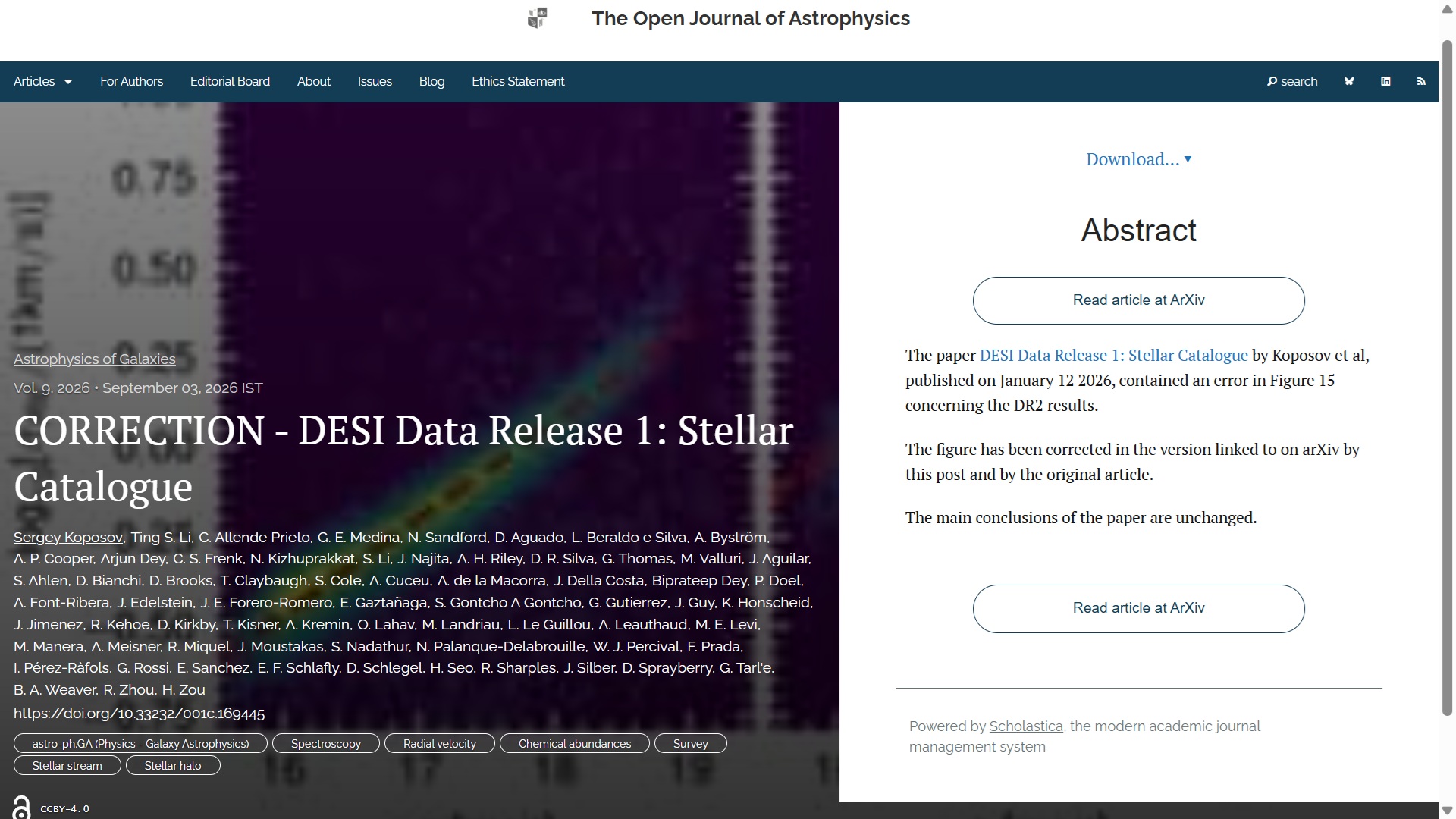
CORRECTION issued at the Open Journal of Astrophysics: "CORRECTION – DESI Data Release 1: Stellar Catalogue" by Koposov et al. (2026) (DOI:10.33232/001c.155260)
In the past when we have had minor correctionsto make we have simply asked the authors to create a new version, then when it has been checked, to place it on arXiv with a comment on the correction made. We then change the overlay to point to the new version with a comment on the change. I was recently advised, however, that best practice is to create a specific entry in Crossref for the corrected version, linked to the old one. Our Scholastica platform now has a mechanism to do this so from now on we will adopt this approach.
After a very busy week, it’s time once more for another Saturday update of activity at the Open Journal of Astrophysics. Since the last update we have published a further twelve papers, bringing the number in Volume 9 (2026) to 189 and the total so far published by OJAp up to 637. As I pointed out on Wednesday this week is the first during which we have published at least one paper in each of the six categories on astro-ph.
I continue to include the posts made on our Mastodon account (on Fediscience); these announcements also show the DOI for each paper. The Mastodon account has regular updates and announcements from OJAp too.
In the past on these posts I have included the article keywords as tags, but this is quite a lot of effort to do for little benefit so I’ve decided just to tag the arXiv category (i.e. folder) and arXiv ID for each paper as well as the lede from the journal platform.
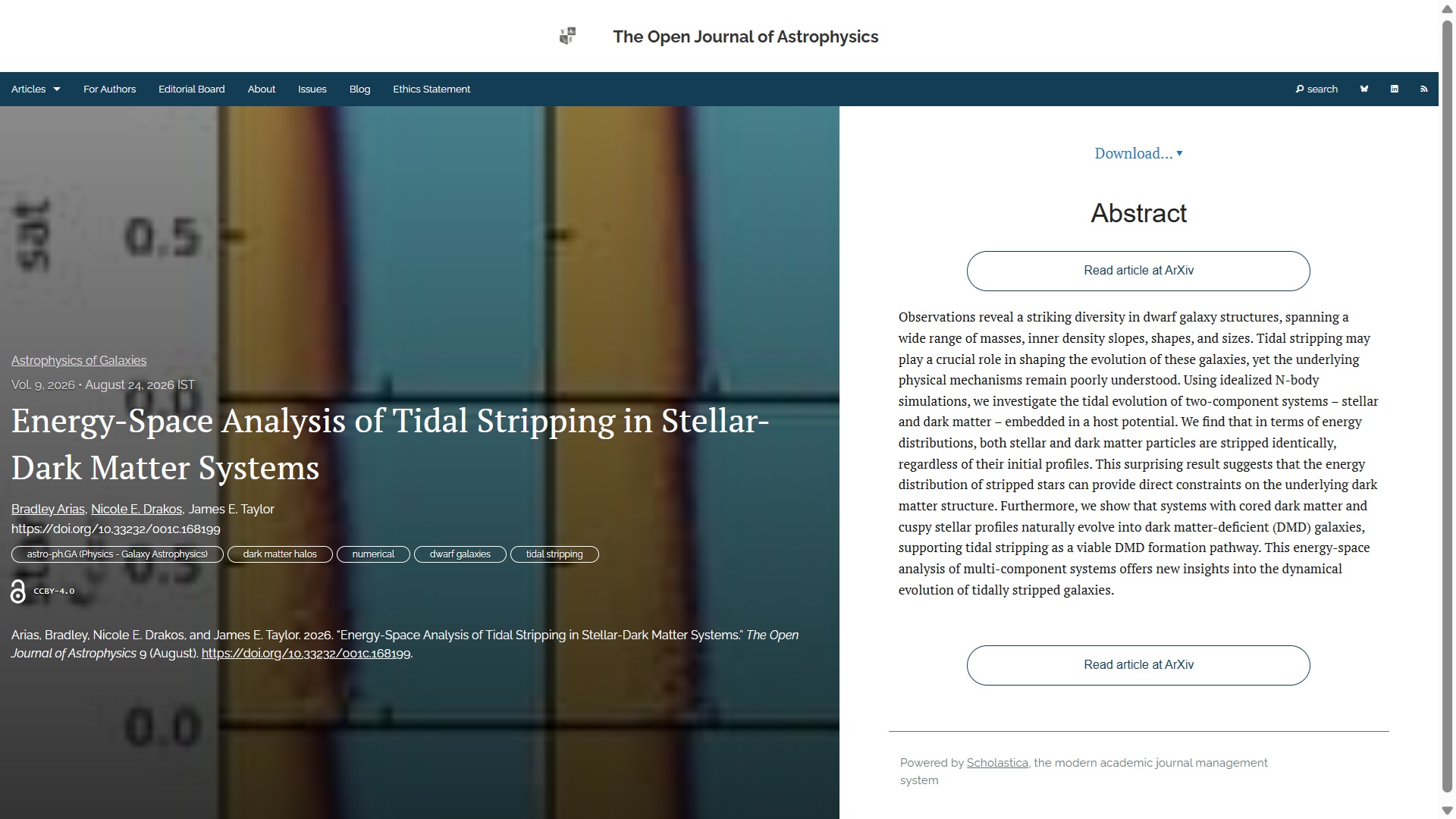
The first one up this week was published on Monday 24th August 2026 in the folder Astrophysics of Galaxies. “Energy-Space Analysis of Tidal Stripping in Stellar-Dark Matter Systems“, by Bradley Arias (UC Berkeley, USA), Nicole E. Drakos (U. Hawaii, USA) and James E. Taylor (U. Waterloo, Canada), uses simulations to explore how tidal stripping shapes the stellar distribution of dwarf galaxies, also suggesting a pathway for the formation of galaxies deficient in dark matter
You can find the officially accepted version on arXiv here and the announcement on Fediverse here:
New Publication at the Open Journal of Astrophysics: "Energy-Space Analysis of Tidal Stripping in Stellar-Dark Matter Systems" by Bradley Arias (UC Berkeley, USA), Nicole E. Drakos (U. Hawaii, USA) and James E. Taylor (U. Waterloo, Canada)
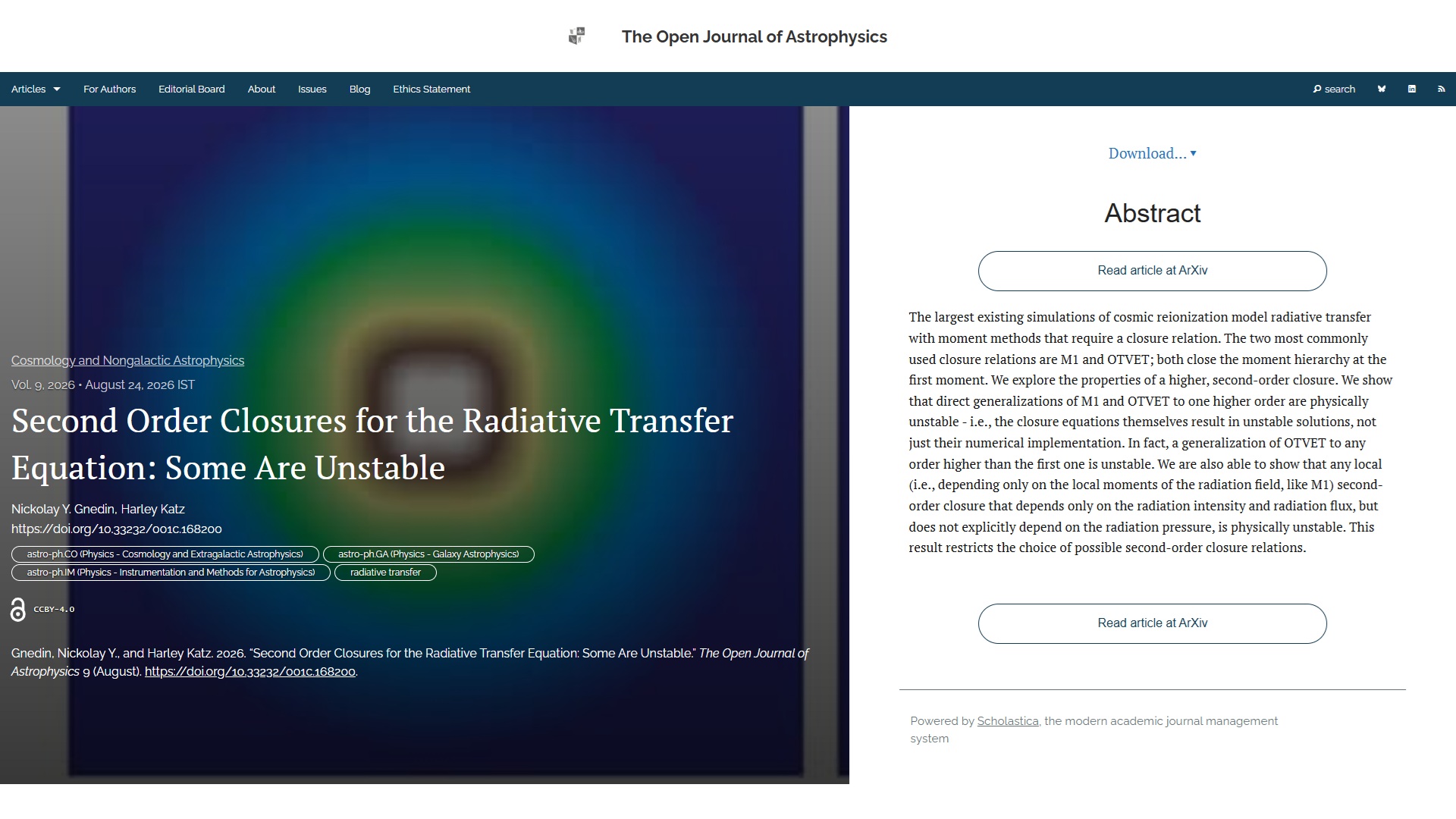
The second paper for this week, also published on Monday 24th August but in the folder Cosmology and Nongalactic Astrophysics is “Second Order Closures for the Radiative Transfer Equation: Some Are Unstable” by Nickolay Y. Gnedin and Harley Katz (U.Chicago, USA). This study explores higher-order closure relations in cosmic reionization simulations, finding that direct generalizations of M1 and OTVET are physically unstable, limiting second-order closure options.
The overlay looks like this:
The official version of the paper can be found on arXiv here and the Fediverse announcement here:
New Publication at the Open Journal of Astrophysics: "Second Order Closures for the Radiative Transfer Equation: Some Are Unstable" by Nickolay Y. Gnedin and Harley Katz (U.Chicago, USA)
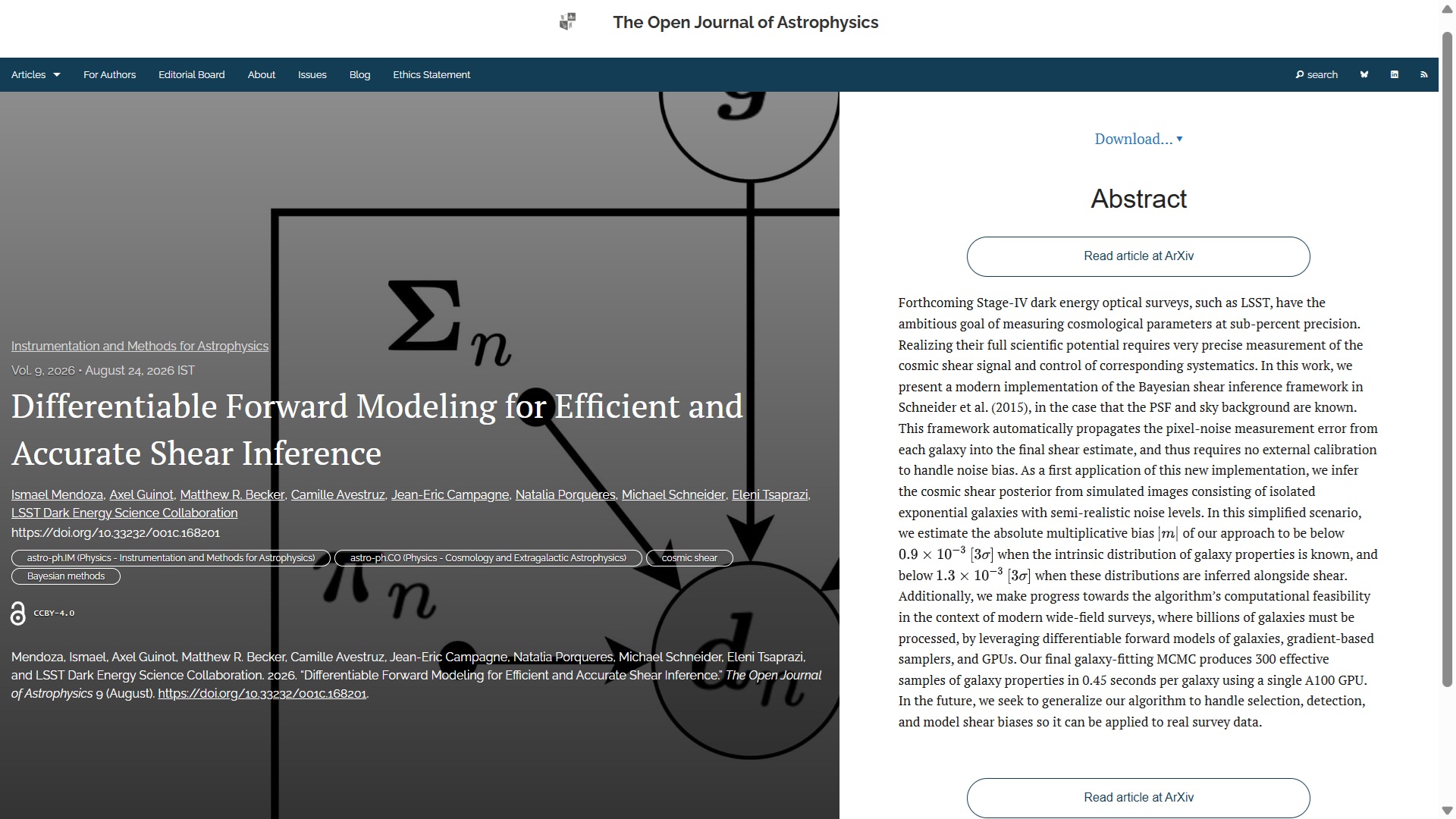
New Publication at the Open Journal of Astrophysics: "Differentiable Forward Modeling for Efficient and Accurate Shear Inference" by Ismael Mendoza and 7 others on behalf of the LSST Dark Energy Science Collaboration.
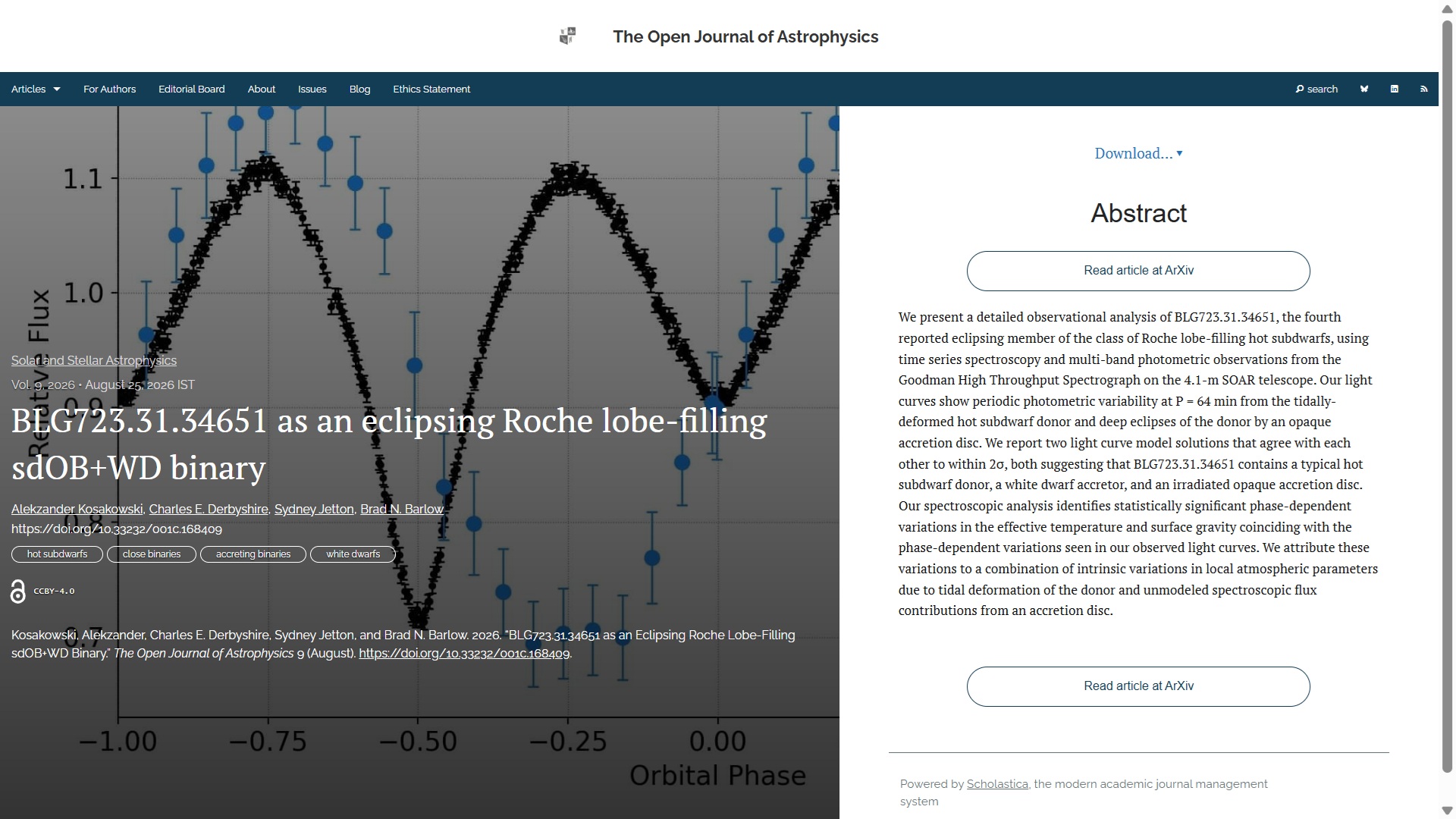
New Publication at the Open Journal of Astrophysics: "BLG723.31.34651 as an eclipsing Roche lobe-filling sdOB+WD binary" by Alekzander Kosakowski, Charles E. Derbyshire, Sydney Jetton and Brad N. Barlow (University of North Carolina, USA)
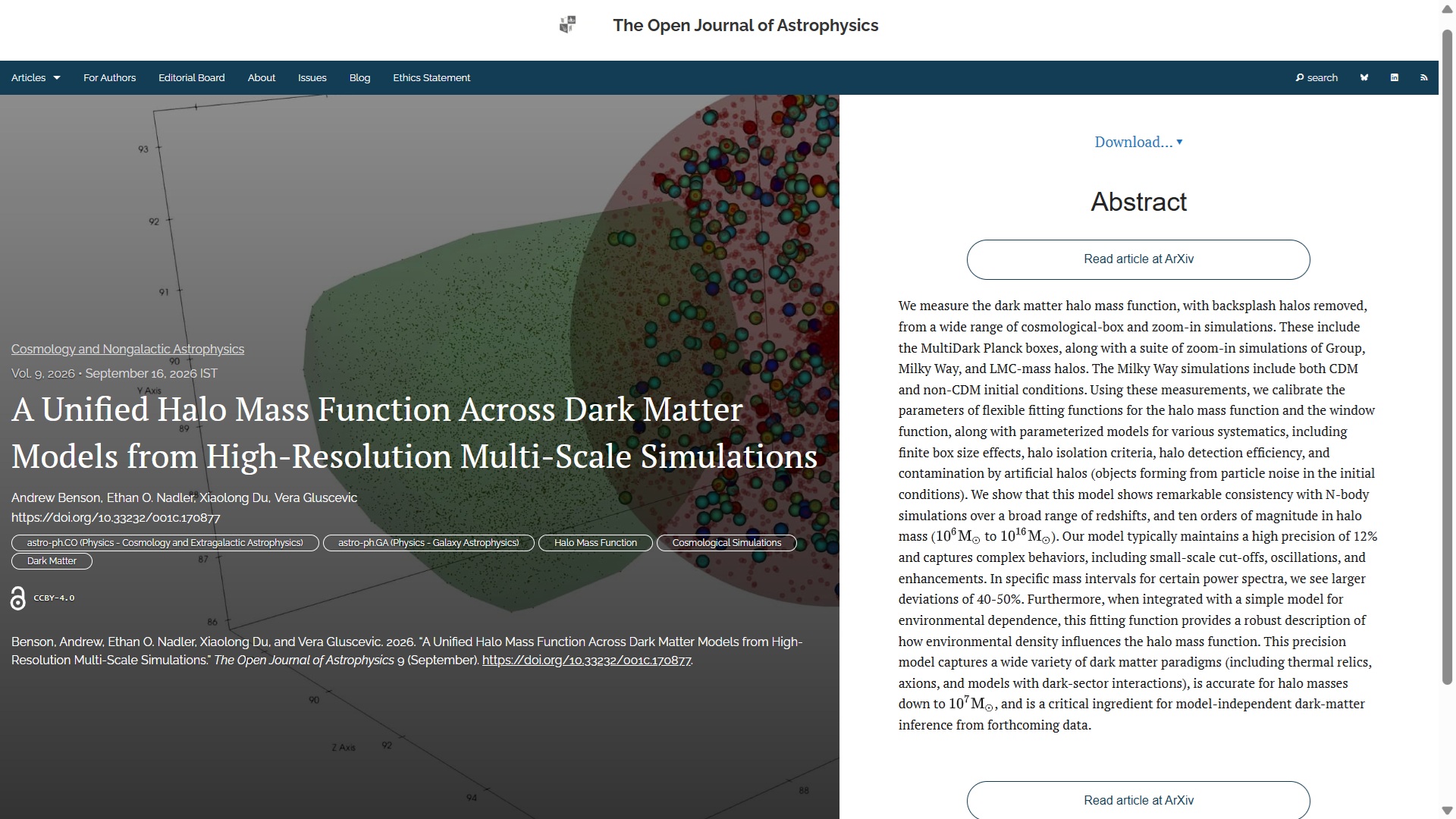
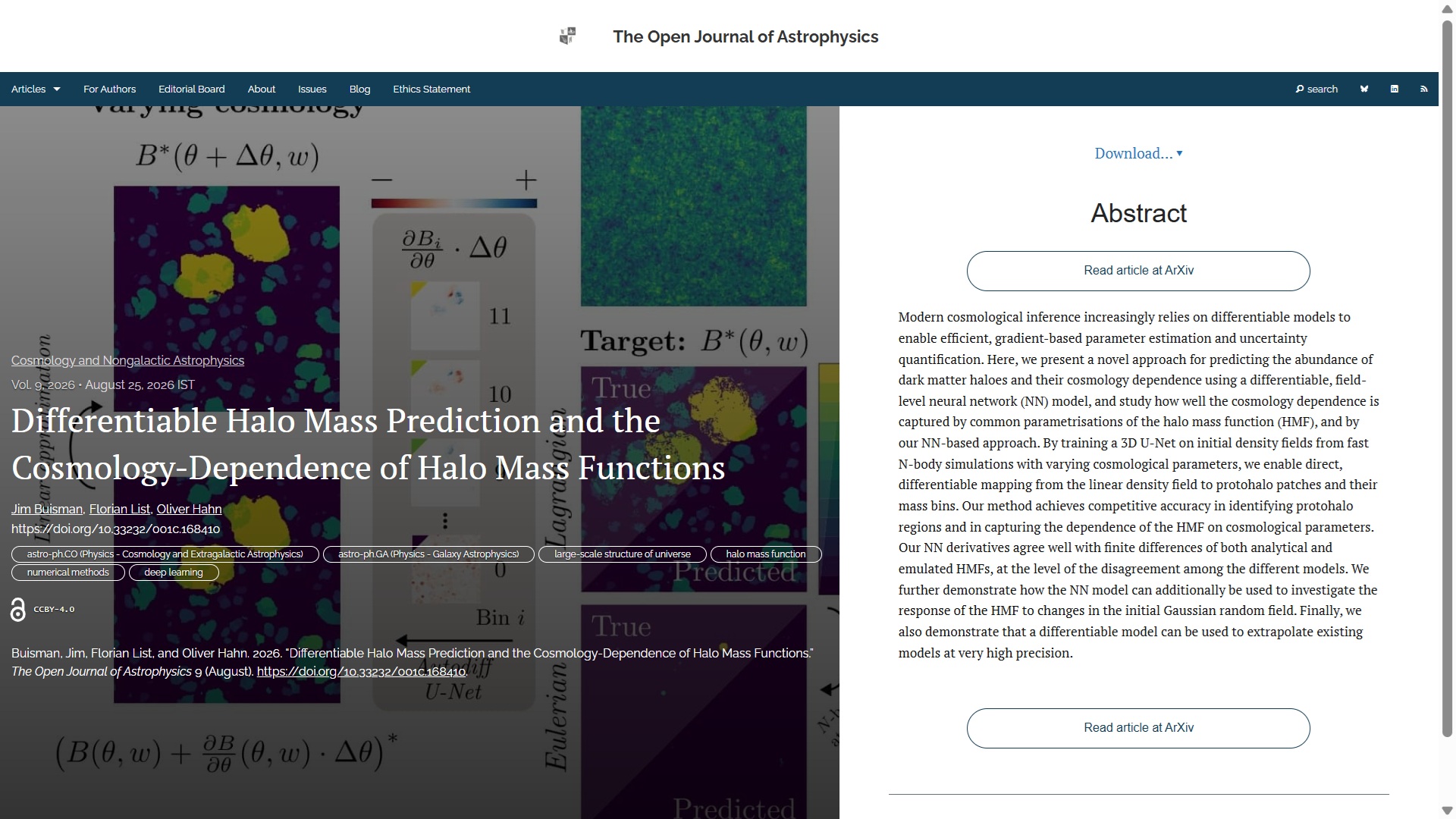
The fifth paper of the week is “Differentiable Halo Mass Prediction and the Cosmology-Dependence of Halo Mass Functions” by Jim Buisman, Florian List and Oliver Hahn (U. Vienna, Austria). This was published on Tuesday 25th August in the folder Cosmology and Nongalactic Astrophysics; it presents a novel approach using a differentiable neural network model for predicting dark matter haloes abundance and their cosmology dependence, achieving competitive accuracy in identifying protohalo regions.Abstractfor Differentiable Halo Mass Prediction and the Cosmology-Dependence of Halo Mass Functions.
The overlay is here:
The officially-accepted version of the paper can be found on arXiv here and the Fediverse announcement here:
New Publication at the Open Journal of Astrophysics: "Differentiable Halo Mass Prediction and the Cosmology-Dependence of Halo Mass Functions" by Jim Buisman, Florian List and Oliver Hahn (U. Vienna, Austria)
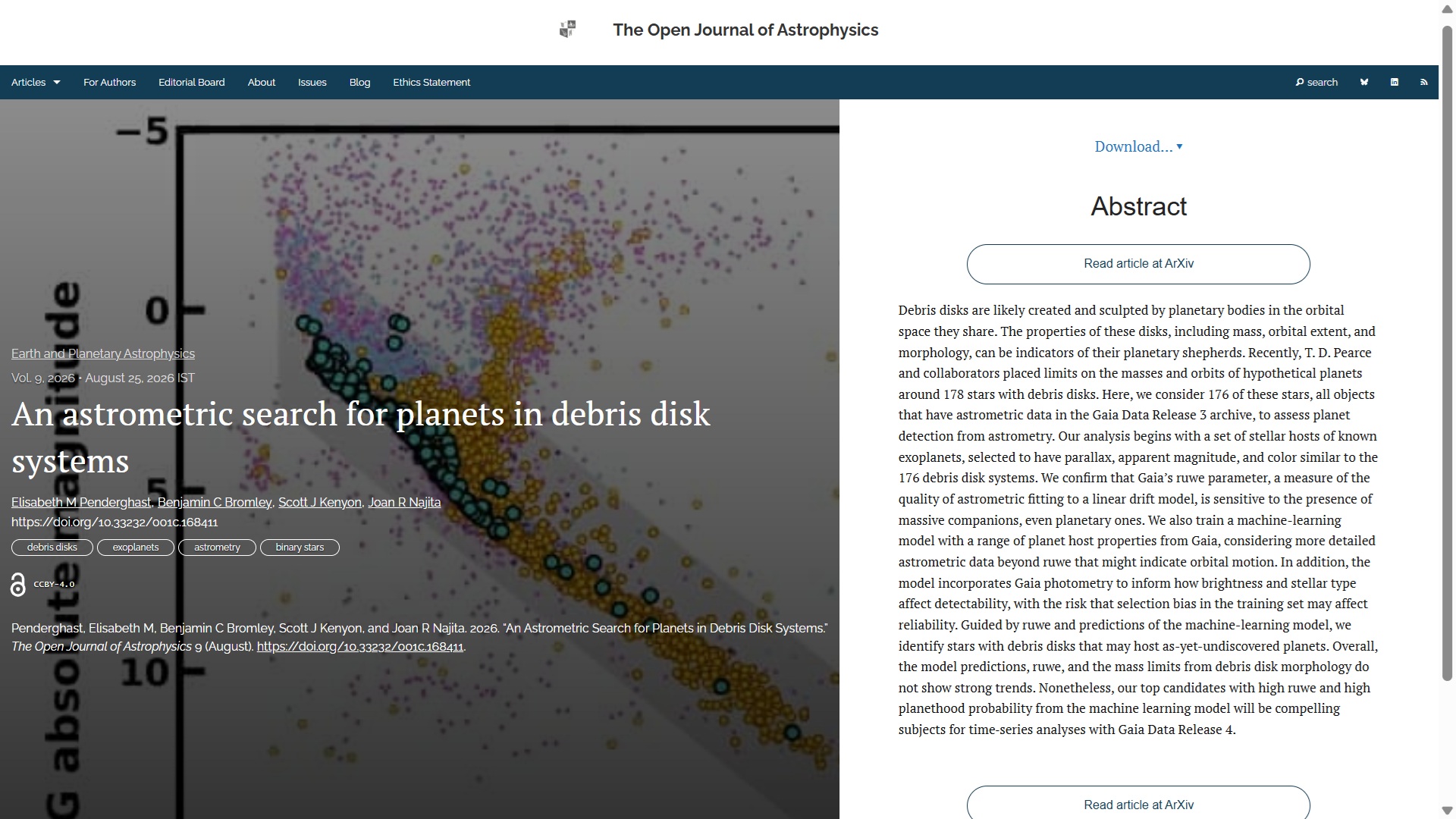
The sixth paper of the week is “An astrometric search for planets in debris disk systems” by Elisabeth M Penderghast & Benjamin C Bromley (U. Utah, USA), Scott J Kenyon (Smithsonian Astrophys. Obs., USA) and Joan R Najita (NSF NOIRLab, USA). This was published on Tuesday 25th August 2026 in the folder Earth and Planetary Astrophysics. This study uses Gaia astrometric data and machine learning to identify stars with debris disks that may host undiscovered planets, providing potential subjects for future analyses.
The overlay is here:
You can find the officially-accepted version of the paper on arXiv here and the Fediverse announcement here:
New Publication at the Open Journal of Astrophysics: "An astrometric search for planets in debris disk systems" by Elisabeth M Penderghast & Benjamin C Bromley (U. Utah, USA), Scott J Kenyon (Smithsonian Astrophys. Obs., USA) and Joan R Najita (NSF NOIRLab, USA)
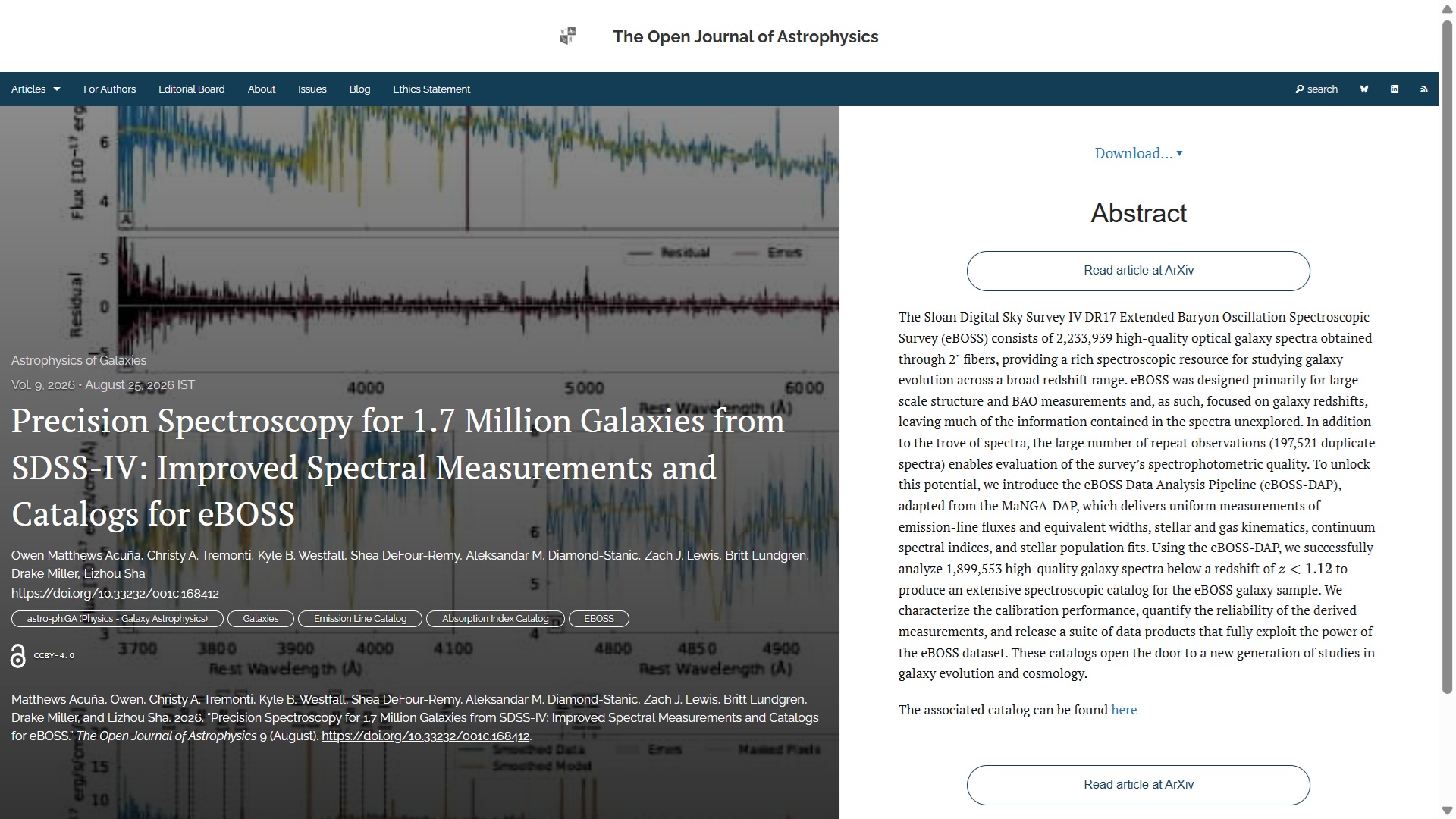
New Publication at the Open Journal of Astrophysics: "Precision Spectroscopy for 1.7 Million Galaxies from SDSS-IV: Improved Spectral Measurements and Catalogs for eBOSS" by Owen Matthews Acuña (U. Wisconsin Madison, USA) and 8 others based at various instititions in the USA.
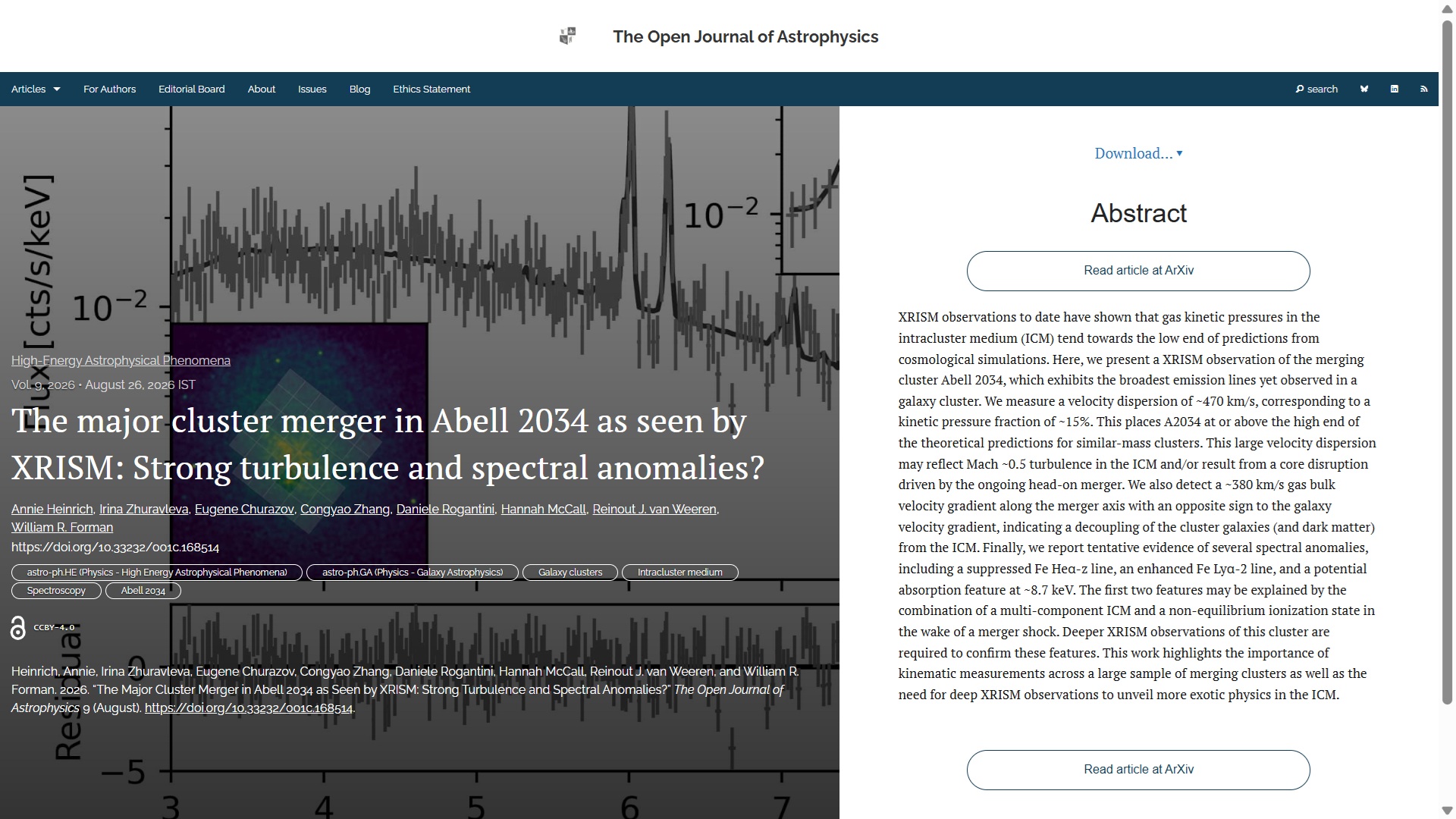
The eighth paper of the week, published on Wednesday 27th August in the folder High-Energy Astrophysical Phenomena is the one that completed our full house for the week. This study presents XRISM observations of the merging cluster Abell 2034, revealing the broadest emission lines yet seen in a galaxy cluster, indicating potential turbulence and core disruption.
The overlay is here:
You can find the official version on arXiv here and the Mastodon announcement is here
New Publication at the Open Journal of Astrophysics: "The major cluster merger in Abell 2034 as seen by XRISM: Strong turbulence and spectral anomalies?" by Annie Heinrich (U. Chicago) and 7 others based in the USA and Europe.
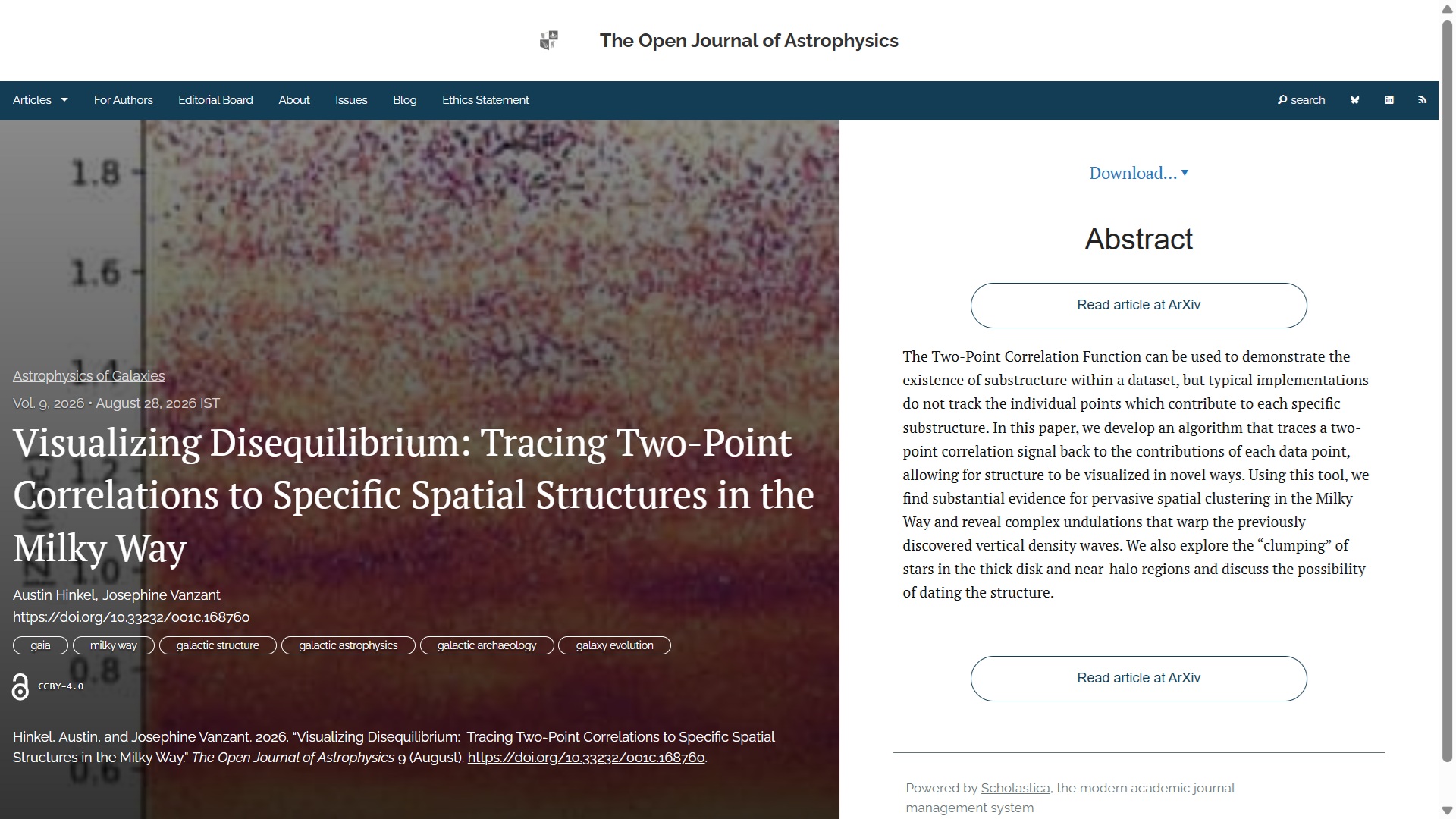
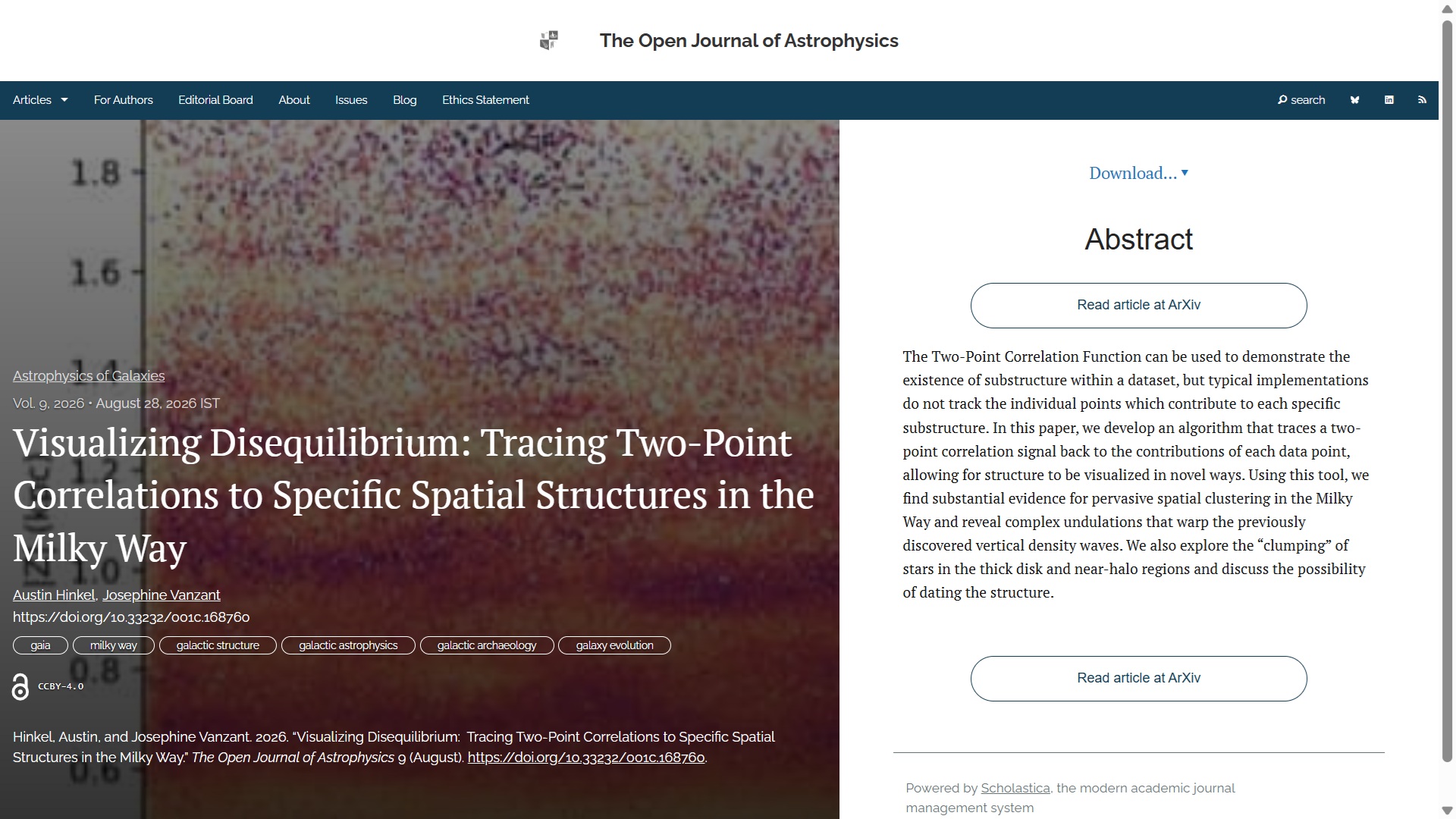
New Publication at the Open Journal of Astrophysics: "Visualizing Disequilibrium: Tracing Two-Point Correlations to Specific Spatial Structures in the Milky Way" by Austin Hinkel and Josephine Vanzant (Thomas More U. USA)
The tenth paper of the week is “Assessing Self-Absorbed Molecular Lines as Tracers of Gravitational Collapse” by Lillian Y. Cai (Priinceton U., USA) and Felix D. Priestley & Sarah E. Ragan (Cardiff U., UK). This paper, reveals that traditional observational techniques probably underestimate true infall velocities and mass accretion rates in collapsing prestellar cores due to non-uniform radial velocity profiles.
The overlay for this one is here:
The officially accepted version can be found on arXiv here and here is the fediverse announcement:
New Publication at the Open Journal of Astrophysics: "Assessing Self-Absorbed Molecular Lines as Tracers of Gravitational Collapse" by Lillian Y. Cai (Priinceton U., USA) and Felix D. Priestley & Sarah E. Ragan (Cardiff U., UK)
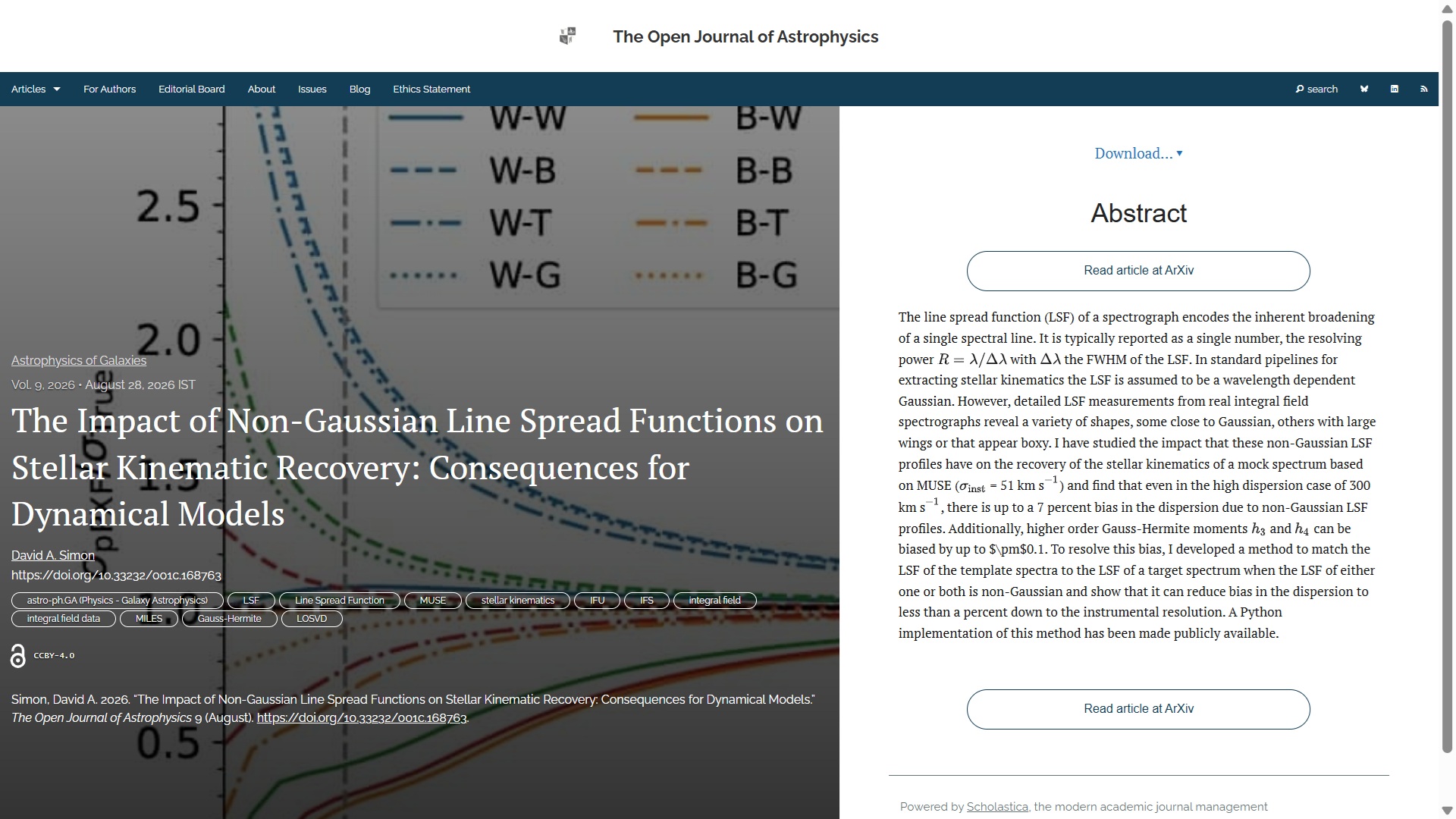
New Publication at the Open Journal of Astrophysics: "The Impact of Non-Gaussian Line Spread Functions on Stellar Kinematic Recovery: Consequences for Dynamical Models" by David A. Simon (Oxford U, UK)
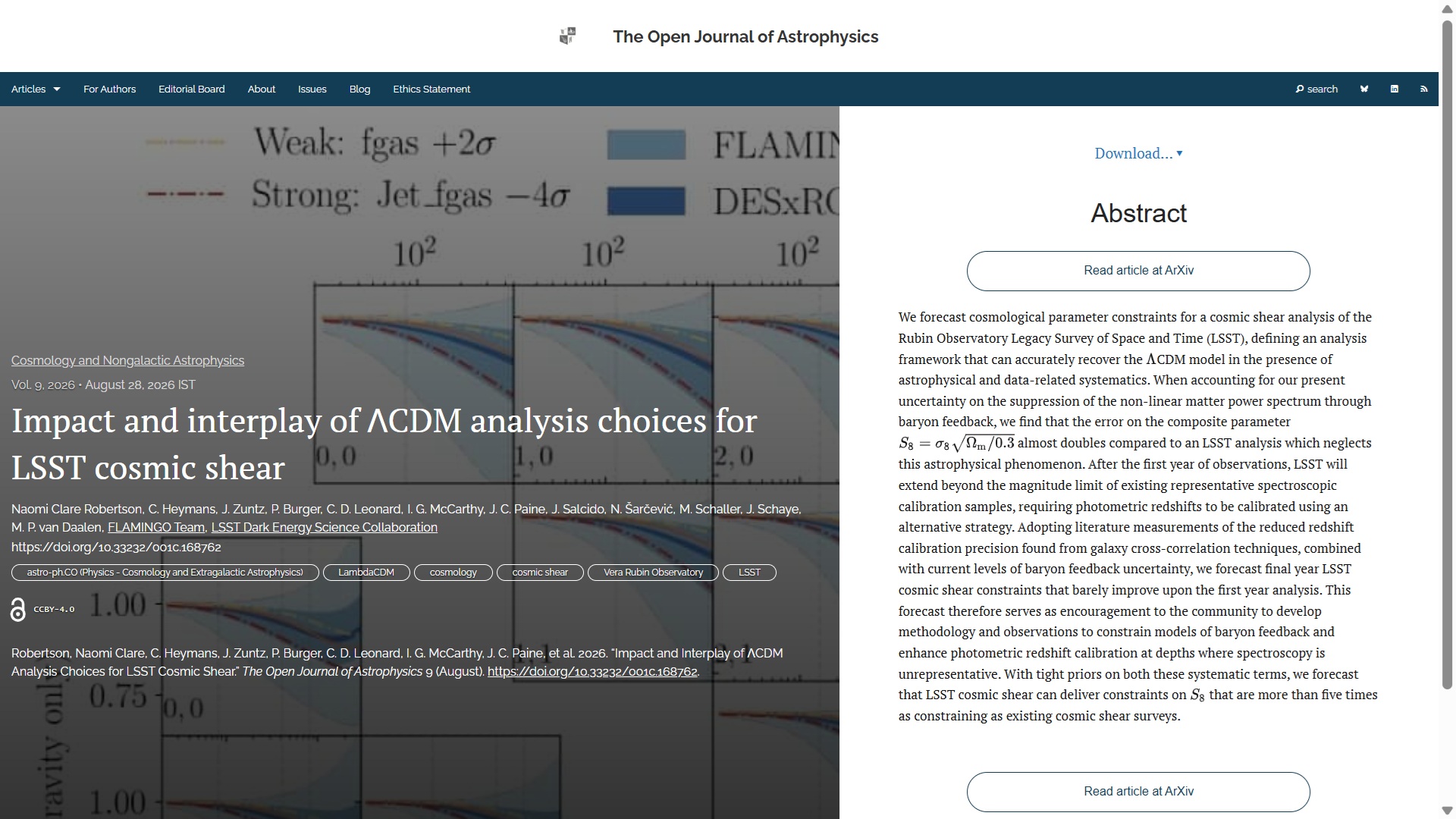
New Publication at the Open Journal of Astrophysics: "Impact and interplay of ΛCDM analysis choices for LSST cosmic shear" by Naomi Clare Robertson and 11 others for the FLAMINGO Team and the LSST Dark Energy Science Collaboration
Later than usual, it’s time once more for another Saturday update of activity at the Open Journal of Astrophysics. Since the last update we have published a further six papers, bringing the number in Volume 9 (2026) to 177 and the total so far published by OJAp up to 625.
I continue to include the posts made on our Mastodon account (on Fediscience); these announcements also show the DOI for each paper. In the past on these posts I have included the article keywords as tags, but this is quite a lot of effort to do for little benefit so I’ve decided just to tag the arXiv category (i.e. folder) and arXiv ID for each paper.
The first one up this week was published on Tuesday 18th August in the folder Astrophysics of Galaxies. The article “Ghostly DLAs in SDSS DR16” by Patrick Petitjean (Institut d’Astrophysique de Paris, France). This study revisits the origin of proximate damped Lyman-alpha absorbers (PDLAs), associating most with the AGN or quasar host galaxy environment..
You can find the officially accepted version on arXiv here and the announcement on Fediverse here:
The second paper for this week, also published on Tuesday 18th August in the folder Astrophysics of Galaxies is “Dust in the Average Galaxy: Attenuation, Emission, and Opacity from 0<z<7” by Caitlin M. Casey (University of California Santa Barbara, USA) and an international cast of 45 others. This study analyzes over 500,000 galaxies to understand dust emission and attenuation properties. Findings reveal UV/optical attenuation underestimates IR luminosity, and dust constraints are crucial for understanding star-forming galaxies.
The overlay looks like this:
The official version of the paper can be found on arXiv here and the Fediverse announcement here:
New Publication at the Open Journal of Astrophysics: "Dust in the Average Galaxy: Attenuation, Emission, and Opacity from 0<z<7" by Caitlin M. Casey (University of California Santa Barbara, USA) and an international cast of 45 others.
New Publication at the Open Journal of Astrophysics: "First Light And Reionization Epoch Simulations (FLARES) XXI: The UV Indices of Galaxies in the Early Universe" by Connor Sant Fournier (University of Malta, Malta) and 7 others based in Malta and the UK.
The fourth paper of the week is “White dwarf + M dwarf Detached Binaries in Long Period Radio Transients: Observed Binary Parameters, Evolution, and Population Constraints” by Antonio Rodriguez (Harvard-Smithsonian CfA, USA), Kareem El-Badry (Caltech, USA), Iris de Ruiter (U. Sydney, Australia), Kaustubh Rajwade (U. Oxford, UK), Edo Berger & Liam Connor (CfA) and Natasha Hurley-Walker (Curtin U., Australia). This was published on Wednesday 19th August in the folder Solar and Stellar Astrophysics. This article presents new findings on long period radio transients (LPTs), slow-pulsing radio sources, associated with M dwarf-white dwarf systems., suggests these systems are part of a significant Galactic population of such objects.
The overlay is here:
The officially-accepted version of the paper can be found on arXiv here and the Fediverse announcement here:
New Publication at the Open Journal of Astrophysics: "White dwarf + M dwarf Detached Binaries in Long Period Radio Transients: Observed Binary Parameters, Evolution, and Population Constraints" by Antonio Rodriguez (Harvard-Smithsonian CfA, USA), Kareem El-Badry (Caltech, USA), Iris de Ruiter (U. Sydney, Australia), Kaustubh Rajwade (U. Oxford, UK), Edo Berger & Liam Connor (CfA) and Natasha Hurley-Walker (Curtin U., Australia)
The fifth paper of the week is “Cosmological Dynamics of Multi-Axion Quintessence” by Supakorn Katewongveerachart (Mahidol U., Thailand) and David J. E. Marsh, King’s College London, UK). This was published on Thursday 20th August 2026 in the folder Cosmology and Nongalactic Astrophysics. This study explores dark energy dynamics, and their potential observational consequences, for a cosmological model with two, three or four axion fields.
The overlay is here:
The officially-accepted version of the paper can be found on arXiv here and the Fediverse announcement here:
New Publication at the Open Journal of Astrophysics: "Cosmological Dynamics of Multi-Axion Quintessence" by Supakorn Katewongveerachart (Mahidol U., Thailand) and David J. E. Marsh, King's College London, UK)
Finally for this week, the sixth paper of the week is “How can we finally see the first light? Status and perspective in the search for Population III stars” by Alessandra Venditti (U. Texas Austin, USA) and 28 others from around the world. This was published on Thursday August 20th in the folder Astrophysics of Galaxies. This review article discusses the ongoing search for the first stars (Population III), their formation, and characteristics. It highlights various observational strategies and the role of advanced technology in this quest. This can perhaps act as a reminder that we do publish review articles, as long as the Editorial Board and the reviewers consider them a useful contribution to the literature.
The overlay is here:
You can find the officially-accepted version of the paper on arXiv here and the Fediverse announcement here:
New Publication at the Open Journal of Astrophysics: "How can we finally see the first light? Status and perspective in the search for Population III stars" by Alessandra Venditti (U. Texas Austin, USA) and 28 others from around the world
And that’s all for this week. We’re starting to clear the backlog of papers accepted through the summer but yet to be published, but it will probably take a few weeks to do so completely.
Although it’s still holiday season for some, it’s time once more for another Saturday update of activity at the Open Journal of Astrophysics. Since the last update we have published a further four papers, bringing the number in Volume 9 (2026) to 171 and the total so far published by OJAp up to 619.
I continue to include the posts made on our Mastodon account (on Fediscience); these announcements also show the DOI for each paper.
New Publication at the Open Journal of Astrophysics: "Search for neutrino emission from blazar γ-ray flares accounting for possible neutrino time delays" by Egor Podlesny & Foteini Oikonomou (Norwegian University of Science & Technology, Trondheim, Norway)
The second paper for this week, published on Tuesday 11th August in the folder Cosmology and Nongalactic Astrophysics is “The velocity coherence scale: a novel probe of cosmic homogeneity and a potential standard ruler” by Leonardo Giani (Swinburne University of Technology), Cullan Howlet (U. Queensland), Chris Blake (Swinburne), Ryan J. Turner (Australia National University) and Tamara M. Davis (U. Queensland) – all in Australia. This paper argues that velocity coherence scale, a measure that identifies the transition point of galaxy motion from correlated to anti-correlated, could potentially characterize the onset of cosmic homogeneity.
The overlay looks like this:
The official version of the paper can be found on arXiv here and the Fediverse announcement here:
New Publication at the Open Journal of Astrophysics: "The velocity coherence scale: a novel probe of cosmic homogeneity and a potential standard ruler" by Leonardo Giani (Swinburne U. Tech.), Cullan Howlet (U. Queensland), Chris Blake (Swinburne), Ryan J. Turner (ANU) and Tamara M. Davis (U. Queensland) – all in Australia.
New Publication at the Open Journal of Astrophysics: "A GLIMPSE of the 99%: a census of the faintest galaxies during the epoch of reionization and its implications for galaxy formation models" by Hakim Atek (Sorbonne Université, Paris, France) and 21 others based around the world.
The fourth and final paper of the week was published on Wednesday 12th August in the folder Astrophysics of Galaxies: “Dust and Grain Size Evolution in Galaxy Simulations: What Matters and What Does Not” by Massimiliano Parente & Desika Narayanan (U. Florida, USA) and Paul Torrey (U. Virginia, USA) presents the first implementation of an evolving dust grain size distribution within a model of galaxy evolution, successfully reproducing key observational constraints and exploring the mechanisms shaping galaxies.
The overlay is here:
The officially-accepted version of the paper can be found on arXiv here and the Fediverse announcement here:
New Publication at the Open Journal of Astrophysics: "Dust and Grain Size Evolution in Galaxy Simulations: What Matters and What Does Not" by Massimiliano Parente & Desika Narayanan (U. Florida, USA) and Paul Torrey (U. Virginia, USA)
That’s all for this week. We’re just ticking over at the moment, and steadily building up a backlog of papers to publish while we wait for authors to put their final versions on arXiv. I have a feeling there’s going to be a big splurge sometime. Will it be next week? We’ll find out next Saturday!
Although it’s holiday season for some, it’s time once more for another Saturday update of activity at the Open Journal of Astrophysics. Since the last update we have published a further four papers, bringing the number in Volume 9 (2026) to 167 and the total so far published by OJAp up to 615.
I continue to include the posts made on our Mastodon account (on Fediscience); these announcements also show the DOI for each paper.
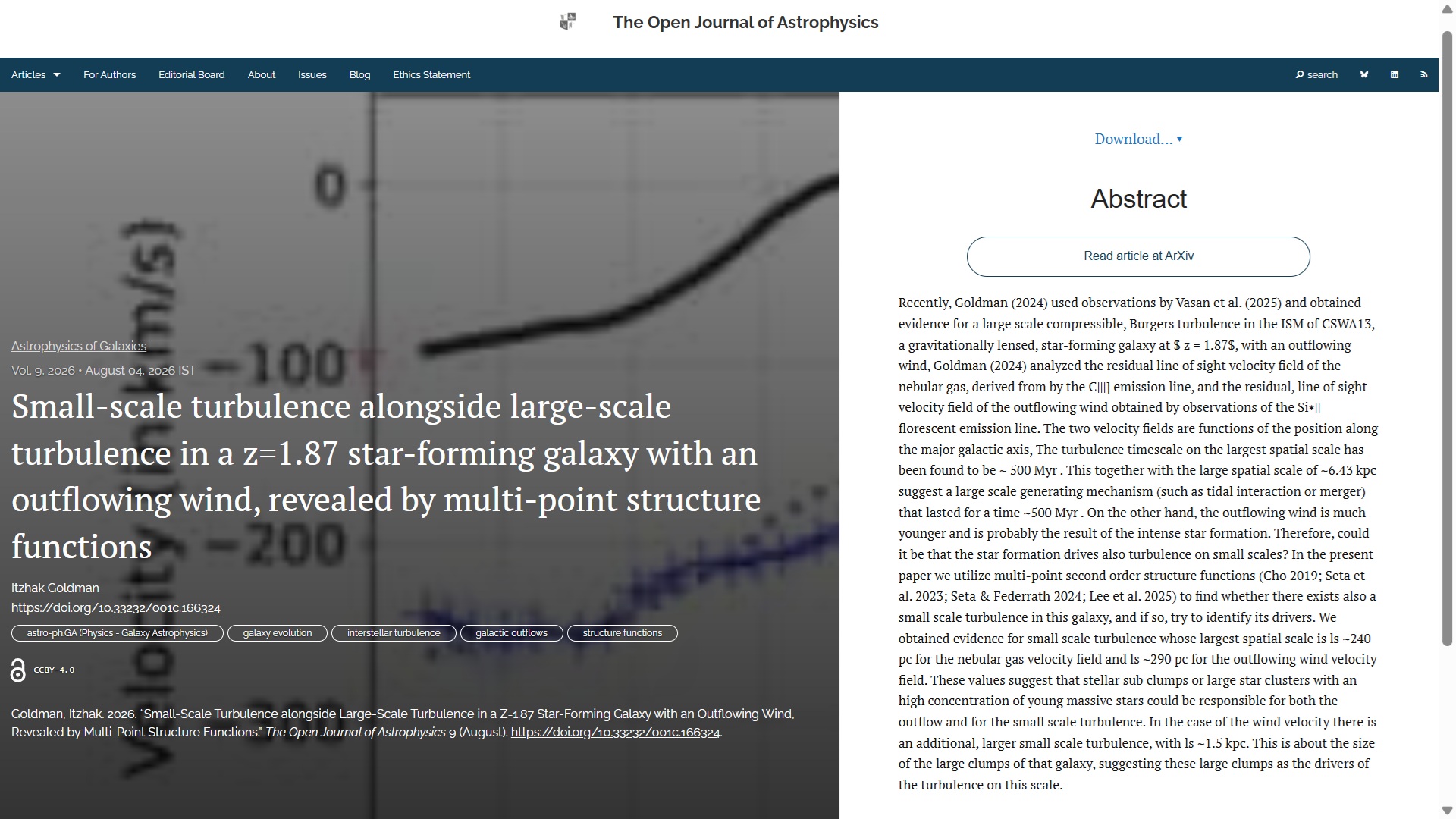
New Publication at the Open Journal of Astrophysics: "Small-scale turbulence alongside large-scale turbulence in a z=1.87 star-forming galaxy with an outflowing wind, revealed by multi-point structure functions" by Itzhak Goldman (Afeka College, Israel)
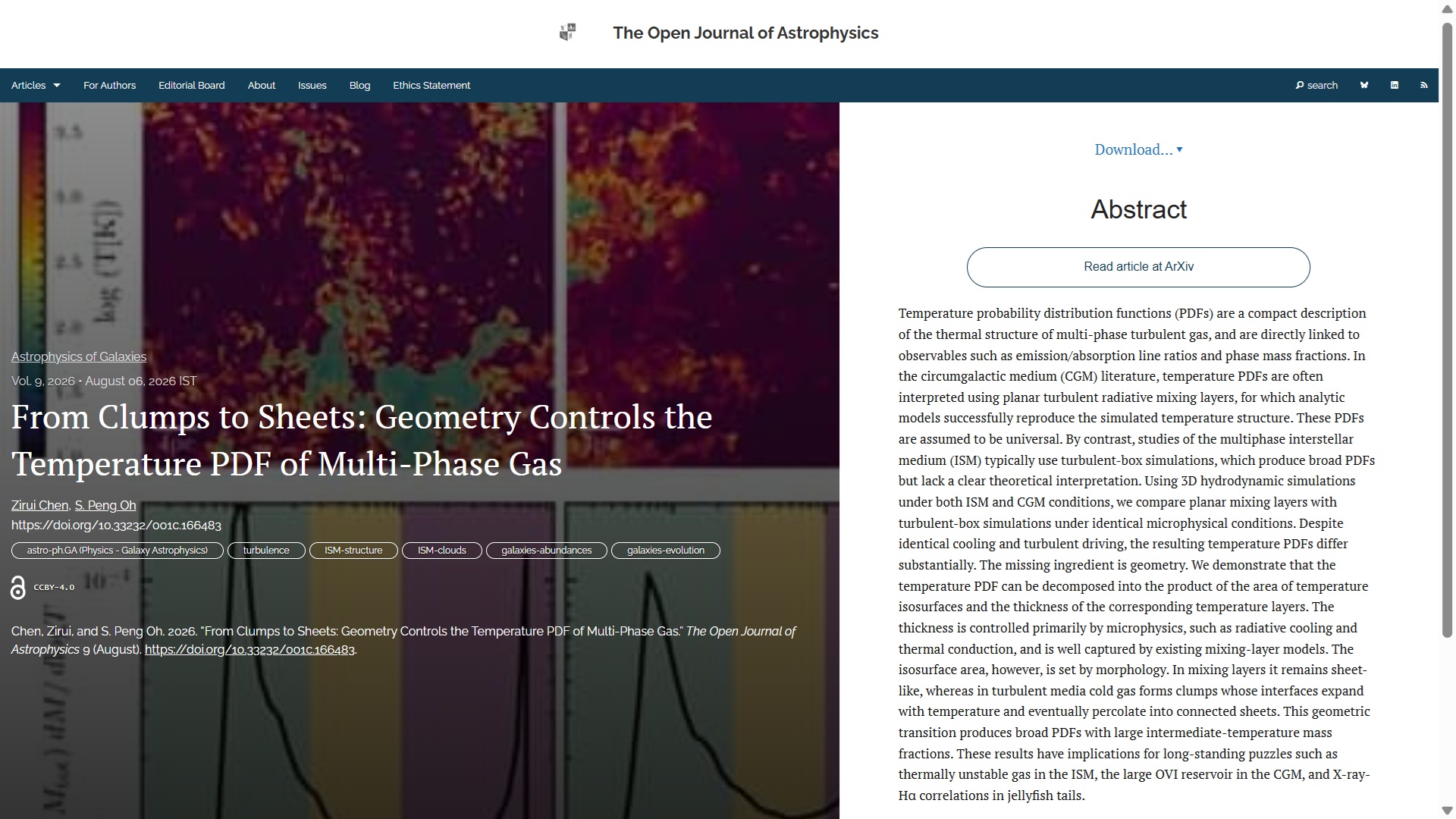
The second paper for this week, published on Thursday 6th August in the folder Astrophysics of Galaxies, is “From Clumps to Sheets: Geometry Controls the Temperature PDF of Multi-Phase Gas” by Zirui Chen and S. Peng Oh (UC Santa Barbara, USA). This study uses 3D hydrodynamic simulations to show that the temperature probability distribution functions (PDFs) of multi-phase turbulent gas differ significantly under interstellar medium (ISM) and circumgalactic medium (CGM) conditions.
The overlay looks like this:
The official version of the paper can be found on arXiv here and the Fediverse announcement here:
New Publication at the Open Journal of Astrophysics: "From Clumps to Sheets: Geometry Controls the Temperature PDF of Multi-Phase Gas" by Zirui Chen and S. Peng Oh (UC Santa Barbara, USA)
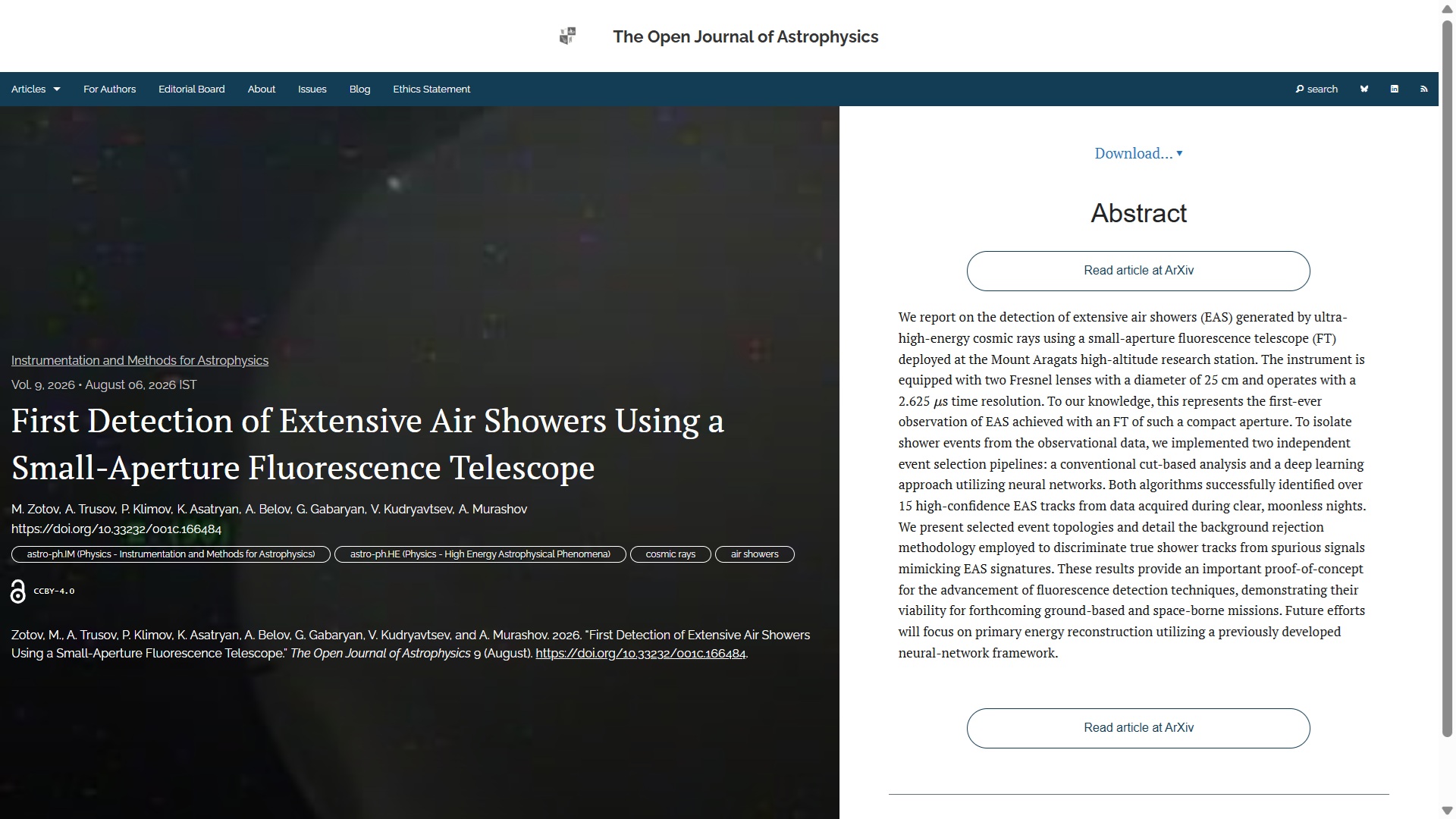
New Publication at the Open Journal of Astrophysics: "First Detection of Extensive Air Showers Using a Small-Aperture Fluorescence Telescope" by M. Zotov (M.V. Lomonosov Moscow State University, Russia) and 7 others based in Russia and Armenia
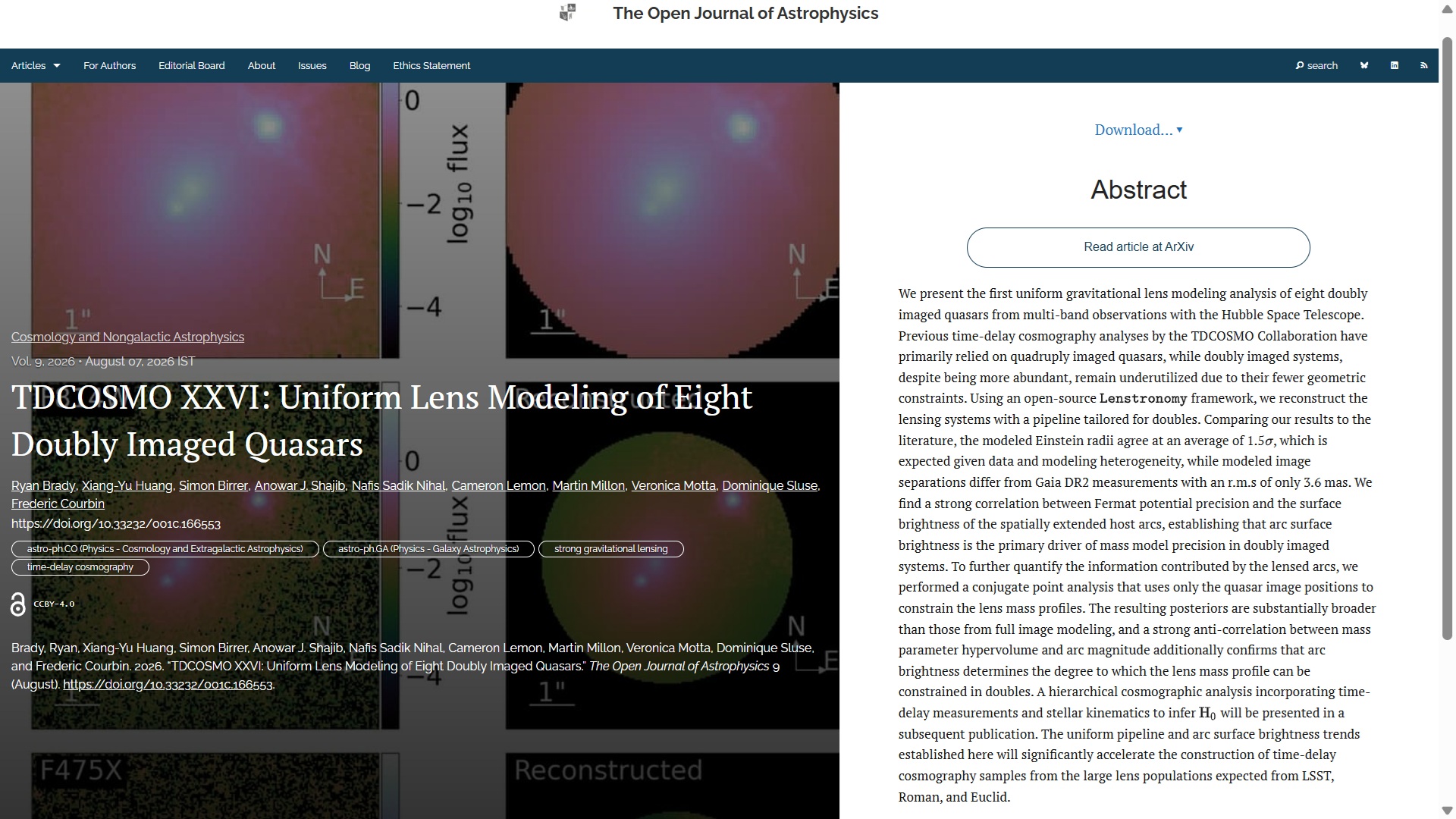
The fourth and final paper of the week was published on Friday 7th August in the folder Cosmology and Nongalactic Astrophysics: “TDCOSMO XXVI: Uniform Lens Modeling of Eight Doubly Imaged Quasars“, by Ryan Brady (Stony Brook University, USA) and 9 others based all around the world, presents a new method for analyzing doubly imaged quasars using the Hubble Space Telescope, revealing that arc surface brightness is key to precision in mass model measurements.
The overlay is here:
The officially-accepted version of the paper can be found on arXiv here and the Fediverse announcement here:
New Publication at the Copen Journal of Astrophysics: "TDCOSMO XXVI: Uniform Lens Modeling of Eight Doubly Imaged Quasars" by Ryan Brady (Stony Brook University, USA) and 9 others based around the world.
That’s all for this week. We have about a dozen more papers accepted and waiting for the authors to put the final version on arXiv, which they will presumably do when they’re back from holiday. I’ll do an update next weekend and we’ll see!
I saw recently an announcement that arXiv – which recently became a standalone nonprofit organization – now hosts more than three million articles. That message took me to a post on the arXiv blog from which I learnt that said blog is on WordPress which makes it possible to include embedded links from this WordPress blog, i.e.:
This in turn reminded me to answer a question that people sometimes ask about the Open Journal of Astrophysics, namely what would happen if arXiv went offline? Since OJAp is an arXiv-overlay journal this would appear to be fatal. We have been keeping duplicates of all the papers we publish, and associated metadata, in a local repository so that if arXiv went down we could reistate them fairly quickly. All we would need to do is alter the overlay to point to a different web address: there is no reason at all why the overlay idea can’t be adapted to other forms of repository.
Recently, however, arXiv decided to do a similar thing for all its articles. Here is a blog post about it:
Anyway, if you use arXiv at all – which will include most astrophysicists – then it would be a good idea to follow the arXiv blog as there is very important news on it, including information about alterations to the schedule of announcements.
It’s time once more for another Saturday update of activity at the Open Journal of Astrophysics. Since the last update we have published a further three papers, bringing the number in Volume 9 (2026) to 163 and the total so far published by OJAp up to 611.
I continue to include the posts made on our Mastodon account (on Fediscience); these announcements also show the DOI for each paper.
The first paper to report this week was published on Tuesday 28th July in the folder Cosmology and Nongalactic Astrophysics. “The Origins of the Bulk Flow” by Richard Watkins & Trajan Clark (Willamett U., USA) and Hume A Feldman (U. Kansas, USA) analyzes the origin of large-scale bulk flow using the CosmicFlows-4 catalog, finding that it is largely influenced by structures beyond 200 h-1 Mpc, challenging previous assumptions.
The overlay for this paper is here
You can find the officially accepted version on arXiv here and the announcement on Fediverse here:
New Publication at the Open Journal of Astrophysics: "The Origins of the Bulk Flow" by Richard Watkins & Trajan Clark (Willamett U., USA) and Hume A Feldman (U. Kansas, USA).
The second paper for this week, also published on Tuesday 28th July in the folder Cosmology and Nongalactic Astrophysics is: “Enhancing weak lensing redshift distribution characterization by optimizing the Dark Energy Survey Self-Organizing Map Photo-z method” by A. Campos (Carnegie Mellon U., USA) and the DES collaboration (113 authors). This study improves the Self-Organizing Map methodology for estimating redshift distribution in galaxies, notably reducing overlap between redshift bins, in preparation for the Dark Energy Survey Year 6 data.Abstractfor Enhancing weak lensing redshift distribution characterization by optimizing the Dark Energy Survey Self-Organizing Map Photo-z method.
The overlay looks like this:
The official version of the paper can be found on arXiv here and the Fediverse announcement here:
New Publication at the Open Journal of Astrophysics: "Enhancing weak lensing redshift distribution characterization by optimizing the Dark Energy Survey Self-Organizing Map Photo-z method" by A. Campos (Carnegie Mellon U., USA) and the DES collaboration (113 authors)
New Publication at the Open Journal of Astrophysics: "The Ray Tracing Sampler: Bayesian Sampling of Neural Networks for Everyone" by Peter Behroozi (U. Arizona, USA)
It’s time once more for another Saturday update of activity at the Open Journal of Astrophysics. Since the last update we have published a further nine papers, bringing the number in Volume 9 (2026) to 160 and the total so far published by OJAp up to 608.
I will continue to include the posts made on our Mastodon account (on Fediscience); these announcements also show the DOI for each paper.
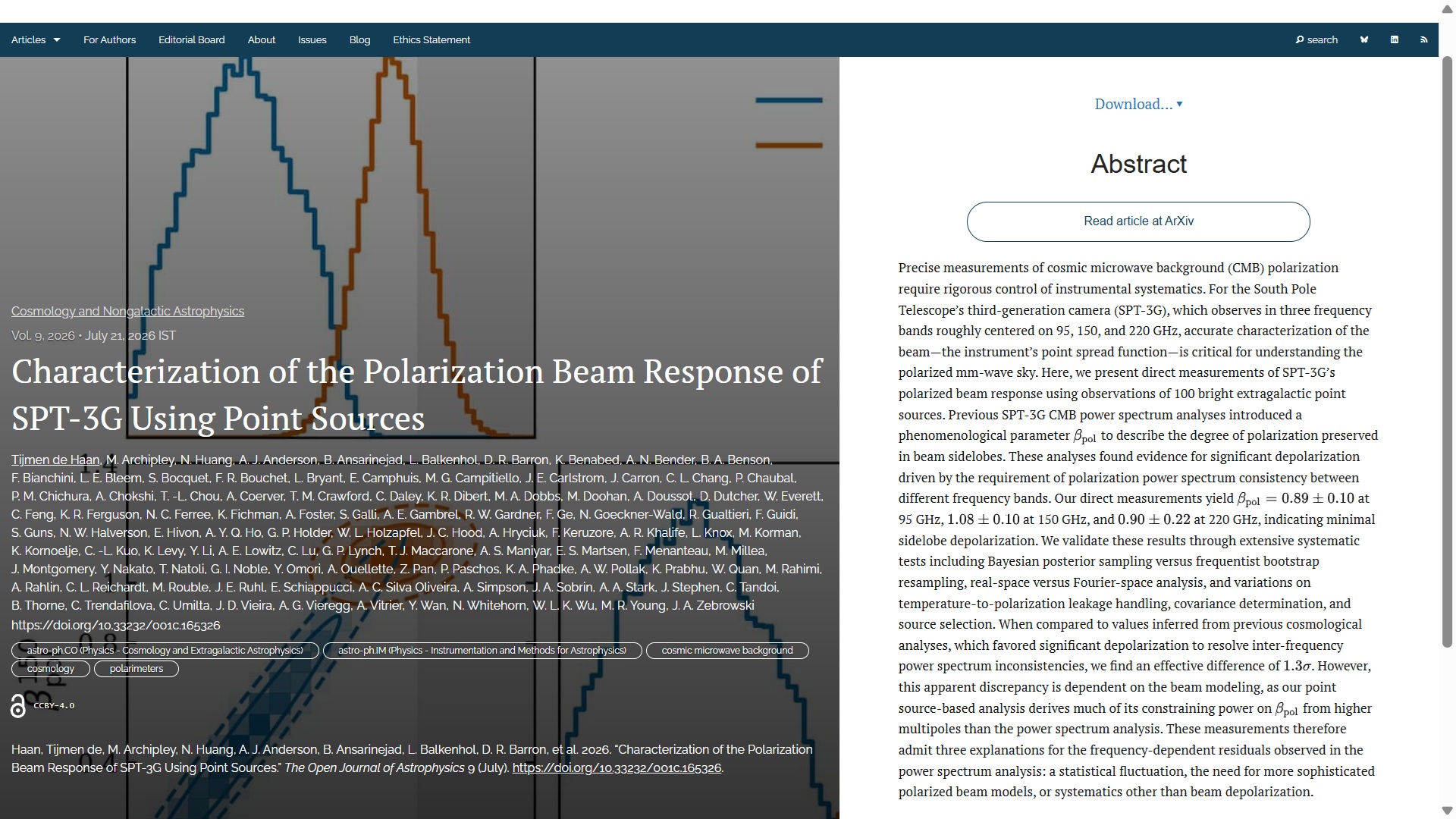
The first paper to report this week was published on Tuesday 21st July in the folder Cosmology and Nongalactic Astrophysics. The title is “Characterization of the Polarization Beam Response of SPT-3G Using Point Sources” by Tijmen de Haan (Institute of Particle and Nuclear Studies, Ibaraki, Japan) and an international cast of 101 others. This study presents measurements of the South Pole Telescope’s polarized beam response, indicating minimal sidelobe depolarization. The findings suggest potential explanations for frequency-dependent residuals in power spectrum analysis.
The overlay for this paper is here
You can find the officially accepted version on arXiv here and the announcement on Fediverse here:
New Publication at the Open Journal of Astrophysics: "Characterization of the Polarization Beam Response of SPT-3G Using Point Sources" by Tijmen de Haan (Institute of Particle and Nuclear Studies, Ibaraki, Japan) and 101 others from around the world
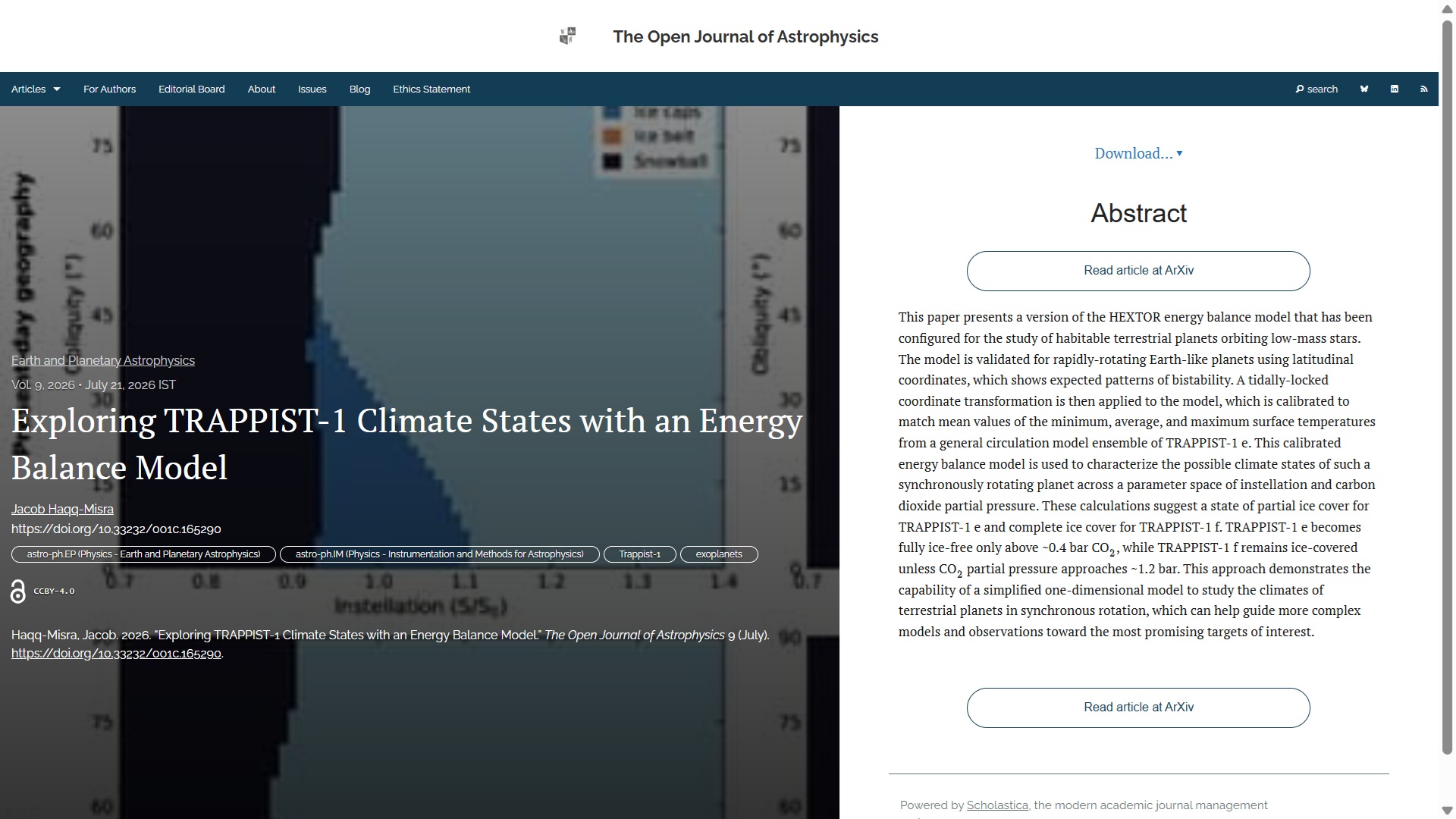
The second paper for this week, also published on Tuesday 21st July but in the folder Earth and Planetary Astrophysics is: “Exploring TRAPPIST-1 Climate States with an Energy Balance Model” by Jacob Haqq-Misra (Blue Marble Space, USA). The study uses a modified HEXTOR energy balance model to predict climate states of terrestrial planets orbiting low-mass stars, suggesting partial to complete ice cover for TRAPPIST-1 e and f.Abstractfor Exploring TRAPPIST-1 Climate States with an Energy Balance Model.
The overlay looks like this:
The official version of the paper can be found on arXiv here and the Fediverse announcement here:
New Publication at the Open Journal of Astrophysics: "Exploring TRAPPIST-1 Climate States with an Energy Balance Model" by Jacob Haqq-Misra (Blue Marble Space, USA)
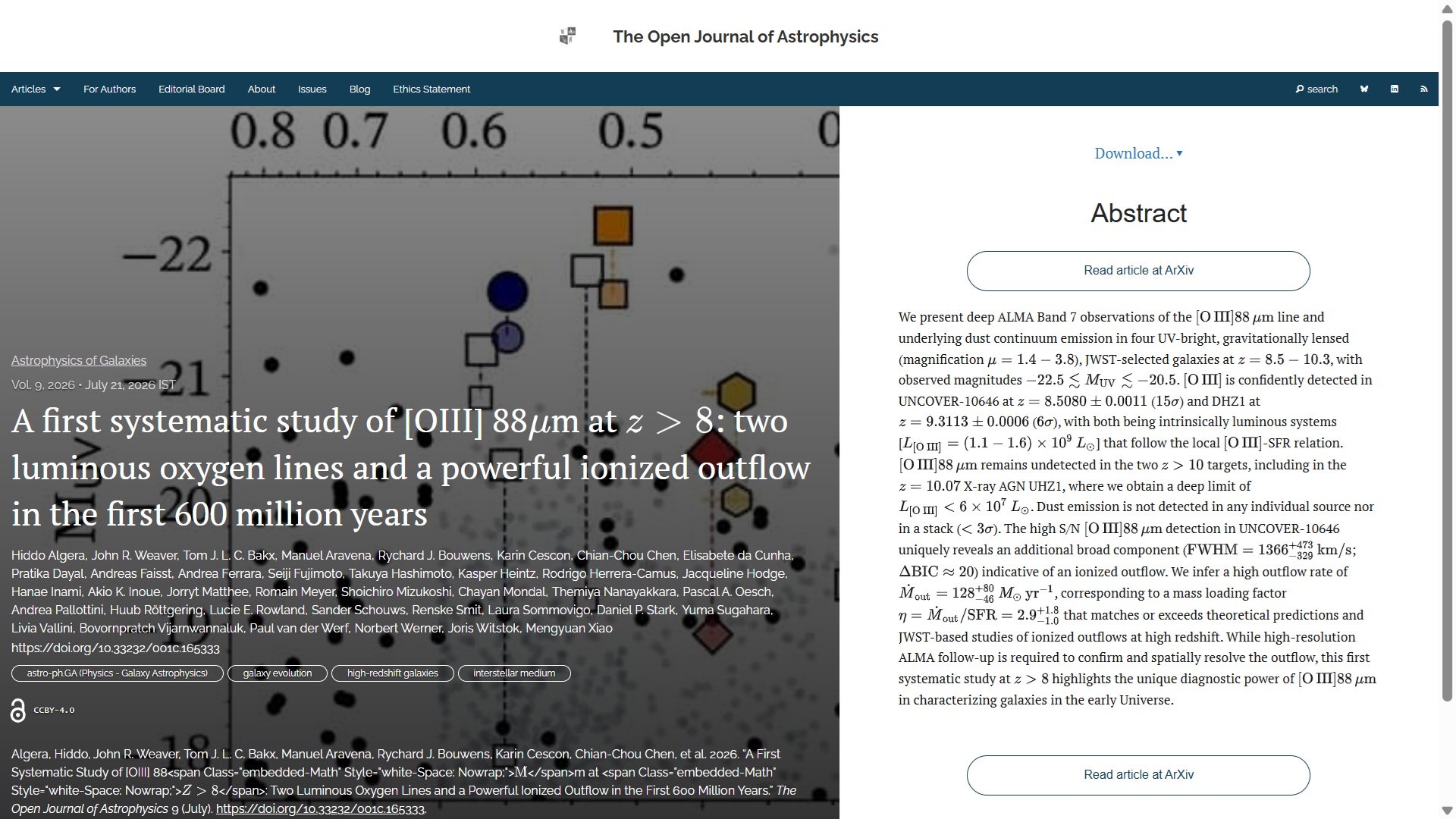
New Publication at the Open Journal of Astrophysics: "A first systematic study of [OIII] 88μm at z>8: two luminous oxygen lines and a powerful ionized outflow in the first 600 million years" by Hiddo Algera (Institute of Astronomy and Astrophysics, Taipei, Taiwan) and 37 others from all around the world.
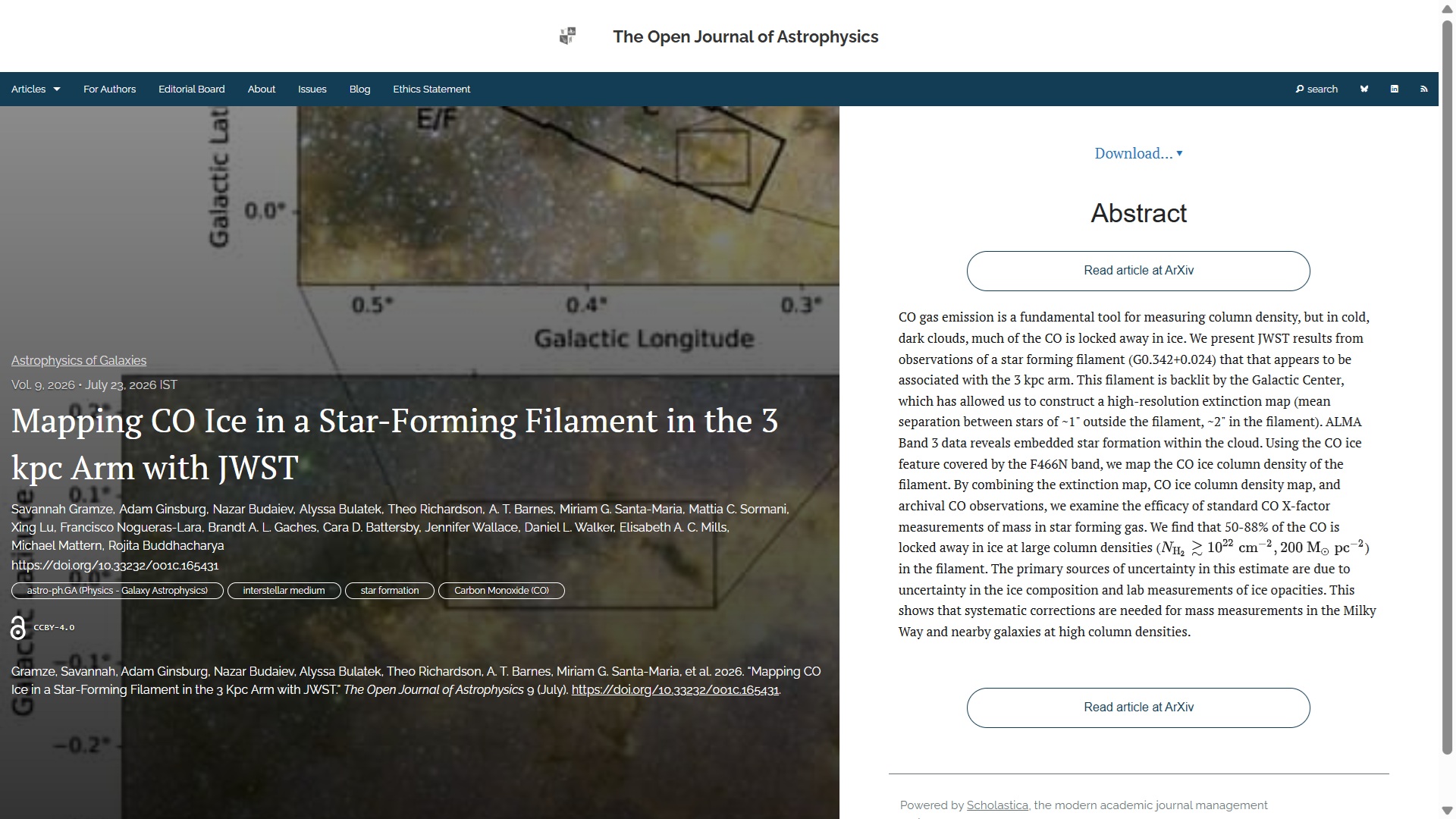
The fourth paper of the week, published on Thursday 23rd July in the folder Astrophysics of Galaxies, is “Mapping CO Ice in a Star-Forming Filament in the 3 kpc Arm with JWST” by Savannah Gramze (U. Florida, USA) and 16 others based all around the world. This paper shows that JWST observations and ALMA Band 3 data reveal that 50-88% of CO gas in a star-forming filament is locked in ice; corrections are needed for mass measurements in such systems.
The overlay for this one is here:
You can read the final version of this one on arXiv here and the Mastodon announcement is here:
New Publication at the Open Journal of Astrophysics: "Mapping CO Ice in a Star-Forming Filament in the 3 kpc Arm with JWST" by Savannah Gramze (U. Florida, USA) and 16 others based all around the world.
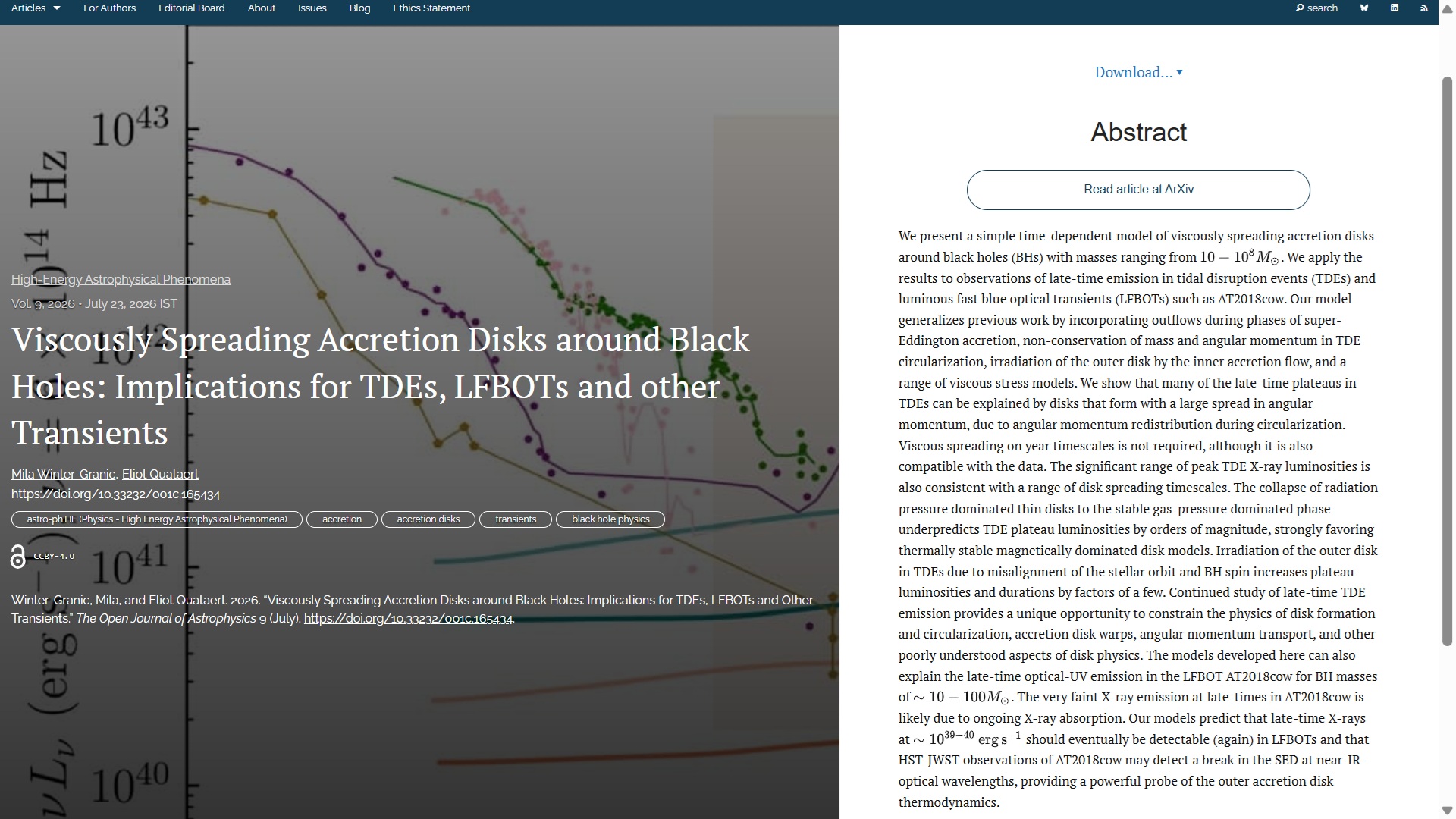
New Publication at the Open Journal of Astrophysics: "Viscously Spreading Accretion Disks around Black Holes: Implications for TDEs, LFBOTs and other Transients" by Mila Winter-Granic and Eliot Quataert (Princeton University, USA)
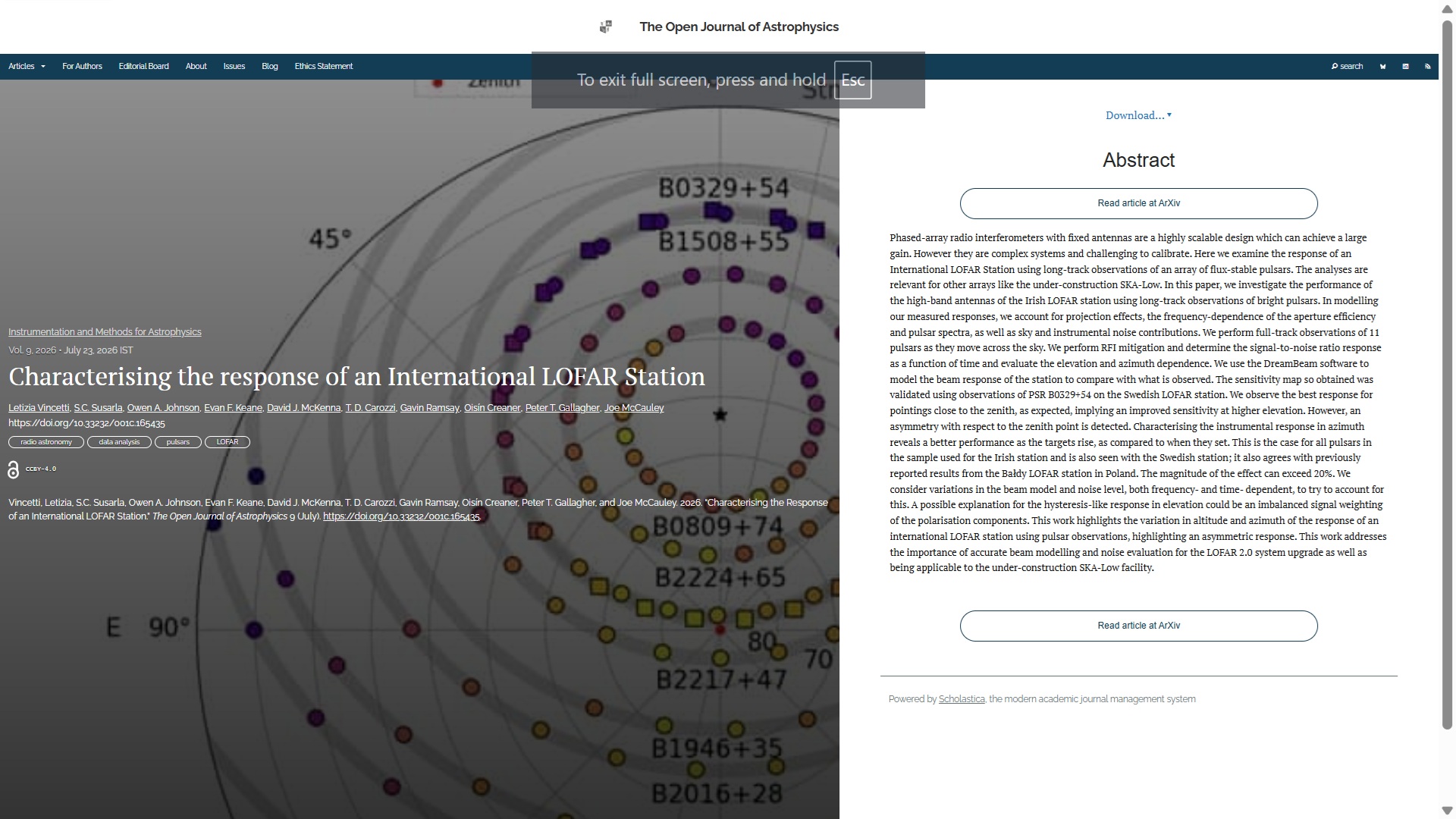
The sixth paper of this week is “Characterising the response of an International LOFAR Station” by Letizia Vincetti (Trinity Collge Dublin, Ireland) and 9 others based in Ireland, USA, The Netherlands and Sweden. This was also published on Thursday July 23rd and is in the folder Instrumentation and Methods for Astrophysics. The article presents an investigation of the performance and calibration challenges of phased-array radio interferometers, using the Irish LOFAR station as a case study, highlighting the importance of accurate beam modelling, etc.
The overlay for this one is here:
You can find the final accepted version on arXiv here and the Mastodon announcement is here:
New Publication at the Open Journal of Astrophysics: "Characterising the response of an International LOFAR Station" by Letizia Vincetti (Trinity Collge Dublin, Ireland) and 9 others based in Ireland, USA, The Netherlands and Sweden
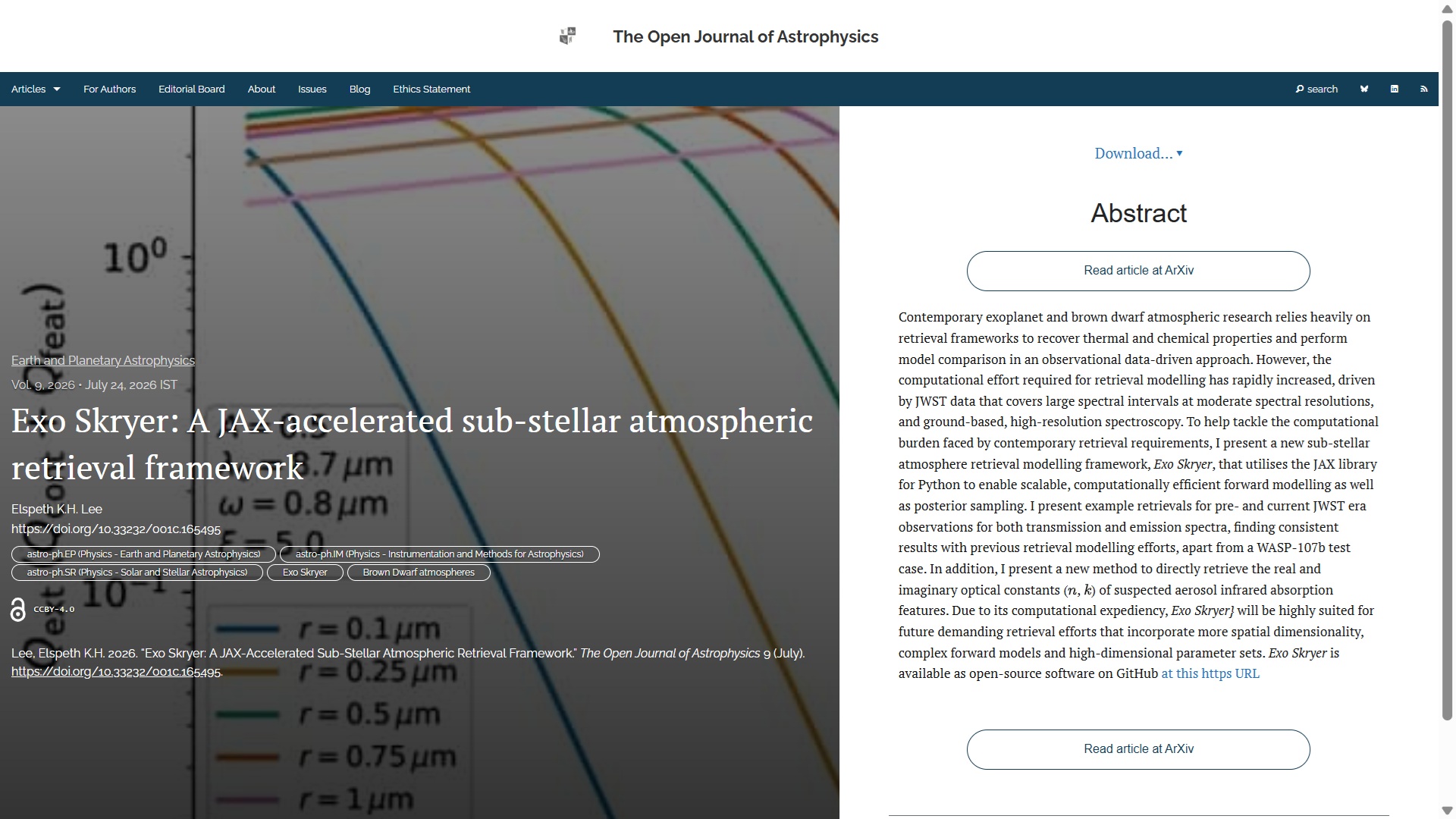
New Publication at the Open Journal of Astrophysics: "Exo Skryer: A JAX-accelerated sub-stellar atmospheric retrieval framework" by Elspeth K.H. Lee (U. Bern, Switzerland)
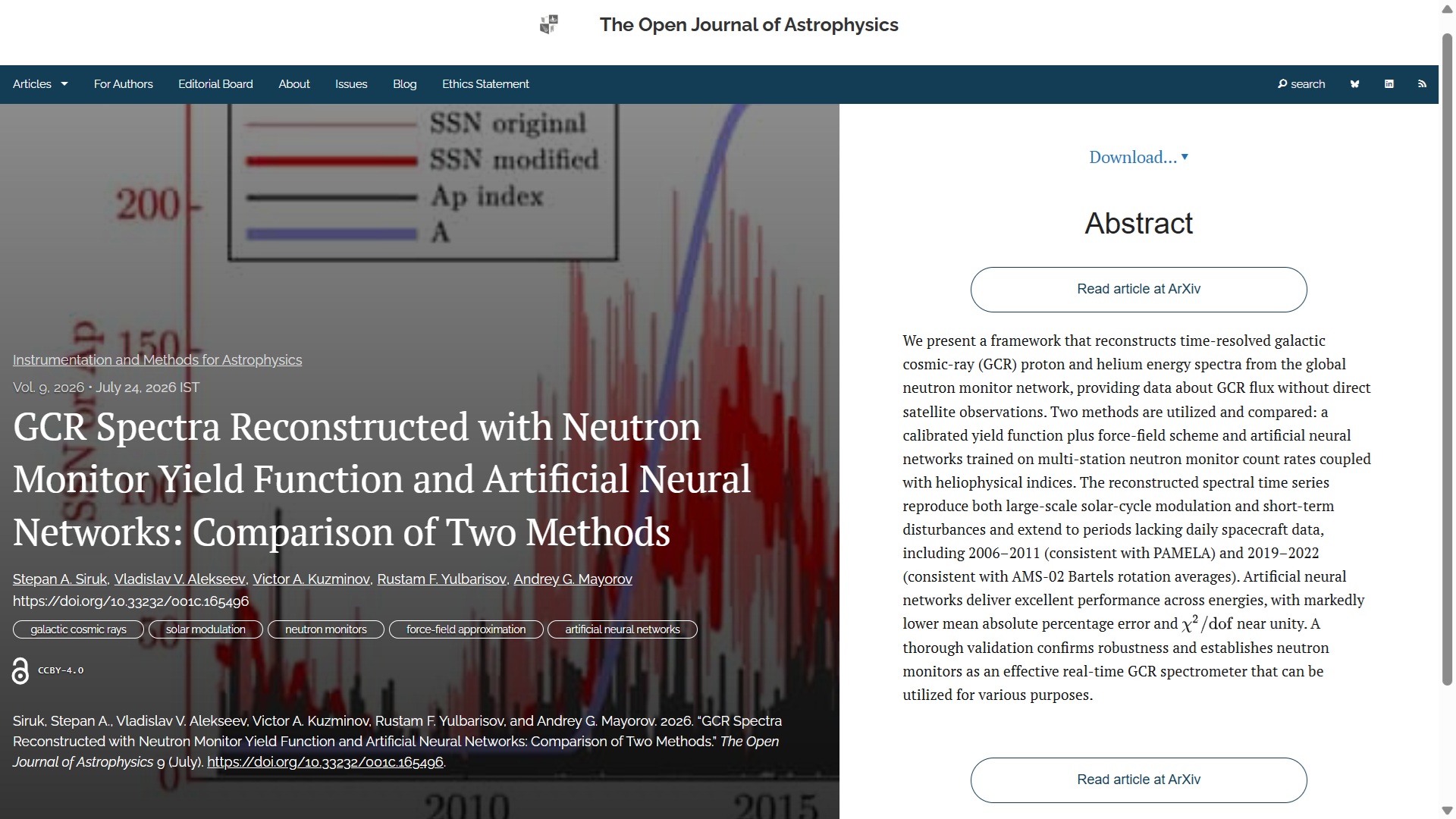
New Publication at the Open Journal of Astrophysics: "GCR Spectra Reconstructed with Neutron Monitor Yield Function and Artificial Neural Networks: Comparison of Two Methods" by Stepan A. Siruk (Moscow Engineering Physics Institute MEPhI, Russia) and four others based in Russia
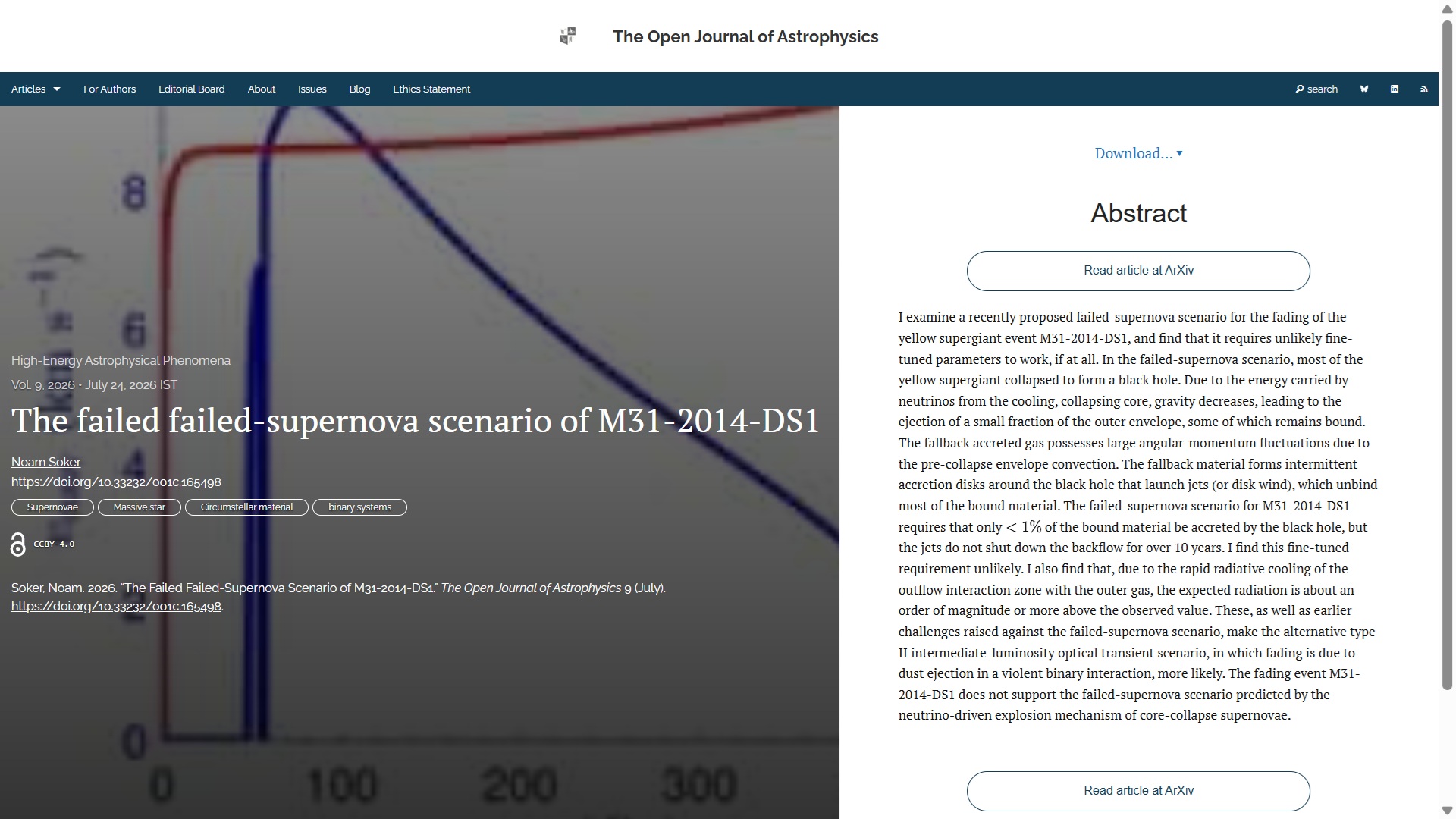
And finally for this week we have “The failed failed-supernova scenario of M31-2014-DS1” by Noam Soker (Technion, Israel), a paper which challenges the failed-supernova theory for the fading of the yellow supergiant event M31-2014-DS1, suggesting it requires unlikely parameters and supports an alternative scenario involving violent binary interaction. This was published on Friday 24th July in the folder High-Energy Astrophysical Phenomena.
The overlay for this one is here:
You can find the final accepted version on arXiv here and the Mastodon announcement is here:
And that concludes the update of this week’s business. As it was foretold, the total number of publications at OJAp has now passed the 600 mark, and the likely number for 2026 is around 300. We published a paper in five of the six astro-ph categories this week, but still haven’t had a week when we’ve published a full house with at least one in all six…
The views presented here are personal and not necessarily those of my employer (or anyone else for that matter).
Feel free to comment on any of the posts on this blog but comments may be moderated; anonymous comments and any considered by me to be vexatious and/or abusive and/or defamatory will not be accepted. I do not necessarily endorse, support, sanction, encourage, verify or agree with the opinions or statements of any information or other content in the comments on this site and do not in any way guarantee their accuracy or reliability.