It’s Saturday again so it’s time for another update of activity at the Open Journal of Astrophysics. Since the last update we have published a further three papers, bringing the number in Volume 9 (2026) to 122 and the total so far published by OJAp up to 570.
I will continue to include the posts made on our Mastodon account (on Fediscience); these announcements also show the DOI for each paper.
The first paper to report this week, published on Thursday 11th June, is “Dancing Streams In Merging Halos: Stellar Streams in a MW–LMC-like merger” by (all based in the USA): Sachi Weerasooriya (Carnegie Observatories), Tjitske Starkenburg (Northwestern U.), Emily C. Cunningham (Columbia U.) & Kathryn V. Johnston (Flatiron Institute). This article explores how galaxy mergers, like the Milky Way-Large Magellanic Cloud merger, significantly alter the properties and structures of stellar streams, challenging the recovery of their initial orbits. It is in the folder marked Astrophysics of Galaxies.
The overlay for this paper is here
You can find the officially accepted version on arXiv here and the announcement on Fediverse here:
New Publication at the Open Journal of Astrophysics: "Dancing Streams In Merging Halos: Stellar Streams in a MW–LMC-like merger" by (all based in the USA): Sachi Weerasooriya (Carnegie Observatories), Tjitske Starkenburg (Northwestern U.), Emily C. Cunningham (Columbia U.) & Kathryn V. Johnston (Flatiron Institute).
New Publication at the Open Journal of Astrophysics: "X-SORTER (X-ray Survey Of meRging clusTErs in Redmapper): X-ray and Spectroscopic Characterization of 12 Optically Selected Galaxy Cluster Merger Candidates" by Christopher Hopp, David Wittman, Rodrigo Stancioli, Zhuoran Gao & Faik Bouhrik (UC Davis) and Scott Adler (Rochester), all based in the USA.
The third and final paper of the week, published on Friday 12th June in the folder Earth and Planetary Astrophysics, is “JCMT Constraints on the Early-Time HCN and CO Emission and HCN Temporal Evolution of 3I/ATLAS” by Jason T. Hinkle (U. Illinois, USA) and 6 others based in the USA and Chile. This article presents observations of the third Interstellar Object, 3I/ATLAS, providing early sub-mm constraints on its activity. The findings suggest a steeper production rate slope than typical Solar System comets.
The overlay for this one is here:
The final, accepted version can be found on arXiv here and the Mastodon announcement is here:
New Publication at the Open Journal of Astrophysics: "JCMT Constraints on the Early-Time HCN and CO Emission and HCN Temporal Evolution of 3I/ATLAS" by Jason T. Hinkle (U. Illinois, USA) and 6 others based in the USA and Chile.
And that concludes this week’s update. It has been a slow week on the publishing front, but the main reason is that we have a big backlog of papers accepted but waiting for the authors to put their final versions on arXiv and we can’t do anything about that! I’ll do another update next Saturday.
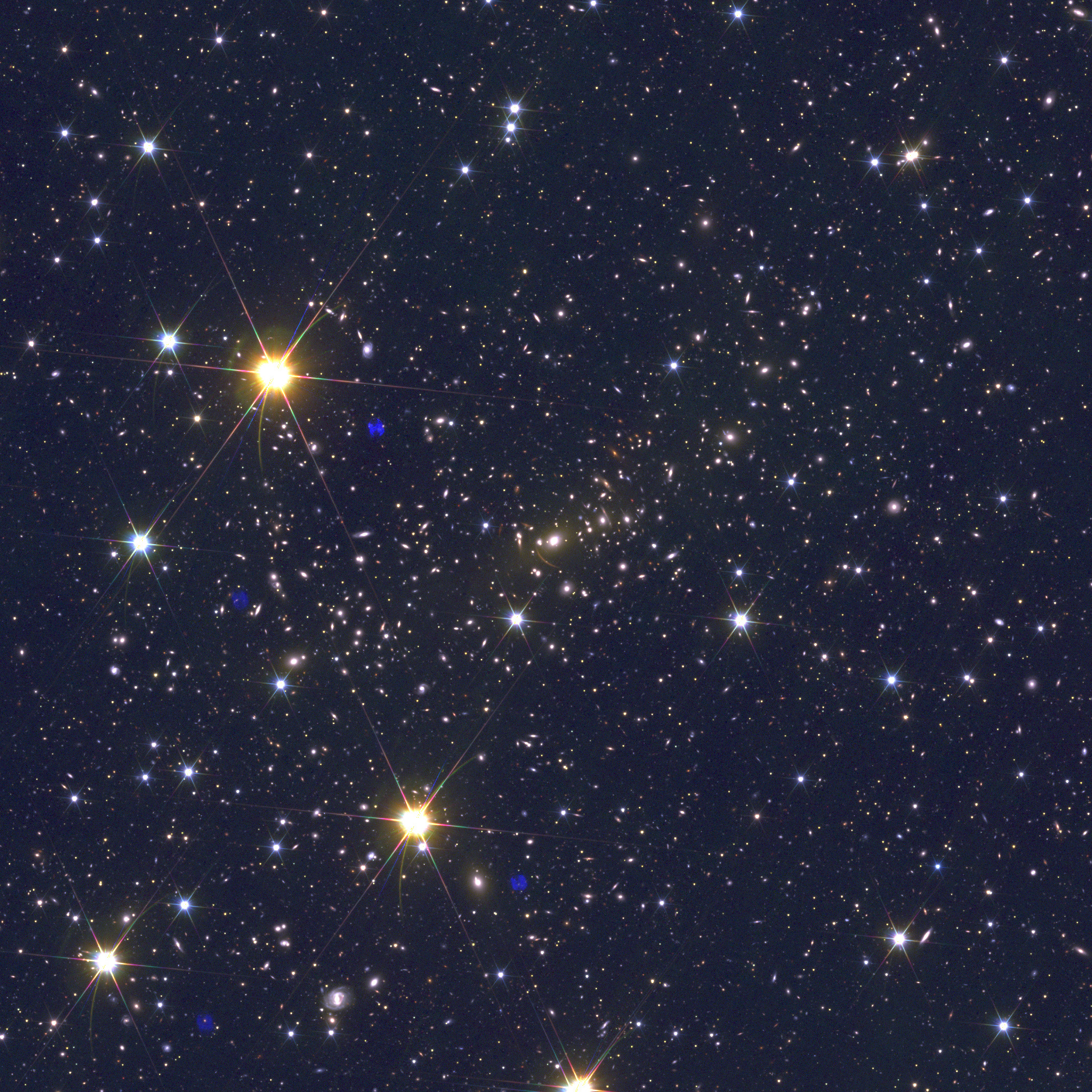
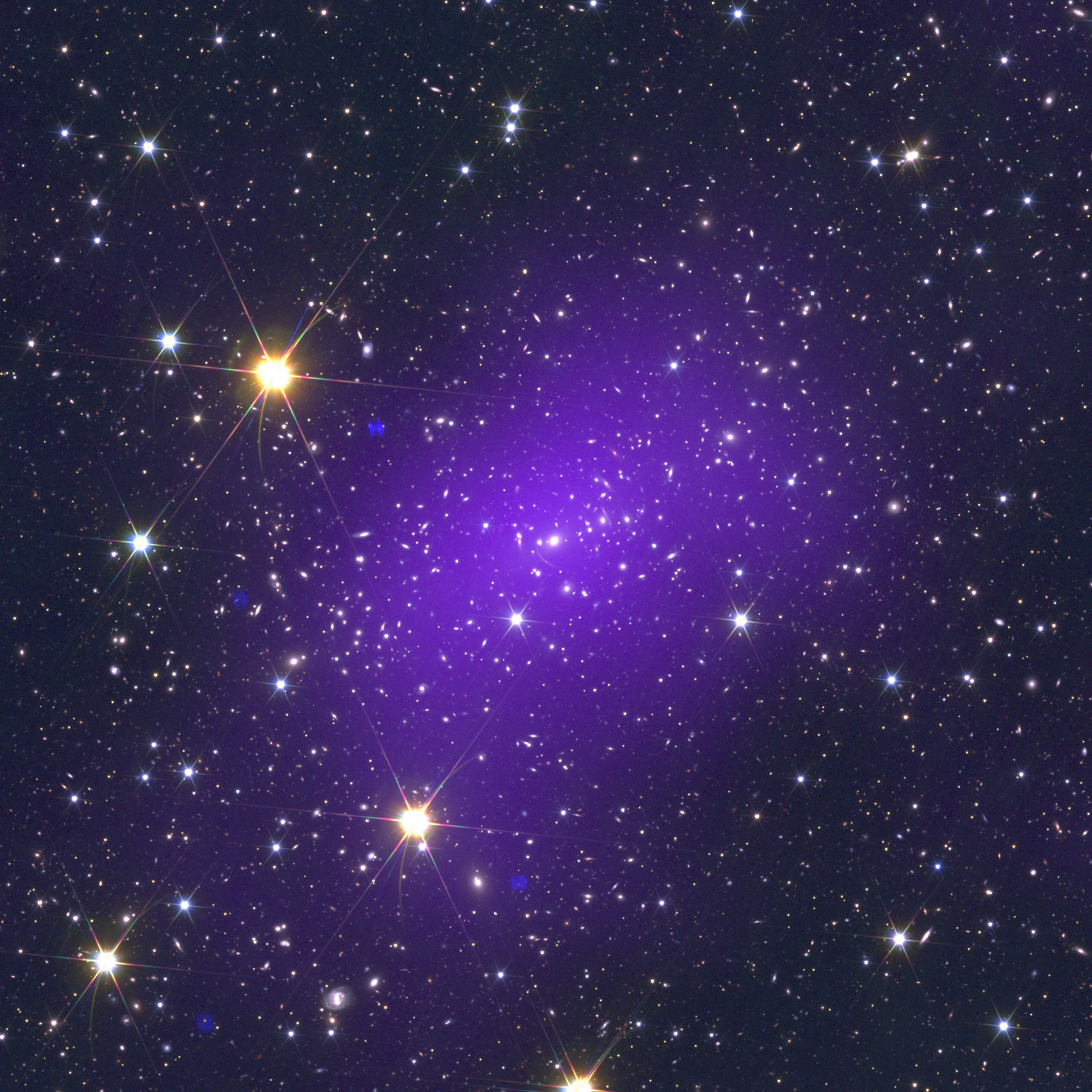
I’ve been slow onto a result which was announced last week concerning the detection weak gravitational lensing in the cluster Abell 2390 by the Euclid spacecraft and its use to determine the distribution of dark matter in the cluster. You can find a full discussion of the result here and the scientific paper is here.
The analysis was based on Early Release Observations of the cluster, a pretty picture of which are shown here:
Credit: ESA/Euclid/Euclid Consortium/NASA, image processing by J.-C. Cuillandre (CEA Paris-Saclay), G. Anselmi.
(The little blue patches are artefacts caused by internal reflections in the VIS instrument and can be dealt with in software.)
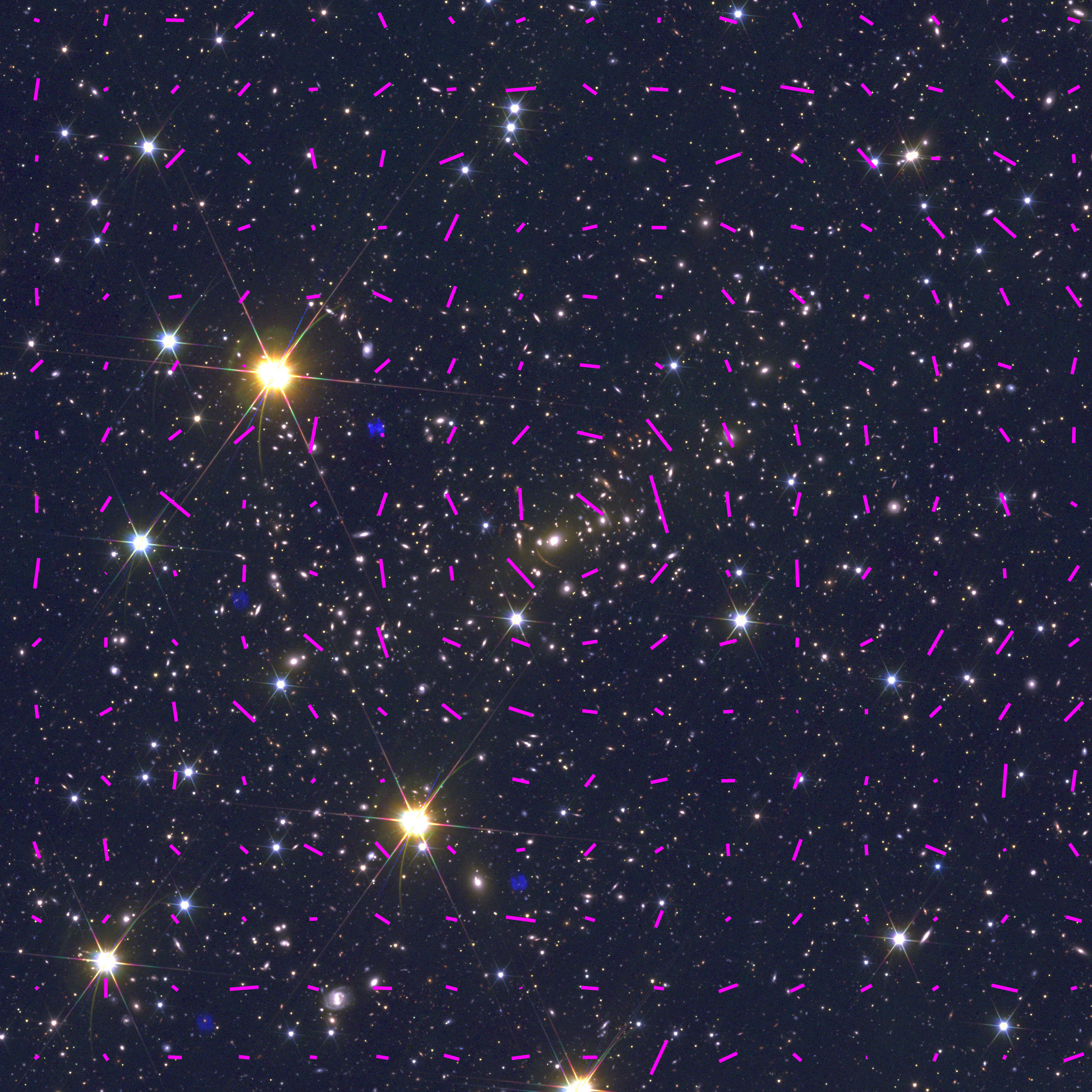
According to general relativity, the presence of any mass bends the path of light passing near it, producing gravitational lensing. The most famous examples of this are the giant arcs and multiple images associated with strong gravitational lensing, but these are very rare as they require good alignment between observer, lens and source.. Most lines of sight in the universe do not satisfy this condition so are in the weak lensing regime. Even in such cases, however, the presence of the foreground mass can be detected, by way of a systematic alignment in the orientation of background sources around the lensing mass. A circular background image would be distorted into an ellipse by this process. Unfortunately galaxies aren’t circular but are approximately elliptical, so the shape of each source is changed from an ellipse to differently shaped ellipse. The distortion is therefore impossible to detect in a single background source because we don’t know the intrinsic orientation of the galaxy, but the distortion of different sources is correlated in a particular way. Weak gravitational lensing is thus an intrinsically statistical measurement, but it provides a way to measure the masses of astronomical objects without requiring assumptions about their composition or dynamical state. Weak gravitational lensing observations are, however technically difficult to carry out and analyse, as one has to be very careful that no correlations are introduced by systematic errors in the optics.
Anyway, they say that a picture paints a thousand words so here are two pictures. On the left we see the shear axes as extracted from the above image and on the right the inferred dark matter distribution. You can slide the bar backwards and forwards to see how the two images relate.
Shear map (left) and inferred dark matter distribution (right)
You can see that the shear tends to be aligned tangentially to a line connecting the image to the cluster centre (in the plane of the sky), which is what theory would predict.
There’ll be much more of this sort of analysis in the full Euclid Survey. I hope to be able to give an update about this reasonably soon.
Another Saturday, another update of activity at the Open Journal of Astrophysics. Since the last update we have published a further five papers, bringing the number in Volume 9 (2026) to 119 and the total so far published by OJAp up to 567.
I will continue to include the posts made on our Mastodon account (on Fediscience); these announcements also show the DOI for each paper.
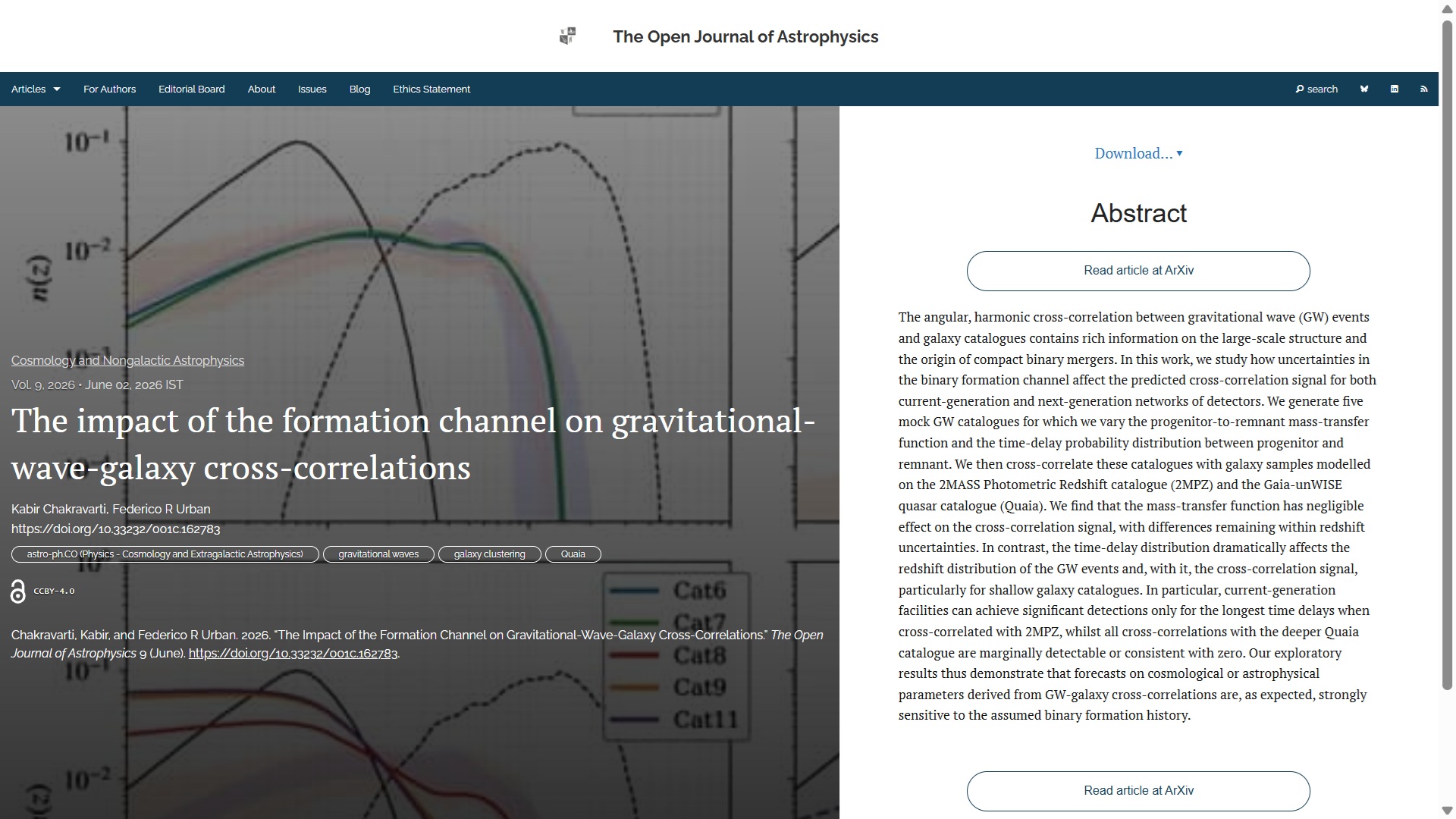
The first paper to report this week, published on Tuesday 2nd June, is “The impact of the formation channel on gravitational-wave-galaxy cross-correlations” by Kabir Chakravarti (Chennai Mathematical Institute, India) and Federico R Urban (CEICO-FZU, Czech Republic). This article, published in the folder Cosmology and Nongalactic Astrophysics, explores how uncertainties in binary formation affect the cross-correlation signal between gravitational wave events and galaxy catalogues, finding that time-delay distribution significantly impacts the signal.
The overlay for this paper is here
You can find the officially accepted version on arXiv here and the announcement on Fediverse here:
New Publication at the Open Journal of Astrophysics: "The impact of the formation channel on gravitational-wave-galaxy cross-correlations" by Kabir Chakravarti (Chennai Mathematical Institute, India) and Federico R Urban (CEICO-FZU, Czech Republic)
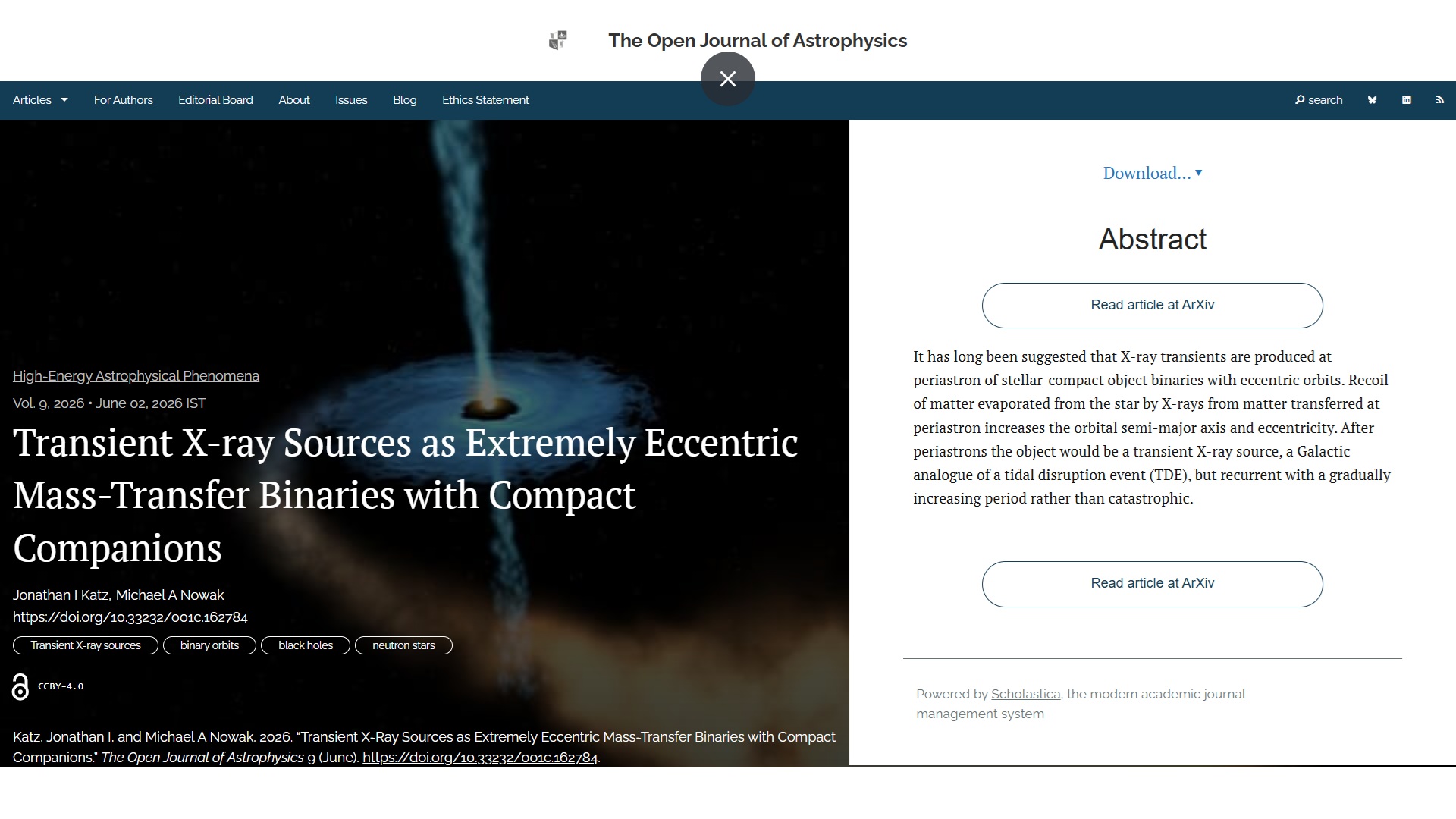
New Publication at the Open Journal of Astrophysics: "Transient X-ray Sources as Extremely Eccentric Mass-Transfer Binaries with Compact Companions" by Jonathan I Katz and Michael A Nowak (Washington University, USA)
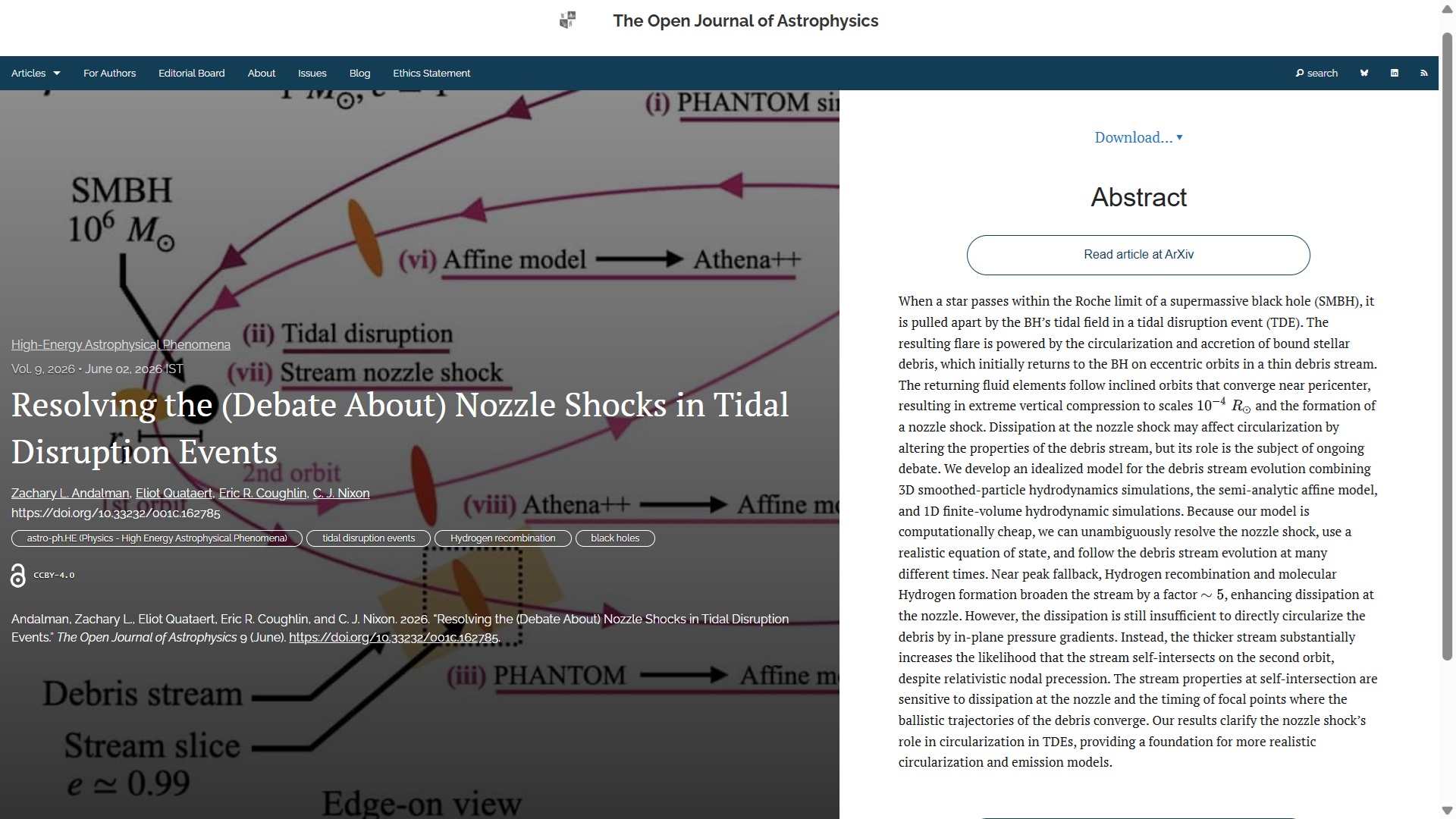
Next one up, the third paper of the week, also published on Tuesday 2nd June in the folder High-Energy Astrophysical Phenomena is “Resolving the (Debate About) Nozzle Shocks in Tidal Disruption Events” by Zachary L. Andalman & Eliot Quataert (Princeton U., USA), Eric R. Coughlin (Syracuse U. USA) and C. J. Nixon (U. Leeds, UK). This paper presents a model to understand the role of nozzle shocks in the circularization of stellar debris during a tidal disruption event when a star approaches a supermassive black hole (SMBH)
The overlay for this one is here:
The final, accepted version can be found on arXiv here and the Mastodon announcement is here:
New Publication at the Open Journal of Astrophysics: "Resolving the (Debate About) Nozzle Shocks in Tidal Disruption Events" by Zachary L. Andalman & Eliot Quataert (Princeton U., USA), Eric R. Coughlin (Syracuse U. USA) and C. J. Nixon (U. Leeds, UK)
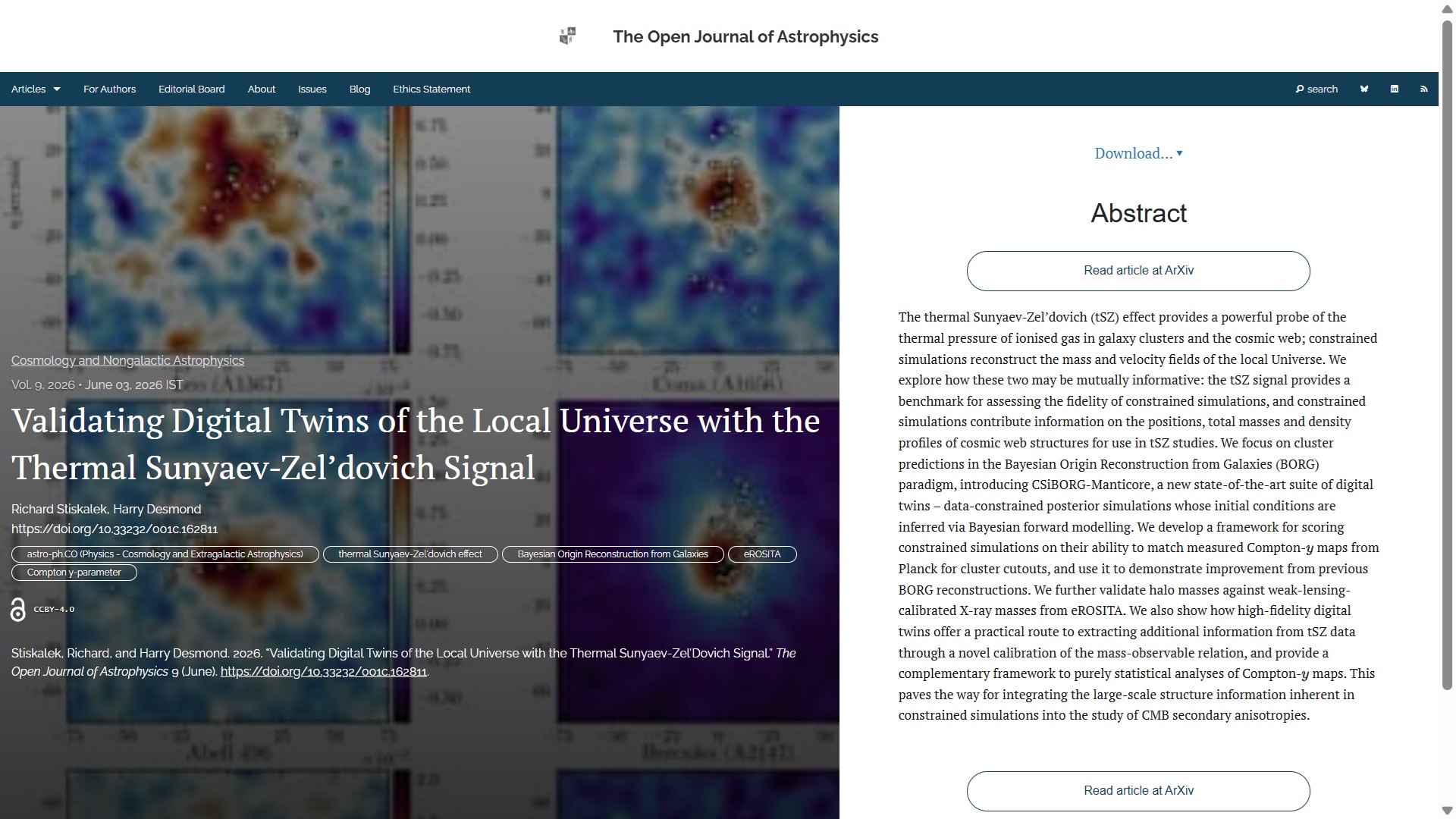
The fourth paper this week, published on Wednesday 3rd June in the folder Cosmology and Nongalactic Astrophysics, is “Validating Digital Twins of the Local Universe with the Thermal Sunyaev-Zel’dovich Signal” by Richard Stiskalek (University of Oxford, UK) and Harry Desmond (University of Portsmouth, UK). The thermal Sunyaev-Zel’dovich effect and constrained simulations are used to analyze the thermal pressure of ionized gas in galaxy clusters and produce a set of digital twins for cosmological study.
The overlay is here:
The officially accepted version can be found on arXiv here and here is the Mastodon announcement:
New Publication at the Open Journal of Astrophysics: "Validating Digital Twins of the Local Universe with the Thermal Sunyaev-Zel’dovich Signal" by Richard Stiskalek (U. Oxford, UK) and Harry Desmond (U. Portsmouth, UK)
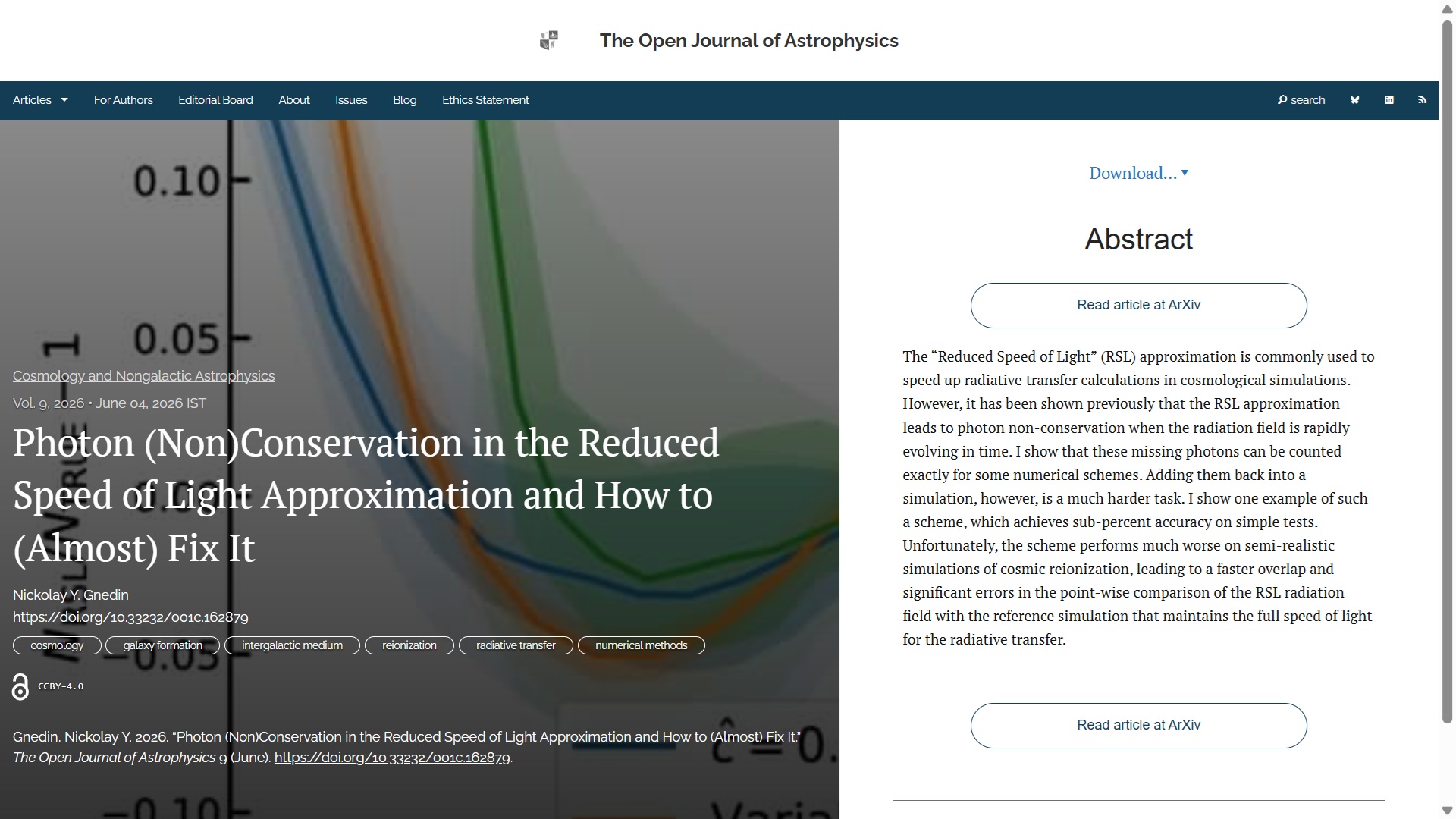
New Publication at the Open Journal of Astrophysics: "Photon (Non)Conservation in the Reduced Speed of Light Approximation and How to (Almost) Fix It" by Nickolay Y. Gnedin (U. Chicago, USA)
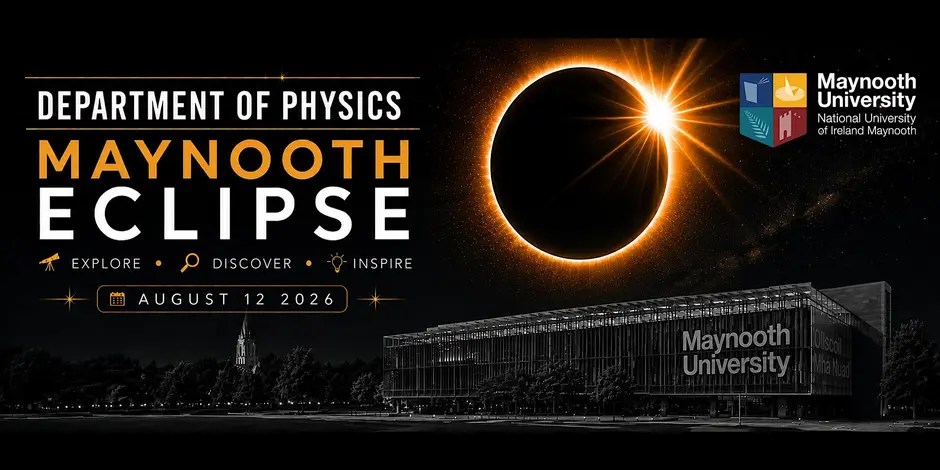
Here’s an invitation to people interested in astronomy to join staff from the Department of Physics at Maynooth University on Wednesday, August 12th 2026 from 5:30 pm to 8:30 pm for a special public celebration of one of the deepest solar eclipses visible from Ireland in decades. The next eclipse with > 90% obscuration of the Sun by the Moon won’t be seen again in Ireland until 2090, by which time I will have retired.
Experience the eclipse safely through:
eclipse viewing glasses
solar telescopes
live astronomy demonstrations
List of Solar Talks during the evening:
Dr. Emma Whelan – The Story of the Sun
Dr. Joshuah Heath – The Quantum Sun
Dr. Marcin Gradziel – (Electric) Power from the Sun. The good, the bad, and the glinty!
Dr. Michelle McCrystall – The star of the show: How the Sun drives our climate
Prof. Peter Coles – Einstein and the Eclipse (Who He? Ed.)
Dr. Patrick Kavanagh – Will our Sun go Supernova?
The evening will also include:
an immersive* astronomy show in our inflatable planetarium
hands-on arts and crafts activities for children
*especially if it rains
Maynooth University Staff can reserve a place here until June 14th, after which booking will be opened to the general public – I’ll repost this invitation with a link at that time.
It’s Saturday once again, so it’s time for another update of activity at the Open Journal of Astrophysics. Since the last update we have published a further four papers, bringing the number in Volume 9 (2026) to 114 and the total so far published by OJAp up to 562.
I will continue to include the posts made on our Mastodon account (on Fediscience); these announcements also show the DOI for each paper.
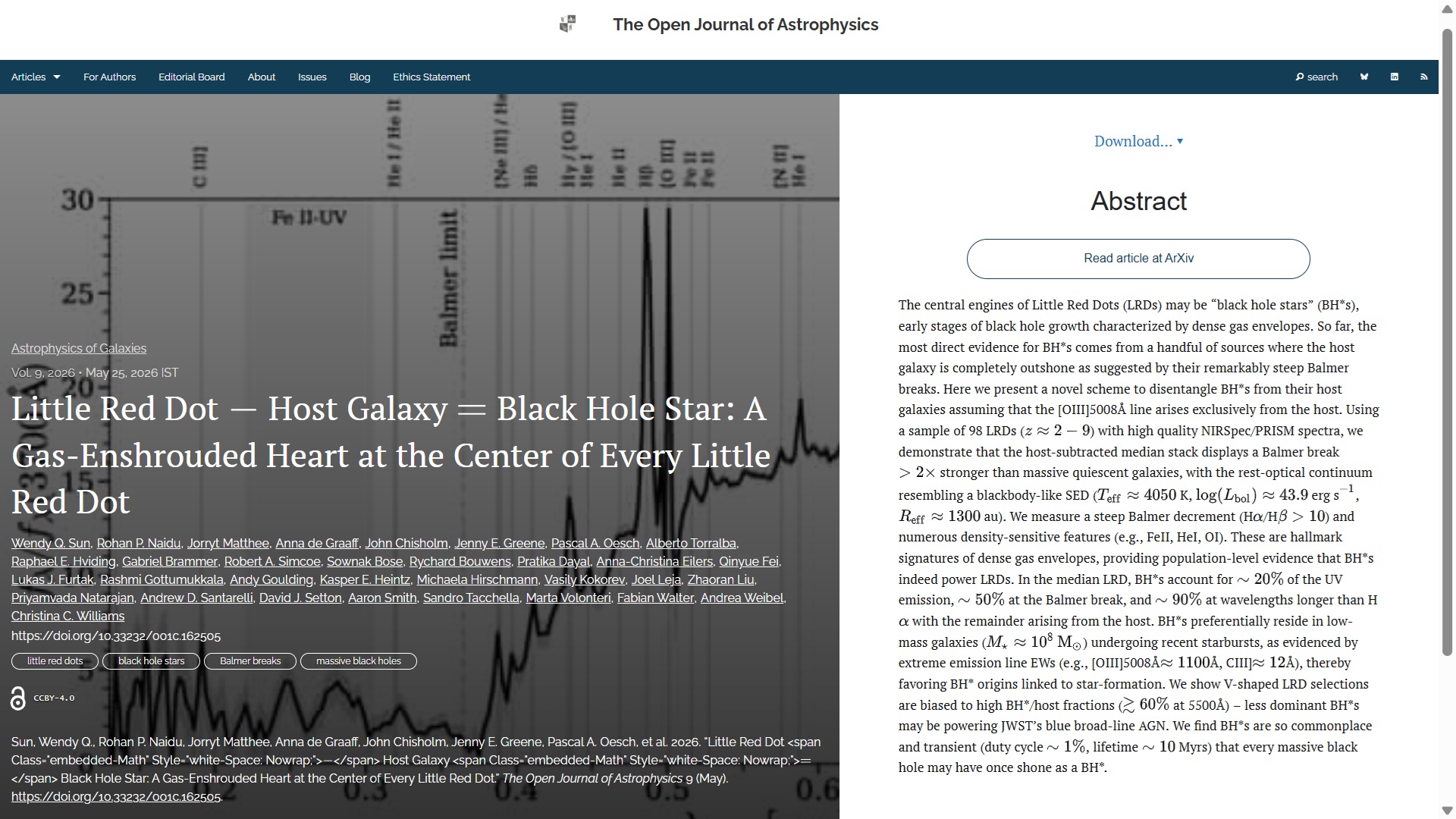
New Publication at the Open Journal of Astrophysics: "Little Red Dot – Host Galaxy = Black Hole Star: A Gas-Enshrouded Heart at the Center of Every Little Red Dot" by Wendy Q. Sun (MIT, USA) and 32 others from around the world.
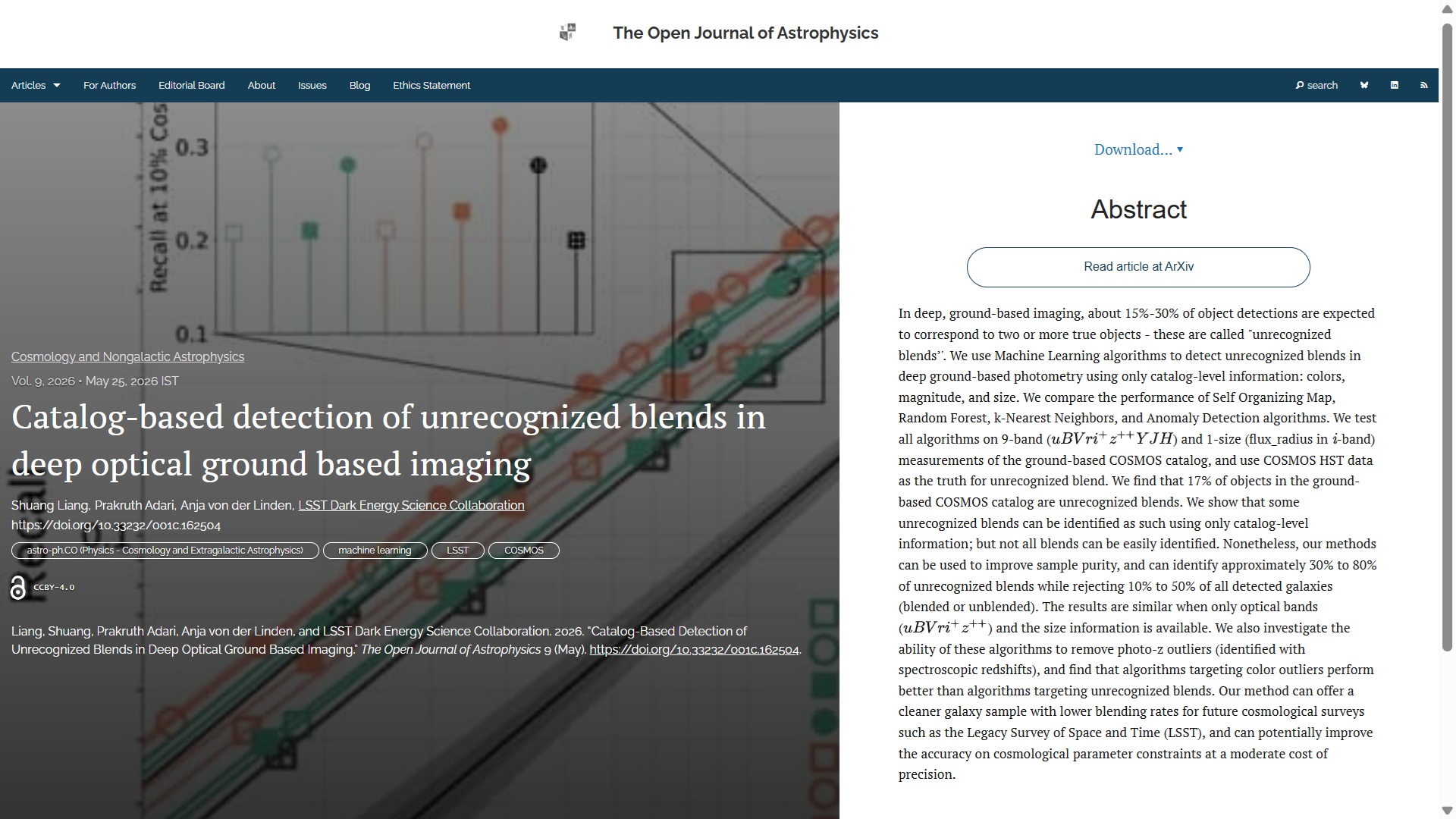
New Publication at the Open Journal of Astrophysics: "Catalog-based detection of unrecognized blends in deep optical ground based imaging" by Shuang Liang (Stanford U., USA) and Prakruth Adari & Anja von der Linden (Stony Brook U., USA) on behalf of the LSST Dark Energy Science Collaboration
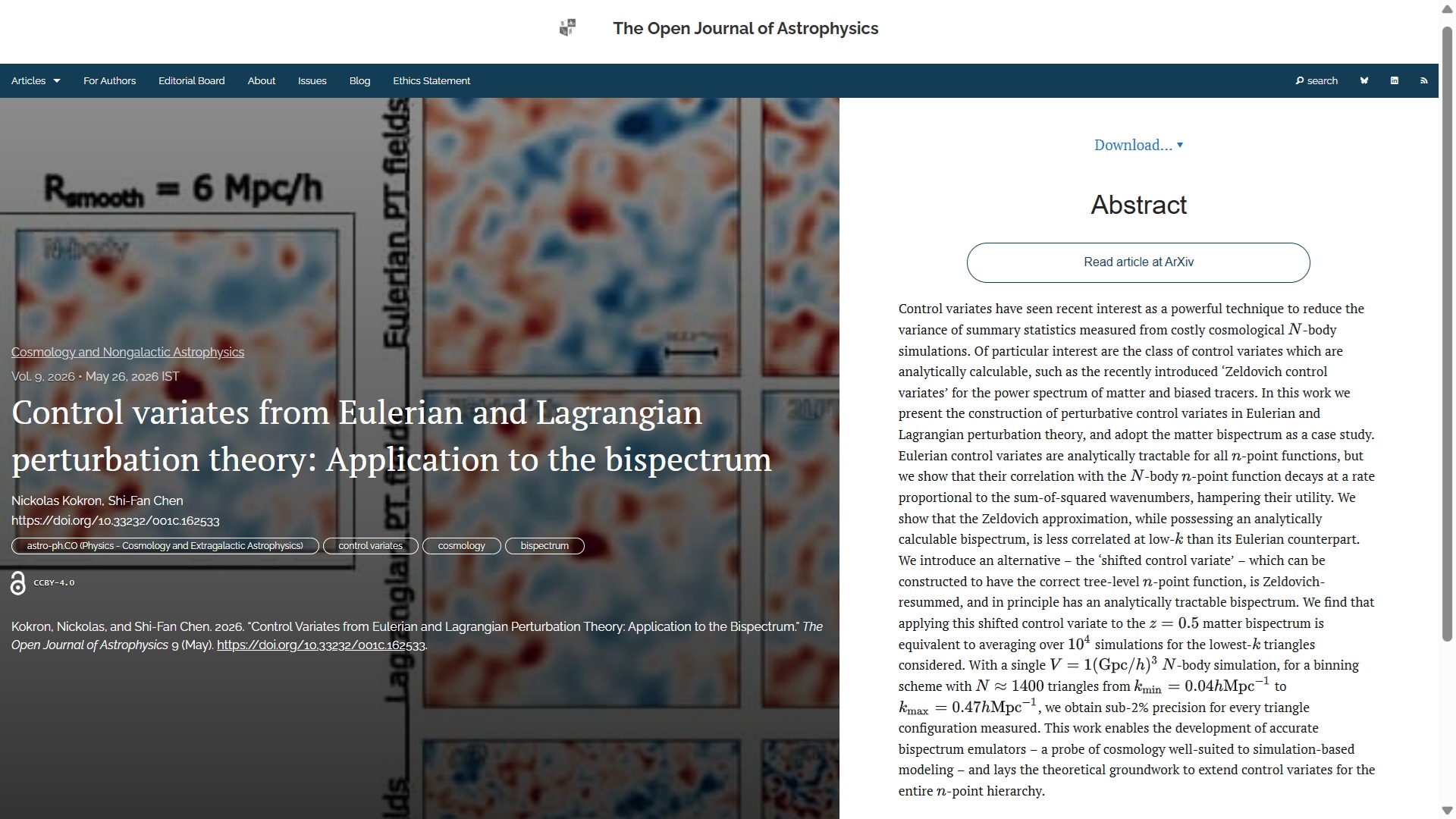
Next one up, the third paper of the week, published on Tuesday 26th May in the folder Cosmology and Nongalactic Astrophysics is “Control variates from Eulerian and Lagrangian perturbation theory: Application to the bispectrum” by Nickolas Kokron and Shi-Fan Chen (Institute for Advanced Study, Princeton, USA). This paper hexplores the use of control variates in cosmological simulations, introducing a new ‘shifted control variate’ that improves precision and enables accurate bispectrum emulators, aiding in cosmology modeling.
The overlay for this one is here:
The final, accepted version can be found on arXiv here and the Mastodon announcement is here:
New Publication at the Open Journal of Astrophysics: "Probing Dark Energy Microphysics with kSZ Tomography" by Julius Adolff, Selim Hotinli and Neal Dalal (Perimeter Institute, Canada)
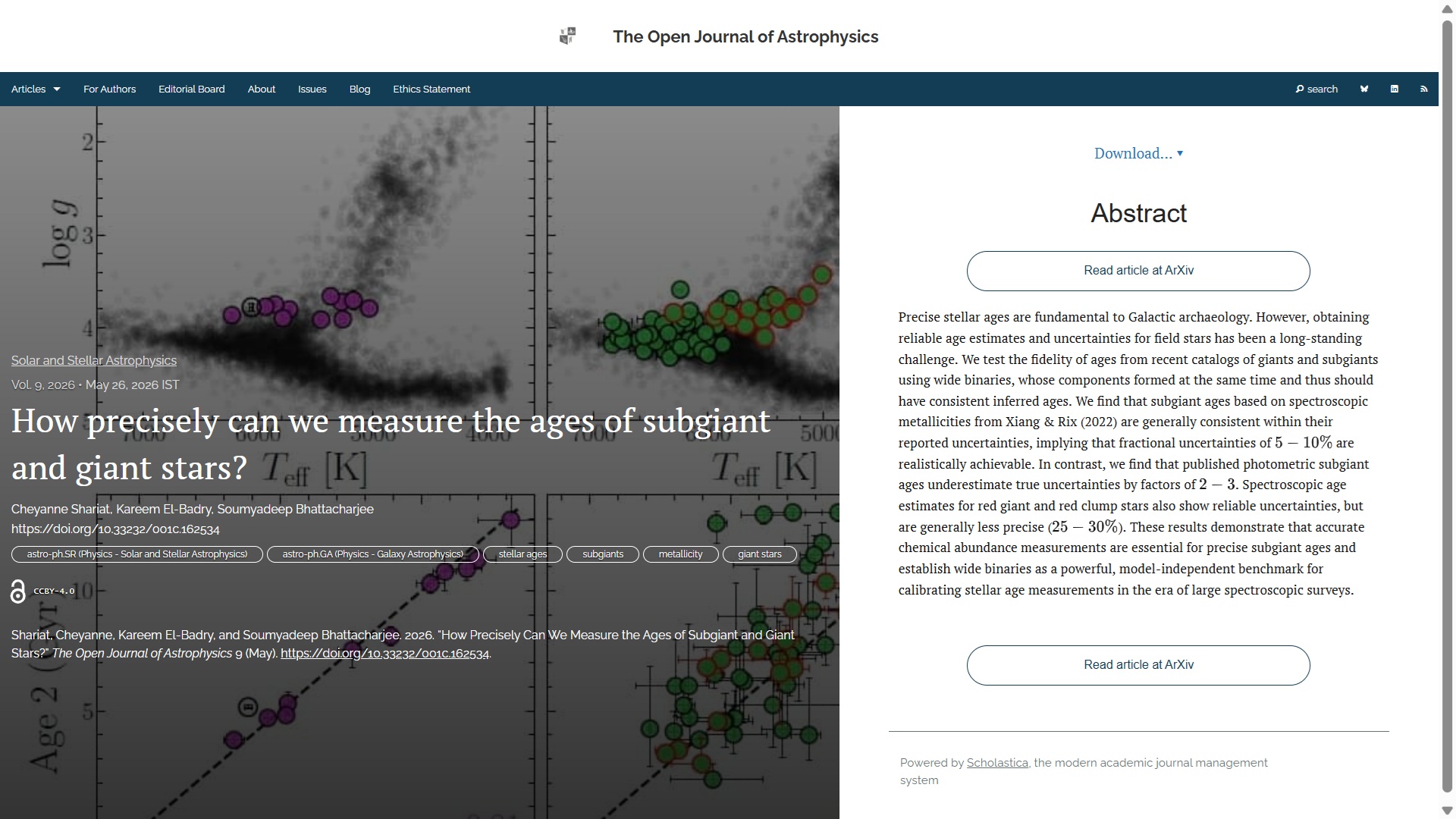
The fourth and final paper this week, also published on Tuesday 26th May is “How precisely can we measure the ages of subgiant and giant stars?” by Cheyanne Shariat, Kareem El-Badry and Soumyadeep Bhattacharjee (California Institute of Technology, USA). This article, published in the folder Solar and Stellar Astrophysics, is about testing the accuracy of stellar age estimates from recent catalogs, finding that spectroscopic metallicities provide reliable subgiant ages, while photometric ages underestimate uncertainties. Accurate chemical abundance measurements are essential.
The overlay is here:
The officially accepted version can be found on arXiv here and here is the Mastodon announcement:
New Publication at the Open Journal of Astrophysics: "How precisely can we measure the ages of subgiant and giant stars?" by Cheyanne Shariat, Kareem El-Badry and Soumyadeep Bhattacharjee (California Institute of Technology, USA)
It’s Saturday once again, so time for another update of activity at the Open Journal of Astrophysics. Since the last update we have published a further six papers, bringing the number in Volume 9 (2026) to 110 and the total so far published by OJAp up to 558.
I will continue to include the posts made on our Mastodon account (on Fediscience); these announcements also show the DOI for each paper.
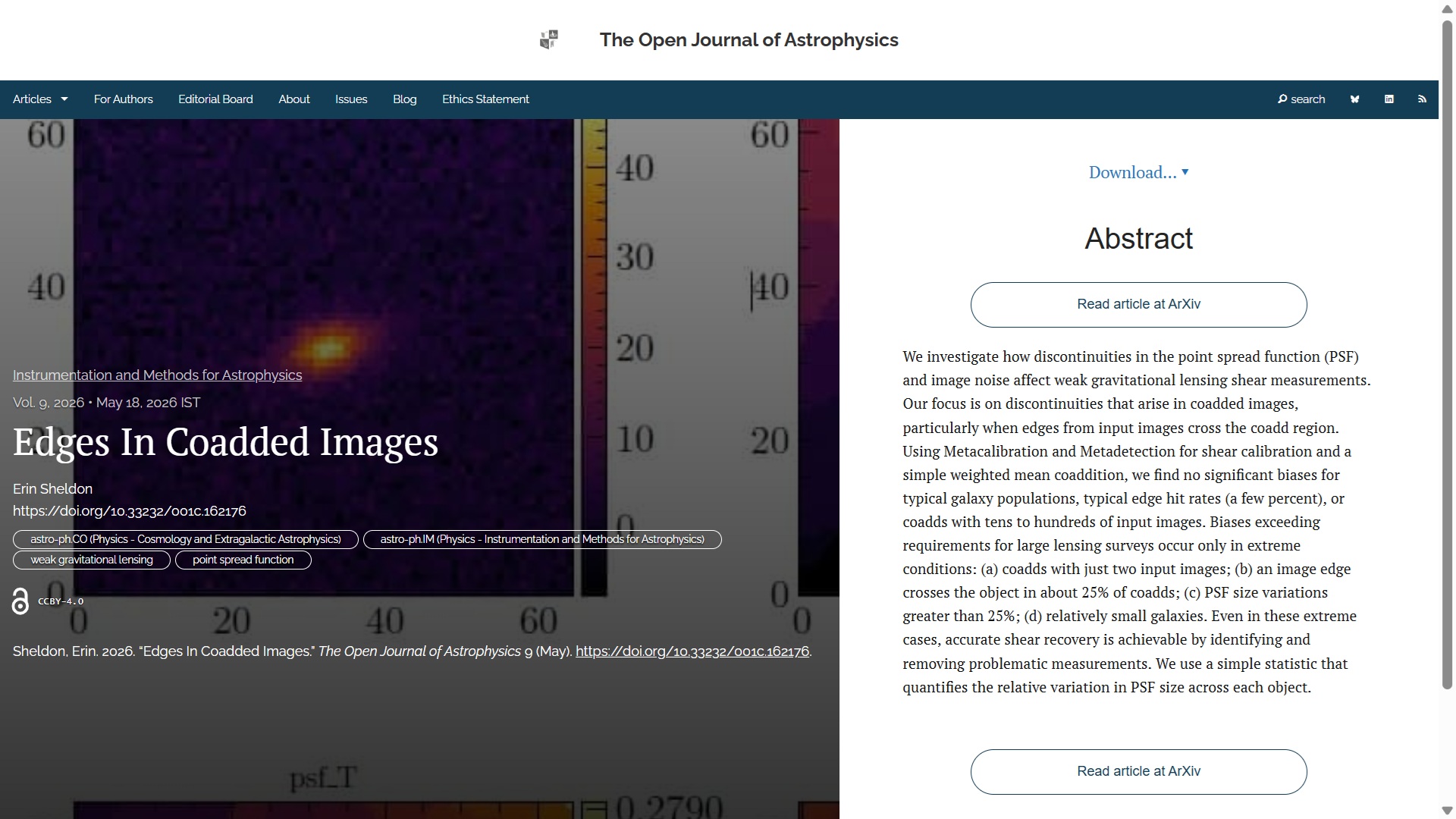
The first paper to report this week, published on Monday 18th May in the folder Instrumentation and Methods for Astrophysics is “Edges In Coadded Images” by Erin Sheldon (Brookhaven National Laboratory, USA). This paper describes a study exploring how image discontinuities and noise impact weak gravitational lensing measurements, finding no significant biases under typical conditions. Biases occur only in extreme cases, but can be mitigated.
The overlay for this paper is here
You can find the officially accepted version on arXiv here and the announcement on Fediverse here:
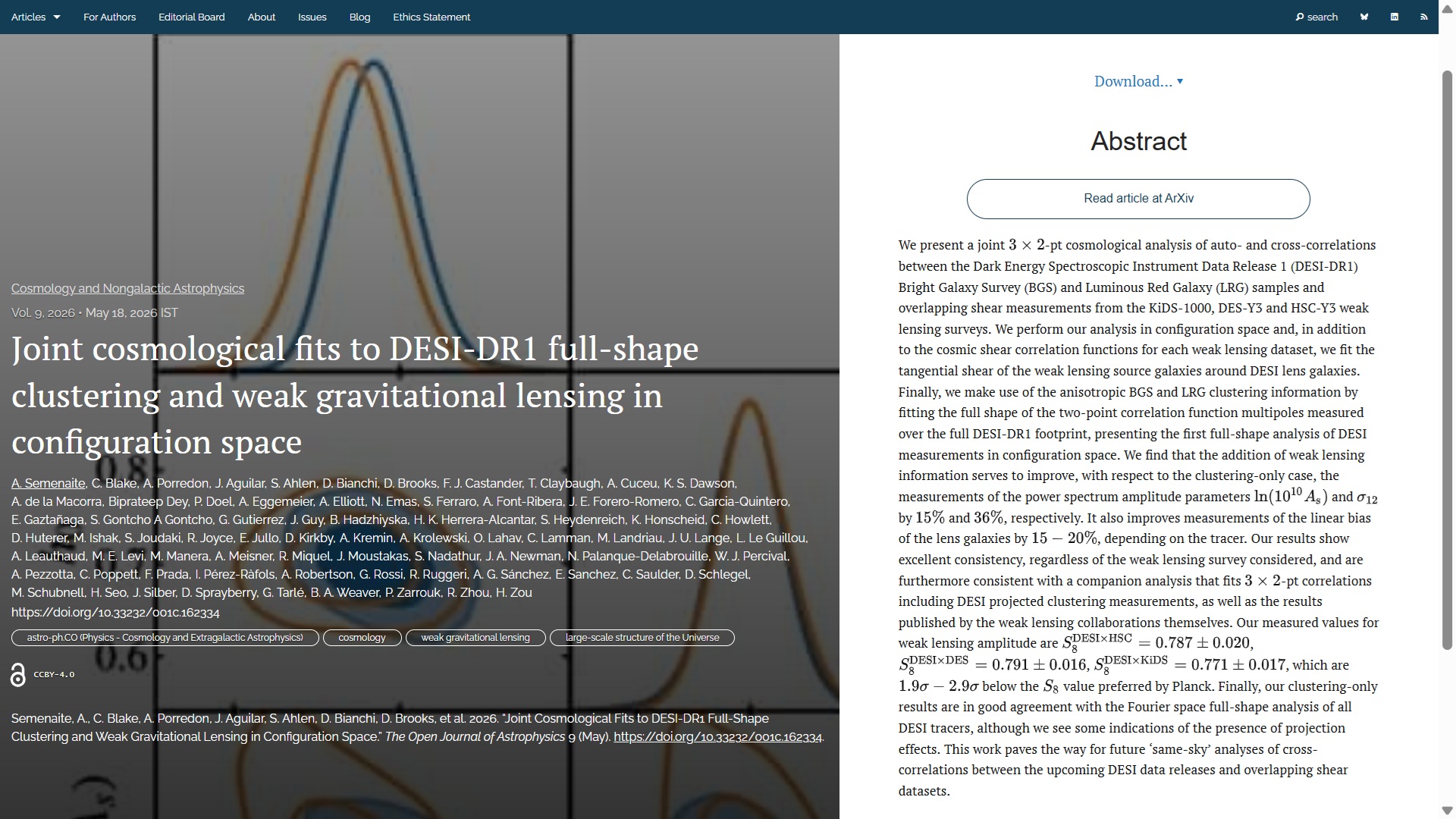
New Publication at the Open Journal of Astrophysics: "Joint cosmological fits to DESI-DR1 full-shape clustering and weak gravitational lensing in configuration space " by A. Semenaite (Swinburne Institute of Technology, Australia) and 72 others from all round the world.
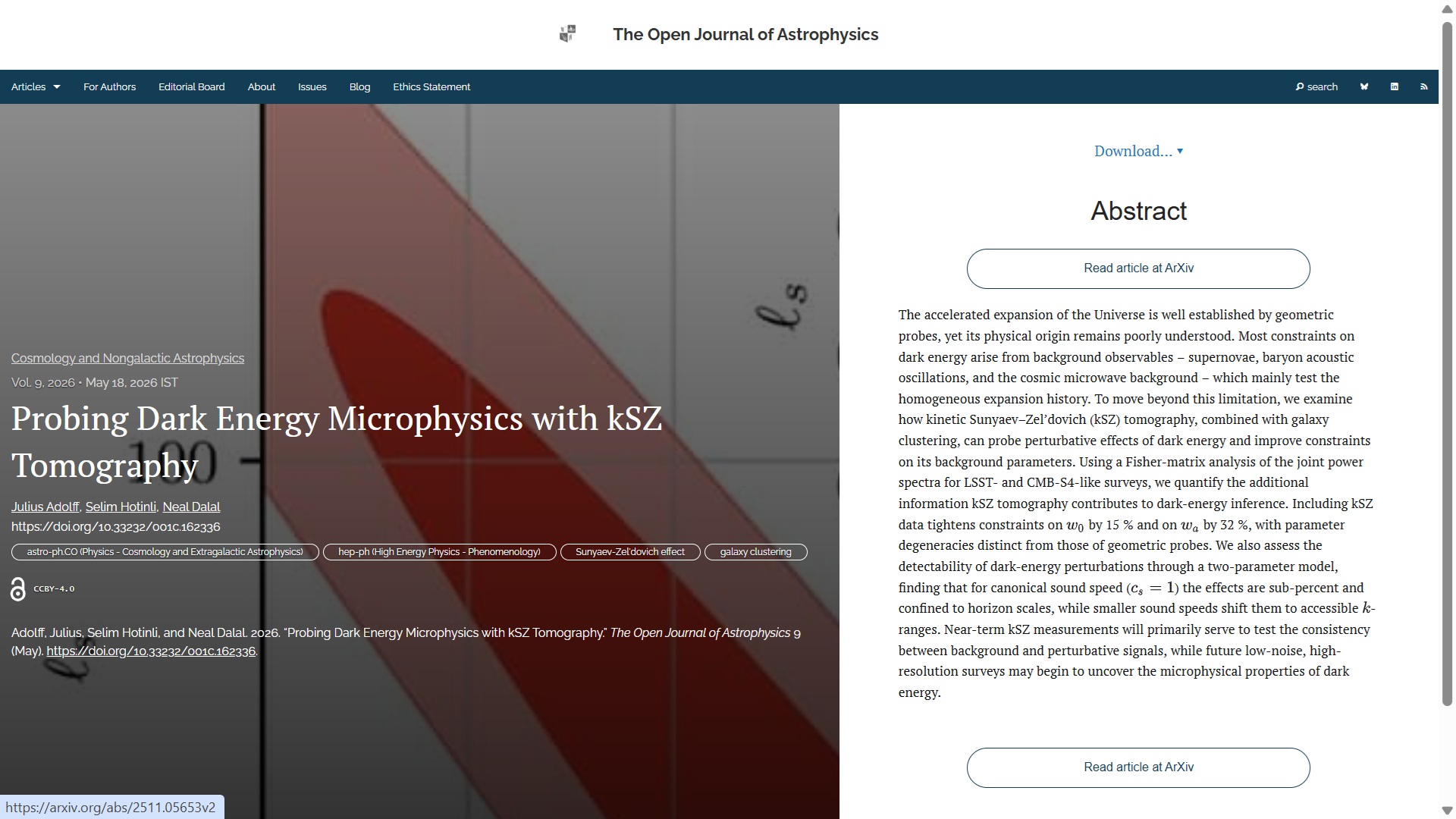
Next one up, the third paper of the week, and the third published on Monday 18th May, and in the folder Cosmology and Nongalactic Astrophysics is “Probing Dark Energy Microphysics with kSZ Tomography” by Julius Adolff, Selim Hotinli and Neal Dalal (all of the Perimeter Institute, Canada). This paper explores how kinetic Sunyaev-Zel’dovich tomography and galaxy clustering can enhance our understanding of dark energy and its effects, potentially revealing its microphysical properties in future surveys.
The overlay for this one is here:
The final, accepted version can be found on arXiv here and the Mastodon announcement is here:
New Publication at the Open Journal of Astrophysics: "Probing Dark Energy Microphysics with kSZ Tomography" by Julius Adolff, Selim Hotinli and Neal Dalal (Perimeter Institute, Canada)
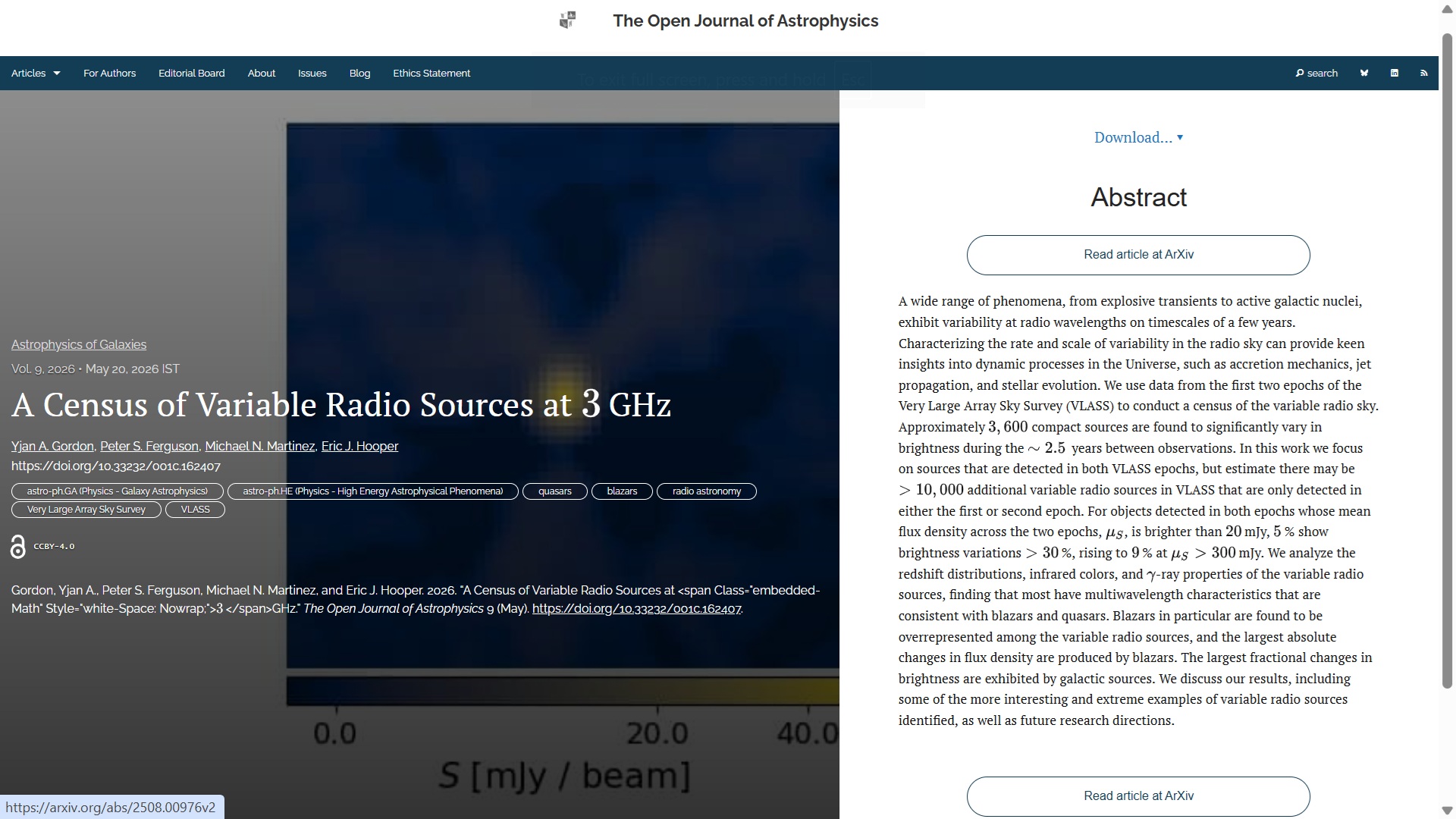
The fourth paper this week, published on Wednesday May 20th is “A Census of Variable Radio Sources at 3 GHz” by Yjan A. Gordon, Peter S. Ferguson, Michael N. Martinez and Eric J. Hooper (all of the University of Wisconsin, USA). This article, published in the folder Astrophysics of Galaxies, uses data from the Very Large Array Sky Survey to analyze variability in the radio sky, finding most changes consistent with blazars and quasars.
The overlay is here:
The officially accepted version can be found on arXiv here and here is the Mastodon announcement:
New Publication at the Open Journal of Astrophysics: "A Census of Variable Radio Sources at 3 GHz" by Yjan A. Gordon, Peter S. Ferguson, Michael N. Martinez & Eric J. Hooper (U. Wisconsin, USA)
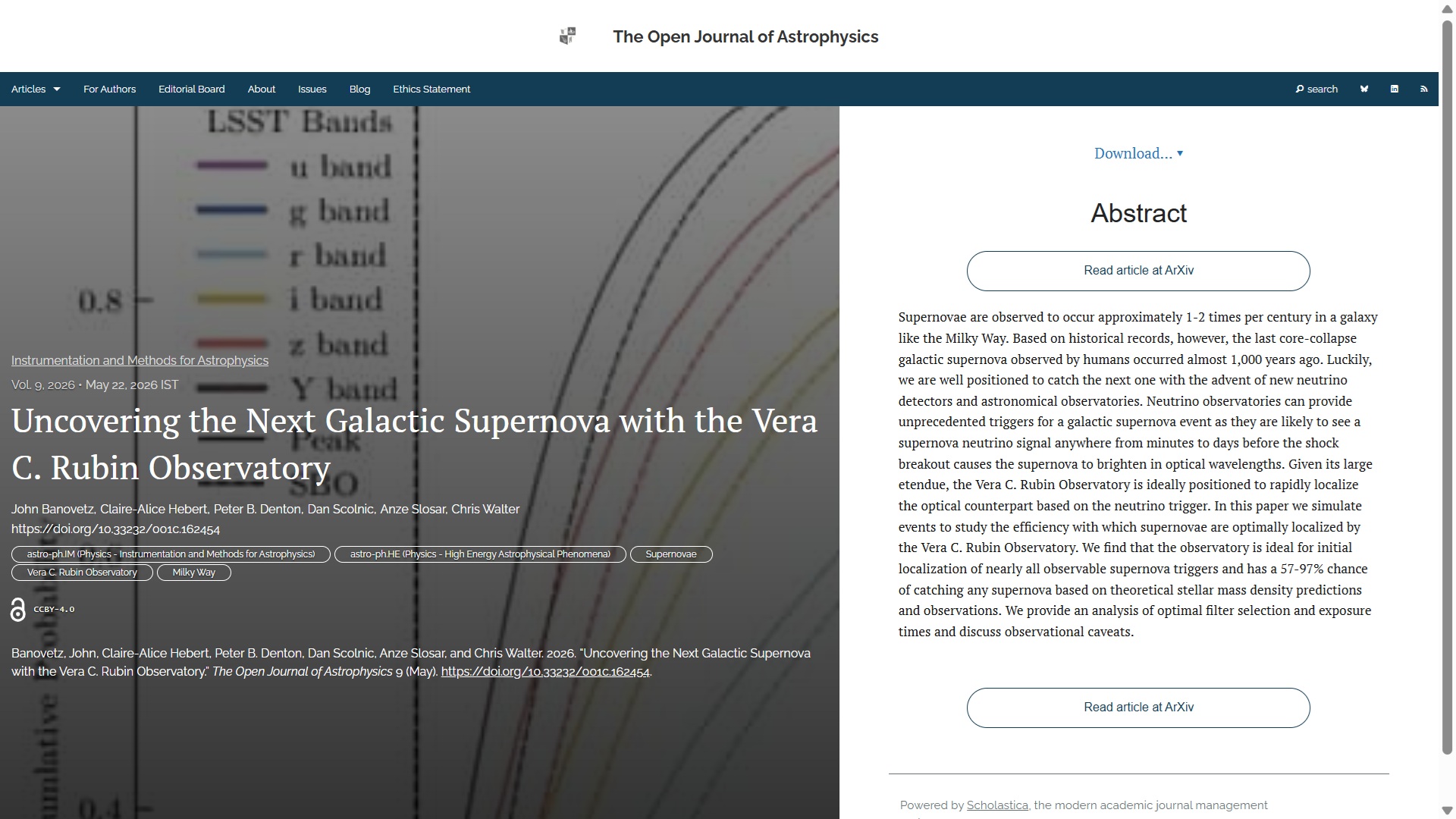
The fifth article of this week was published on Friday 22nd May in the folder Instrumentation and Methods for Astrophysics. The title is “Uncovering the Next Galactic Supernova with the Vera C. Rubin Observatory” by John Banovetz (Lawrence Berkeley Lab., USA), Claire-Alice Hebert & Peter B. Denton (Brookhaven National Lab., USA), Dan Scolnic (Duke University, USA), Anze Slosar (Brookhaven) and Chris Walter (Duke). The paper presents a study simulating how effectively the Vera C. Rubin Observatory can localize supernovae using neutrino triggers, finding a 57-97% success rate based on stellar mass density predictions.
The overlay is here:
You can find the authorized version of this paper on arXiv here and the Fediverse announcement is here:
New Publlication at the Open Journal of Astrophysics: "Uncovering the Next Galactic Supernova with the Vera C. Rubin Observatory" by John Banovetz (Lawrence Berkeley Lab., USA), Claire-Alice Hebert & Peter B. Denton (Brookhaven National Lab., USA) , Dan Scolnic (Duke U., USA) , Anze Slosar (Brookhaven), and Chris Walter (Duke)
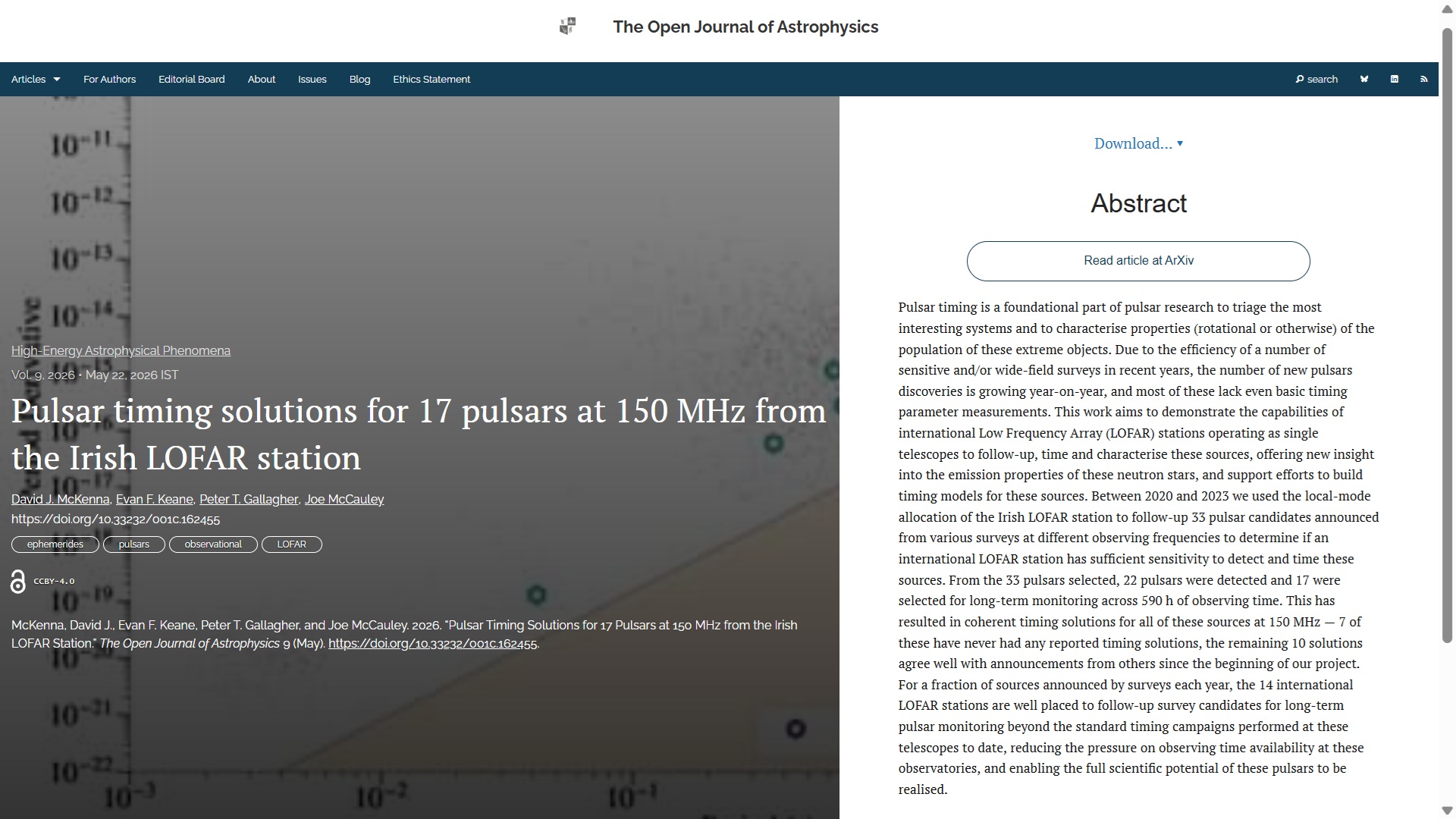
Last, but by no means least, this week we have “Pulsar timing solutions for 17 pulsars at 150 MHz from the Irish LOFAR station” by David J. McKenna (ASTRON, The Netherlands), Evan F. Keane (Trinity College Dublin, Ireland), Peter T. Gallagher (DIAS, Ireland) and Joe McCauley (Trinity). This was published on Friday 22nd May in the folder High-Energy Astrophysical Phenomena. It presents a demonstration of the use of international Low Frequency Array (LOFAR) stations in tracking and characterizing pulsars, providing new insights into these neutron stars’ emission properties.
The overlay for this one is here:
You can find the authorized version of this paper on arXiv here and the Fediverse announcement is here:
New Publication at the Open Journal of Astrophysics: "Pulsar timing solutions for 17 pulsars at 150 MHz from the Irish LOFAR station" by David J. McKenna (ASTRON, The Netherlands), Evan F. Keane (Trinity College Dublin, Ireland), Peter T. Gallagher (DIAS, Ireland) and Joe McCauley (Trinity)
It’s Saturday once again, so time for another update of activity at the Open Journal of Astrophysics. Since the last update we have published a further five papers, bringing the number in Volume 9 (2026) to 104 and the total so far published by OJAp up to 552. It took us until late July to pass 100 last year.
I will continue to include the posts made on our Mastodon account (on Fediscience) to encourage you to visit it. Mastodon is a really excellent service, and a more than adequate replacement for X/Twitter (which nobody should be using); these announcements also show the DOI for each paper.
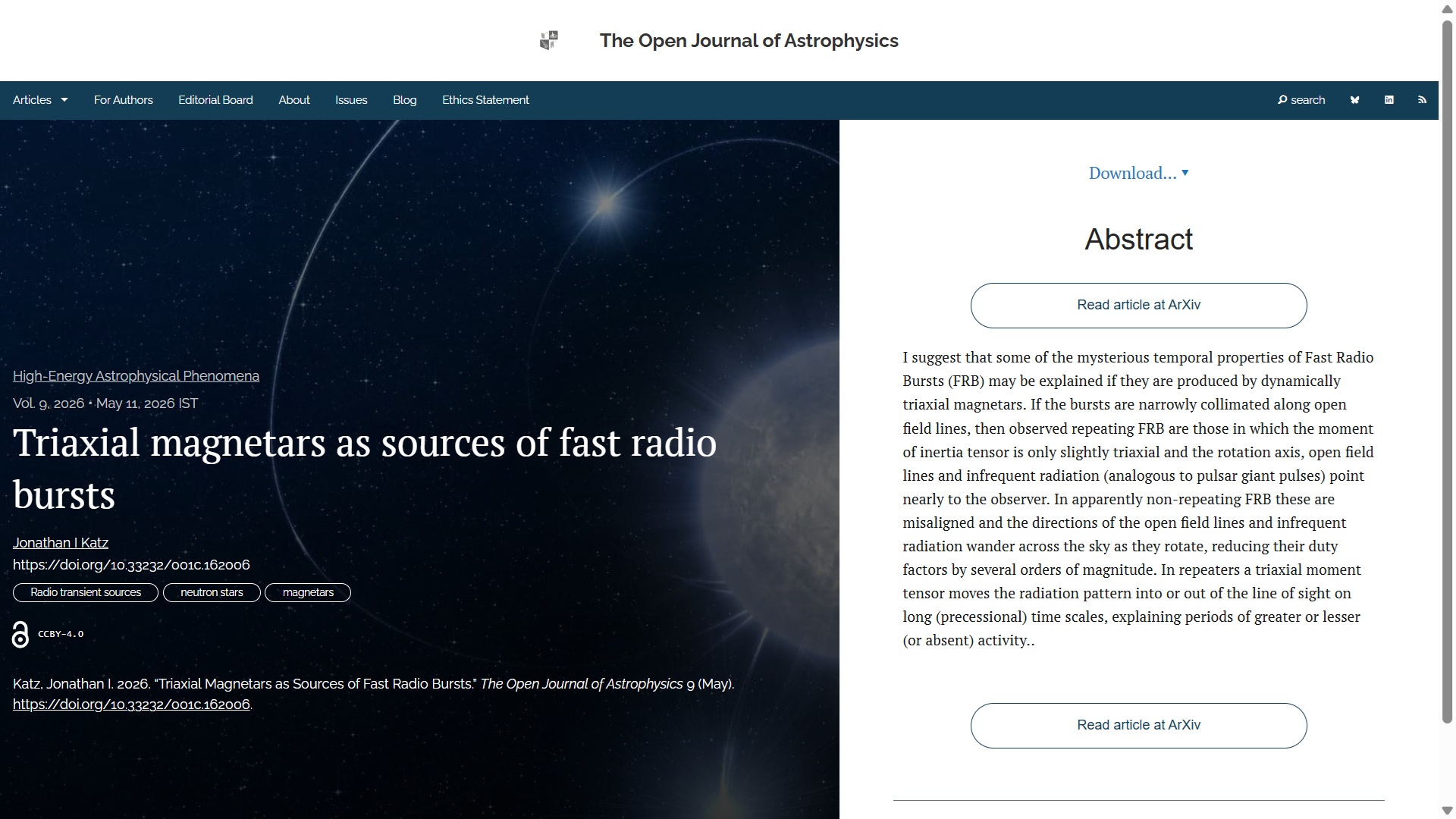
The first paper to report this week, published on Monday 11th May in the folder High-Energy Astrophysical Phenomena is “Triaxial magnetars as sources of fast radio bursts” by Jonathan I Katz (Washington University, USA). This paper suggests that the mysterious properties of Fast Radio Bursts (FRB) could be explained by triaxial magnetars, with their activity levels influenced by precessional time scales.
The overlay for this paper is here
You can find the officially accepted version on arXiv here and the announcement on Fediverse here:
New Publication at the Open Journal of Astrophysics: "Triaxial magnetars as sources of fast radio bursts" by Jonathan I Katz (Washington University, USA)
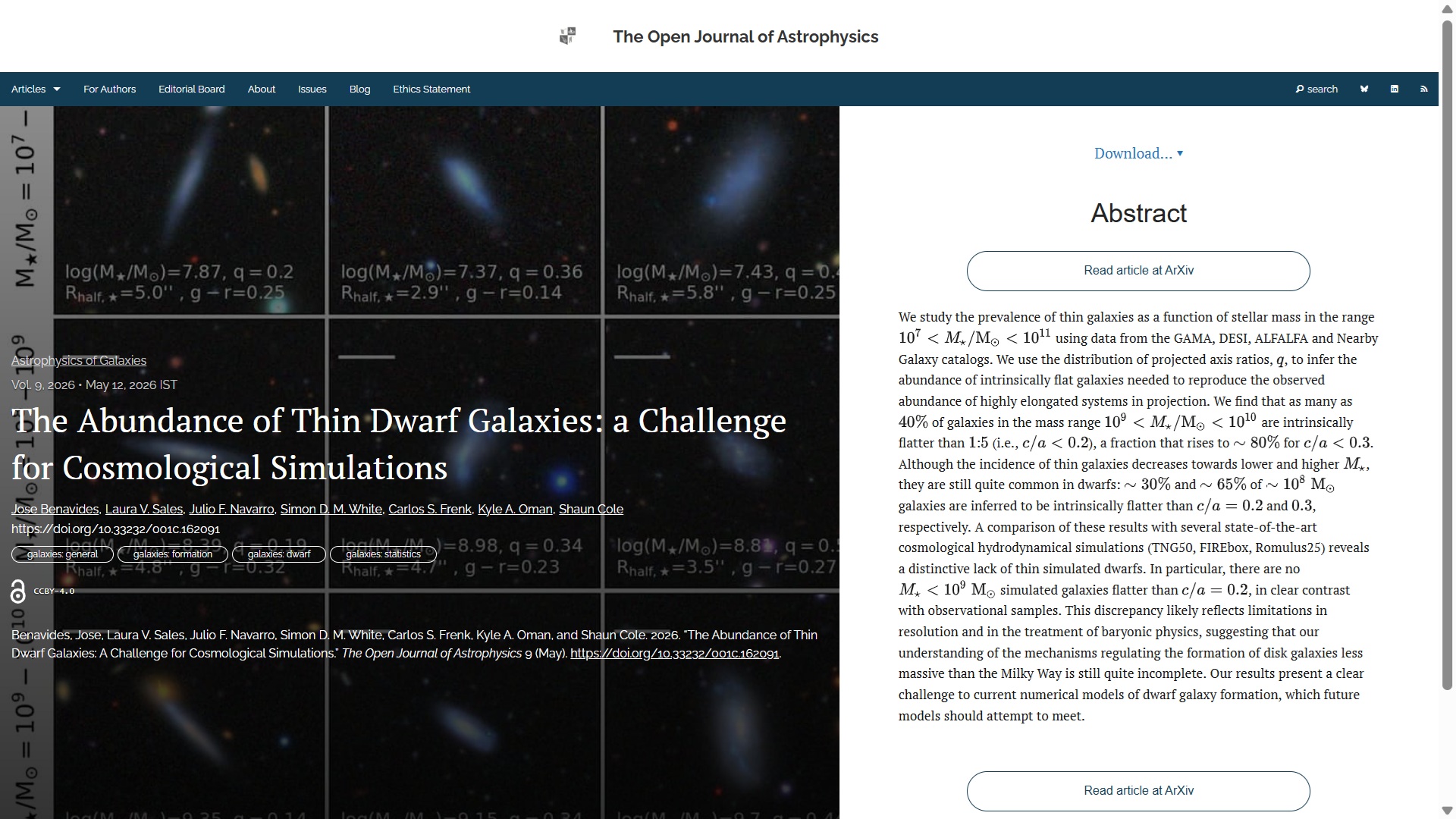
The second paper for this week, published on Tuesday 12th May in the folder Astrophysics of Galaxies, is “The Abundance of Thin Dwarf Galaxies: a Challenge for Cosmological Simulations” by Jose Benavides & Laura V. Sales (UC Riverside, USA), Julio F. Navarro (U. Victoria, Canada), Simon D. M. White (MPA Garching, Germany), and Carlos S. Frenk, Kyle A. Oman & Shaun Cole (U. Durham, UK). Depending on mass up to 40% of galaxies are intrinsically flat, a fraction that numerical models of galaxy formation struggle to reproduce suggesting the models are incomplete.
The overlay for this one is here:
The official version of the paper can be found on arXiv here and the Fediverse announcement here:
New Publication at the Open Journal of Astrophysics: "The Abundance of Thin Dwarf Galaxies: a Challenge for Cosmological Simulations" by Jose Benavides & Laura V. Sales (UC Riverside, USA), Julio F. Navarro (U. Victoria, Canada), Simon D. M. White (MPA Garching, Germany), and Carlos S. Frenk, Kyle A. Oman & Shaun Cole (U. Durham, UK)
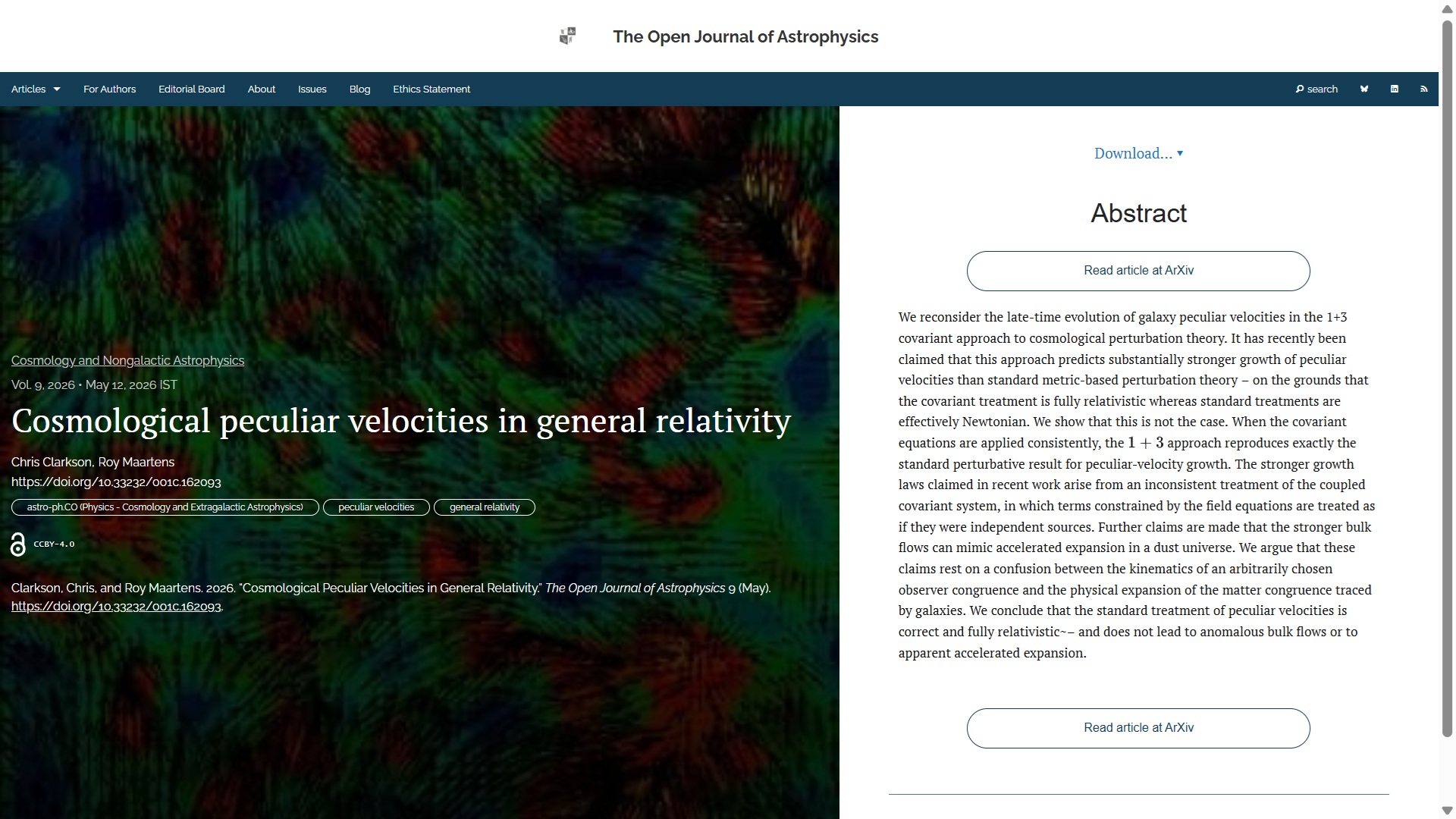
Next one up, the third paper of the week, also published on Tuesday 12th May but in the folder Cosmology and Nongalactic Astrophysics is “Cosmological peculiar velocities in general relativity” by Chris Clarkson (Queen Mary, University of London, UK) and Roy Maartens (U. Western Cape, South Africa). This paper refutes claims that the 1+3 covariant approach to cosmological perturbation theory predicts stronger growth of galaxy peculiar velocities, arguing that standard treatments are correct and fully relativistic.
The overlay for this one is here:
The final, accepted version can be found on arXiv here and the Mastodon announcement is here:
New Publication at the Open Journal of Astrophysics: "Cosmological peculiar velocities in general relativity" by Chris Clarkson (QMUL, UK) and Roy Maartens (U. Western Cape, South Africa)
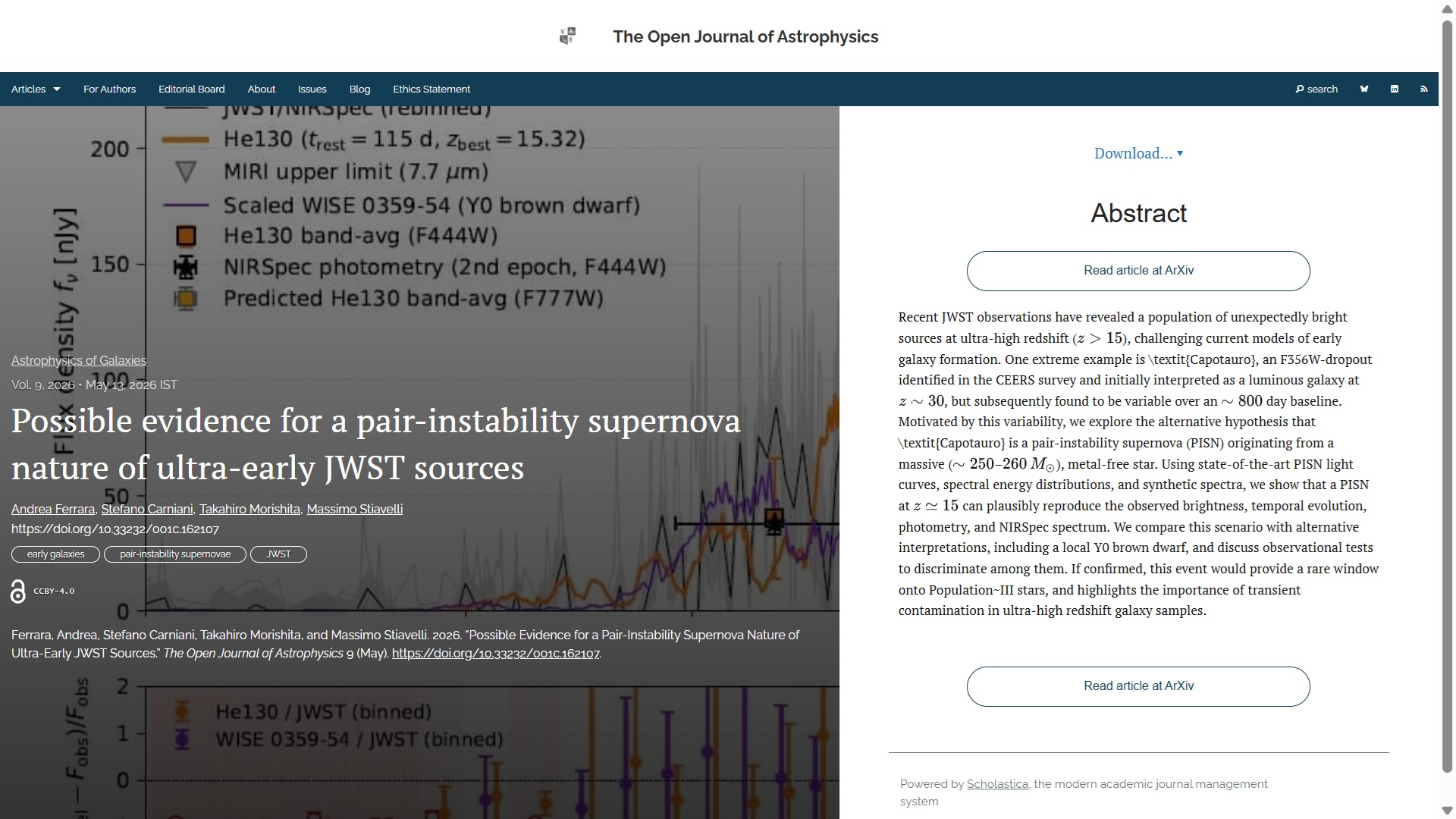
The fourth paper this week, published on Wednesday May 13th “Possible evidence for a pair-instability supernova nature of ultra-early JWST sources” by Andrea Ferrara & Stefano Carniani (Scuola Normale Superiore, Pisa, Italy), Takahiro Morishita (California Institute of Technology, USA), and Massimo Stiavelli (Space Telescope Science Institute, USA). Published in the section Astrophysics of Galaxies. This paper argues that recent observations challenge early galaxy formation models, suggesting that the bright source, Capotauro, could be a supernova from a massive, metal-free star, not a luminous galaxy as initially thought.
The overlay is here:
The officially accepted version can be found on arXiv here and here is the Mastodon announcement:
New Publication at the Open Journal of Astrophysics: "Possible evidence for a pair-instability supernova nature of ultra-early JWST sources" by Andrea Ferrara & Stefano Carniani (Scuola Normale Superiore, Pisa, Italy), Takahiro Morishita (Caltech, USA) and Massimo Stiavelli (STScI, USA)
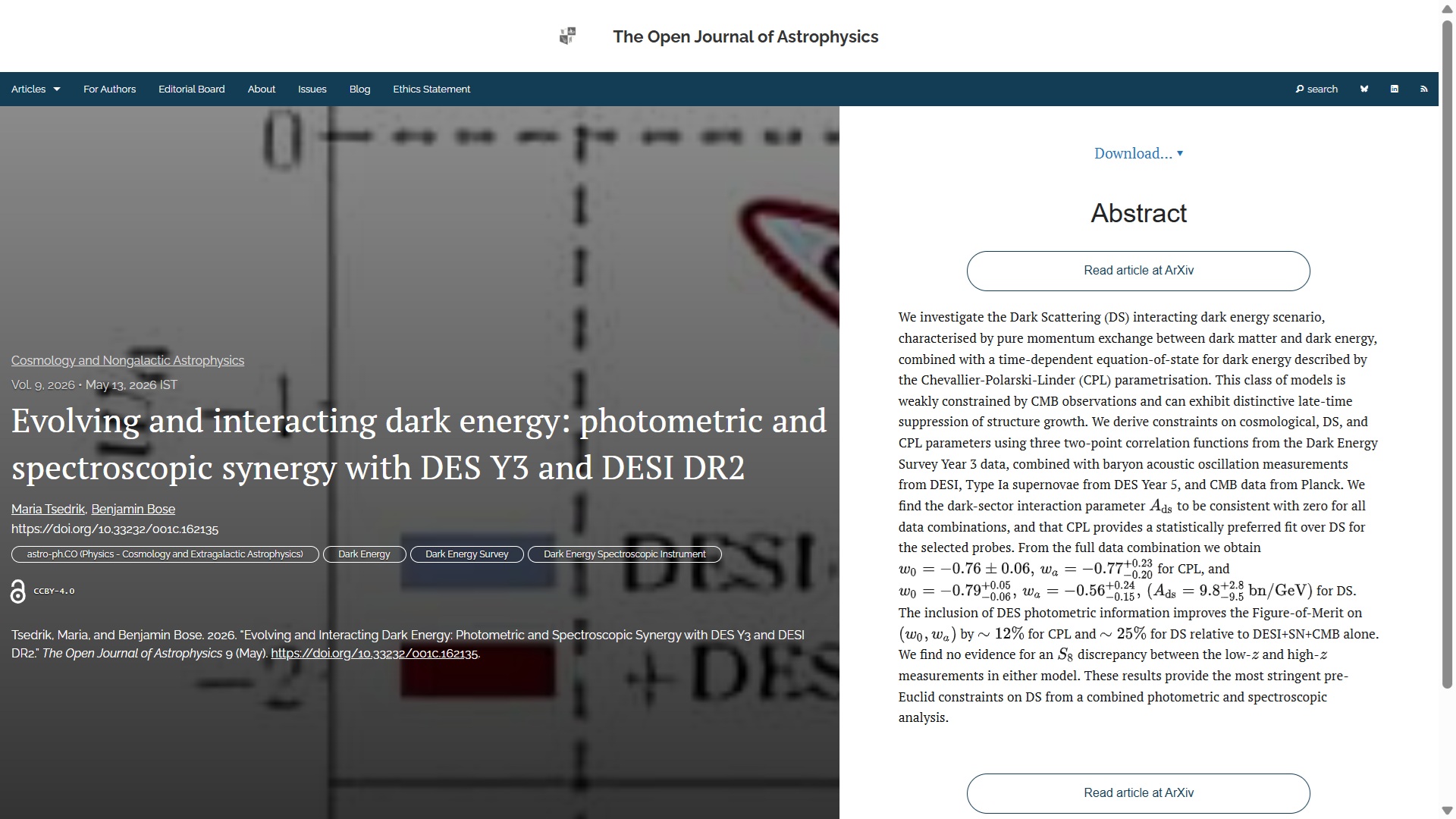
The fifth and final article of this week was also published on Wednesday 13th May but in the folder Cosmology and Nongalactic Astrophysics. The title is “Evolving and interacting dark energy: photometric and spectroscopic synergy with DES Y3 and DESI DR2” and it is by Maria Tsedrik and Benjamin Bose (University of Edinburgh, UK). The study investigates the Dark Scattering interacting dark energy scenario, using data from various sources. Results show no evidence of dark-sector interaction and a preference for the Chevallier-Polarski-Linder parametrisation.
The overlay is here:
You can find the authorized version of this paper on arXiv here and the Fediverse announcement is here:
New Publication at the Open Journal of Astrophysics: "Evolving and interacting dark energy: photometric and spectroscopic synergy with DES Y3 and DESI DR2" by Maria Tsedrik and Benjamin Bose (University of Edinburgh, UK)
This morning I did my last teaching session of the Academic Year 2025-6, an informal revision lecture/tutorial on Computational Physics. It was optional, for the students, as this is officially a study break, and was at 9am, and only a handful of students showed up, but I hope those that did found it useful. As is often the case with optional sessions, I think the students who came were the keenest and probably therefore those who least needed last-minute tips for the examination, but that’s always the way.
In the past such revision classes have been routine, at least for me, but for some reason the University has taken to locking most of the teaching rooms during the study break. This causes huge problems finding a space to do revision sessions. I really don’t understand this. There are constant complaints from students about the lack of study space, and the response from the University is that right before the examinations they lock dozens of empty rooms.
Anyway, the Examination Period starts tomorrow morning, Friday15th, but most of the students who turned up this morning have their first examination on Tuesday 19th May (which happens to be Computational Physics).
take the opportunity to wish all students the best for their examinations:
You shouldn’t really be relying on luck of course, so here are some tips (especially for physics students, but applicable elsewhere).
Try to get a good night’s sleep before the examination and arrive in plenty of time before the start. Spending all night cramming is unlikely to help you do well.
Prepare well in advance so you’re relaxed when the time comes.
Read the entire paper before starting to answer any questions. In particular, make sure you are aware of any supplementary information, formulae, etc, given in the rubric or at the end. You can always ask for log tables if there’s something you can’t remember.
Start off by tackling the question you are most confident about answering, even if it’s not Question 1. This will help settle any nerves. You’re under no obligation to answer the questions in the order they are asked.
Don’t rush! Students often lose marks by making careless errors. In particular, check all your working out, including numerical results obtained your calculator, at least twice
Please remember the UNITS!
Don’t panic! You’re not expected to answer everything perfectly. A first-class mark is anything over 70%, so don’t worry if there are bits you can’t do. If you get stuck on a part of a question, don’t waste too much time on it (especially if it’s just a few marks). Just leave it and move on. You can always come back to it later.
It’s Saturday once again, so time for another update of activity at the Open Journal of Astrophysics. Since the last update we have published a further five papers, bringing the number in Volume 9 (2026) to 99 and the total so far published by OJAp up to 547. We didn’t quite make it to a hundred for the year last week, but will do so with the next paper.
I will continue to include the posts made on our Mastodon account (on Fediscience) to encourage you to visit it. Mastodon is a really excellent service, and a more than adequate replacement for X/Twitter (which nobody should be using); these announcements also show the DOI for each paper.
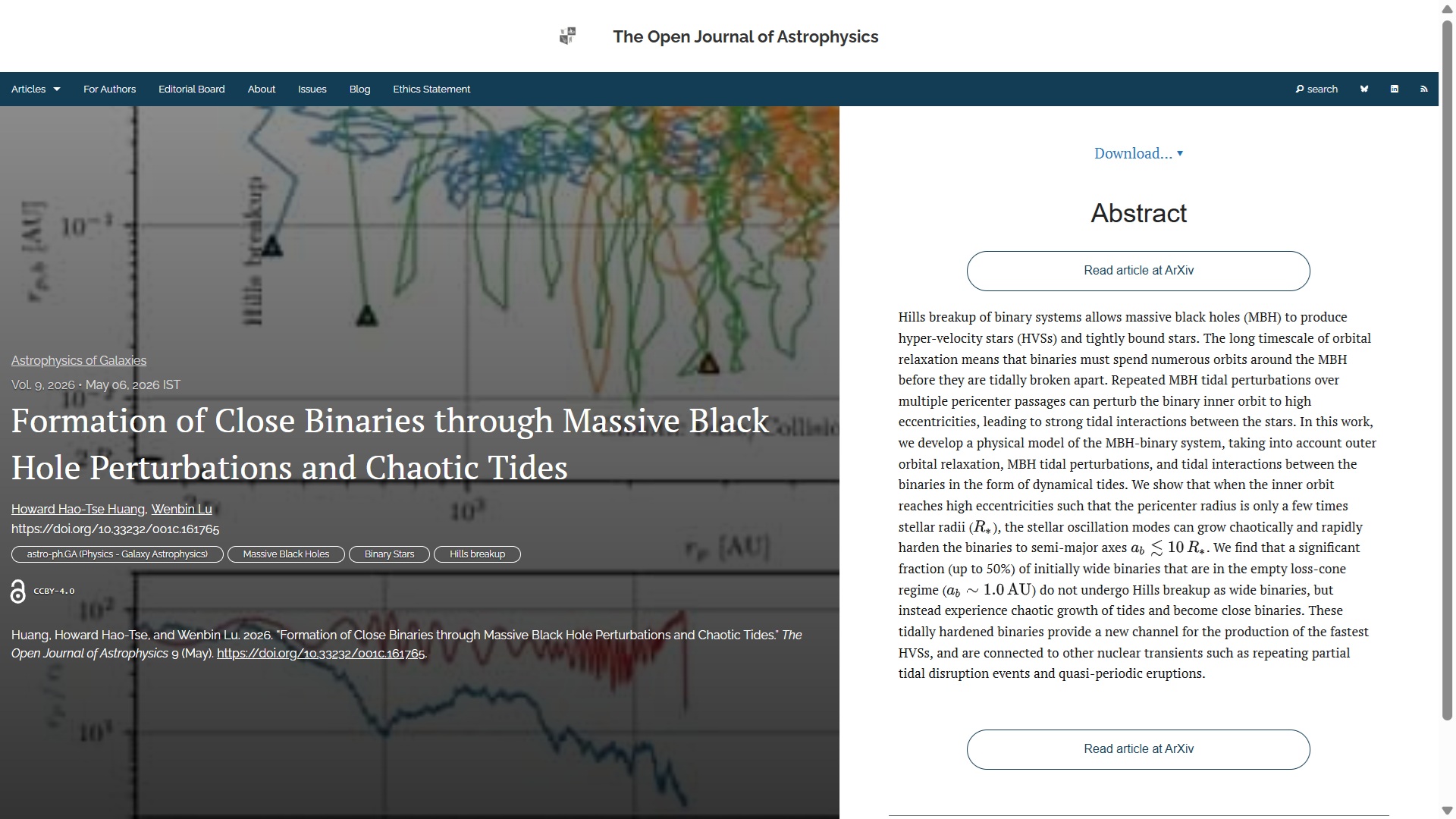
The first paper to report this week is “Formation of Close Binaries through Massive Black Hole Perturbations and Chaotic Tides” by Howard Hao-Tse Huang and Wenbin Lu (University of California at Berkeley, USA). This one was published on Wednesday 6th May 2026 in the folder Astrophysics of Galaxies. The paper presents a model of massive black hole-binary systems, showing that repeated tidal interactions can lead to the creation of hyper-velocity stars and other nuclear transients.
The overlay for this paper is here
You can find the officially accepted version on arXiv here and the announcement on Fediverse here:
New Publication at the Open Journal of Astrophysics: "Formation of Close Binaries through Massive Black Hole Perturbations and Chaotic Tides" by Howard Hao-Tse Huang & Wenbin Lu (U. California Berkeley, USA)
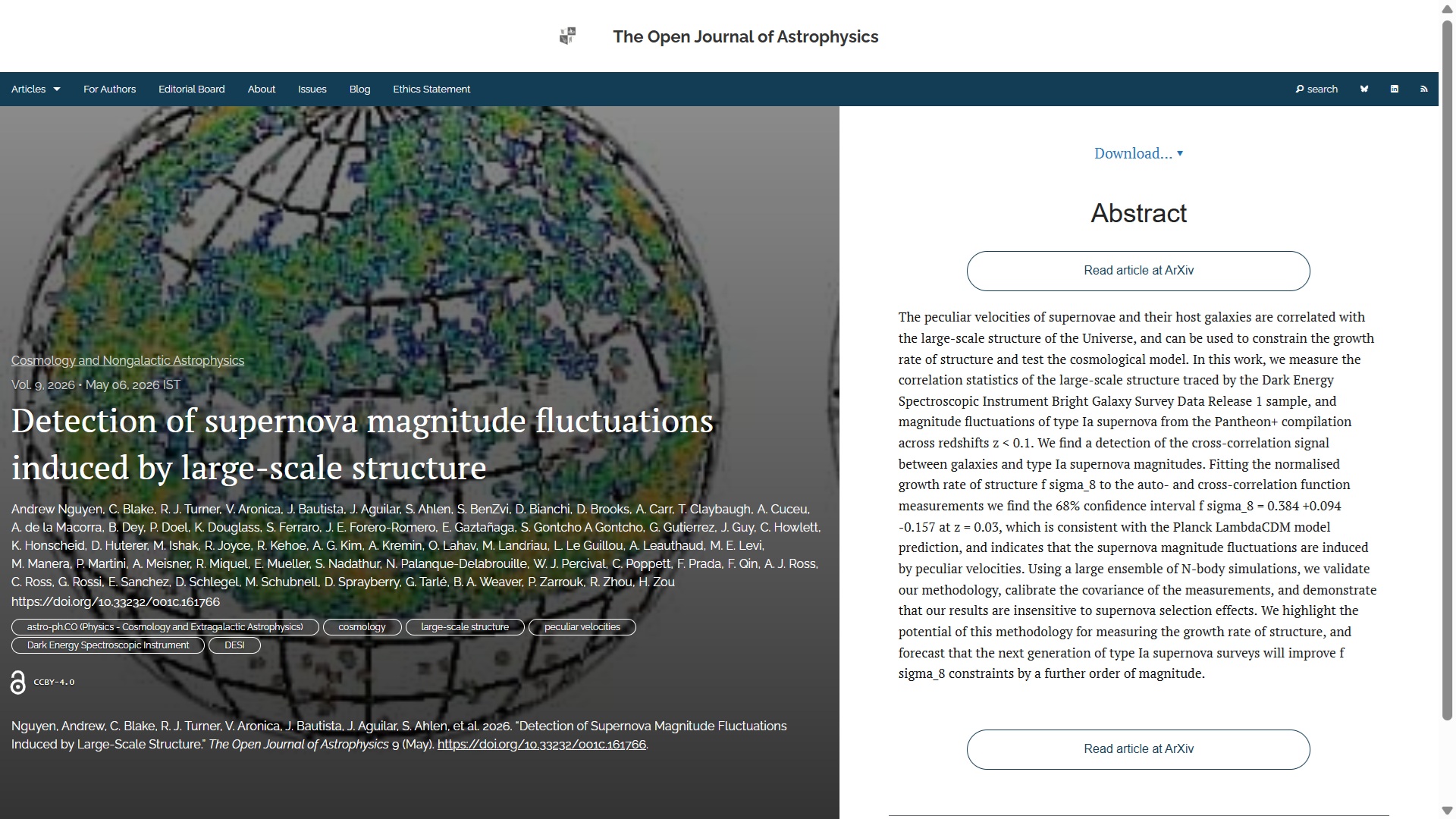
The second paper for this week, also Wednesday 6th May, but in the folder Cosmology and Nongalactic Astrophysics is “Detection of supernova magnitude fluctuations induced by large-scale structure” by Andrew Nguyen (Swinburne Institute of Technology, Australia) and 58 others based all around the world. This study uses supernovae and galaxy velocities to measure the universe’s structure growth rate, confirming the Planck LambdaCDM model prediction. The methodology is validated and shows potential for future research.
The overlay for this one is here:
The official version of the paper can be found on arXiv here and the Fediverse announcement here:
New Publication at the Open Journal of Astrophysics: "Detection of supernova magnitude fluctuations induced by large-scale structure" by Andrew Nguyen (Swinburne Institute of Technology, Australia) and 58 others based all around the world.
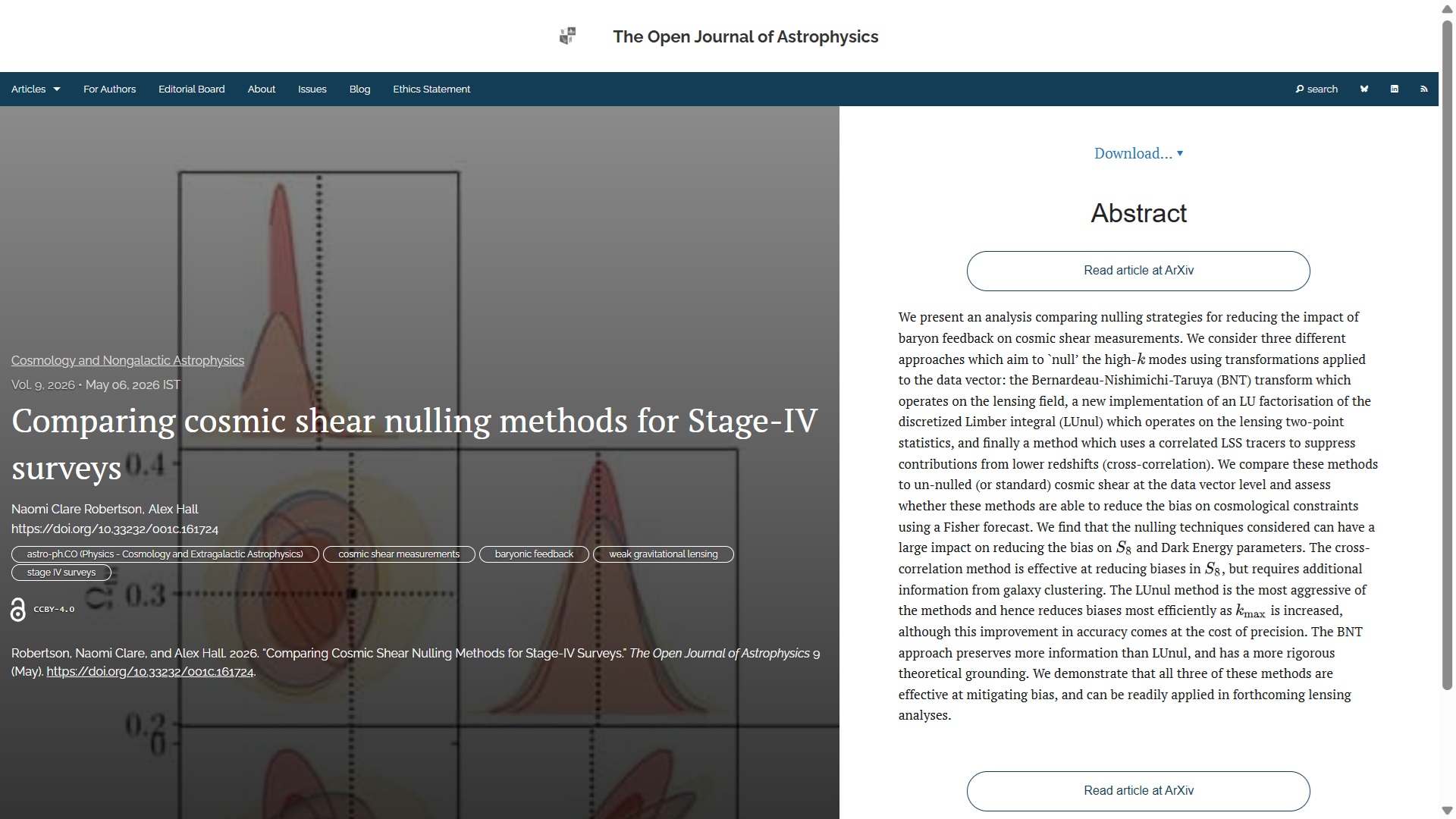
Next one up, the third paper of the week, also published on Wednesday 6th May in the folder Cosmology and Nongalactic Astrophysics is “Comparing cosmic shear nulling methods for Stage-IV surveys” by Naomi Clare Robertson and Alex Hall (University of Edinburgh, UK). This study compares three strategies for reducing baryon feedback impact on cosmic shear measurements. All methods effectively mitigate bias, with varying degrees of efficiency and information preservation.
The overlay for this one is here:
The final, accepted version can be found on arXiv here and the Mastodon announcement is here:
New Publication at the Open Journal of Astrophysics: "Comparing cosmic shear nulling methods for Stage-IV surveys" by Naomi Clare Robertson & Alex Hall (U. Edinburgh, UK)
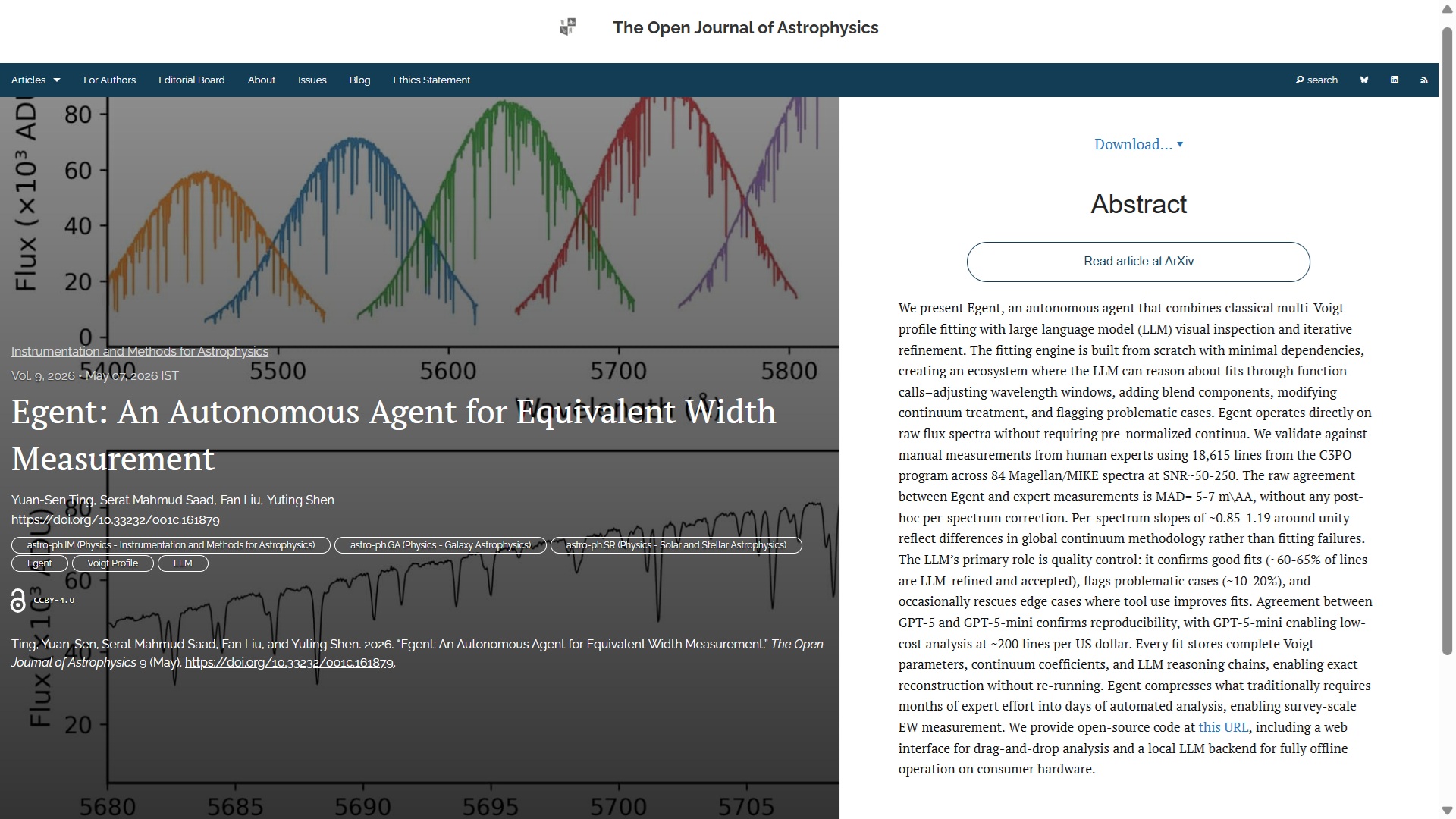
The fourth paper this week, published on Thursday May 7th, is “Egent: An Autonomous Agent for Equivalent Width Measurement” by Yuan-Sen Ting & Serat Mahmud Saad (Ohio State University, USA), Fan Liu (National Astronomical Observatories, Beijing, China), and Yuting Shen (Georgia Institute of Technology, USA). Egent is an autonomous agent that combines multi-Voigt profile fitting with large language model visual inspection for efficient, automated analysis of raw flux spectra, validated against expert measurements. This one is in the folder Instrumentation and Methods for Astrophysics. The associated software can be found here.
The overlay is here:
The officially accepted version can be found on arXiv here and here is the Mastodon announcement:
New Publication at the Open Journal of Astrophysics: "Egent: An Autonomous Agent for Equivalent Width Measurement" by Yuan-Sen Ting & Serat Mahmud Saad (Ohio State U., USA), Fan Liu (National Astronomical Observatories, China) and Yuting Shen (Georgia Institute of Technology, USA)
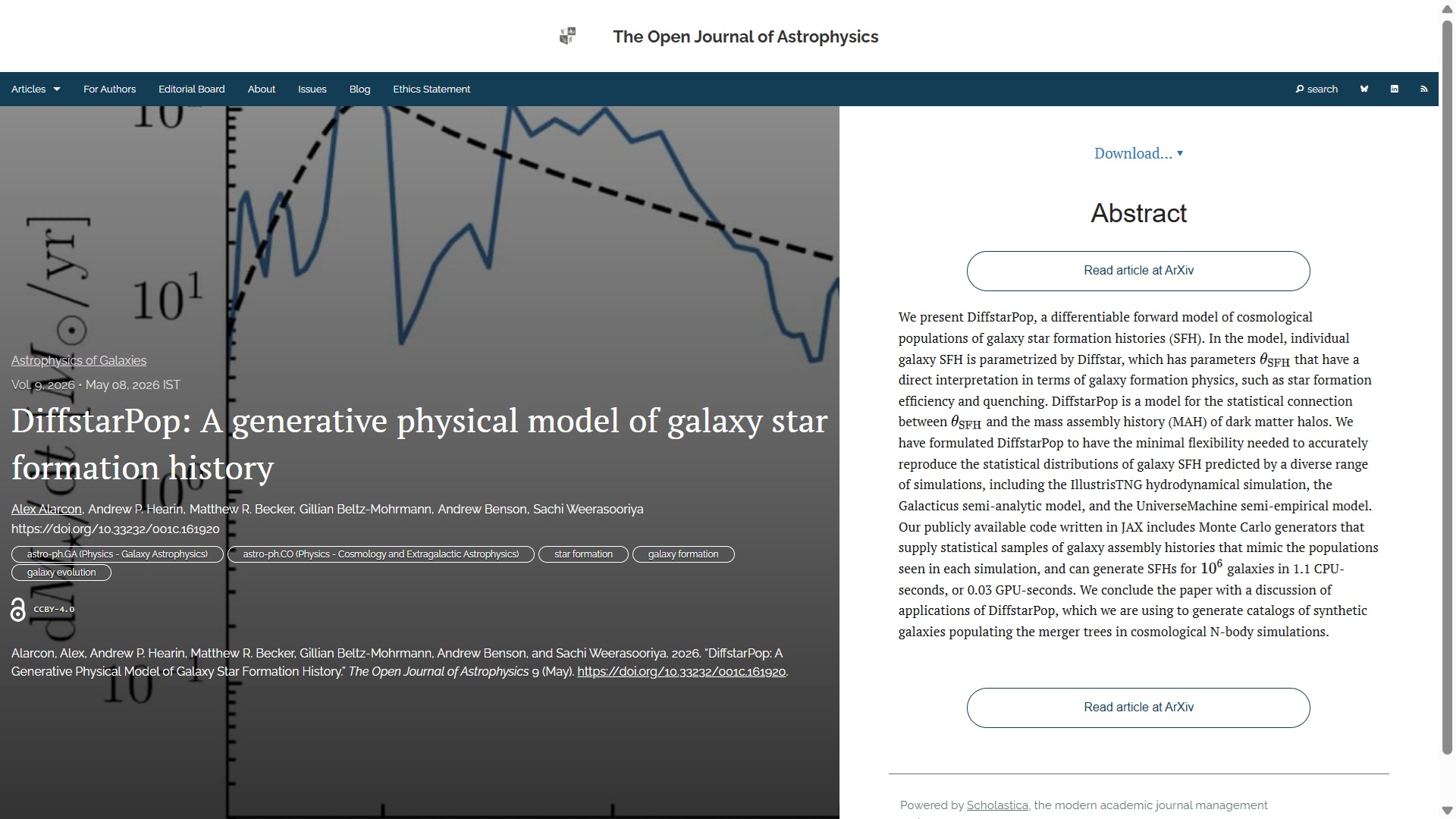
The fifth and final article of this week was published on Friday 8th May in the folder Astrophysics of Galaxies. The title is “DiffstarPop: A generative physical model of galaxy star formation history” and it is by Alex Alarcon (Institute of Space Sciences, Barcelona, Spain), Andrew P. Hearin , Matthew R. Becker & Gillian Beltz-Mohrmann (Argonne National Laborarory, USA), and Andrew Benson & Sachi Weerasooriya (Carnegie Observatories, USA). DiffstarPop is a model that accurately and rapidly reproduces statistical distributions of galaxy star formation histories (SFH), using parameters related to galaxy formation physics.
The overlay is here:
You can find the authorized version of this paper on arXiv here and the Fediverse announcement is here:
New Publication at the Open Journal of Astrophysics: "DiffstarPop: A generative physical model of galaxy star formation history" by Alex Alarcon (Institute of Space Sciences, Barcelona, Spain), Andrew P. Hearin , Matthew R. Becker & Gillian Beltz-Mohrmann (Argonne National Laborarory, USA), and Andrew Benson & Sachi Weerasooriya (Carnegie Observatories, USA)
At last we’ve made it to the end of term. This morning I delivered my last particle physics lecture. Given that it is the last day of the semester I was half-expecting no students would turn up, but in the end I had about 60% attendance. At the end of my lecture there was even a smattering of applause, which I interpreted as meaning that the students were happy that I’d finished.
I thought I would end this module with some topics that I didn’t have time to cover in any detail, but thought the students should know at least something about. These loose ends included:
Renormalization
Grand Unified Theories (GUTS)
Supersymmetry (SUSY)
Particle candidates for Dark Matter
Baryogenesis
I only had time for a superficial treatment of these topics, but felt the class should at least hear the words. There are some very good unanswered research questions under those headings, which I think is an appropriate way to end a final-year module, given that at least some of the class are intending to carry on to further study in physics.
This afternoon we had a colloquium by our PhD student John Ibrahim on the subject of the “Quark‑Gluon Vertex and Confinement of Quarks”. It was a nice talk but it struck me how big the gap was between what I’d been teaching at undergraduate level and the standard that a PhD student has to reach.
Today was also the deadline for Computational Physics projects. I’ll be grading them next week. Even then the term won’t quite be over – there is the small matter of exam marking to be done – but at least I’ve got no more formal teaching to do until September.
Last night on the way home I decided to buy a nice bottle of white wine and put it in the fridge so I could drink it in celebration of the end of term when I get home, with a nice fish supper.
The views presented here are personal and not necessarily those of my employer (or anyone else for that matter).
Feel free to comment on any of the posts on this blog but comments may be moderated; anonymous comments and any considered by me to be vexatious and/or abusive and/or defamatory will not be accepted. I do not necessarily endorse, support, sanction, encourage, verify or agree with the opinions or statements of any information or other content in the comments on this site and do not in any way guarantee their accuracy or reliability.




 In the Dark