It’s Saturday once more, so it’s time for another update of activity at the Open Journal of Astrophysics. Since the last update we have published a further four papers, bringing the number in Volume 9 (2026) to 51 and the total so far published by OJAp up to 499. I hoped we would reach 500 this week, but that milestone will have to wait. We have however passed the 50 mark for this year, so we have now published more papers so far in 2026 than we published in all of 2023.
I will continue to include the posts made on our Mastodon account (on Fediscience) to encourage you to visit it. Mastodon is a really excellent service, and a more than adequate replacement for X/Twitter (which nobody should be using); these announcements also show the DOI for each paper.
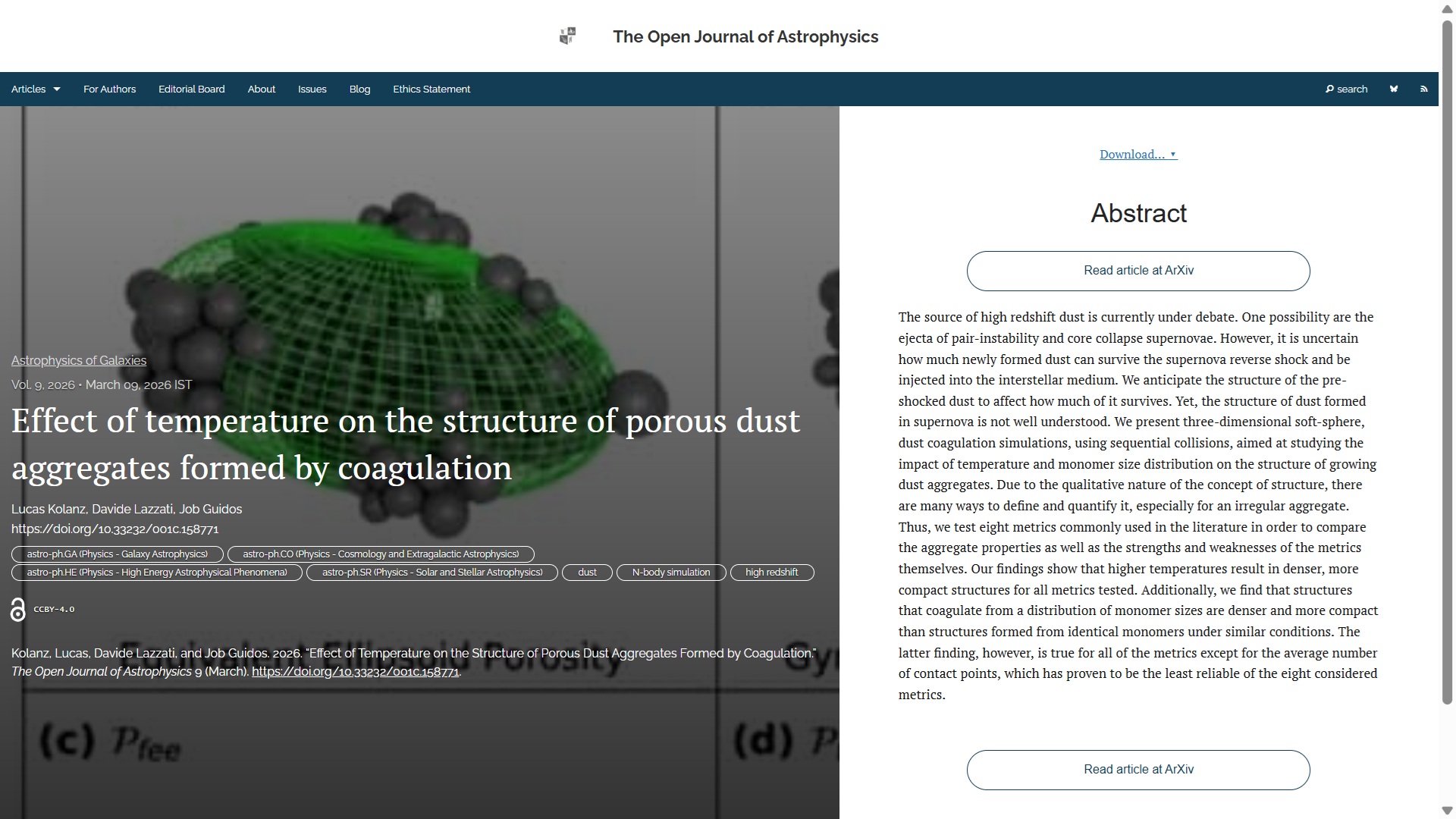
New Publication at the Open Journal of Astrophysics: "Effect of temperature on the structure of porous dust aggregates formed by coagulation" by Lucas Kolanz, Davide Lazzati and Job Guidos (Oregon State University, USA)
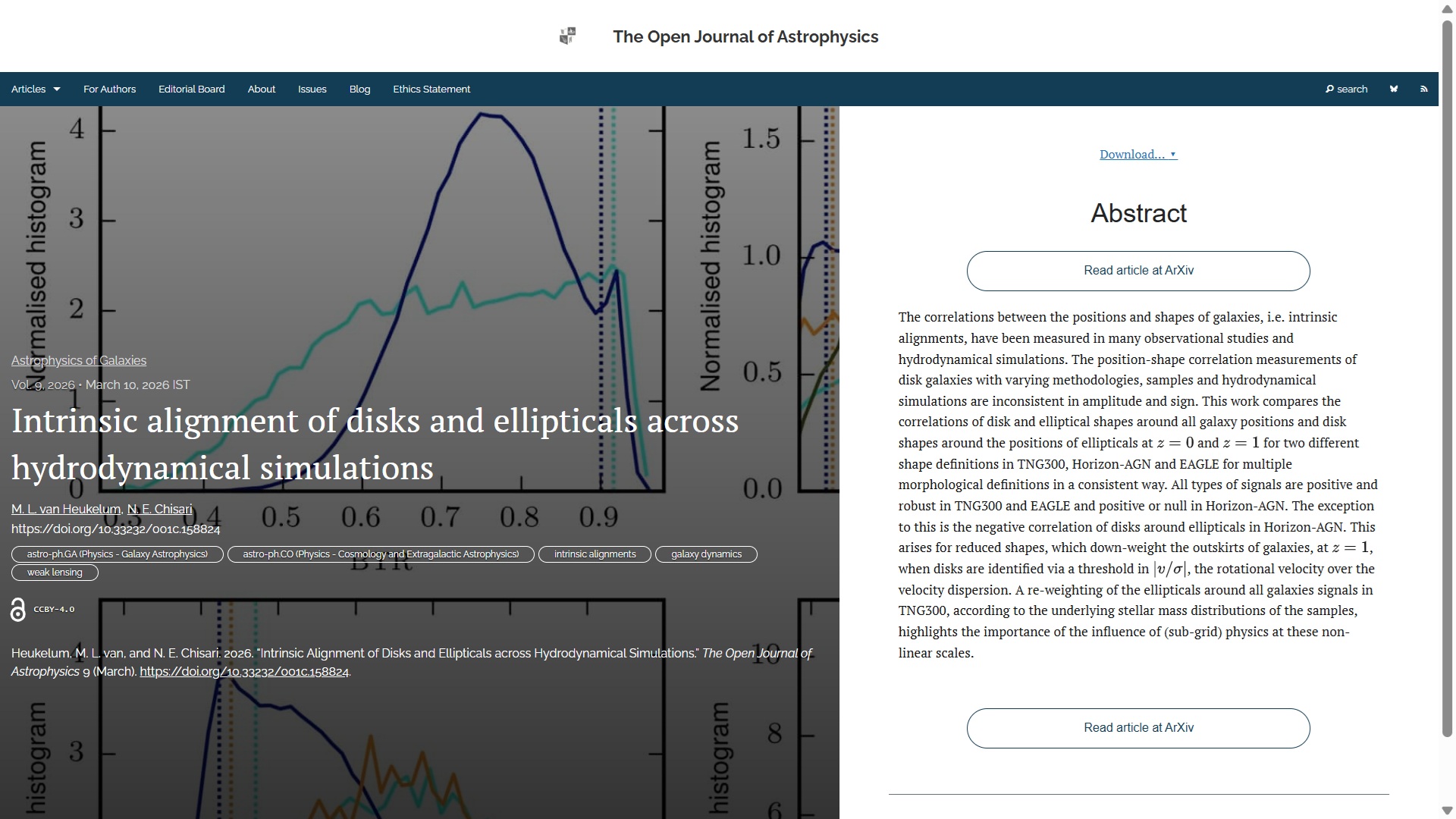
The second paper for this week is “Intrinsic alignment of disks and ellipticals across hydrodynamical simulations” by M. L. van Heukelum and N. E. Chisari (Utrecht University, The Netherlands). This is one of two papers published on Tuesday 10th March. This one is in the folder Astrophysics of Galaxies: it examines the inconsistent correlations between galaxy positions and shapes, comparing disk and elliptical shapes in different simulations. The results highlight the importance of sub-grid physics at non-linear scales.
The overlay for this one is here:
The official version of the paper can be found on arXiv here and the Fediverse announcement here:
New Publication at the Open Journal of Astrophysics: "Intrinsic alignment of disks and ellipticals across hydrodynamical simulations" by M. L. van Heukelum and N. E. Chisari (Utrecht University, The Netherlands)
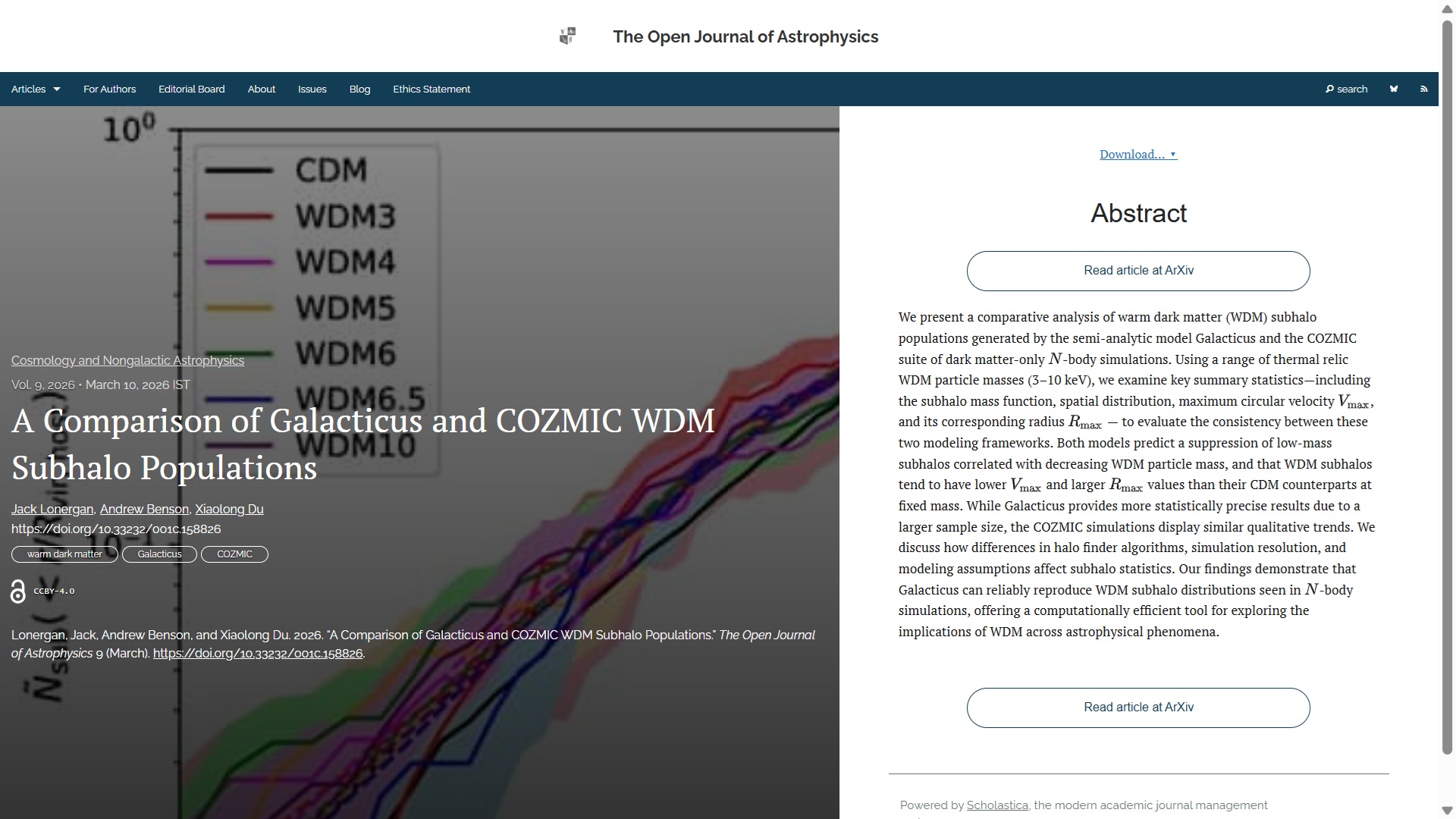
Next one up is “A Comparison of Galacticus and COZMIC WDM Subhalo Populations” by Jack Lonergan (U. Southern California), Andrew Benson (Carnegie Observatories) and Xiaolong Du (UCLA), all based in the USA. This paper was published on 10th March 2026 in the folder Cosmology and Nongalactic Astrophysics. The study compares warm dark matter subhalo populations using the Galacticus model and COZMIC simulations, finding both can reliably reproduce these distributions, with Galacticus offering computational efficiency.Abstractfor A Comparison of Galacticus and COZMIC WDM Subhalo Populations.
The overlay for this one is here:
The final, accepted version can be found on arXiv here and the Mastodon announcement is here:
New Publication at the Open Journal of Astrophysics: "A Comparison of Galacticus and COZMIC WDM Subhalo Populations" by Jack Lonergan (U. Southern California), Andrew Benson (Carnegie Observatories) and Xiaolong Du (UCLA), all based in the USA.
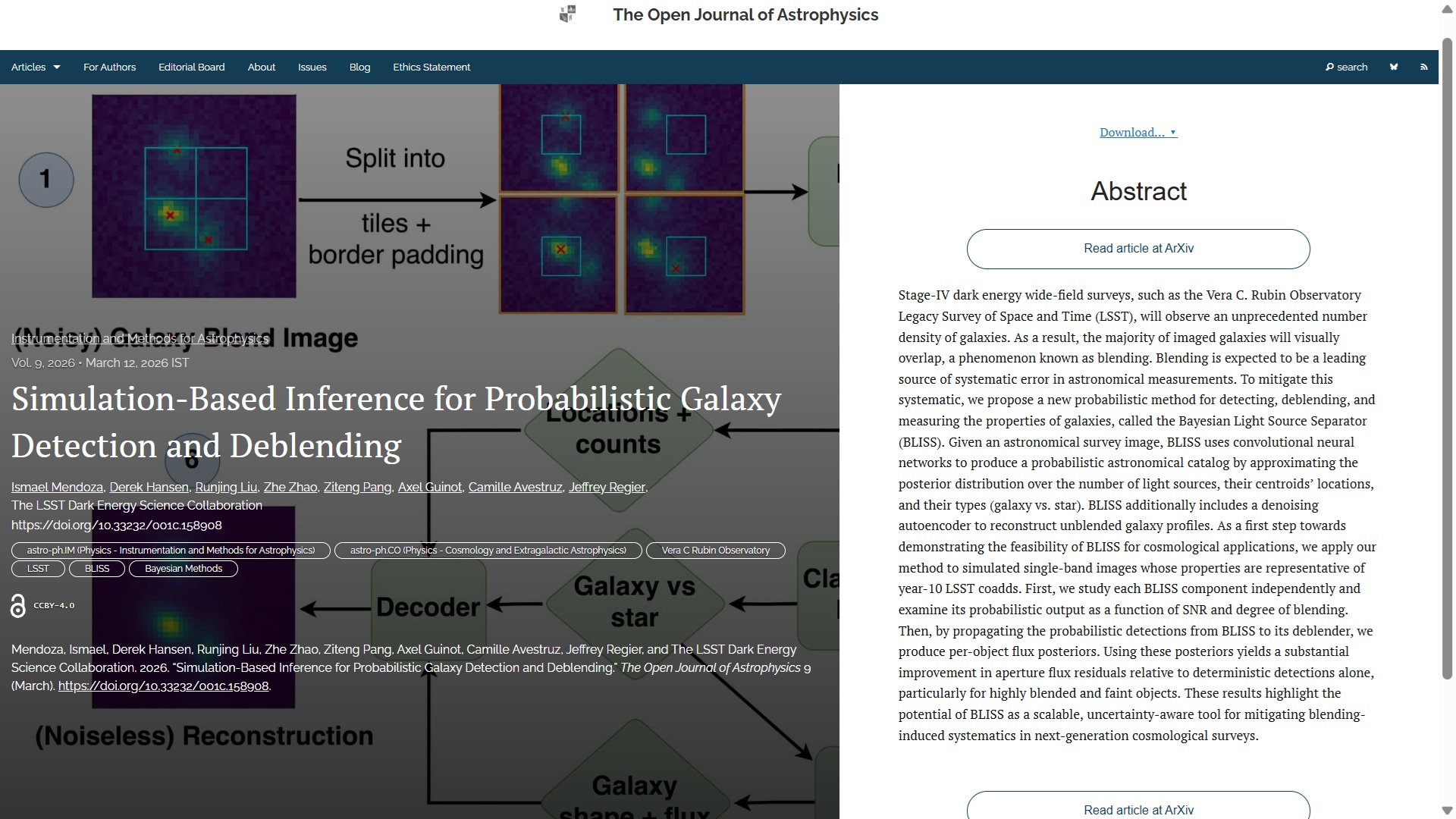
And finally for this week we have “Simulation-Based Inference for Probabilistic Galaxy Detection and Deblending” by Ismael Mendoza (U. Maryland, USA) and 7 others (all based in the USA) on behalf of the LSST Dark Energy Science Collaboration. This was published on Thursday March 12th in the folder Instrumentation and Methods for Astrophysics. The article introduces the Bayesian Light Source Separator (BLISS), for detecting and measuring galaxy properties in wide-field cosmological surveys. BLISS demonstrates improved performance, particularly for faint and blended objects.
The overlay is here:
The finally accepted version of this paper can be found here and the Mastodon announcement is here:
New Publication at the Open Journal of Astrophysics: "Simulation-Based Inference for Probabilistic Galaxy Detection and Deblending" by Ismael Mendoza (U. Maryland, USA) and 7 others (all based in the USA) on behalf of the LSST Dark Energy Science Collaboration
P.S. Thank you once again to the many people who have responded to the latest call for editors. I’ve been sending out invitations and getting people onboard as quickly as I can, but I still have a number to get to, so please bear with me!
It’s Saturday once more, so it’s time for another update of activity at the Open Journal of Astrophysics. It has been a busy week. Since the last update we have published a further nine papers, bringing the number in Volume 9 (2026) to 45 and the total so far published by OJAp up to 493.
I will continue to include the posts made on our Mastodon account (on Fediscience) to encourage you to visit it. Mastodon is a really excellent service, and a more than adequate replacement for X/Twitter (which nobody should be using); these announcements also show the DOI for each paper.
The first four papers this week were all published on Monday 23rd February.
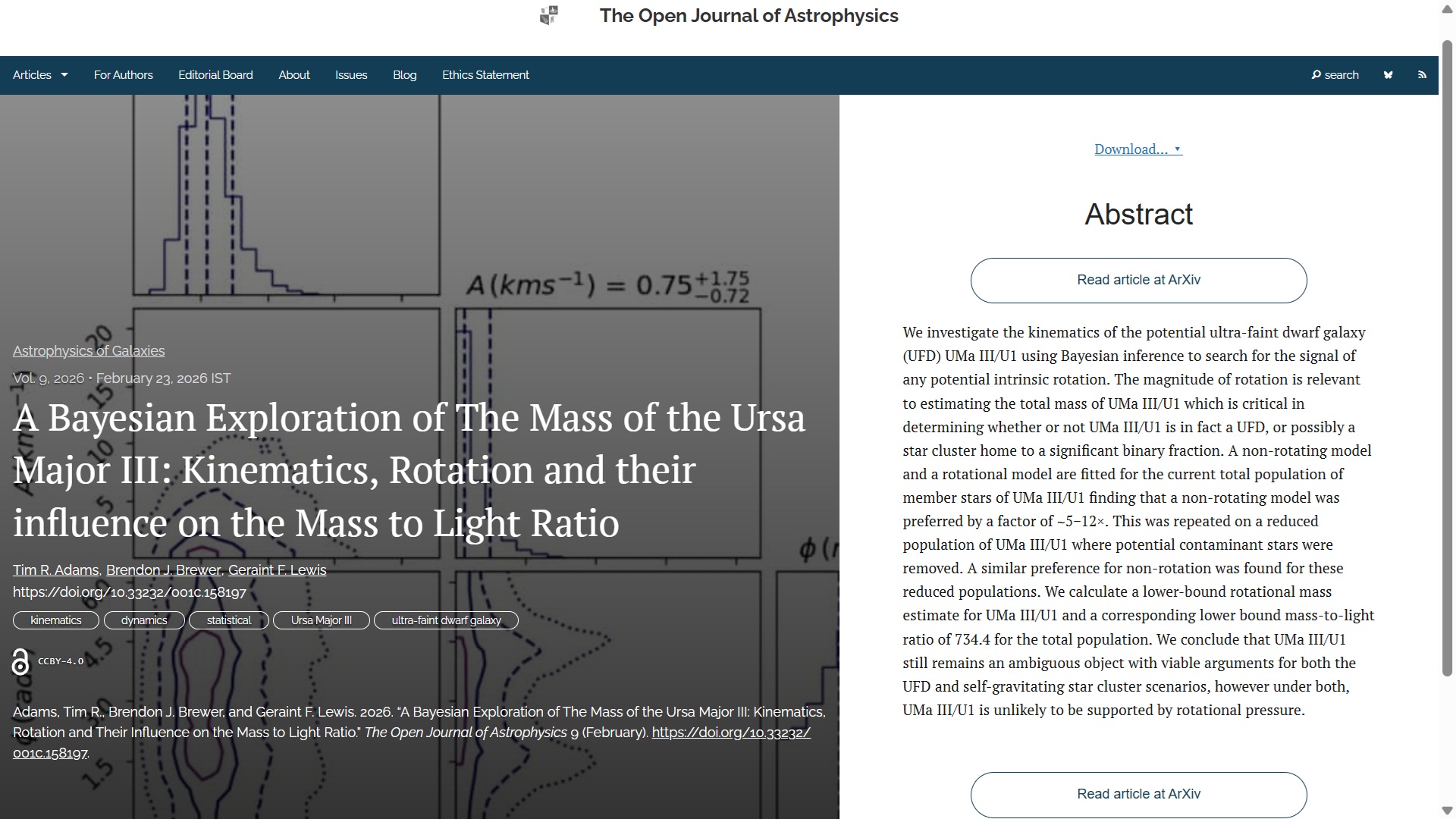
New Publication at the Open Journal of Astrophysics: "A Bayesian Exploration of The Mass of the Ursa Major III: Kinematics, Rotation and their influence on the Mass to Light Ratio" by Tim R. Adams (U. Sydney, Australia), Brendon J. Brewer (U. Auckland, New Zealand) and Geraint F. Lewis (Sydney)
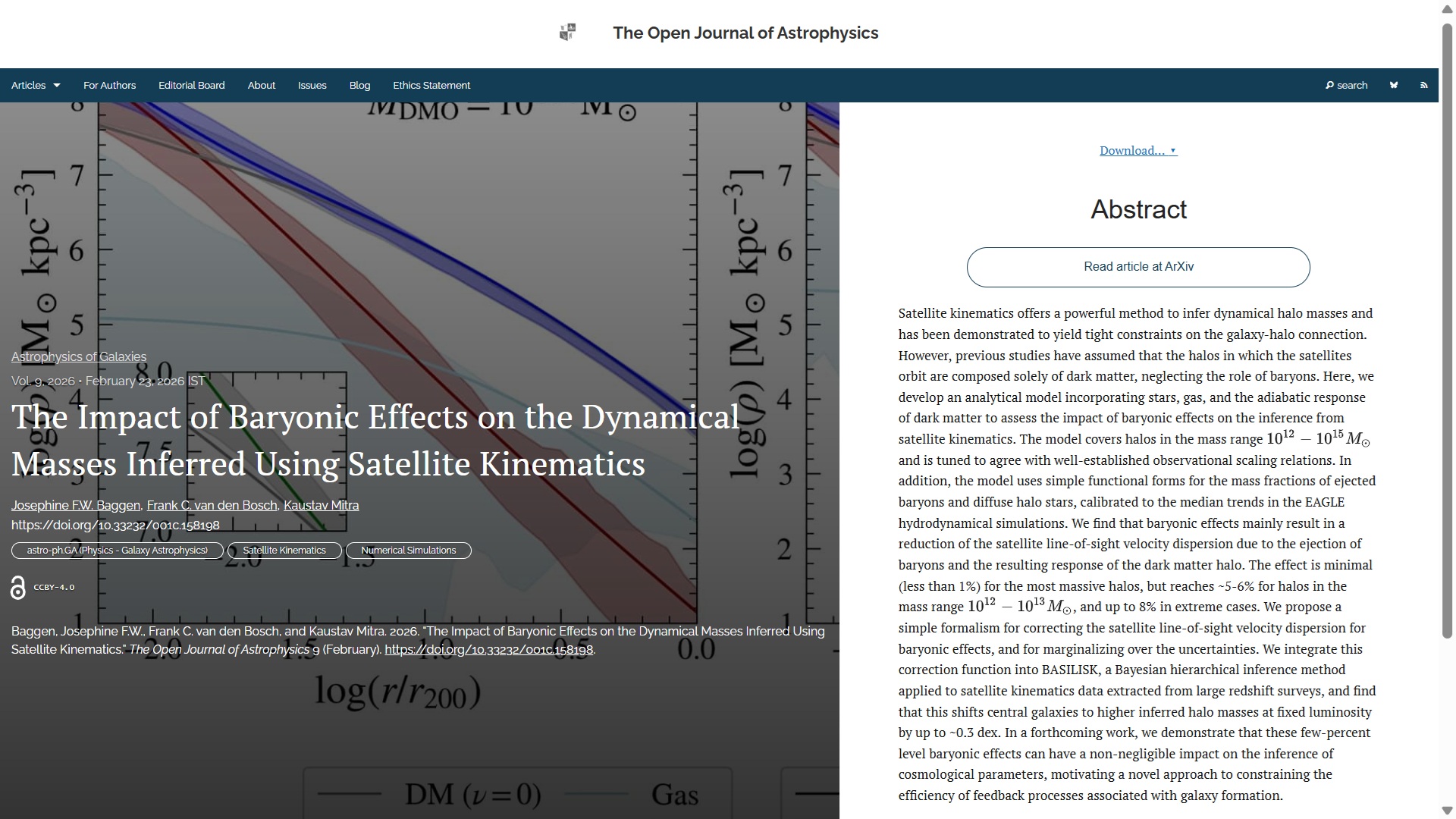
The second paper is “The Impact of Baryonic Effects on the Dynamical Masses Inferred Using Satellite Kinematics” by Josephine F.W. Baggen, Frank C. van den Bosch, and Kaustav Mitra (Yale U., USA). This paper, also in the folder Astrophysics of Galaxies, presents a model to assess the impact of stars and gas on satellite kinematics, showing that these baryonic effects can reduce the satellite velocity dispersion and increase inferred central galaxy masses.
The overlay for this one is here:
The official version of the paper can be found on arXiv here and the Fediverse announcement here:
New Publication at the Open Journal of Astrophysics: "The Impact of Baryonic Effects on the Dynamical Masses Inferred Using Satellite Kinematics" by Josephine F.W. Baggen, Frank C. van den Bosch, and Kaustav Mitra (Yale U., USA)
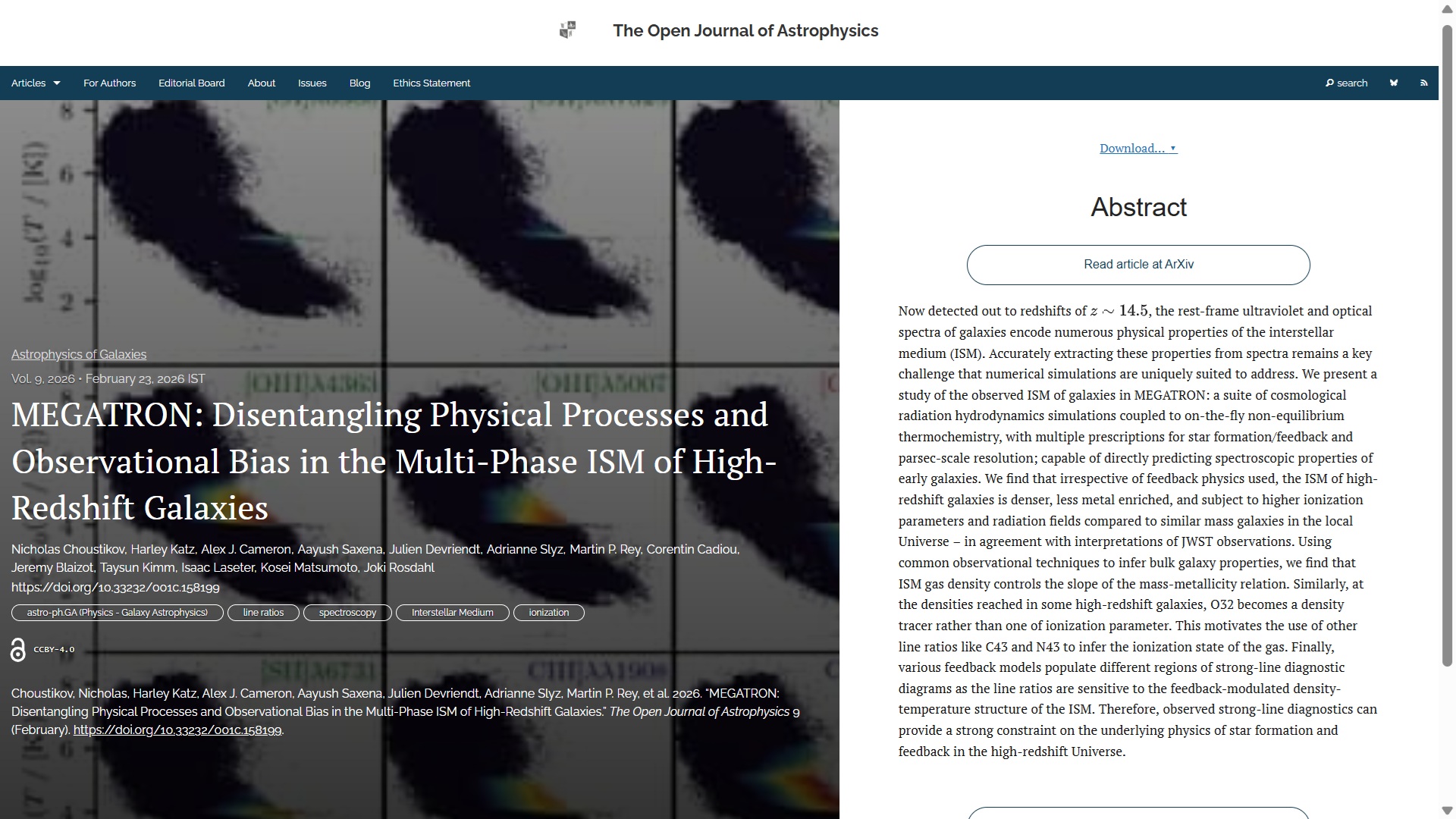
The third paper this week, and the third published on Monday 23rd February, and the third in the folder Astrophysics of Galaxies, is “MEGATRON: Disentangling Physical Processes and Observational Bias in the Multi-Phase ISM of High-Redshift Galaxies” by Nicholas Choustikov (U. Oxford, UK) and 12 others based in UK, USA, France, Korea and Belgium. The study uses MEGATRON simulations to analyze the interstellar medium (ISM) of high-redshift galaxies, finding it denser and less metal-enriched than local galaxies with implications for line ratios as diagnostics
The overlay is here:
The official version can be found on arXiv here and the Fediverse announcement is here:
New Publication at the Open Journal of Astrophysics: "MEGATRON: Disentangling Physical Processes and Observational Bias in the Multi-Phase ISM of High-Redshift Galaxies" by Nicholas Choustikov (U. Oxford, UK) and 12 others based in UK, USA, France, Korea and Belgium
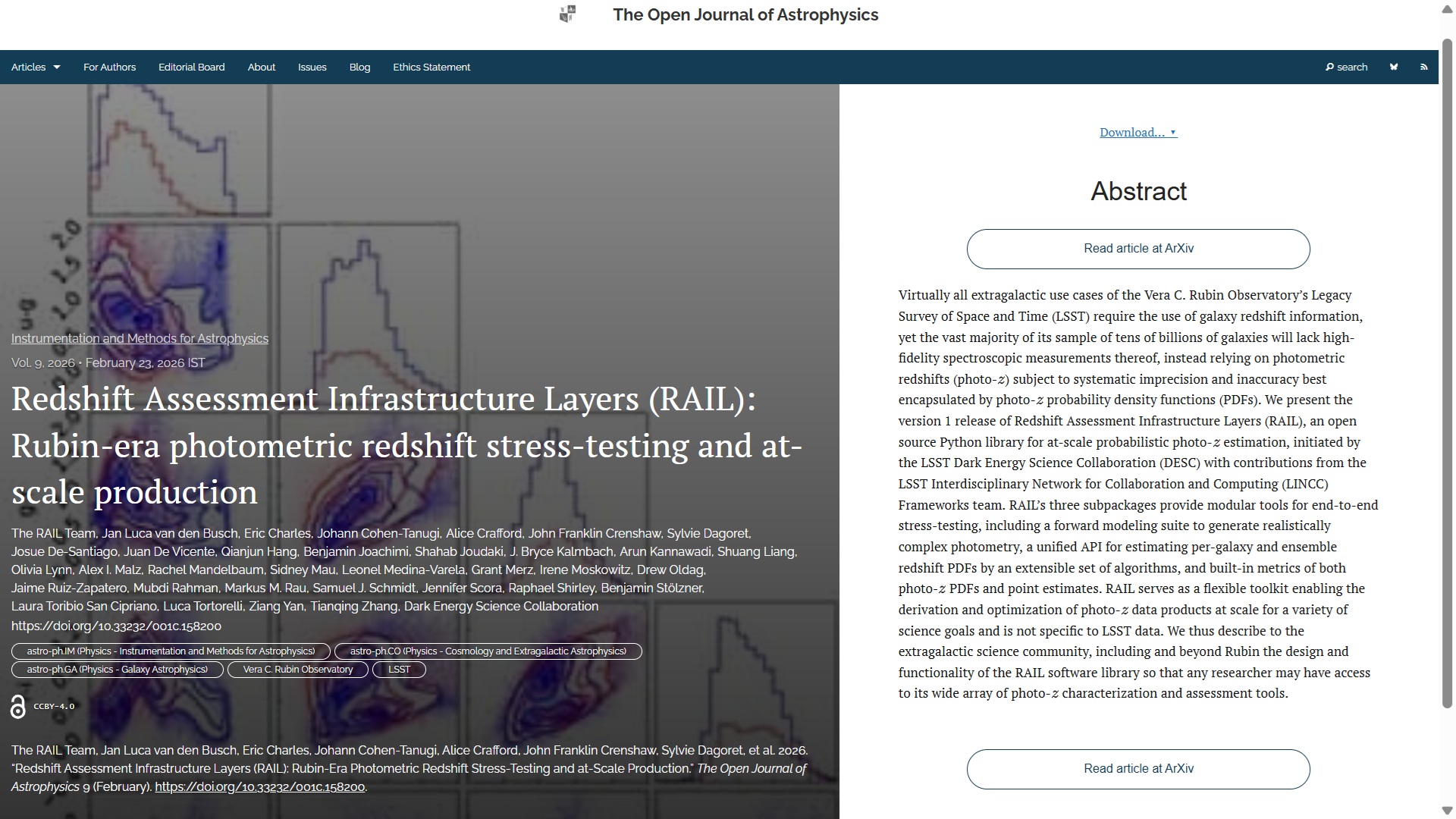
New Publication at the Open Journal of Astrophysics: "Redshift Assessment Infrastructure Layers (RAIL): Rubin-era photometric redshift stress-testing and at-scale production" by the RAIL Team (31 authors) and the Dark Energy Science Collaboration
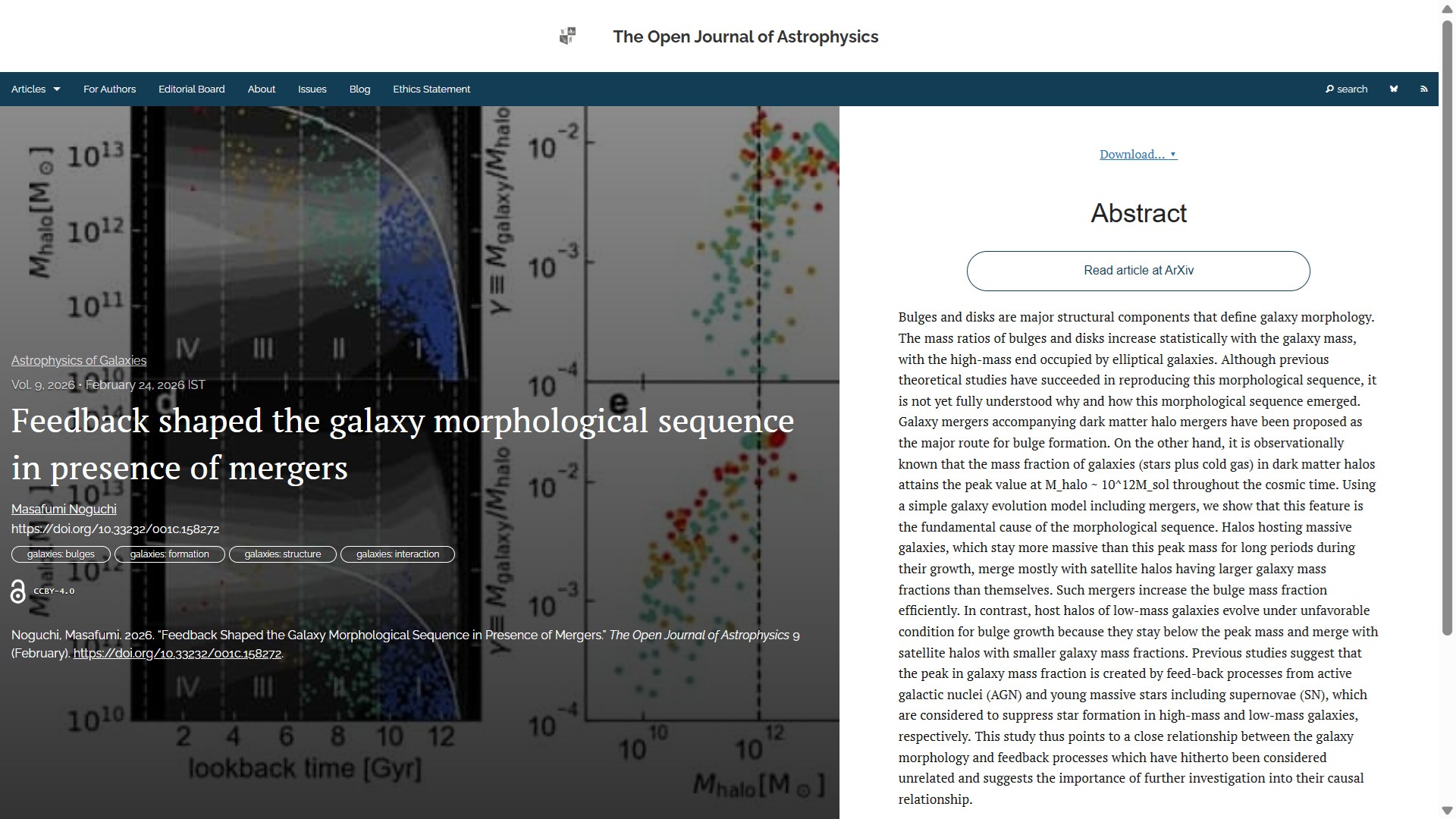
Moving on to Tuesday 24th February, the fifth paper this week, is “Feedback shaped the galaxy morphological sequence in presence of mergers” by Masafumi Noguchi (Tohoku University, Japan). This article was published in the folder Astrophysics of Galaxies. This study suggests that galaxy morphology, specifically the mass ratios of bulges and disks, is influenced by galaxy mergers and feedback processes from active galactic nuclei and supernovae.
The overlay is here:
The accepted version can be found on arXiv here, and the fediverse announcement is here:
New Publication at the Open Journal of Astrophysics: "Feedback shaped the galaxy morphological sequence in presence of mergers" by Masafumi Noguchi (Tohoku University, Japan)
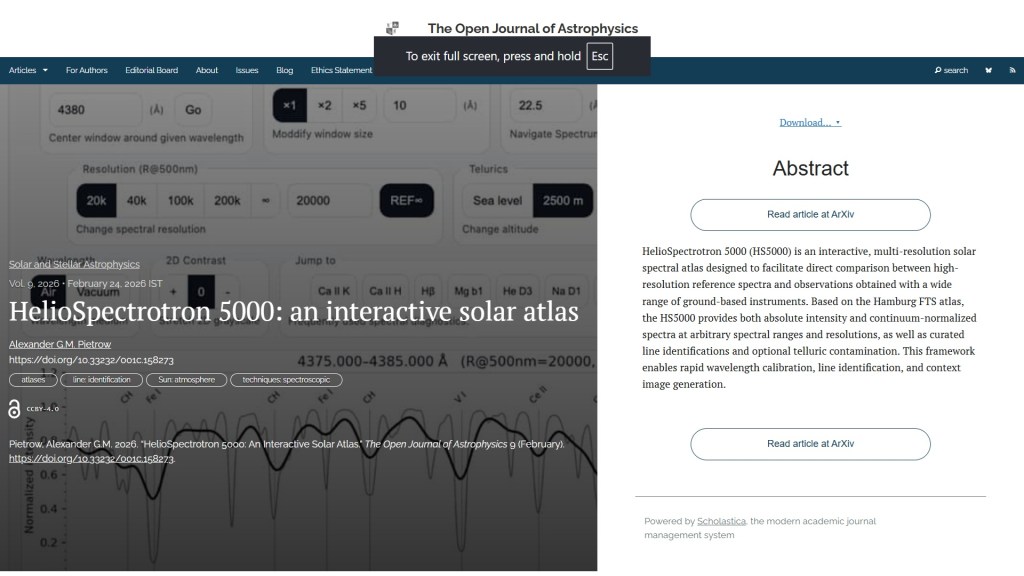
The sixth paper this week is “HelioSpectrotron 5000: an interactive solar atlas” by Alexander G.M. Pietrow (AIP Potsdam, Germany). This was published on Tuesday 24th February in the folder Solar and Stellar Astrophysics. This describes HelioSpectrotron~5000 (HS5000), which is an interactive solar spectral atlas that allows comparison between high-resolution spectra and ground-based instrument observations, aiding in wavelength calibration and line identification. The software can be found here; I had a play with it yesterday and it’s very easy to use!
The overlay is here:
You can find the officially accepted version on arXiv here and the Mastodon announcement is here:
New Publication at the Open Journal of Astrophysics: "HelioSpectrotron 5000: an interactive solar atlas" by Alexander G.M. Pietrow (AIP Potsdam, Germany)
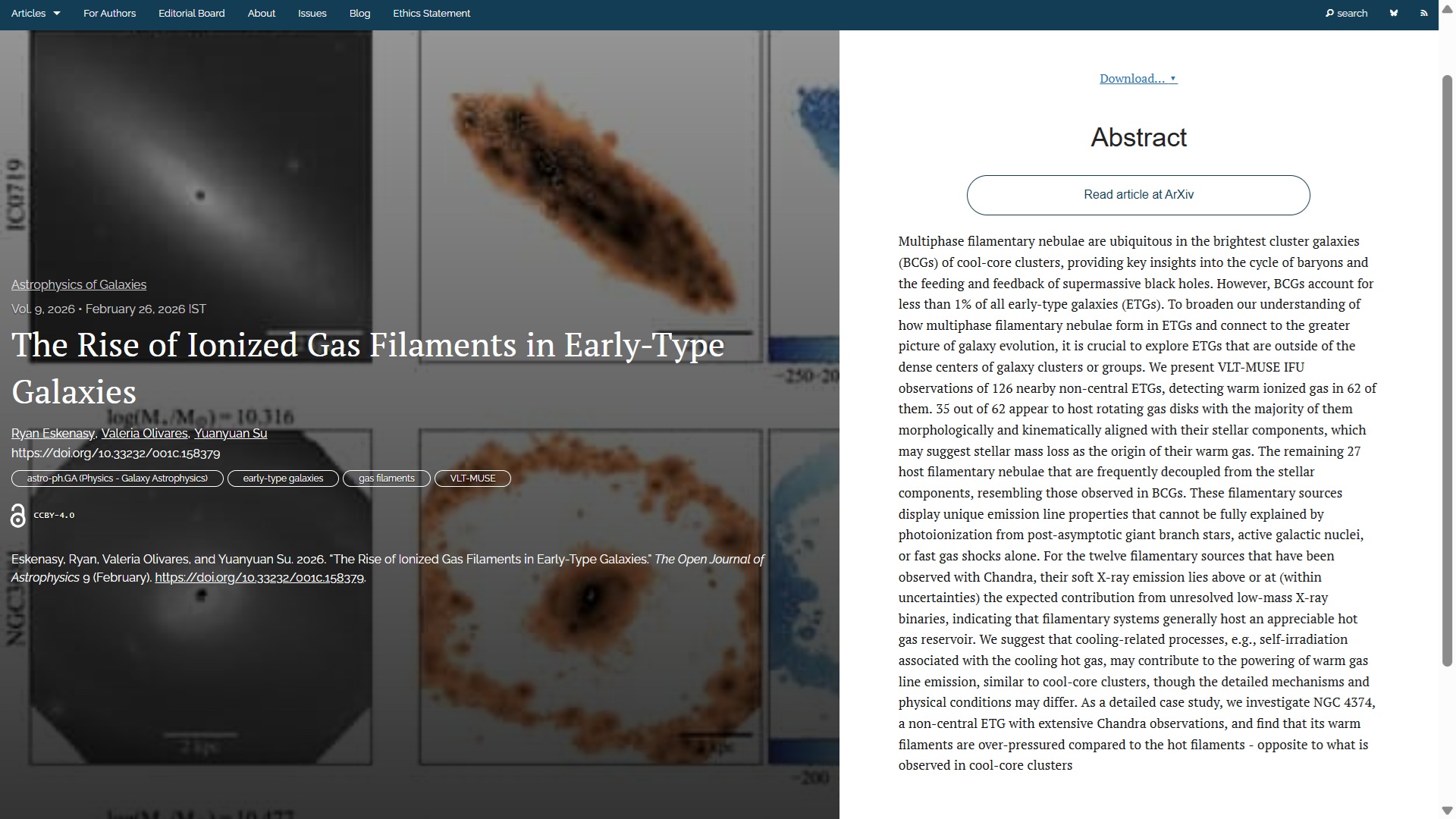
The seventh paper of this week was published on Thursday 26th February is “The Rise of Ionized Gas Filaments in Early-Type Galaxies” by Ryan Eskenasy (U. Kentucky, USA), Valeria Olivares (Universidad de Santiago de Chile) and Yuanyuan Su (U. Kentucky, USA). This article, in the folder Astrophysics of Galaxies, is an exploration of the formation of multiphase filamentary nebulae in early-type galaxies (ETGs), using VLT-MUSE IFU observations of 126 non-central ETGs, focussing on the hot gas components thereof.
The overlay is here:
The officially accepted version of this paper can be found on the arXiv here and the Mastodon announcement is here:
New Publication at the Open Journal of Astrophysics: "The Rise of Ionized Gas Filaments in Early-Type Galaxies" by Ryan Eskenasy (U. Kentucky, USA), Valeria Olivares (Universidad de Santiago de Chile) and Yuanyuan Su (U. Kentucky, USA)
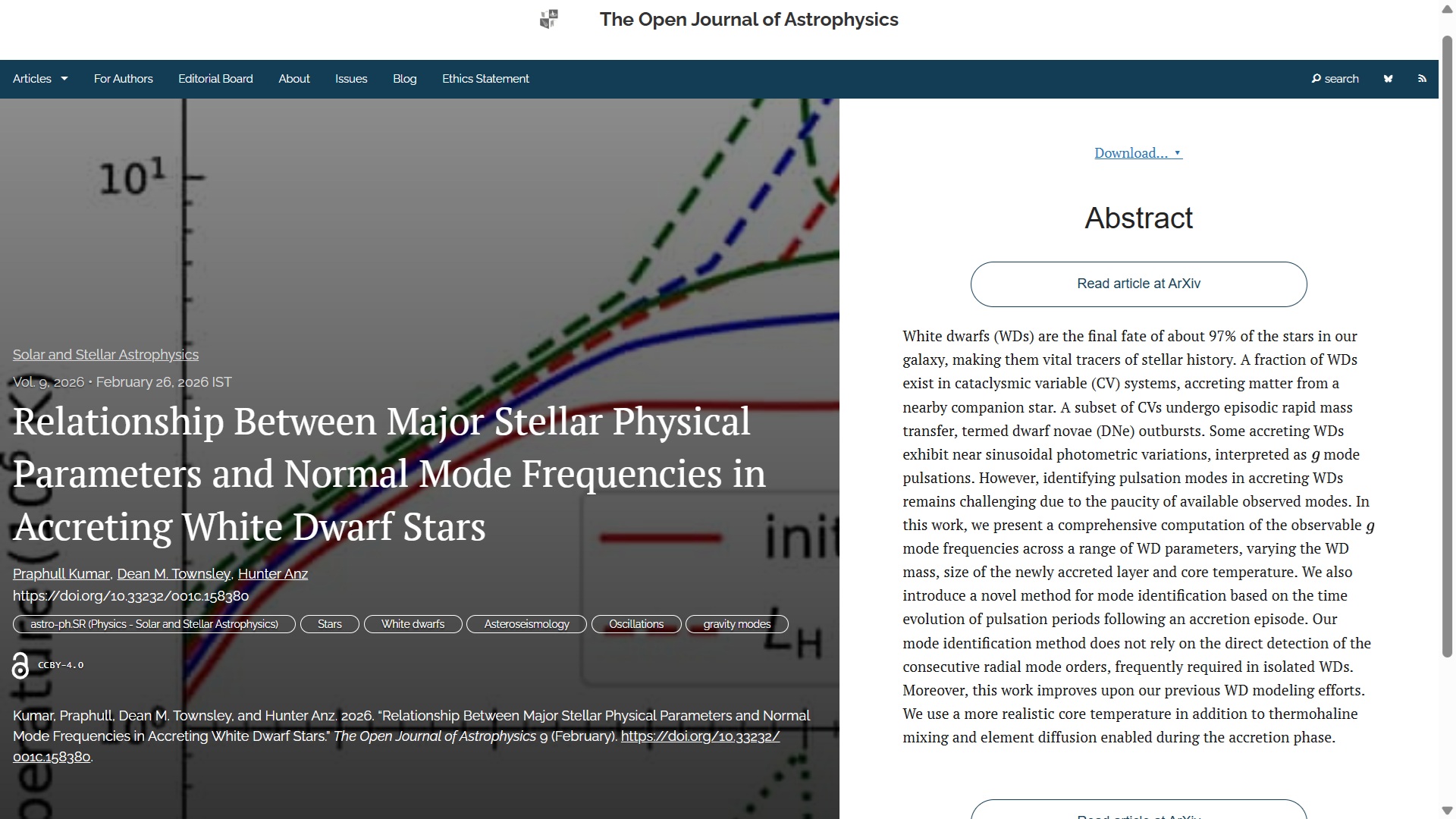
New Publication at the Open Journal of Astrophysics: "Relationship Between Major Stellar Physical Parameters and Normal Mode Frequencies in Accreting White Dwarf Stars" by Praphull Kumar, Dean M. Townsley and Hunter Anz (U. Alabama, USA)
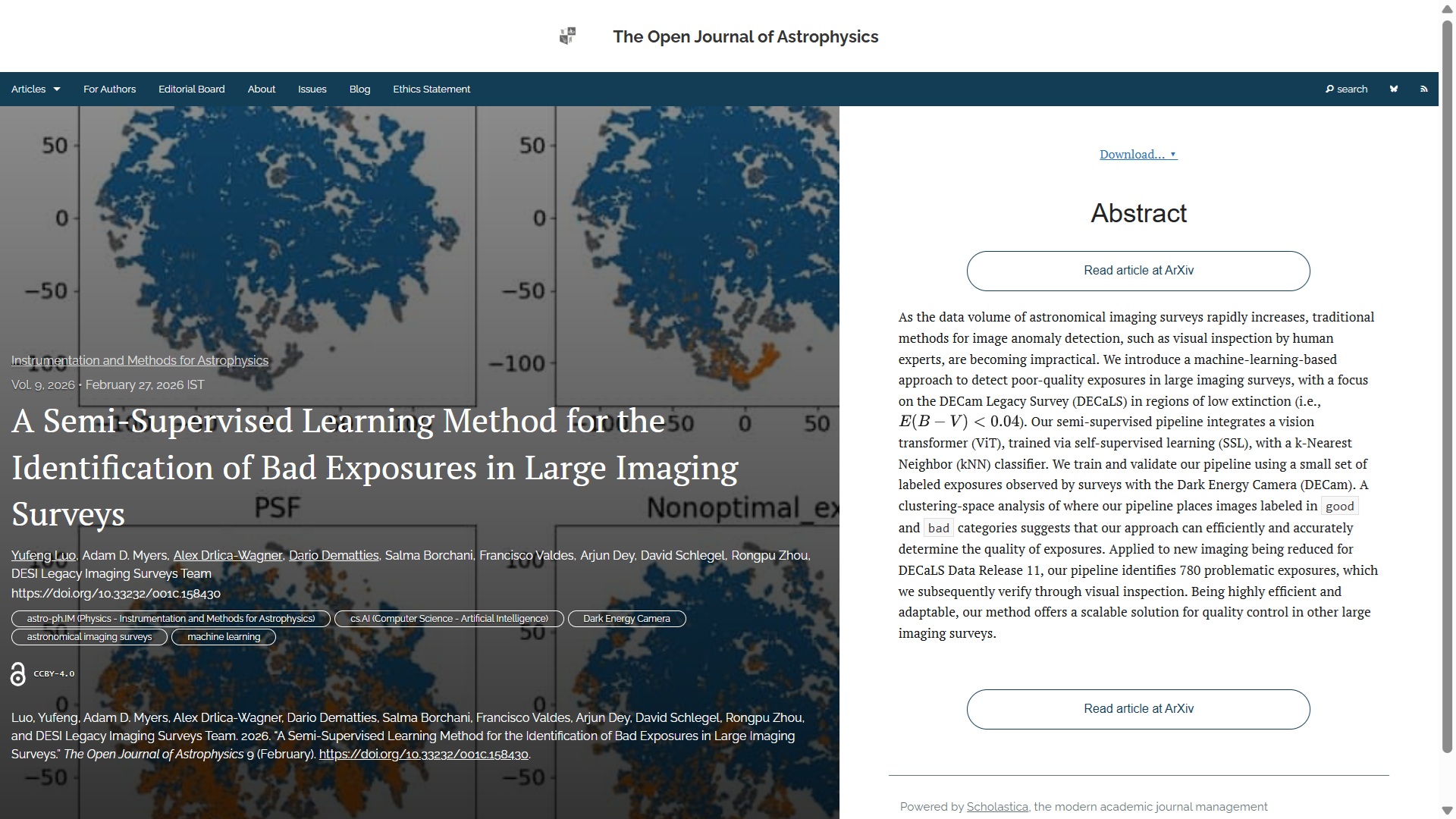
The ninth, and final, paper for this week is “A Semi-Supervised Learning Method for the Identification of Bad Exposures in Large Imaging Surveys” by Yufeng Luo (U. Wyoming, USA) and 8 others from the DESI Legacy Imaging Surveys Team. This was published on Friday 27th February, i.e yesterday, in the folder Instrumentation and Methods for Astrophysics. The paper describes a machine-learning approach for detecting poor-quality exposures in large astronomical imaging surveys, proving efficient and accurate in identifying problematic exposures.
The overlay is here:
The official version on arXiv can be found here and the Mastodon announcement follows:
New Publication at the Open Journal of Astrophysics: "A Semi-Supervised Learning Method for the Identification of Bad Exposures in Large Imaging Surveys" by Yufeng Luo (U. Wyoming, USA) and 8 others from the DESI Legacy Imaging Surveys Team
And that concludes this week’s update. We have now published 45 papers in two complete months of 2026, on which basis we can estimate about 270 papers in the year. For the record, in the first two months of 2025 we published 21 papers.
P.S. Thank you to the many people who responded to the latest call for editors. I’ve been sending out invitations and getting people onboard as quickly as I can, but I still have a number to get to so please bear with me!
It’s Saturday once more so time for another update of activity at the Open Journal of Astrophysics. Since the last update we have published a further six papers, bringing the number in Volume 9 (2026) to 36 and the total so far published by OJAp up to 484.
I will continue to include the posts made on our Mastodon account (on Fediscience) to encourage you to visit it. Mastodon is a really excellent service, and a more than adequate replacement for X/Twitter (which nobody should be using); these announcements also show the DOI for each paper.
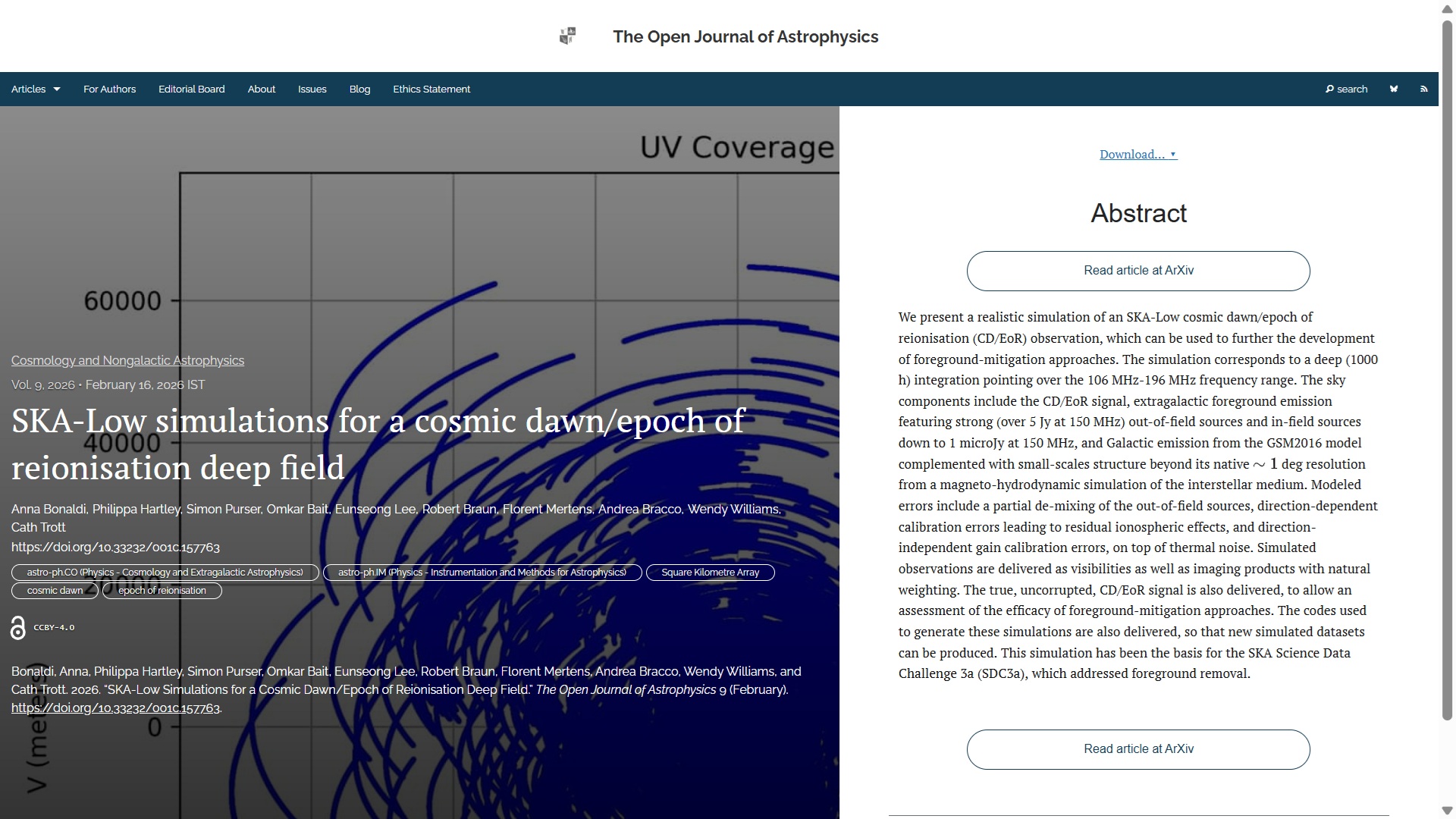
The first paper to report this week is “SKA-Low simulations for a cosmic dawn/epoch of reionisation deep field” by Anna Bonaldi, Philippa Hartley, Simon Purser & Omkar Bait (SKAO, UK), Eunseong Lee (U. Manchester, UK), Robert Braun (SKAO), Florent Mertens (Sorbonne Université, France), Andrea Bracco (Osservatorio Astrofisico di Arcetri, IT), Wendy Williams (SKAO) and Cath Trott (Curtin U., Australia). This paper presents a simulation of an SKA-Low cosmic dawn/epoch of reionisation observation to advance foreground-mitigation approaches: the simulation includes various sky components and modelled errors, allowing for efficacy assessment. It was published on Monday 16th February in the folder Cosmology and Nongalactic Astrophysics.
The overlay is here:
You can find the officially accepted version on arXiv here and the announcement on Fediverse here:
New Publication at the Open Journal of Astrophysics: "SKA-Low simulations for a cosmic dawn/epoch of reionisation deep field" by Anna Bonaldi, Philippa Hartley, Simon Purser & Omkar Bait (SKAO, UK), Eunseong Lee (U. Manchester, UK), Robert Braun (SKAO), Florent Mertens (Sorbonne Université, France), Andrea Bracco (Osservatorio Astrofisico di Arcetri, IT), Wendy Williams (SKAO) and Cath Trott (Curtin U., Australia)
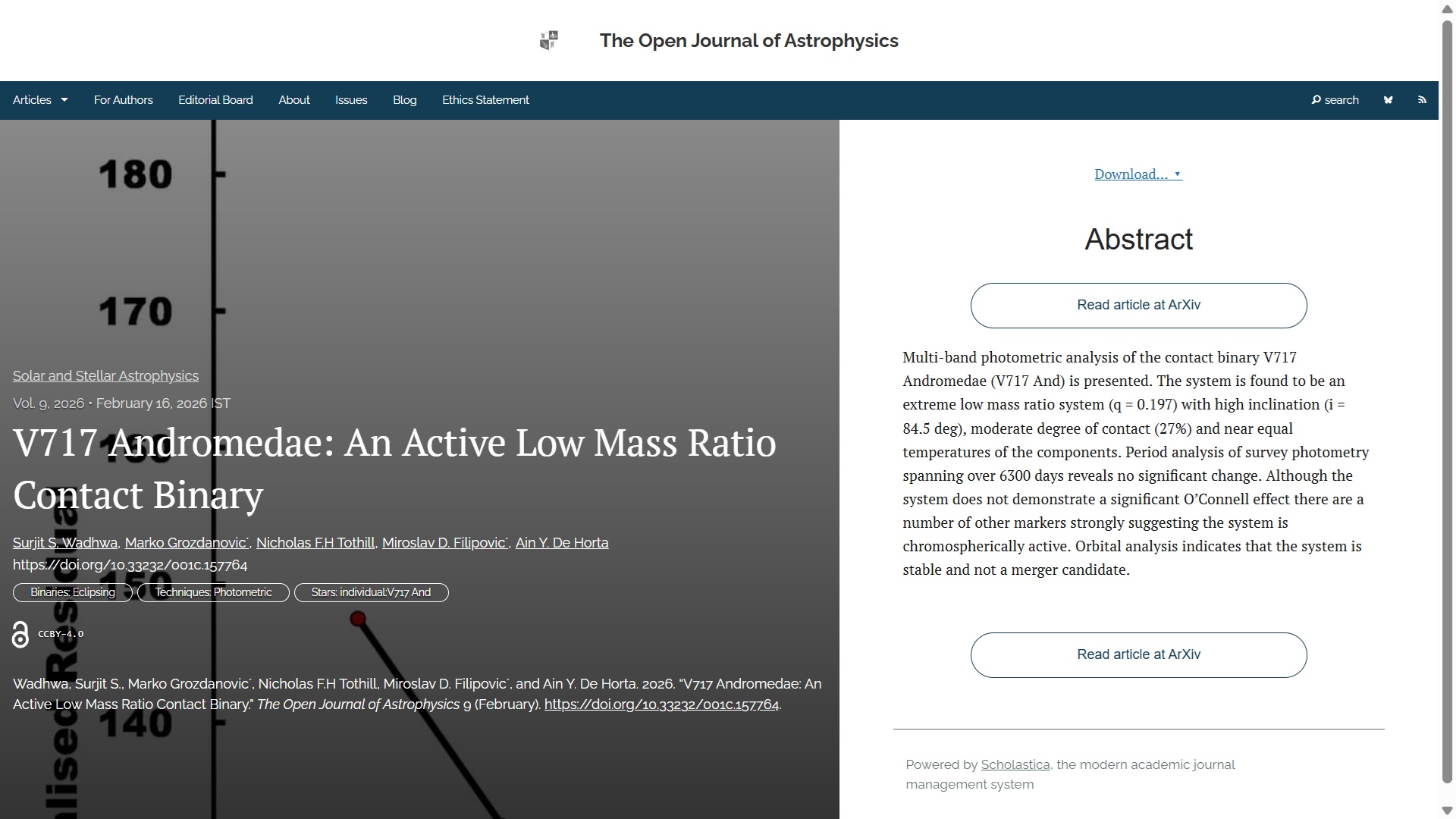
The second paper is “V717 Andromedae: An Active Low Mass Ratio Contact Binary” by Surjit S. Wadhwa (Western Sydney U. Australia), Marko Grozdanovic (Astronomical Observatory Belgrade, Serbia), and Nicholas F.H Tothill, Miroslav D. Filipovic, Ain Y. De Horta (Western Sydney U.). This was also published on Monday 1th February, but in the folder Solar and Stellar Astrophysics. The article discusses the contact binary V717 Andromedae, an extreme low mass ratio system with high inclination and moderate contact, showing signs of chromospheric activity but stable and not a merger candidate
The overlay for this one is here:
The official version of the paper can be found on arXiv here and the Fediverse announcement here:
New Publication at the Open Journal of Astrophysics: "V717 Andromedae: An Active Low Mass Ratio Contact Binary" by Surjit S. Wadhwa (Western Sydney U. Australia), Marko Grozdanovic (Astronomical Observatory Belgrade, Serbia), and Nicholas F.H Tothill, Miroslav D. Filipovic, Ain Y. De Horta (Western Sydney U.)
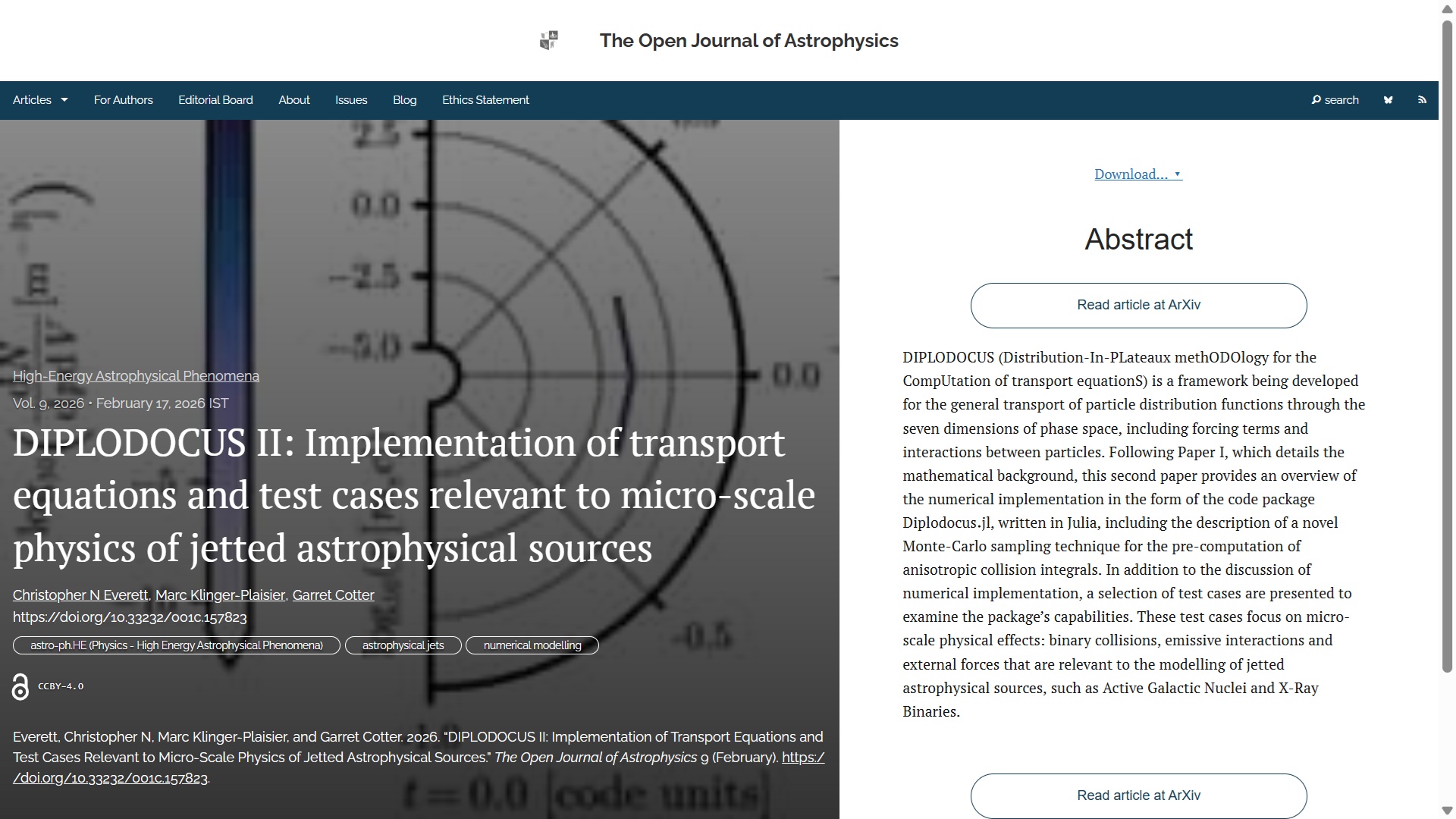
New Publication at the Open Journal of Astrophysics: "DIPLODOCUS II: Implementation of transport equations and test cases relevant to micro-scale physics of jetted astrophysical sources" by Christopher N Everett (Oxford U., UK), Marc Klinger-Plaisier (U. Amsterdam, NL) and Garret Cotter (Oxford)
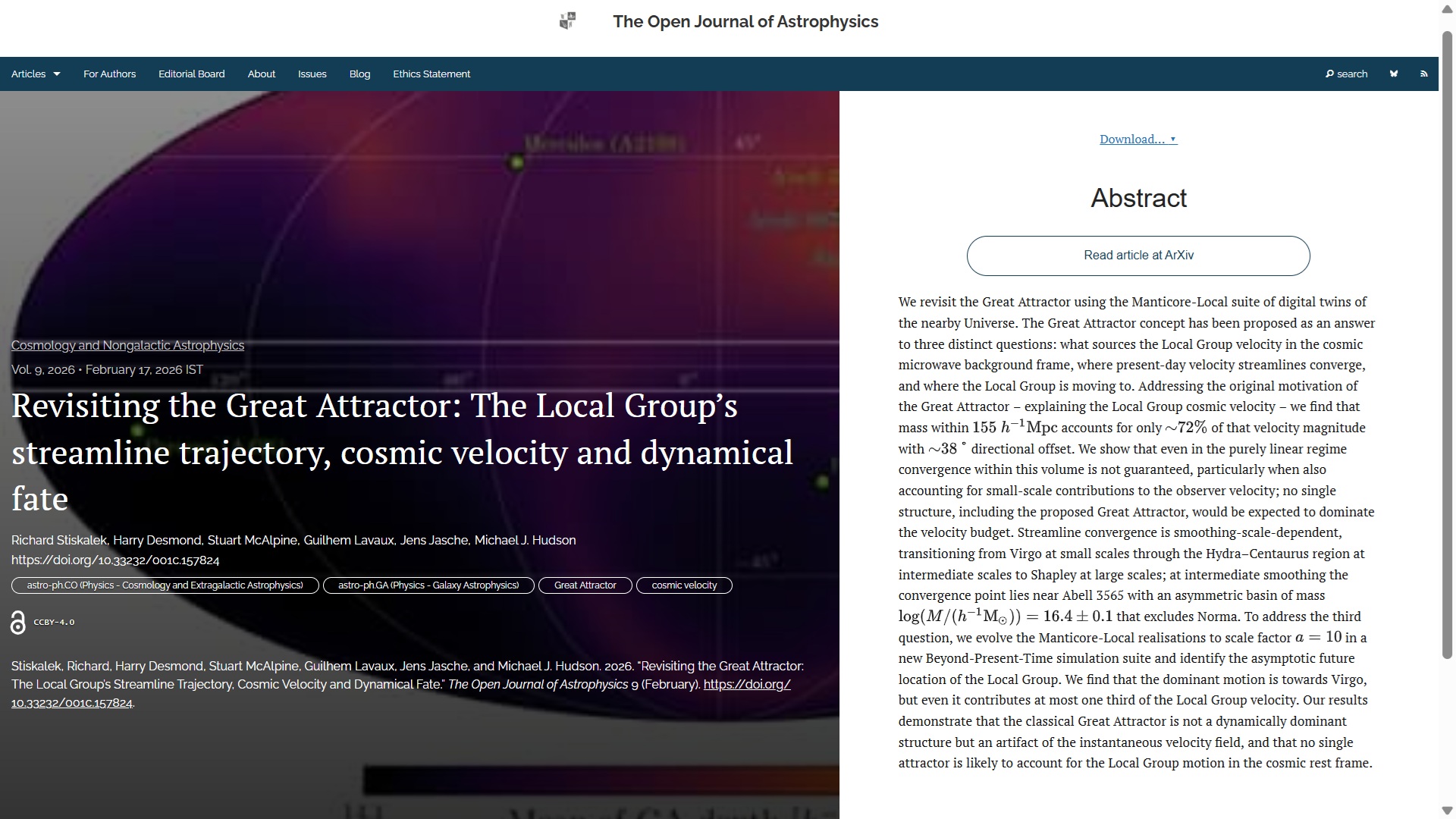
The fourth paper this week, also published on Tuesday 17th February, but in the folder Cosmology and Nongalactic Astrophysics is “Revisiting the Great Attractor: The Local Group’s streamline trajectory, cosmic velocity and dynamical fate” by Richard Stiskalek (Oxford U., UK), Harry Desmond (U. Portsmouth, UK), Stuart McAlpine (Stockholm, SE), Guilhem Lavaux (Sorbonne Université, FR), Jens Jasche (Stockholm) and Michael J. Hudson (U. Waterloo, Canada). This paper revisits the so-called “Great Attractor” concept, finding that it doesn’t dominate the Local Group’s cosmic velocity; multiple structures contribute to the motion, with no single attractor accounting for the flow.
Here is the overlay:
The official version can be found on arXiv here and the Fediverse announcement is here:
New Publication at the Open Journal of Astrophysics: "Revisiting the Great Attractor: The Local Group’s streamline trajectory, cosmic velocity and dynamical fate" by Richard Stiskalek (Oxford U., UK), Harry Desmond (U. Portsmouth, UK), Stuart McAlpine (Stockholm, SE), Guilhem Lavaux (Sorbonne Université, FR), Jens Jasche (Stockholm) and Michael J. Hudson (U. Waterloo, Canada)
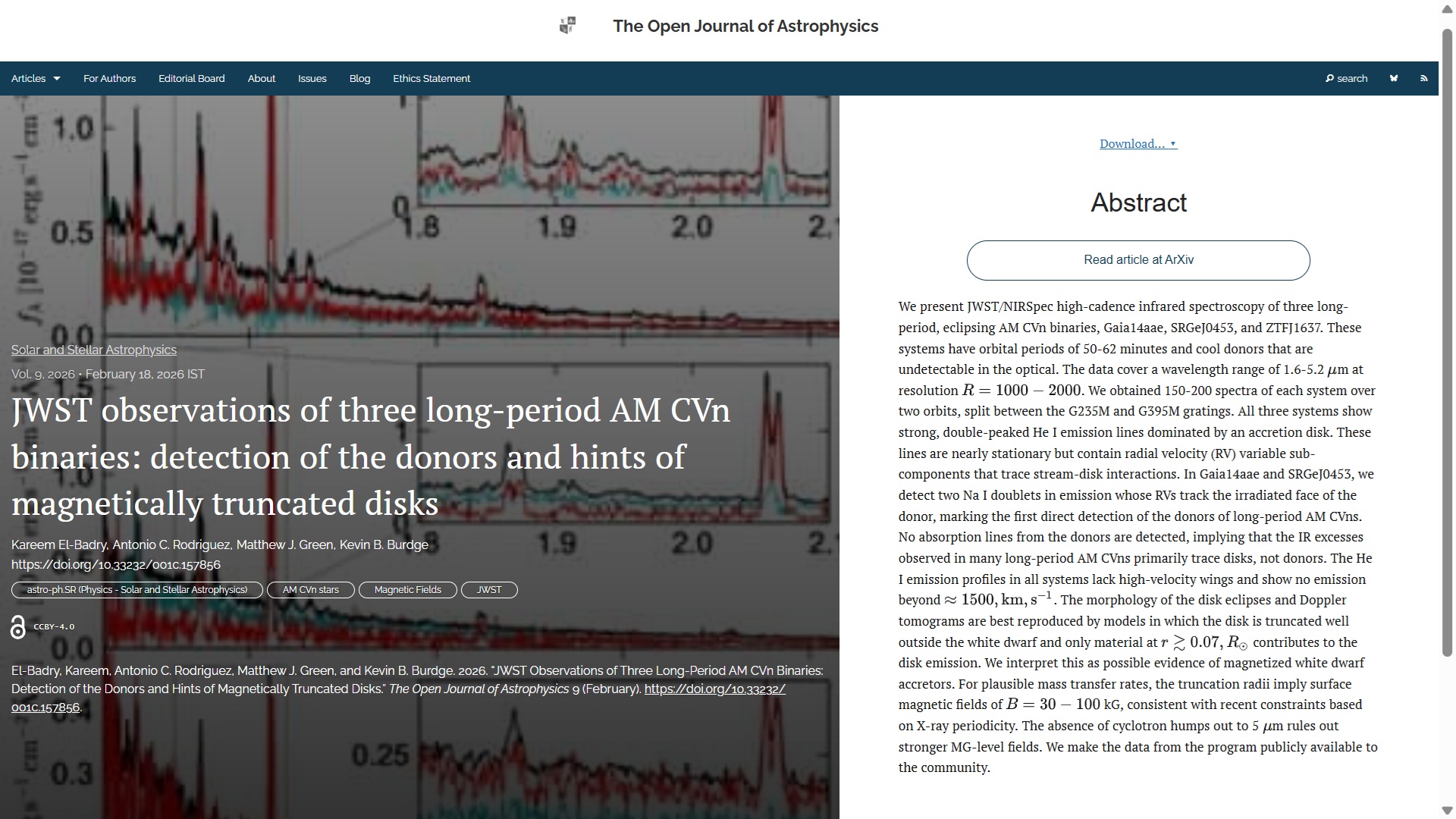
The fifth paper this week, is “JWST observations of three long-period AM CVn binaries: detection of the donors and hints of magnetically truncated disks” by Kareem El-Badry (Caltech), Antonio C. Rodriguez (CfA Harvard), Matthew J. Green (U. Oklahoma) & Kevin B. Burdge (MIT); all based in the USA. The article was published on Thursday 19th February 2026 in the folder Solar and Stellar Astrophysics. The paper describes high-cadence infrared spectroscopy used to analyze three long-period, eclipsing AM CVn (AM Canum Venaticorum) binaries; findings suggest the presence of magnetized white dwarf accretors, with surface magnetic fields of 30-100 kG.
The overlay is here:
The accepted version can be found on arXiv here, and the fediverse announcement is here:
New Publication at the Open Journal of Astrophysics: "JWST observations of three long-period AM CVn binaries: detection of the donors and hints of magnetically truncated disks" by Kareem El-Badry (Caltech), Antonio C. Rodriguez (CfA Harvard), Matthew J. Green (U. Oklahoma) & Kevin B. Burdge (MIT); all in USA
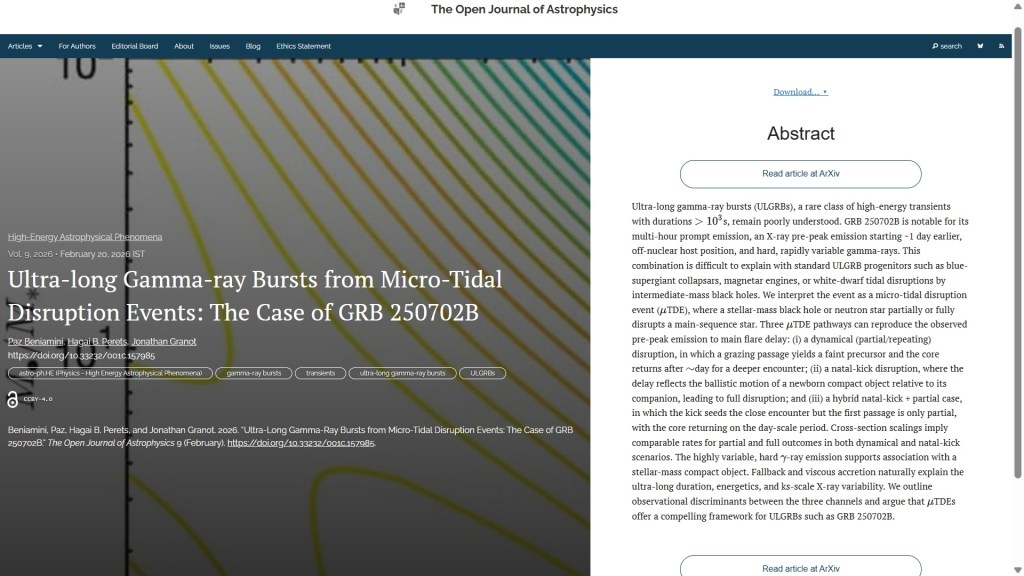
Finally for this week we have “Ultra-long Gamma-ray Bursts from Micro-Tidal Disruption Events: The Case of GRB 250702B” by Paz Beniamini (Open University, IL), Hagai B. Perets (Technion, IL) and Jonathan Granot (Open University, IL); all based in Israel. The paper was published on Friday 18th February 2026 in the folder High-Energy Astrophysical Phenomena.
The overlay is here:
You can find the officially accepted version on arXiv here and the Mastodon announcement is here:
New Publication at the Open Journal of Astrophysics: "Ultra-long Gamma-ray Bursts from Micro-Tidal Disruption Events: The Case of GRB 250702B" by Paz Beniamini (Open University, IL), Hagai B. Perets (Technion, IL) and Jonathan Granot (Open University, IL)
And that concludes this week’s update. I will do another next Saturday, by which time I expect we will have published a similar number of papers to this week.
It’s Saturday once more so time for another update of activity at the Open Journal of Astrophysics. Since the last update we have published a further six papers, bringing the number in Volume 9 (2026) to 30 and the total so far published by OJAp up to 478.
I will continue to include the posts made on our Mastodon account (on Fediscience) to encourage you to visit it. Mastodon is a really excellent service, and a more than adequate replacement for X/Twitter (which nobody should be using); these announcements also show the DOI for each paper.
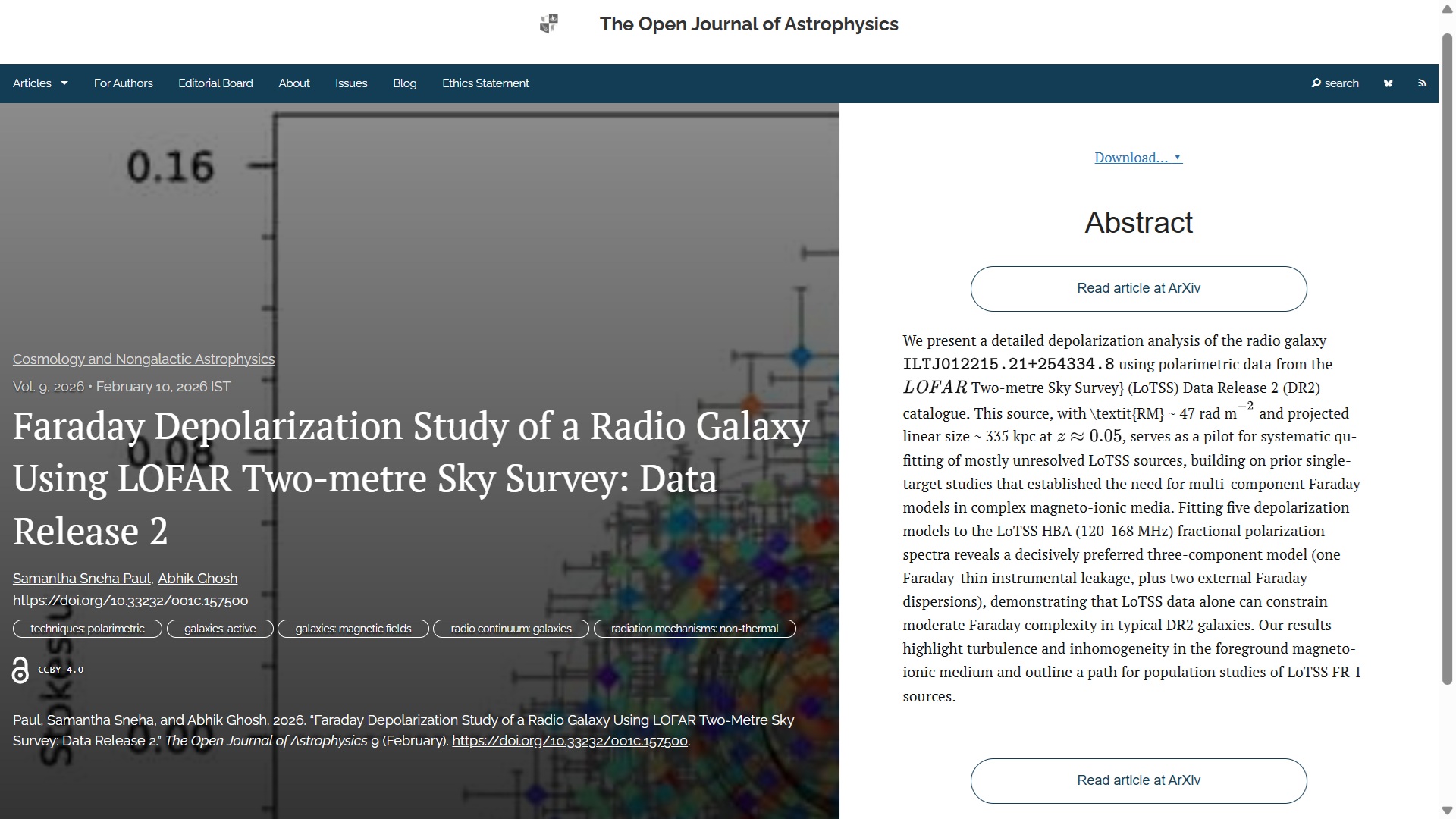
New Publication at the Open Journal of Astrophysics: "Faraday Depolarization Study of a Radio Galaxy Using LOFAR Two-metre Sky Survey: Data Release 2" by Samantha Sneha Paul and Abhik Ghosh (Banwarilal Bhalotia College, India)
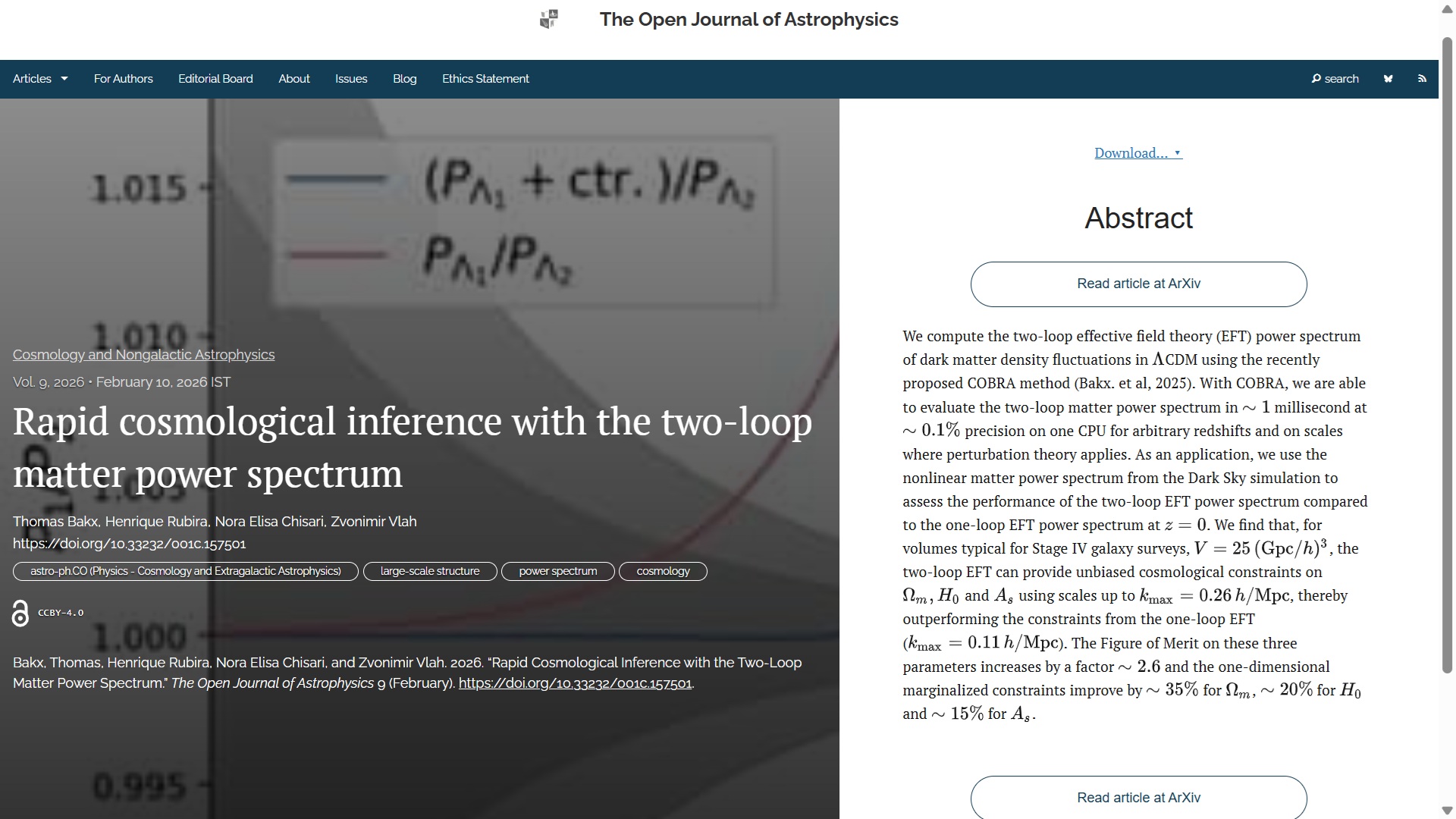
The second paper is “Rapid cosmological inference with the two-loop matter power spectrum” by Thomas Bakx (Utrecht U., NL), Henrique Rubira (Ludwig-Maximilians-Universität, DE), Nora Elisa Chisari (Utrecht) and Zvonimir Vlah (Ruđer Bošković Institute, Croatia). This was also published on Tuesday February 10th in the folder Cosmology and Nongalactic Astrophysics. This paper uses the COBRA method to compute the two-loop effective field theory power spectrum of dark matter density fluctuations, providing more precise cosmological constraints than the one-loop EFT.
The overlay for this one is here:
The official version of the paper can be found on arXiv here and the Fediverse announcement here:
New Publication at the Open Journal of Astrophysics: "Rapid cosmological inference with the two-loop matter power spectrum" by Thomas Bakx (Utrecht U., NL), Henrique Rubira (Ludwig-Maximilians-Universität, DE), Nora Elisa Chisari (Utrecht) and Zvonimir Vlah (Ruđer Bošković Institute, Croatia)
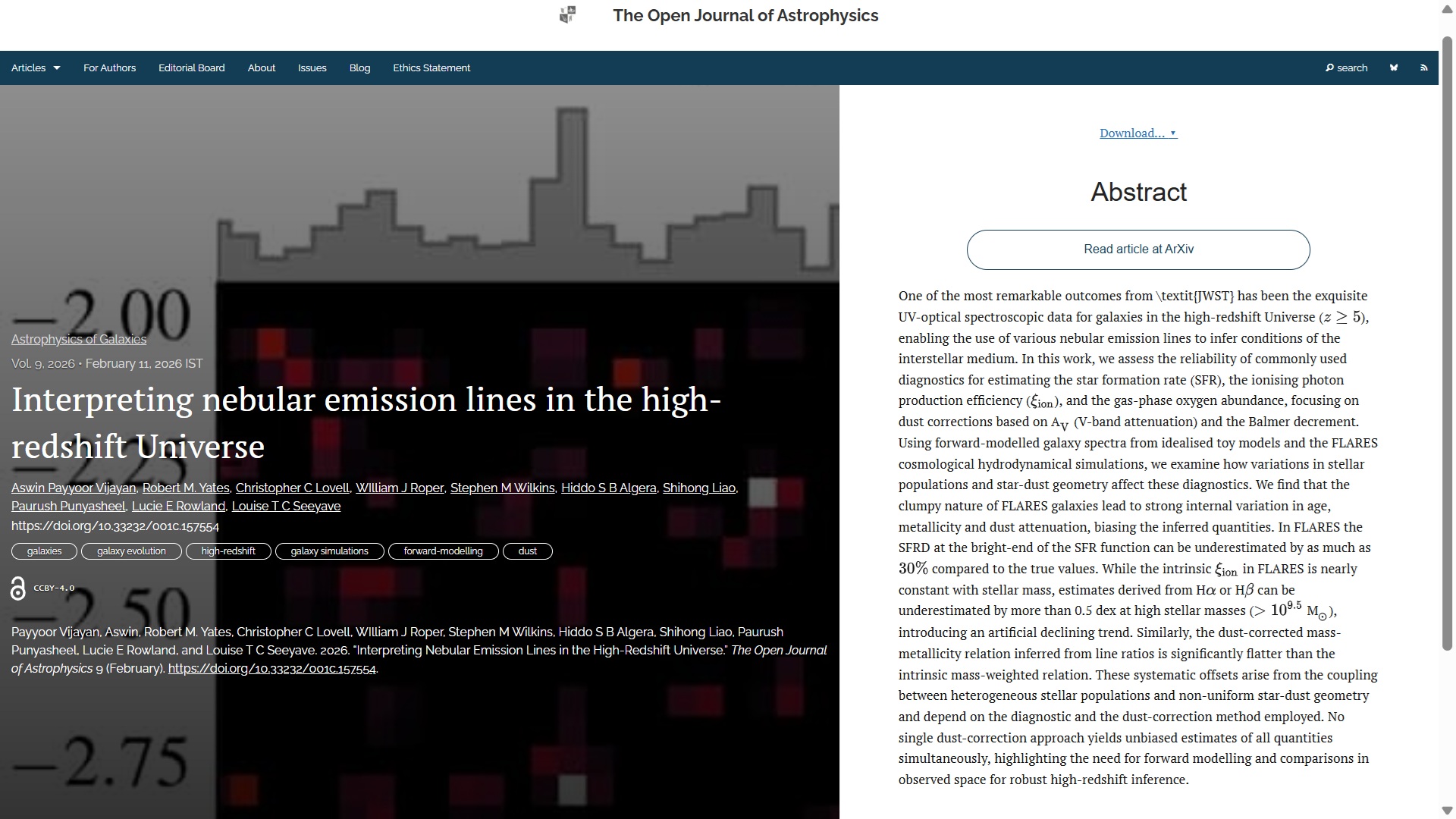
Next, published on Wednesday 11th February in the folder Astrophysics of Galaxies, is “Interpreting nebular emission lines in the high-redshift Universe” by Aswin P. Vijayan (U. Sussex, UK) and 9 others based in the UK, Taiwan, China and The Netherlands. This article examines the reliability of diagnostics used to estimate star formation rate and gas-phase oxygen abundance in high-redshift galaxies. It finds that variations in stellar populations and star-dust geometry. The overlay is here:
The official version can be found on arXiv here and the Fediverse announcement is here:
New Publication at the Open Journal of Astrophysics: "Interpreting nebular emission lines in the high-redshift Universe" by Aswin P. Vijayan (U. Sussex, UK) and 9 others based in the UK, Taiwan, China and The Netherlands
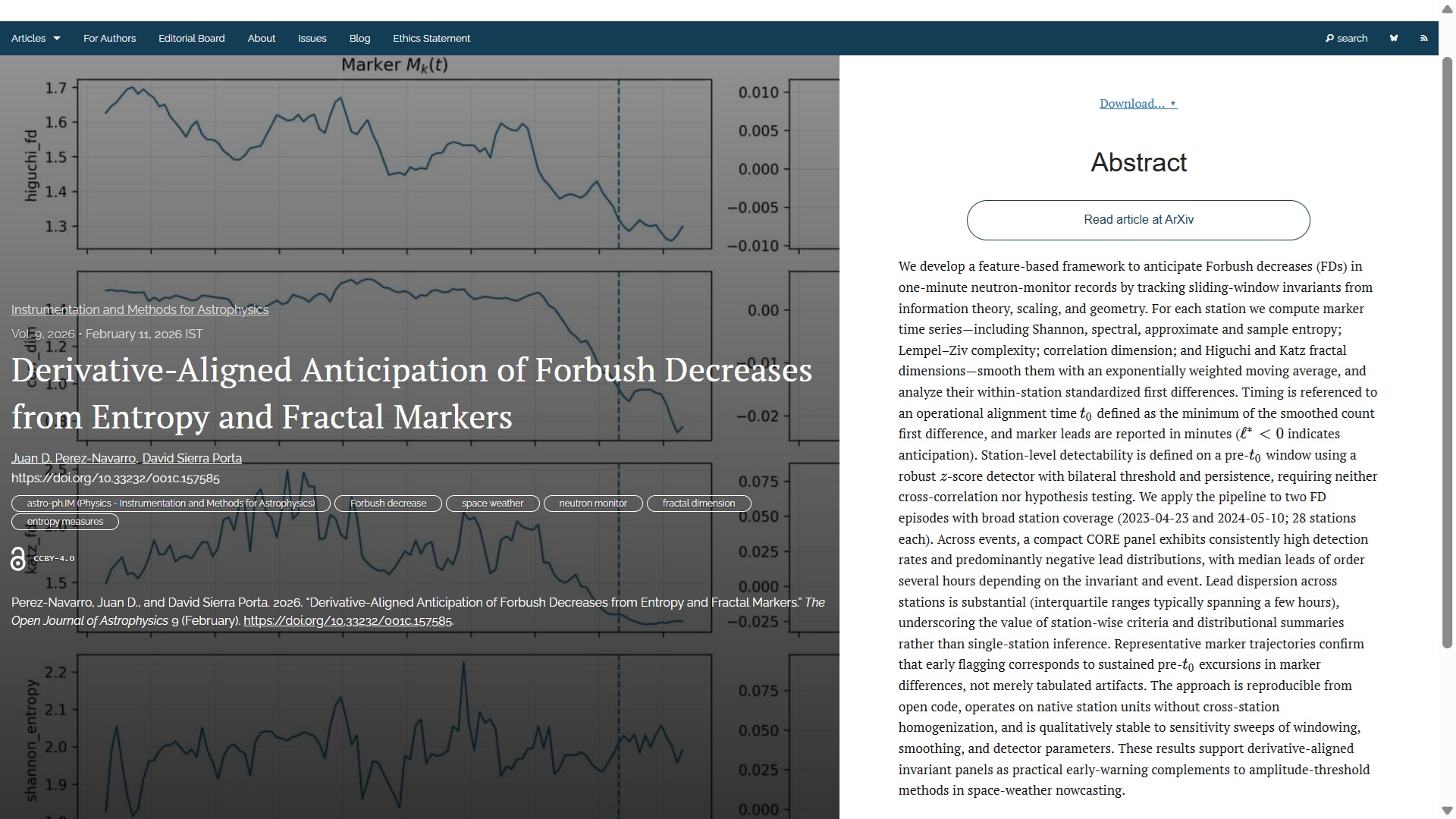
The fourth paper this week, also published on Wednesday 11th February, but in the folder Instrumentation and Methods for Astrophysics is “Derivative-Aligned Anticipation of Forbush Decreases from Entropy and Fractal Markers” by Juan D. Perez-Navarro & David Sierra Porta (Universidad Tecnológica de Bolívar, Colombia). The paper presents a feature-based framework for predicting Forbush decreases, i.e. rapid, temporary drops in galactic cosmic ray (GCR) intensity (up to tens of percent) caused by solar wind disturbances, typically Coronal Mass Ejections (CMEs) or high-speed streams from coronal holes, in neutron-monitor records using various computational methods. The approach is reproducible, operates on native station units, and is stable.
Here is the overlay:
The official version can be found on arXiv here and the Fediverse announcement is here:
New Publication at the Open Journal of Astrophysics: "Derivative-Aligned Anticipation of Forbush Decreases from Entropy and Fractal Markers" by Juan D. Perez-Navarro & David Sierra Porta (Universidad Tecnológica de Bolívar, Colombia)
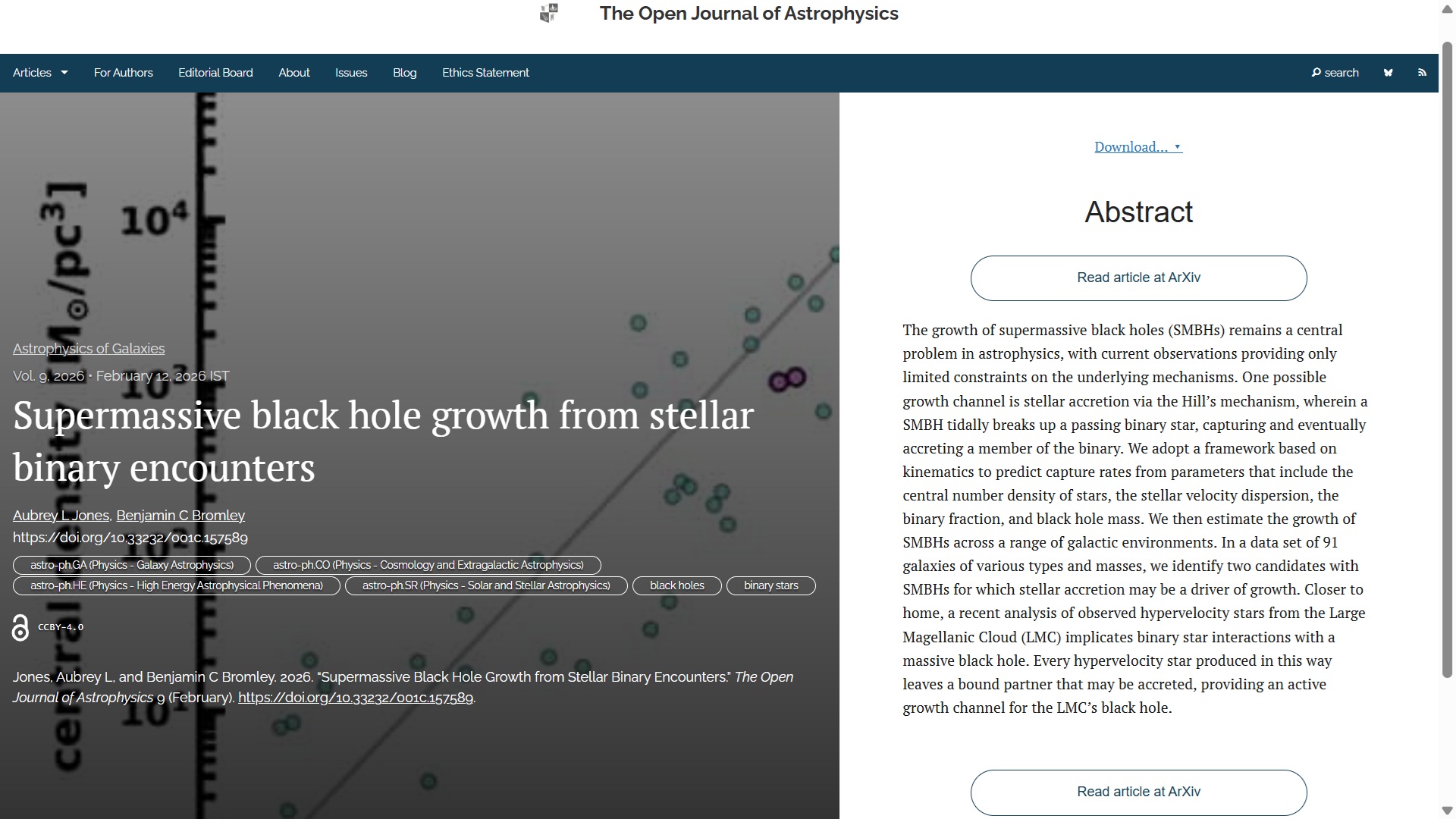
The fifth paper, the penultimate for this week, is “Supermassive black hole growth from stellar binary encounters” by Aubrey L Jones and Benjamin C Bromley (University of Utah, USA). This paper explores the growth of supermassive black holes (SMBHs) through stellar accretion via the Hill’s mechanism, predicting capture rates and identifying potential growth drivers in 91 galaxies. It was published on Thursday 11th February 2026 in the folder Astrophysics of Galaxies.
The overlay is here:
The accepted version can be found on arXiv here, and the fediverse announcement is here:
New Publication at the Open Journal of Astrophysics: "Supermassive black hole growth from stellar binary encounters" by Aubrey L Jones and Benjamin C Bromley (University of Utah, USA)
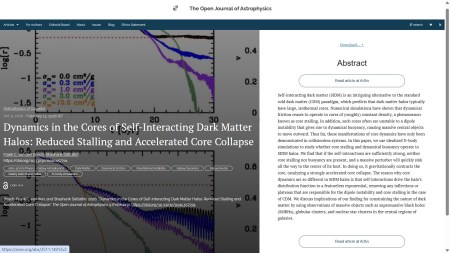
Finally for this week we have “Dynamics in the Cores of Self-Interacting Dark Matter Halos: Reduced Stalling and Accelerated Core Collapse” by Frank C. van den Bosch and Shashank Dattathri (Yale University, USA). This study uses simulations to explore core dynamics in self-interacting dark matter (SIDM) halos. Findings suggest strong self-interactions prevent core stalling and buoyancy, leading to accelerated core collapse. This was published yesterday, on Friday 13th February 2026, in the folder Astrophysics of Galaxies.
The overlay is here:
You can find the published version of the article here, and the Mastodon announcement is here:
New Publication at the Open Journal of Astrophysics: "Dynamics in the Cores of Self-Interacting Dark Matter Halos: Reduced Stalling and Accelerated Core Collapse" by Frank C. van den Bosch and Shashank Dattathri (Yale University, USA)
It’s Saturday once more so time for another update of activity at the Open Journal of Astrophysics. Since the last update we have published a further six papers, bringing the number in Volume 9 (2026) to 24 and the total so far published by OJAp up to 472.
I will continue to include the posts made on our Mastodon account (on Fediscience) to encourage you to visit it. Mastodon is a really excellent service, and a more than adequate replacement for X/Twitter which nobody should be using; these announcement also show the DOI for each paper.
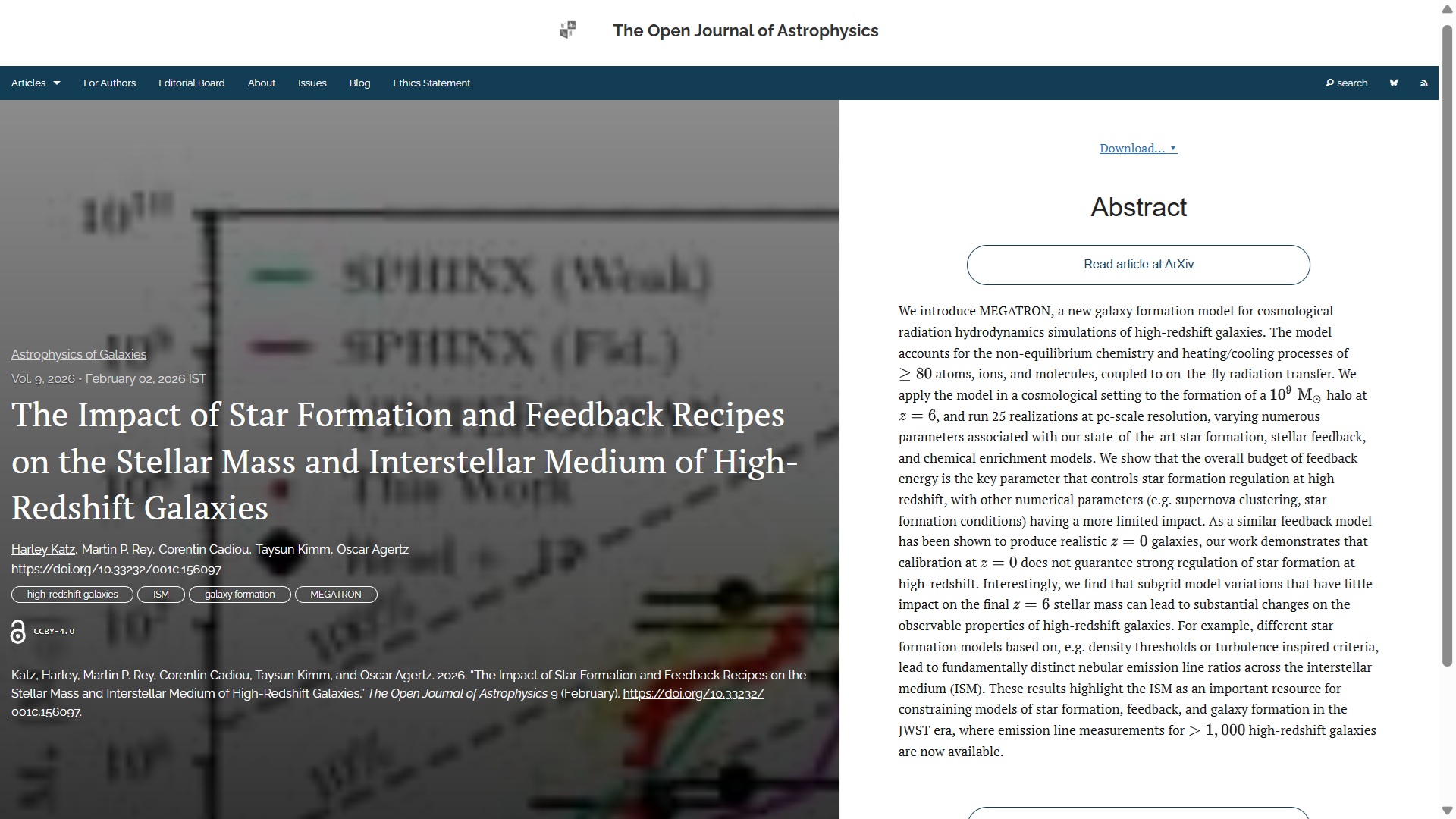
The first paper to report this week is “The Impact of Star Formation and Feedback Recipes on the Stellar Mass and Interstellar Medium of High-Redshift Galaxies” by Harley Katz (U. Chicago, USA), Martin P. Rey (U. Oxford, UK), Corentin Cadiou (Lund U., Sweden) Taysun Kimm (Yonsei U., Korea) and Oscar Agertz (Lund). This paper was published on Monday 2nd February 2026 in the folder Astrophysics of Galaxies. It introduces MEGATRON, a new model for galaxy formation simulations, highlighting that feedback energy controls star formation at high redshift and highlighting the importance of the interstellar medium.
The overlay is here:
You can find the officially accepted version on arXiv here and the announcement on Fediverse here:
New Publication at the Open Journal of Astrophysics: "The Impact of Star Formation and Feedback Recipes on the Stellar Mass and Interstellar Medium of High-Redshift Galaxies" by Harley Katz (U. Chicago, USA), Martin P. Rey (U. Oxford, UK), Corentin Cadiou (Lund U., Sweden) Taysun Kimm (Yonsei U., Korea) and Oscar Agertz (Lund)
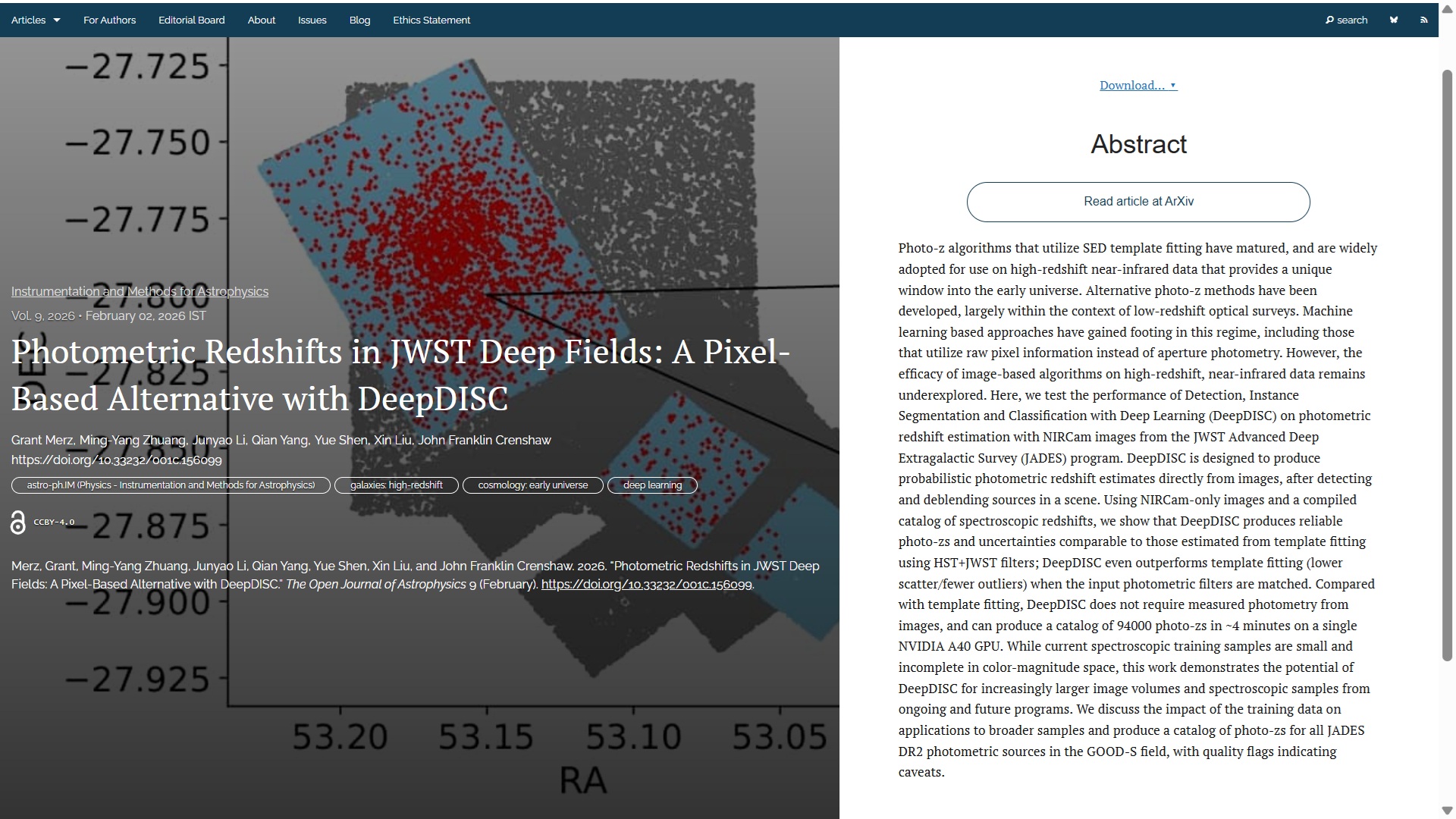
The second paper is “Photometric Redshifts in JWST Deep Fields: A Pixel-Based Alternative with DeepDISC” by Grant Merz (U. Illinois at Urbana-Champaign) and 6 others, all based in the USA. This paper was published on Monday February 2nd 2026 in the folder Instrumentation and Methods for Astrophysics. This paper explores the effectiveness of the DeepDISC machine learning algorithm in estimating photometric redshifts from near-infrared data, demonstrating its potential for larger image volumes and spectroscopic samples
The overlay for this one is here:
The official version of the paper can be found on arXiv here and the Fediverse announcement here:
New Publication at the Open Journal of Astrophysics: "Photometric Redshifts in JWST Deep Fields: A Pixel-Based Alternative with DeepDISC" by Grant Merz (U. Illinois at Urbana-Champaign) and 6 others, all based in the USA
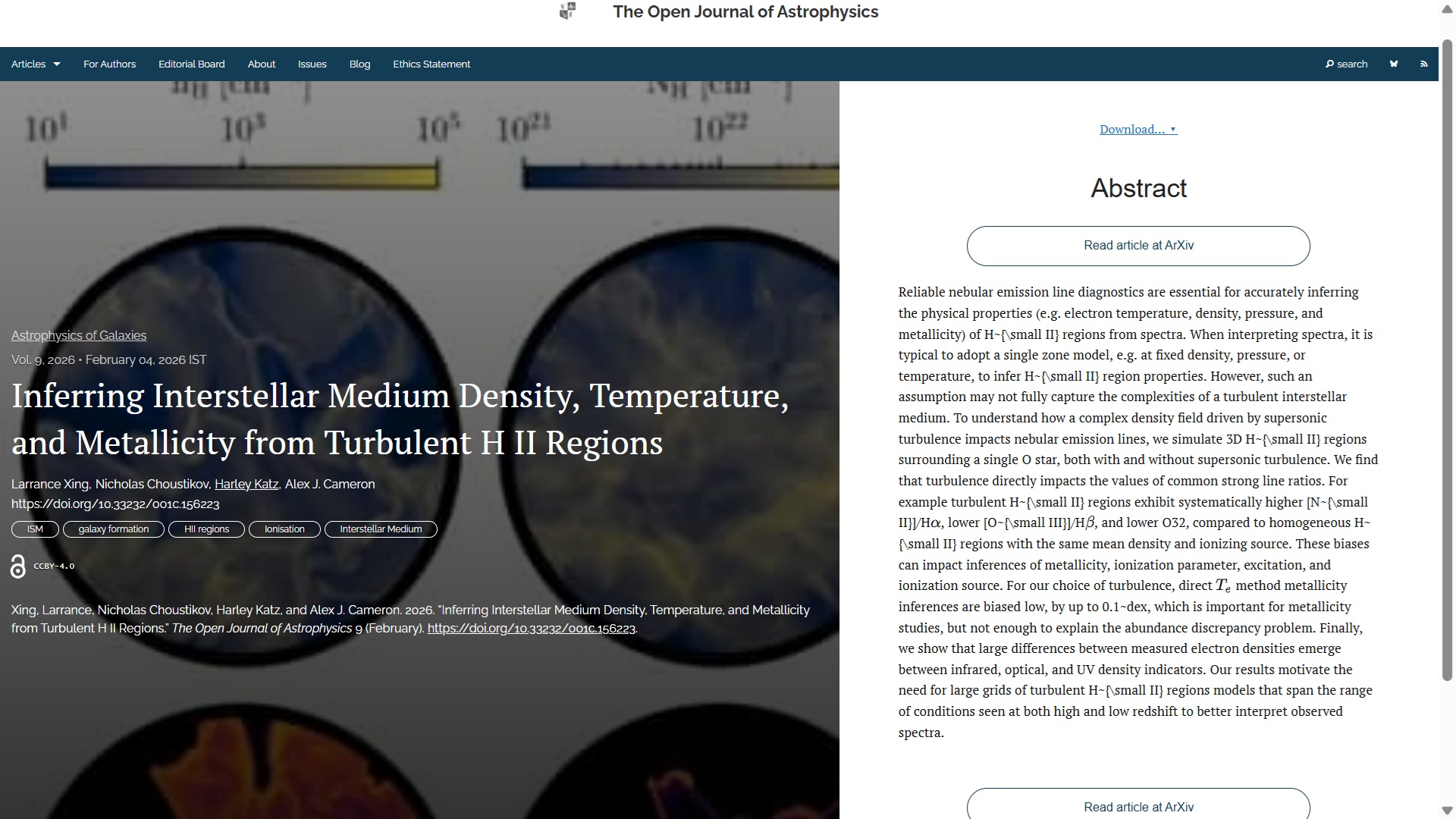
Next, published on Wednesday 4th February in the folder Astrophysics of Galaxies, is “Inferring Interstellar Medium Density, Temperature, and Metallicity from Turbulent H II Regions” by Larrance Xing (U. Chicago, USA), Nicholas Choustikov (U. Oxford, UK), Harley Katz (U. Chicago) and Alex J. Cameron (DAWN, Denmark). This paper argues that supersonic turbulenc affects the interpretation of H II region properties, potentially impacting inferred metallicity, ionization, and excitation from in nebular emission lines, motivating more extensive modelling.
The overlay is here:
The official version can be found on arXiv here and the Fediverse announcement is here:
New Publication at the Open Journal of Astrophysics: "Inferring Interstellar Medium Density, Temperature, and Metallicity from Turbulent H II Regions" by Larrance Xing (U. Chicago, USA), Nicholas Choustikov (U. Oxford, UK), Harley Katz (U. Chicago) and Alex J. Cameron (DAWN, Denmark)
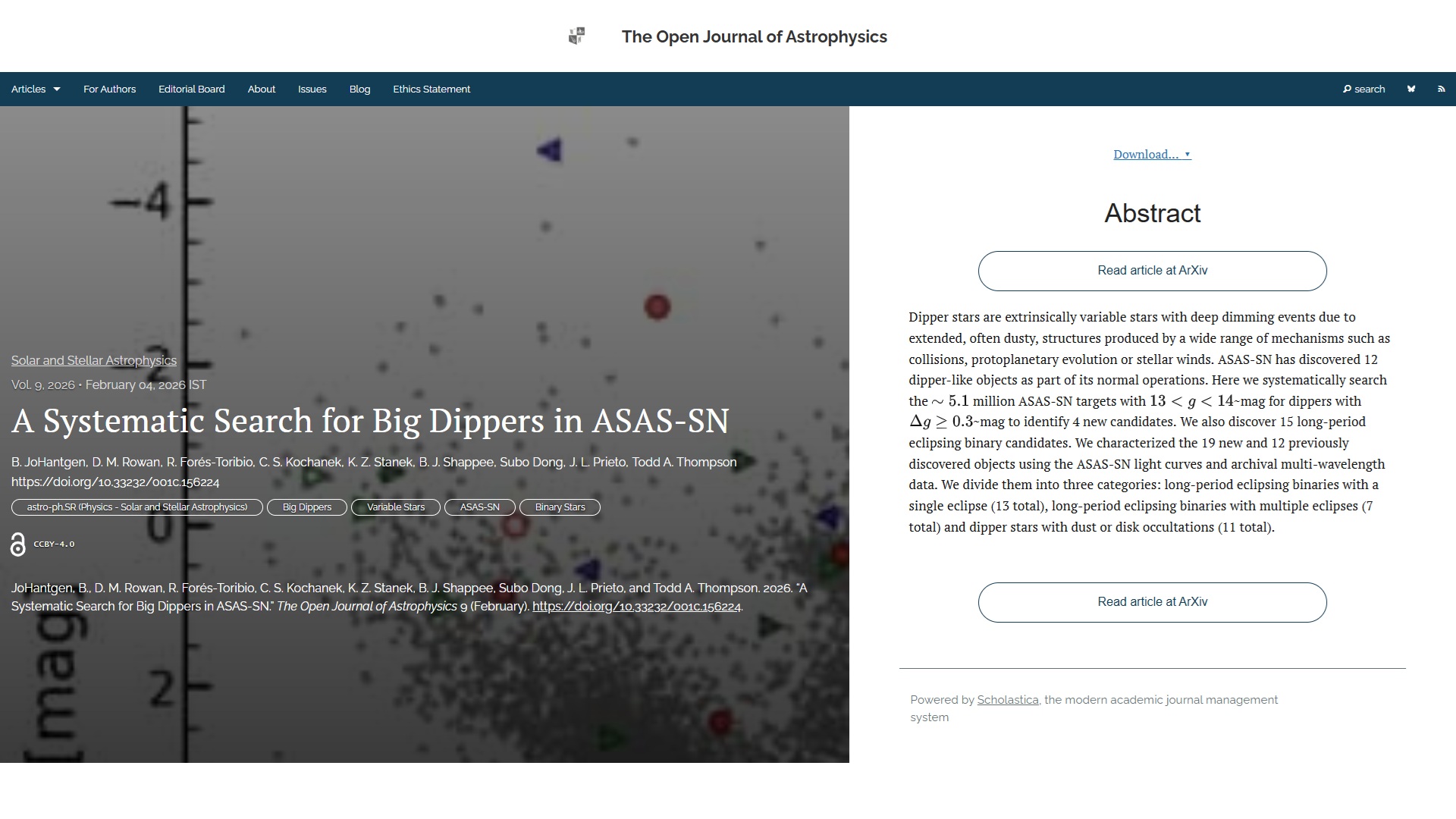
The fourth paper this week, also published on Wednesday 4th February, but in the folder Solar and Stellar Astrophysics, is “A Systematic Search for Big Dippers in ASAS-SN” by B. JoHantgen, D. M. Rowan, R. Forés-Toribio, C. S. Kochanek, & K. Z. Stanek (Ohio State University, USA), B. J. Shappee (U. Hawaii, USA), Subo Dong (Peking University), J. L. Prieto Universidad Diego Portales, Chile) and Todd A. Thompson (Ohio State). This study identifies 4 new dipper stars and 15 long-period eclipsing binary candidates using ASAS-SN light curves and multi-wavelength data, categorizing them based on their characteristics.
Here is the overlay:
The official version can be found on arXiv here and the Fediverse announcement is here:
New Publication at the Open Journal of Astrophysics: "A Systematic Search for Big Dippers in ASAS-SN" by B. JoHantgen , D. M. Rowan, R. Forés-Toribio, C. S. Kochanek, & K. Z. Stanek (Ohio State University, USA), B. J. Shappee (U. Hawaii, USA), Subo Dong (Peking University), J. L. Prieto Universidad Diego Portales, Chile) and Todd A. Thompson (Ohio State)
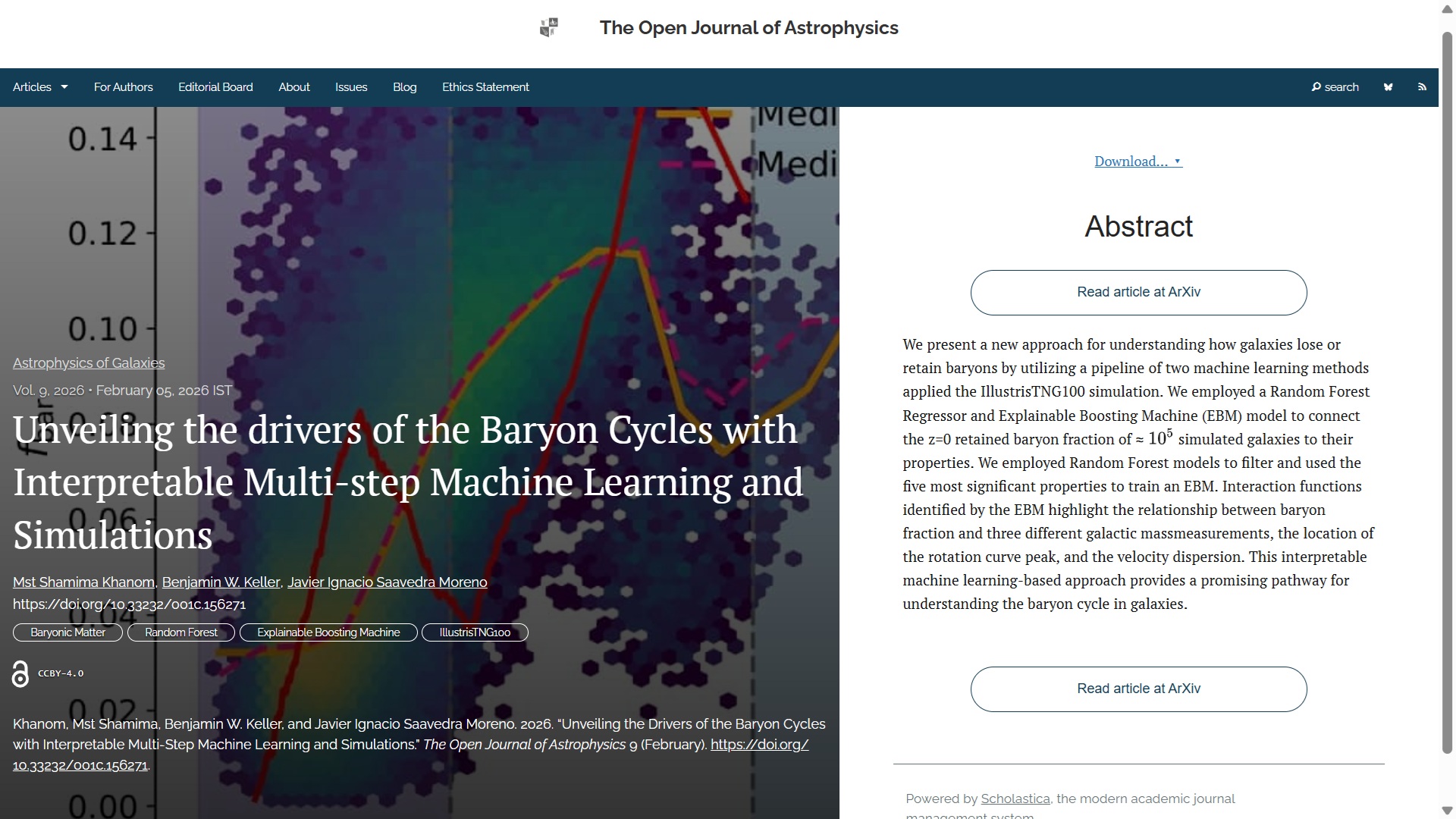
Fifth, and next to last this week we have “Unveiling the drivers of the Baryon Cycles with Interpretable Multi-step Machine Learning and Simulations” by Mst Shamima Khanom, Benjamin W. Keller and Javier Ignacio Saavedra Moreno (U. Memphis, USA). This paper was published on Thursday 5th February 2026 in the folder Astrophysics of Galaxies. This study uses machine learning methods to understand how galaxies lose or retain baryons, highlighting the relationship between baryon fraction and various galactic measurements.
The overlay is here:
The accepted version can be found on arXiv here, and the fediverse announcement is here:
New Publication at the Open Journal of Astrophysics: "Unveiling the drivers of the Baryon Cycles with Interpretable Multi-step Machine Learning and Simulations" by Mst Shamima Khanom, Benjamin W. Keller and Javier Ignacio Saavedra Moreno (U. Memphis, USA)
Finally for this week we have “The Bispectrum of Intrinsic Alignments: II. Precision Comparison Against Dark Matter Simulations” by Thomas Bakx (Utrecht U., Netherlands), Toshiki Kurita (MPA Garching, Germany), Alexander Eggemeier (U. Bonn, Germany), Nora Elisa Chisari (Utrecht) and Zvonimir Vlah (Ruđer Bošković Institute, Croatia). This paper was accepted in December, but publication got delayed by the Christmas effect so was published on February 6th 2026, in the folder Cosmology and Nongalactic Astrophysics. This study uses N-body simulations to accurately measure three-dimensional bispectra of halo intrinsic alignments and dark matter overdensities, providing a method to determine higher order shape bias parameters.
The overlay is here:
You can find the published version of the article here, and the Mastodon announcement is here:
New Publication at the Open Journal of Astrophysics: "The Bispectrum of Intrinsic Alignments: II. Precision Comparison Against Dark Matter Simulations" by Thomas Bakx (Utrecht U., Netherlands), Toshiki Kurita (MPA Garching, Germany), Alexander Eggemeier (U. Bonn, Germany), Nora Elisa Chisari (Utrecht) and Zvonimir Vlah (Ruđer Bošković Institute, Croatia)
It’s Saturday once more so time for another update of activity at the Open Journal of Astrophysics. Since the last update we have published a further four papers, bringing the number in Volume 9 (2026) to 18 and the total so far published by OJAp up to 466.
I will continue to include the posts made on our Mastodon account (on Fediscience) to encourage you to visit it. Mastodon is a really excellent service, and a more than adequate replacement for X/Twitter which nobody should be using; these announcement also show the DOI for each paper.
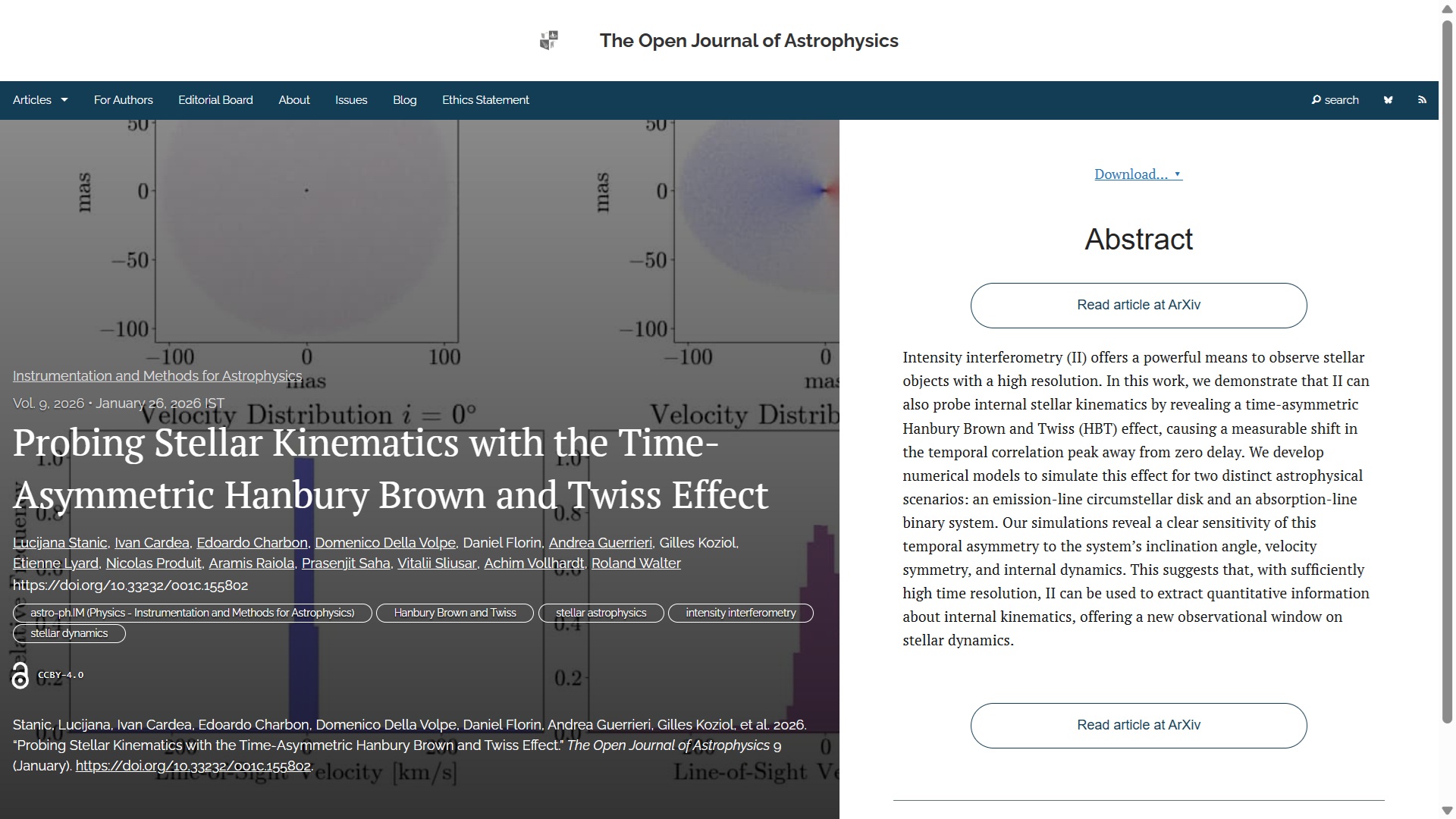
The first paper to report this week is “Probing Stellar Kinematics with the Time-Asymmetric Hanbury Brown and Twiss Effect” by Lucijana Stanic (University of Zurich, Switzerland) and 13 others based in Zurich, Lausanne and Geneva (all in Switzerland). This was published on Monday 26th January 2026 in the folder Instrumentation and Methods for Astrophysics. This research demonstrates that intensity interferometry can reveal internal stellar kinematics, providing a new way to observe stellar dynamics with high time resolution.
The overlay is here:
You can find the officially accepted version on arXiv here and the announcement on Fediverse here:
New Publication at the Open Journal of Astrophysics: "Probing Stellar Kinematics with the Time-Asymmetric Hanbury Brown and Twiss Effect" by Lucijana Stanic (University of Zurich, Switzerland) and 13 others based in Zurich, Lausanne and Geneva.
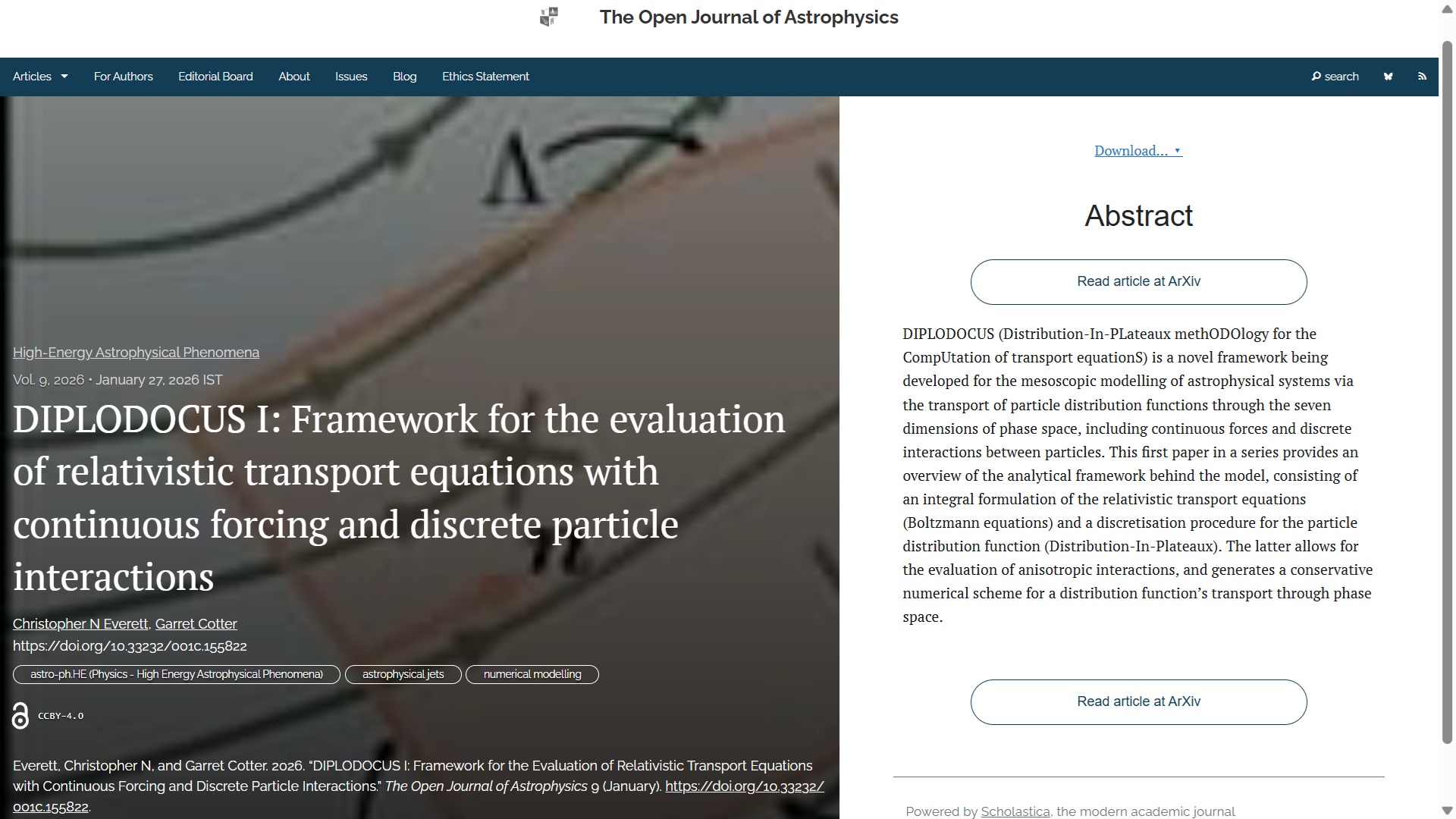
New Publication at the Open Journal of Astrophysics: "DIPLODOCUS I: Framework for the evaluation of relativistic transport equations with continuous forcing and discrete particle interactions" by Christopher N Everett & Garret Cotter (University of Oxford, UK)
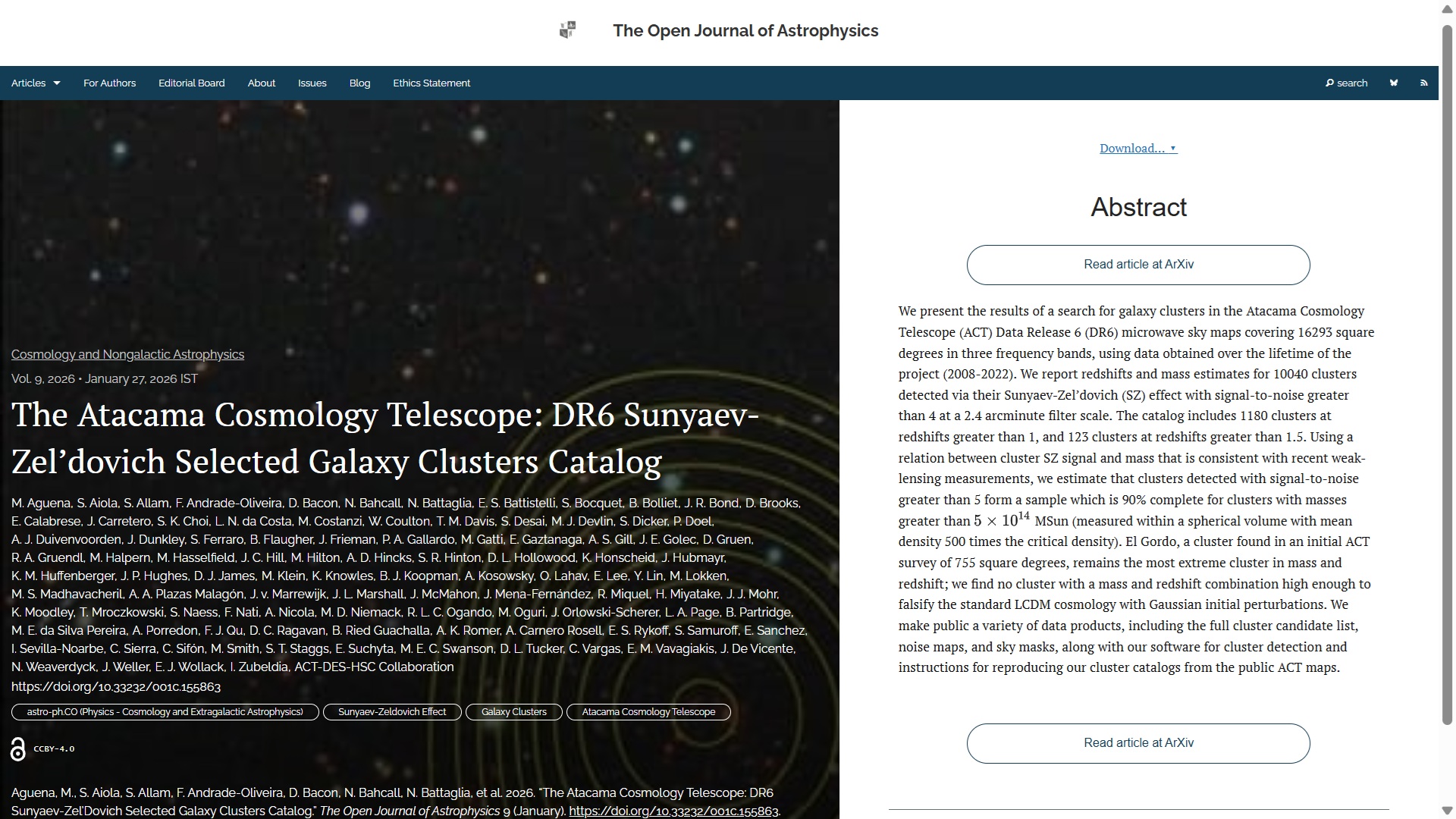
New Publication at the Open Journal of Astrophysics: "The Atacama Cosmology Telescope: DR6 Sunyaev-Zel’dovich Selected Galaxy Clusters Catalog" by M. Aguena et al. (101 authors altogether), on behalf of the ACT-DES-HSC Collaboration
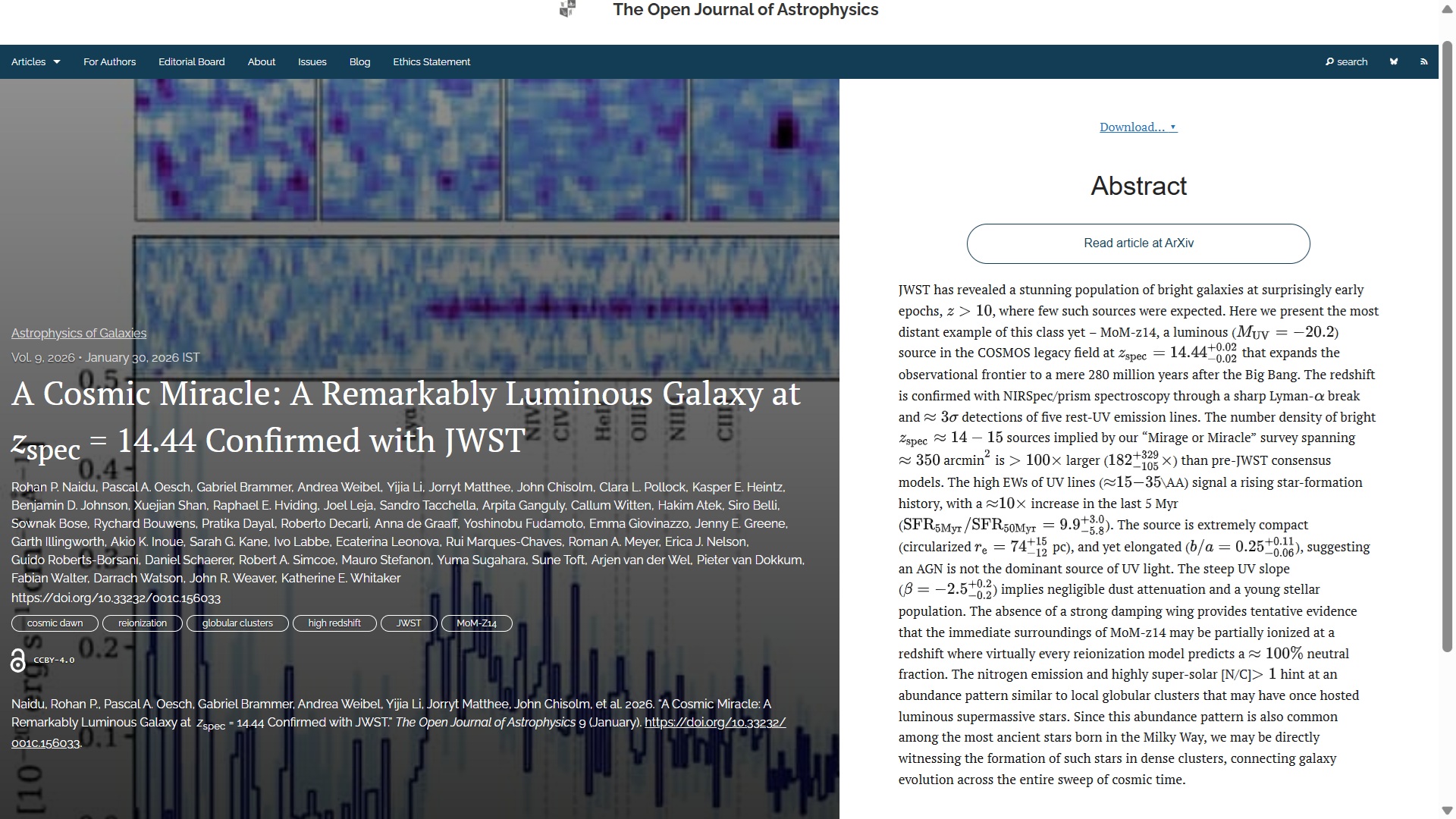
And finally for this week we have a paper published yesterday, Friday 30th January 2026, in the folder Astrophysics of Galaxies. This is the paper I blogged about yesterday: “A Cosmic Miracle: A Remarkably Luminous Galaxy at zspec = 14.44 Confirmed with JWST” by Rohan Naidu (MIT Kavli Institute) and an international cast of 45 others. This article reports on the discovery by the James Webb Space Telescope (JWST) of a bright galaxy, MoM-z14, located 280 million years post-Big Bang, that challenges models of galaxy formation and the star-formation history of early galaxies.
The overlay is here:
The accepted version can be found on arXiv here, and the fediverse announcement is here:
New Publication at the Open Journal of Astrophysics: "A Cosmic Miracle: A Remarkably Luminous Galaxy at $z_{rm spec} = 14.44$ Confirmed with JWST" by Rohan Naidu (MIT Kavli Institute) and 45 others.
A while ago (last May, in fact) I posted an article about a galaxy with an apparent spectroscopic redshift of 14.44. The paper to which that post related had been submitted to the Open Journal of Astrophysics and I haven’t mentioned that paper again until now as the paper was then, so to speak, sub judice. Well, as of today, the paper is now published and will feature in tomorrow’s traditional Saturday roundup of publications at the journal.
This paper was in fact accepted for publication before Christmas, but it took until this morning for the final accepted article to reach the arXiv. Rather awkwardly, the Space Telescope Science Institute issued a press release about this paper on 28th January 2026 stating that the paper was published in the Open Journal of Astrophysics, when that statement was not accurate. As Editor-in Chief of the Open Journal of Astrophysics, I was subsequently contacted by a number of journalists asking where they could find the paper on the OJAp platform. Since it hadn’t been published then I had to say they couldn’t, so a number of pieces (including, for example, this one in Scientific American) have appeared based on the STSCi press release without links to the final version of the paper. It would have been far better, in my opinion, to have delayed the press release until the paper was actually published. It’s better to wait until the ball is in the back of the net before you start celebrating!
Anyway, thanks to me getting up at 6am today, it’s now published so there’s no real harm done.
New Publication at the Open Journal of Astrophysics: "A Cosmic Miracle: A Remarkably Luminous Galaxy at $z_{rm spec} = 14.44$ Confirmed with JWST" by Rohan Naidu (MIT Kavli Institute) and 45 others.
For reference, here is the key plot showing the spectrum from which the galaxy’s redshift is determined. It is rather noisy, but the Lyman break seems convincing and there are some emission lines that offer corroborative evidence:
It’s Saturday once more so time for another update of activity at the Open Journal of Astrophysics. Since the last update we have published seven papers, bringing the number in Volume 9 (2026) to 11 and the total so far published by OJAp up to 459. This week has been quite busy; for only the second time in recorded history we published at least one paper each working day.
I will continue to include the announcements made on our Mastodon account (on Fediscience) to encourage you to visit it. Mastodon is a really excellent service, and a more than adequate replacement for X/Twitter which nobody should be using.
The first three papers this week were all published on Monday January 12th in the folder Astrophysics of Galaxies.
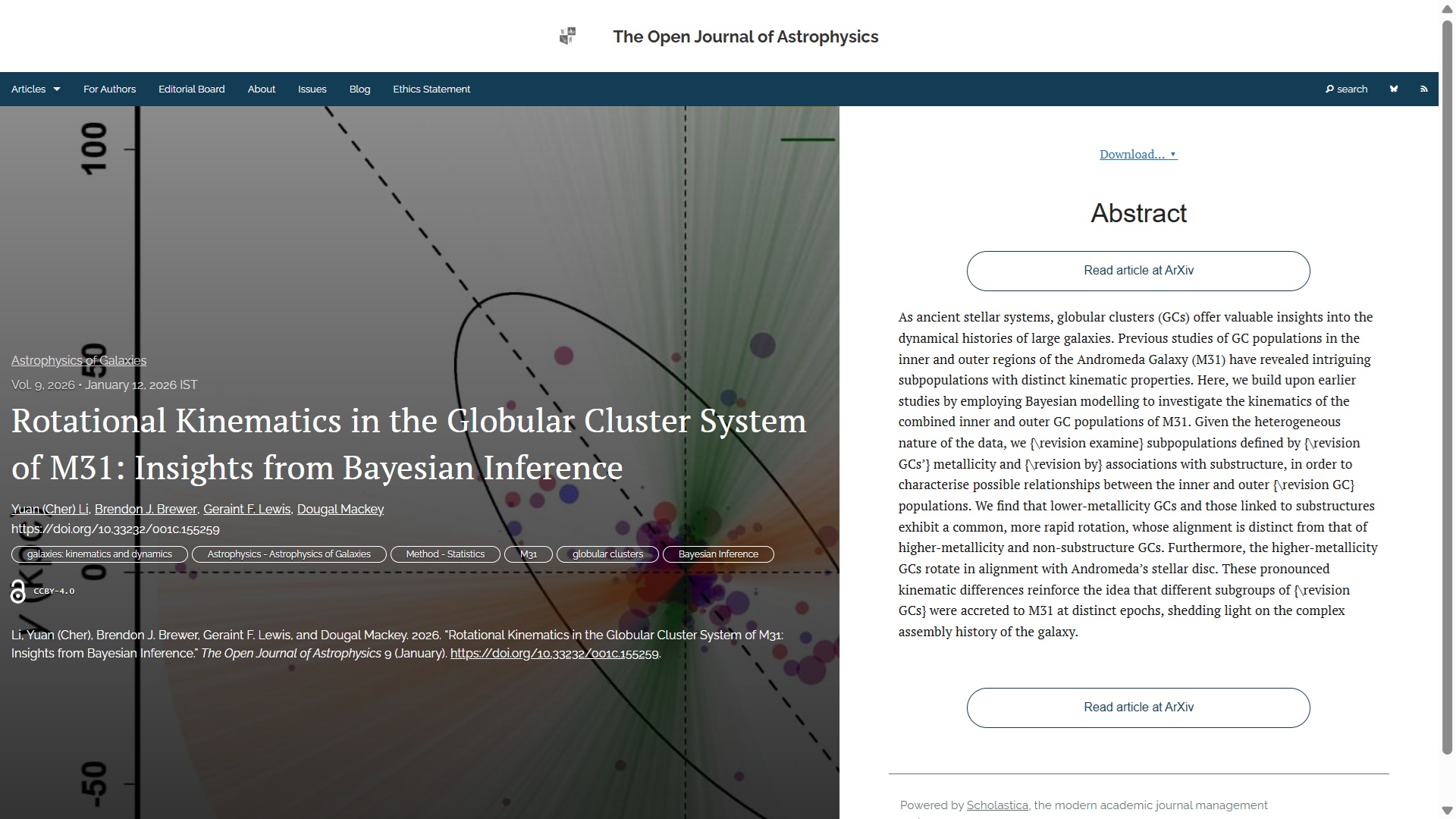
The first paper to report this week is “Rotational Kinematics in the Globular Cluster System of M31: Insights from Bayesian Inference” by Yuan (Cher) Li & Brendon J. Brewer (U. Auckland, New Zealand), Geraint F. Lewis (U. Sydney, Australia) and Dougal Mackey (independent researcher, Australia). This study uses Bayesian modelling to explore the kinematics of globular clusters in the Andromeda Galaxy, revealing distinct rotation patterns that suggest different subgroups were added at separate times.
The overlay is here:
You can find the officially accepted version on arXiv here and the announcement on Fediverse here:
New Publication at the Open Journal of Astrophysics: "Rotational Kinematics in the Globular Cluster System of M31: Insights from Bayesian Inference" by Yuan (Cher) Li & Brendon J. Brewer (U. Auckland, New Zealand), Geraint F. Lewis (U. Sydney, Australia) and Dougal Mackey
The second paper is “DESI Data Release 1: Stellar Catalogue” by Sergey Koposov (U. Edinburgh, UK) and an international cast of 67 other authors. This paper introduces and describes the stellar Value-Added Catalogue (VAC) based on DESI Data Release 1, providing measurements for over 4 million stars, including radial velocity, abundance, and stellar parameters.
The overlay for this one is here:
The official version of the paper can be found on arXiv here and the Fediverse announcement here:
New Publication at the Open Journal of Astrophysics: "DESI Data Release 1: Stellar Catalogue" by Sergey Koposov (U. Edinburgh, UK) and an international cast of 67 other authors.
New Publication at the Open Journal of Astrophysics: "On the origins of oxygen: ALMA and JWST characterise the multi-phase, metal-enriched, star-bursting medium within a ‘normal’ z>11 galaxy" by Joris Witstok (Cosmic Dawn Centre, Copenhagen, Denmark) and 37 others dotted around the world
The fourth paper this week is also in the folder Astrophysics of Galaxies. but was published on Tuesday 13th January. It is entitled “Accelerated calibration of semi-analytic galaxy formation models” by Andrew Robertson and Andrew Benson (Carnegie Observatories, USA). This paper presents a faster calibration framework for galaxy formation models, using fewer simulations for each evaluation. However, the model shows discrepancies suggesting the model needs to be made more flexible.
The overlay is here:
You can find the officially accepted version on arXiv here and the Mastodon announcement here:
New Publication at the Open Journal of Astrophysics: "Accelerated calibration of semi-analytic galaxy formation models" by Andrew Robertson and Andrew Benson (Carnegie Observatories, USA)
Next one up, published on Wednesday 14th January in the folder Cosmology and Nongalactic Astrophysics, is “Constraints from CMB lensing tomography with projected bispectra” by Lea Harscouet & David Alonso (U. Oxford), UK), Andrina Nicola (U. Manchester, UK) and Anže Slosar (Brookhaven National Laboratory, USA). This study presents angular power spectra and bispectra of DESI luminous red galaxies, finding that the galaxy bispectrum can constrain the amplitude of matter fluctuations and the non-relativistic matter fraction. The overlay is here:
You can find the officially accepted paper on arXiv here and the Mastodon announcement here:
New Publication at the Open Journal of Astrophysics: "Constraints from CMB lensing tomography with projected bispectra" by Lea Harscouet & David Alonso (U. Oxford, UK), Andrina Nicola (U. Manchester, UK) and Anže Slosar (Brookhaven National Laboratory, USA)
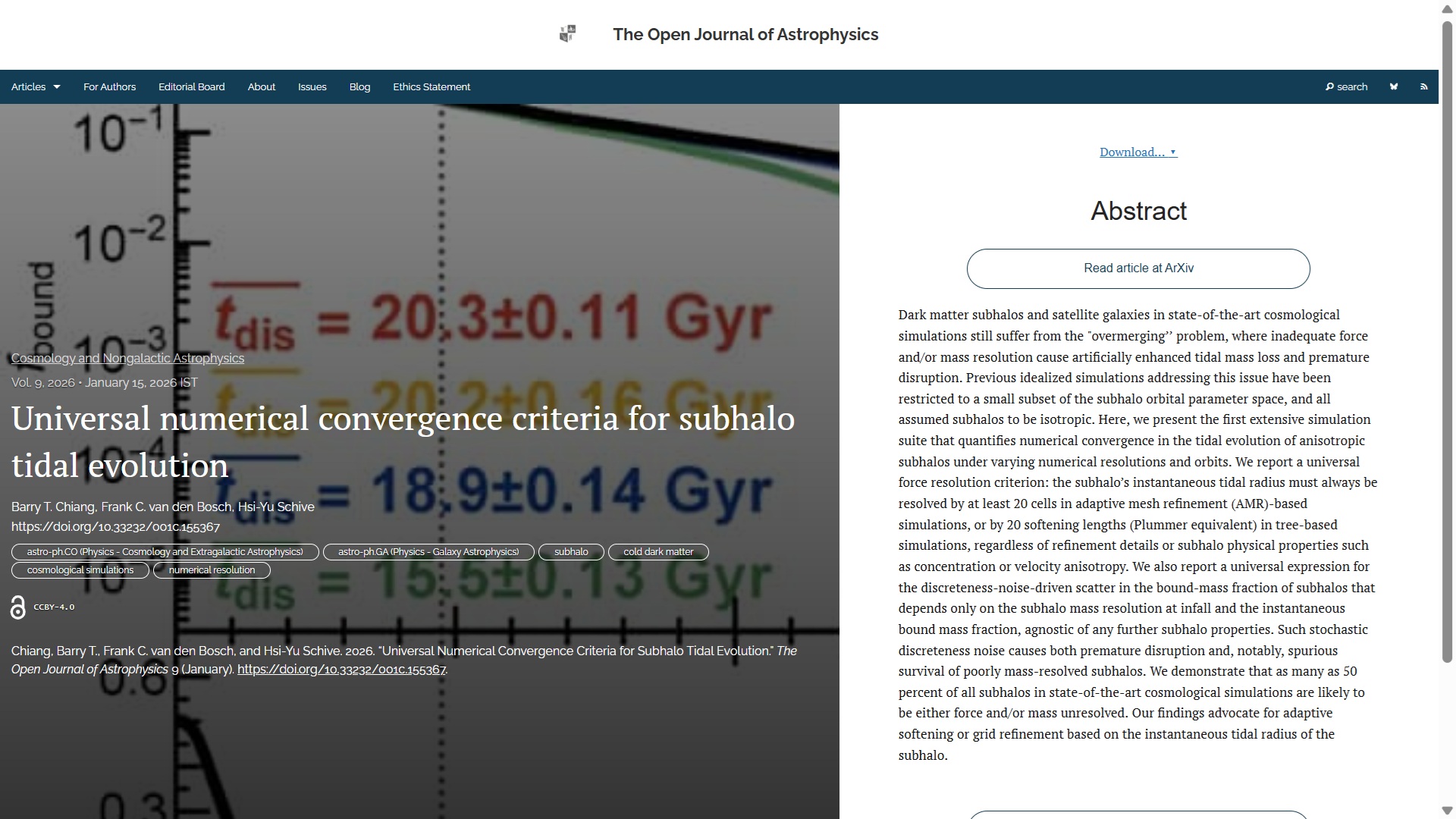
The sixth paper this week is “Universal numerical convergence criteria for subhalo tidal evolution” by Barry T. Chiang & Frank C. van den Bosch (Yale U., USA) and Hsi-Yu Schive (National Taiwan University, Taiwan). This was published on Thursday 15th January in the folder Cosmology and Nongalactic Astrophysics; it presents an analysis of a simulation suite that addresses the ‘overmerging’ problem in cosmological simulations of dark matter subhalos, showing that up to 50% of halos in state-of-the art simulations are unresolved. The overlay is here:
The final accepted version of this paper can be found on arXiv here. The Mastodon announcement follows:
New Publication at the Open Journal of Astrophysics: "Universal numerical convergence criteria for subhalo tidal evolution" by Barry T. Chiang & Frank C. van den Bosch (Yale U., USA) and Hsi-Yu Schive (National Taiwan University, Taiwan)
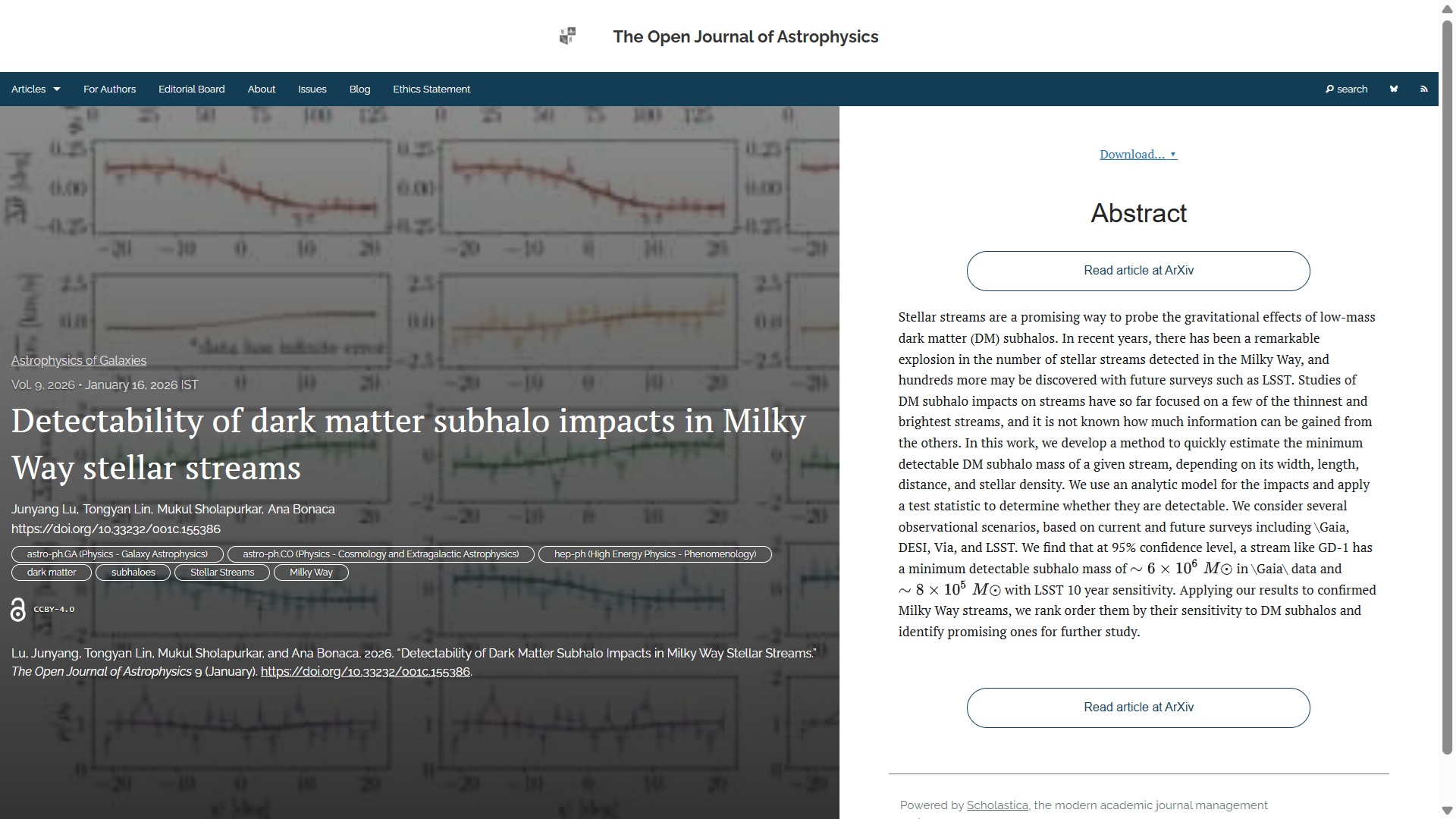
Finally for this week we have “Detectability of dark matter subhalo impacts in Milky Way stellar streams” by Junyang Lu , Tongyan Lin & Mukul Sholapurkar (UCSD, USA) and Ana Bonaca (Carnegie Observatories, USA). This was published on Friday 16th January (i.e. yesterday) in the folder Astrophysics of Galaxies. The study develops a method to estimate the minimum detectable dark matter subhalo mass in stellar streams, ranking them by sensitivity and identifying promising lines for further research.
The overlay is here:
The officially accepted version can be found on arXiv here and the Fediverse announcement here:
New Publication at the Open Journal of Astrophysics: "Detectability of dark matter subhalo impacts in Milky Way stellar streams" by Junyang Lu , Tongyan Lin & Mukul Sholapurkar (UCSD, USA) and Ana Bonaca (Carnegie Observatories, USA)
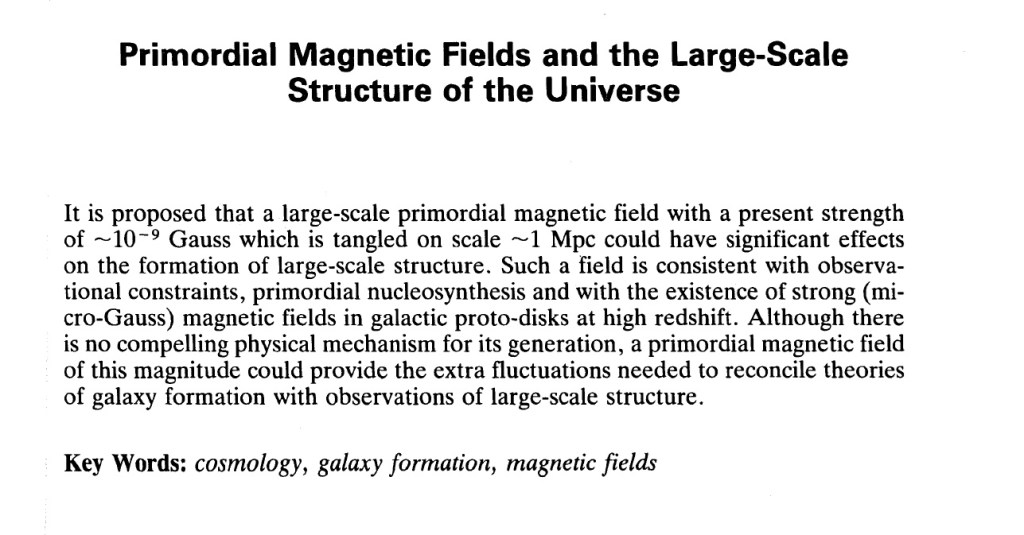
This paper reminded me of a paper I wrote a long time ago (in 1991, when I was at Queen Mary) about primordial magnetic fields and galaxy formation. It had its origins in a lunchtime talk I gave which was based on an old paper from the 1970s by Ira Wasserman. All I did was go through the paper and add a few small comments to update it, including some more recent observational constraints and mentions of dark non-baryonic matter; the Wasserman paper was framed in a model in which all the matter in the Universe was baryonic.
Anyway, the talk went down quite well and I was encouraged to write it up. I did so, and submitted it to a journal (MNRAS). Not unreasonably, it was rejected on the grounds that it didn’t have sufficient original content. I therefore expanded the discussion and submitted it as a review article to Comments on Astrophysics. That journal is now defunct, but the paper can be found on NASA/ADS here. It’s even got some citations!
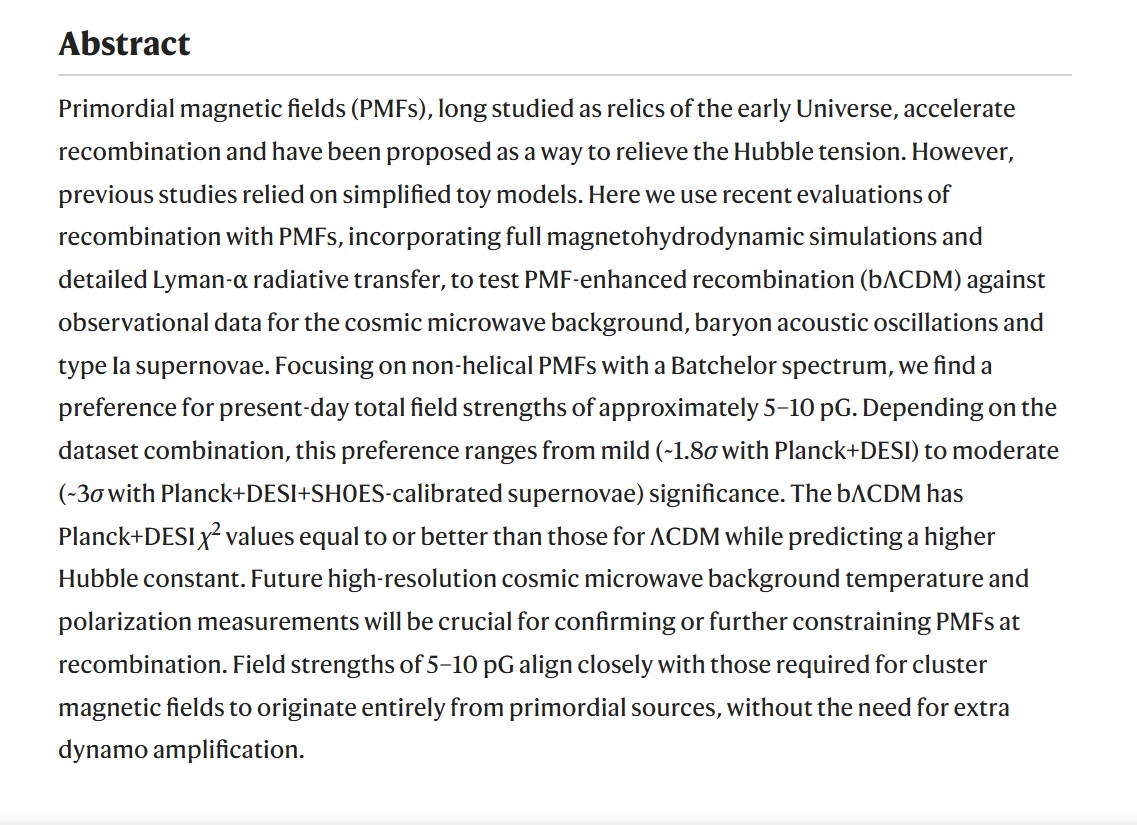
You will see I was advocating a larger magnetic field than in the recent one, with a view to affecting galaxy formation directly rather than larger scale features of the Universe. An important point is that primordial magnetic fields can have a large effect soon after recombination, so they might play a role in the formation of galaxies at high redshift which we are struggling to explain. At least – unlike some of the more exotic explanations that have been proposed – we know that magnetic fields actually exist…
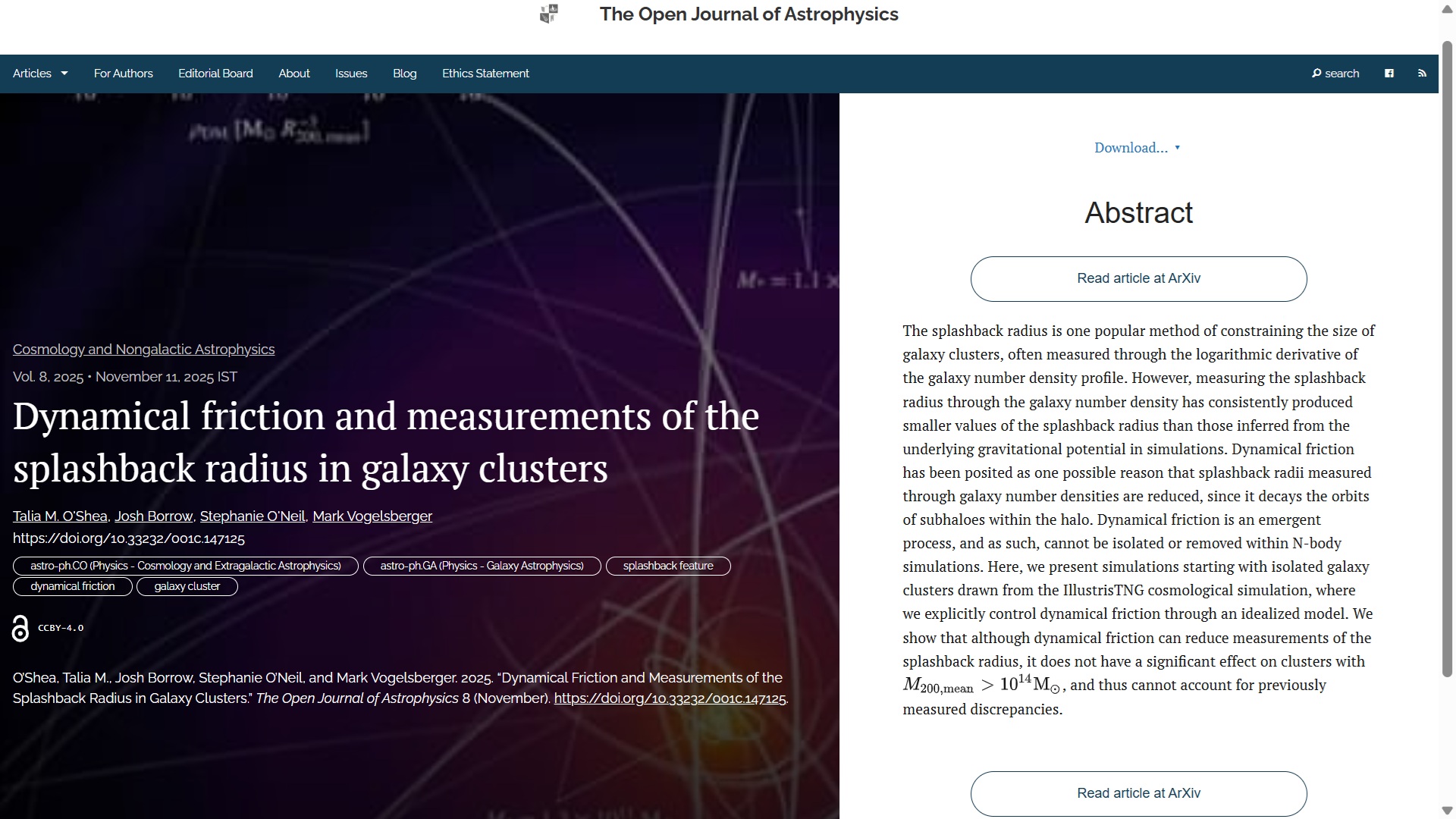
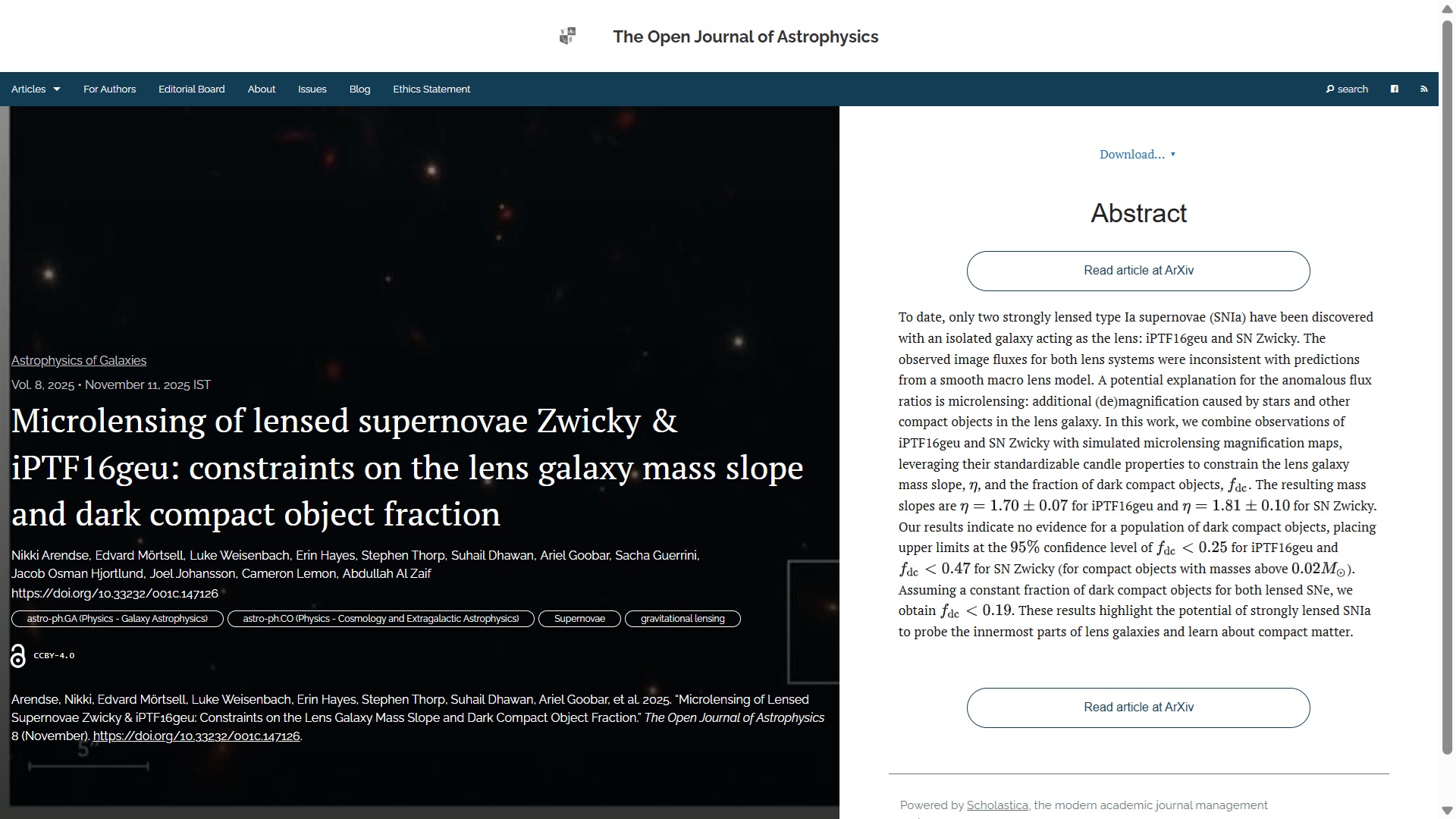
It’s Saturday again, so it’s time for the usual update of the week’s new papers at the Open Journal of Astrophysics. It has been quite a busy week. Since the last update we have published another seven papers, which brings the number in Volume 8 (2025) up to 175, and the total so far published by OJAp up to 410.
First on the menu for this week is “Dynamical friction and measurements of the splashback radius in galaxy clusters” by Talia M. O’Shea (U. Wisconsin-Madison, USA), Josh Borrow & Stephanie O’Neil (U. Pennsylvania, USA) and Mark Vogelsberger (MIT, USA). Published on Tuesday 11th November in the folder Cosmology and NonGalactic Astrophysics, this one presents a study suggesting that dynamical friction does not play a major role in reducing the radius of the splashback feature in real data compared to numerical simulations.
The overlay is here:
You can find the officially accepted version on arXiv here.
New Publication at the Open Journal of Astrophysics: "Dynamical friction and measurements of the splashback radius in galaxy clusters" by Talia M. O'Shea (U. Wisconsin-Madison, USA), Josh Borrow & Stephanie O'Neil (U. Pennsylvania, USA) and Mark Vogelsberger (MIT, USA)
New Publication at the Open Journal of Astrophysics: "Microlensing of lensed supernovae Zwicky & iPTF16geu: constraints on the lens galaxy mass slope and dark compact object fraction" by Nikki Arendse (Stockholm University, Sweden) and 11 others based in Sweden, UK and France
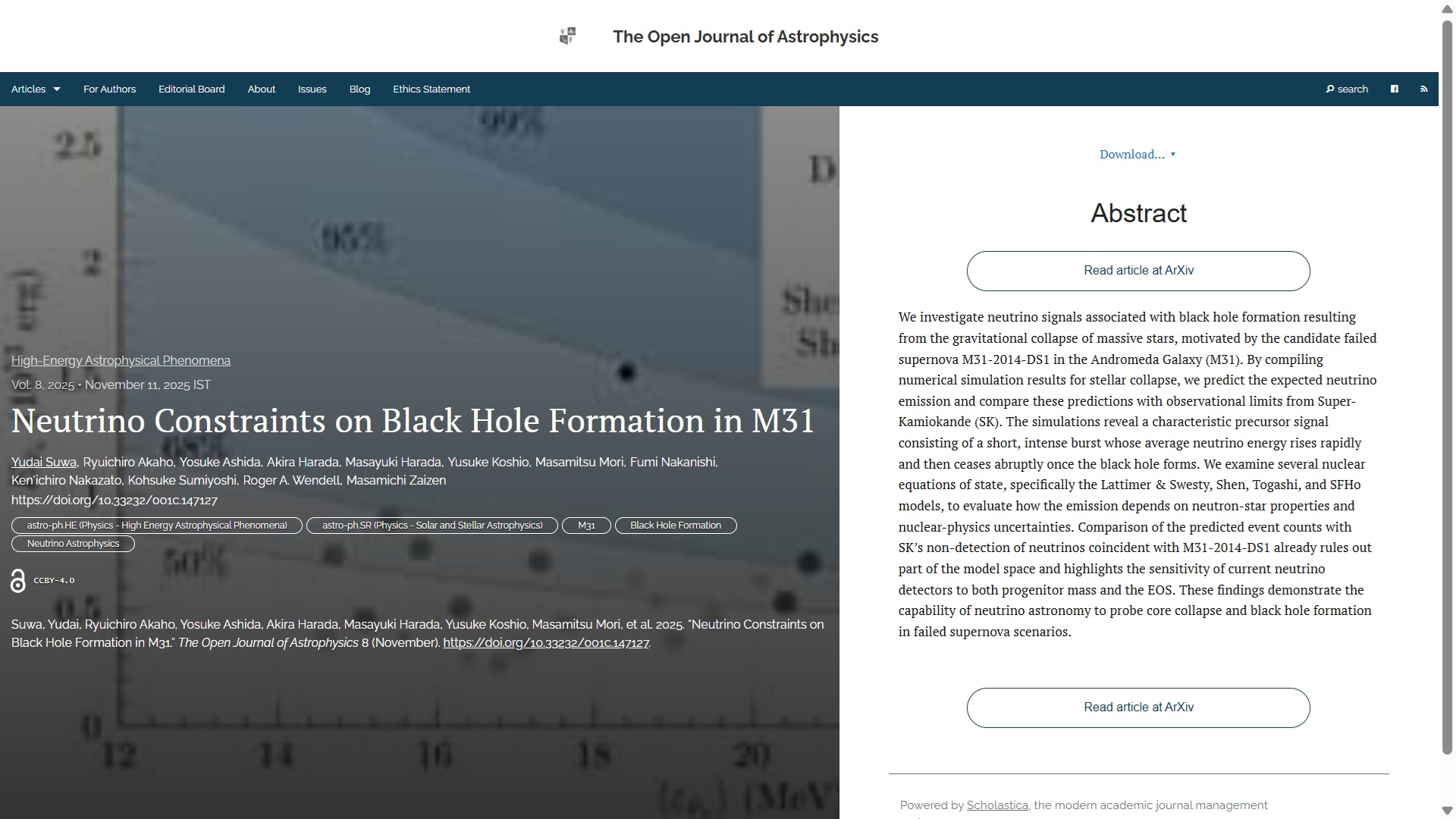
Next one up is “Neutrino Constraints on Black Hole Formation in M31” by Yudai Sawa (U. Tokyo, Japan) and 11 others all based in Japan. This was published on Tuesday 11th November in the folder High-Energy Astrophysical Phenomena. It presents a calculation of the neutrino emission expected from the collapse of massive stars and its use in constraining black hole formation using neutrino detectors.
The overlay is here:
You can find the official accepted version on arXiv here. The fediverse announcement is here:
New Publication at the Open Journal of Astrophysics: "Neutrino Constraints on Black Hole Formation in M31" by Yudai Sawa (U. Tokyo, Japan) and 11 others all based in Japan
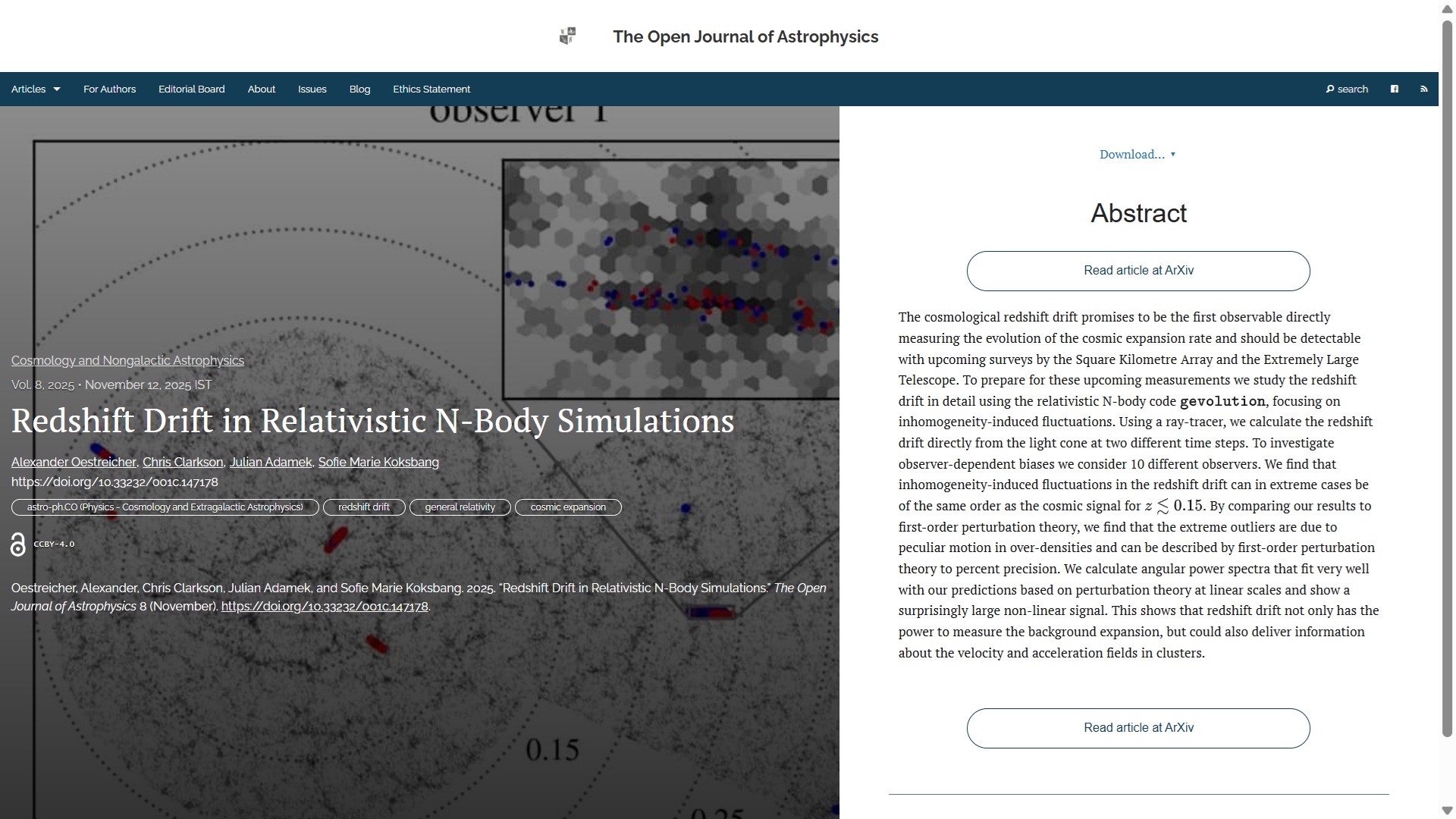
The fourth paper this week is “Redshift Drift in Relativistic N-Body Simulations” by Alexander Oestreicher (U. Southern Denmark, DK), Chris Clarkson (QMUL, UK), Julian Adamek (U. Zürich, CH) and Sofie Marie Koksbang (U. Southern Denmark, DK). This one was published on Wednesday 12th November in the folder marked Cosmology and NonGalactic Astrophysics. It presents numerical calculations of the cosmological redshift drift effect for comparison with future surveys.
The overlay is here:
You can find the official published version on arXiv here. The Fediverse announcement follows:
New Publication at the Open Journal of Astrophysics: "Redshift Drift in Relativistic N-Body Simulations" by Alexander Oestreicher (U. Southern Denmark, DK), Chris Clarkson (QMUL, UK), Julian Adamek (U. Zürich, CH) and Sofie Marie Koksbang (U. Southern Denmark, DK)
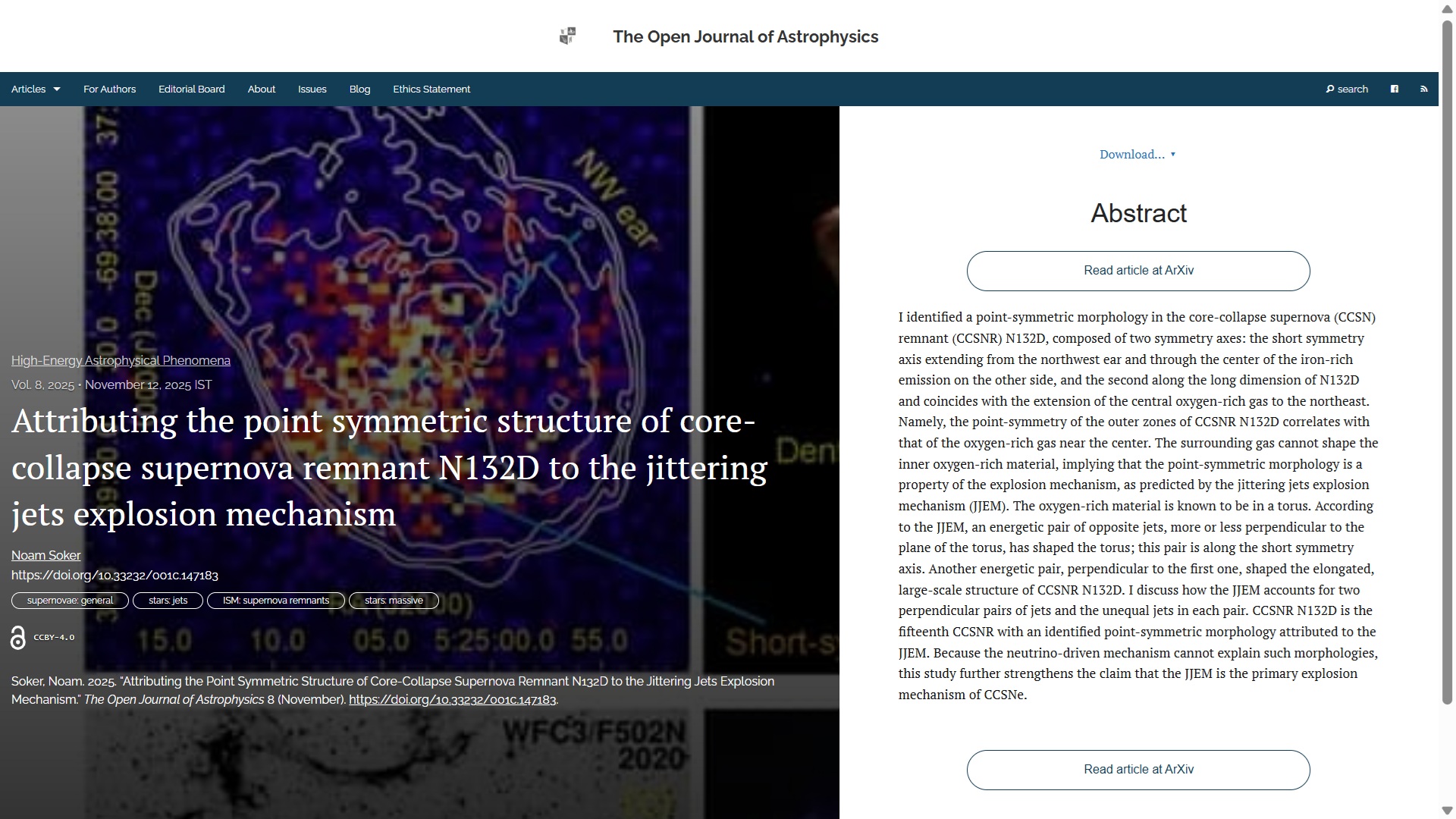
New Publication at the Open Journal of Astrophysics: "Attributing the point symmetric structure of core-collapse supernova remnant N132D to the jittering jets explosion mechanism" by Noam Soker (Technion, Haifa, Israel)
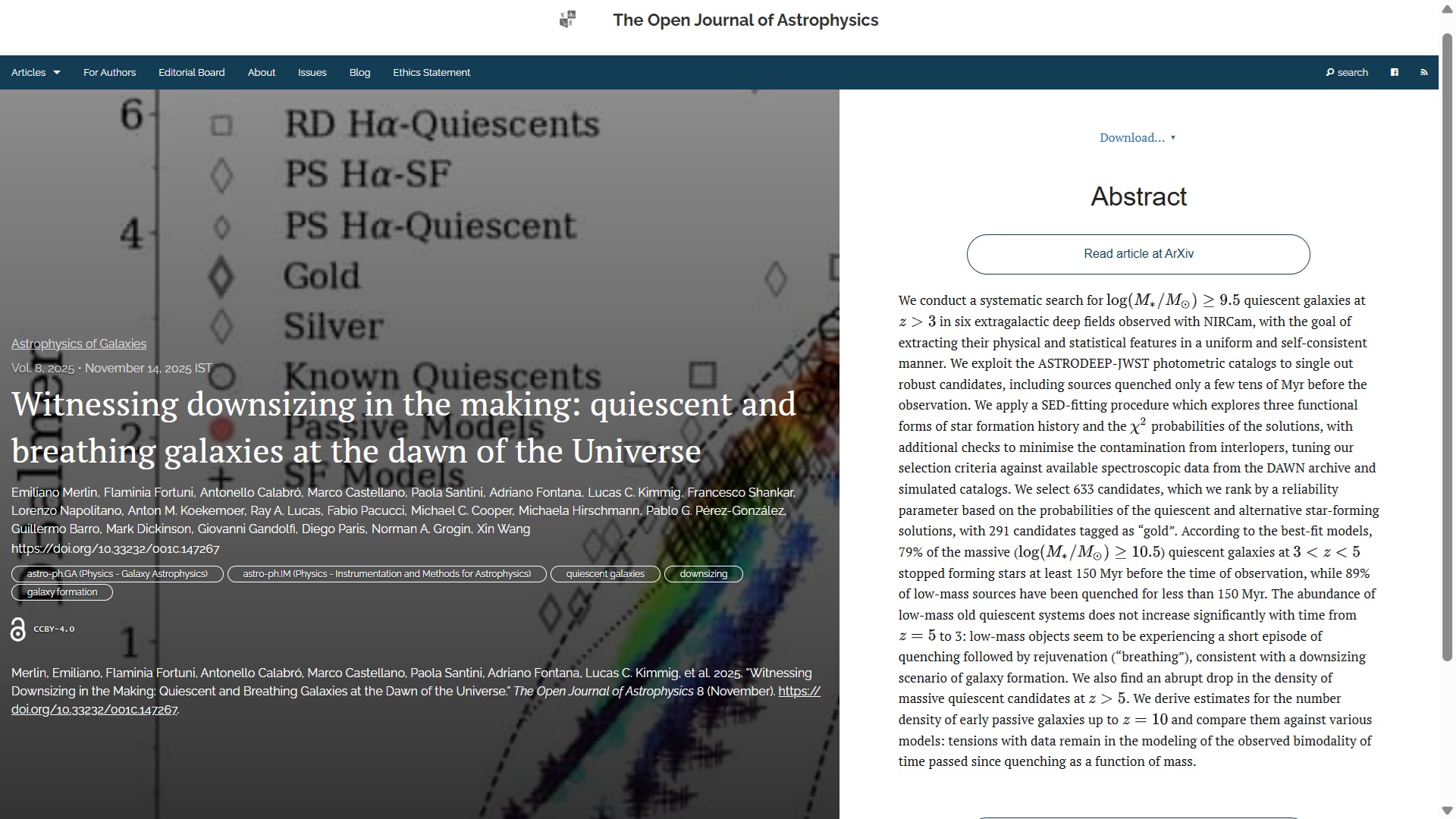
New Publication at the Open Journal of Astrophysics: "Witnessing downsizing in the making: quiescent and breathing galaxies at the dawn of the Universe" by Emiliano Merlin (Osservatorio Astronomico di Roma, Italy) and 20 others based in Italy, Germany, UK, USA, Switzerland, Spain and China
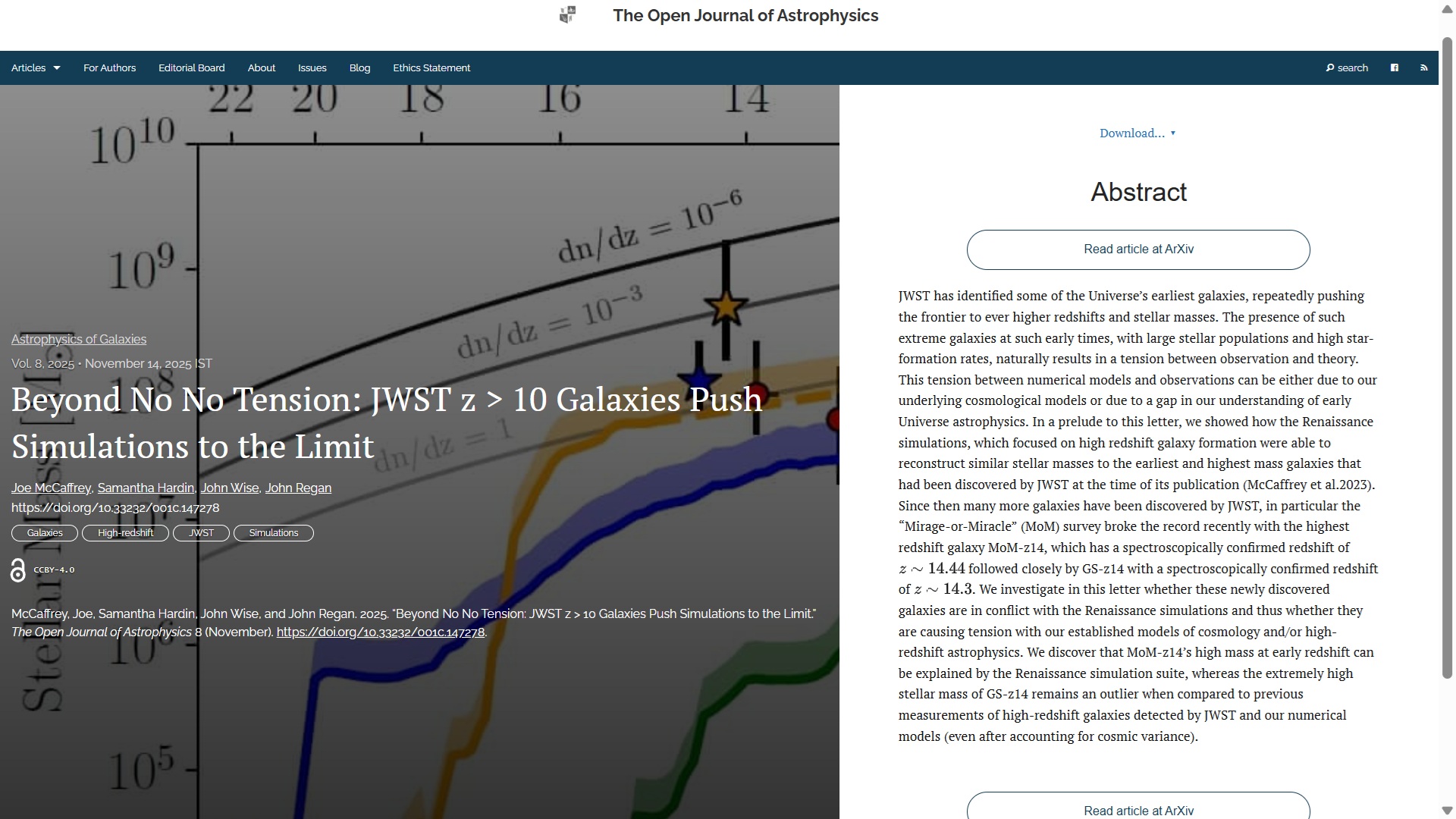
And finally (for this week) we have “Beyond No No Tension: JWST z > 10 Galaxies Push Simulations to the Limit” by Joe McCaffrey (NUI Maynooth, Ireland), Samantha Hardin & John Wise (Georgia Institute of Technology, USA) and John Regan (Maynooth). This one was also published on Friday 14th November, in the folder marked Astrophysics of Galaxies. It asks the question whether newly-discovered high redshift galaxies are consistent with simulations of galaxy formation. The overlay is here:
You can find the officially acceopted version on arXiv here. The fediverse announcement is here:
New Publication at the Open Journal of Astrophysics: "Beyond No No Tension: JWST z > 10 Galaxies Push Simulations to the Limit" by Joe McCaffrey (NUI Maynooth, Ireland), Samantha Hardin & John Wise (Georgia Institute of Technology, USA) and John Regan (Maynooth)
The views presented here are personal and not necessarily those of my employer (or anyone else for that matter).
Feel free to comment on any of the posts on this blog but comments may be moderated; anonymous comments and any considered by me to be vexatious and/or abusive and/or defamatory will not be accepted. I do not necessarily endorse, support, sanction, encourage, verify or agree with the opinions or statements of any information or other content in the comments on this site and do not in any way guarantee their accuracy or reliability.