Archive for Open Access Publishing.

Weekly Update from the Open Journal of Astrophysics – 08/02/2025

Posted in OJAp Papers, Open Access, The Universe and Stuff with tags , , , , , , , on February 8, 2025 by telescoper

It’s Saturday morning, so once again it’s time for an update from the Open Journal of Astrophysics. Since the last update we have published one new paper, which brings the number in Volume 8 (2025) up to 12 and the total so far published by OJAp up to 247.

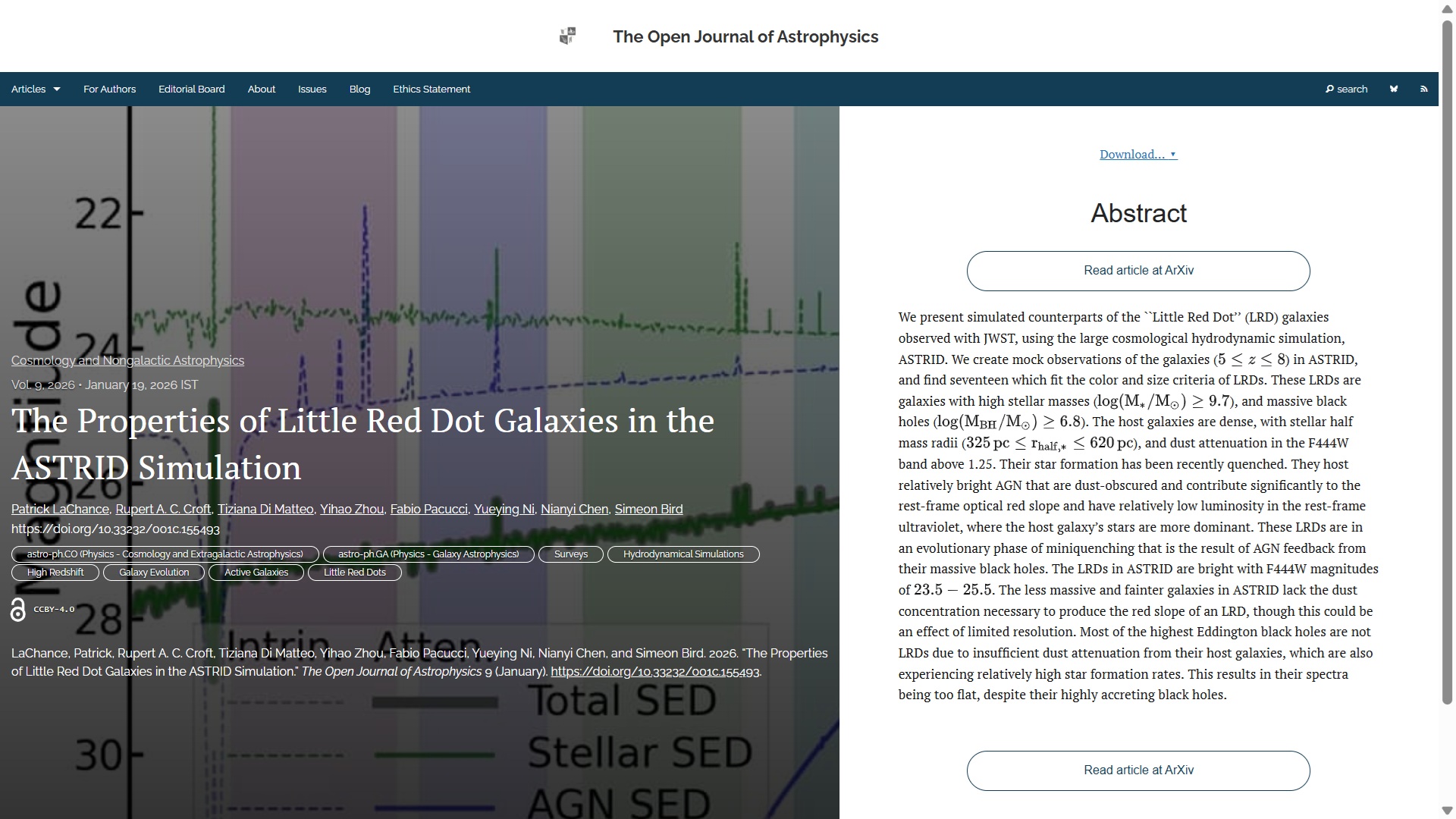
Galaxy evolution in the post-merger regime. III – The triggering of active galactic nuclei peaks immediately after coalescence” was written by Sara Ellison, Leonardo Ferreira, Robert Bickley & Tess Grindlay (U. Victoria, Canada), Samir Salim (Indiana U., USA), Shoshannah Byrne-Mamahit (Victoria), Shobita Satyapal (George Mason U., USA), David R. Patton (Trent U., Canada) and Jillian M. Scudder (Oberlin College, USA).  It was published on 4th February 2025 and is in the folder marked Astrophysics of Galaxies. The paper describes an investigation into the timescale of triggering of AGN activity after galaxy mergers and concluding that most occurs immediately after coalescence. 

You can find the officially accepted version of this paper on arXiv here.

That’s all for this week. I’ll have more updates next Saturday.

Who Publishes A&A?

Posted in Euclid, Open Access with tags , , , , , , , on May 8, 2024 by telescoper

The journal Astronomy & Astrophysics, generally known as A&A, which featured in yesterday’s post, is and has been for some time the journal of choice for many astrophysics researchers, especially those based in Europe. It is the journal in which the bulk of publications from Euclid will be published, including a batch due to come out in a couple of weeks.

The journal, which has existed since 1969, is published on behalf of the European Southern Observatory by EDP Sciences (Édition Diffusion Presse Sciences) which began life as a joint venture of four French learned societies in science, mathematics, and medicine. The company was acquired in 2019 by  China Science Publishing & Media (which has headquarters in Beijing). Judging by its social media activity, EDP Sciences sees A&A as a flagship journal; for a list of other journals it runs see here.

A&A publishes papers through a curious hybrid model called “S2O” (Subscribe to Open; not to be confused with “420”). This is not fully Open Access because it requires libraries to pay a subscription to access the journal, but unlike some journals A&A does allow authors to place their papers on arXiv without restriction, so they can be read there for free. On the other hand, A&A also requires authors to pay “Page Charges” – essentially an Article Processing Charge (APC) – if they are not from a “member country”. Authors from a member country do not have to pay APCs to publish but their institutional libraries still have to pay a subscription if they are to access the paper.

You might ask why you should publish in A&A if you can put your papers on arXiv. The answer given on the website is:

Preprint servers such as arXiv play a vital role in bringing research into the astronomy and astrophysics communities as quickly as possible. However, content uploaded to this service has not undergone rigorous peer review and the editorial oversight offered by a professional publisher such as EDP Sciences. In addition, preprints don’t offer the content selection and curation processes that make a scholarly journal a reliable and trusted addition to library collections.

In summary, publishing your article in A&A increases the value and impact of your work by making your article more trustworthy, easier to find, read, and cite, whilst ensuring that the version of record is preserved in perpetuity.

In other words, A&A does nothing that the Open Journal of Astrophysics doesn’t do for free…

Incidentally, I am struck by the frequent assertion that publishers preserve or curate content. Actually they don’t. Libraries do that. If a publisher such as EDP Science decides a journal is no longer commercially viable it will simply ditch it. Fortunately nowadays institutions maintain their own repositories of published papers as insurance against this.

Here is some more information about how S20 works, taken from the A&A website:

A&A is a community journal sponsored by a board of member countries. While subscriptions fund the publishing costs of the journal, the editorial costs are funded both by the contributions from member countries, and the page charges for authors of non-member countries. This division of costs between authors and readers makes it possible to offer low subscription prices, while at the same time removing barriers to publishing for authors from A&A sponsoring countries, and allowing authors from non-sponsoring countries to publish for a modest charge.

If the S2O model is successful, editorial costs will continue to be funded by A&A member contributions and page charges, while subscriptions will be used to cover the open access publication of the journal. Authors from sponsoring countries can therefore publish in open access free of charge, while authors from other countries remain liable for page charges to fund the editorial process of their article (note: page charges are paid to A&A directly and not to the publisher).

This arrangement is being kept under annual review so whether it will persist is open to question.

How do we make accessible research papers a reality?

Posted in Open Access with tags , , , , on March 21, 2023 by telescoper

I wanted to advertise an event – an accessibility forum – organized by arXiv that looks interesting to anyone interested in open access publishing understood in the widest possible sense. It’s advertised as a practical forum, free for all:

Hosted by arXiv, this half-day online forum will center the experiences of academic researchers with disabilities who face barriers to accessing and reading papers. The forum will be useful for people across the academic authoring and publishing ecosystem who are committed to making accessible research papers a reality. Together, we can chart a path towards fully accessible research papers, and leave with practical next steps for our own organizations.

It’s on April 17th, from 1pm to 5pm Eastern Time (USA), which is 6pm to 10pm Dublin Time. You can find more details including information on how to register, here.

We usually focus on open access publishing in terms of the costs involved, but there is much more we can do in other respects to make scientific research as accessible as possible to as wide a community as possible. Having said that, this announcement did inspire me to go off

When I saw the word “ecosystem” in the description above, it reminded me of a brief discussion I had recently with a colleague who asked what I hoped to achieve with the Open Journal of Astrophysics (other than “world domination”). My answer was that I just wanted to show that there is a practical way to bypass the enormous expense of the traditional journal industry. Instead of just sitting around complaining about the state of things I wanted to demonstrate that it doesn’t have to be the way it is. The way the number of submissions to OJAp is increasing, it seems more and more people are becoming convinced.

It seems to me that the switch from subscription charges to the dreaded Article Processing Charge has help generate momentum in this direction, by making it even more explicit that the current arrangements are unsustainable. Previously the profits of the big publishers were hidden in library budgets. Now they are hitting researchers and their grants directly, as authors now have to pay, and people who previously hadn’t thought much about the absurdity of it all are now realizing what a racket academic publishing really is.

Increasing numbers of researchers think that the current ecosystem is doomed. I am convinced that it will die a natural death soon enough. But a question I am often asked is what will replace it? I think the answer to that is very clear: a worldwide network of institutional and/or subject-based repositories that share research literature freely for the common good. Universities and research centres should simply bypass the grotesque parasite that is the publishing industry. Indeed, I would be in favour of hastening the demise of the Academic Journal Racket by having institutions make it a disciplinary offence for any researcher to pay an APC.

We’re lucky in physics and astronomy because arXiv has already done the hard work for us. Indeed, it is now a fact universally acknowledged that every research paper worth reading in these disciplines can be found on arXiv. Old-style journals are no longer necessary. It is great that arXiv is being joined by similar ventures in other fields, such as BiorXiv and EarthArxiv. I’m sure many more will follow. What is needed is a global effort to link these repositories to each other and to peer review mechanisms. One way is through overlays as demonstrated by the Open Journal of Astrophysics, there being no reason why the idea can’t be extended beyond arXiv. Other routes are possible, of course, and I would love to see different models developed. I think the next few years are going to be very exciting.

Elsevier? Just say No!
Posted in Open Access with tags , , , on March 6, 2021 by telescoper

I found out via Twitter that UK Universities are now negotiating again with publishing giant Elsevier for access to its range of hideously overpriced journals.

Five years ago the result of similar negotiations was a clear victory for Elsevier and UK institutions have been paying ever since. This time there’s a strong feeling in the UK academic community that the negotiators have to take a much firmer line, even if that means losing access to Elsevier journals.

See, e.g., this thread from mathematician Tim Gowers (who runs a very successful arXiv overlay journal called Discrete Analysis along similar lines to the Open Journal of Astrophysics).

and this from Computational Neuroscientist Stephen Eglen:

https://twitter.com/StephenEglen/status/1367820583162032128

It is important to take a stand on this issue if you want the negotiations to succeed in reducing the burden on University budgets caused by profiteering publishers like Elsevier. If you’re on Twitter you can do so using the hashtag #NoElsevier. Alternatively you can make it clear to your institution’s library that you’re prepared to do without Elsevier journals unless they reduce the price substantially.

I’d add a more general comment. If you’re an academic who thinks academia needs the likes of Elsevier then you’re an academic who is not thinking. There are plenty of ways of communicating your results without shaking hands with the Devil. I find it completely mystifying why so many academics and their institutions are so willing to be fleeced in the academic journal racket. Perhaps they believe they don’t understand how little it actually costs to publish articles online?

You could do a lot worse than seize this opportunity to set up your own journal. It’s really quite straightforward and inexpensive, especially if your research community uses the arXiv. Why not try setting up your own overlay journal?

Open Journal of Astrophysics Impact Factor Poll

Posted in Open Access with tags , , on February 5, 2021 by telescoper

A few people ask from time to time about whether the Open Journal of Astrophysics has a Journal Impact Factor.

For those of you in the dark about this, the impact factor for Year N, which is usually published in year N+1, is based on the average number of citations obtained in Year N for papers published in Years N-1 and N-2 so it requires two complete years of publishing.

For the OJA, therefore, the first time an official IF can be constructed is for 2021, which would be published is in 2022 and it would be based on the citations gained in 2021 (this year) for papers published in 2019 and 2020. Earlier years were incomplete so no IF can be defined.

It is my personal view that article-level level bibliometric data are far more useful than journal-level descriptors such as the Journal Impact Factor (JIF). I think the Impact Factor is very silly actually. Unfortunately, however, there are some bureaucrats that seem to think that the Journal Impact Factor is important and some of our authors think we should apply to have an official one.
What do you think? If you have an opinion you can vote on the twitter poll here:

https://twitter.com/OJ_Astro/status/1357653546146136069

I should add that my criticisms of the Journal Impact Factor are not about the Open Journal’s own citation performance. We have every reason to believe our impact factor would be pretty high.

Comments welcome.

Plan S – are you compliant?

Posted in Open Access with tags , , on November 19, 2020 by telescoper

Those nice people at cOAlition S have produced a new online tool that allows authors to check whether a given academic journal complies with the requirements of Plan S as they apply to a given funder and institution. For information on how ot works see here. For the actual tool (beta version) see here.

Obviously I checked how it applies to the Open Journal of Astrophysics and here’s an example result!

The Open Journal of Astrophysics and the Free Journals Network

Posted in Uncategorized with tags , , , on March 30, 2020 by telescoper


I am pleased to announce that The Open Journal of Astrophysics is now a member of the Free Journal Network.

We are in fact the 51st member of the network, which exists

…to promote scholarly journals run according to the Fair Open Access model (roughly, journals that are controlled by the scholarly community, and have no financial barriers to readers and authors.

A full list of the illustrious journals belonging to this network can be found here.


ADS and the Open Journal of Astrophysics

Posted in Open Access with tags , , , , , on January 19, 2020 by telescoper

Most if not all of the authors of papers published in the Open Journal of Astrophysics, along with a majority of astrophysicists in general, use the NASA/SAO Astrophysics Data System (ADS) as an important route to the research literature in their domain, including bibliometric statistics and other information. Indeed this is the most important source of such data for most working astrophysicists. In light of this we have been taking steps to facilitate better interaction between the Open Journal of Astrophysics and the ADS.

First, note that journals indexed by ADS are assigned a short code that makes it easier to retrieve a publication. For reference, the short code for the Open Journal of Astrophysics is OJAp. For example, the 12 papers published by the Open Journal of Astrophysics can be found on ADS here.

If you click the above link you will find that the papers published more recently have not got their citations assigned yet. When we publish a paper at the Open Journal of Astrophysics we assign a DOI and deposit it and related metadata to a system called CrossRef which is accessed by ADS to populate bibliographic fields in its own database. ADS also assigns a unique bibliometric code it generates itself (based on the metadata it obtains from Crossref). This process can take a little while, however, as both Crossref and ADS update using batch processes, the latter usually running only at weekends. This introduces a significant delay in aggregating the citations acquired via different sources.

To complicate things further, papers submitted to the arXiv as preprints are indexed on ADS as preprints and only appear as journal articles when they are published. Among other things, citations from the preprint version are then aggregated on the system with those of the published article, but it can take a while before this process is completed, particularly if an author does not update the journal reference on arXiv.

For a combination of reasons, therefore, the papers we have published in the past have sometimes appeared on ADS out of order. On top of this, of the 12 papers published in 2019, there is one assigned a bibliometric code ending in 13 by ADS and none numbered 6! This is not too much a problem as the ADS identifiers are unique, but the result is not as tidy as it might be.

To further improve our service to the community, we have decided at the Open Journal of Astrophysics that from now on we will speed up this interaction with ADS by depositing information directly at the same time as we lodge it with Crossref. This means that (a) ADS does not have to rely on authors updating the arXiv field and (b) we can give ADS directly information that is not lodged at Crossref.

I hope this clarifies the situation.

Plan S and the Open Journal of Astrophysics

Posted in Open Access with tags , , , , on June 24, 2019 by telescoper

Things have been a little quiet on this side of the Open Journal of Astrophysics but rest assured it has been very busy behind the scenes, with a sizeable batch of papers going through peer review and a number of those are very near the finishing post.

My target was to build up to an average of about one submission a week by the end of 2019, and I think we’re on track to reach that comfortably by the end of summer.

I’ll report more on new publications as they are published, but before that I thought I’d report on a couple of bits of news to do with Plan S, following the issuance last month of revised guidelines.

First, here is a nice summary (taken from this article) of the different ways in principle one could deliver Open Access publishing in a manner consistent with Plan S:

You can click on the image to make it bigger.

The important thing is that the Open Journal of Astrophysics belongs in the column on the far right of the table. I draw your attention to the various comments, especially the one at the end that says the cost of overlay journals is substantially lower. It is, as I explain here.

the authors of this post think it is unclear whether these are compliant with Plan S. That’s a fair comment, but it can be clarified into a definite yes with very few tweaks. It is very encouraging on this point that the CEO of Scholastica (who provide our platform) has written a blog in which he describes the steps being taken to ensure that all Scholastica journals are indeed compliant with Plan S.

Over the coming months, we will announce new functionality that supports complying with Plan S guidelines, and we’re committed to updating our software to meet changes to the Plan S implementation rules as they come out.

I was very happy to read this plan as it includes adding a number of things to the Scholastica system that we currently have to do ourselves (e.g. registering DOIs with CrossRef).

Anyway, another notification from Scholastica has just come in so that will have to be that for now.


Promoting the Open Journal of Astrophysics

Posted in Open Access, The Universe and Stuff with tags , , , on March 24, 2019 by telescoper

The talk I gave at the meeting I attended last week to celebrate the retirement 60th Birthday of Alan Heavens was about the Open Journal of Astrophysics project. Here are the slides:

I decided a while ago that whenever I get the opportunity at conferences or other meetings I will talk about the Open Journal of Astrophysics (OJA for short) , mainly to encourage more submissions but also to raise OJA’s profile so people aren’t tempted to dismiss review invitations as spam from predatory journals.  At the moment, refereeing is the rate-limiting step in the publication process, at least part of the reason being that people don’t really know what we’re about and perhaps assume that it’s not a bona fide operation.

The talk I gave on Friday generated a fair amount of discussion, and was hopefully a small step along the way to establishing OJA as a mainstream journal and perhaps even the default choice for papers on astrophysics. Emma Chapman posted a tweet about my talk (including a picture of me in action) which got quite a lot of attention on Twitter:


https://twitter.com/DrEOChapman/status/1109125125411139584

I’ll just add that you can read more about the extent of the profiteering going on here.


Finally, and perhaps most importantly, let me mention I have some money (in a grant courtesy of the Gordon & Betty Moore Foundation) to help promote this project, and I can legitimately spend it on travel to give talks etc.. If anyone would like a talk about this project, please feel free to contact me!