Archive for Open Access Publishing

Supplement to the Open Journal of Astrophysics – “Pulsar Science with the SKAO”

Posted in OJAp Papers, Open Access, The Universe and Stuff with tags , , , , , , , , on December 19, 2025 by telescoper

It’s been a busy day at the Open Journal of Astrophysics as we’ve published 12 related papers in the form of our first ever Supplement; officially it is Vol. 8 Supplement Issue 1. The idea of a Supplement is to publish a set of related papers together. I imagine it might be of interest for publishing conference proceedings, etc.

The topic of this Supplement is Pulsar Science with the Square Kilometre Array Observatory and it includes updates to the Science Case for the SKAO, the previous version of which is 10 years old. All the papers are indendependently peer-reviewed, which took some organizing and a lot of time because many potential referees are themselves members of the SKA Pulsar Science Working Group! Anyway, the final versions of all the papers hit the arXiv this morning so I published them all today.

Rather than include all 12 papers in tomorrow’s Saturday update I decided just to show the overlay for the overview of the special issue, which is here:

The following paragraph describes the content of the supplement and includes links to the other 11 papers in the issue.

The large instantaneous sensitivity, a wide frequency coverage and flexible observation modes with large number of beams in the sky are the main features of the upcoming SKA observatory’s two telescopes, the SKA-Low and the SKA-Mid, which are located on two different continents. Owing to these capabilities, the SKAO telescopes are going to be a game-changer for radio astronomy in general and pulsar astronomy in particular. The eleven articles in this special issue on pulsar science with the SKA Observatory describe its impact on different areas of pulsar science. Phase 1 of the rollout of the SKAO telescope is likely to double the known pulsar population in new surveys described in the first three papers (Keane et al. 2025Abbate et al. 2025Bagchi et al. 2025). These new discoveries will improve our understanding of the dynamics, evolution and gas content of globular clusters and the black hole at the centre of the Milky Way galaxy apart from increasing the samples for each of different kinds of radio emitting neutron stars (Levin et al. 2025). The larger population sample will enhance our understanding of the magneto-ionic interstellar medium (Tiburzi et al. 2025Xu et al. 2025), the pulsar magnetosphere (Oswald et al. 2025) and pulsar wind nebulae (Gelfand et al. 2025). Moreover, the discovery of exotic neutron star systems will test gravity theory ever more stringently (Krishnan et al. 2025) and will probe fundamental physics at sub-atomic level (Basu et al. 2025). Finally, this enhanced sample is likely to make the sky portrait sharper in nano-Hertz gravitational waves impacting on our understanding of the Universe in a fundamental way (Shannon et al. 2025). In summary, the papers in this special issue describe the way the upcoming SKA Observatory’s telescopes address fundamental physics through the study of pulsars and gravitational waves.

Weekly Update from the Open Journal of Astrophysics – 13/12/2025

Posted in OJAp Papers, Open Access, The Universe and Stuff with tags , , , , , , , , , , , , , , , , , , , , , , , , , , on December 13, 2025 by telescoper

It’s time once again for the usual Saturday morning update of the week’s new papers at the Open Journal of Astrophysics. Since the last update we have published a further five papers, which brings the number in Volume 8 (2025) up to 195, and the total so far published by OJAp up to 430.

The first paper this week is “Cosmic Rays Masquerading as Cool Cores: An Inverse-Compton Origin for Cool Core Cluster Emission” by Philip F. Hopkins (Caltech), Eliot Quataert (Princeton), Emily M. Silich, Jack Sayers, Sam B. Ponnada and Isabel S. Sands (Caltech).  This was published on Tuesday 9th December 2025 in the folder marked High-Energy Astrophysical Phenomena. It presents an argument  that cosmic-ray inverse-compton emission could contribute significantly to the X-ray surface brightness (SB) in cool-corre clusters, implying that gas densities may have been overestimated therein.

The overlay is here:

You can find the officially accepted version on arXiv here and the Fediverse announcement is here:

Open Journal of Astrophysics

New Publication at the Open Journal of Astrophysics: "Cosmic Rays Masquerading as Cool Cores: An Inverse-Compton Origin for Cool Core Cluster Emission" by

Philip F. Hopkins (Caltech), Eliot Quataert (Princeton), Emily M. Silich, Jack Sayers, Sam B. Ponnada and Isabel S. Sands (Caltech)

doi.org/10.33232/001c.154053

December 9, 2025, 7:22 am 1 boosts 0 favorites

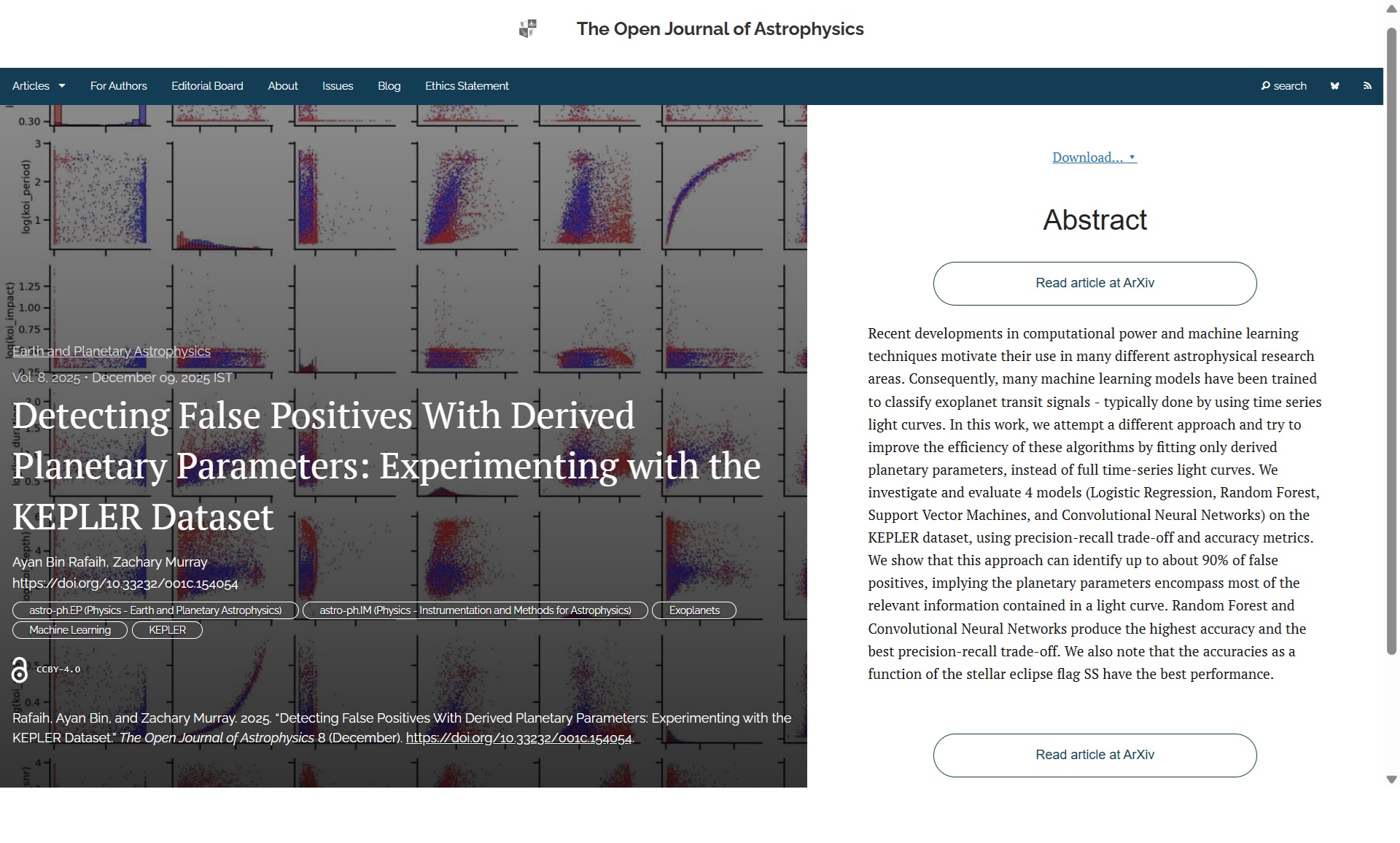
The second paper of the week is “Detecting False Positives With Derived Planetary Parameters: Experimenting with the KEPLER Dataset” by Ayan Bin Rafaih (Aitchison College, Lahore, Pakistan) and Zachary Murray (Université Côte d’Azur, France). This one was published on 9th December 2025 in the folder Earth and Planetary Astrophysics. It is an investigation into the performance of a range of machine-learning algorithms on the KEPLER dataset, using precision-recall trade-off and accuracy metrics.

The overlay is here:

You can find the official version of this one on arXiv here. The federated announcement on Mastodon is here:

Open Journal of Astrophysics

New Publication at the Open Journal of Astrophysics: "Detecting False Positives With Derived Planetary Parameters: Experimenting with the KEPLER Dataset" by Ayan Bin Rafaih (Aitchison College, Lahore, Pakistan) and Zachary Murray (Université Côte d’Azur, France)

doi.org/10.33232/001c.154054

December 9, 2025, 7:34 am 1 boosts 0 favorites

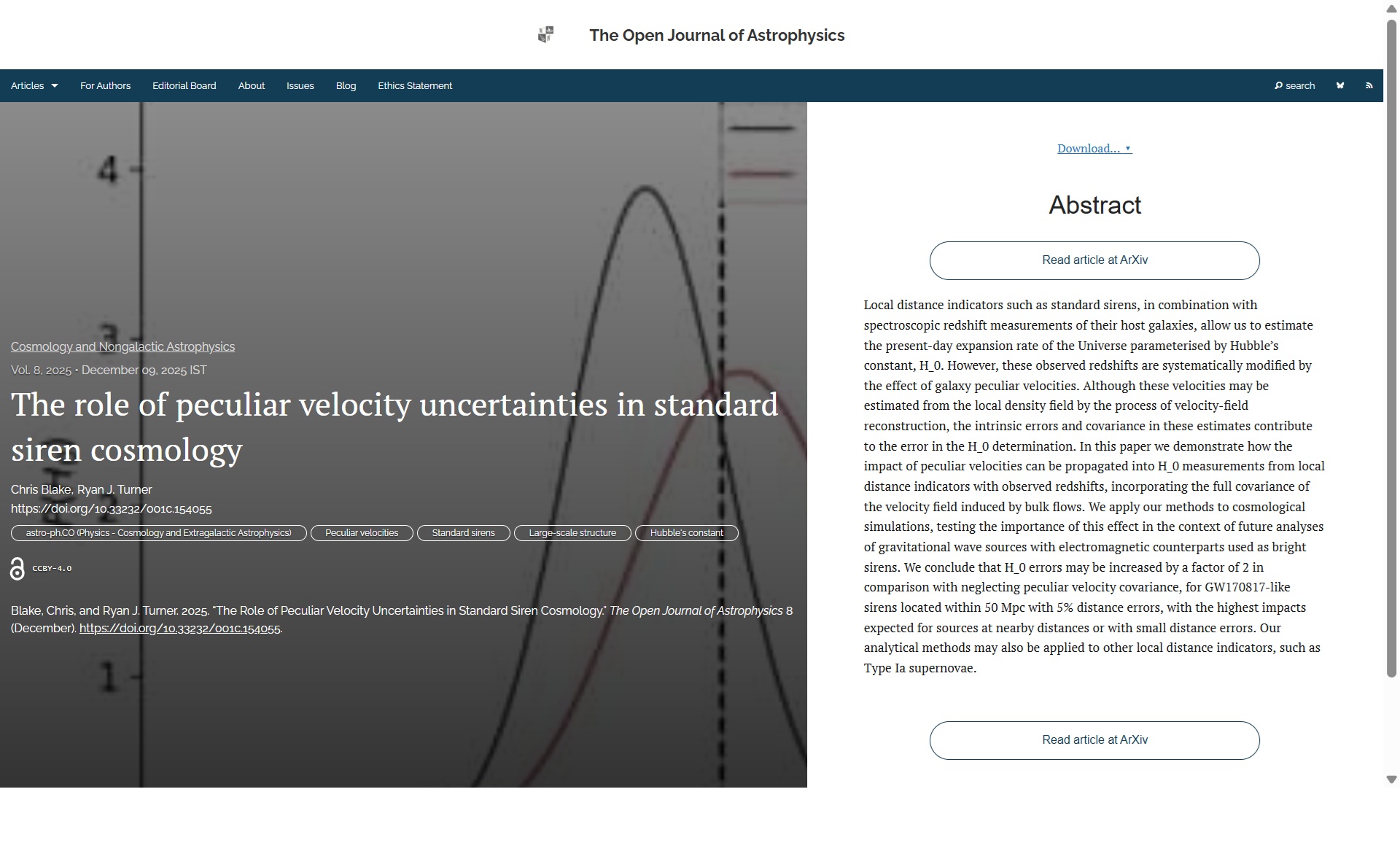
Next one up is “The role of peculiar velocity uncertainties in standard siren cosmology” by Chris Blake and Ryan J. Turner (Swinburne, Australia). This paper discusses the impact of peculiar velocities on the error in H0 determinations from local distance indicators with observed redshifts, incorporating the effect of bulk flows. It was published on Tuesday 9th December in the folder Cosmology and Nongalactic Astrophysics.

The overlay is here:

You can find the official accepted version on arXiv here. The fediverse announcement is here:

Open Journal of Astrophysics

New Publication at the Open Journal of Astrophysics: "The role of peculiar velocity uncertainties in standard siren cosmology" by Chris Blake and Ryan J. Turner (Swinburne, Australia)

doi.org/10.33232/001c.154055

December 9, 2025, 7:47 am 1 boosts 0 favorites

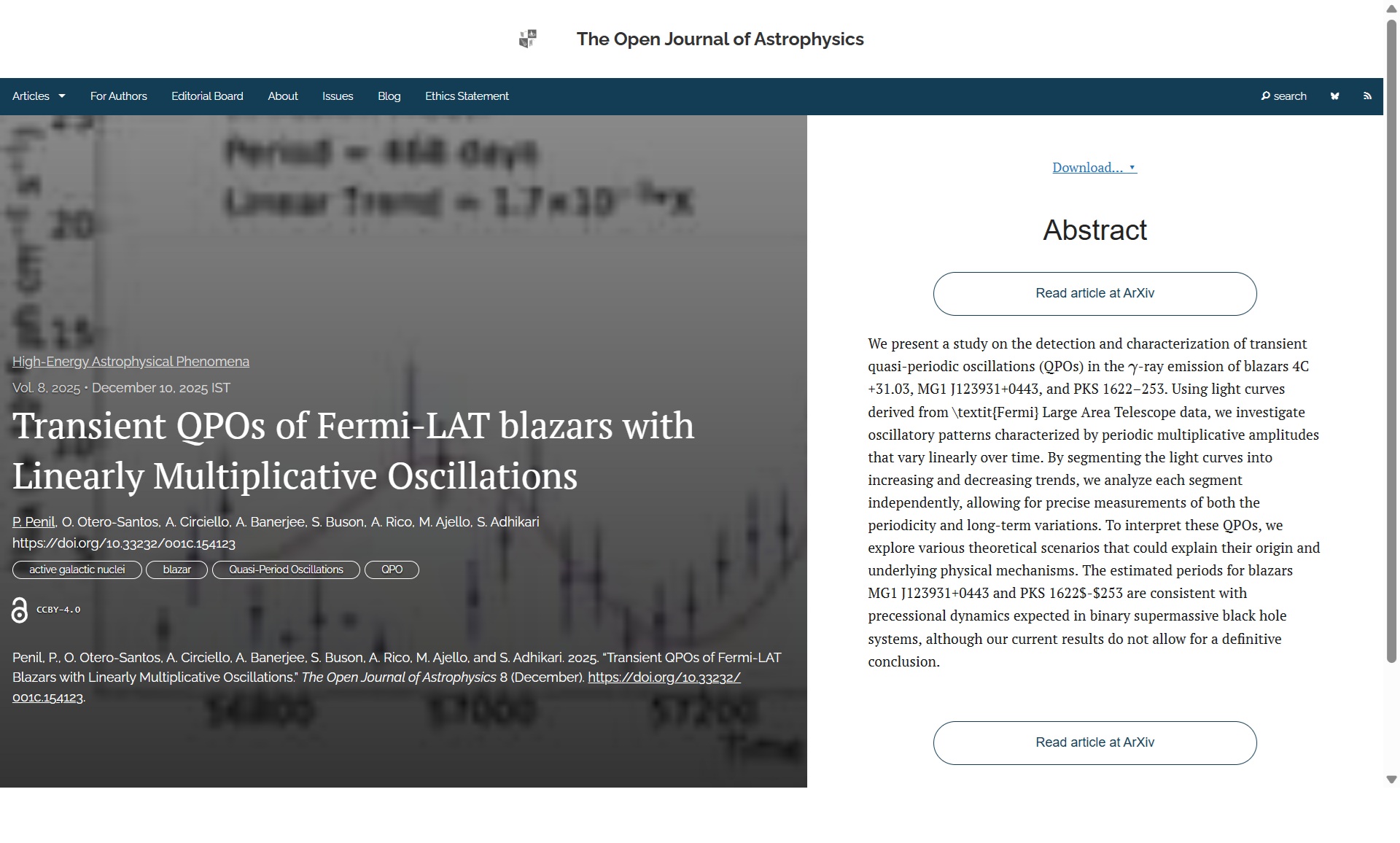
The fourth article of the week is “Transient QPOs of Fermi-LAT blazars with Linearly Multiplicative Oscillations” by P. Penil (Clemson University, USA) and 7 others based in the USA, Italy and Germany. This was published on Thursday 10th December in the folder High-Energy Astrophysical Phenomena. This paper presents an investigation of patterns of quasi-periodic oscillations in observed blazar systems characterized by periodic multiplicative amplitudes including both the periodicities and long-term variations.  The overlay is here:

You can find the official published version on arXiv here. The Fediverse announcement follows:

Open Journal of Astrophysics

New Publication at the Open Journal of Astrophysics: "Transient QPOs of Fermi-LAT blazars with Linearly Multiplicative Oscillations" by P. Penil (Clemson University, USA) and 7 others based in the USA, Italy and Germany

doi.org/10.33232/001c.154123

December 10, 2025, 12:22 pm 0 boosts 1 favorites

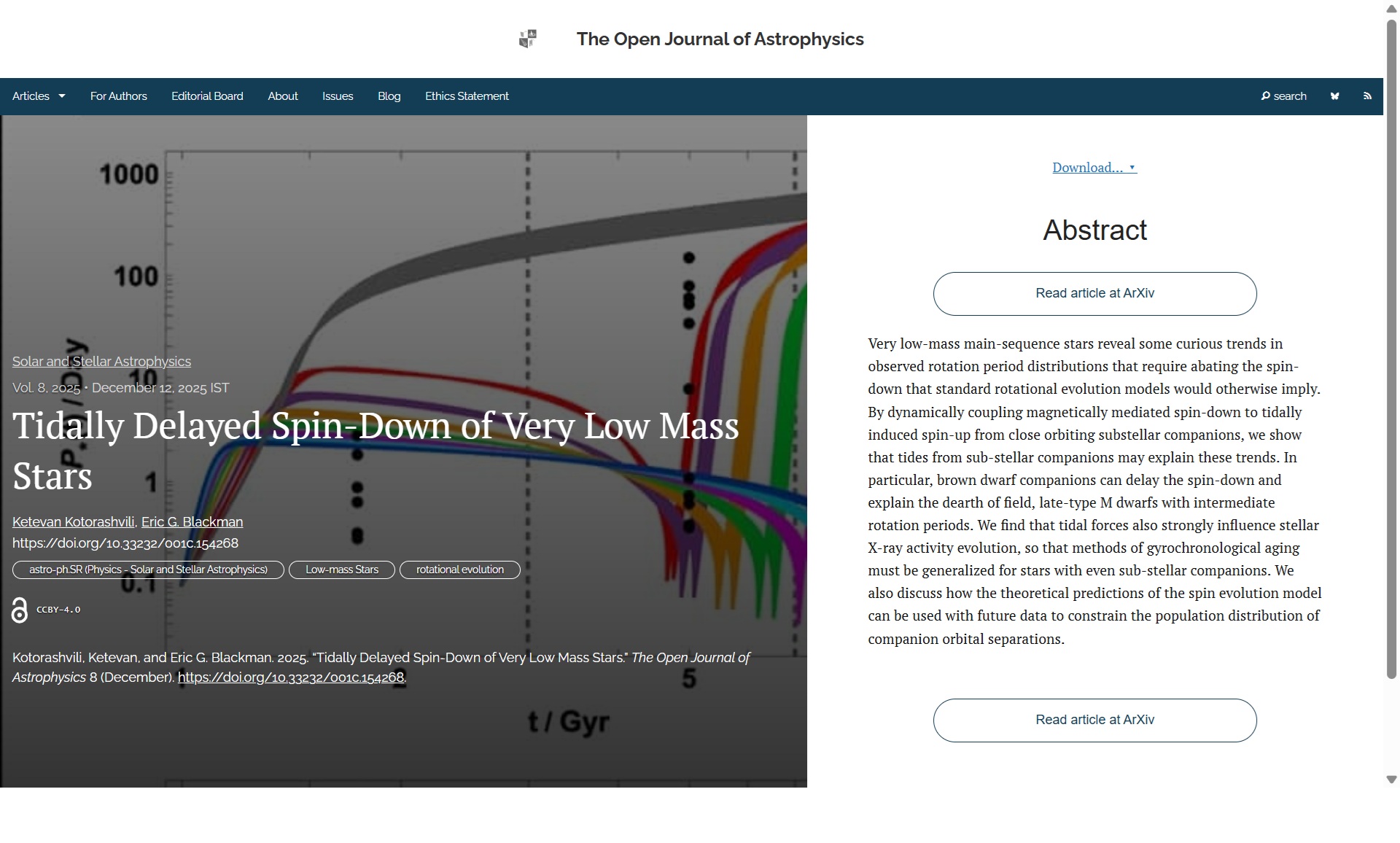
The last paper for this week is “Tidally Delayed Spin-Down of Very Low Mass Stars” by Ketevan Kotorashvili and Eric G. Blackman (U. Rochester, USA). This was published on Friday 12th December (yesterday) in the folder Solar and Stellar Astrophysics. It discusses the effect of tides from sub-stellar companions on rotational evolution of very low-mass stars, suggesting that these may explain the dearth of field, late-type M dwarfs with intermediate rotation periods.

The overlay is here:


You can find the officially-accepted version on arXiv here, and the Mastodon announcement is here:

Open Journal of Astrophysics

New Publication at the Open Journal of Astrophysics: "Tidally Delayed Spin-Down of Very Low Mass Stars" by Ketevan Kotorashvili and Eric G. Blackman (U. Rochester, USA)

doi.org/10.33232/001c.154268

December 12, 2025, 10:31 am 1 boosts 0 favorites


And that concludes the update for this week. I will do another of these regular announcements next Saturday, which will be the last such update for 2025. Will we make it past 200 for the year? Tune in next week to find out!

Weekly Update from the Open Journal of Astrophysics – 06/12/2025

Posted in OJAp Papers, Open Access, The Universe and Stuff with tags , , , , , , , , , , , , , , , , , , , , , , , , , , , on December 6, 2025 by telescoper

Once again it’s time for the usual Saturday morning update of the week’s new papers at the Open Journal of Astrophysics. Since the last update we have published a further six papers, which brings the number in Volume 8 (2025) up to 190, and the total so far published by OJAp up to 425. I blogged about the significance of the latter figure here.

The first paper this week is “The galaxy-IGM connection in THESAN: observability and information content of the galaxy-Lyman-alpha cross-correlation at z>6” by Enrico Garaldi (U. Tokyo, Japan), Verena Bellscheidt (Tech. U. Munich, Germany), Aaron Smith (U. Texas Austin, USA) and Rahul Kannan (York U. Canada). This paper was published on Monday 1st December 2025 in the folder Cosmology and Nongalactic Astrophysics. It describes an investigation of the impact of observational limitations on the ability to retrieve the intrinsic galaxy-Lyman-alpha cross correlation from line-of-sight observations.

The overlay is here:


You can find the officially accepted version on arXiv here and the Fediverse announcement is here:

Open Journal of Astrophysics

New Publication at the Open Journal of Astrophysics: "The galaxy-IGM connection in THESAN: observability and information content of the galaxy-Lyman-alpha cross-correlation at z>6" by Enrico Garaldi (U. Tokyo, Japan), Verena Bellscheidt (Tech. U. Munich, Germany), Aaron Smith (U. Texas Austin, USA) and Rahul Kannan (York U. Canada)

doi.org/10.33232/001c.151666

December 1, 2025, 8:37 am 1 boosts 0 favorites

The second paper of the week is “A Less Terrifying Universe? Mundanity as an Explanation for the Fermi Paradox” by Robin H.D. Corbet (U. Maryland, USA). This paper was published on 1st December 2025 in the folder Instrumentation and Methods for Astrophysics. It presents a discussion of possible explanations for the lack of s evidence for the presence of technology-using extraterrestrial civilizations in the Galaxy (usually called the Fermi paradox). The overlay is here:


You can find the official version of this one on arXiv here. The federated announcement on Mastodon is here:

Open Journal of Astrophysics

New Publication at the Open Journal of Astrophysics: "A Less Terrifying Universe? Mundanity as an Explanation for the Fermi Paradox" by Robin H.D. Corbet (U. Maryland, USA)

doi.org/10.33232/001c.151454

December 1, 2025, 8:50 am 2 boosts 2 favorites


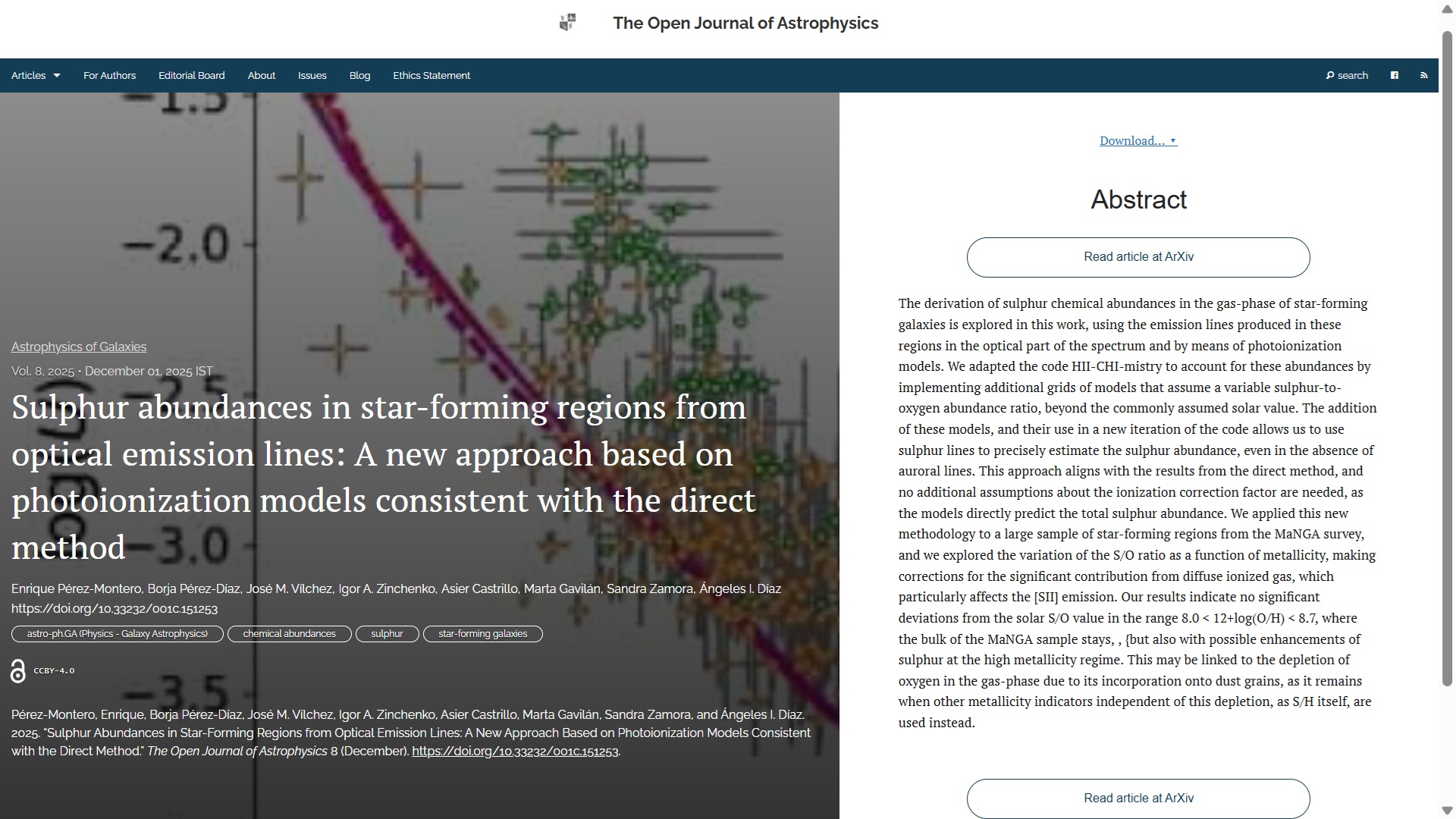
Next one up is “Sulphur abundances in star-forming regions from optical emission lines: A new approach based on photoionization models consistent with the direct method” by Enrique Pérez-Montero, Borja Pérez-Díaz, & José M. Vílchez ( (Instituto de Astrofísica de Andalucía, Spain), Igor A. Zinchenko (LMU, Germany), Asier Castrillo, Marta Gavilán, Sandra Zamora & Ángeles I. Díaz (Universidad Autonoma de Madrid, Spain). This was published on 1st December 2025 in the folder Astrophysics of Galaxies. This study uses the emission lines produced in the optical part of the spectrum and with photoionization models to derive sulphur chemical abundances in the gas-phase of star-forming galaxies.

The overlay is here:


You can find the official accepted version on arXiv here. The fediverse announcement is here:

Open Journal of Astrophysics

New Publication at the Open Journal of Astrophysics: "Sulphur abundances in star-forming regions from optical emission lines: A new approach based on photoionization models consistent with the direct method" by Enrique Pérez-Montero, Borja Pérez-Díaz, & José M. Vílchez ( (Instituto de Astrofísica de Andalucía, Spain), Igor A. Zinchenko (LMU, Germany), Asier Castrillo, Marta Gavilán, Sandra Zamora & Ángeles I. Díaz (Universidad Autonoma de Madrid , Spain)

doi.org/10.33232/001c.151253

December 1, 2025, 9:12 am 0 boosts 0 favorites

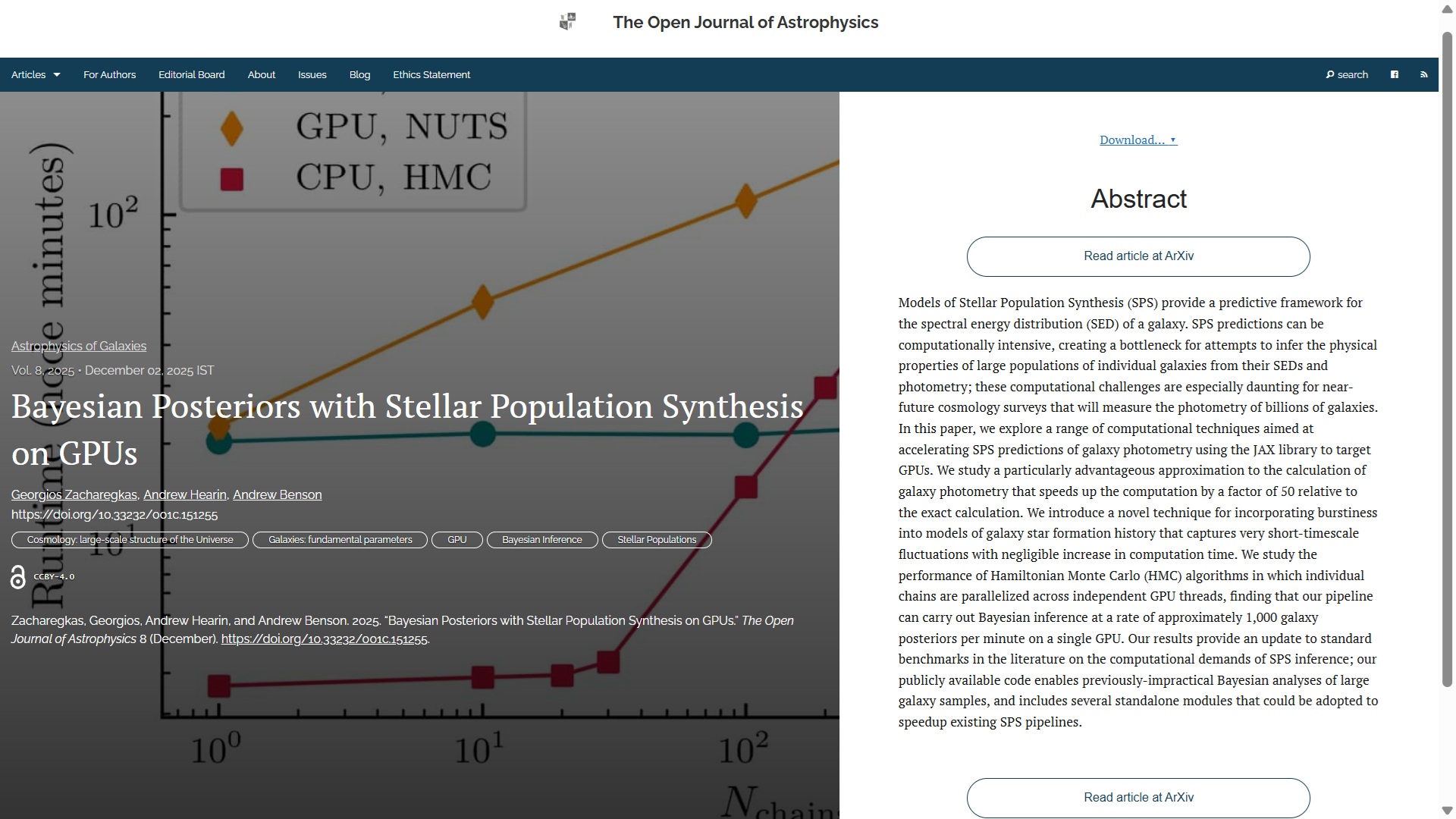
The fourth article of the week is “Bayesian Posteriors with Stellar Population Synthesis on GPUs” by Georgios Zacharegkas & Andrew Hearin (Argonne National Laboratory, USA) and Andrew Benson (Carnegie Observatories, USA). This is an exploration of a range of computational techniques aimed at accelerating Stellar Population Synthesis predictions of galaxy photometry using the JAX library to target GPUs (Graphics Processing Units, in case you didn’t know). This paper was published on Tuesday December 2nd 2025 in the folder Astrophysics of Galaxies.

The overlay is here:


You can find the official published version on arXiv here. The Fediverse announcement follows:

Open Journal of Astrophysics

New Publication at the Open Journal of Astrophysics: "Bayesian Posteriors with Stellar Population Synthesis on GPUs" by Georgios Zacharegkas & Andrew Hearin (Argonne National Laboratory, USA) and Andrew Benson (Carnegie Observatories, USA)

doi.org/10.33232/001c.151255

December 2, 2025, 7:38 am 3 boosts 1 favorites

Next one up is “IAEmu: Learning Galaxy Intrinsic Alignment Correlations” by Sneh Pandya Yuanyuan Yang, Nicholas Van Alfen, Jonathan Blazek and Robin Walters (Northeastern University, Boston, USA). This presents a neural-network-based emulator that predicts the galaxy position-position, position-orientation, and orientation-orientation, correlation functions and their uncertainties using mock catalogs based on the halo occupation distribution (HOD) framework. It was published on December 2nd 2025 in the folder Cosmology and Nongalactic Astrophysics. The overlay is here:

The official accepted version can be found on arXiv here. The Mastodon announcement is here:

Open Journal of Astrophysics

New Publication at the Open Journal of Astrophysics: "IAEmu: Learning Galaxy Intrinsic Alignment Correlations" by Sneh Pandya Yuanyuan Yang, Nicholas Van Alfen, Jonathan Blazek and Robin Walters (Northeastern University, Boston, USA)

doi.org/10.33232/001c.151749

December 2, 2025, 7:52 am 1 boosts 0 favorites

The last paper for this weel is “Unraveling the Nature of the Nuclear Transient AT2020adpi” by Paarmita Pandey (Ohio State University, USA) and a team of 15 others based in the USA, UK and Australia. This was published on Thursday December 4th 2025 in the folder High-Energy Astrophysical Phenomena. It is an investigation into a particular transient event AT2020adpi and a discussion of whether it is an extreme example of AGN variability or a Tidal Disruption Event (TDE). The overlay is here:

You can find the officially-accepted version on arXiv here, and the Mastodon announcement is here:

Open Journal of Astrophysics

New Publication at the Open Journal of Astrophysics: "Unraveling the Nature of the Nuclear Transient AT2020adpi" by Paarmita Pandey (Ohio State University, USA) and 15 others based in the USA, UK and Australia

doi.org/10.33232/001c.151453

December 4, 2025, 8:48 am 1 boosts 0 favorites

And that concludes the update for this week. I will do another next Saturday.

Yet Another Elsevier Scandal

Posted in Open Access with tags , , , on December 3, 2025 by telescoper

I wish to draw your attention to an article in the Spanish newspaper El Pais. I encourage you to read the full article, which in English here, and the headline is this:

The article is about a very dodgy journal called Science of the Total Environment published by Elsevier. As far as I can tell, despite the scandal, this journal is still listed in Scopus which is meant to mean that it is a quality journal. One shouldn’t be surprised however, because Scopus is itself owned by Elsevier. Why anyone would trust Scopus for anything is completely beyond me.

As well as the huge revenues and profit margins revealed in the article, it also mentions that Erik Engstrom, CEO of RELX (the multinational that owns Elsevier), earned more than €15 million ($17.4 million) in 2024 between his salary and other compensation. Nice work if you can get it…

Here’s a quote:

The scandal exposes the windfall profits of scientific publishers, who in recent years have amassed billions of dollars in earnings from public funds earmarked for science.

Quite so. I’ve been saying as much for years, in fact, and it is the major reason for setting up the Open Journal of Astrophysics. In my opinion, however, the scandalous behaviour of publishers is only half the problem: equally to blame are the institutions that go along with it.

Weekly Update from the Open Journal of Astrophysics – 29/11/2025

Posted in OJAp Papers, Open Access, The Universe and Stuff with tags , , , , , , , , , , , , , , , , , , , , on November 29, 2025 by telescoper

It’s Saturday again, so it’s time for the usual update of the week’s new papers at the Open Journal of Astrophysics. Publishing this week was interrupted by the Thanksgiving holiday in the United States, which meant there were no arXiv announcements yesterday. Nevertheless, since the last update we have published another four papers, which brings the number in Volume 8 (2025) up to 184, and the total so far published by OJAp up to 419.

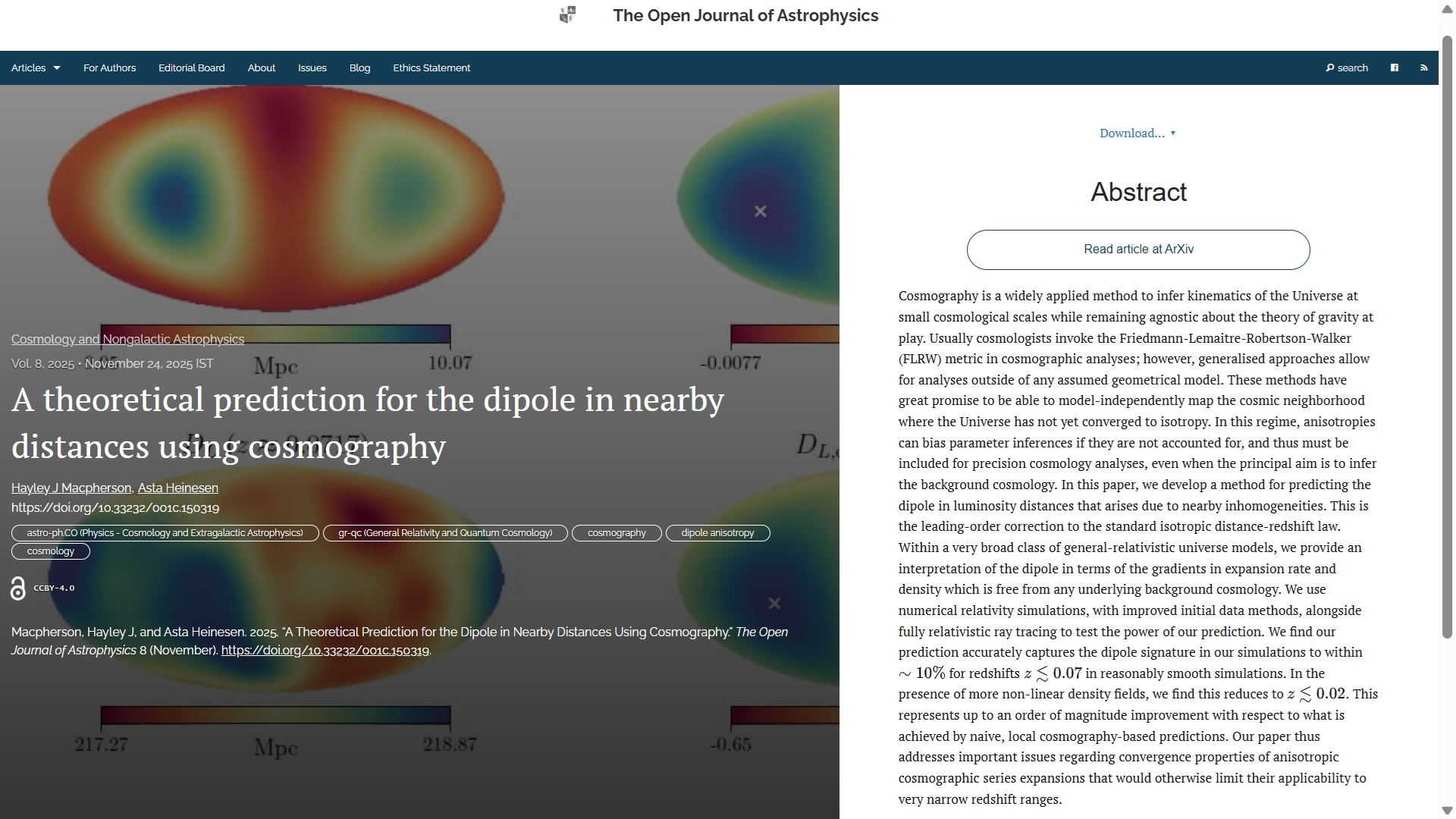
The first paper this week is “A theoretical prediction for the dipole in nearby distances using cosmography” by Hayley J. Macpherson (U. Chicago, USA) and Asta Heinesen (Niels Bohr Institute, Denmark). This was published on Monday 24th November 2025 in the folder Cosmology and Nongalactic Astrophysics. It presents a method to predict the dipole in luminosity distances that arises due to nearby inhomogeneities to leading-order correction to the standard isotropic distance-redshift law. Incidentally, I wrote about a talk by one of the authors here.

The overlay is here:


You can find the officially accepted version on arXiv here and the Fediverse announcement is here:

Open Journal of Astrophysics

New Publication at the Open Journal of Astrophysics: "A theoretical prediction for the dipole in nearby distances using cosmography" by Hayley J Macpherson (U. Chicago, USA) and Asta Heinesen (Niels Bohr Institute, Denmark)

doi.org/10.33232/001c.150319

November 24, 2025, 8:25 am 2 boosts 1 favorites


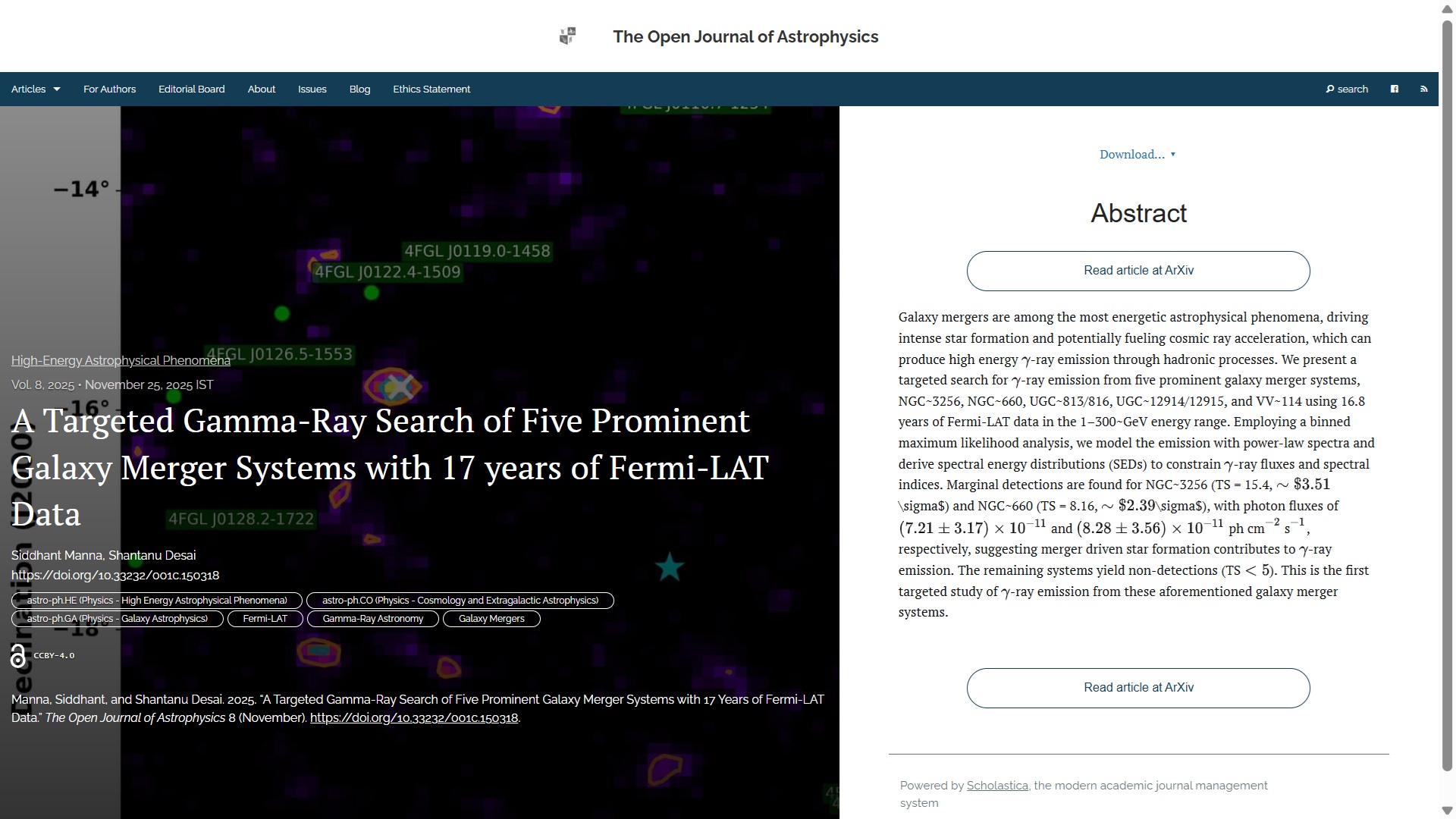
The second paper of the week is “A Targeted Gamma-Ray Search of Five Prominent Galaxy Merger Systems with 17 years of Fermi-LAT Data” by Siddhant Manna and Shantanu Desai (IIT Hyderabad Kandi, India). This one was published on Tuesday November 25th 2025 in the folder marked High-Energy Astrophysical Phenomena. It describes a search for gamma-ray emission in Fermi-LAT data from five merging galaxy systems with marginal detections for two of them

The overlay is here:


You can find the official version of this one on arXiv here. The federated announcement on Mastodon is here:


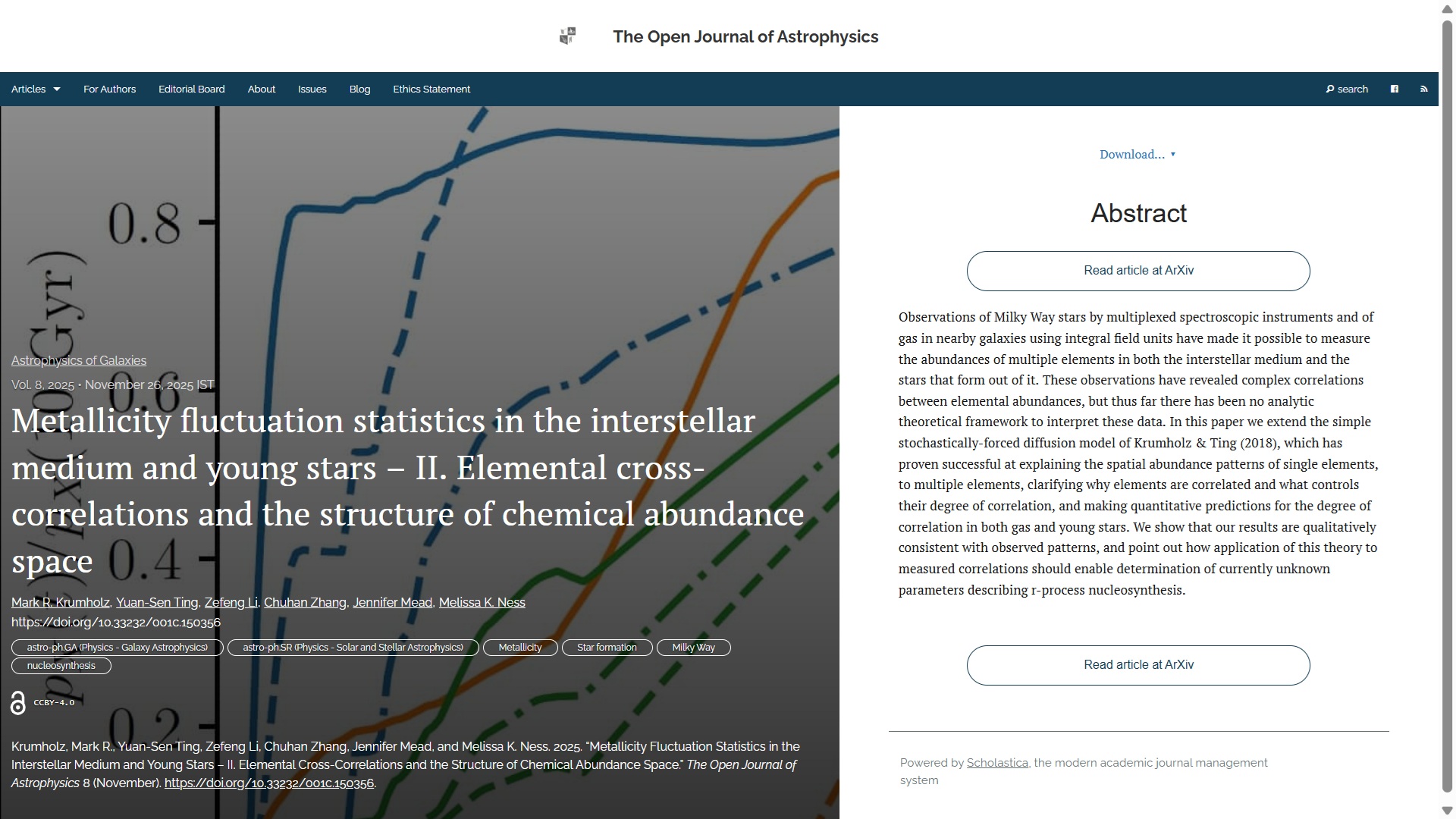
Next one up is “Metallicity fluctuation statistics in the interstellar medium and young stars – II. Elemental cross-correlations and the structure of chemical abundance space” by Mark R. Krumholz (ANU, Australia), Yuan-Sen Ting (Ohio State U., USA), Zefeng Li (Durham U., UK), Chuhan Zhang (ANU), Jennifer Mead (Columbia U., USA) and Melissa K. Ness (ANU). This was published in the folder Astrophysics of Galaxies on Wednesday November 26th. It presents an extended stochastically-forced diffusion model for the chemical evolution of galaxies, making quantitative predictions for the degree of correlation in abundance patterns in both gas and young stars.

The overlay is here:


You can find the official accepted version on arXiv here. The fediverse announcement is here:

Open Journal of Astrophysics

New Publication at the Open Journal of Astrophysics: "Metallicity fluctuation statistics in the interstellar medium and young stars – II. Elemental cross-correlations and the structure of chemical abundance space" by Mark R. Krumholz (ANU, Australia), Yuan-Sen Ting (Ohio State U., USA), Zefeng Li (Durham U., UK), Chuhan Zhang (ANU), Jennifer Mead (Columbia U., USA) and Melissa K. Ness (ANU)

doi.org/10.33232/001c.150356

November 26, 2025, 8:34 am 1 boosts 1 favorites

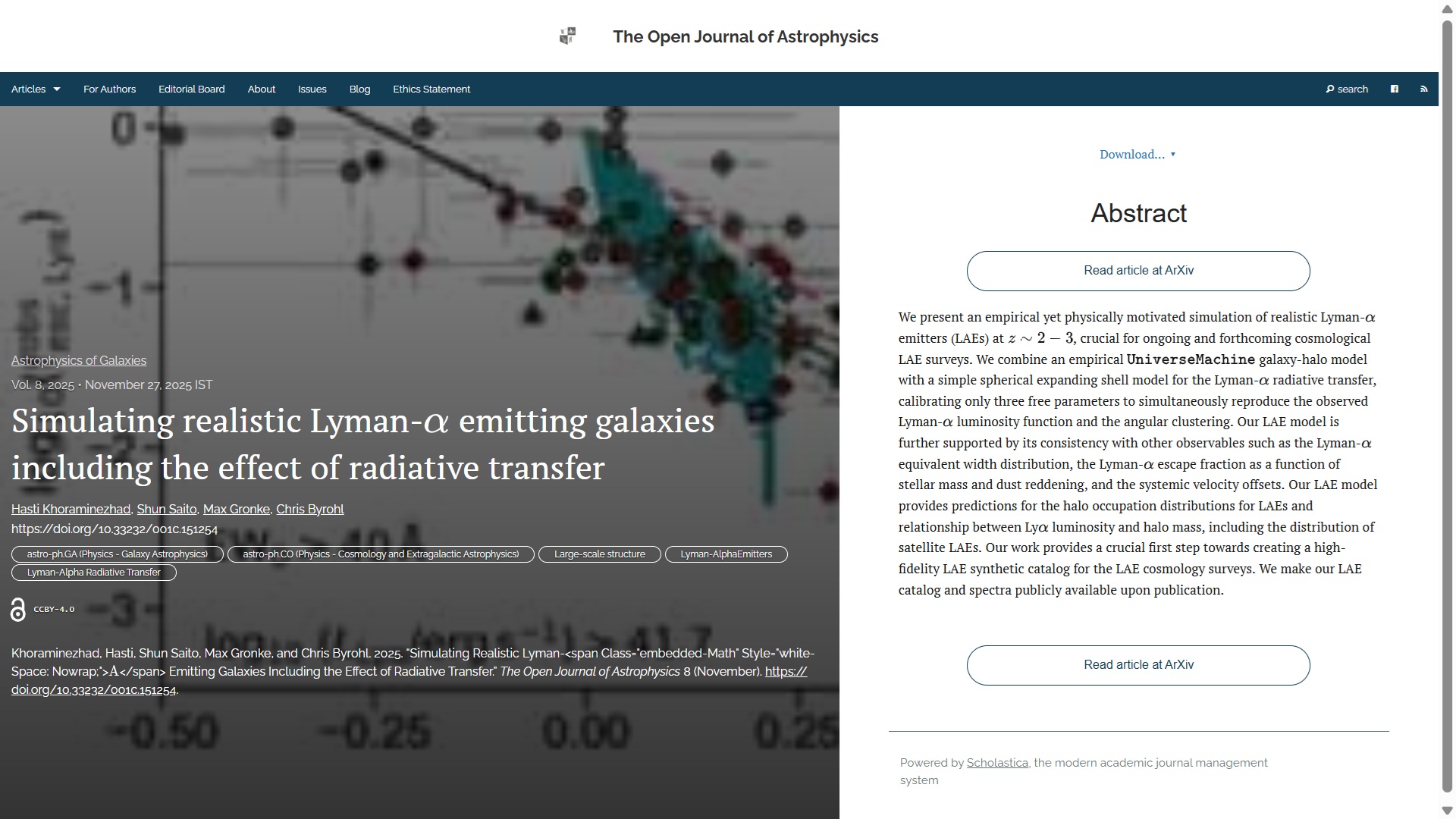
The fourth and final paper of the week is “Simulating realistic Lyman-alpha emitting galaxies including the effect of radiative transfer” by Hasti Khoraminezhad & Shun Saito (Missouri Institute of Science & Technology, USA), Max Gronke (U. Heidelberg, Germany) and Chris Byrohl (MPA Garching, Germany). An empirical model for Lyman-alpha emitters (LAEs) which provides predictions for the halo occupation distributions and relationship between luminosity and halo mass, including the distribution of satellite LAEs. It was published on Thursday November 27th 2025 in the folder Astrophysics of Galaxies.

The overlay is here:

You can find the official published version on arXiv here. The Fediverse announcement follows:

Open Journal of Astrophysics

New Publication at the Open Journal of Astrophysics: "Simulating realistic Lyman-alpha emitting galaxies including the effect of radiative transfer" by Hasti Khoraminezhad & Shun Saito (Missouri Institute of Science & Technology, USA), Max Gronke (U. Heidelberg, Germany) and Chris Byrohl (MPA Garching, Germany)

doi.org/10.33232/001c.151254

November 27, 2025, 9:20 am 1 boosts 1 favorites

And that concludes the update for this week. I will do another next Saturday.

Weekly Update from the Open Journal of Astrophysics – 01/11/2025

Posted in OJAp Papers, Open Access, The Universe and Stuff with tags , , , , , , , , , , , on November 1, 2025 by telescoper

It’s time once again for the usual Saturday update of the week’s new papers at the Open Journal of Astrophysics (although a bit later in the day than usual). Since the last update we have published another two papers, which brings the number in Volume 8 (2025) up to 163, and the total so far published by OJAp up to 398.

The first paper this week is “Instability and vertical eccentricity variation in global hydrodynamic disk simulations” by Janosz W Dewberry (U. Mass. Amherst, USA), Henrik N. Latter and Gordon I. Ogilvie (U. Cambridge, UK) and Sebastien Fromang (U. Paris Saclay, France). This article was published in the folder Solar and Stellar Astrophysics on Tuesday 28th October 2025; it discusses the instabilities and eccentricity variations generated in numerical hydrodynamic simulations of accretion disks.

The overlay is here:

You can find the officially accepted version on arXiv here.

The Fediverse announcement is here:

Open Journal of Astrophysics

New Publication at the Open Journal of Astrophysics: "Instability and vertical eccentricity variation in global hydrodynamic disk simulations" by Janosz W Dewberry (U. Mass. Amherst, USA), Henrik N Latter and Gordon I Ogilvie (U. Cambridge, UK) & Sebastien Fromang (U. Paris Saclay, France)

doi.org/10.33232/001c.146332

October 28, 2025, 9:43 am 2 boosts 0 favorites

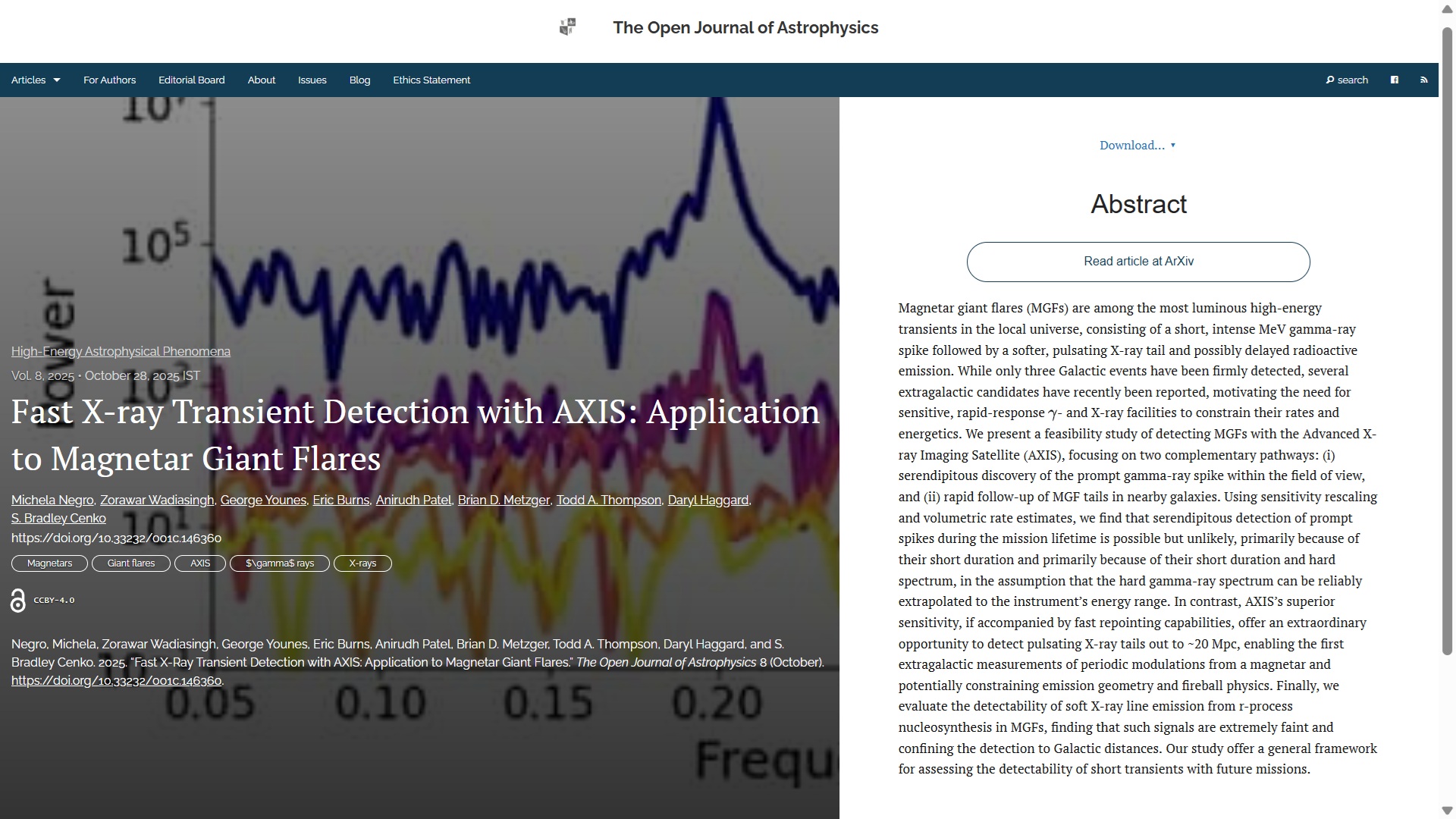
The second (and last) paper of the week is “Fast X-ray Transient Detection with AXIS: application to Magnetar Giant Flares” by Michela Negro (Louisiana State University, USA) and 8 others based in the USA and Canada. This one was also published on Tuesday 28th October, but in the folder High-Energy Astrophysical Phenomena. It presents a feasibility study of detecting Magnetar Giant Flares with the Advanced X-ray Imaging Satellite (AXIS). The overlay is here:

You can find the official version of this one on arXiv here. The announcement on Mastodon is here:

Open Journal of Astrophysics

New Publication at the Open Journal of Astrophysics: "Fast X-ray Transient Detection with AXIS: application to Magnetar Giant Flares" by Michela Negro (Louisiana State University, USA) and 8 others based in the USA and Canada

doi.org/10.33232/001c.146360

October 28, 2025, 10:02 am 1 boosts 1 favorites

It being a relatively slow week we didn’t reach the 400 mark as I thought we might, but we will probably get there next week. After 10 months of the year 2025, in which we have published 163 papers, a rough projection for the 2025 total is 195. We do have some extra papers up our sleeve, however, so we might well reach 200 for the year. We will find out soon enough!

Weekly Update from the Open Journal of Astrophysics – 04/10/2025

Posted in OJAp Papers, Open Access, The Universe and Stuff with tags , , , , , , , , , , , , , , , , , , , , , , , , on October 4, 2025 by telescoper

It’s Saturday again, so it’s time for a summary of the week’s new papers at the Open Journal of Astrophysics. Since the last update we have published five more papers, which brings the number in Volume 8 (2025) up to 146, and the total so far published by OJAp up to 381. At this rate Volume 8 will contain around 190 by the end of 2025.

Anyway, here are this week’s papers, starting with three published on Monday 29th September 2025.

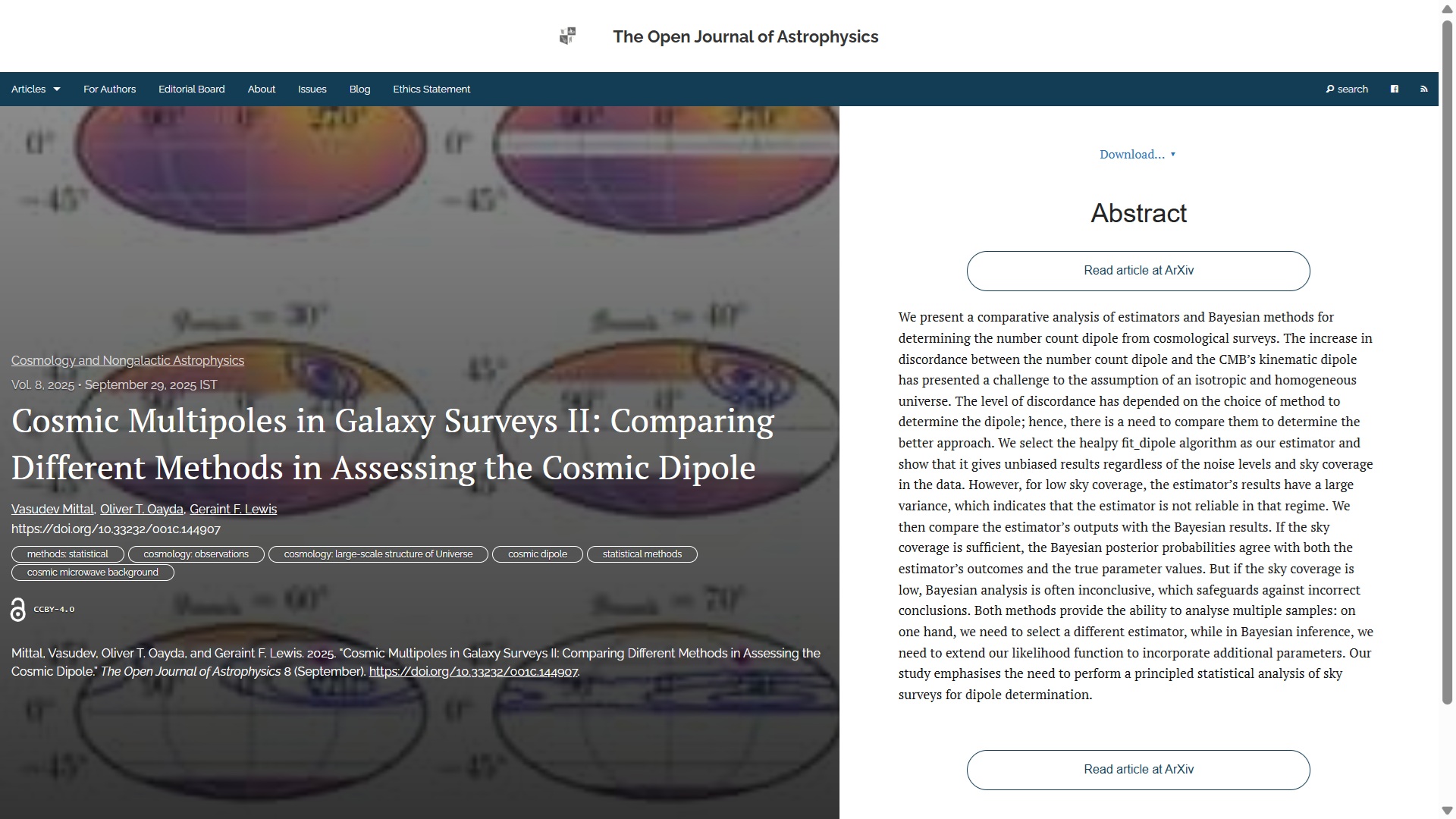
The first paper is “Cosmic Multipoles in Galaxy Surveys II: Comparing Different Methods in Assessing the Cosmic Dipole” by Vasudev Mittal, Oliver T. Oayda and Geraint F. Lewis (U. Sydney, Australia). This is in the folder Cosmology and Nongalactic Astrophysics. It presents a comparison of methods for determining the number count dipole from cosmological surveys with a discussion of the implications for the known discordance with the CMB diple.

The overlay is here:

You can make this larger by clicking on it.  The officially accepted version of this paper can be found on the arXiv here.

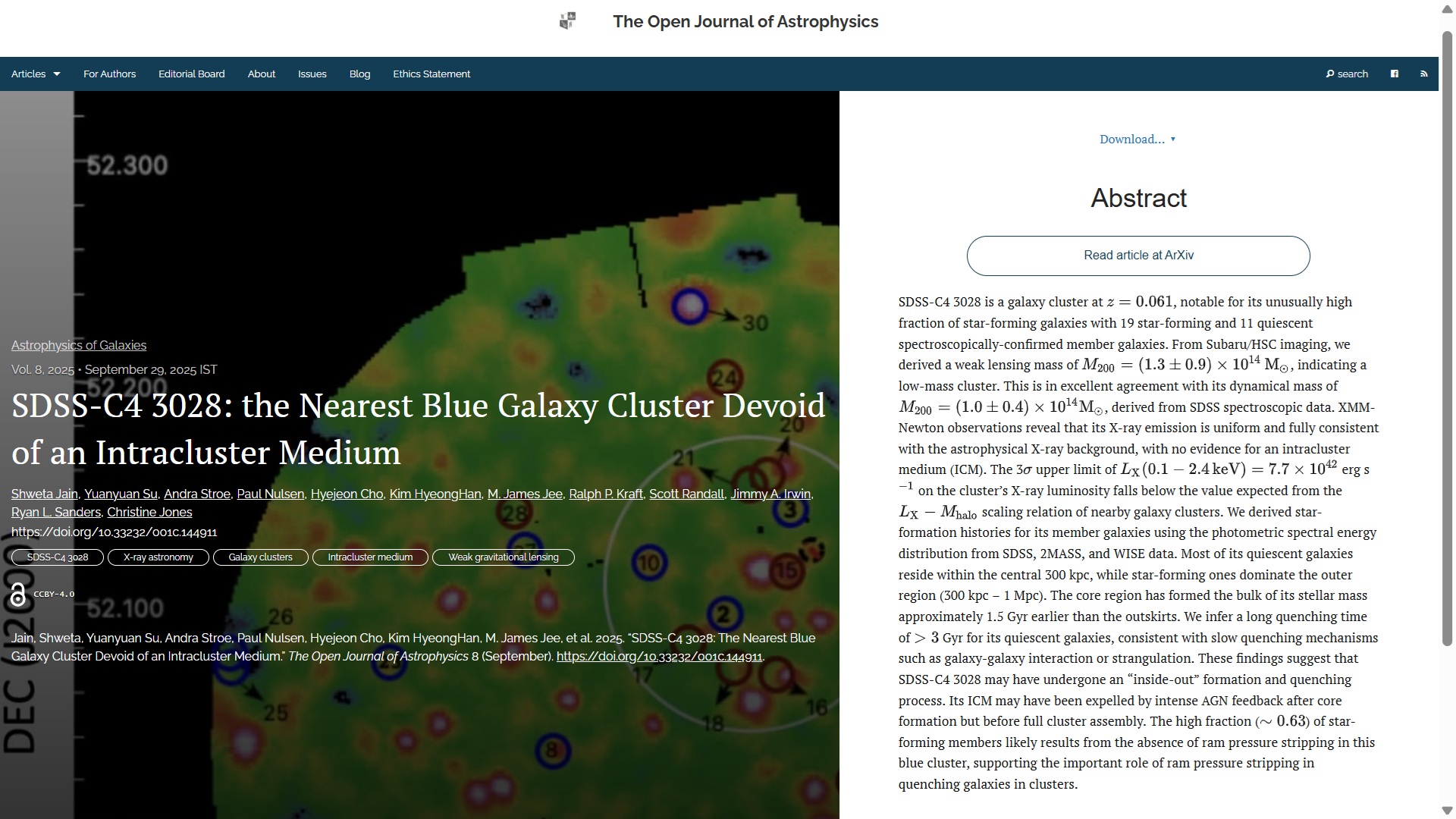
The second paper this week, also published on Monday 29th September, is “SDSS-C4 3028: the Nearest Blue Galaxy Cluster Devoid of an Intracluster Medium” by Shweta Jain (University of Kentucky, USA) and 11 others based in the USA, Australia and Korea. This describes a galaxy cluster with an unusually high fraction (about 63%) of star-forming galaxies which may be a result of ram pressure stripping; the article is in the folder Astrophysics of Galaxies.

The corresponding overlay is here:


You can find the officially accepted version on arXiv here.

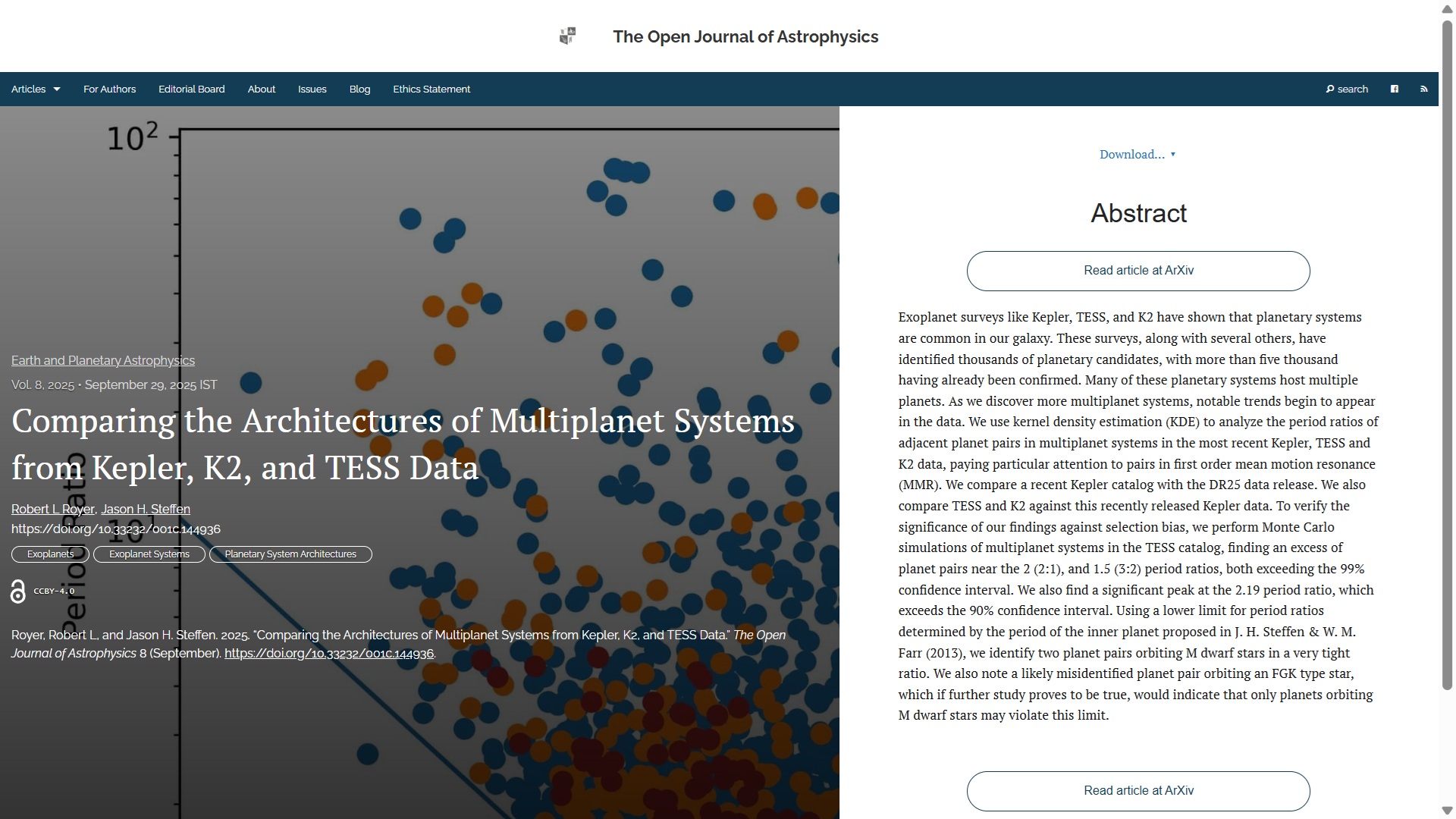
The third one this week, published on also published on Monday 29th September but in the folder Earth and Planetary Astrophysics, is “Comparing the Architectures of Multiplanet Systems from Kepler, K2, and TESS Data” by Robert L Royer and Jason H. Steffen (University of Nevada, USA).  This paper explores the trends seen in exoplanet survey data, including Kepler, TESS, and K2 including many planetary systems with multiple planets.

The overlay is here:


You can find the officially-accepted version on arXiv here.

The next one up is “Seeding Cores: A Pathway for Nuclear Star Clusters from Bound Star Clusters in the First Billion Years” by Fred Angelo Batan Garcia (Columbia University, USA), Massimo Ricotti (University of Maryland, USA) and Kazuyuki Sugimura (Hokkaido University, Japan). This paper was published on Thursday 2nd October in the folder Astrophysics of Galaxies. This is about modelling the formation of Nuclear Star Clusters using cosmological radiation-hydrodynamic simulations, with discussion of the implications for seeding supermassive black holes and the little red dots seen by JWST.

The corresponding overlay is here:

You can find the officially accepted version of this one on arXiv here.

The fifth and last one for this week, published on Friday 3rd October 2025, is “Efficient semi-analytic modelling of Pop III star formation from Cosmic Dawn to Reionization” by Sahil Hegde and Steven R. Furlanetto (University of Californi Los Angeles, USA).  This is also in the folder marked Astrophysics of Galaxies. It uses a self-consistent analytic model to trace the formation of the first stars from their birth through the first billion years of the universe’s history. complementing semi-analytic and computational methods.


You can find the officially-accepted version of this paper on arxiv here.

That concludes the report for this week. I’ll post another update next Saturday.

Weekly Update from the Open Journal of Astrophysics – 27/09/2025

Posted in OJAp Papers, Open Access, The Universe and Stuff with tags , , , , , , , , , , , , , , , , , , , , , , on September 27, 2025 by telescoper

It’s Saturday again, so it’s time for a summary of the week’s new papers at the Open Journal of Astrophysics. Since the last update we have published five new papers, which brings the number in Volume 8 (2025) up to 141, and the total so far published by OJAp up to 376.

The first paper to report this week is “The Bispectrum of Intrinsic Alignments: Theory Modelling and Forecasts for Stage IV Galaxy Surveys” by Thomas Bakx (Utrecht U., NL), Alexander Eggemeier (U. Bonn, DE), Toshiki Kurita (MPA Garching, DE), Nora Elisa Chisari (Leiden U., NL) and Zvonimir Vlah (Ruđer Bošković Institute, Croatia). This paper was published on Monday 22nd September 2025 in the folder Cosmology and NonGalactic Astrophysics. It studies the bispectrum of intrinsic galaxy alignments, a possible source of systematic errors in extracting cosmological information from the analysis of weak lensing surveys.

The overlay is here:

You can make this larger by clicking on it.  The officially accepted version of this paper can be found on the arXiv here.

The second paper this week, published on Tuesday 23rd September 2025 is “Reanalysis of Stage-III cosmic shear surveys: A comprehensive study of shear diagnostic tests” by Jazmine Jefferson (University of Chicago, USA) and 13 others for the LSST Dark Energy Science Collaboration. It is also in the folder Cosmology and NonGalactic Astrophysics; it describes diagnostic tests on three public shear catalogs (KiDS-1000, Year 3 DES-Y3 s, and Year 3 HSC-Y3); not all the surveys pass all the tests.

The corresponding overlay is here:

You can find the officially accepted version on arXiv here.

The third one this week, published on Wednesday 24th September 2025 in the folder Astrophysics of Galaxies, is “Is feedback-free star formation possible?” by Andrea Ferrara, Daniele Manzoni, and Evangelia Ntormousi (all of the Scuola Normale Superiore, Pisa, Italy). This paper presents an argument that Lyman-alpha radiation pressure strongly limits star formation efficiency, even at solar metallicities, so that a feedback-free star formation phase is not possible without feedback. The overlay is here:

You can find the officially-accepted version on arXiv here.

Next we have “Microphysical Regulation of Non-Ideal MHD in Weakly-Ionized Systems: Does the Hall Effect Matter?” by Philip F. Hopkins (Caltech, USA), Jonathan Squire (U. Otago, New Zeland), Raphael Skalidis (Caltech) and Nadine H. Soliman (Caltech). This was also published on Wednesday 24th September 2025, but in the folder Earth and Planetary Astrophysics. It presents an improved treatment of non-ideal effects in magnetohydrodynamics, particularly the Hall effect, and a discussion of the implications for weakly-ionized astrophysical systems.

The corresponding overlay is here:


You can find the officially accepted version of this one on arXiv here.

The fifth, and last, one for this week is “The Local Volume Database: a library of the observed properties of nearby dwarf galaxies and star clusters” by Andrew B. Pace (University of Virginia, USA). This one was published on Friday 26th September (i.e. yesterday) in the folder Astrophysics of Galaxies. It presents a catalogue of positional, structural, kinematic, chemical, and dynamical parameters for dwarf galaxies and star clusters in the Local Volume. The overlay is here:

You can find the officially-accepted version of this paper on arxiv here.


And that concludes the report for this week. I’ll post another update next Saturday.

Weekly Update from the Open Journal of Astrophysics – 02/08/2025

Posted in OJAp Papers, Open Access, The Universe and Stuff with tags , , , , , , , , , , , , , , , , , , , , , , , , , , , , on August 2, 2025 by telescoper

It’s Saturday morning again, and it’s the start of a new month, so it’s time for an update of papers published at the Open Journal of Astrophysics. Since the last update we have published five new papers, which brings the number in Volume 8 (2025) up to 110, and the total so far published by OJAp up to 345. I expect we’ll the total number we published last year (120) sometime this month. I predict that by the end of this year we will have published around 180 papers in Volume 8 and around 400 altogether.

The papers published this week, with their overlays, are as follows. You can click on the images of the overlays to make them larger should you wish to do so.

The first paper to report is “The matter with(in) CPL” by Leonardo Giani (U. Queensland, Australia), Rodrigo Von Marttens (Universidade Federal da Bahia, Brazil) and Oliver Fabio Piattella (Universita degli Studi dell’Insubria, Italy). This was published on Monday 29th July 2025 in the folder Cosmology and Nongalactic Astrophysics. This article presents a new parameterization of the standard model and its implications for the interpretation of cosmological observations.

The overlay is here:


The officially-accepted version can be found on arXiv here.

The second paper of the week, published on Tuesday 30th July in the folder Instrumentation and Methods for Astrophysics, is “An automated method for finding the most distant quasars” by Lena Lenz, Daniel Mortlock, Boris Leistedt & Rhys Barnett (Imperial College London, UK) and Paul C. Hewett (U. Cambridge, UK)”.  This paper presents an automated, reproduceable and objective high-redshift quasar selection pipeline, tested on simulations and real data from the Sloan Digital Sky Survey (SDSS) and UKIRT Infrared Deep Sky Survey (UKIDSS). The overlay is here:


You can find the officially accepted version of the paper on arXiv here.

The third paper of the week is “Early Post Asymptotic Giant Branch Instability: Does it Affect White Dwarf Hydrogen Envelope Mass?” by James MacDonald (University of Delaware, USA). This one was published on Friday 1st Auguest (i.e. yesterday) in the folder Solar and Stellar Astrophysics. It is an investigation into whether Early Post AGB Instability (EPAGBI) can affect determinations of the total abundance of hydrogen in white dwarf stars.

The overlay is here:

The final version is on arXiv here.


The fourth paper of the week, also published on Friday 1st August, is “Light Echoes of Time-resolved Flares and Application to Kepler Data” by Austin King and Benjamin C. Bromley (University of Utah, USA).  This describes a new model for circumstellar disks that incorporates echoes produced by extended, time-resolved flares. It is published in the folder Solar and Stellar Astrophysics. Here is the overlay:

You can find the officially-accepted version on arXiv here.


The fifth and final article published this week, also published on Friday 1st August,  is “Wide Binaries from Gaia DR3 : testing GR vs MOND with realistic triple modelling” by Charalambos Pittordis, Will Sutherland and Paul Shepherd (Queen Mary, University of London, UK). This presents a test for modified gravity from a sample of wide-binary stars from Gaia DR3, finding that (unmodified) Newtonian gravity provides a better fit to the data. It is in the folder Astrophysics of Galaxies.

The overlay is here:


You can find the officially-accepted version on arXiv here.

And that’s all the papers for this week. I’ll do another update next Saturday.

Weekly Update from the Open Journal of Astrophysics – 14/06/2025

Posted in OJAp Papers, Open Access, The Universe and Stuff with tags , , , , , , , , , , , , on June 14, 2025 by telescoper

It’s Saturday so once again it’s time for the weekly update of papers published at the Open Journal of Astrophysics. Since the last update we have published two new papers, which brings the number in Volume 8 (2025) up to 71, and the total so far published by OJAp  is now up to 306.

The two papers published this week, with their overlays, are as follows. You can click on the images of the overlays to make them larger should you wish to do so.

The first paper to report is “Analysis of optical spectroscopy and photometry of the type I X-ray bursting system UW CrB2” by Mark Kennedy (University College Cork, Ireland) and 21 others based in Ireland, UK, USA, Finland, Netherlands and Australia. This one was published on Tuesday June 10th in the folder High-Energy Astrophysical Phenomena.  This describes optical photometry and spectroscopy of the low-mass X-ray binary UW Coronae Borealis taken over 2 years

The overlay is here:


You can read the final accepted version on arXiv here.

The second paper is “The Impact of Feedback-driven Outflows on Bar Formation” by Martin D. Weinberg (University of Massachusetts, Amherst, USA). This paper uses a generalization of the Hamiltonian Mean-Field model to of the disruption of bar formation in galaxies by stellar feedback. It was published on Friday 13th June 2025 in the folder marked Astrophysics of Galaxies.

The overlay is here:


You can find the officially-accepted version of the paper on arXiv here.

That’s all the papers for this week. I’ll post another update next weekend.