It’s Saturday again so it’s time for another update of activity at the Open Journal of Astrophysics. Since the last update we have published a further three papers, bringing the number in Volume 9 (2026) to 122 and the total so far published by OJAp up to 570.
I will continue to include the posts made on our Mastodon account (on Fediscience); these announcements also show the DOI for each paper.
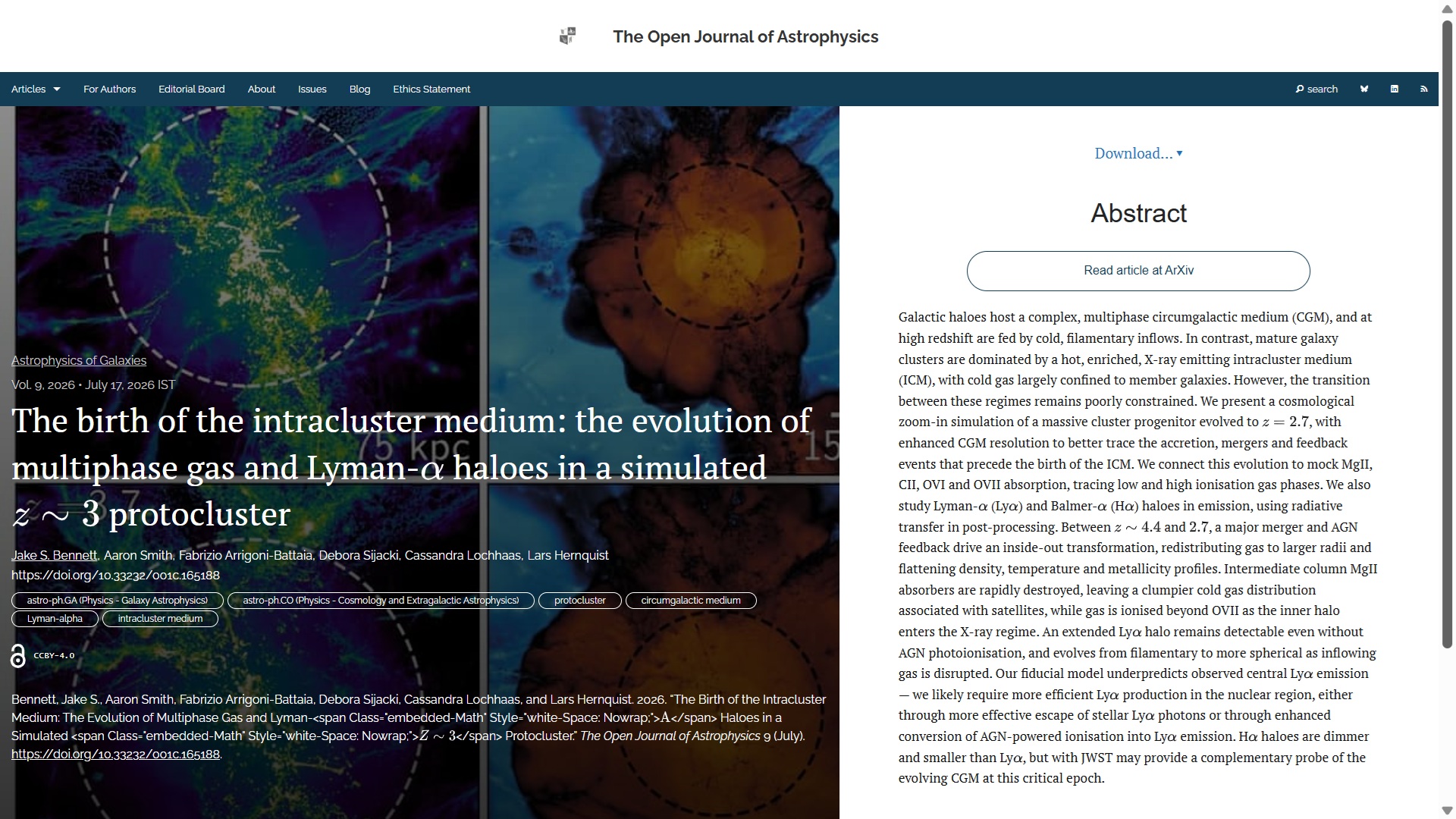
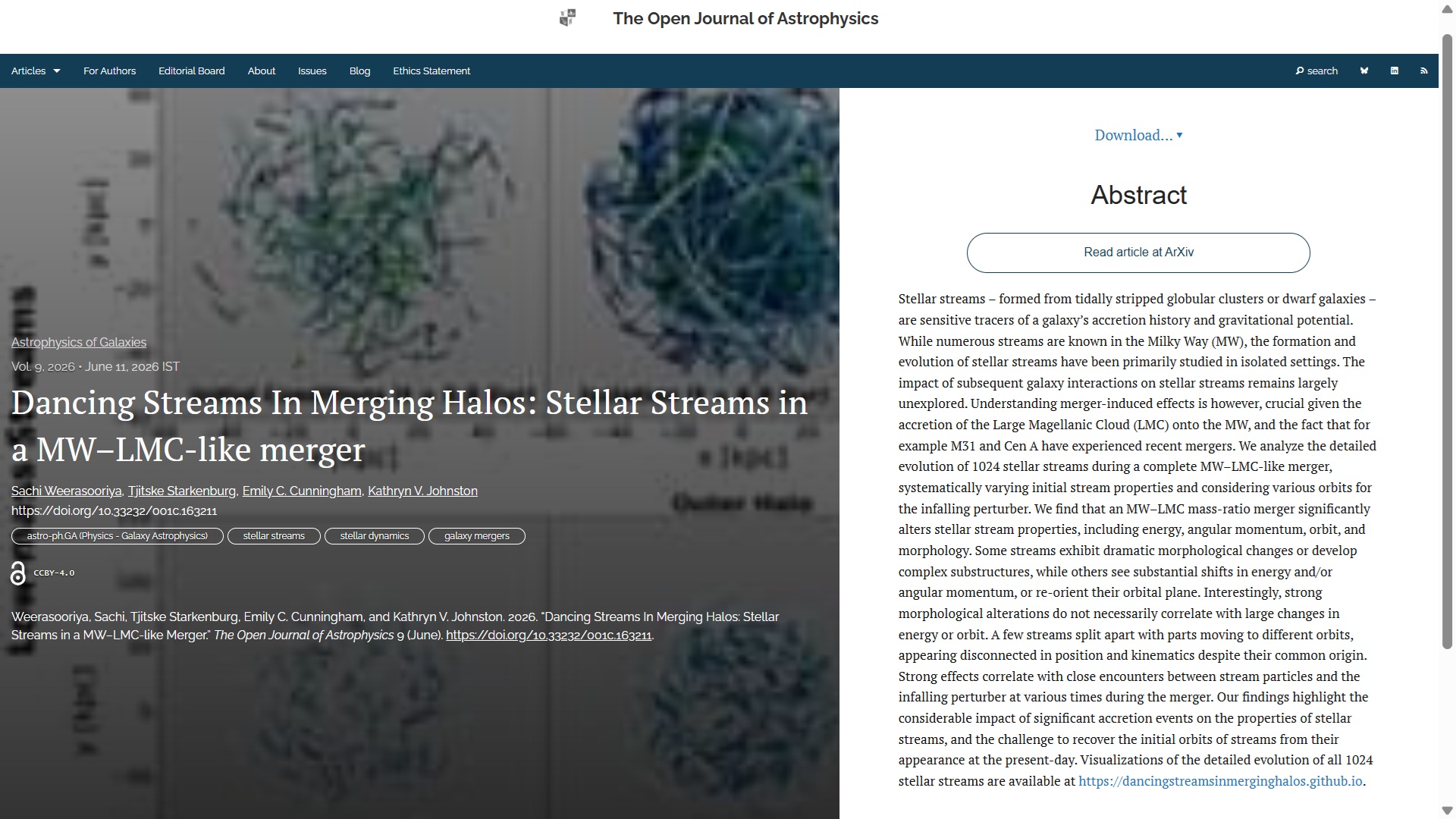
The first paper to report this week, published on Thursday 11th June, is “Dancing Streams In Merging Halos: Stellar Streams in a MW–LMC-like merger” by (all based in the USA): Sachi Weerasooriya (Carnegie Observatories), Tjitske Starkenburg (Northwestern U.), Emily C. Cunningham (Columbia U.) & Kathryn V. Johnston (Flatiron Institute). This article explores how galaxy mergers, like the Milky Way-Large Magellanic Cloud merger, significantly alter the properties and structures of stellar streams, challenging the recovery of their initial orbits. It is in the folder marked Astrophysics of Galaxies.
The overlay for this paper is here
You can find the officially accepted version on arXiv here and the announcement on Fediverse here:
New Publication at the Open Journal of Astrophysics: "Dancing Streams In Merging Halos: Stellar Streams in a MW–LMC-like merger" by (all based in the USA): Sachi Weerasooriya (Carnegie Observatories), Tjitske Starkenburg (Northwestern U.), Emily C. Cunningham (Columbia U.) & Kathryn V. Johnston (Flatiron Institute).
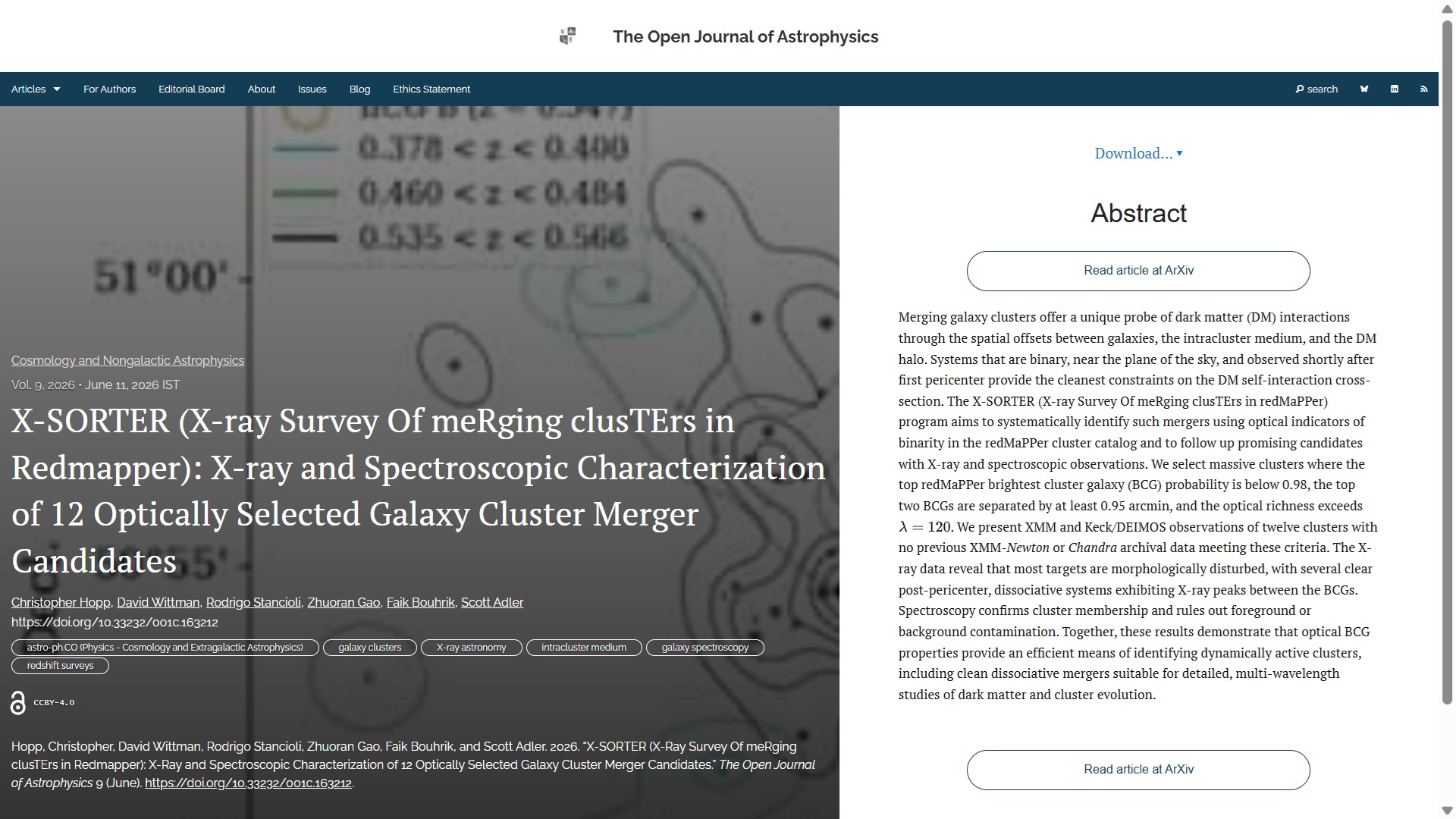
New Publication at the Open Journal of Astrophysics: "X-SORTER (X-ray Survey Of meRging clusTErs in Redmapper): X-ray and Spectroscopic Characterization of 12 Optically Selected Galaxy Cluster Merger Candidates" by Christopher Hopp, David Wittman, Rodrigo Stancioli, Zhuoran Gao & Faik Bouhrik (UC Davis) and Scott Adler (Rochester), all based in the USA.
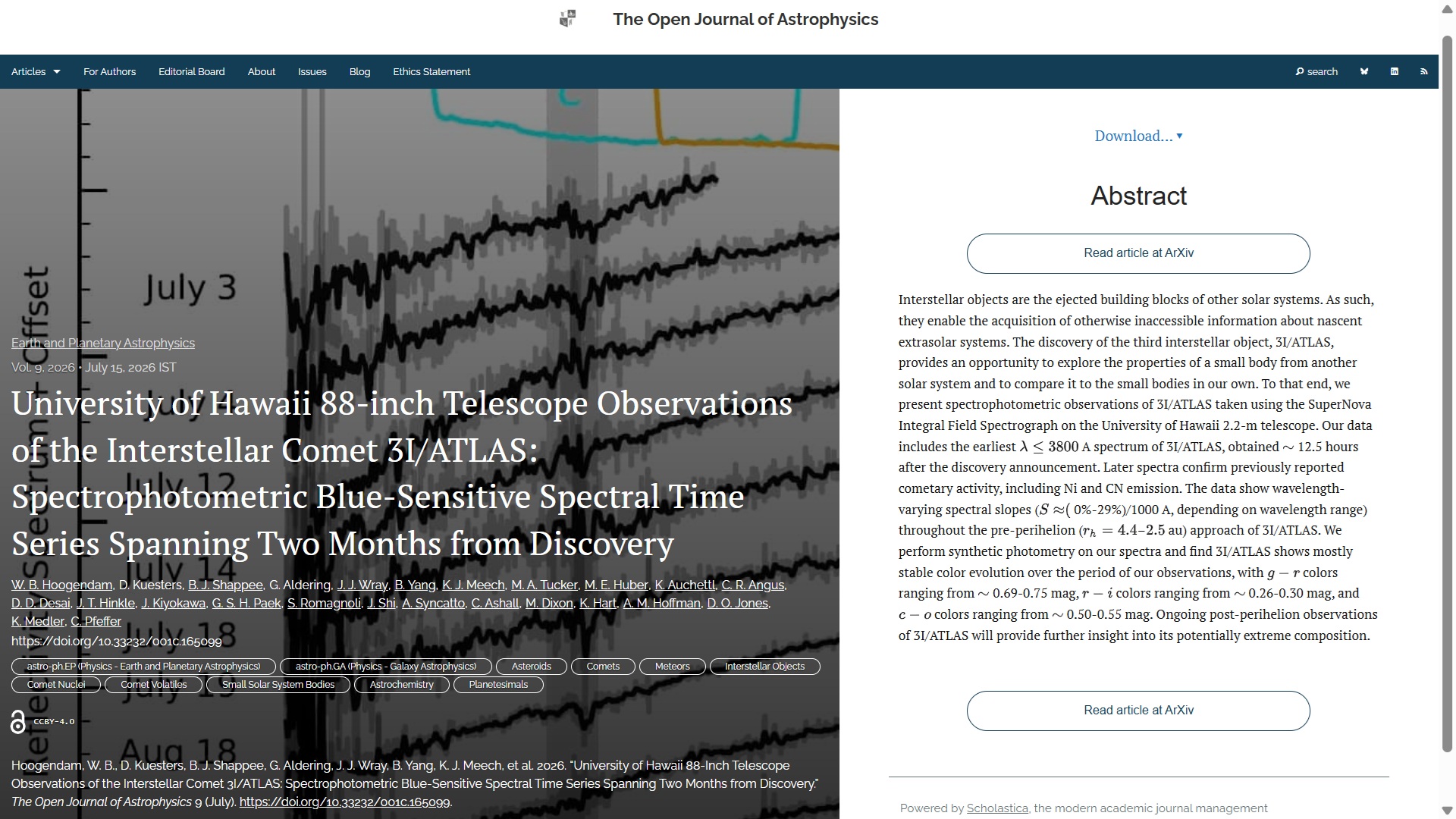
The third and final paper of the week, published on Friday 12the June in the folder Earth and Planetary Astrophysics, is “JCMT Constraints on the Early-Time HCN and CO Emission and HCN Temporal Evolution of 3I/ATLAS” by Jason T. Hinkle (U. Illinois, USA) and 6 others based in the USA and Chile. This article presents observations of the third Interstellar Object, 3I/ATLAS, providing early sub-mm constraints on its activity. The findings suggest a steeper production rate slope than typical Solar System comets.
The overlay for this one is here:
The final, accepted version can be found on arXiv here and the Mastodon announcement is here:
New Publication at the Open Journal of Astrophysics: "JCMT Constraints on the Early-Time HCN and CO Emission and HCN Temporal Evolution of 3I/ATLAS" by Jason T. Hinkle (U. Illinois, USA) and 6 others based in the USA and Chile.
And that concludes this week’s update. It has been a slow week on the publishing front, but the main reason is that we have a big backlog of papers accepted but waiting for the authors to put their final versions on arXiv and we can’t do anything about that! I’ll do another update next Saturday.
So here we are again, on a Saturday morning, with another update of activity at the Open Journal of Astrophysics. Since the last update we have published a further five papers, bringing the number in Volume 9 (2026) to 87 and the total so far published by OJAp up to 535.
I will continue to include the posts made on our Mastodon account (on Fediscience) to encourage you to visit it. Mastodon is a really excellent service, and a more than adequate replacement for X/Twitter (which nobody should be using); these announcements also show the DOI for each paper.
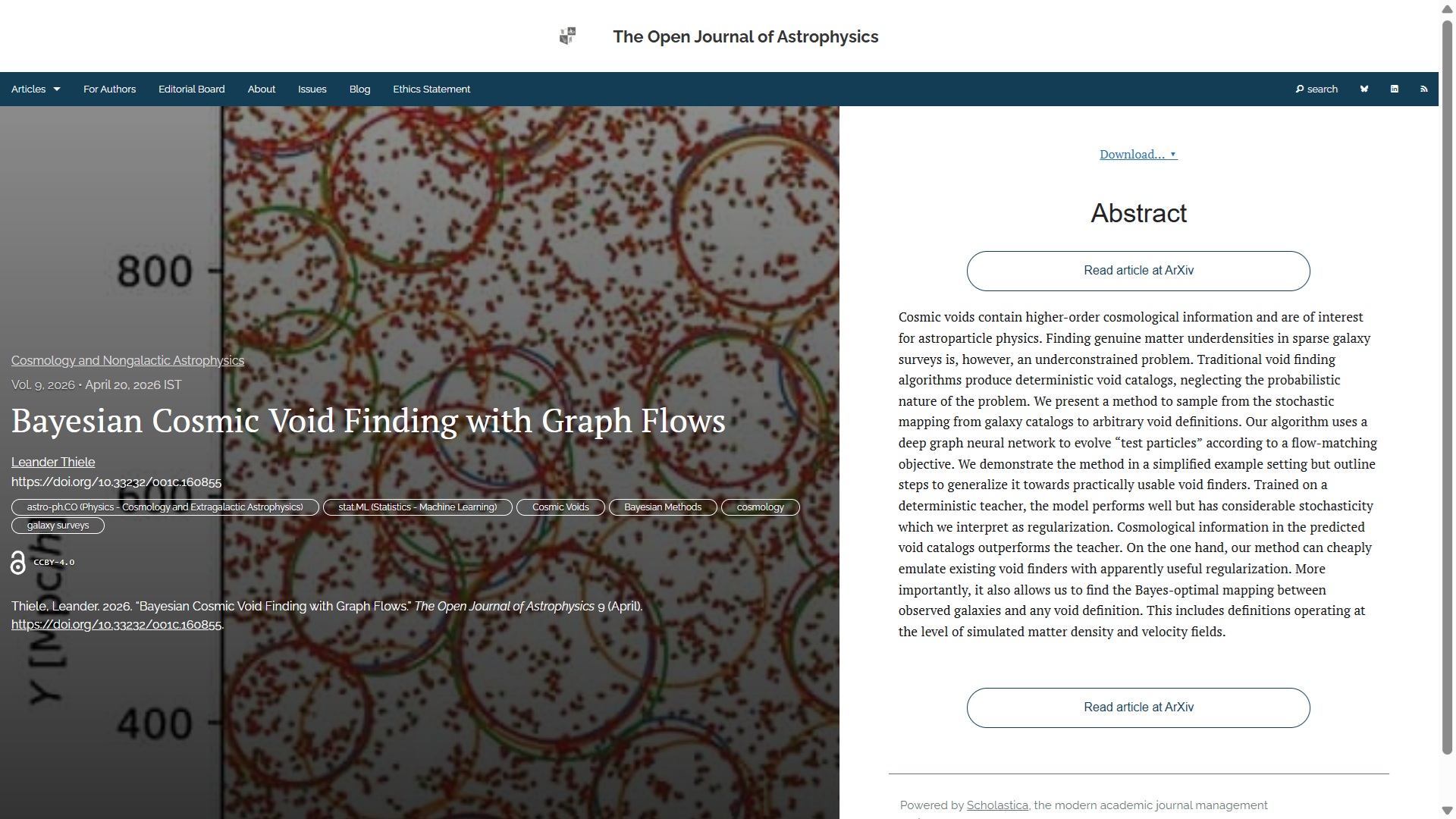
The first paper to report this week is “Bayesian Cosmic Void Finding with Graph Flows” by Leander Thiele (U. Tokyo, Japan). This was published on Monday 20th April in the folder Cosmology and Nongalactic Astrophysics. The paper presents a method using a deep graph neural network to identify cosmic voids in sparse galaxy surveys, improving upon traditional deterministic algorithms by considering the problem’s probabilistic nature. The overlay is here:
You can find the officially accepted version on arXiv here and the announcement on Fediverse here:
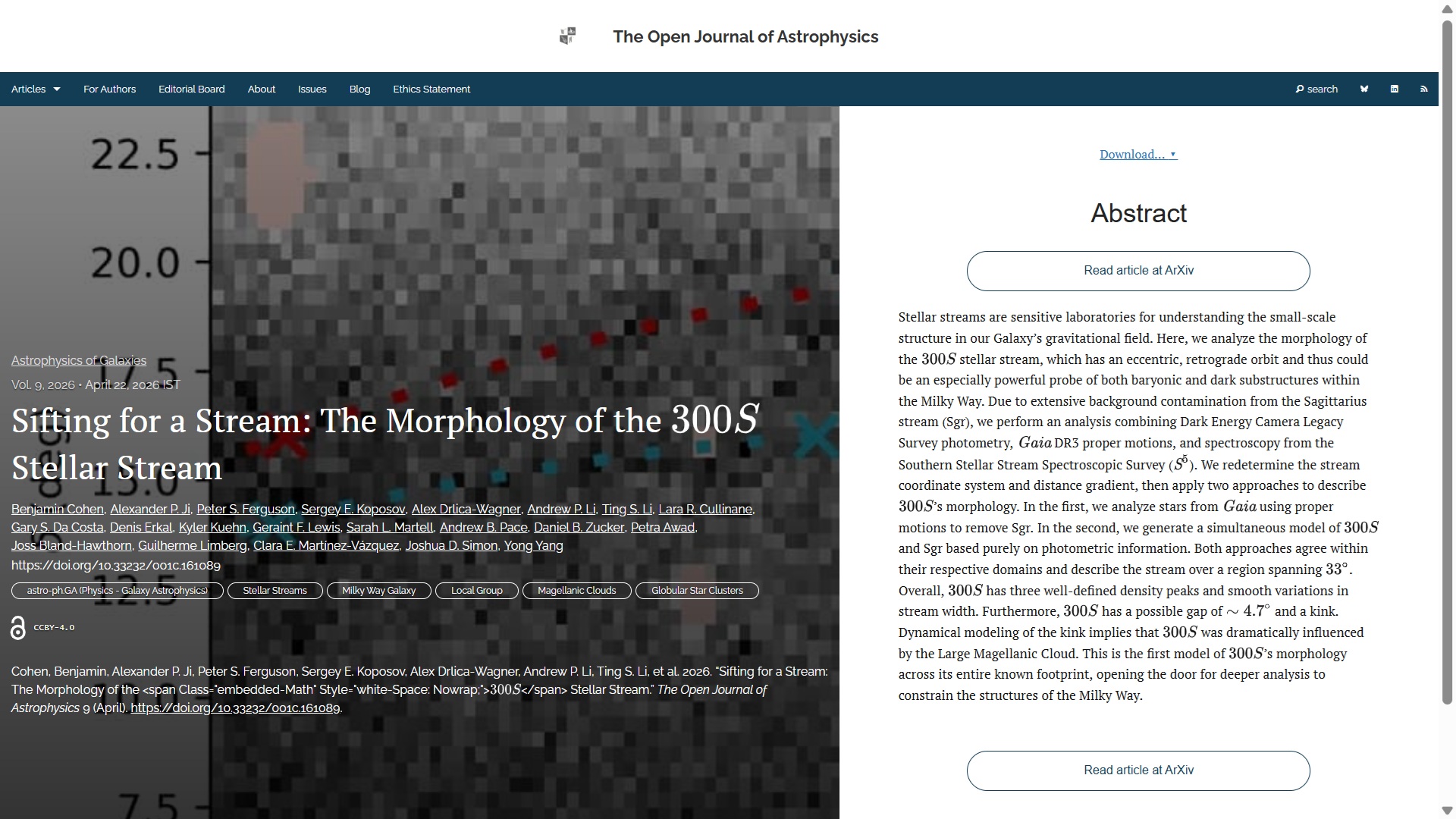
The second paper for this week, published on Wednesday 22nd April in the folder Astrophysics of Galaxies, is “Sifting for a Stream: The Morphology of the 300S Stellar Stream” by Benjamin Cohen (U. Chicago, USA) and 20 others distributed around the world. This study analyzes the morphology of the $300S$ stellar stream, revealing three density peaks, a possible gap, and a kink, suggesting significant influence from the Large Magellanic Cloud on its structure.
The overlay for this one is here:
The official version of the paper can be found on arXiv here and the Fediverse announcement here:
New Publication at the Open Journal of Astrophysics: "Sifting for a Stream: The Morphology of the 300S Stellar Stream" by Benjamin Cohen (U. Chicago, USA) and 20 others distributed around the world.
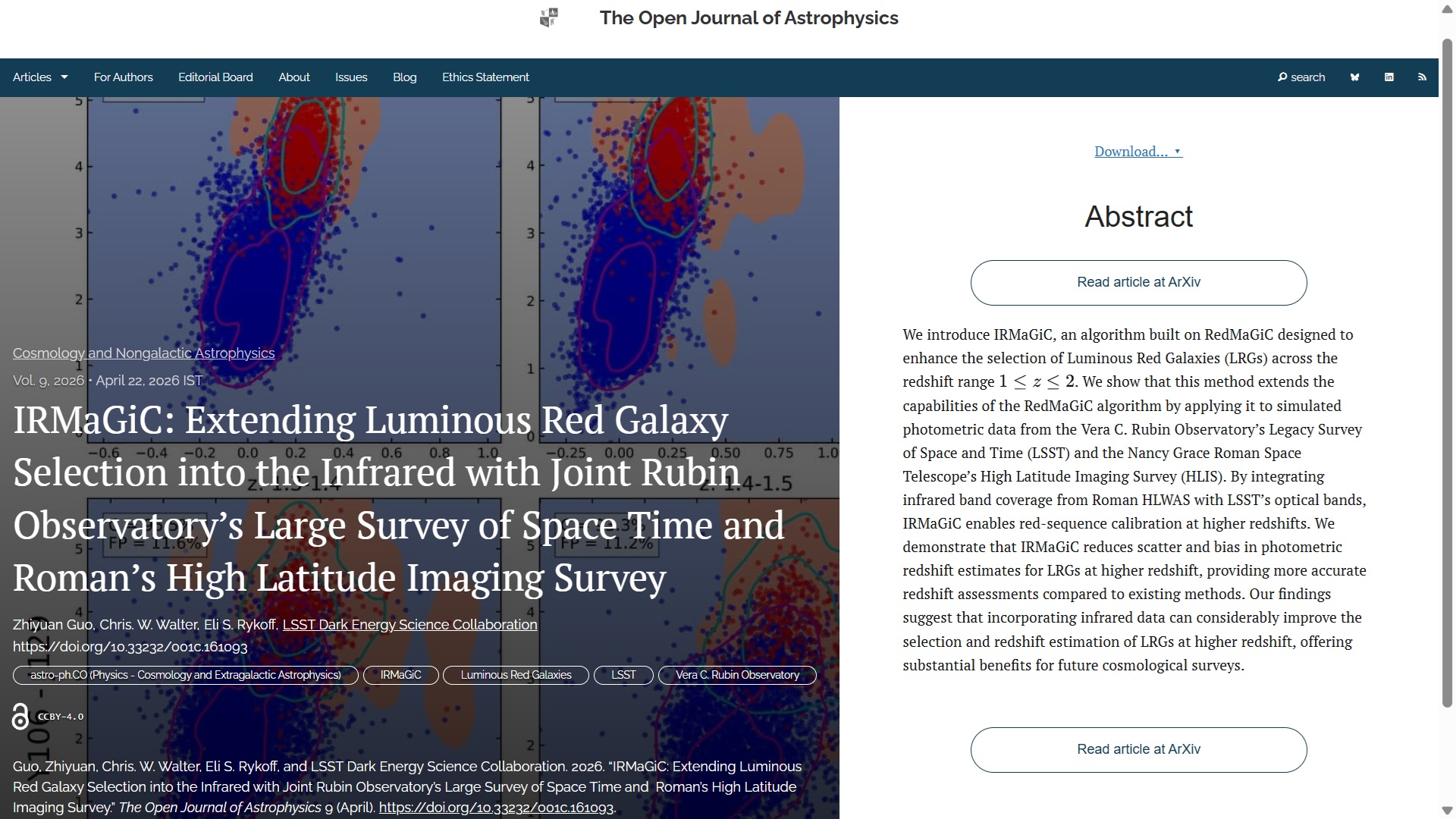
New Publication at the Open Journal of Astrophysics: "IRMaGiC: Extending Luminous Red Galaxy Selection into the Infrared with Joint Rubin Observatory’s Large Survey of Space Time and Roman’s High Latitude Imaging Survey" by Zhiyuan Guo & Chris. W. Walter (Duke U., USA) and Eli S. Rykoff (Stanford U., USA) on behalf of the LSST Dark Energy Science Collaboration
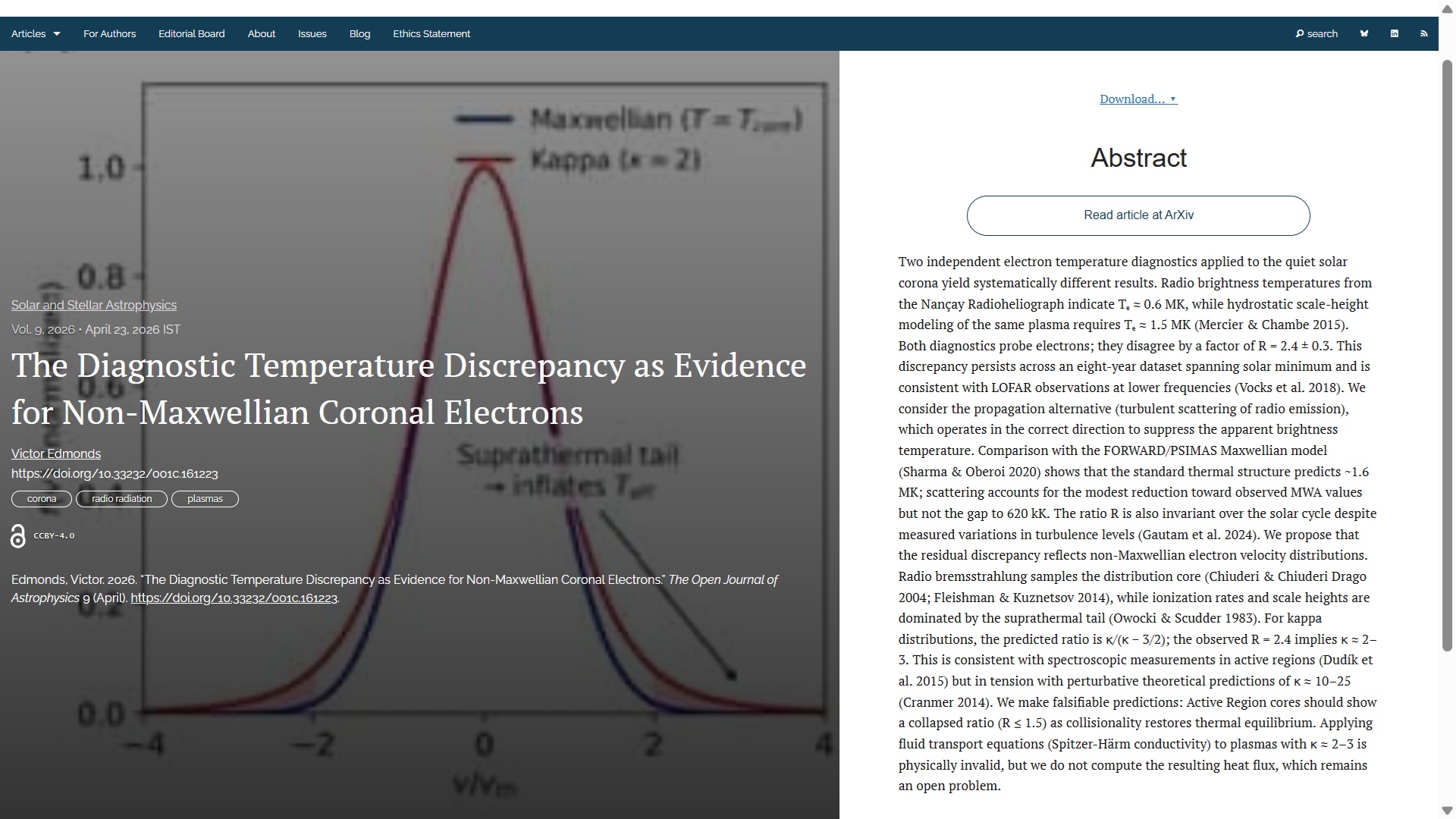
New Publication at the Open Journal of Astrophysics: "The Diagnostic Temperature Discrepancy as Evidence for Non-Maxwellian Coronal Electrons" by Victor Edmonds (Final Stop Consulting, USA)
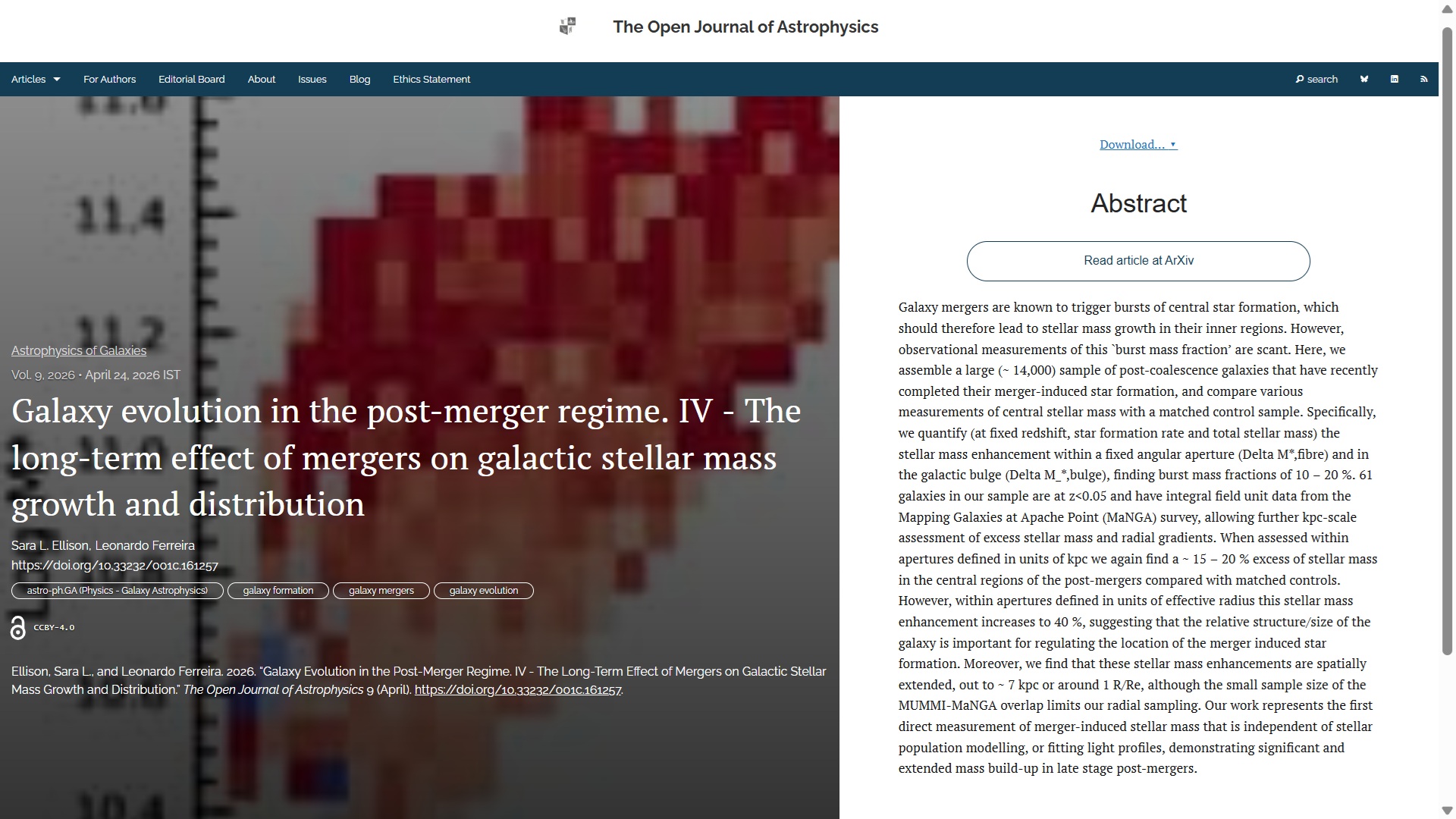
The fifth and final paper for this week was published on Friday 24th April in the folder Astrophysics of Galaxies. The title is “Galaxy evolution in the post-merger regime. IV – The long-term effect of mergers on galactic stellar mass growth and distribution” by Sara L. Ellison (U. Victoria, Canada) and Leonardo Ferreira (Universidade Federal do Rio Grande, Brazil). This study uses a large sample of post-merger galaxies to demonstrate that galaxy mergers trigger significant and extended stellar mass growth in their central regions, independent of stellar population modelling.
The overlay is here:
You can find the authorized version of this paper on arXiv here and the Fediverse announcement is here:
New Publication at the Open Journal of Astrophysics: "Galaxy evolution in the post-merger regime. IV – The long-term effect of mergers on galactic stellar mass growth and distribution" by Sara L. Ellison (U. Victoria, Canada) and Leonardo Ferreira (Universidade Federal do Rio Grande, Brazil)
It is Saturday morning, and therefore time for yet another update of activity at the Open Journal of Astrophysics. Since the last update we have published a further six papers, bringing the number in Volume 9 (2026) to 82 and the total so far published by OJAp up to 530.
I will continue to include the posts made on our Mastodon account (on Fediscience) to encourage you to visit it. Mastodon is a really excellent service, and a more than adequate replacement for X/Twitter (which nobody should be using); these announcements also show the DOI for each paper.
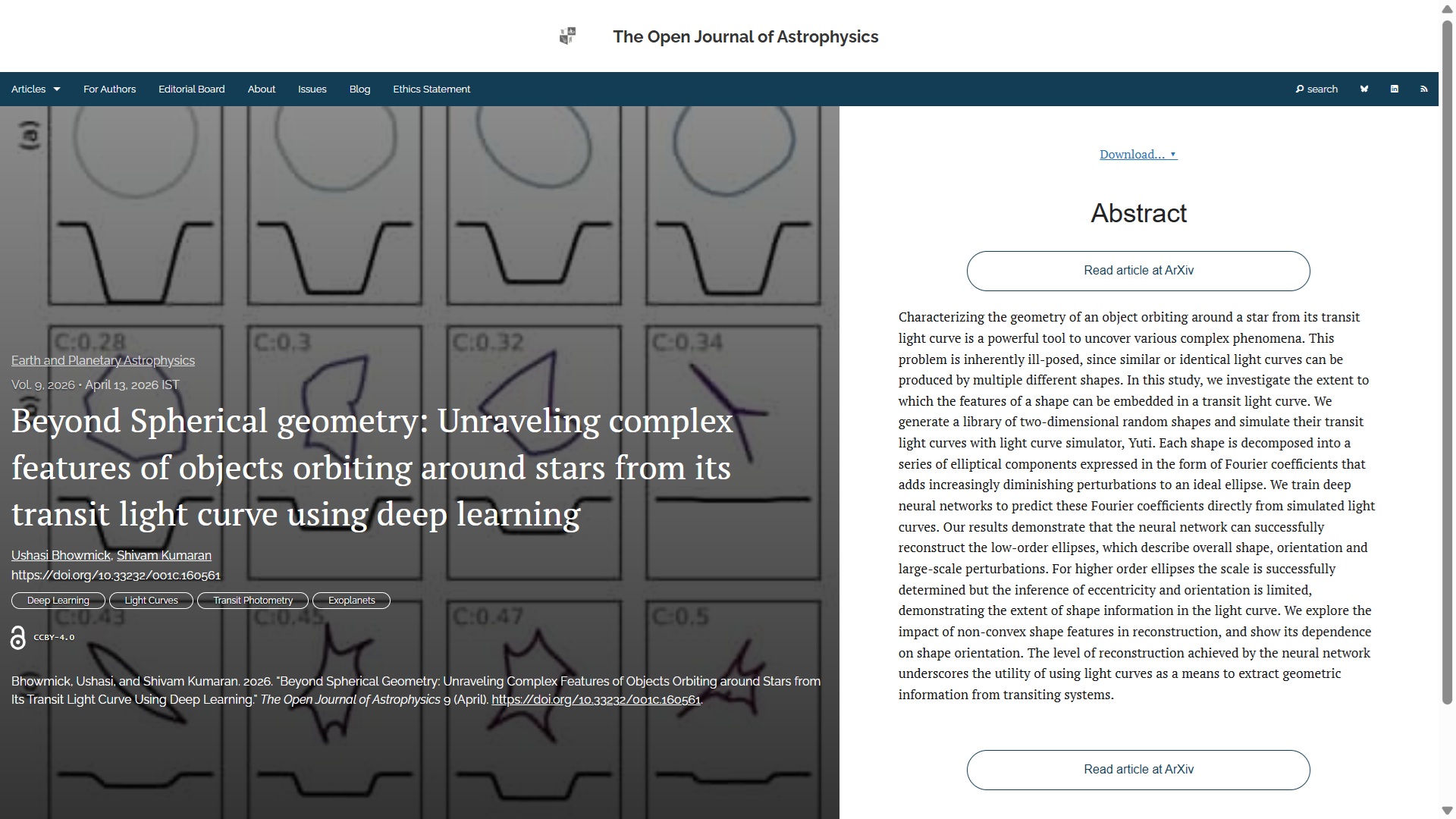
New Publication at the Open Journal of Astrophysics: "Beyond Spherical geometry: Unraveling complex features of objects orbiting around stars from its transit light curve using deep learning" by Ushasi Bhowmick & Shivam Kumaran (ISRO, Ahmedabad, India)
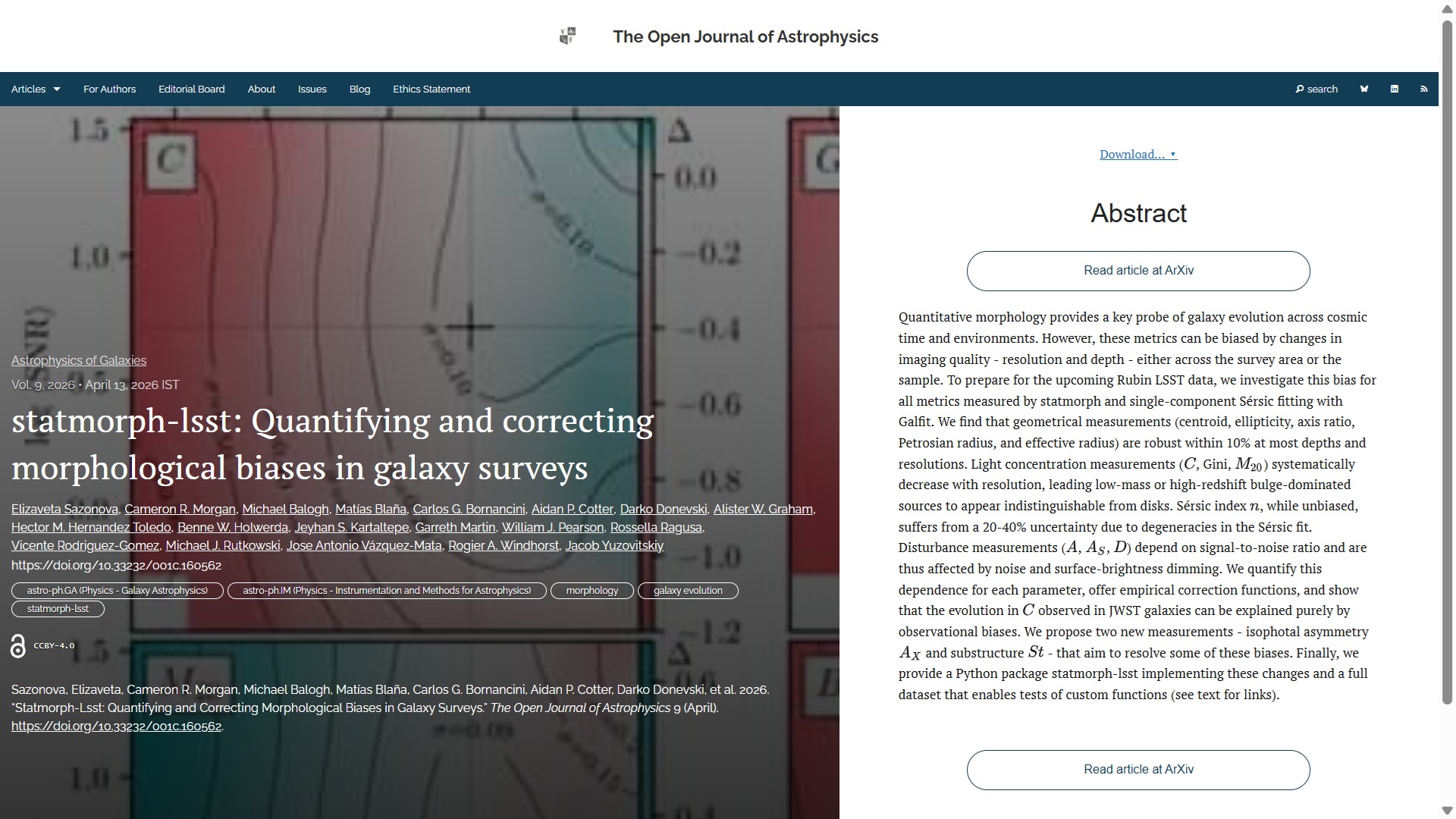
The second paper for this week, also published on Monday 13th April but in the folder Astrophysics of Galaxies, is “statmorph-lsst: Quantifying and correcting morphological biases in galaxy surveys” by Elizaveta Sazonova (U. Waterloo, Canada) and an international cast of 18 others. This paper presents an investigation of potential biases in quantitative morphology metrics used in galaxy evolution studies, proposing two new measurements to resolve biases, and provides a related Python package (statmorph-lsst), which can be found here on github.
The overlay for this one is here:
The official version of the paper can be found on arXiv here and the Fediverse announcement here:
New Publication at the Open Journal of Astrophysics: "statmorph-lsst: Quantifying and correcting morphological biases in galaxy surveys" by Elizaveta Sazonova (U. Waterloo, Canada) and an international cast of 18 others.
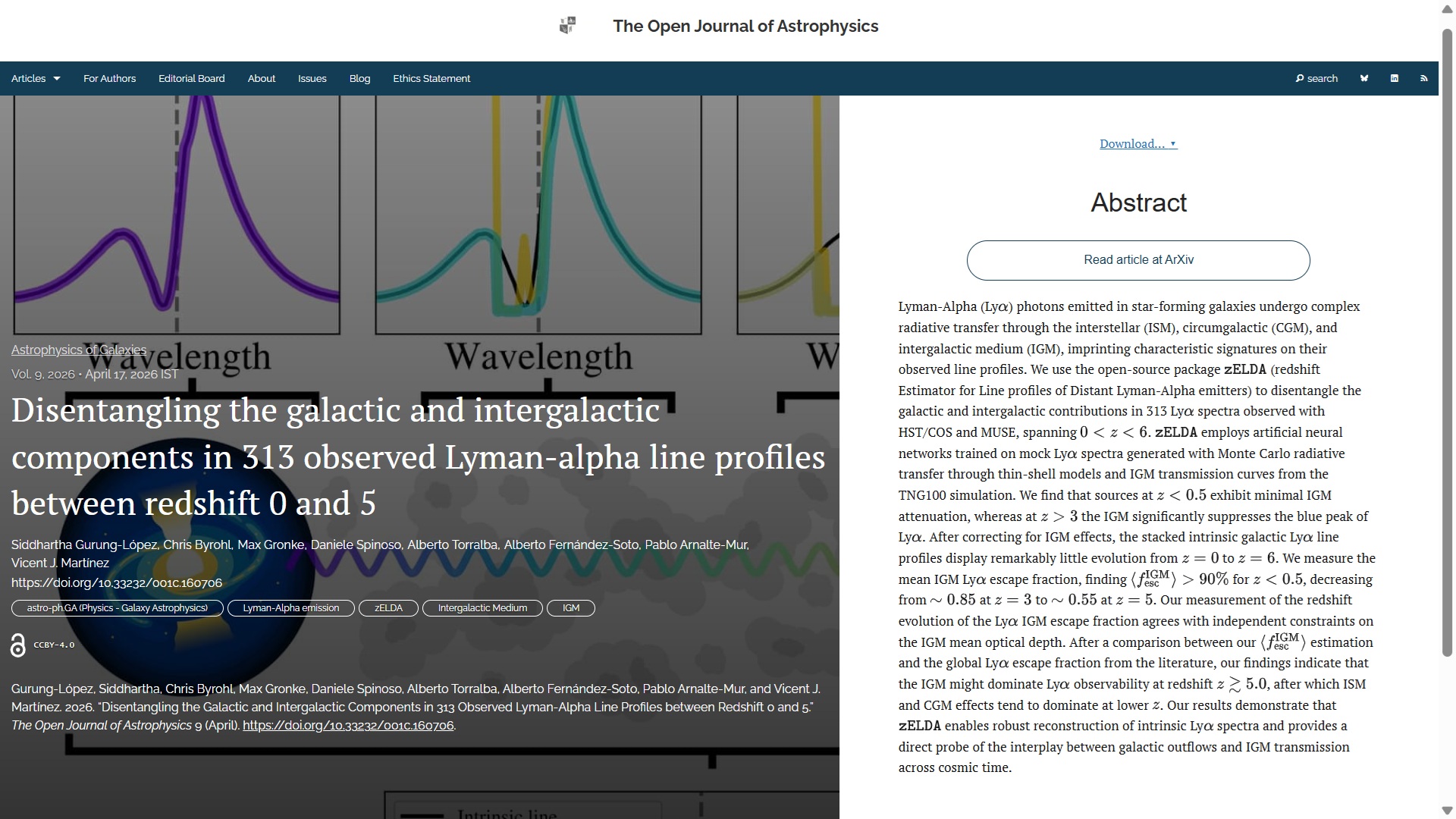
Next one up, the third paper of the week, one of four published on Friday 17th April, is “Disentangling the galactic and intergalactic components in 313 observed Lyman-alpha line profiles between redshift 0 and 5” by Siddhartha Gurung-López (Universitat de València, Spain) and 7 others based in Spain and Germany. Published in the folder Astrophysics of Galaxies, this paper uses the zELDA package to analyze Lyman-alpha photons from star-forming galaxies, revealing IGM effects dominate Lyman-alpha observability at high redshifts, while galactic outflows become more important at lower z.
The overlay for this one is here:
The final, accepted version can be found on arXiv here and the Mastodon announcement is here:
New Publication at the Open Journal of Astrophysics: "Disentangling the galactic and intergalactic components in 313 observed Lyman-alpha line profiles between redshift 0 and 5" by Siddhartha Gurung-López (Universitat de València, Spain) and 7 others based in Spain and Germany.
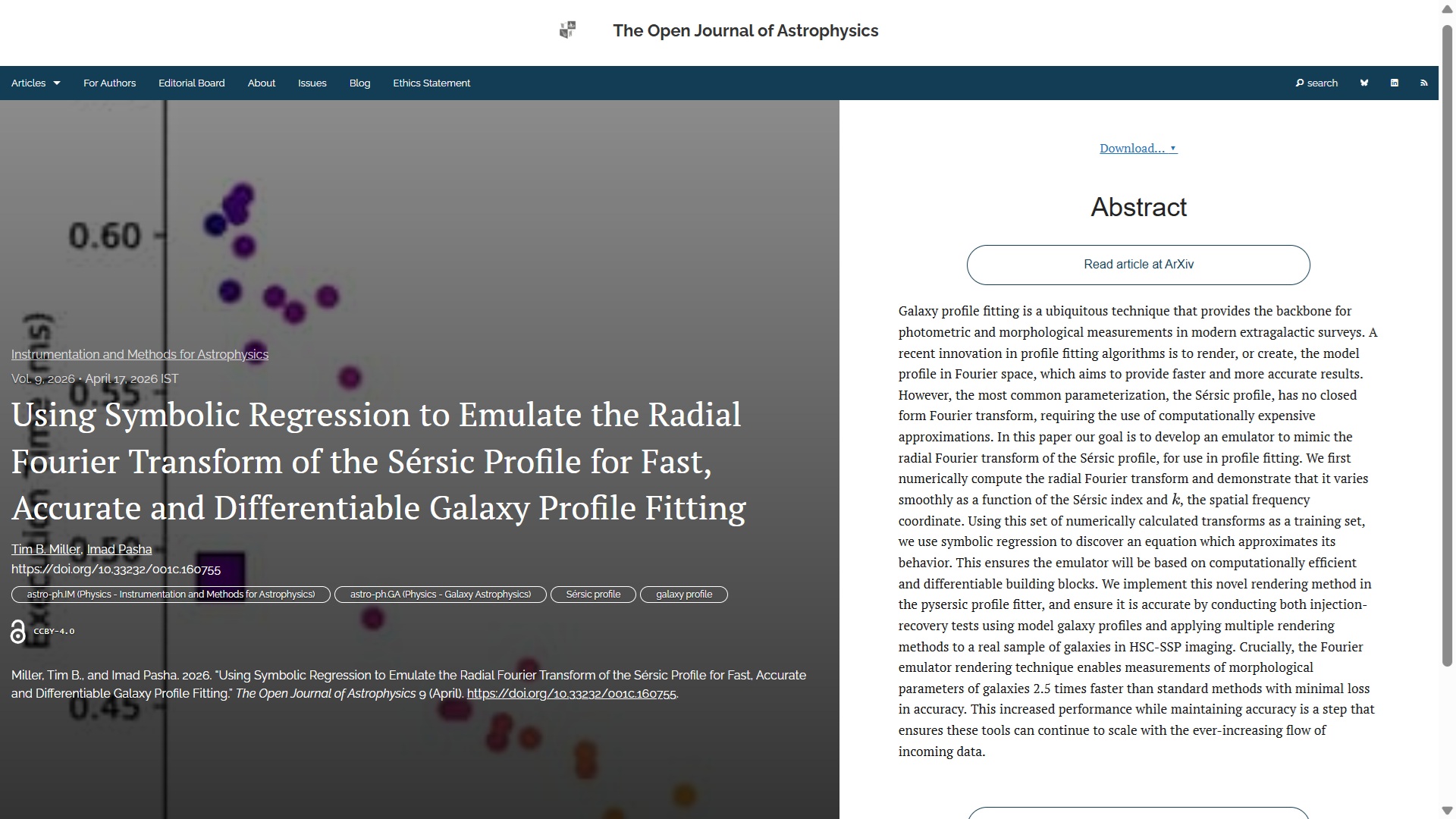
New Publication at the Open Journal of Astrophysics: "Using Symbolic Regression to Emulate the Radial Fourier Transform of the Sérsic Profile for Fast, Accurate and Differentiable Galaxy Profile Fitting" by Tim B. Miller (Northwestern University, USA) and Imad Pasha (Yale University, USA)
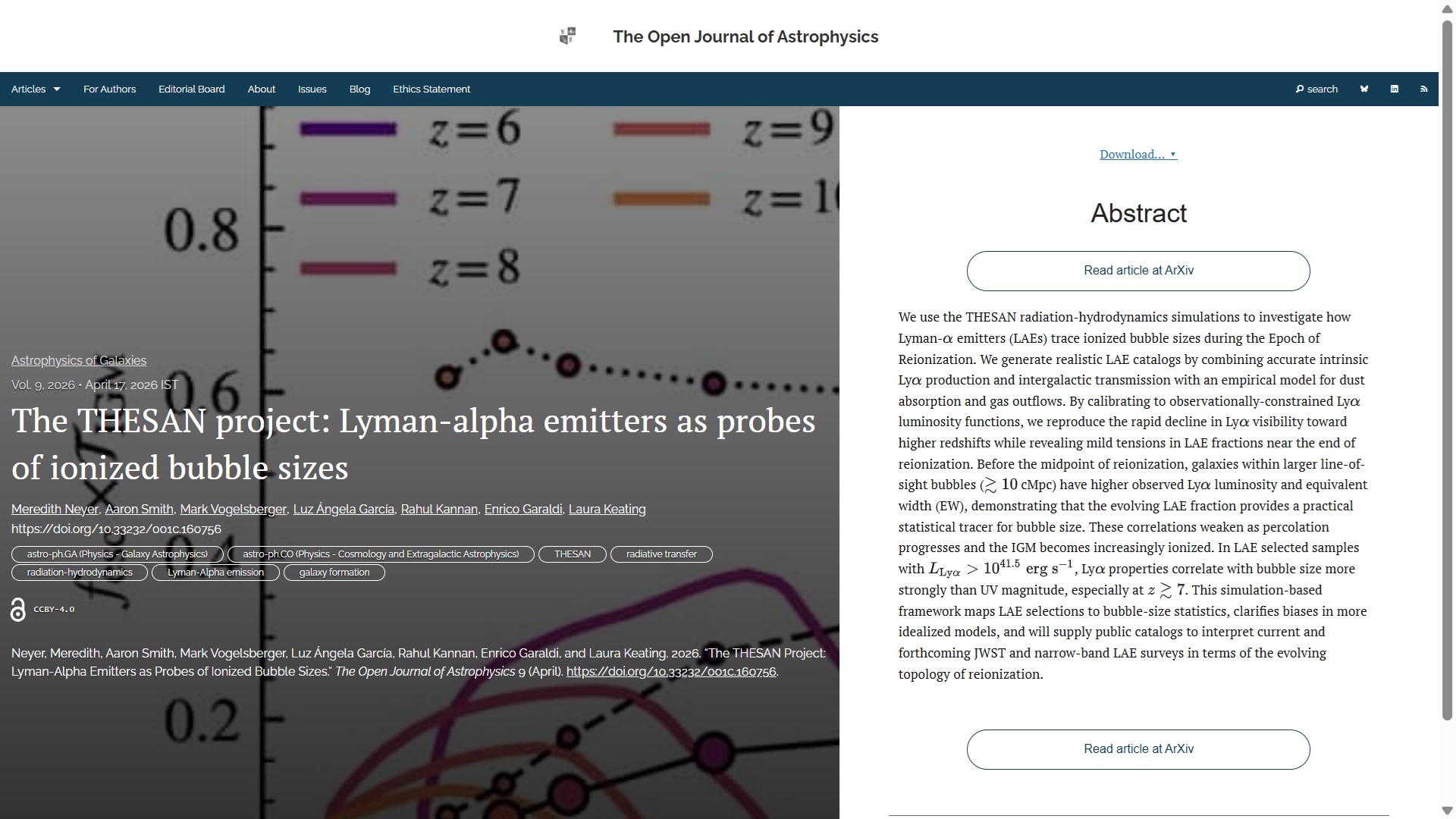
The fifth paper for this week is “The THESAN project: Lyman-alpha emitters as probes of ionized bubble sizes” by Meredith Neyer (MIT, USA) and 6 others based in the USA, Colombia, Canada, Japan and UK. The study uses THESAN simulations to explore how Lyman-alpha emitters (LAEs) trace ionized bubble sizes during the Epoch of Reionization, providing a framework for interpreting LAE surveys. This was published on Friday 17th April in the folder Astrophysics of Galaxies.
The overlay for this one is here:
You can find the authorized version of this paper on arXiv here and the Fediverse announcement is here:
New Publication at the Open Journal of Astrophysics: "The THESAN project: Lyman-alpha emitters as probes of ionized bubble sizes" by Meredith Neyer (MIT, USA) and 6 others based in the USA, Colombia, Canada, Japan and UK.
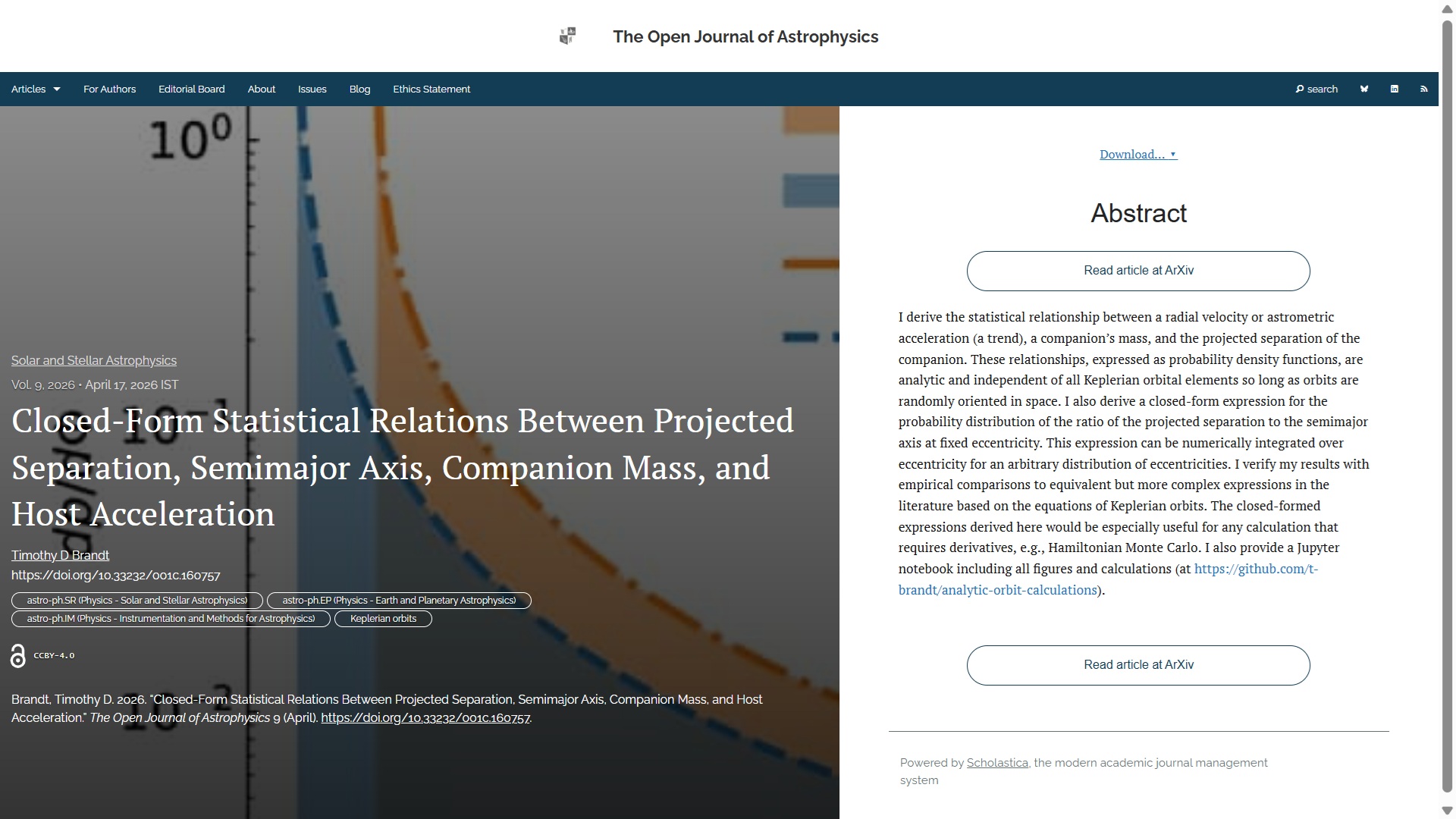
New Publication at the Open Journal of Astrophysics: "Closed-Form Statistical Relations Between Projected Separation, Semimajor Axis, Companion Mass, and Host Acceleration" by Timothy D Brandt (Space Telescope Science Institute, USA)
Once again it’s time for the usual Saturday morning update of activity at the Open Journal of Astrophysics. Since the last update we have published a further eight papers, bringing the number in Volume 9 (2026) to 67 and the total so far published by OJAp up to 515.
I will continue to include the posts made on our Mastodon account (on Fediscience) to encourage you to visit it. Mastodon is a really excellent service, and a more than adequate replacement for X/Twitter (which nobody should be using); these announcements also show the DOI for each paper.
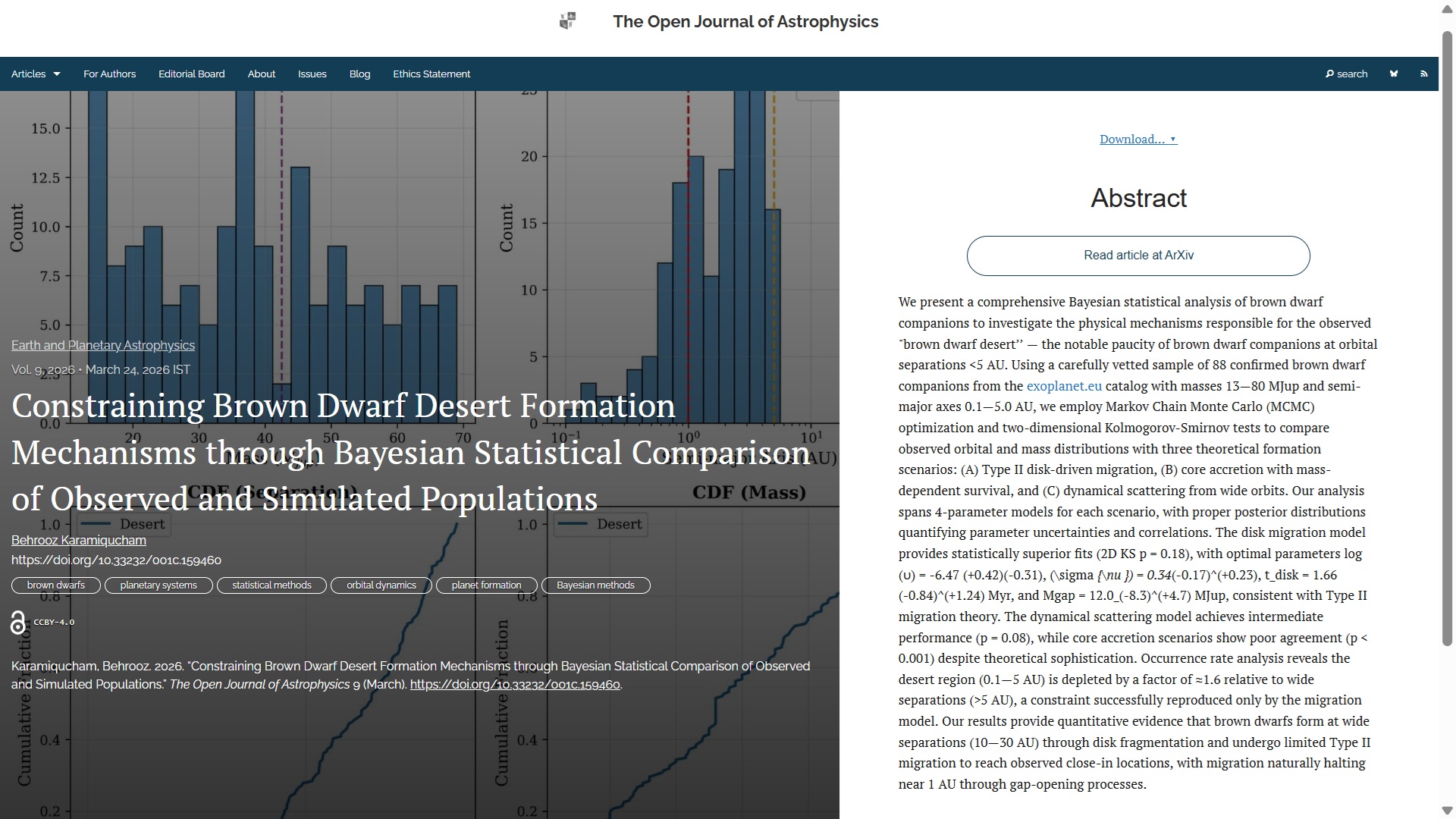
New Publication at the Open Journal of Astrophysics: "Constraining Brown Dwarf Desert Formation Mechanisms through Bayesian Statistical Comparison of Observed and Simulated Populations" by Behrooz Karamiqucham (College of Charleston, USA)
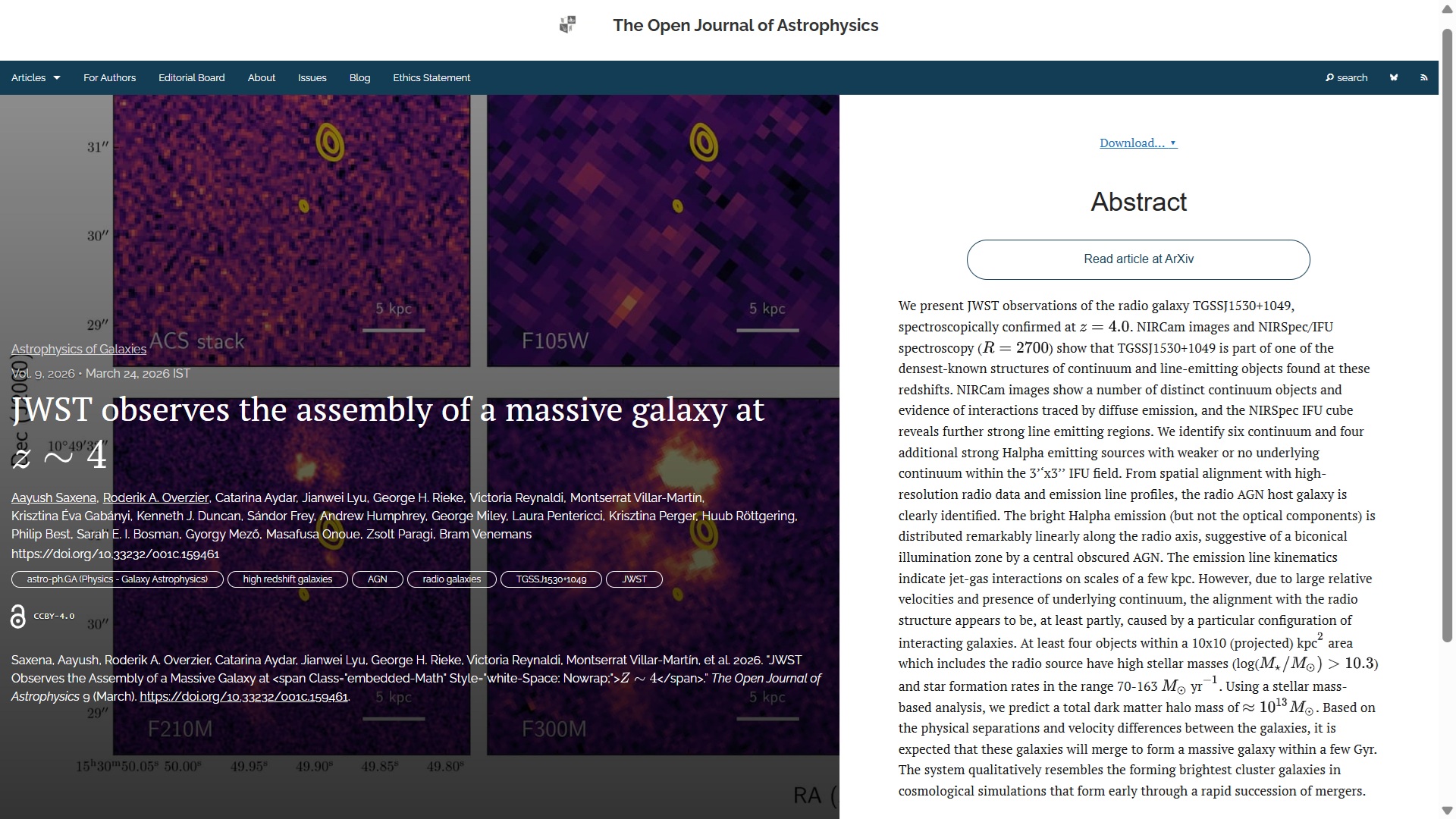
The second paper for this week, also published on Tuesday March 24th, but in the folder Astrophysics of Galaxies, is “JWST observes the assembly of a massive galaxy at z ~ 4” by Aayush Saxena (University of Oxford, UK) and 20 others (based in the UK, Europe, USA, Brazil, Japan and China). The paper presents observations of radio galaxy TGSSJ1530+1049, revealing it as part of a dense structure of emitting objects likely to merge to form a massive galaxy within a few Gyr.
The overlay for this one is here:
The official version of the paper can be found on arXiv here and the Fediverse announcement here:
New Publication at the Open Journal of Astrophysics: "JWST observes the assembly of a massive galaxy at z ~ 4" by Aayush Saxena (University of Oxford, UK) and 20 others (based in the UK, Europe, USA, Brazil, Japan and China)
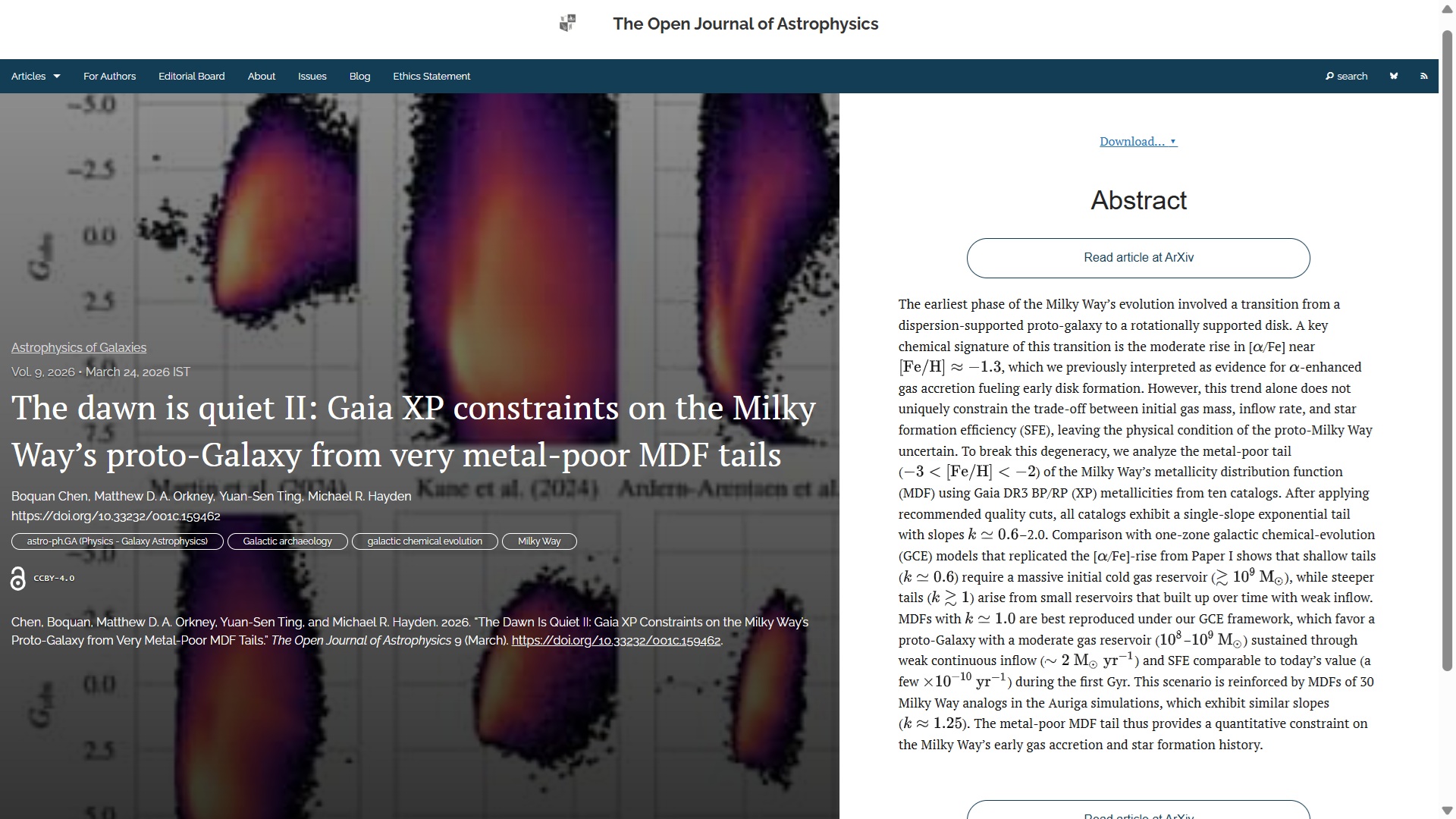
Next one up, the third paper of the week, also published on Tuesday March 24th in the folder Astrophysics of Galaxies, is “The dawn is quiet II: Gaia XP constraints on the Milky Way’s proto-Galaxy from very metal-poor MDF tails” by Boquan Chen (Ohio State U., USA), Matthew D. A. Orkney (Universitat de Barcelona, Spain), Yuan-Sen Ting (Ohio State U.) & Michael R. Hayden (U. Oklahoma, USA). The paper aegues that the Milky Way’s metallicity distribution suggests that its early evolution involved a moderate gas reservoir, sustained by weak continuous inflow, and star formation efficiency similar to the present value.
The overlay for this one is here:
The final, accepted version can be found on arXiv here and the Mastodon announcement is here:
New Publication at the Open Journal of Astrophysics: "The dawn is quiet II: Gaia XP constraints on the Milky Way’s proto-Galaxy from very metal-poor MDF tails" by Boquan Chen (Ohio State U., USA), Matthew D. A. Orkney (Universitat de Barcelona, Spain), Yuan-Sen Ting (Ohio State U.) & Michael R. Hayden (U. Oklahoma, USA)
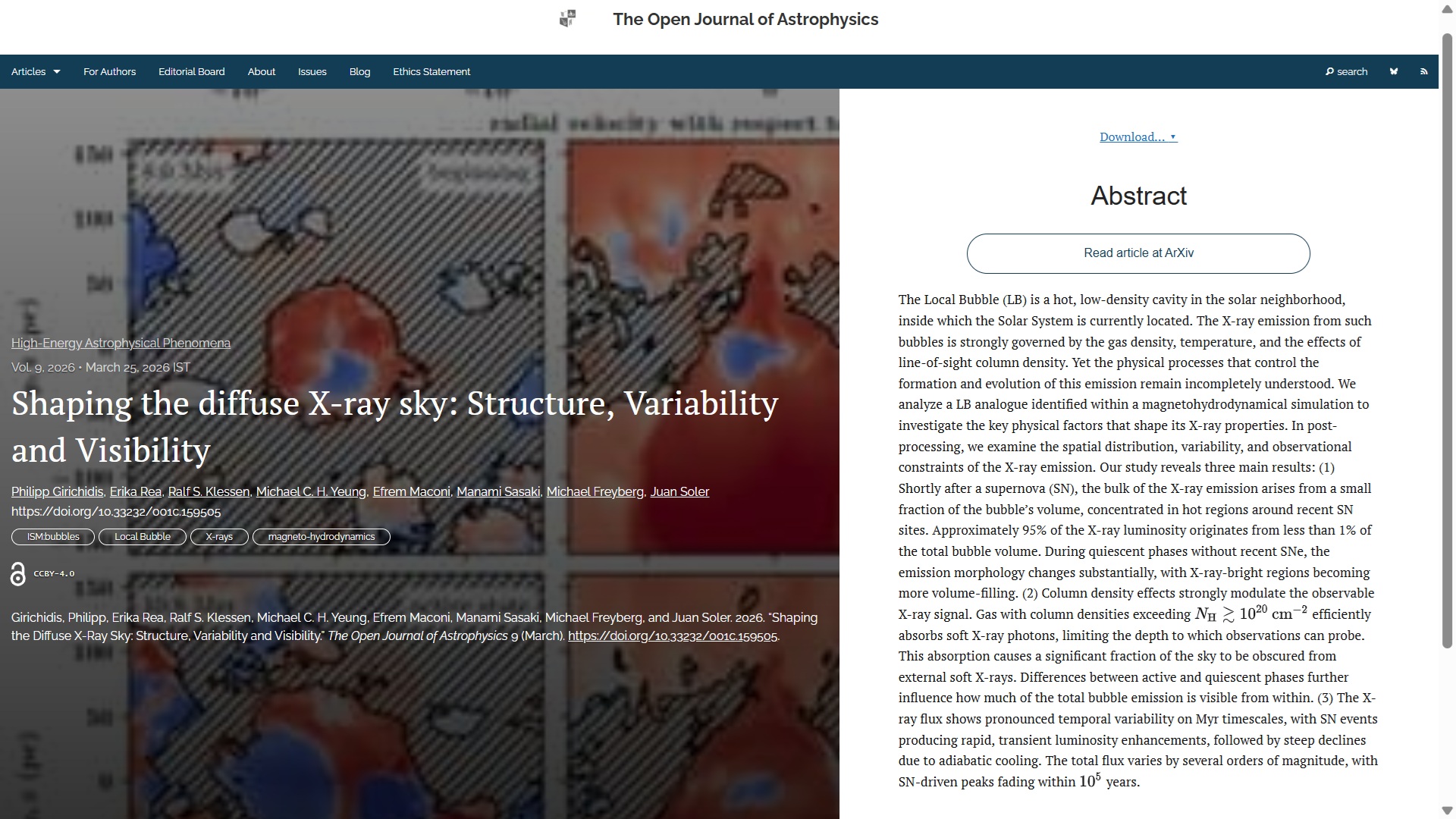
The fourth paper this week, published on Wednesday 25th March 2026 in the folder High-Energy Astrophysical Phenomena is “Shaping the diffuse X-ray sky: Structure, Variability and Visibility” by Philipp Girichidis (Heidelberg U., Germany) and 7 others based in Germany, USA, Austria and Italy. The paper argues that the X-ray properties of the Local Bubble (LB), a low-density cavity in the solar neighborhood reveal that supernova events significantly influence X-ray emissions, which show pronounced temporal variability
The overlay is here:
The finally accepted version of this paper can be found here and the Mastodon announcement is here:
New Publication at the Open Journal of Astrophysics: "Shaping the diffuse X-ray sky: Structure, Variability and Visibility" by Philipp Girichidis (Heidelberg U., Germany) and 7 others based in Germany, USA, Austria and Italy
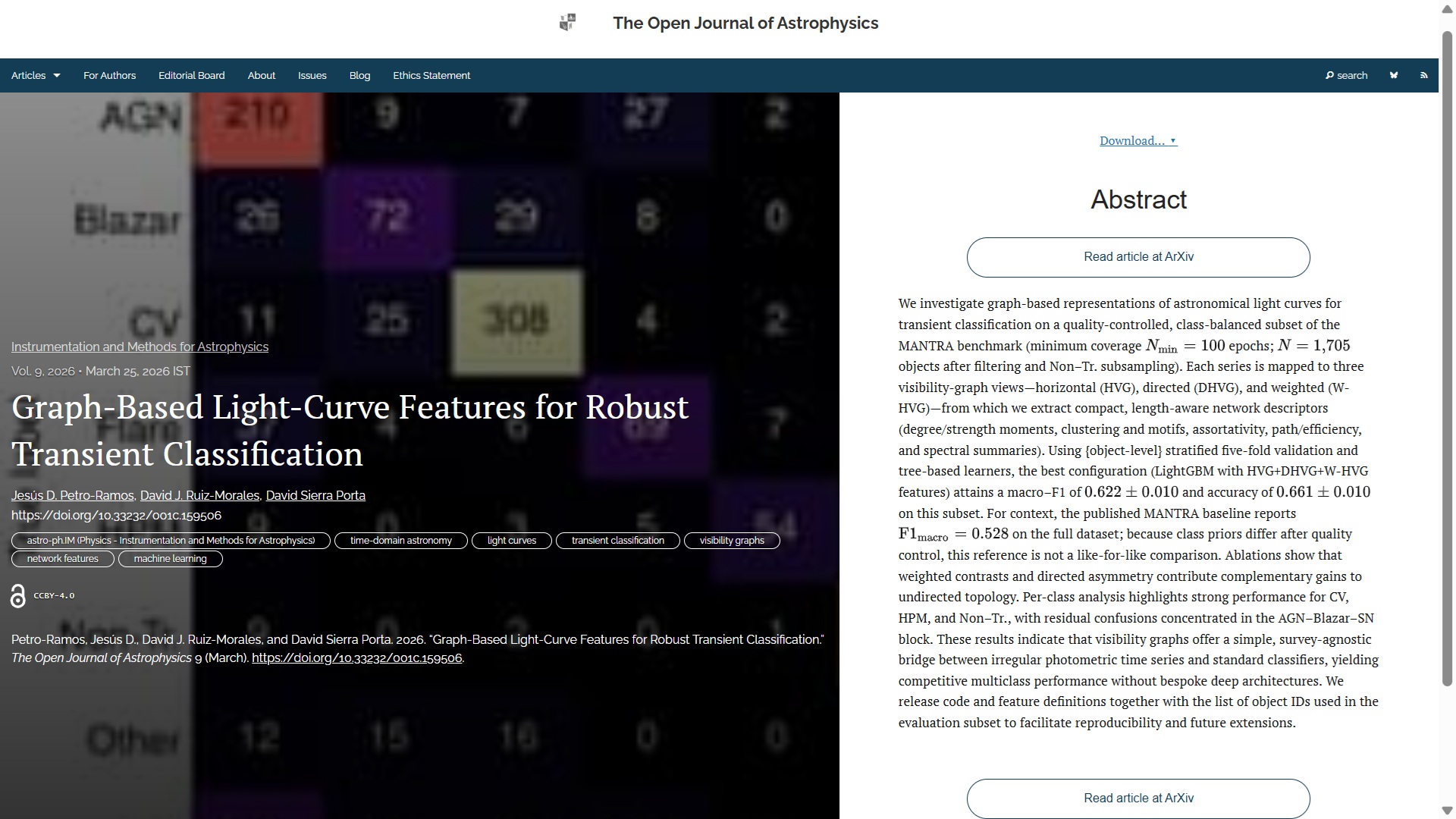
The fifth paper this week, also published on Wednesday 25th March 2026, is “Graph-Based Light-Curve Features for Robust Transient Classification” by Jesús D. Petro-Ramos David J. Ruiz-Morales, David Sierra Porta (Universidad Tecnológica de Bolívar, Colombia). This paper, which is in the folder Instrumentation and Methods for Astrophysics, uses graph-based representations of astronomical light curves for transient classification, achieving competitive multiclass performance, highlighting the potential of visibility graphs as a survey-agnostic tool for classifying time series.
This is the overlay:
The officially accepted version can be found on arXiv here and the Mastodon announcement follows:
New Publication at the Open Journal of Astrophysics: "Graph-Based Light-Curve Features for Robust Transient Classification" by Jesús D. Petro-Ramos David J. Ruiz-Morales, David Sierra Porta (Universidad Tecnológica de Bolívar, Colombia)
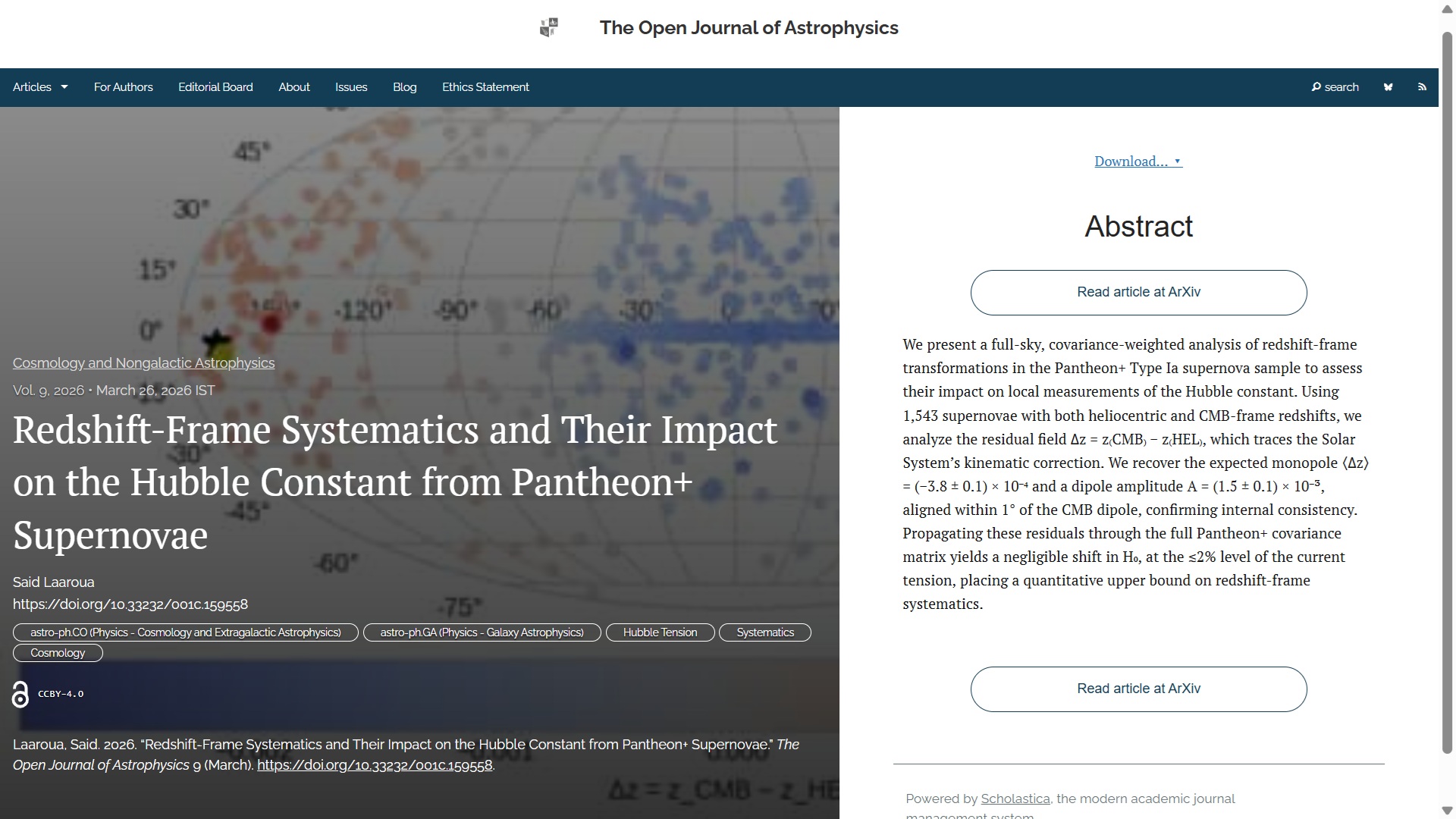
New Publication at the Open Journal of Astrophysics: "Redshift-Frame Systematics and Their Impact on the Hubble Constant from Pantheon+ Supernovae" by Said Laaroua (Santa Rosa Junior College, USA)
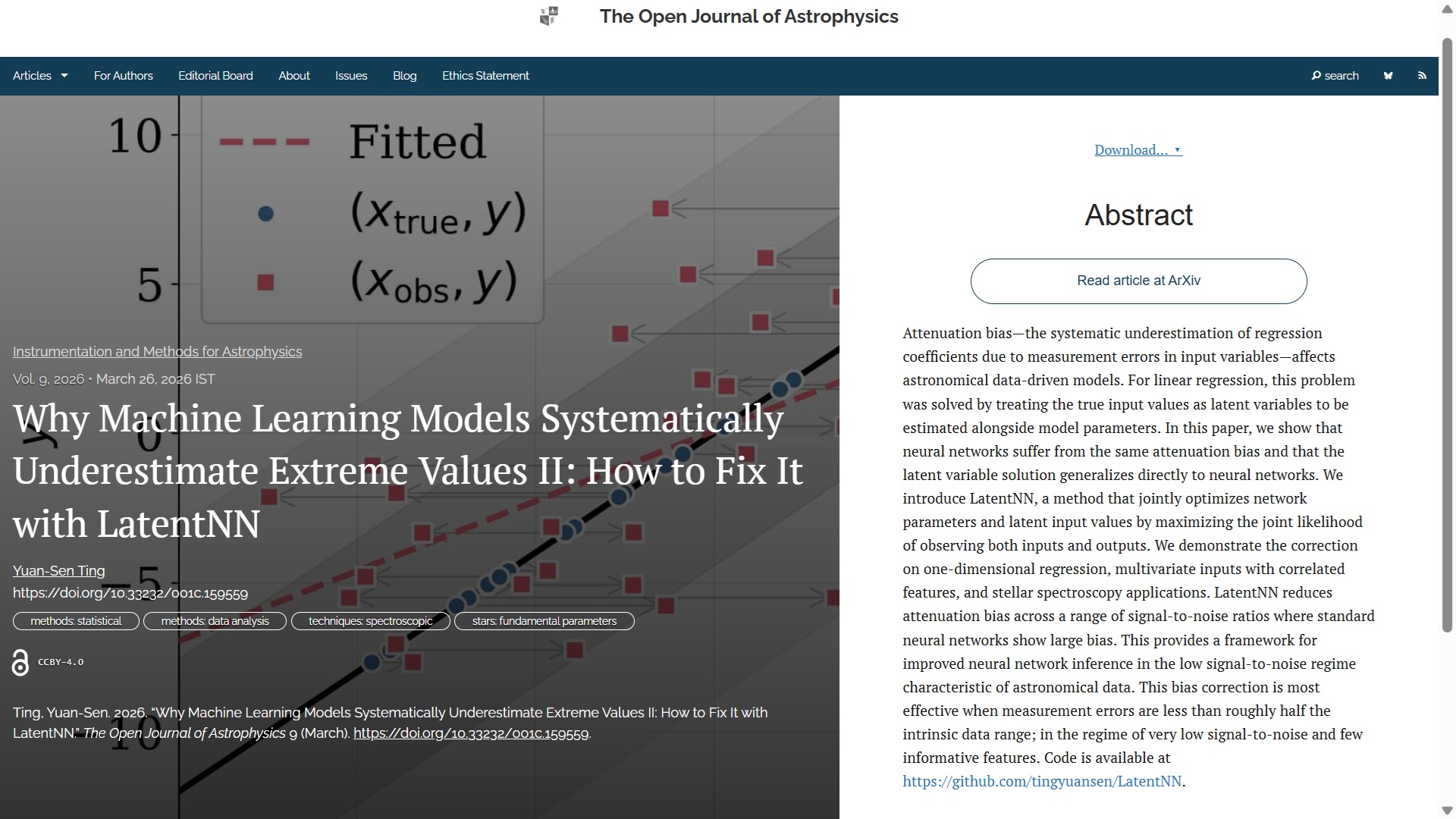
New Publication at the Open Journal of Astrophysics: "Why Machine Learning Models Systematically Underestimate Extreme Values II: How to Fix It with LatentNN" by Yuan-Sen Ting (Ohio State University, USA)
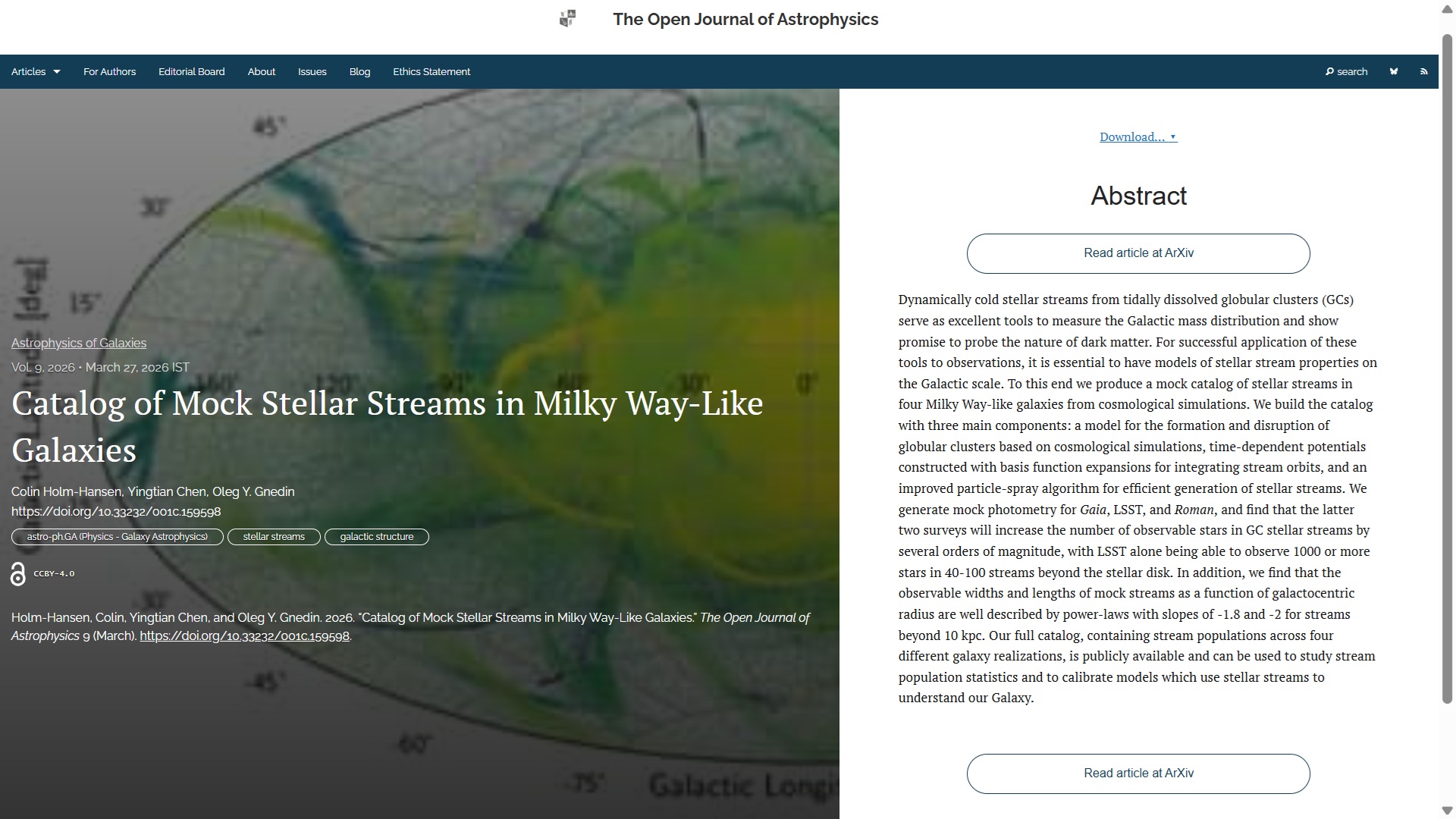
New Publication at the Open Journal of Astrophysics: "Catalog of Mock Stellar Streams in Milky Way-Like Galaxies" by Colin Holm-Hansen, Yingtian Chen and Oleg Y. Gnedin (University of Michigan, USA)
You will have observed that this week’s papers cover five of the six main categories on astro-ph. We haven’t yet managed to cover all six in a week – we only missed Solar and Stellar Astrophysics this time!
Welcome to the first proper update for 2026 from the Open Journal of Astrophysics. The New Year brings us to Volume 9. In many countries, especially in Europe, Christmas is celebrated on January 6th so this week was also affected by the holiday season. Nevertheless, since the last update we have published four papers, bringing the number in Volume 9 (2026) to 4 and the total so far published by OJAp up to 452.
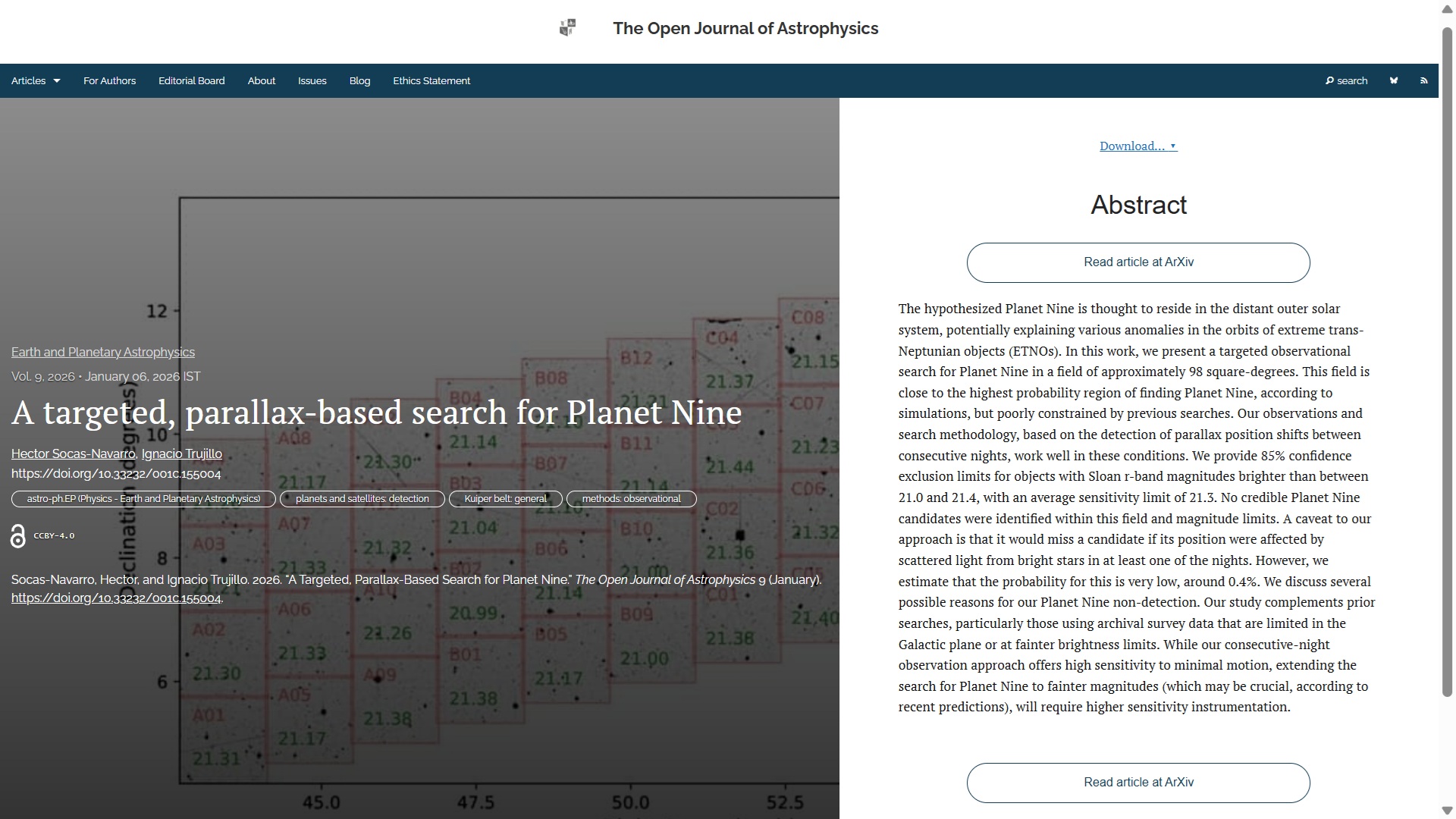
The first paper this week (and of course the first of 2026) is “A targeted, parallax-based search for Planet Nine” by Hector Socas-Navarro and Ignacio Trujillo (both of the Instituto de Astrofísica de Canaria, Spain). This article describes a targeted search for the hypothesized Planet Nine in the outer solar system, using parallax position shifts. No credible candidates were found within the observed field. It was published on Tuesday January 6th in the folder Earth and Planetary Astrophysics. The overlay is here:
You can find the officially accepted version on arXiv here and the announcement on Fediverse here:
New Publication at the Open Journal of Astrophysics: "A targeted, parallax-based search for Planet Nine" by Hector Socas-Navarro and Ignacio Trujillo (Instituto de Astrofísica de Canaria, Spain)
The second paper is “Going beyond S8: fast inference of the matter power spectrum from weak-lensing surveys” by Cyrille Doux (Université Grenoble Alpes, France) and Tanvi Karwal (U. Chicago, USA). This was published on Wednesday January 7th in the folder Cosmology and Nongalactic Astrophysics and it presents a new framework to extract the scale-dependent matter power spectrum from cosmic shear and CMB lensing measurements, revealing a consistent suppression in the matter power spectrum in galaxy-lensing. The overlay is here:
The official version of the paper can be found on arXiv here and the Fediverse announcement here:
New Publication at the Open Journal of Astrophysics: "Going beyond $S_{8}$: fast inference of the matter power spectrum from weak-lensing surveys" by Cyrille Doux (Université Grenoble Alpes, France) and Tanvi Karwal (U. Chicago, USA)
Next we have “Constraining the Stellar-to-Halo Mass Relation with Galaxy Clustering and Weak Lensing from DES Year 3 Data” which is led by G. Zacharegkas et al. (Argonne National Laboratory, USA) and has 102 other authors too numerous to list by name from many institutions around the world again too numerous to list by name. It presents a framework to analyze the relationship between a galaxy’s stellar mass and its dark matter halo mass, using data from the Dark Energy Survey. The findings align with previous results. This paper was published on Thursday January 8th in the folder Astrophysics of Galaxies. The overlay is here:
The official version can be found on arXiv here and the Fediverse announcement is here:
New Publication at the Open Journal of Astrophysics: "Constraining the Stellar-to-Halo Mass Relation with Galaxy Clustering and Weak Lensing from DES Year 3 Data" by G. Zacharegkas et al. (Argonne National Laboratory, USA) and 102 others based in numerous countries.
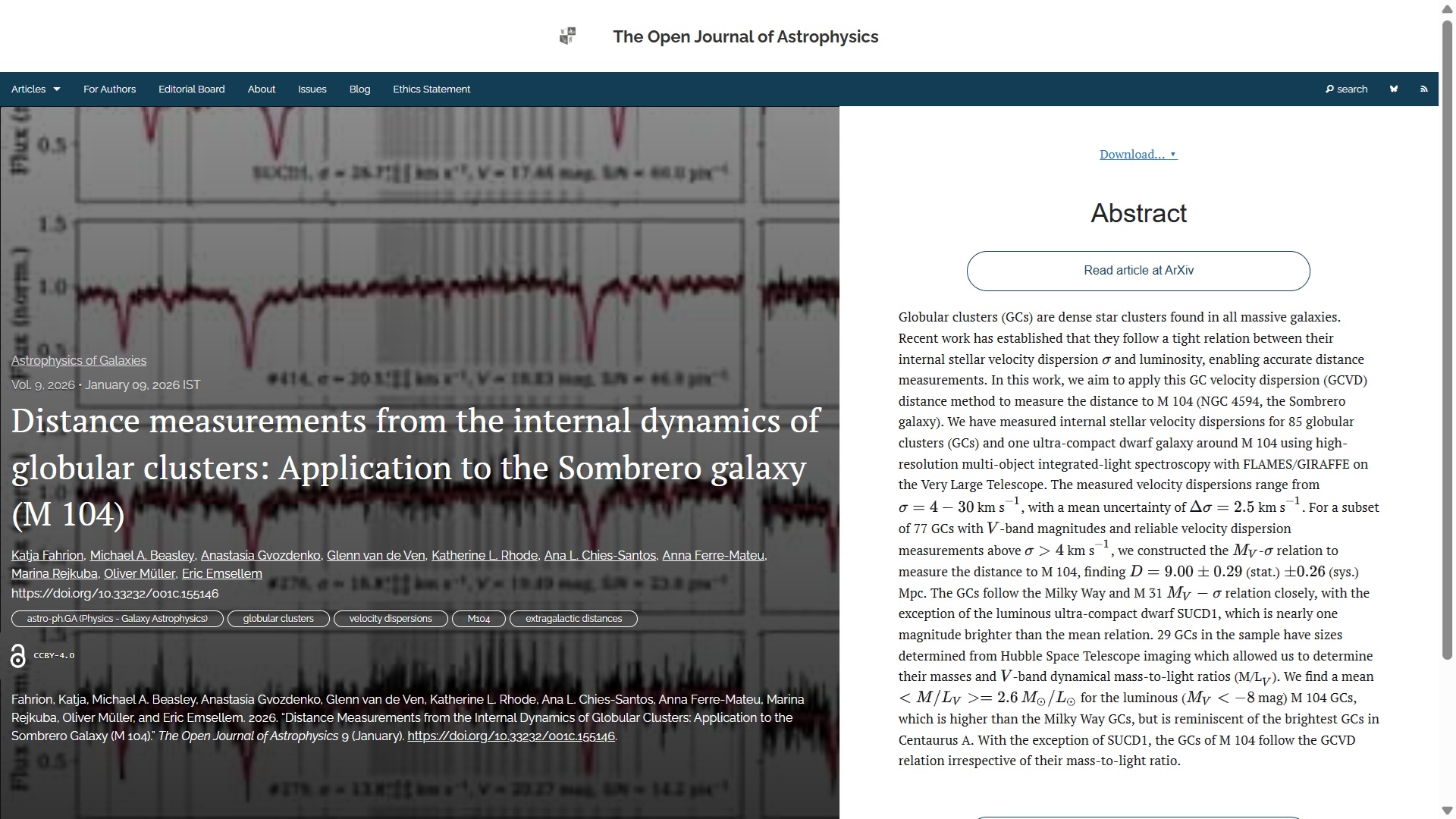
New Publication at the Open Journal of Astrophysics: "Distance measurements from the internal dynamics of globular clusters: Application to the Sombrero galaxy (M 104)" by Katja Fahrion (University of Vienna, Austria) and 9 others based in Spain, Australia, UK, USA, Brazil, Germany and Switzerland.
I wasn’t planning to do another update this week but I thought it would be best to complete the publications for 2025 at the Open Journal of Astrophysics, so that I don’t have to do a bigger update in the new year, and I have a bit of time this morning, so here we go.
Since the last update we have published four papers which brings the number in Volume 8 (2025) up to 201. Adding the 12 papers in the Supplement, this brings the final total for the year up to 213, and the total so far published by OJAp up to 448. In 2023 we published just 50 papers, so we have more than quadrupled in two years.
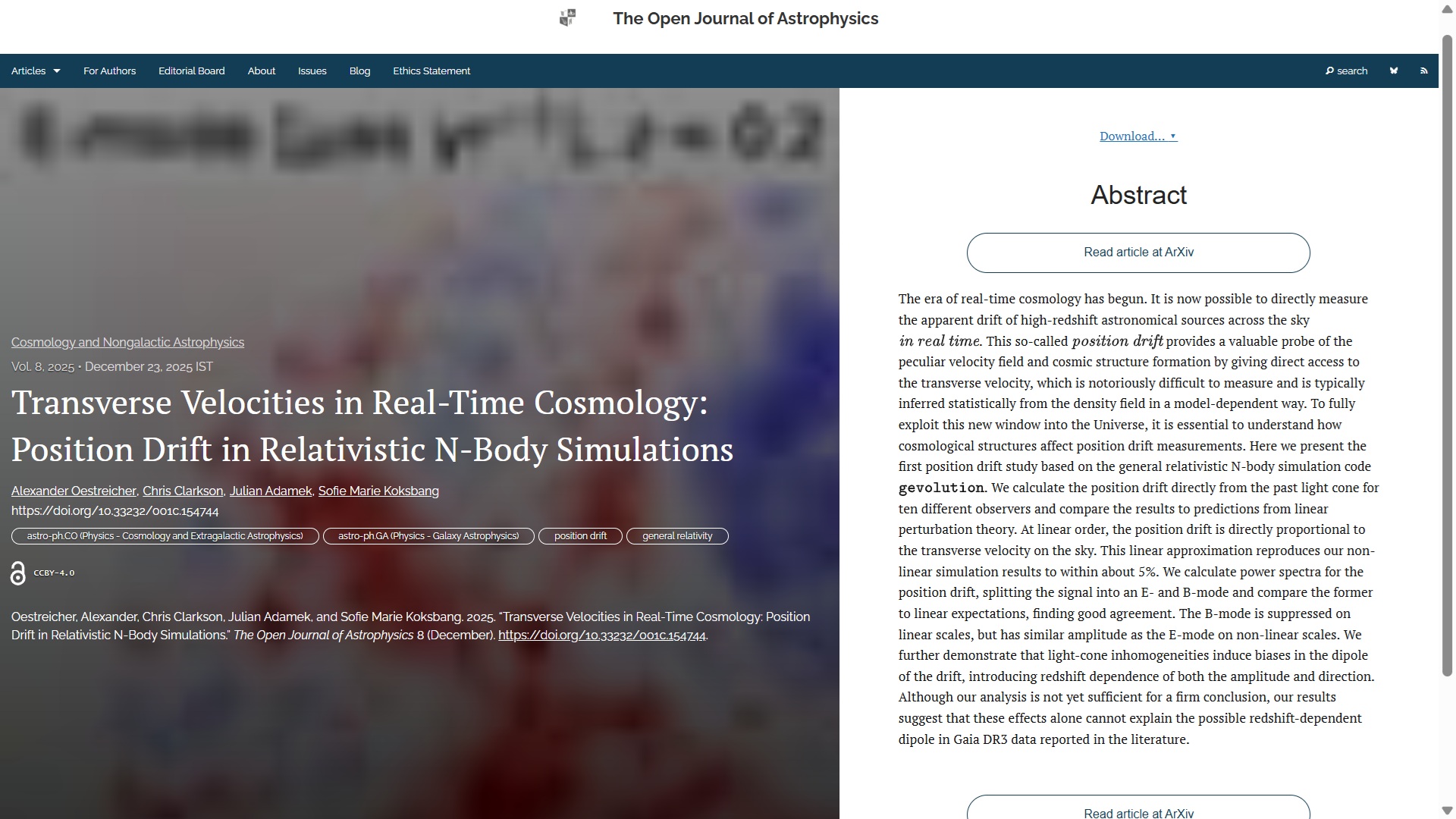
The first paper this week is “Transverse Velocities in Real-Time Cosmology: Position Drift in Relativistic N-Body Simulations” by Alexander Oestreicher (University of Southern Denmark), Chris Clarkson (QMUL, UK), Julian Adamek (Universität Zürich, CH) and Sofie Marie Koksbang (U. Southern Denmark). This study uses a general relativistic N-body simulation code to explore how cosmological structures affect position drift measurements, a new method for studying cosmic structure formation and velocity fields. This was published on Tuesday 23rd December 2025 in the folder Cosmology and Nongalactic Astrophysics.
The overlay is here:
You can find the officially accepted version on arXiv here and this is the announcement on Mastodon (Fediscience):
New Publication at the Open Journal of Astrophysics: "Transverse Velocities in Real-Time Cosmology: Position Drift in Relativistic N-Body Simulations" by Alexander Oestreicher (University of Southern Denmark), Chris Clarkson (QMUL, UK), Julian Adamek (Universität Zürich, CH) and Sofie Marie Koksbang (U. Southern Denmark)
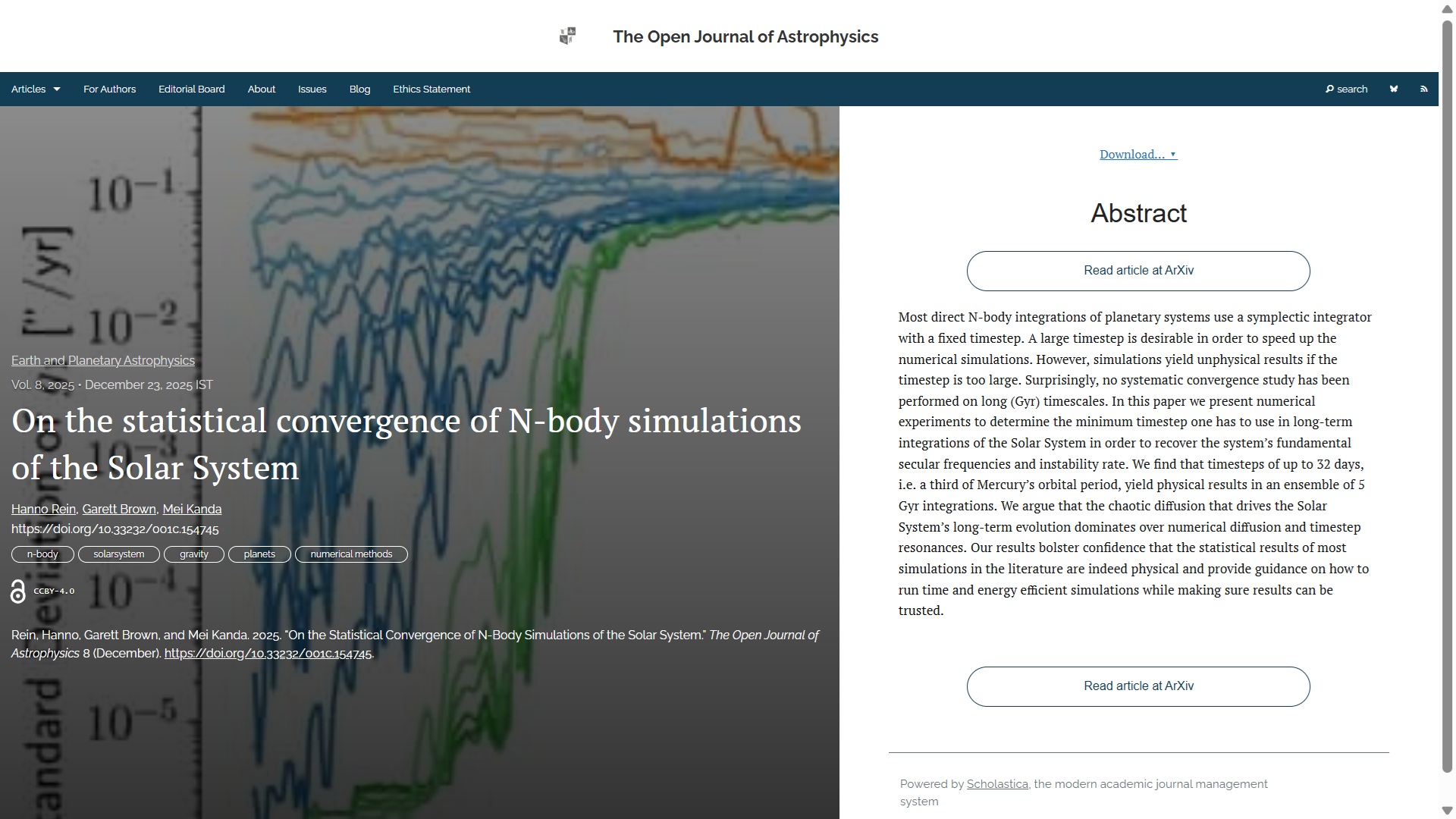
The second paper of the week is “On the statistical convergence of N-body simulations of the Solar System” by Hanno Rein, Garett Brown and Mei Kanda (U. Toronto, Canada). This study presents numerical experiments to determine the minimum timestep for long-term simulations of the Solar System, finding that timesteps up to 32 days yield physical results. It was published on Tuesday December 23rd in the folder Earth and Planetary Astrophysics.
The overlay is here:
You can find the official version of this one on arXiv here. The federated announcement on Mastodon is here:
New Publication at the Open Journal of Astrophysics: "On the statistical convergence of N-body simulations of the Solar System" by Hanno Rein, Garett Brown and Mei Kanda (U. Toronto, Canada)
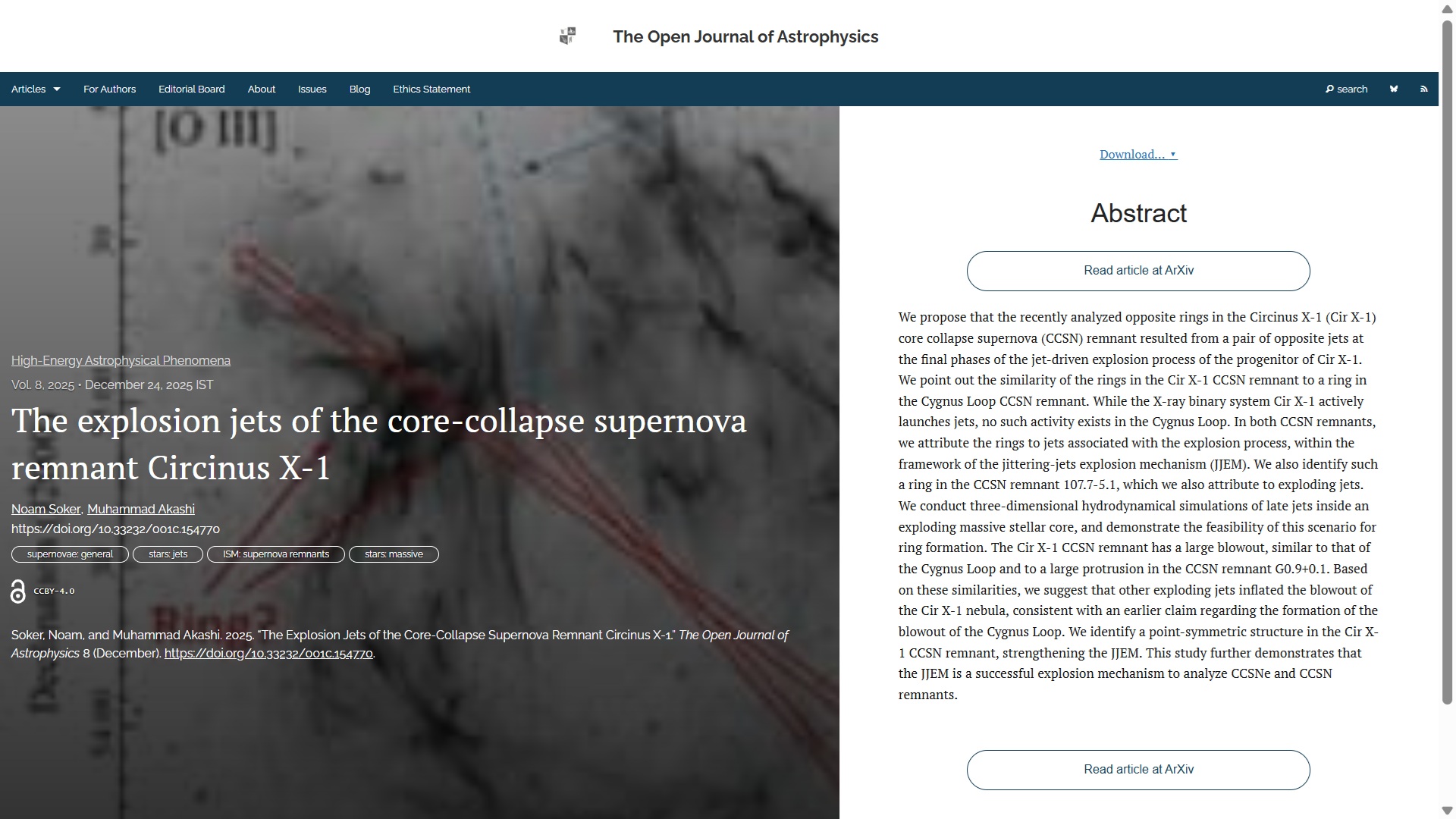
Next, published on 24th December 2025 in the folder High-Energy Astrophysical Phenomena, we have “The explosion jets of the core-collapse supernova remnant Circinus X-1” by Noam Soker and Muhammad Akashi (Technion, Haifa, Israel). This paper suggests that the rings in the Circinus X-1 supernova remnant resulted from jet-driven explosions, supporting the jittering-jets explosion mechanism theory for core collapse supernovae.
The overlay is here:
The officially accepted paper can be found on arXiv here and the announcement on Mastodon is here
New Publication at the Open Journal of Astrophysics: "The explosion jets of the core-collapse supernova remnant Circinus X-1" by Noam Soker and Muhammad Akashi (Technion, Haifa, Israel)
Finally for 2025 we have “Quantifying the Fermi paradox via passive SETI: a general framework” by Matthew Civiletti (City University of New York, USA). This was published on Wednesday 24th December in the folder Instrumentation and Methods for Astrophysics. The author uses SETI observations and the Drake Equation to calculate the probability of detecting at least one extraterrestrial signal, highlighting the model’s limitations and potential improvements. The overlay is here:
The officially accepted version can be found on arXiv here and the Mastodon announcement here:
New Publication at the Open Journal of Astrophysics: "Quantifying the Fermi paradox via passive SETI: a general framework" by Matthew Civiletti (City University of New York, USA)
And that concludes the updates for 2025. I’ll be back in a week with the first update of 2026, which will include the first paper(s) of Volume 9.
I’d like to thank everyone who has supported the Open Journal of Astrophysics this year – Editors, Reviewers, Authors and the excellent Library staff at Maynooth – and who have made it such a bumper year. In 2023 we published just 50 papers, so we have more than quadrupled in two years. How many will we publish in 2026?
It’s time once again for the usual Saturday morning update of the week’s new papers at the Open Journal of Astrophysics. Since the last update we have published a further five papers, which brings the number in Volume 8 (2025) up to 195, and the total so far published by OJAp up to 430.
The first paper this week is “Cosmic Rays Masquerading as Cool Cores: An Inverse-Compton Origin for Cool Core Cluster Emission” by Philip F. Hopkins (Caltech), Eliot Quataert (Princeton), Emily M. Silich, Jack Sayers, Sam B. Ponnada and Isabel S. Sands (Caltech). This was published on Tuesday 9th December 2025 in the folder marked High-Energy Astrophysical Phenomena. It presents an argument that cosmic-ray inverse-compton emission could contribute significantly to the X-ray surface brightness (SB) in cool-corre clusters, implying that gas densities may have been overestimated therein.
The overlay is here:
You can find the officially accepted version on arXiv here and the Fediverse announcement is here:
New Publication at the Open Journal of Astrophysics: "Cosmic Rays Masquerading as Cool Cores: An Inverse-Compton Origin for Cool Core Cluster Emission" by
Philip F. Hopkins (Caltech), Eliot Quataert (Princeton), Emily M. Silich, Jack Sayers, Sam B. Ponnada and Isabel S. Sands (Caltech)
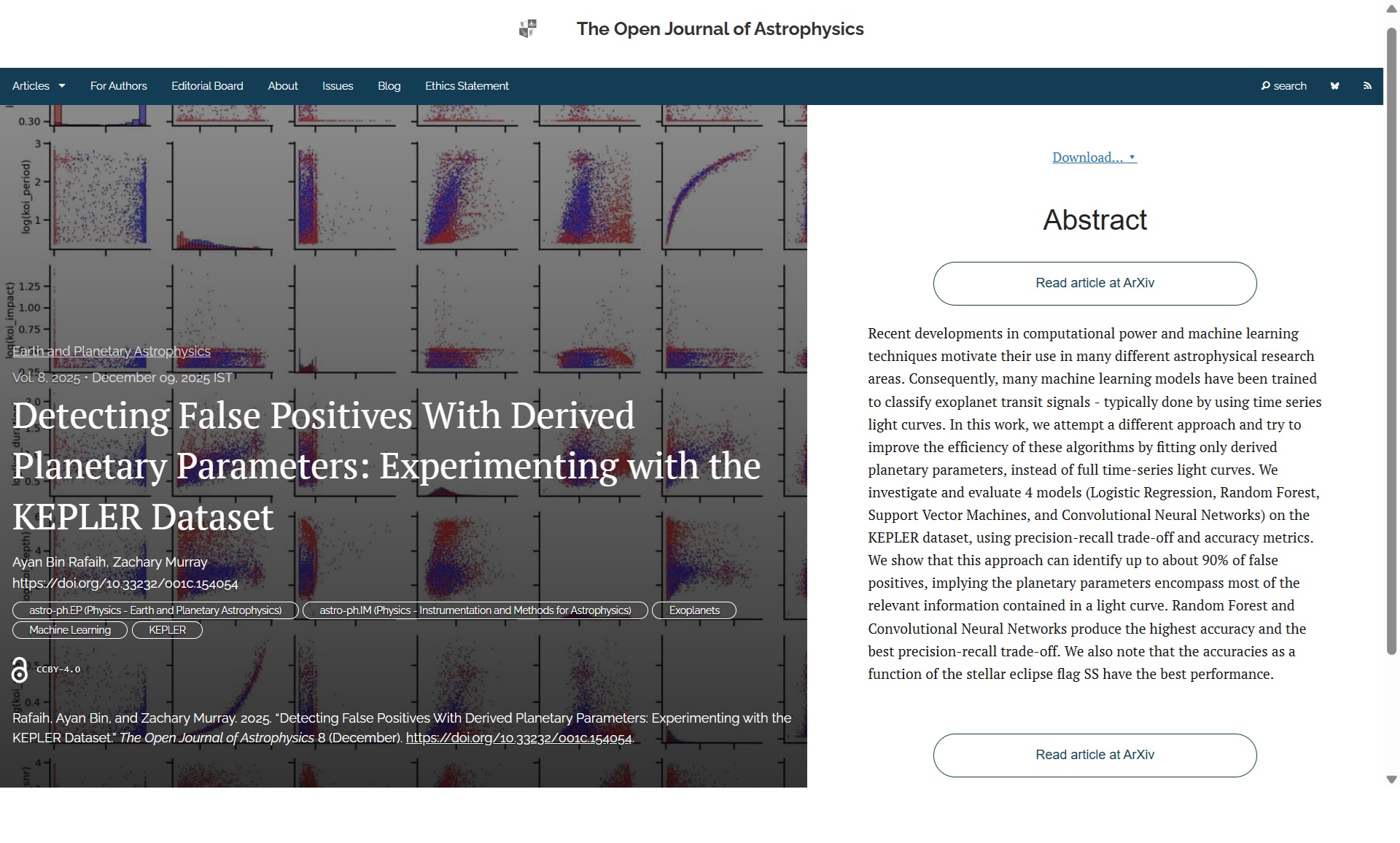
New Publication at the Open Journal of Astrophysics: "Detecting False Positives With Derived Planetary Parameters: Experimenting with the KEPLER Dataset" by Ayan Bin Rafaih (Aitchison College, Lahore, Pakistan) and Zachary Murray (Université Côte d’Azur, France)
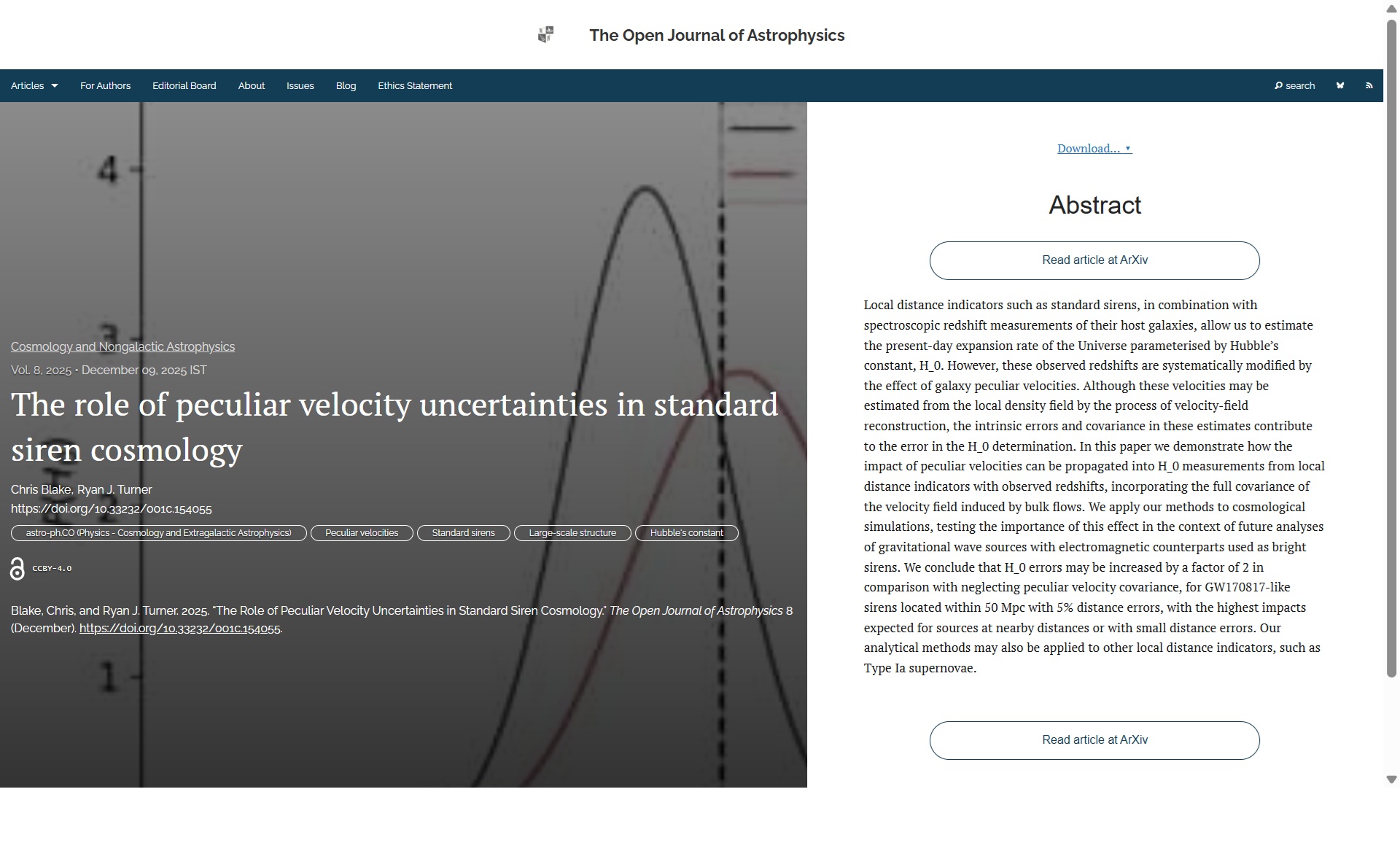
New Publication at the Open Journal of Astrophysics: "The role of peculiar velocity uncertainties in standard siren cosmology" by Chris Blake and Ryan J. Turner (Swinburne, Australia)
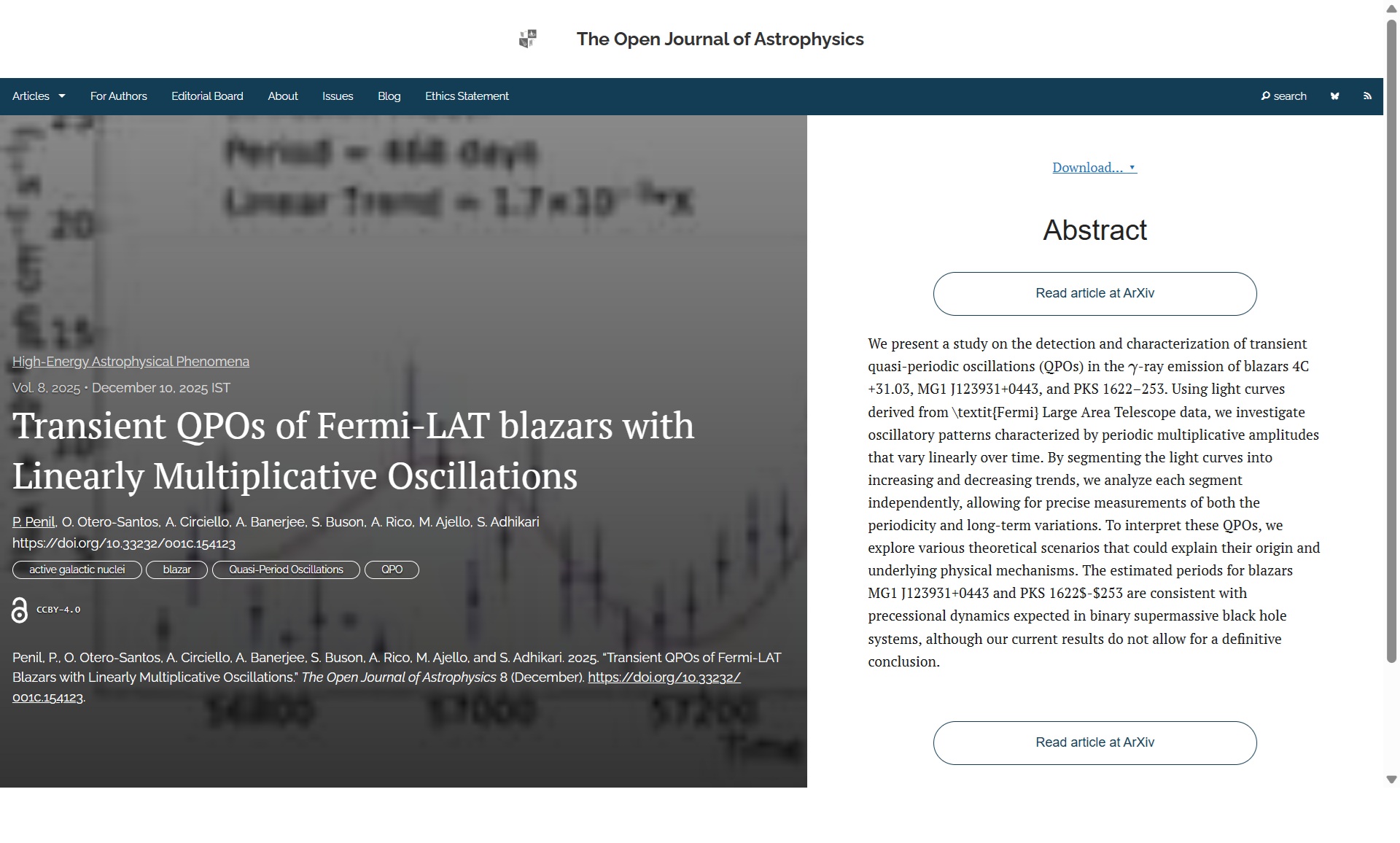
The fourth article of the week is “Transient QPOs of Fermi-LAT blazars with Linearly Multiplicative Oscillations” by P. Penil (Clemson University, USA) and 7 others based in the USA, Italy and Germany. This was published on Thursday 10th December in the folder High-Energy Astrophysical Phenomena. This paper presents an investigation of patterns of quasi-periodic oscillations in observed blazar systems characterized by periodic multiplicative amplitudes including both the periodicities and long-term variations. The overlay is here:
You can find the official published version on arXiv here. The Fediverse announcement follows:
New Publication at the Open Journal of Astrophysics: "Transient QPOs of Fermi-LAT blazars with Linearly Multiplicative Oscillations" by P. Penil (Clemson University, USA) and 7 others based in the USA, Italy and Germany
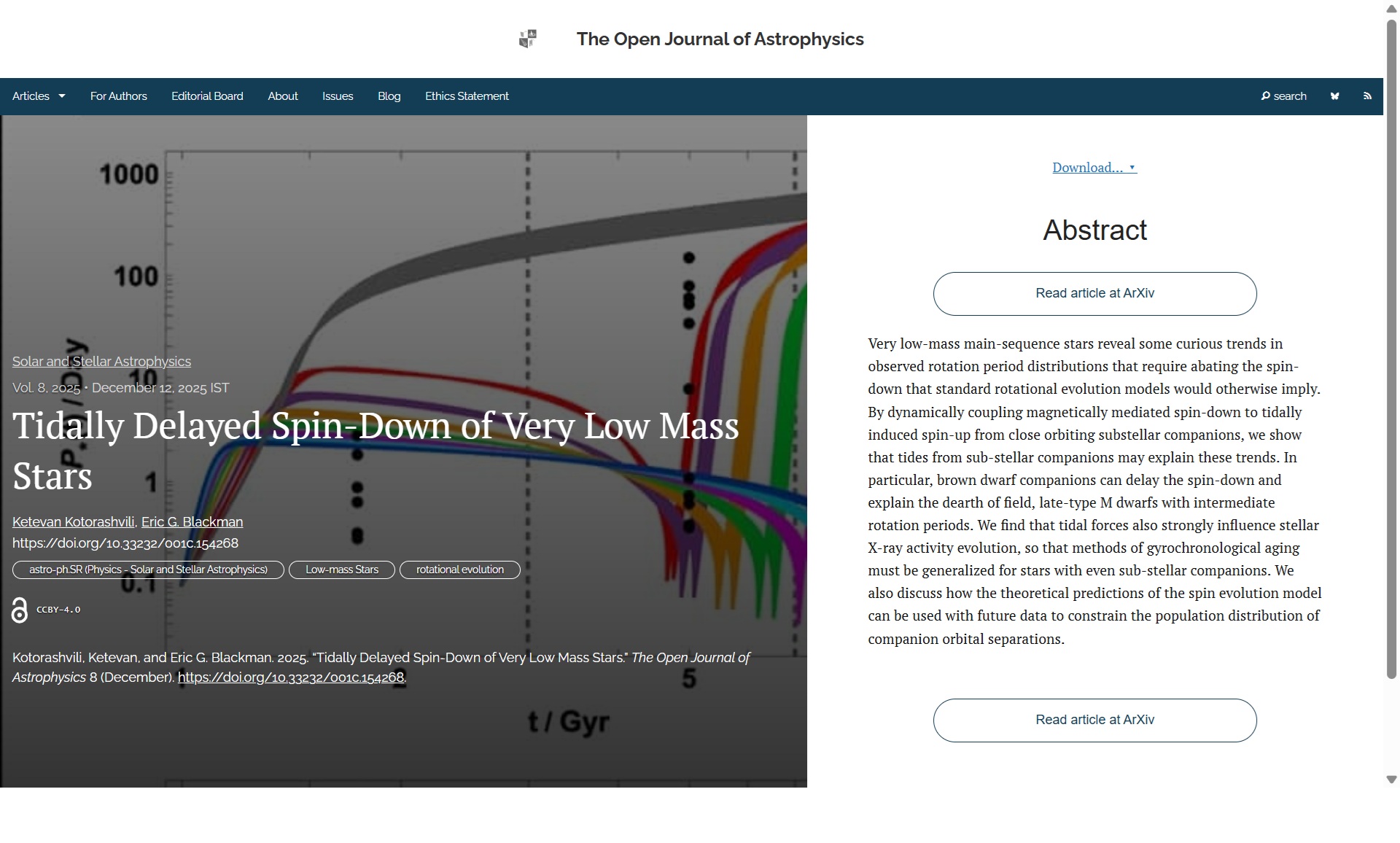
The last paper for this week is “Tidally Delayed Spin-Down of Very Low Mass Stars” by Ketevan Kotorashvili and Eric G. Blackman (U. Rochester, USA). This was published on Friday 12th December (yesterday) in the folder Solar and Stellar Astrophysics. It discusses the effect of tides from sub-stellar companions on rotational evolution of very low-mass stars, suggesting that these may explain the dearth of field, late-type M dwarfs with intermediate rotation periods.
The overlay is here:
You can find the officially-accepted version on arXiv here, and the Mastodon announcement is here:
New Publication at the Open Journal of Astrophysics: "Tidally Delayed Spin-Down of Very Low Mass Stars" by Ketevan Kotorashvili and Eric G. Blackman (U. Rochester, USA)
And that concludes the update for this week. I will do another of these regular announcements next Saturday, which will be the last such update for 2025. Will we make it past 200 for the year? Tune in next week to find out!
It’s Saturday again, so it’s time for the usual update of the week’s new papers at the Open Journal of Astrophysics. Since the last update we have published another five papers, which brings the number in Volume 8 (2025) up to 168, and the total so far published by OJAp up to 403.
The first paper this week is “Maximizing Ariel’s Survey Leverage for Population-Level Studies of Exoplanets” by Nicolas B. Cowan and Ben Coull-Neveu (McGill University, Canada). This article was published in the folder Earth and Planetary Astrophysics on Tuesday 4th November 2025; it discusses various different schemes to select the mission reference sample for a notional three year transit spectroscopy survey with the European Space Agency’s Ariel mission
The overlay is here:
You can find the officially accepted version on arXiv here.
New Publication at the Open Journal of Astrophysics: "Maximizing Ariel’s Survey Leverage for Population-Level Studies of Exoplanets" by Nicolas B. Cowan and Ben Coull-Neveu (McGill University, Canada)
The second paper of the week is “A substellar flyby that shaped the orbits of the giant planets” by Garett Brown (U. Toronto at Scarborough, Canada), Renu Malhotra (U. Arizona, USA) and Hanno Rein (U. Toronto at Scarborough, Canada). This article was published on Wednesday 5th November 2025, also in the folder Earth and Planetary Astrophysics. It argues that an ancient close encounter with a substellar object offers a plausible explanation for the origin of the moderate eccentricities and inclinations of the giant planets.
The overlay is here:
You can find the official version of this one on arXiv here. The federated announcement on Mastodon is here:
New Publication at the Open Journal of Astrophysics: "A substellar flyby that shaped the orbits of the giant planets" by Garett Brown (U. Toronto at Scarborough, Canada), Renu Malhotra (U. Arizona, USA) and Hanno Rein (U. Toronto at Scarborough, Canada)
Next one up is “The Potential Impact of Primordial Black Holes on Exoplanet Systems” by Garett Brown (U. Toronto at Scarborough), Linda He (Harvard U., USA), and James Unwin (U. Illinois Chicago, USA). This one was also published on Wednesday 5th November 2025, but in the folder Astrophysics of Galaxies. This one is an exploration of the possibility that primordial black holes (PBHs) in our Galaxy, might impact the orbits of exoplanets. The overlay is here:
You can find the official accepted version on arXiv here. The fediverse announcement is here:
New Publication at the Open Journal of Astrophysics: "The Potential Impact of Primordial Black Holes on Exoplanet Systems" by Garett Brown (U. Toronto at Scarborough), Linda He (Harvard U., USA), James Unwin (U. Illinois Chicago, USA)
The fourth paper to report is “The Unhurried Universe: A Continued Search for Long Term Variability in ASAS-SN” by Sydney Petz, C. S. Kochanek & K. Z. Stanek (Ohio State U., USA), Benjamin J. Shappee (U. Hawaii, USA), Subo Dong (Peking University, China), J. L. Prieto (Universidad Diego Portales, Chile) and Todd A. Thompson (Ohio State U., USA). This one was also published on Wednesday November 5th 2025, but in the folder Solar and Stellar Astrophysics. It describes the discovery and investigation of slowly-varying sources in the All Sky Automated Survey for SuperNovae (ASAS-AN) leading to the identification of 200 new variable stars. The overlay is here:
You can find the official published version on arXiv here. The Fediverse announcement follows:
New Publication at the Open Journal of Astrophysics: "The Unhurried Universe: A Continued Search for Long Term Variability in ASAS-SN" by Sydney Petz, C. S. Kochanek & K. Z. Stanek (Ohio State U., USA), Benjamin J. Shappee (U. Hawaii, USA), Subo Dong (Peking University, China), J. L. Prieto (Universidad Diego Portales, Chile) and Todd A. Thompson (Ohio State U., USA)
The fifth and final paper for this week is “Measuring the splashback feature: Dependence on halo properties and history” by Qiaorong S. Yu (Oxford U., UK) and 9 others based in the UK and USA. This was published on Friday 7th November 2025 in the folder Cosmology and Nongalactic Astrophysics. It discusses how the properties of “splashback” features in halo profiles relate to the halo’s assembly history (e.g. mass accretion rate and most recent merger time). The overlay is here:
The officially accepted version can be found on arXiv here. The Fediverse announcement is here:
New Publication at the Open Journal of Astrophysics: "Measuring the splashback feature: Dependence on halo properties and history" by Qiaorong S. Yu (Oxford U., UK) and 9 others based in the UK and USA.
It’s Saturday again, so it’s time for a summary of the week’s new papers at the Open Journal of Astrophysics. Since the last update we have published five more papers, which brings the number in Volume 8 (2025) up to 146, and the total so far published by OJAp up to 381. At this rate Volume 8 will contain around 190 by the end of 2025.
Anyway, here are this week’s papers, starting with three published on Monday 29th September 2025.
You can make this larger by clicking on it. The officially accepted version of this paper can be found on the arXiv here.
The second paper this week, also published on Monday 29th September, is “SDSS-C4 3028: the Nearest Blue Galaxy Cluster Devoid of an Intracluster Medium” by Shweta Jain (University of Kentucky, USA) and 11 others based in the USA, Australia and Korea. This describes a galaxy cluster with an unusually high fraction (about 63%) of star-forming galaxies which may be a result of ram pressure stripping; the article is in the folder Astrophysics of Galaxies.
The corresponding overlay is here:
You can find the officially accepted version on arXiv here.
You can find the officially-accepted version on arXiv here.
The next one up is “Seeding Cores: A Pathway for Nuclear Star Clusters from Bound Star Clusters in the First Billion Years” by Fred Angelo Batan Garcia (Columbia University, USA), Massimo Ricotti (University of Maryland, USA) and Kazuyuki Sugimura (Hokkaido University, Japan). This paper was published on Thursday 2nd October in the folder Astrophysics of Galaxies. This is about modelling the formation of Nuclear Star Clusters using cosmological radiation-hydrodynamic simulations, with discussion of the implications for seeding supermassive black holes and the little red dots seen by JWST.
The corresponding overlay is here:
You can find the officially accepted version of this one on arXiv here.
The fifth and last one for this week, published on Friday 3rd October 2025, is “Efficient semi-analytic modelling of Pop III star formation from Cosmic Dawn to Reionization” by Sahil Hegde and Steven R. Furlanetto (University of Californi Los Angeles, USA). This is also in the folder marked Astrophysics of Galaxies. It uses a self-consistent analytic model to trace the formation of the first stars from their birth through the first billion years of the universe’s history. complementing semi-analytic and computational methods.
You can find the officially-accepted version of this paper on arxiv here.
That concludes the report for this week. I’ll post another update next Saturday.
It’s Saturday again, so it’s time for a summary of the week’s new papers at the Open Journal of Astrophysics. Since the last update we have published five new papers, which brings the number in Volume 8 (2025) up to 141, and the total so far published by OJAp up to 376.
The first paper to report this week is “The Bispectrum of Intrinsic Alignments: Theory Modelling and Forecasts for Stage IV Galaxy Surveys” by Thomas Bakx (Utrecht U., NL), Alexander Eggemeier (U. Bonn, DE), Toshiki Kurita (MPA Garching, DE), Nora Elisa Chisari (Leiden U., NL) and Zvonimir Vlah (Ruđer Bošković Institute, Croatia). This paper was published on Monday 22nd September 2025 in the folder Cosmology and NonGalactic Astrophysics. It studies the bispectrum of intrinsic galaxy alignments, a possible source of systematic errors in extracting cosmological information from the analysis of weak lensing surveys.
The overlay is here:
You can make this larger by clicking on it. The officially accepted version of this paper can be found on the arXiv here.
You can find the officially accepted version on arXiv here.
The third one this week, published on Wednesday 24th September 2025 in the folder Astrophysics of Galaxies, is “Is feedback-free star formation possible?” by Andrea Ferrara, Daniele Manzoni, and Evangelia Ntormousi (all of the Scuola Normale Superiore, Pisa, Italy). This paper presents an argument that Lyman-alpha radiation pressure strongly limits star formation efficiency, even at solar metallicities, so that a feedback-free star formation phase is not possible without feedback. The overlay is here:
You can find the officially-accepted version on arXiv here.
Next we have “Microphysical Regulation of Non-Ideal MHD in Weakly-Ionized Systems: Does the Hall Effect Matter?” by Philip F. Hopkins (Caltech, USA), Jonathan Squire (U. Otago, New Zeland), Raphael Skalidis (Caltech) and Nadine H. Soliman (Caltech). This was also published on Wednesday 24th September 2025, but in the folder Earth and Planetary Astrophysics. It presents an improved treatment of non-ideal effects in magnetohydrodynamics, particularly the Hall effect, and a discussion of the implications for weakly-ionized astrophysical systems.
The corresponding overlay is here:
You can find the officially accepted version of this one on arXiv here.
The views presented here are personal and not necessarily those of my employer (or anyone else for that matter).
Feel free to comment on any of the posts on this blog but comments may be moderated; anonymous comments and any considered by me to be vexatious and/or abusive and/or defamatory will not be accepted. I do not necessarily endorse, support, sanction, encourage, verify or agree with the opinions or statements of any information or other content in the comments on this site and do not in any way guarantee their accuracy or reliability.