Weekly Update from the Open Journal of Astrophysics 11/07/2026

Posted in OJAp Papers, Open Access, The Universe and Stuff with tags , , , , , , , , , , , , , , , , , , , , , , , , , , , , , , , , , , , , , on July 11, 2026 by telescoper

Back home to Maynooth, just in time for another Saturday update of activity at the Open Journal of Astrophysics. Since the last update we have published a further nine papers, bringing the number in Volume 9 (2026) to 145 and the total so far published by OJAp up to 593.

I will continue to include the posts made on our Mastodon account (on Fediscience); these announcements also show the DOI for each paper.

The first paper to report this week, published on Tuesday 7th July, is “The Information Content of Quasar Variability Light Curves: How Well Can we Infer Stochastic Model Parameters?” by Brendon Brewer (U. Auckland, NZ), Geraint F. Lewis (U. Sydney, AU), Xiang Yu & Yuan Li (Auckland). Published in the folder Astrophysics of Galaxies, this study suggests that quasar variability studies should focus on the short term volatility parameter, as it’s more informative than the variability timescale. Volatility decreases with redshift suggesting intrinsic effects.

The overlay for this paper is here
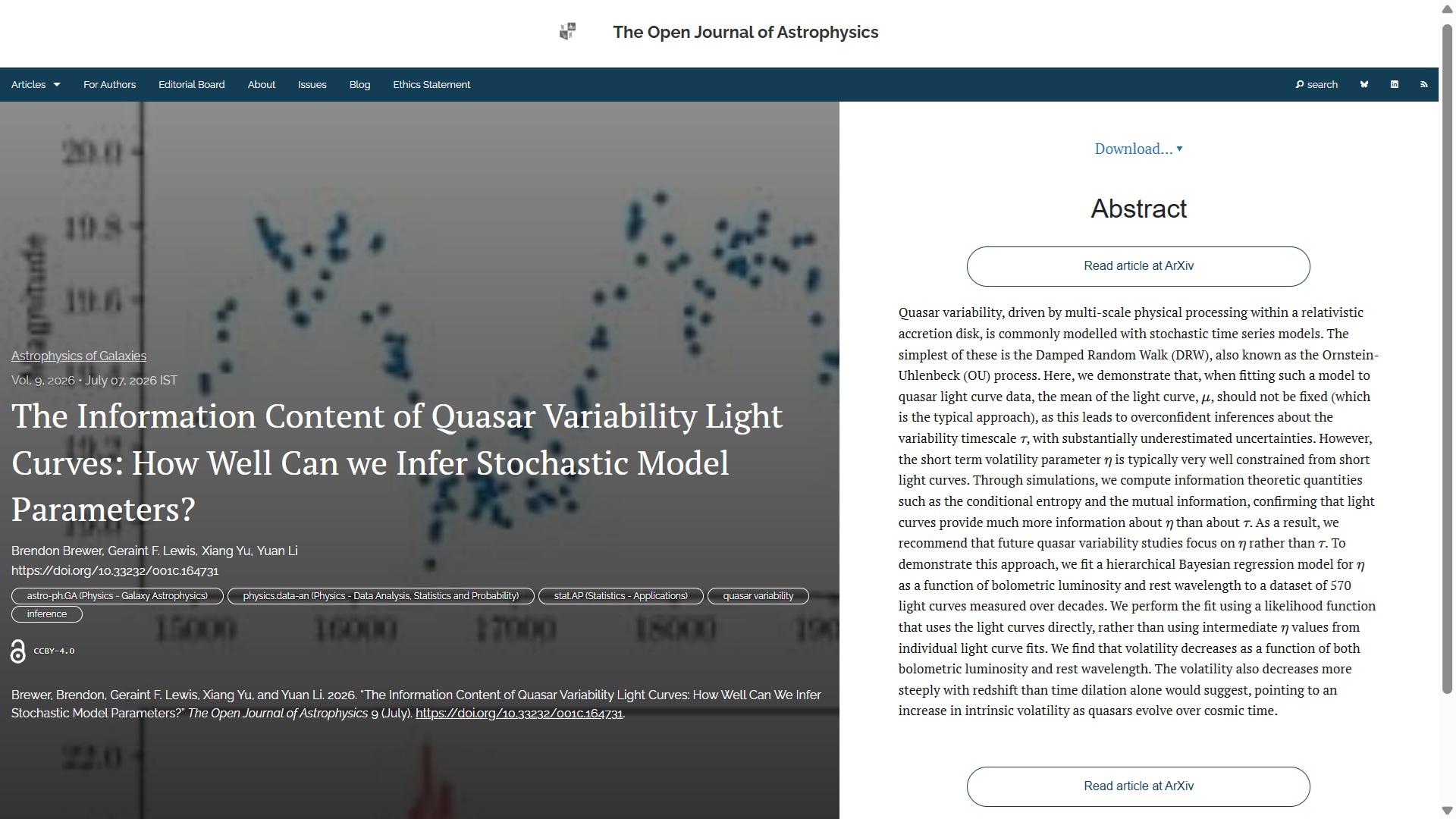
You can find the officially accepted version on arXiv here and the announcement on Fediverse here:

Open Journal of Astrophysics

New Publication at the Open Journal of Astrophysics: "The Information Content of Quasar Variability Light Curves: How Well Can we Infer Stochastic Model Parameters?" by Brendon Brewer (U. Auckland, NZ), Geraint F. Lewis (U. Sydney, AU), Xiang Yu & Yuan Li (Auckland)

doi.org/10.33232/001c.164731

July 7, 2026, 5:48 am 0 boosts 2 favorites

The second paper for this week, also published on Tuesday 7th July, but in the folder High-Energy Astrophysical Phenomena, is “Cygnus X-3 as a PeVatron and the LHAASO 2025 data” by Michael Kachelriess & E. Lammert (NTNU, Trondheim, Norway). This paper suggests that the high-mass X-ray binary Cygnus X-3 can accelerate cosmic rays beyond PeV energies, contributing to a photon flux peaking around PeV energies.

The overlay looks like this:
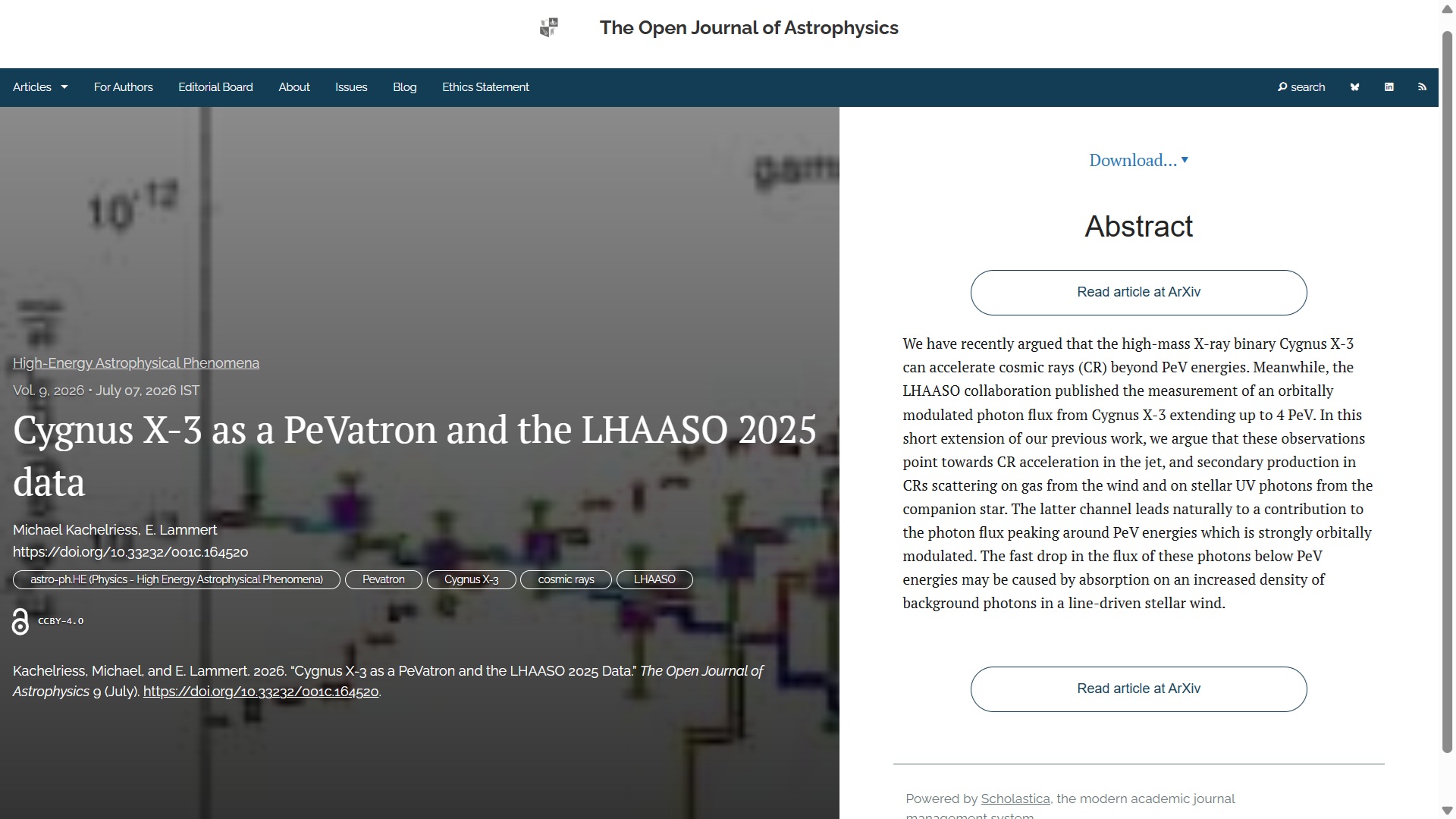
The official version of the paper can be found on arXiv here and the Fediverse announcement here:

Open Journal of Astrophysics

New Publication at the Open Journal of Astrophysics: "Cygnus X-3 as a PeVatron and the LHAASO 2025 data" by Michael Kachelriess & E. Lammert (NTNU, Trondheim, Norway)

doi.org/10.33232/001c.164520

July 7, 2026, 6:52 am 0 boosts 0 favorites

The third paper of the week, also published on Tuesday 7th July, but in the folder Cosmology and Nongalactic Astrophysics is “The DESI DR1 Peculiar Velocity Survey: growth rate measurements from galaxy and momentum correlation functions” by Ryan J Turner (Swinburne Institute of Technology, Australia) and 63 others from around the world. This paper analyzes local peculiar velocity and galaxy density fields to test cosmological models of gravity, finding results consistent with predictions from Planck+ΛCDM cosmology and general relativity.

The overlay for this one is here:
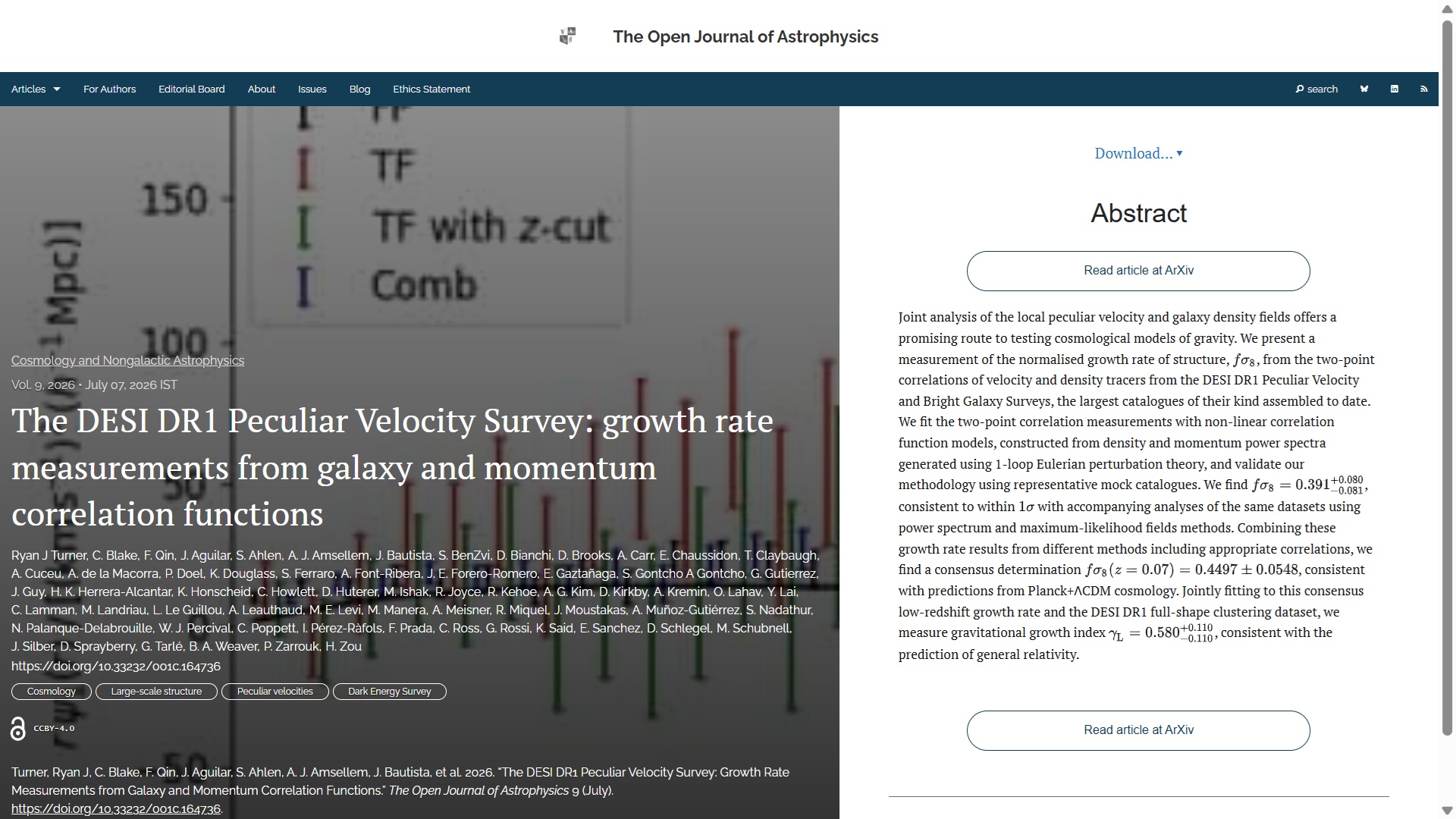
The final, accepted version can be found on arXiv here and the Mastodon announcement is here:

Open Journal of Astrophysics

New Publication at the Open Journal of Astrophysics: "The DESI DR1 Peculiar Velocity Survey: growth rate measurements from galaxy and momentum correlation functions" by Ryan J Turner (Swinburne Institute of Technology, Australia) and 63 others from around the world.

doi.org/10.33232/001c.164736

July 7, 2026, 7:51 am 0 boosts 0 favorites

The fourth paper of the week, published on Wednesday 8th July in the folder Instrumentation and Methods for Astrophysics , is “Morphological Fingerprints of Forbush Decreases and Their Relation to Geomagnetic Storm Severity” by Juan Diego Perez Navarro and David Sierra Porta (Universidad Tecnológica de Bolívar, Colombia). This article introduces a graph-based method to analyze Forbush decreases (FDs), transient depressions in cosmic-ray flux, and uses network signatures to predict geomagnetic storm intensity.

The overlay for this one is here:
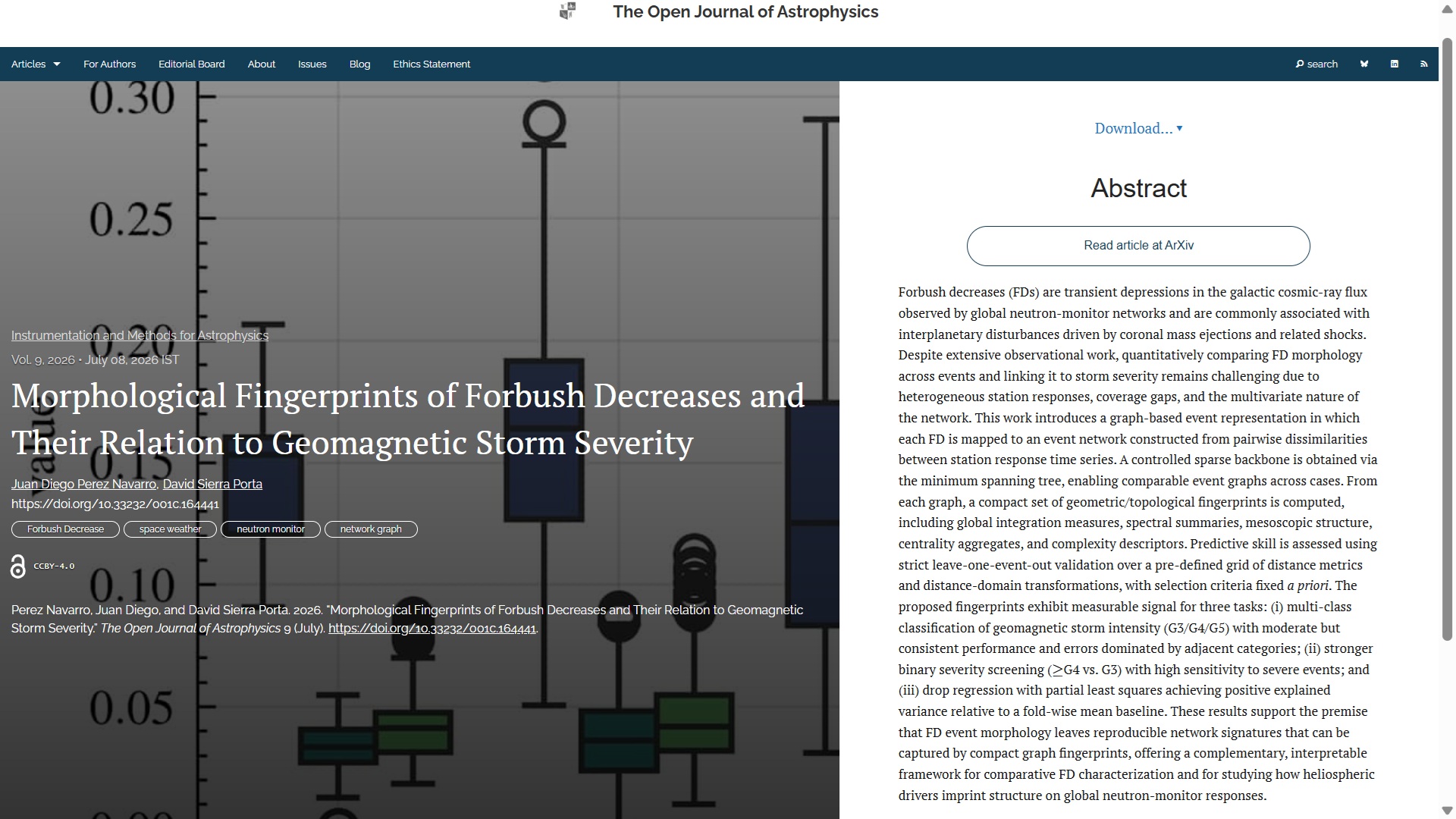
You can read the final version of this one on arXiv here and the Mastodon announcement is here:

Open Journal of Astrophysics

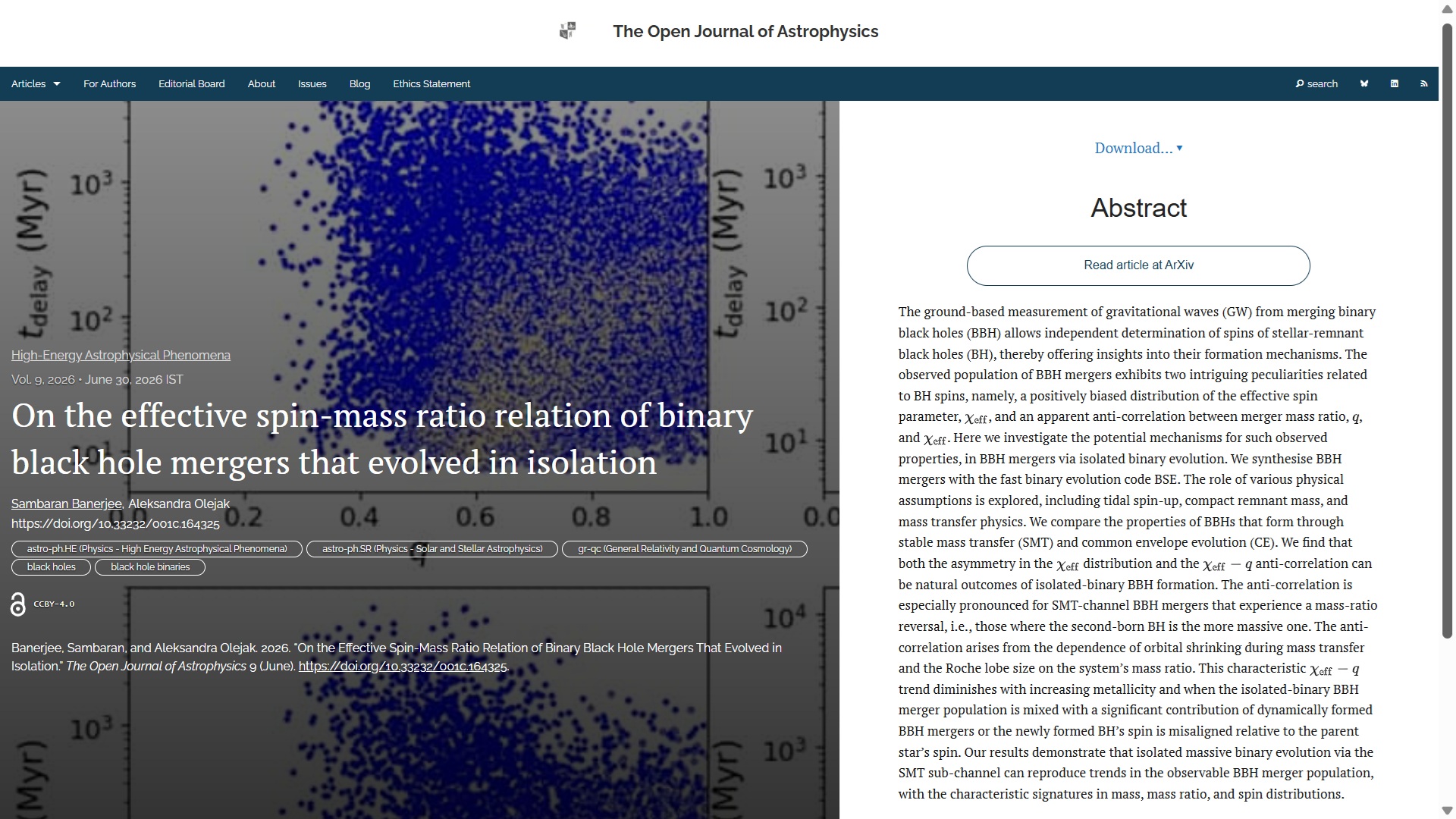
New Publication at the Open Journal of Astrophysics: "On the effective spin-mass ratio relation of binary black hole mergers that evolved in isolation" by Sambaran Banerjee (Helmholtz-Instituts für Strahlen und Kernphysik, Germany) and Aleksandra Olejak (MPA Garching, Germany)

doi.org/10.33232/001c.164325

June 30, 2026, 7:16 am 1 boosts 1 favorites

The fifth paper of the week, also published on Wednesday 8th July but in the folder Astrophysics of Galaxies, is “On the connection between galaxy orientation and halo absorption properties” by Rohan Venkat, Soo May Wee, and Hsiao-Wen Chen (U. Chicago, USA). This article investigates the azimuthal dependence of metal-line absorption in the circumgalactic medium of 87 isolated galaxies. The results show no significant correlation between absorption strength and azimuthal angle.

The overlay for this one is here:
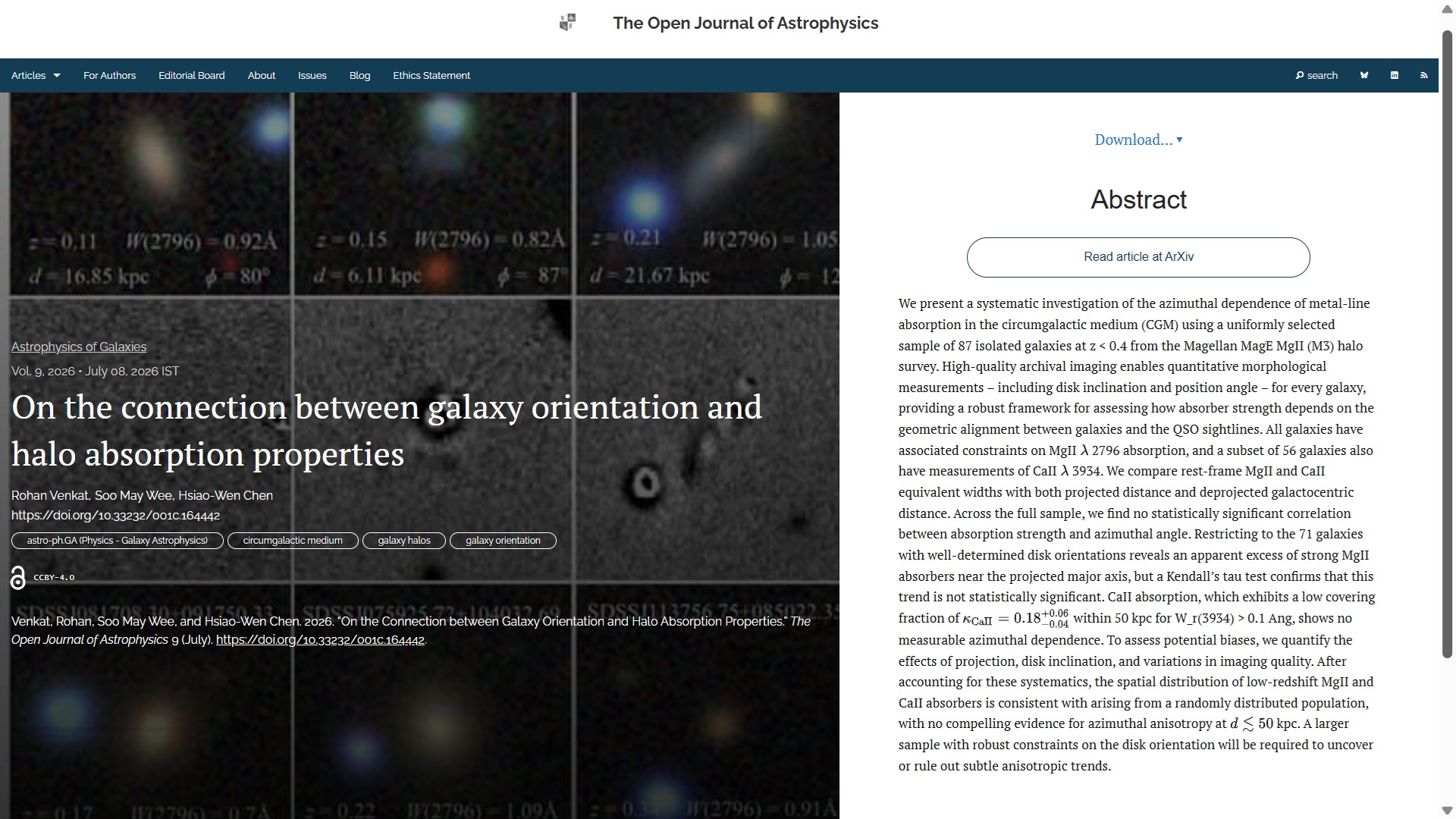
You can read the final version of this one on arXiv here and the Mastodon announcement is here:

The sixth paper of this week is “Searching for Periodicity in FRB 20240114A” by Jonathan I Katz (Washington U., USA). This was published on Thursday 9th July in the folder High-Energy Astrophysical Phenomena. The study described in this paper observed FRB 20240114A, an active Fast Radio Burst, but found no significant periodicity in its bursts, contradicting magnetar models predictions.

The overlay for this one is here:
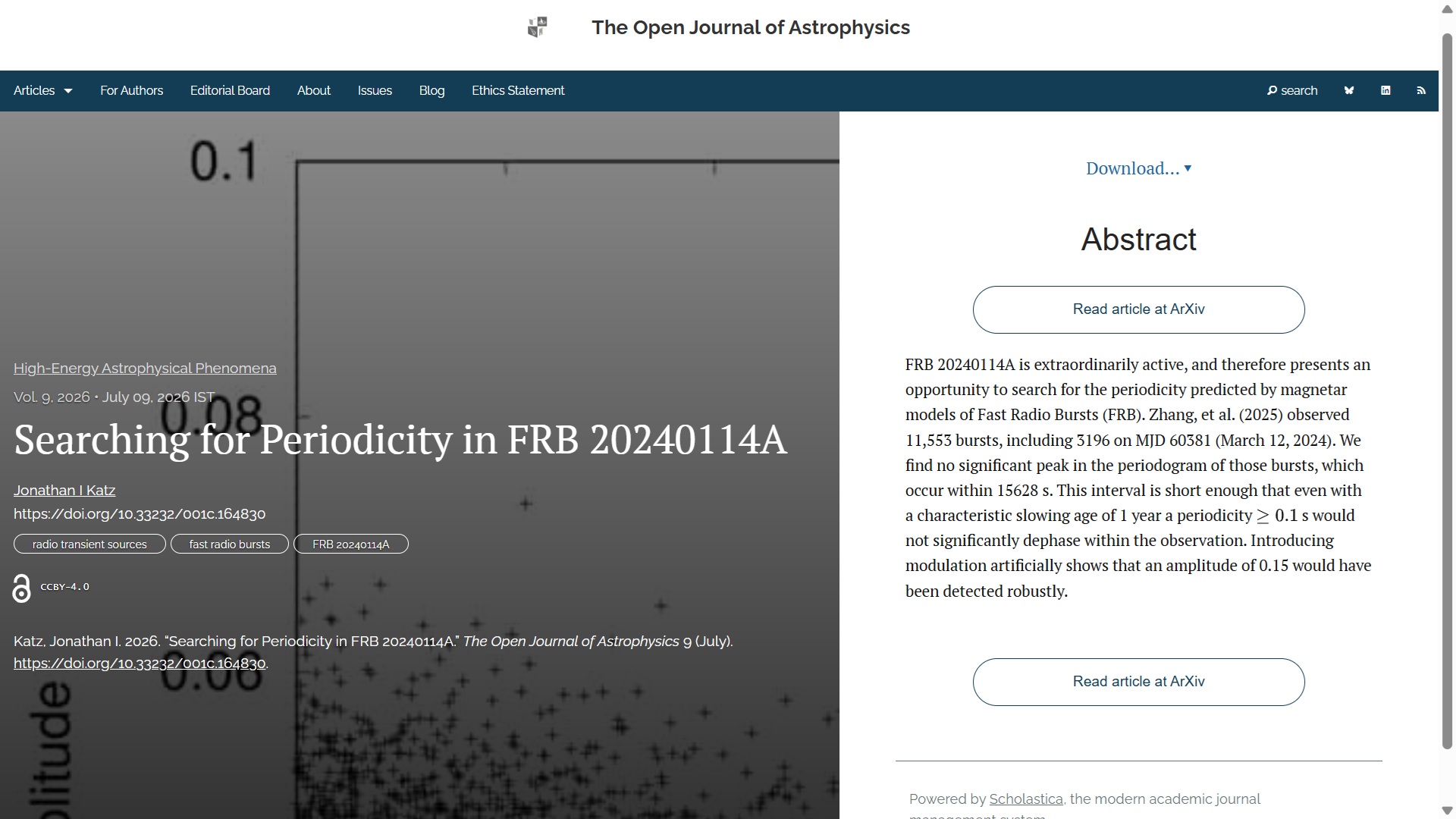
You can find the final accepted version on arXiv here and the Mastodon announcement is here:

Open Journal of Astrophysics

New Publication at the Open Journal of Astrophysics: "Searching for Periodicity in FRB 20240114A" by Jonathan I Katz (Washington U., USA)

doi.org/10.33232/001c.164830

July 9, 2026, 5:27 am 1 boosts 0 favorites

The seventh article for this week is “Multiphase gas in Circumgalactic cloud complexes: Insights from kiloparsec-scale Magnetohydrodynamic Turbulence Simulations” by Rajsekhar Mohapatra (Princeton U., USA), Alankar Dutta (MPA Garching, Germany) and Prateek Sharma (Indian Institute of Science, Bangalore). This -paper was also published on Thursday 9th July, in the folder Astrophysics of Galaxies. This paper uses high-resolution simulations to investigate the mass distribution of the circumgalactic medium (CGM), a diffuse gas surrounding a galaxy’s halo with small-scale clumps of cold gas forming in quiescent regions.

The overlay for this one is here:
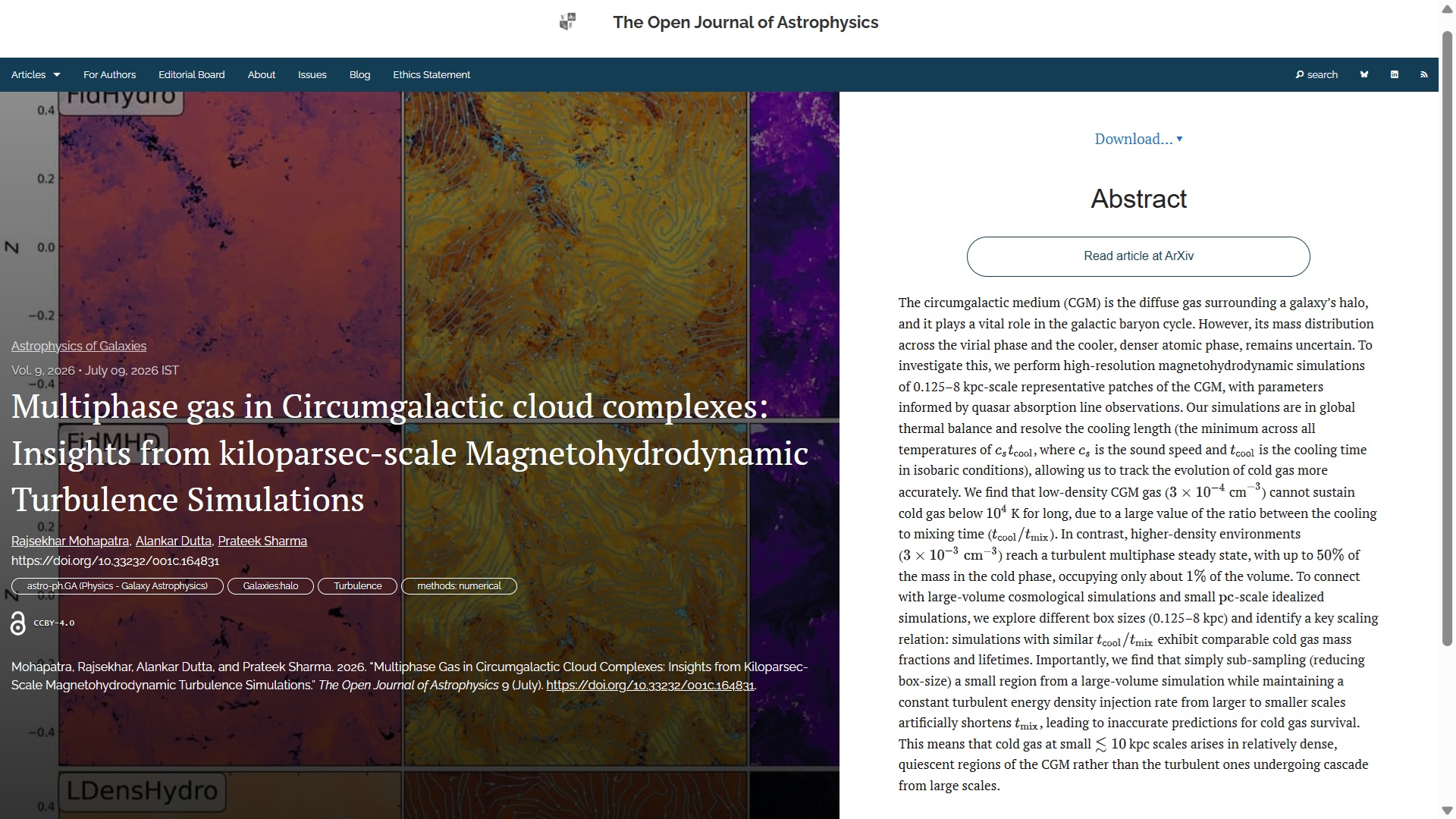
You can find the final accepted version of this one on arXiv here and the Mastodon announcement is here:

Open Journal of Astrophysics

New Publication at the Open Journal of Astrophysics: "Multiphase gas in Circumgalactic cloud complexes: Insights from kiloparsec-scale Magnetohydrodynamic Turbulence Simulations" by Rajsekhar Mohapatra (Princeton U., USA), Alankar Dutta (MPA Garching, Germany) and Prateek Sharma (Indian Institute of Science, Bangalore)

doi.org/10.33232/001c.164831

July 9, 2026, 5:43 am 1 boosts 0 favorites

The (penultimate) eighth article for this week is “Line-of-sight shear in SLACS strong lenses I: shear and mass model parametrisations” by Natalie B. Hogg (U. Cambridge, UK), Daniel Johnson (U. Montpellier, France), Anowar J. Shajib (U. Chicago, USA) and Julien Larena (Montpellier). This was also published on Thursday 9th July, but in the folder Cosmology and Nongalactic Astrophysics. This article studies models of 23 strong gravitational lenses to measure line-of-sight shear for the first time, providing potential new constraints on cosmological parameters.

The overlay for this one is here:

You can find the final accepted version on arXiv here and the Mastodon announcement is here:

Open Journal of Astrophysics

New Publication at the Open Journal of Astrophysics: "Line-of-sight shear in SLACS strong lenses I: shear and mass model parametrisations" by Natalie B. Hogg (U. Cambridge, UK), Daniel Johnson (U. Montpellier, France), Anowar J. Shajib (U. Chicago, USA) and Julien Larena (Montpellier)

doi.org/10.33232/001c.164832

July 9, 2026, 6:33 am 1 boosts 1 favorites

The ninth and last article for this week is “Current and future constraints on the expansion history of the GREA model” by Irene Graziotti (INAF-Osservatorio Astronomico di Capodimonte, Italy), Chiara De Leo (Sapienza University of Rome, Italy) and Matteo Martinelli (INAF-Osservatorio Astronomico di Roma, Italy). This study explores the General Relativistic Entropic Acceleration (GREA) framework, comparing it to the standard description of the universe. Current data favors the standard model, but GREA remains competitive.

The overlay for this one is here:
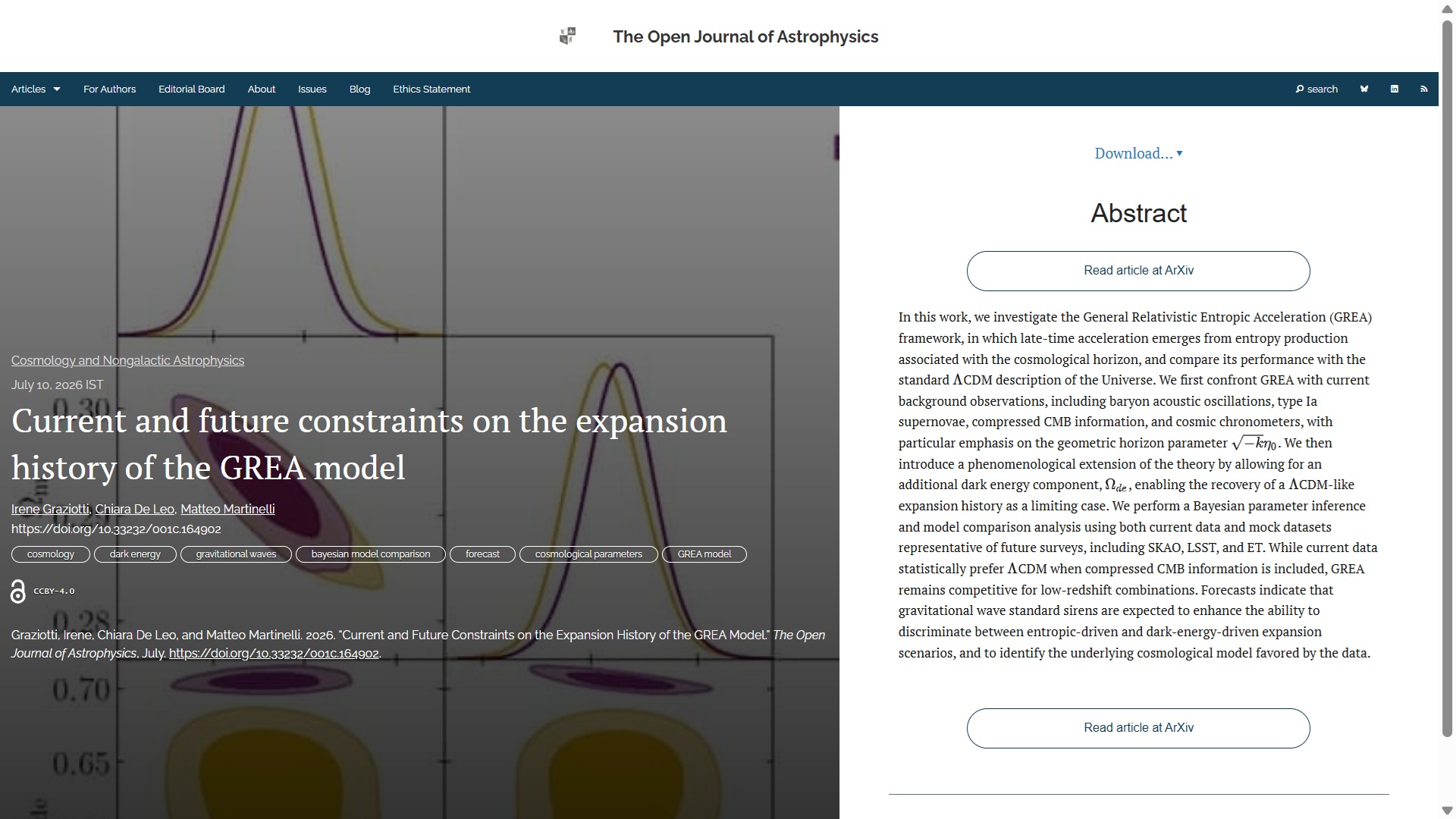
You can find the officially-accepted version on arXiv here and the Mastodon announcement here:

Open Journal of Astrophysics

New Publication at the Open Journal of Astrophysics: "Current and future constraints on the expansion history of the GREA model" by Irene Graziotti (INAF-Osservatorio Astronomico di Capodimonte, Italy), Chiara De Leo (Sapienza University of Rome, Italy) and Matteo Martinelli (INAF-Osservatorio Astronomico di Roma, Italy)

doi.org/10.33232/001c.164902

July 10, 2026, 5:41 am 1 boosts 0 favorites

As you can see, it has been a bumper week, especially when you consider that there was no arXiv mailing om Monday July 6th owing to the July 4th holiday in the USA. I should have known this would happen while I was travelling!
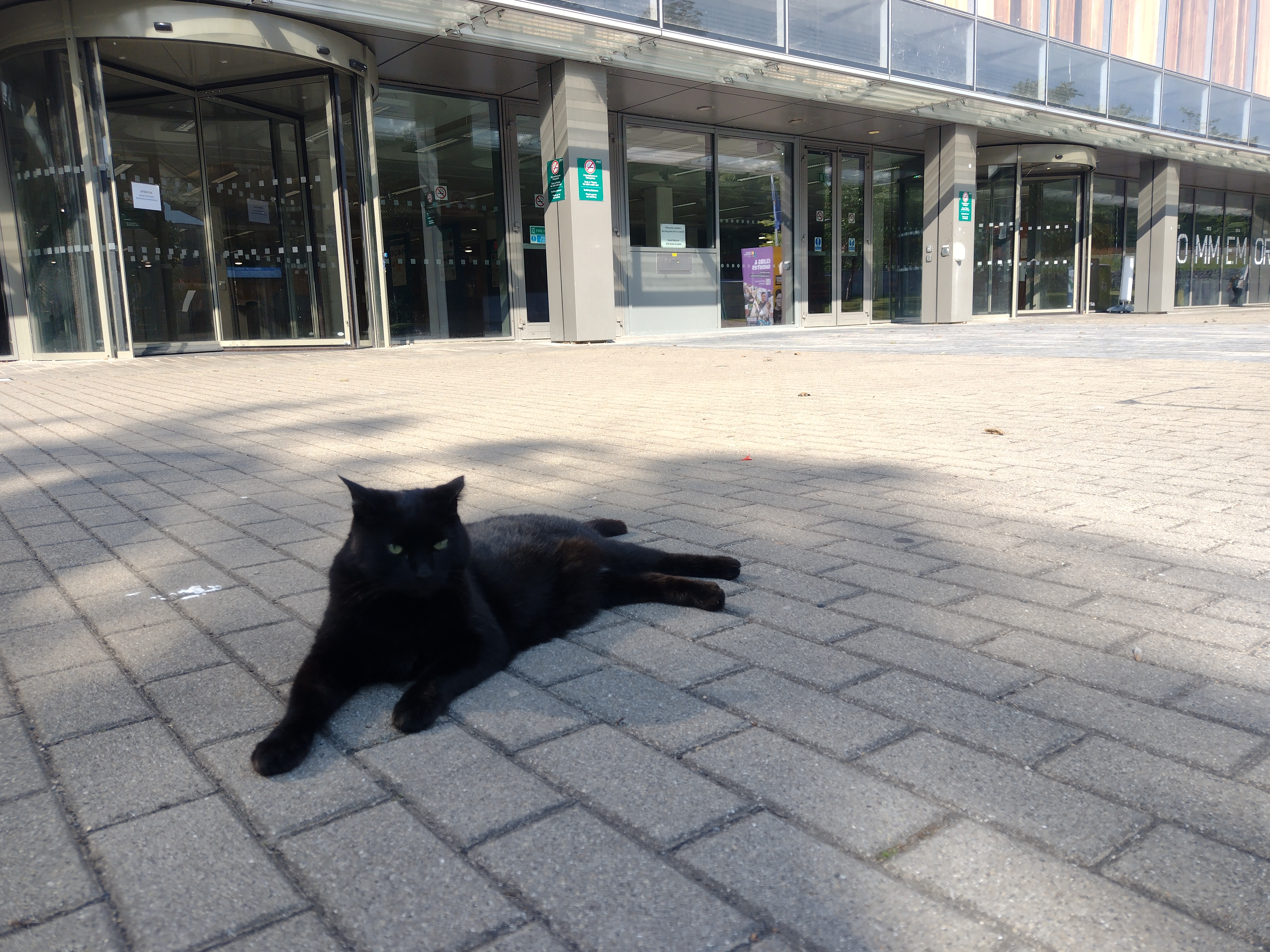
Maynooth University Library Cat Update

Posted in Maynooth with tags , , , on July 9, 2026 by telescoper

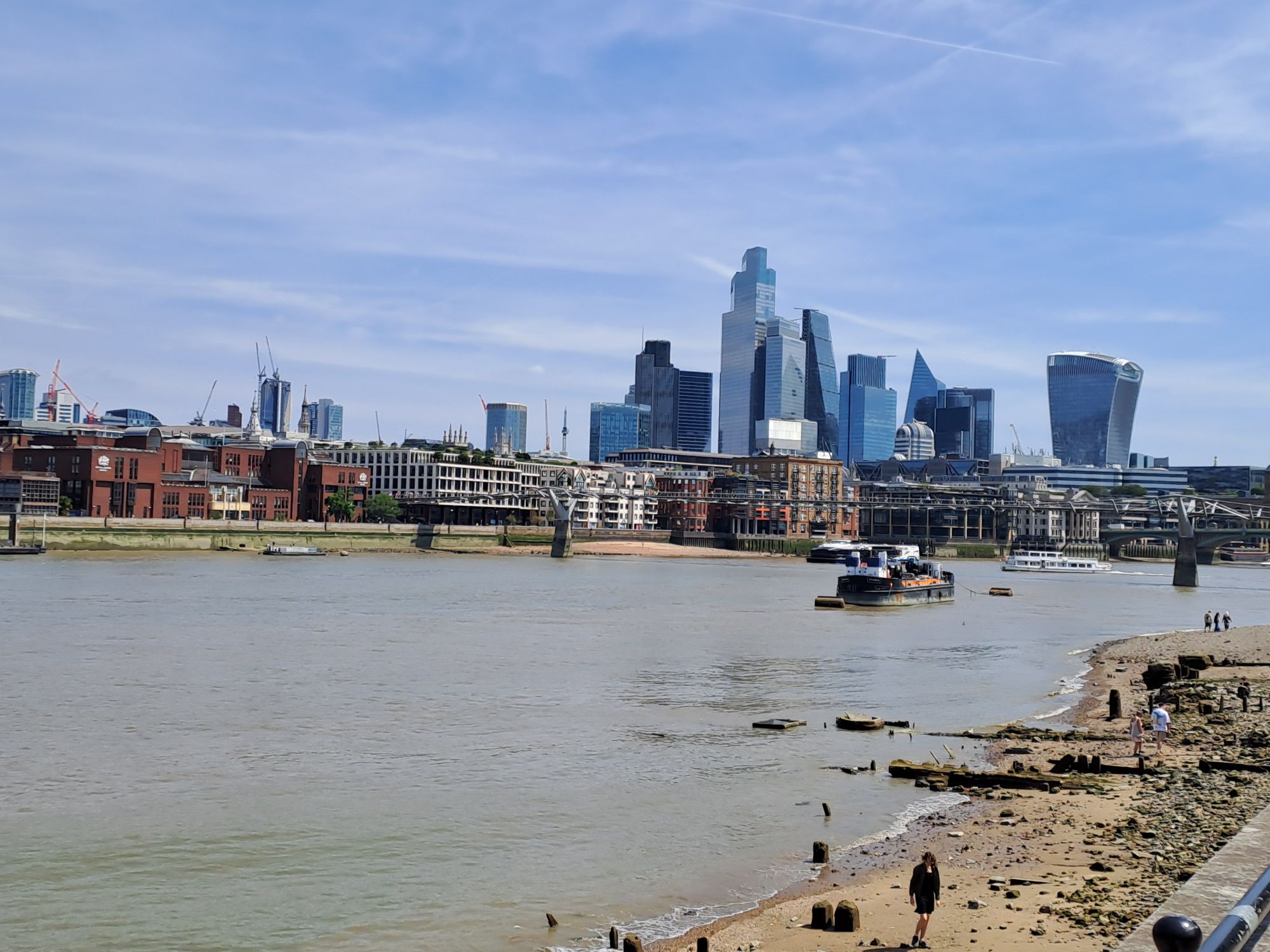
I’m not in Maynooth right now, but I gather it’s warm there. Not perhaps as warm as here in London (34°C), bit still a bit warm to be wearing a fur coat. Still, it seems that Maynooth Library Cat is surviving…

picture by Joost Slingerland

Invisible Rainbows, by Alfredo Carpineti

Posted in Biographical, LGBTQ+, Literature with tags , , , , on July 8, 2026 by telescoper

Today has been a very frustrating day from the point of view of travel – apparently it’s too hot for trains to function – but at least that gave me time to read the book Invisible Rainbows by Dr Alfredo Carpineti (left). This is an engaging and nicely written tour of what we know (and don’t know) about the Universe organized by wavelength of electromagnetic radiation, from radio through microwaves and infrared, to ultraviolet and X-rays to gamma rays. All the wavebands outside the range of human perception, in fact.

What makes this book different from others that have taken the same general approach is that he builds that fairly conventional narrative around conversations with LGBTQIA+ scientists to demonstrate how diverse perspectives have contributed to the advancement of astronomy, astrophysics and cosmology.

There are even a couple of quotes from yours truly, but it’s not just for vanity’s sake that I’m very happy to see this book published. It’s very nicely written and offers a very new perspective on science as a human endeavour. This definitely the first astrophysics book I’ve seen with a dedication “For all the queer kids reaching for the stars”. I guess I was one of those once! The book is at times humorous, even cheeky, but always driven by a passion for astrophysics and the celebration of human diversity. I wish I had I time to read it before Pride Month, but I’m nevertheless very proud to have featured even in a tiny way in such a delightful book.
Progress at Pride

Posted in Biographical, LGBTQ+ with tags , on July 7, 2026 by telescoper

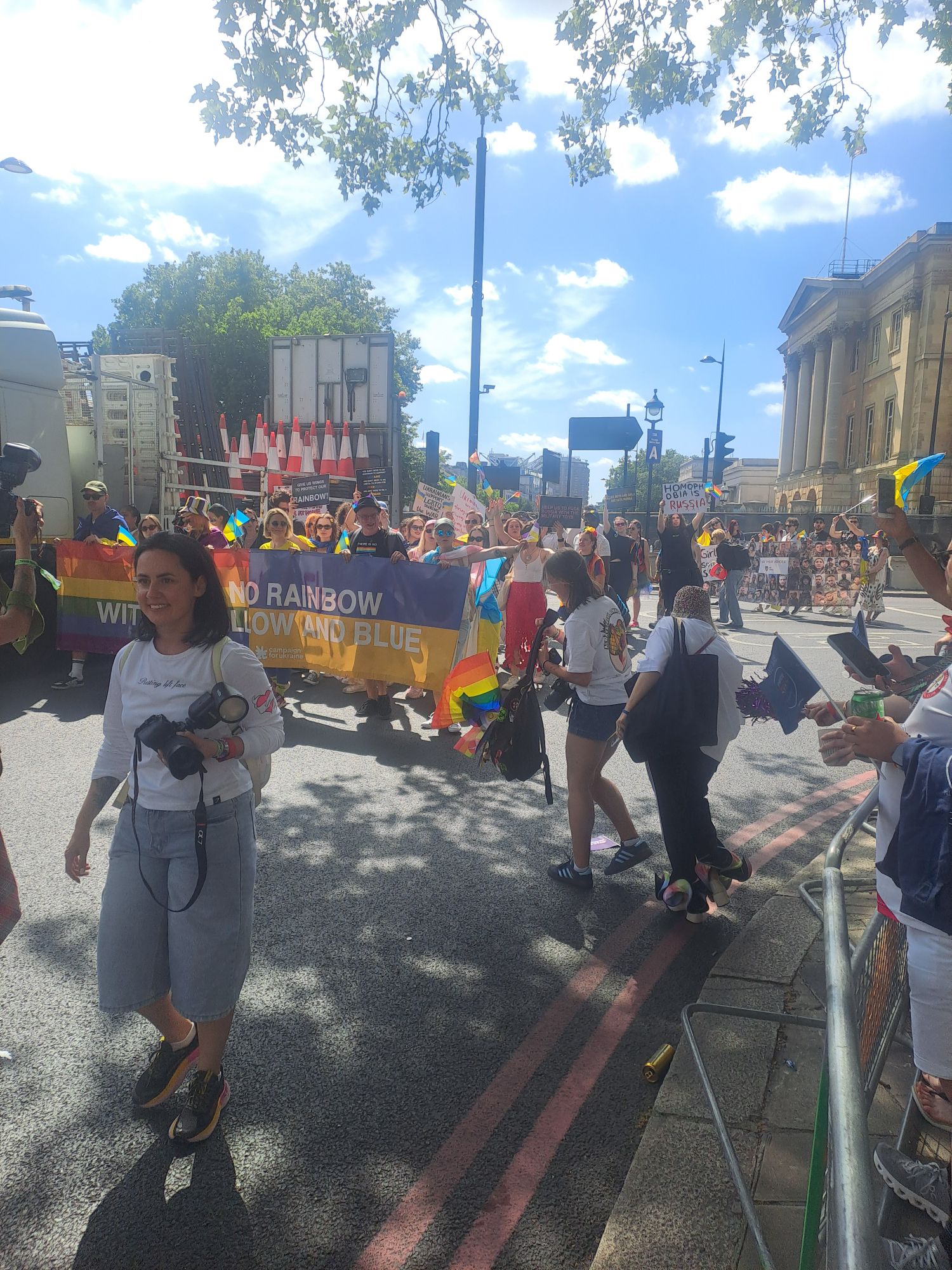
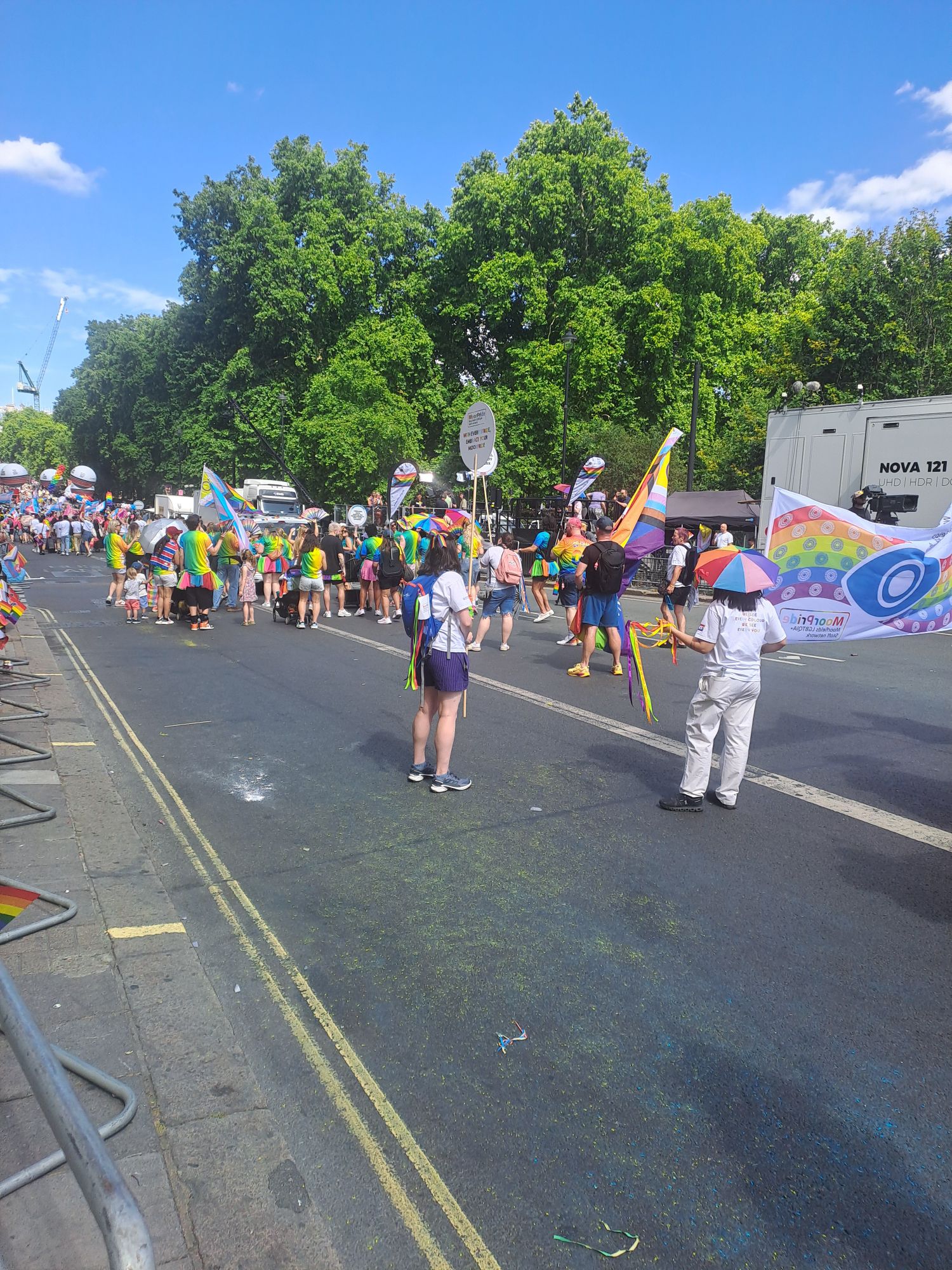
It’s been three days now since Pride in London and I think it’s time to post a few pictures to show I was actually there.

My partner took a bit of persuading to come along – he’s not out (for good reasons) and does not like the idea of having pictures on the internet. He detests social media too and, unusually for a person his age, has no instagram or tiktok or anything else.

He thought it would be hard to avoid being pictured. Anyway, we found a fairly unobtrusive spot and although he was a bit nervous at first he soon relaxed and started to enjoy it. Some people took pics of the crowds lining the route, but there was a convenient tree for him to hide behind. We stayed several hours, actually, and the parade was still passing our place at the end of Piccadilly when we left, so it must have been a very long parade.

A wonderful thing happened, halfway through our stay at the Parade: we held hands in public for the first time. That may not seem much but it meant a great deal to me. I often hear people saying that Pride is no longer needed, but remember that not everyone has an understanding family or grew up in an accepting environment. It’s taken two and a half years to get this far. It’s not the sort of “progress” that the “pride progress” flag is supposed to represesent, but it’s progress nonetheless.

Henry Moore at Kew Gardens

Posted in Art, Biographical with tags , , on July 6, 2026 by telescoper

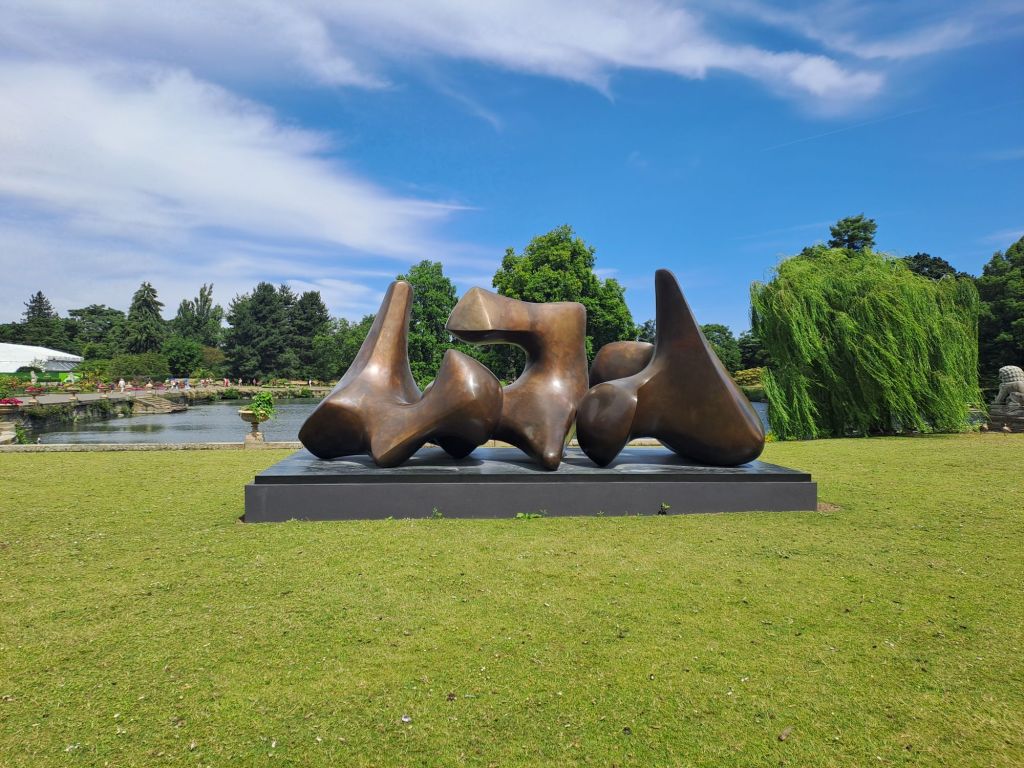
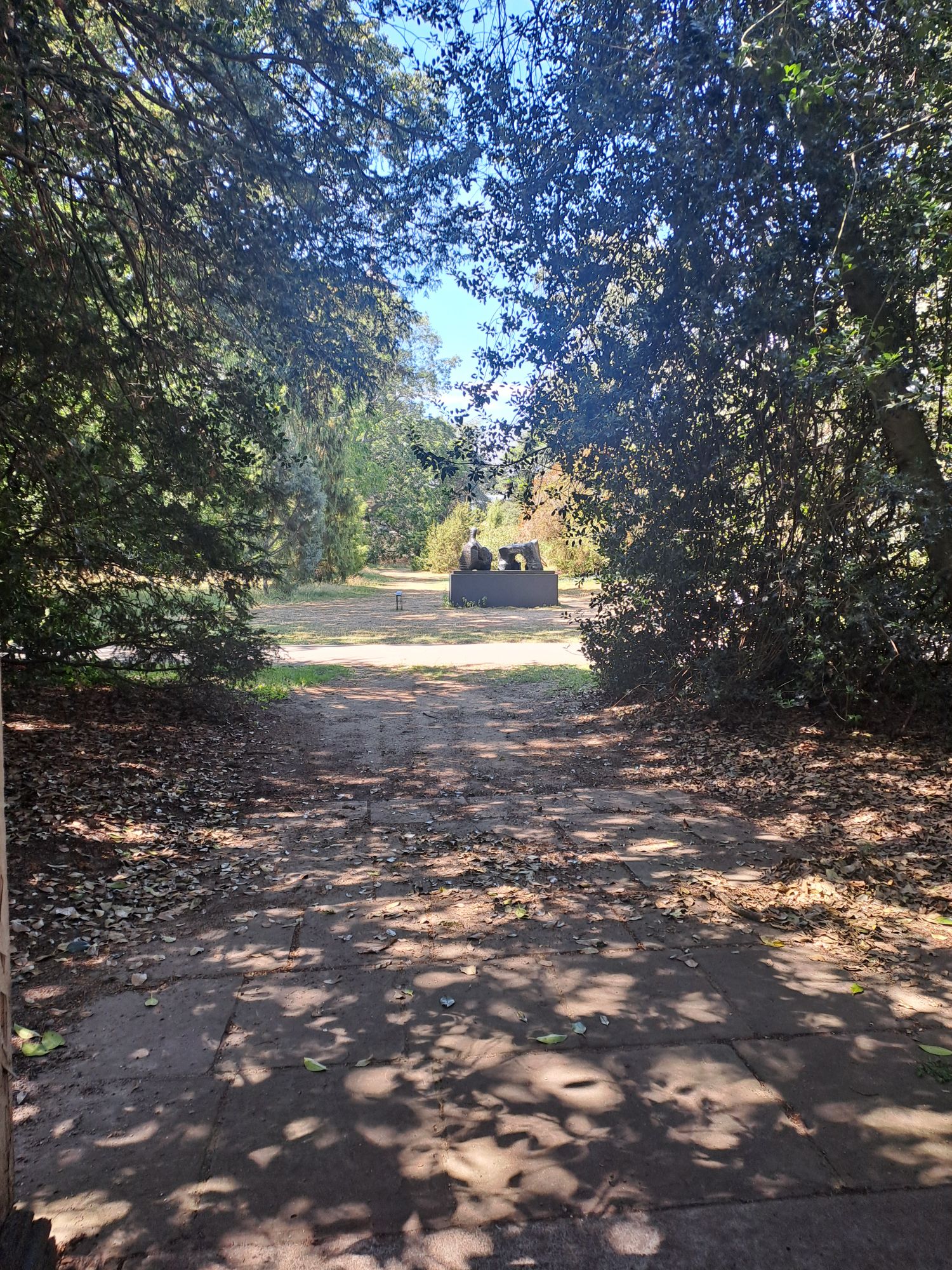
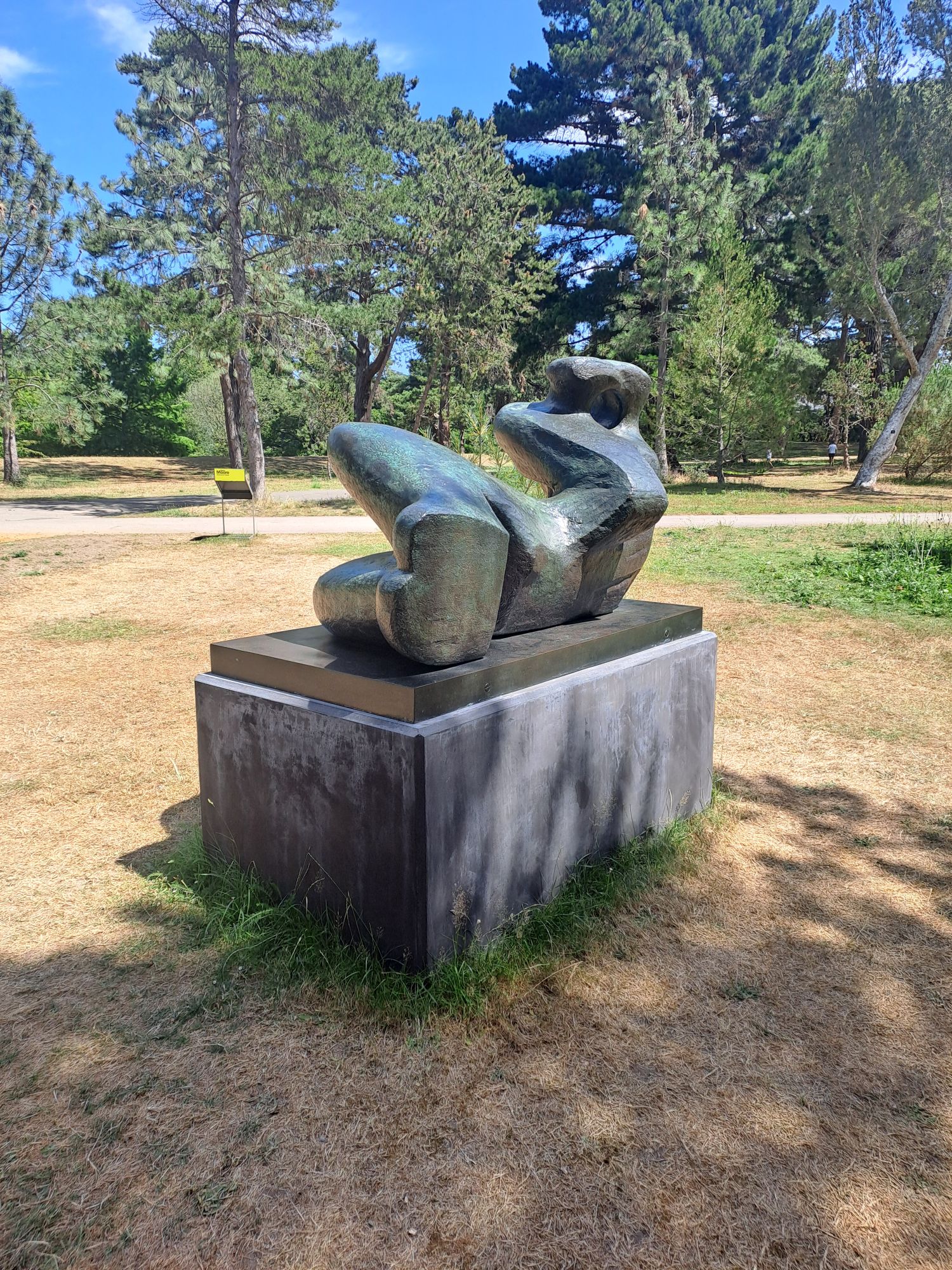
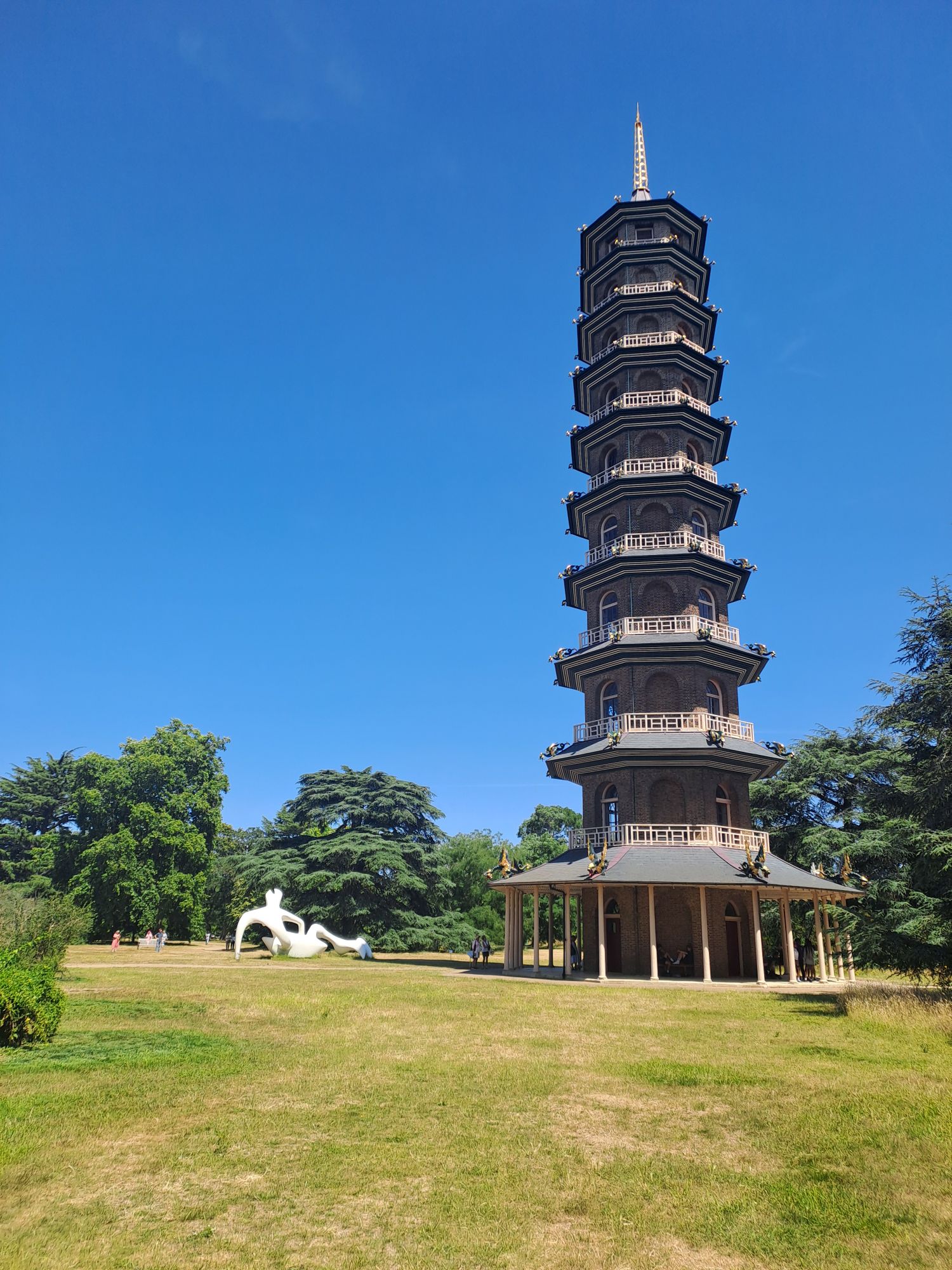
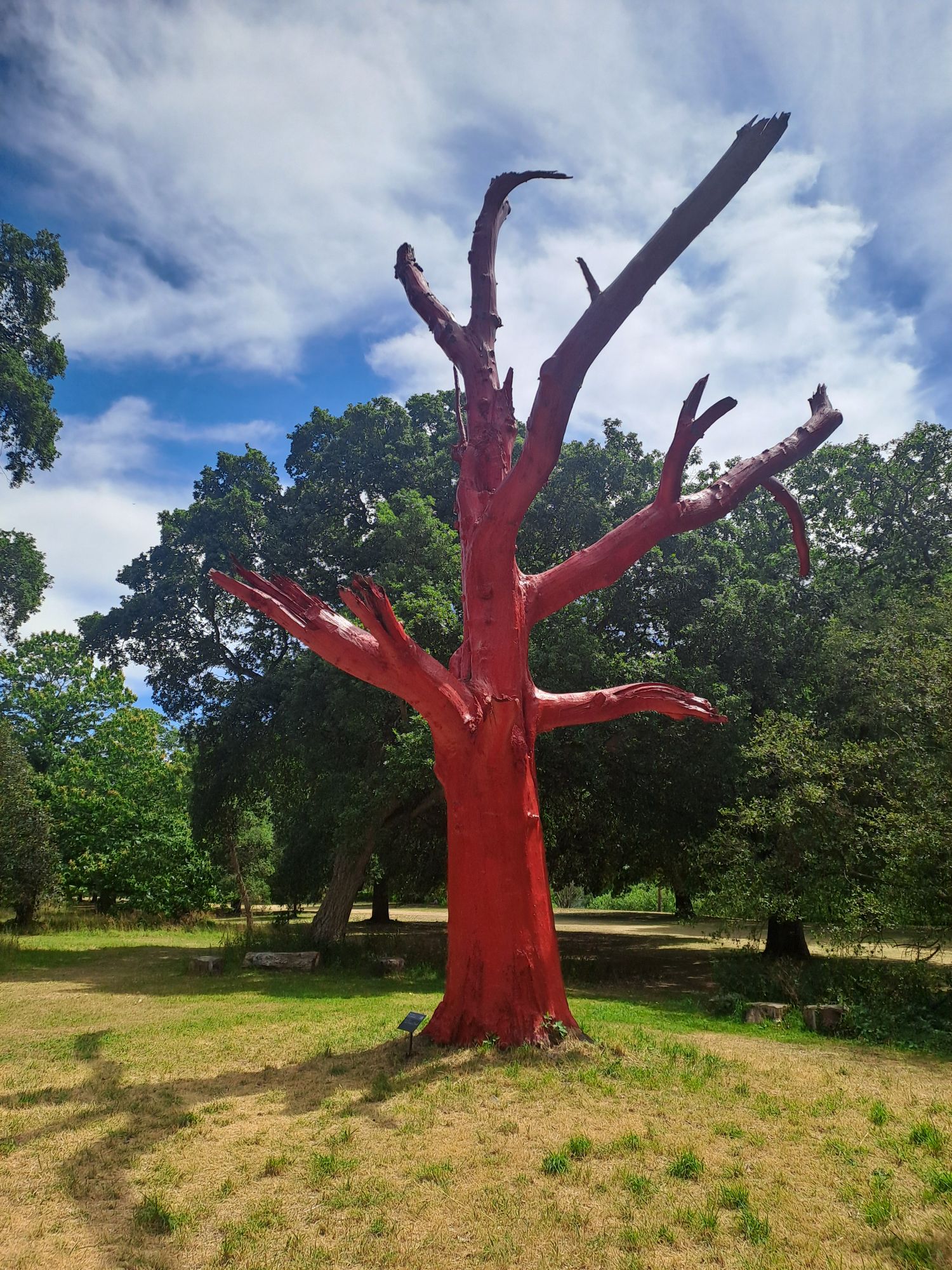
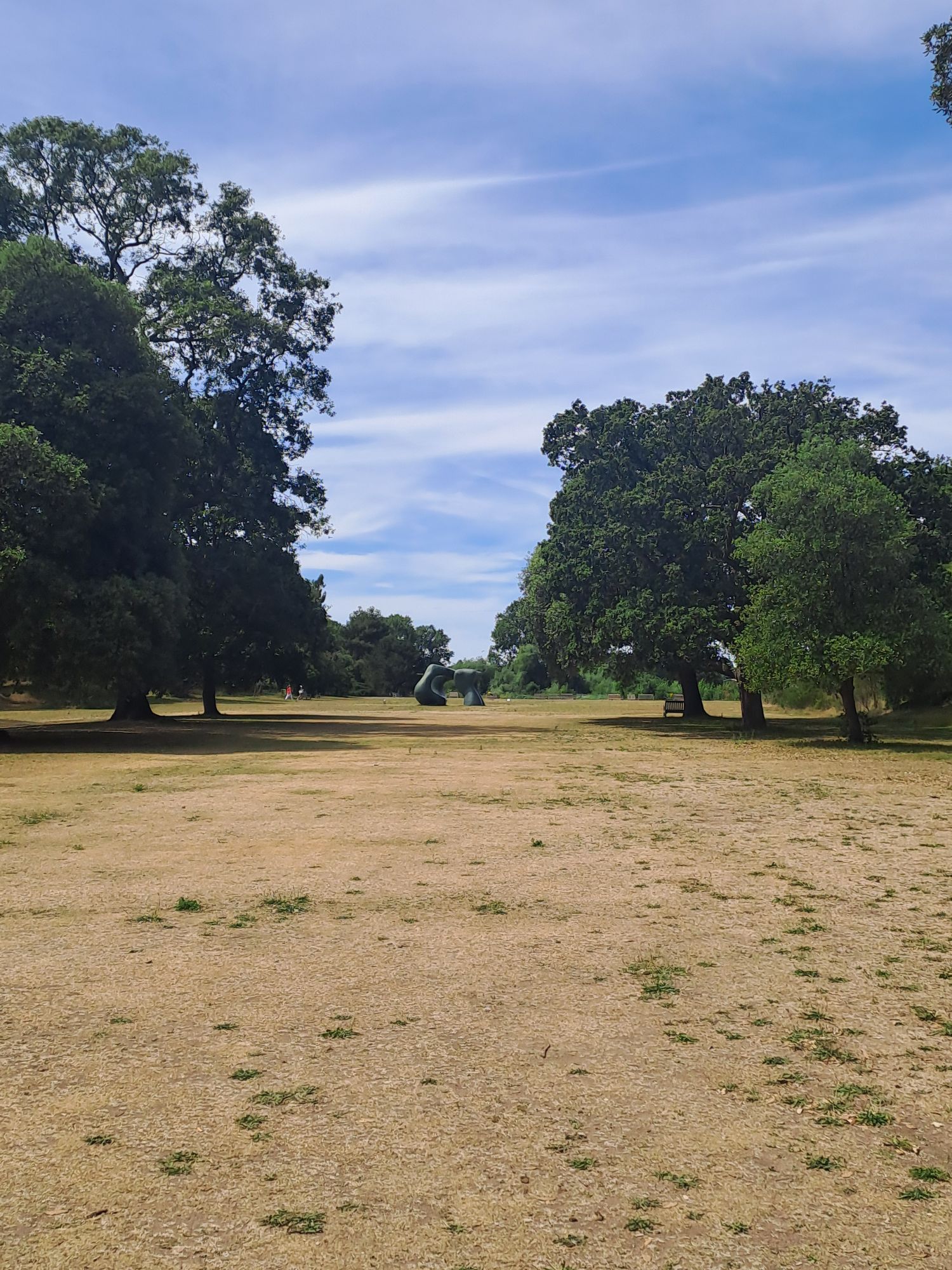
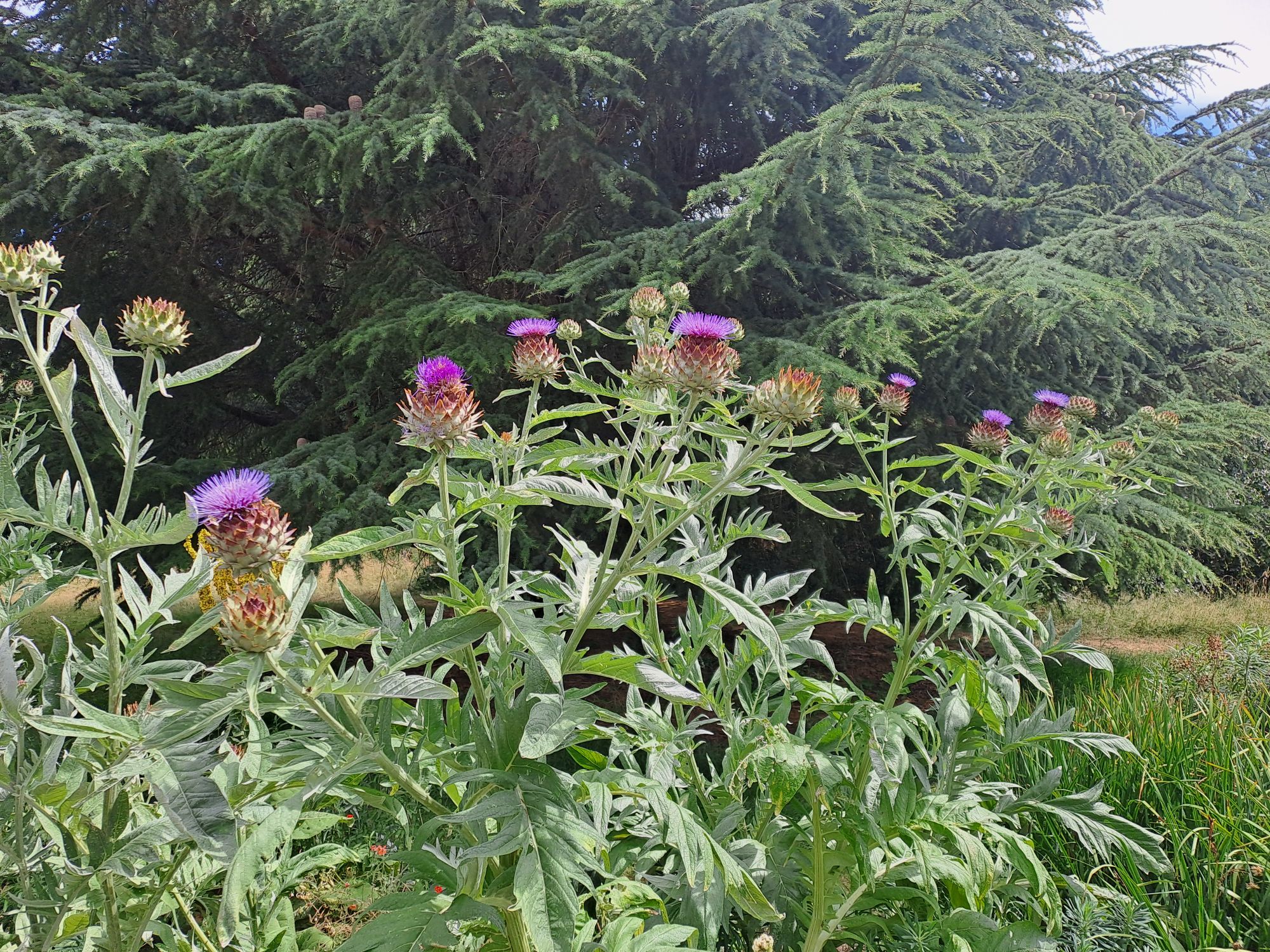
Another warm day in London found us taking the shortish trip by Tube to Kew to see not only the magnificent botanical gardens but also the large collection of sculptures by Henry Moore dispersed throughout. Here are a few snaps I took on the way around. As you can see in the pictures, the gardens are looking a bit parched.

It’s more than 30 years since I was last at Kew Gardens, so I didn’t remember the way round very well. We ended up spending about four hours there, including a stop for tea at the Orangery which, I’m delighted to say, was served properly, in a pot, with nice cups and saucers and milk in a little jug. The last time I saw works by Henry Moore in an outdoor setting was back in 2011; see this post.

Though not many people have gardens as extensive as Kew, they are very helpful in assisting domestic gardeners with hints and suggestions of things to plant in different spaces: dry, damp, sunlit, shady, you name it.

Anyway, it was a really lovely day for all kinds of reasons. I know it’s corny but I was reminded of that song by Lou Reed:

just a perfect day
you make me forget myself
I thought I was someone else
someone good

After picking up his things from the hotel we went to Paddington where I saw my weekend companion onto the train for Heathrow. I’m a bit sad to be on my own again, but it won’t be long until the next time…and the next place.

Whistler at Tate Britain

Posted in Art, Jazz with tags , , , , , on July 5, 2026 by telescoper

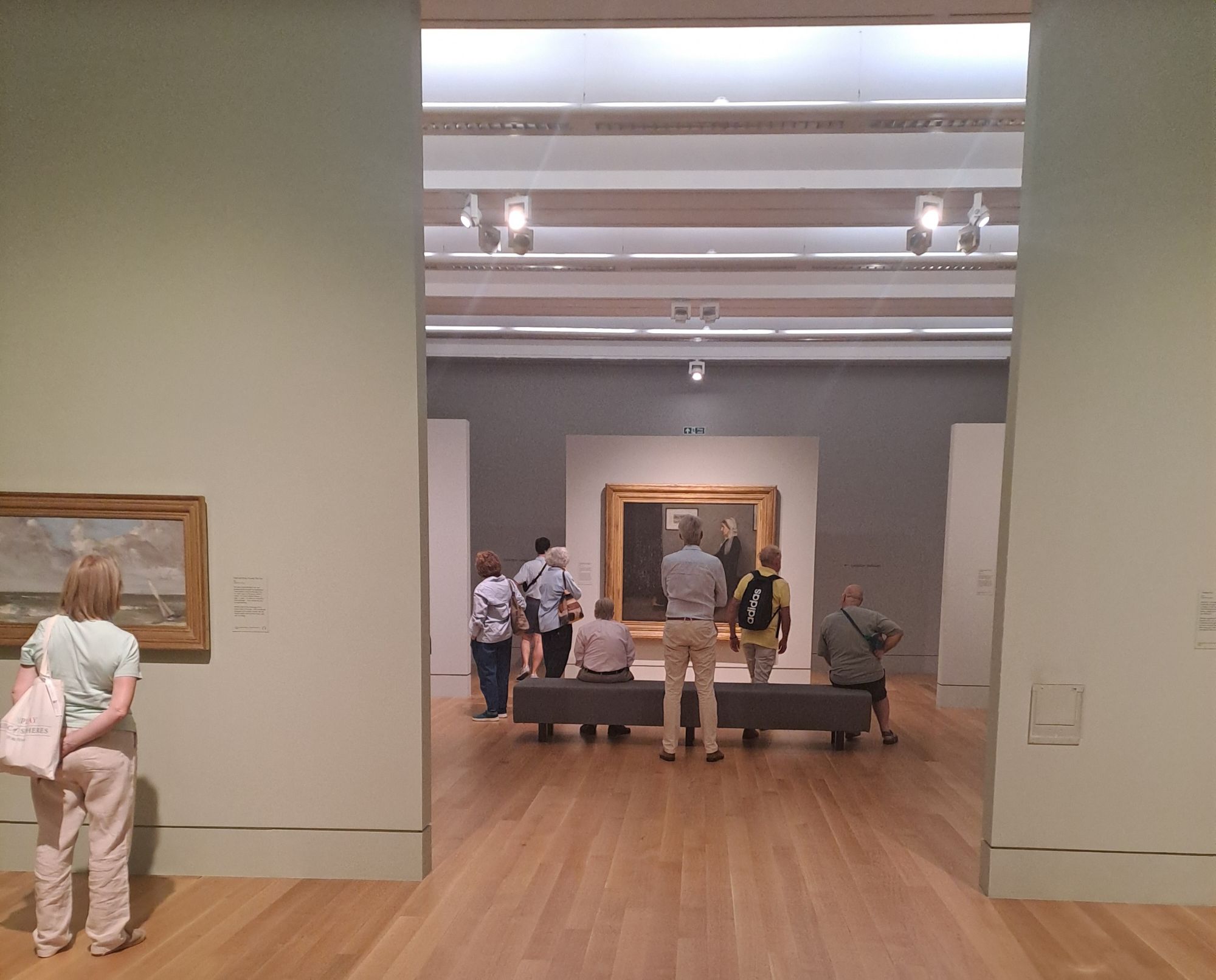
Back to the hotel for a short siesta after spending most of the day at Tate Britain, where there is a special exhibition of works by and about James McNeill Whistler. The main collection at Tate Britain is free, but the Whistler exhibition costs £24 to see. It’s well worth it though.

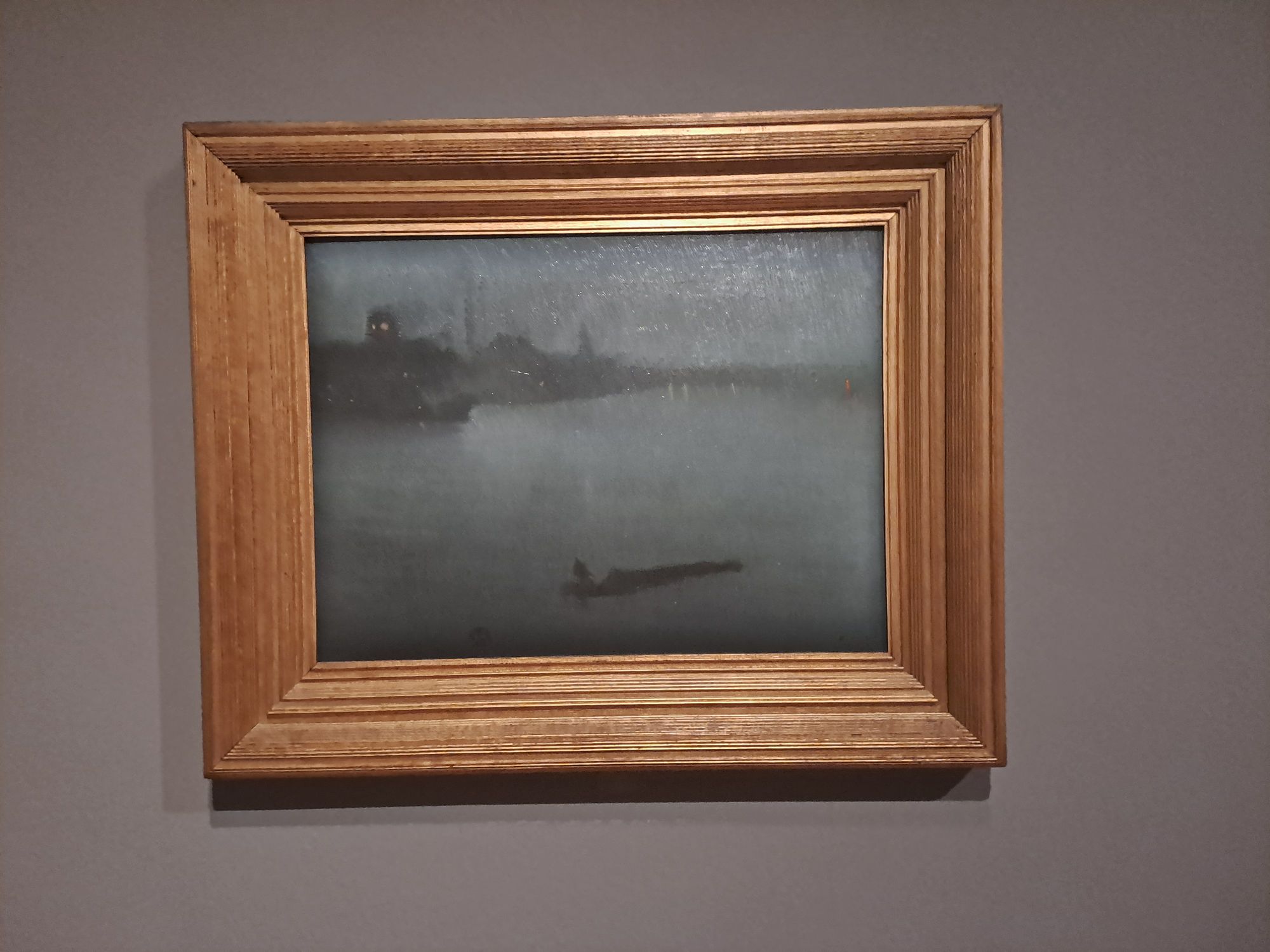
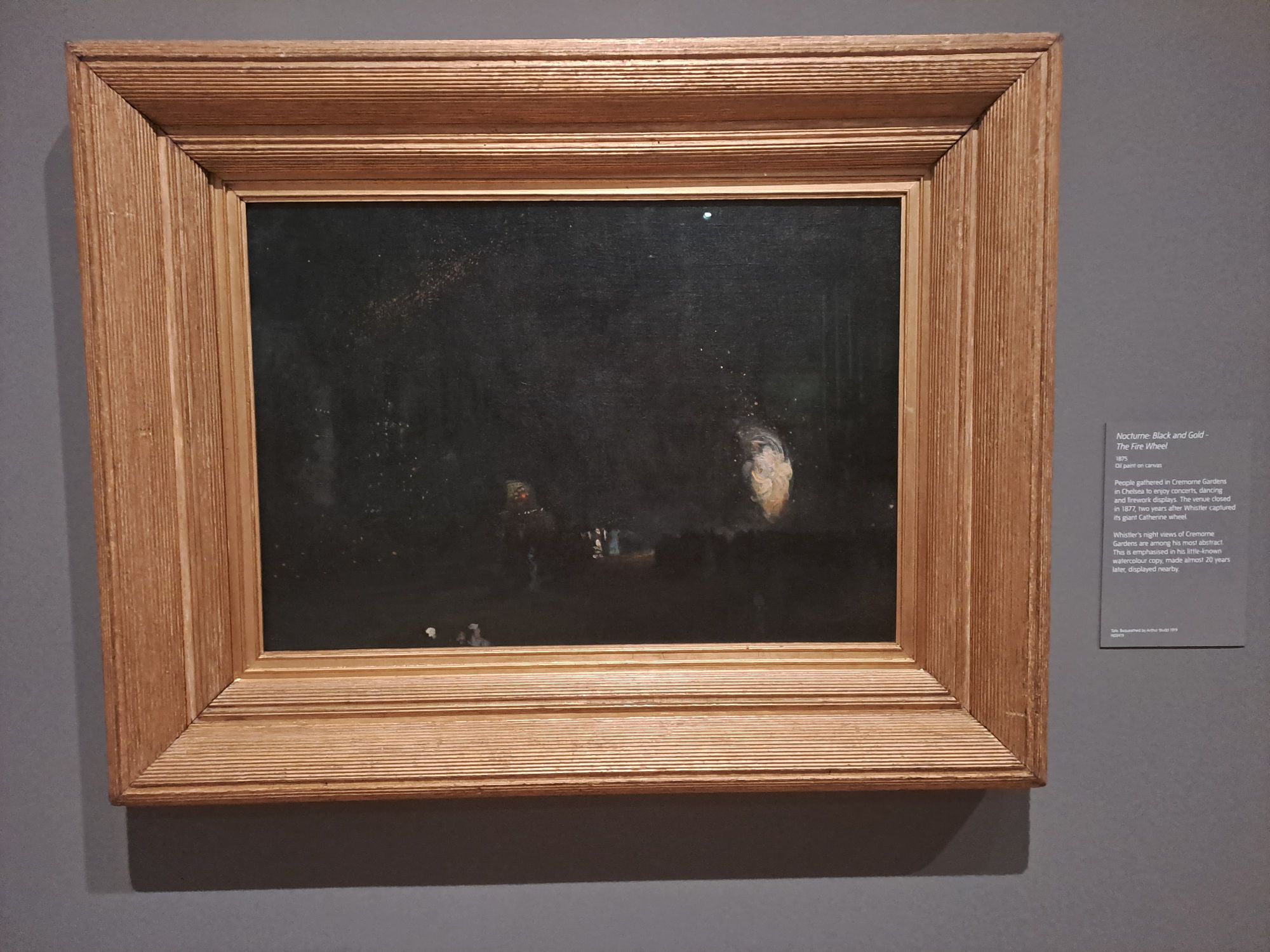
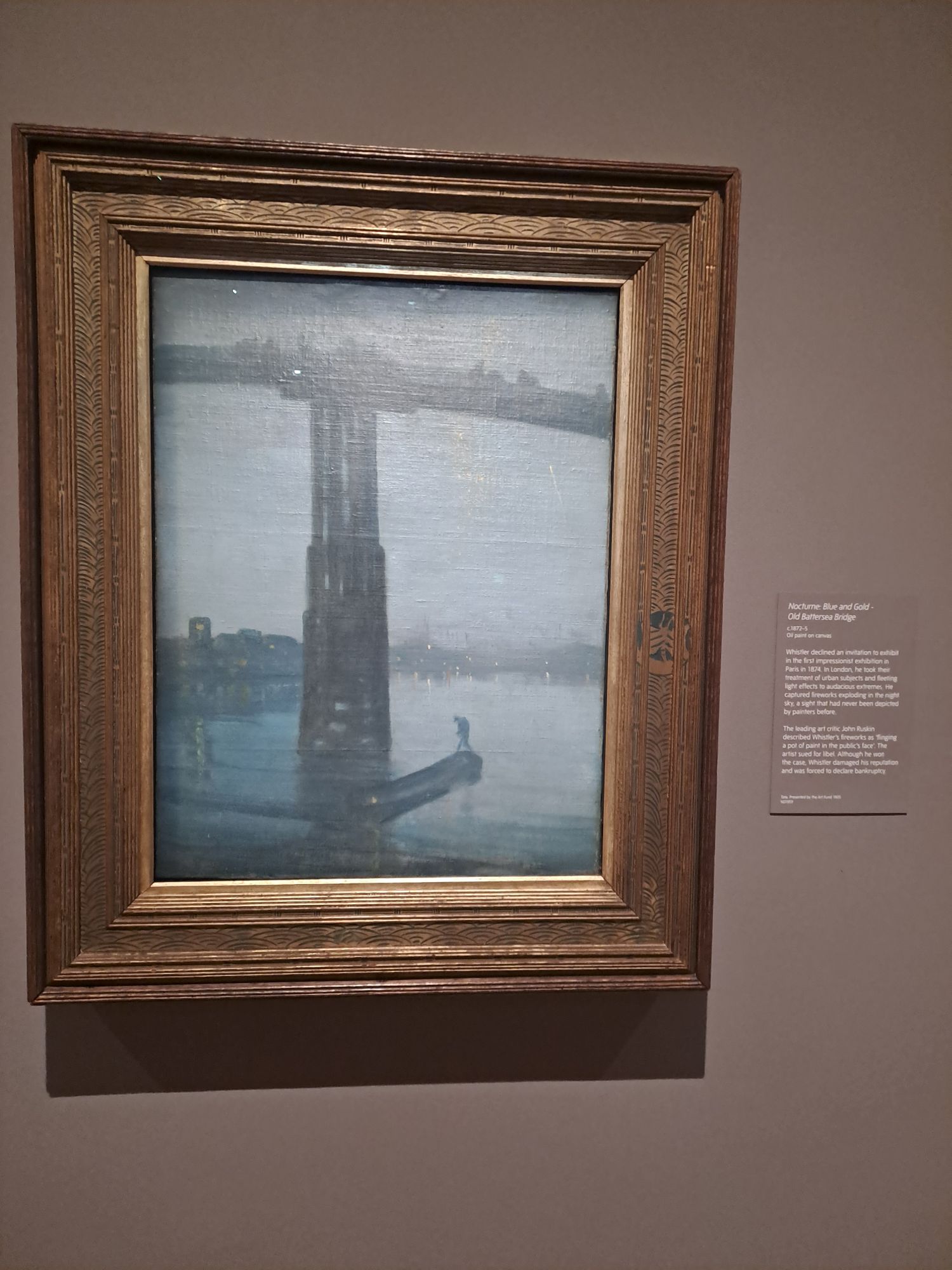
The first picture shows Whistler’s famous portrait of his mother, who seems to be holding court. My favourite pieces, however, the Nocturnes, two of which I have mentioned on this blog before. There are three shown below, but photographs don’t do them justice at all. The appearance of the paint when seen close up is quite remarkable, a sort of translucent quality to it even when the picture is very dark. Whistler was one of the first artists to really master painting in the dark without using moonlight or other obvious illumination.

The last of these is particularly interesting to me. When the great American songwriter Billy Strayhorn saw the beautifully evocative painting (above) of one of the bridges over the River Thames, it inspired him to write an equally evocative song to be performed by his longstanding musical collaborator and friend Duke Ellington. The song was written in 1941, but it was only years later that he realized that he had named it after the wrong bridge. The painting was of Battersea Bridge; but he had named the song  Chelsea Bridge, a much less romantic location. Chelsea Bridge is an intriguing tune, based on minor sixth chords voiced via their third inversions, it sounds almost atonal but very evocative, just like the painting.

In one of the video segments played during the exhibition we hear the actor Anton Lesser quoting Whistler with words the effect that he saw colours like notes on a keyboard; he started naming his paintings after musical works, e.g. “Symphony in White” before he got to his masterpieces, the Nocturnes.

I wrote about another of the Nocturnes here. Nocturne in Black and Gold, in the same series as the third picture above, is famous for having been at the centre of a libel case. The influential art critic John Ruskin hated it and accused Whistler of “flinging a pot of paint in the public’s face”. Whistler sued for damages (though he couldn’t really afford to). He won the case against Ruskin, but the outcome was financially disastrous for him because he was awarded only one farthing in damages and was bankrupted.

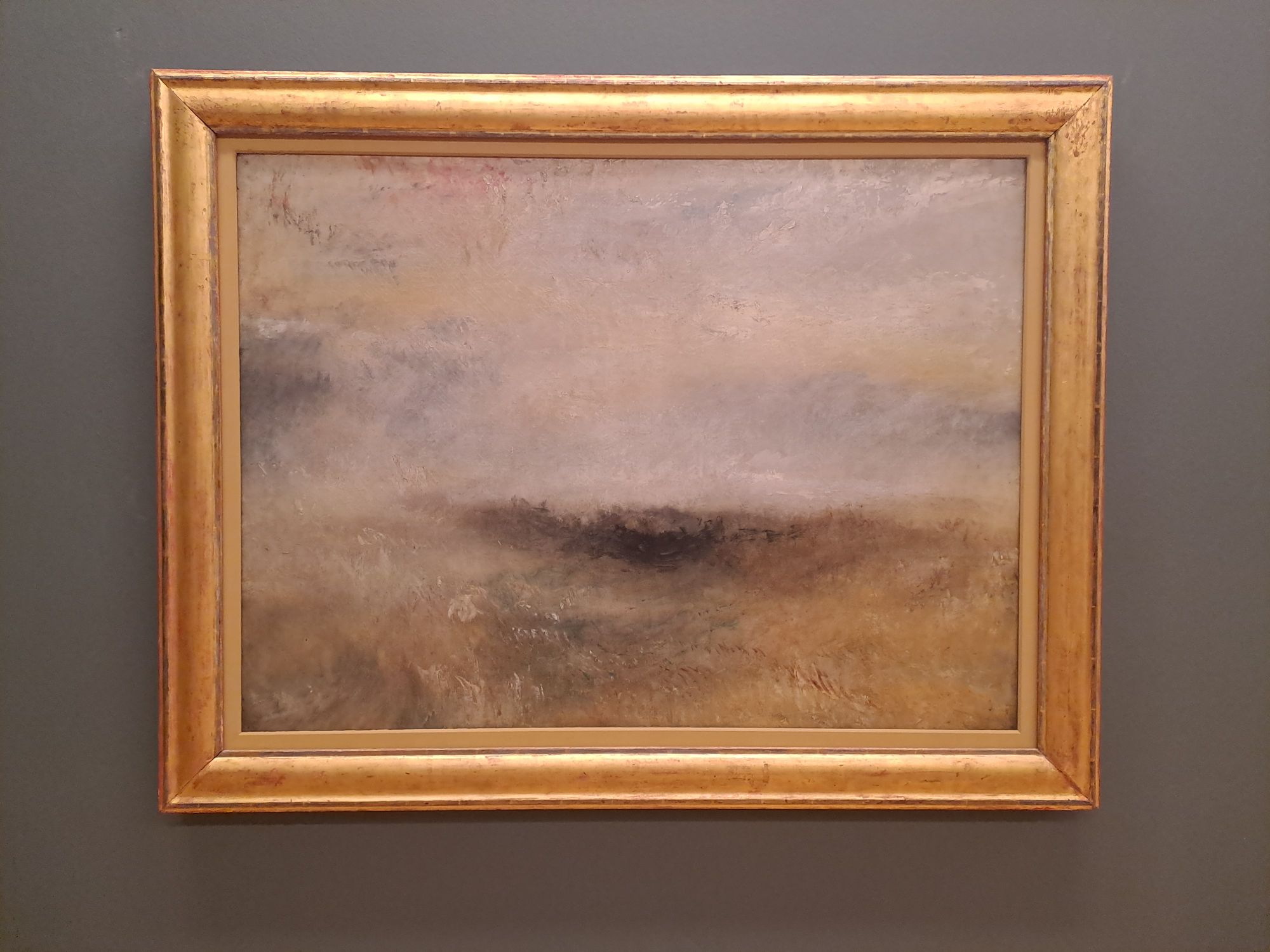
Tate Britain has an extensive permanent collection of primarily English art from about 1600 onwards, not least a huge collection of works by J.M.W. Turner. It’s fascinating to see so many of these together, charting this extraordinary artist’s evolution from brilliant if conventional upstart to pioneering impressionist. Along the way Turner’s interest in conventional themes began to wane in favour of the interplay between sea and clouds, to the extent that his works began to look like abstracts. There is in my mind a strong influence on Whistler. This one, ostensibly a seascape with a distant shore, reminds me of Rothko.

The Victoria and Albert…

Posted in Art, Biographical with tags , , , , , on July 4, 2026 by telescoper

I can’t remember when I was last in the Victoria and Albert Museum but it’s long enough ago for me to have forgotten how big it is. It being free to get in and very near to why I am we are staying it was an easy decision to head there this morning before going to the Pride festivities. In fact it was so enjoyable and so extensive we were a bit late leaving. It’s definitely well worth a visit if you’re in London.

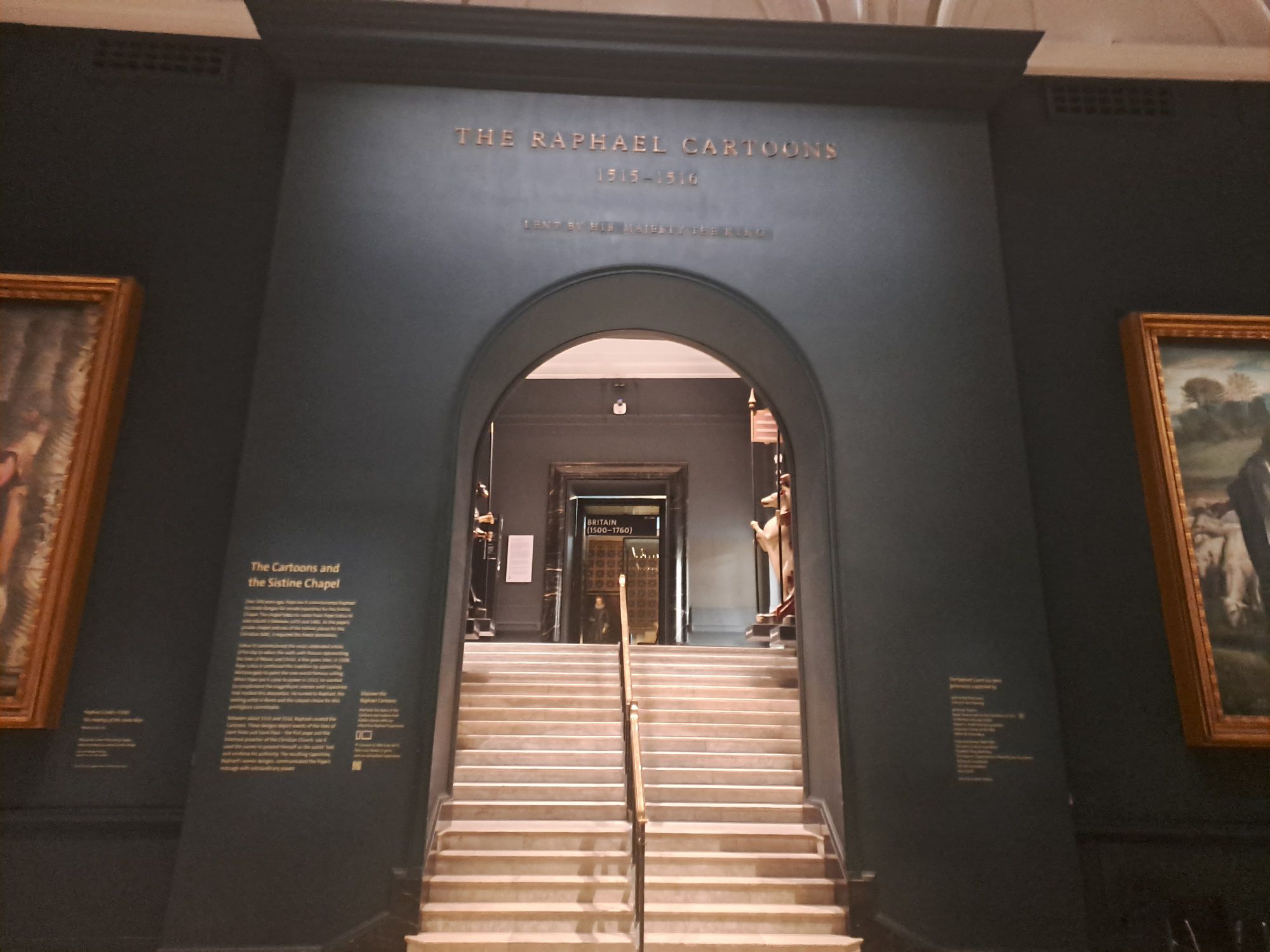
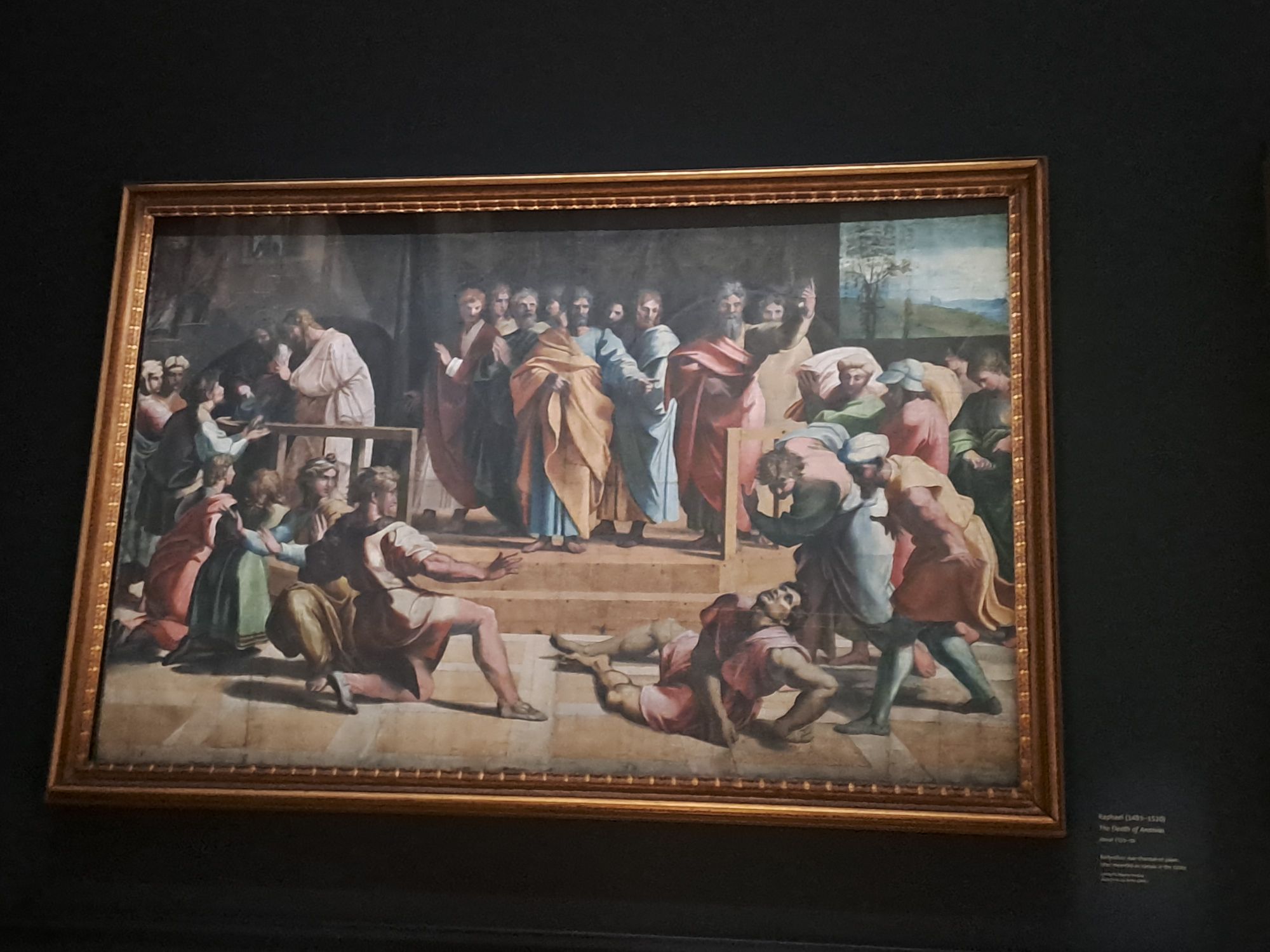
I remember the Raphael Cartoons from when I was last at the V&A. They’re very well done – an example is on the right below – but I didn’t find them very funny. In fact I couldn’t see the joke in any of them!

Just so you don’t think I’m a complete ignoramus, the “cartoons” are complete designs for tapestries – they would be placed underneath the loom as a template for the weavers to follow. Incidentally, the Bayeux “Tapestry” – currently on display in the British Museum – is not a tapestry at all. Being stitched rather than woven, it’s an embroidery not a tapestry. The Raphael cartoons were made for tapestries that hang on the walls in the Sistine Chapel in the Vatican, intended to complement Michelangelo’s famous ceiling. I still don’t know who did the floor.

I’m not very good at taking pictures in galleries, especially when I’ve got company as I had today, but in the light of yesterday’s post I couldn’t resist this:

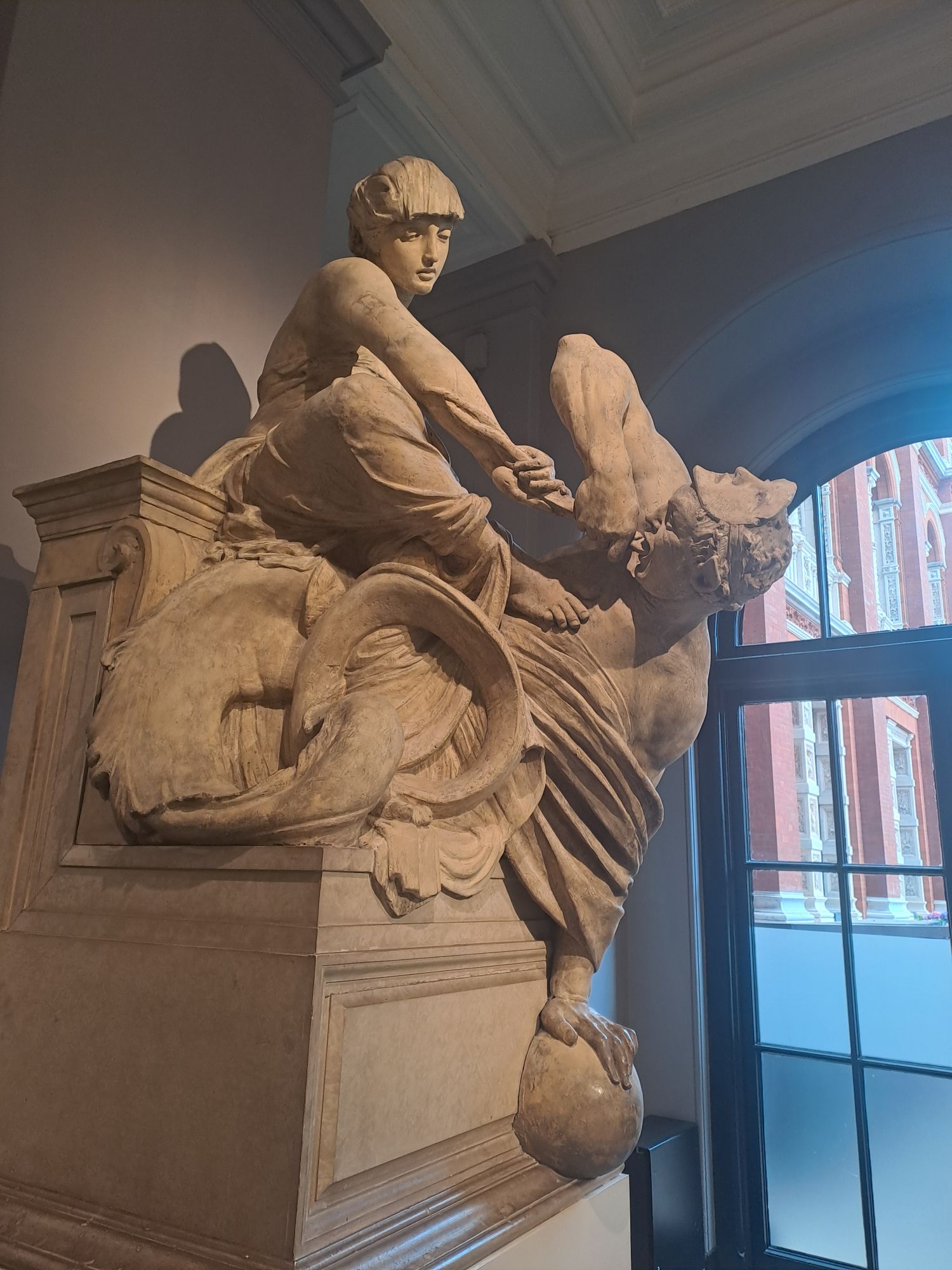
It’s a plaster study by Alfred Stevens for a sculpture that would form part of the memorial to the Duke of Wellington in St Paul’s Cathedral. It’s called Truth and Falsehood (there is another called Valour and Cowardice).

In this work Truth tears out the double tongue of Falsehood and pushes aside the mask concealing his grotesque features. His serpent-tails are exposed beneath the drapery. 

Another thing I was reminded of by today’s visit is the prominent role played in the early days of the Victoria & Albert Museum in South Kensington by the artist Frederic Leighton, who featured in a recent post.

Weekly Update from the Open Journal of Astrophysics 04/07/2026

Posted in OJAp Papers, Open Access, The Universe and Stuff with tags , , , , , , , , , , , , , , , , , , , , , , , , , , , , , , on July 4, 2026 by telescoper

It’s Saturday again so it’s time for another update of activity at the Open Journal of Astrophysics. Since the last update we have published a further seven papers, bringing the number in Volume 9 (2026) to 136 and the total so far published by OJAp up to 584.

I will continue to include the posts made on our Mastodon account (on Fediscience); these announcements also show the DOI for each paper.

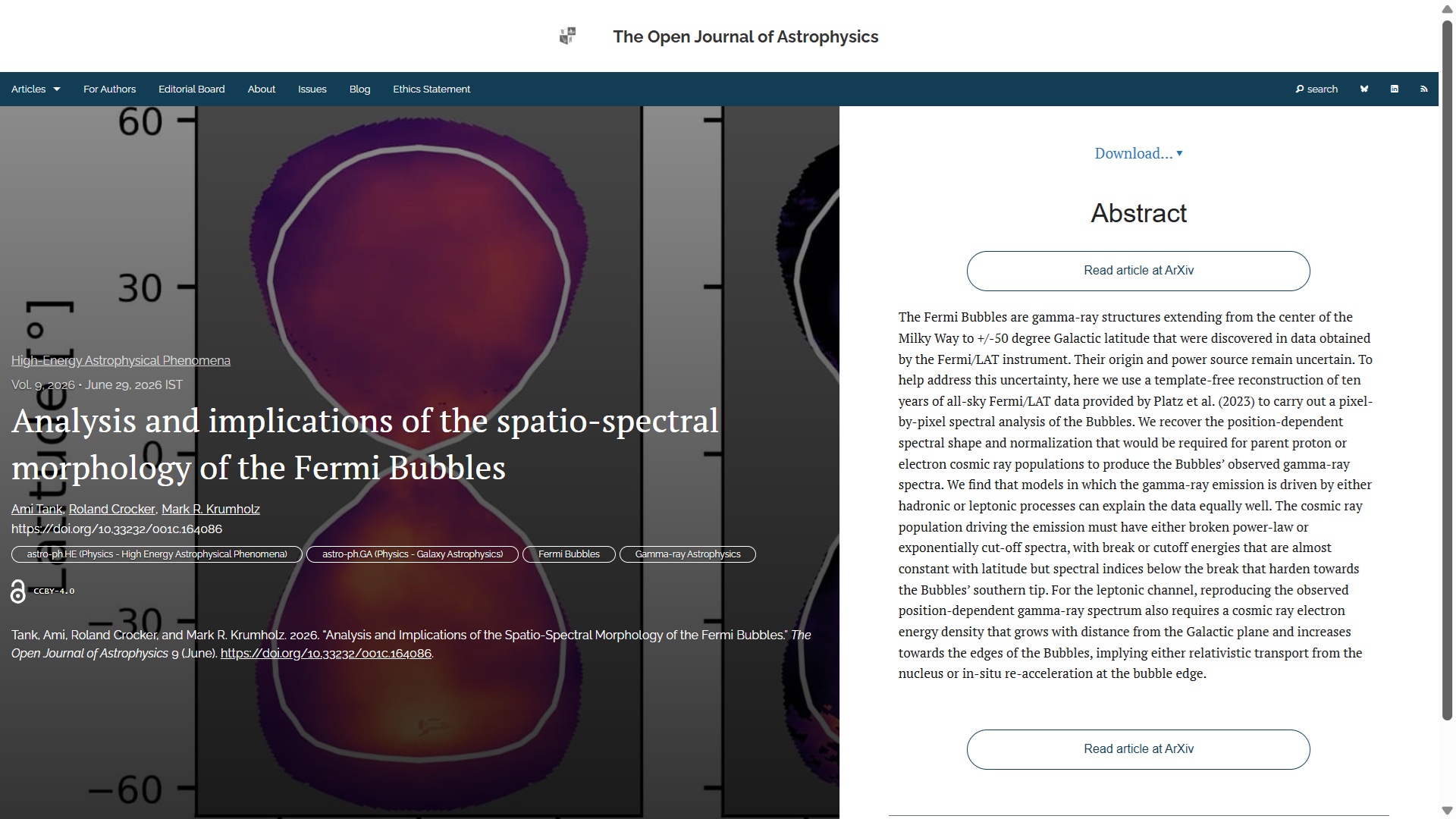
The first paper to report this week, published on Monday 29th June, is “Analysis and implications of the spatio-spectral morphology of the Fermi Bubbles” by Ami Tank (Indian Institute of Technology) and Roland Crocker & Mark R. Krumholz (Australian National University). Published in the folder High-Energy Astrophysical Phenomena, this paper presents an analysis of the gamma-ray structures of Fermi Bubbles in the Milky Way using a decade of data. The research suggests either hadronic or leptonic processes can explain the data.

The overlay for this paper is here

You can find the officially accepted version on arXiv here and the announcement on Fediverse here:

Open Journal of Astrophysics

New Publication at the Open Journal of Astrophysics: "Analysis and implications of the spatio-spectral morphology of the Fermi Bubbles" by Ami Tank (Indian Institute of Technology) and Roland Crocker & Mark R. Krumholz (Australian National University)

doi.org/10.33232/001c.164086

June 29, 2026, 5:30 am 1 boosts 2 favorites

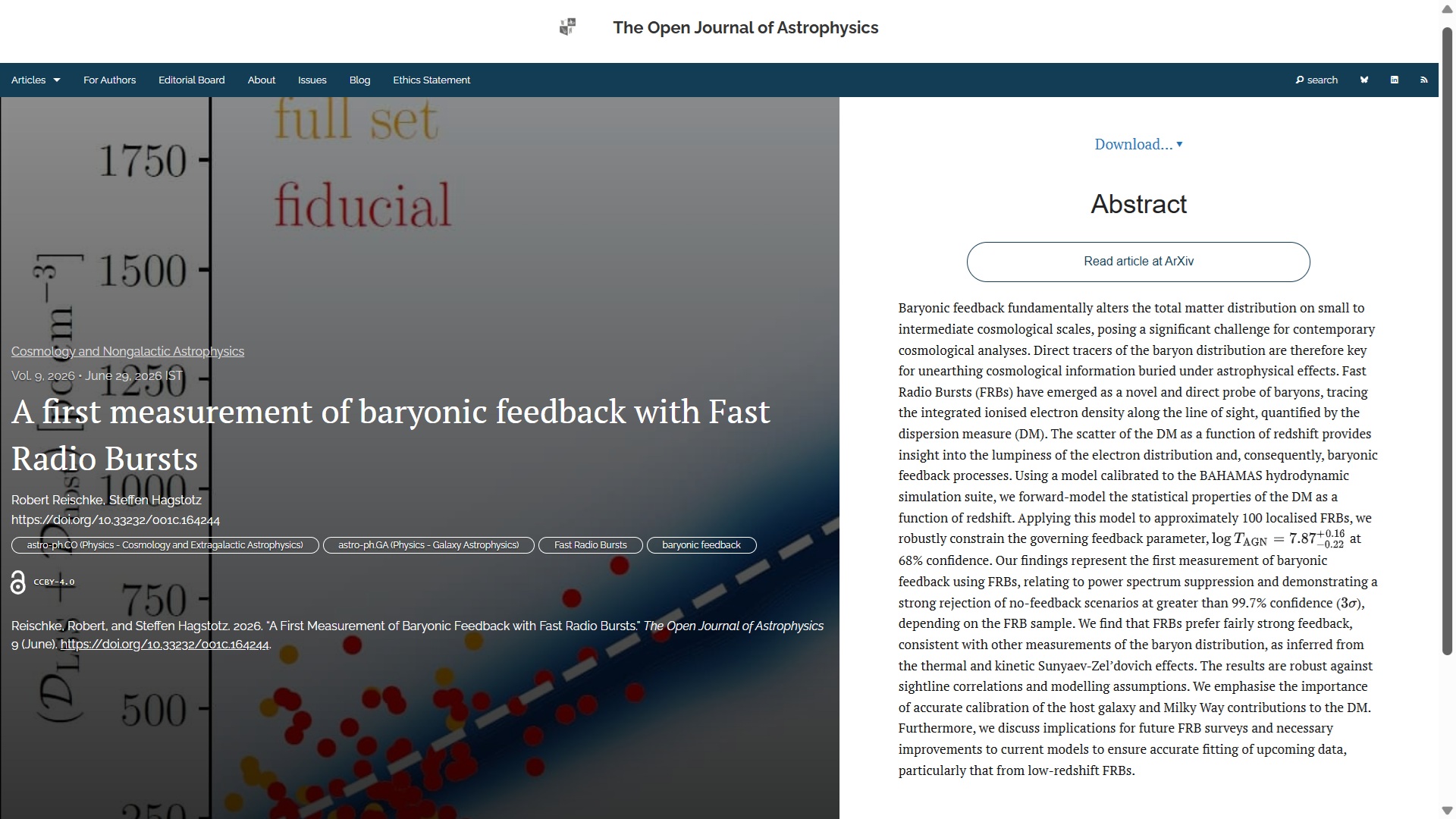
The second paper for this week, also published on Monday 29th June, but in the folder Cosmology and Nongalactic Astrophysics, is “A first measurement of baryonic feedback with Fast Radio Bursts” by Robert Reischke (Universität Bonn, Germany) and Steffen Hagstotz (Ludwig-Maximilians Universität München, Germany). This paper argues that Fast Radio Bursts (FRBs) provide a new method to trace baryon distribution and feedback in the cosmos, offering insights into matter distribution and rejecting no-feedback scenarios with high confidence.

The overlay looks like this:

The official version of the paper can be found on arXiv here and the Fediverse announcement here:

Open Journal of Astrophysics

New Publication at the Open Journal of Astrophysics: "A first measurement of baryonic feedback with Fast Radio Bursts" by Robert Reischke (Universität Bonn, Germany) and Steffen Hagstotz (Ludwig-Maximilians Universität München, Germany)

doi.org/10.33232/001c.164244

June 29, 2026, 5:50 am 2 boosts 2 favorites

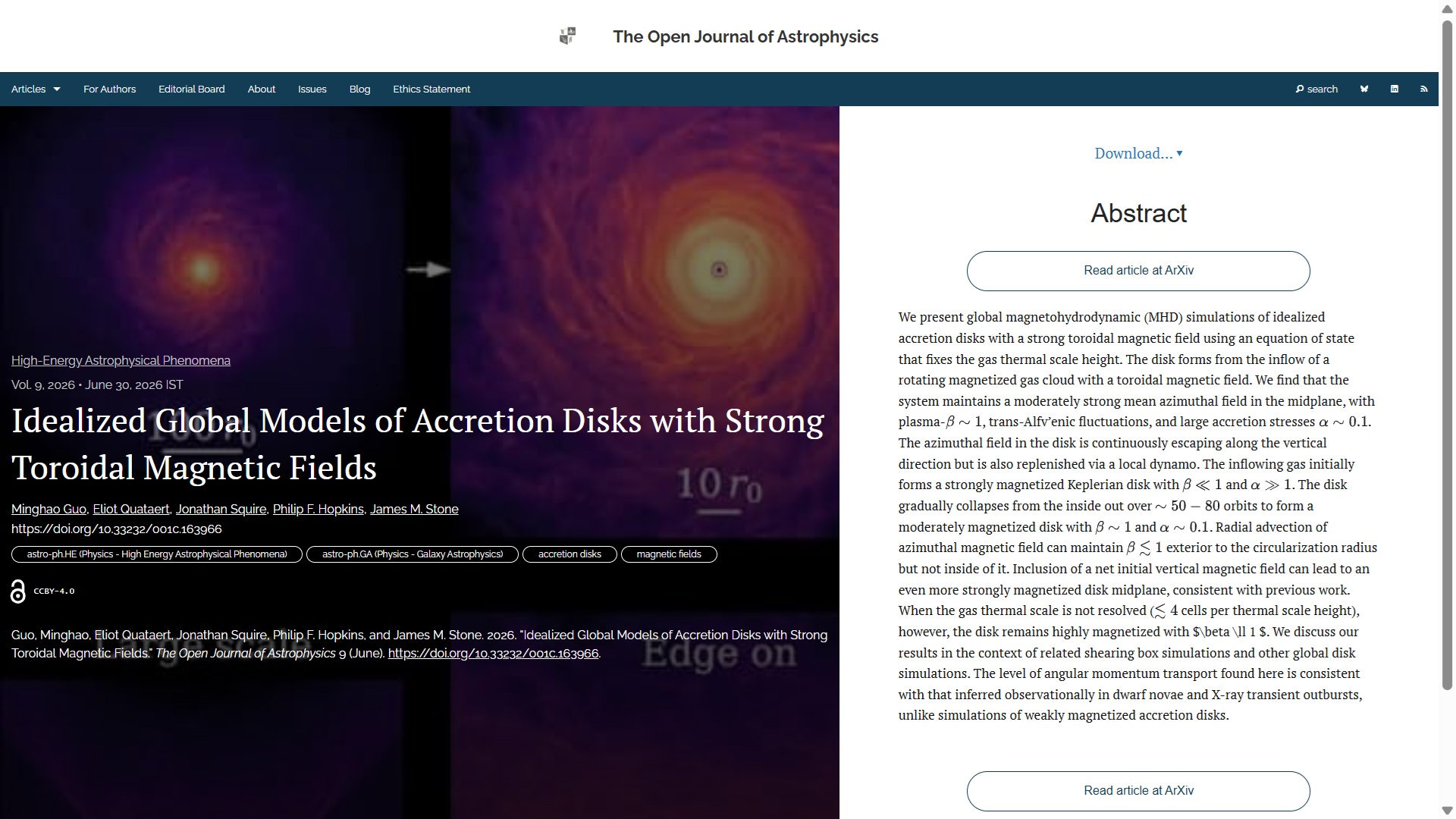
The third paper of the week, published on Tuesday 30th June in the folder High-Energy Astrophysical Phenomena, is “Idealized Global Models of Accretion Disks with Strong Toroidal Magnetic Fields” by Minghao Guo & Eliot Quataert (Princeton U., USA), Jonathan Squire (U. Otago, NZ), Philip F. Hopkins (Caltech, USA) and James M. Stone (Princeton). This study uses global magnetohydrodynamic simulations to explore the behavior of idealized accretion disks with strong toroidal magnetic fields, finding that these systems maintain a moderately strong mean azimuthal field.

The overlay for this one is here:

The final, accepted version can be found on arXiv here and the Mastodon announcement is here:

Open Journal of Astrophysics

New Publication at the Open Journal of Astrophysics: "Idealized Global Models of Accretion Disks with Strong Toroidal Magnetic Fields" by Minghao Guo & Eliot Quataert (Princeton U., USA), Jonathan Squire (U. Otago, NZ), Philip F. Hopkins (Caltech, USA) and James M. Stone (Princeton)

doi.org/10.33232/001c.163966

June 30, 2026, 6:32 am 1 boosts 3 favorites

The fourth paper of the week, published on Tuesday 30th June in the folder High-Energy Astrophysical Phenomena, is “On the effective spin-mass ratio relation of binary black hole mergers that evolved in isolation” by Sambaran Banerjee (Helmholtz-Instituts für Strahlen und Kernphysik, Germany) and Aleksandra Olejak (MPA Garching, Germany). This study explores mechanisms of binary black hole mergers and finds that certain spin and mass ratio trends can be naturally explained by isolated binary evolution. The overlay for this one is here:

You can read the final version of this one on arXiv here and the Mastodon announcement is here:

Open Journal of Astrophysics

New Publication at the Open Journal of Astrophysics: "On the effective spin-mass ratio relation of binary black hole mergers that evolved in isolation" by Sambaran Banerjee (Helmholtz-Instituts für Strahlen und Kernphysik, Germany) and Aleksandra Olejak (MPA Garching, Germany)

doi.org/10.33232/001c.164325

June 30, 2026, 7:16 am 1 boosts 1 favorites

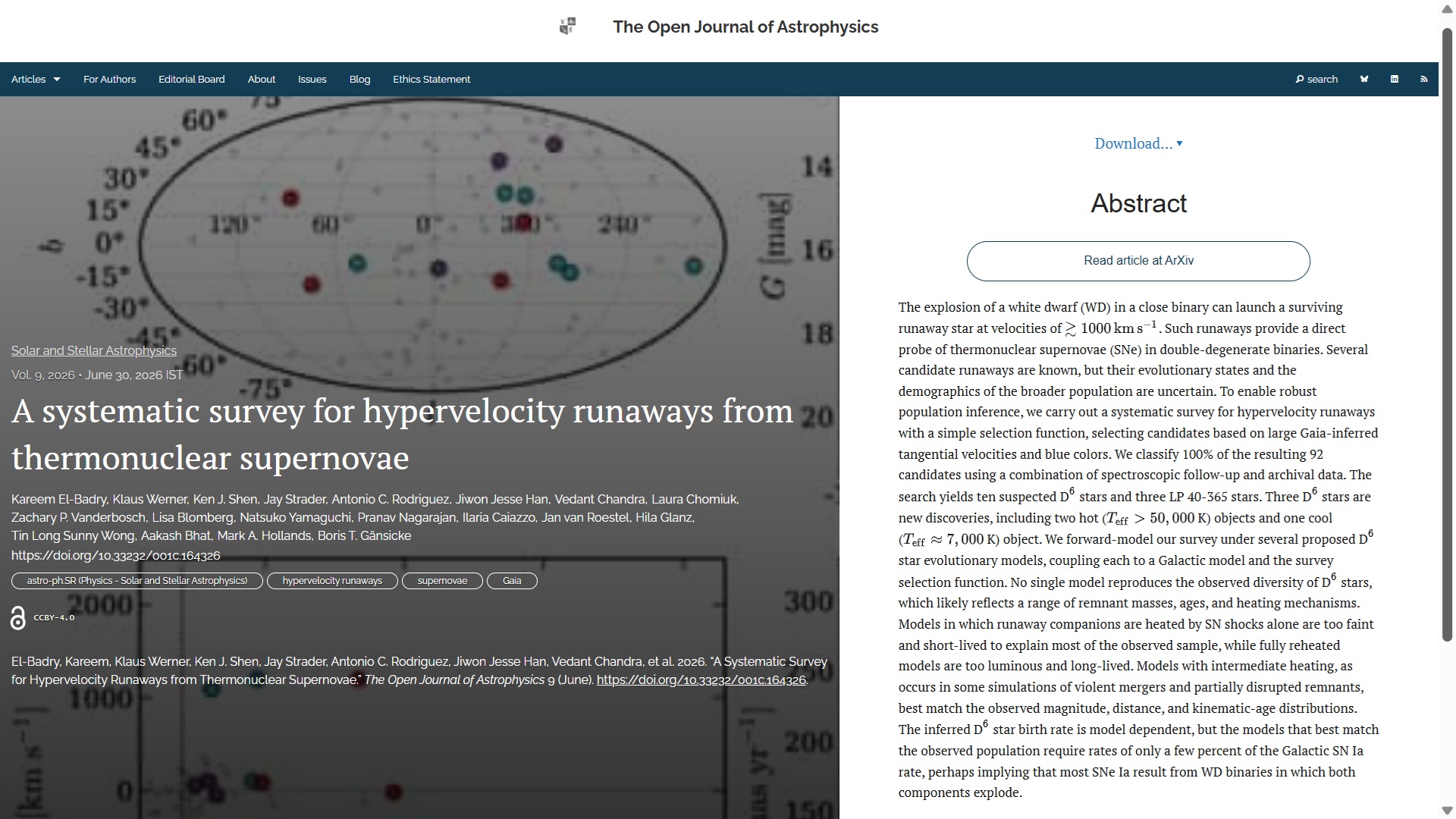
The fifth paper of the week, also published on Tuesday 30th June but in the folder Solar and Stellar Astrophysics is “A systematic survey for hypervelocity runaways from thermonuclear supernovae” by Kareem El-Badry (Caltech, USA), and 18 others based in the USA, Germany, Austria and the UK. This paper presents a systematic survey of hypervelocity runaways, resulting from white dwarf explosions in binary systems. The findings suggest a diversity of remnant masses, ages, and heating mechanisms, challenging theoretical models.

The overlay for this one is here:

You can read the final version of this one on arXiv here and the Mastodon announcement is here:

Open Journal of Astrophysics

New Publication at the Open Journal of Astrophysics: "A systematic survey for hypervelocity runaways from thermonuclear supernovae" by Kareem El-Badry (Caltech, USA), and 18 others based in the USA, Germany, Austria and the UK.

doi.org/10.33232/001c.164326

June 30, 2026, 7:33 am 2 boosts 2 favorites

The sixth and penultimate paper of this week is “Boris and Exponential Integrators in the Theory of Particles Interacting with Magnetic Turbulence” by Andreas Shalchi (U. Manitoba, Canada). This was published on Wednesday 1st July, in the folder Solar and Stellar Astrophysics (it is posted in the plasma physics section of aXiv but cross-listed in solar and stellar astrophysics). The study compares the Rodrigues and Boris integrators in test-particle simulations of charged particles interacting with magnetic fields, finding both methods yield similar results.

The overlay for this one is here:

You can find the final accepted version on arXiv here and the Mastodon announcement is here:

Open Journal of Astrophysics

New Publication at the Open Journal of Astrophysics: "Boris and Exponential Integrators in the Theory of Particles Interacting with Magnetic Turbulence" by Andreas Shalchi (U. Manitoba, Canada)

doi.org/10.33232/001c.164434

July 1, 2026, 5:42 am 1 boosts 0 favorites

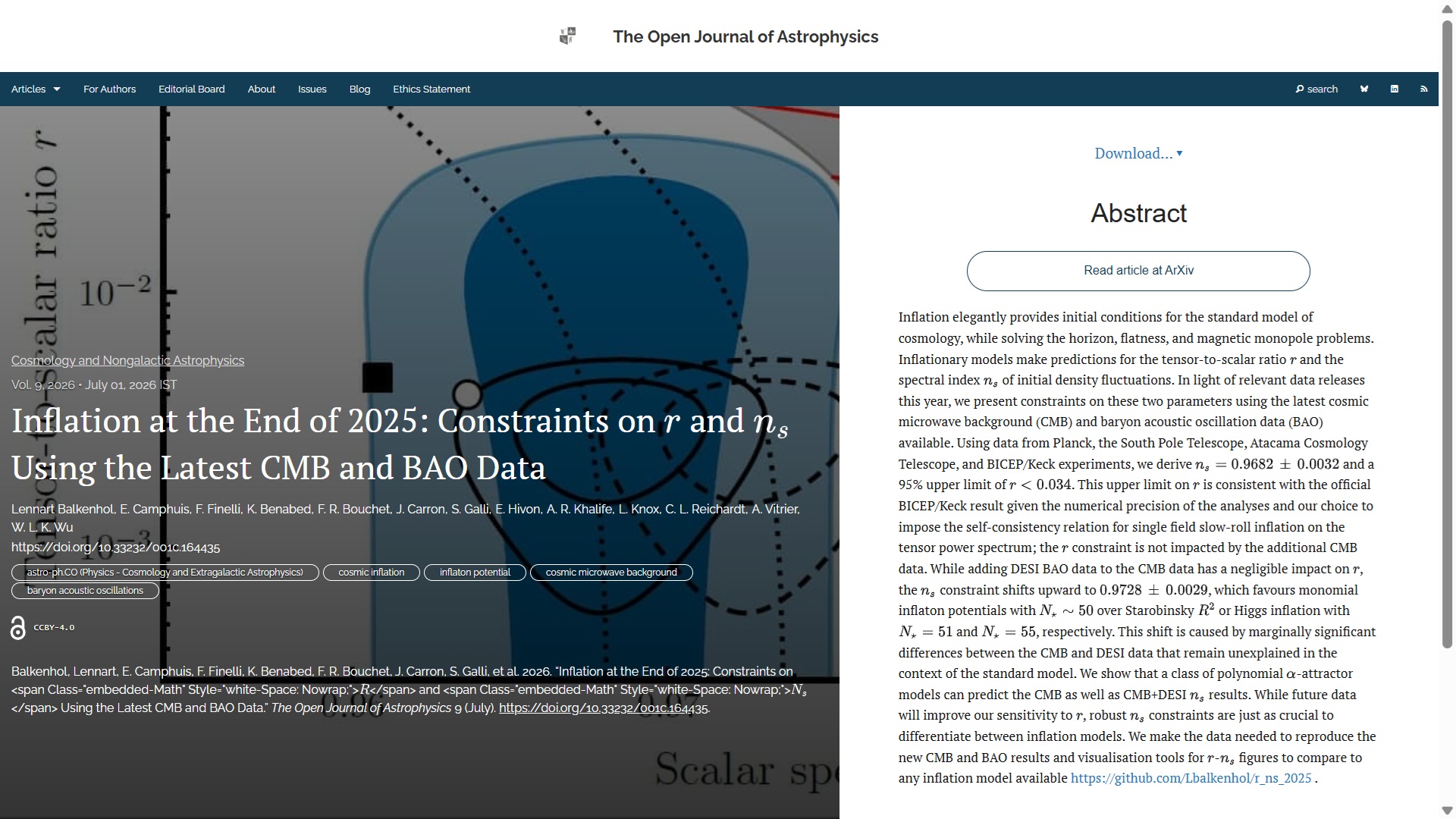
The seventh and final paper for this week is “Inflation at the End of 2025: Constraints on $r$ and $n_S$ using the Latest CMB and BAO Data” by Lennart Balkenhol (Institut d’Astrophysique de Paris, France) and 12 others based in France, Italy, Switzerland, UK, USA and Australia. This was also published on Wednesday 1st July, in the folder Cosmology and Nongalactic Astrophysics. This study presents constraints on parameters of inflationary models in cosmology, using the latest cosmic microwave background and baryon acoustic oscillation data. The findings help differentiate between inflation models.

The overlay for this one is here:

You can find the final accepted version of this one on arXiv here and the Mastodon announcement is here:

Open Journal of Astrophysics

New Publication at the Open Journal of Astrophysics: "Inflation at the End of 2025: Constraints on $r$ and $n_S$ using the Latest CMB and BAO Data" by Lennart Balkenhol (Institut d’Astrophysique de Paris, France) and 12 others based in France, Italy, Switzerland, UK, USA and Australia.

doi.org/10.33232/001c.164435

July 1, 2026, 6:37 am 2 boosts 1 favorites

And that concludes this week’s update. We’re starting to catch up on the backlog generated in June. At just past the halfway point of the year, which is where we are, we’re on 136 papers, which suggests a total around 272 for the year.

Out and About in London

Posted in Biographical, Art, LGBTQ+ with tags , , , , , , , , , on July 3, 2026 by telescoper

I spent today in London, wandering about and visiting various locations I haven’t seen for a while, including the Science Museum (near where I’m staying) and Tate Modern (not near where I’m staying). The Science Museum has changed quite a bit since my last visit there many moons ago, but it still reminded me of Toby Esterhase’s description in Smiley’s People:

In the Science Museum, top floor. All those airplanes. Lot of kiddies eating crisps.

There was indeed a lot of kiddies, this being peak season for school trips, and the aeroplanes are still there. On the way from the Science Museum to Tate Modern, I bumped into some members of the union Unite from the Institute of Cancer Research who were at outside South Kensington tube station protesting about pay and conditions, and promised to send a message of solidarity on social media, which I hereby do.

Tate Modern was really good, if also busy with a lot of kiddies. I particularly enjoyed The Tanks, in one of which there is an eerily lit exhibition of Giacometti scupltures and another an installation by Nora Chipaumire called Gadzi, which includes sculpted and audio elements between which you can sit or move around. One of the interesting things about installations like this is watching what other people do: some were sitting on the large loudspeakers playing the music, others moving around to experience changes in the sonic experience.

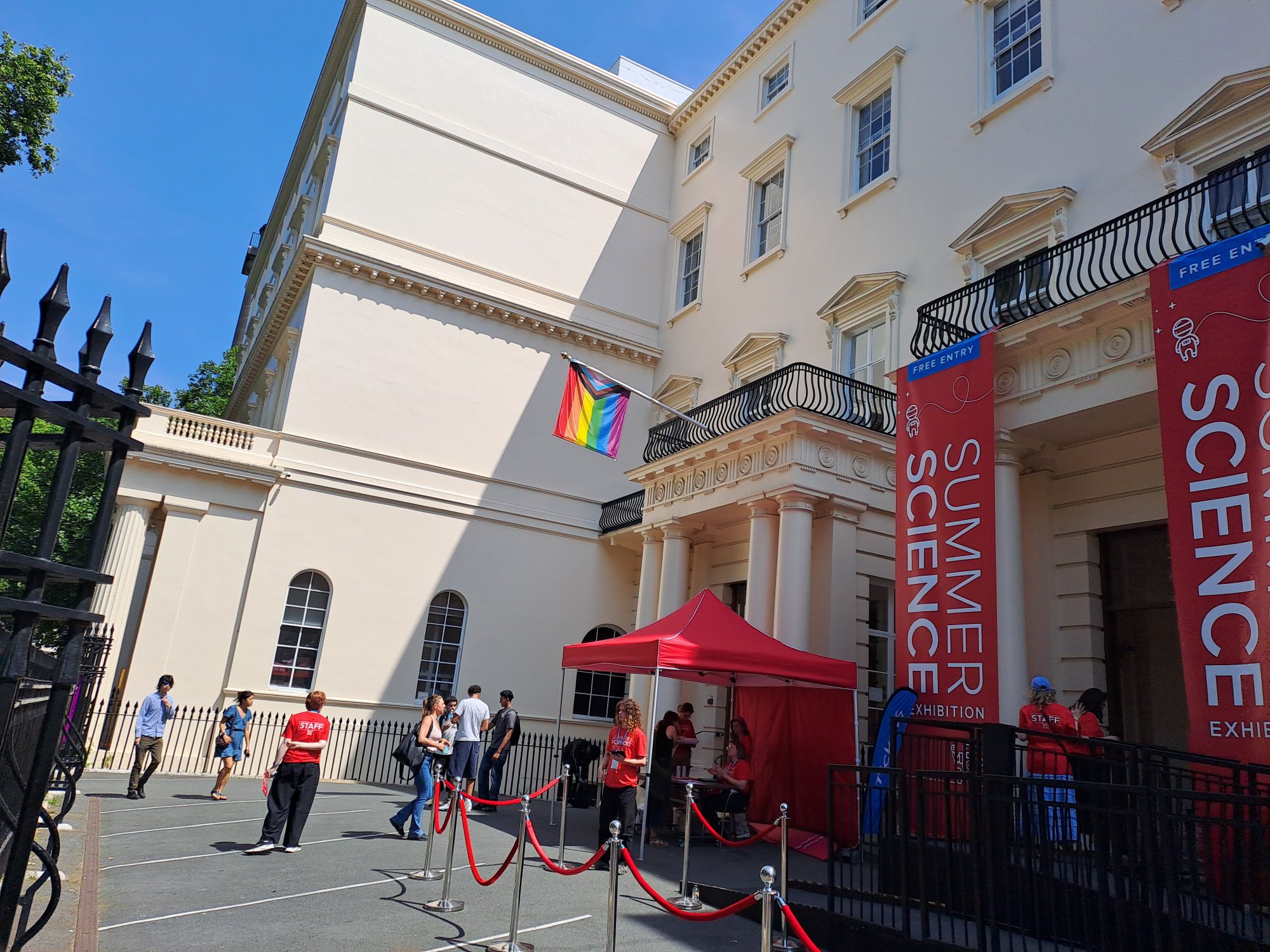
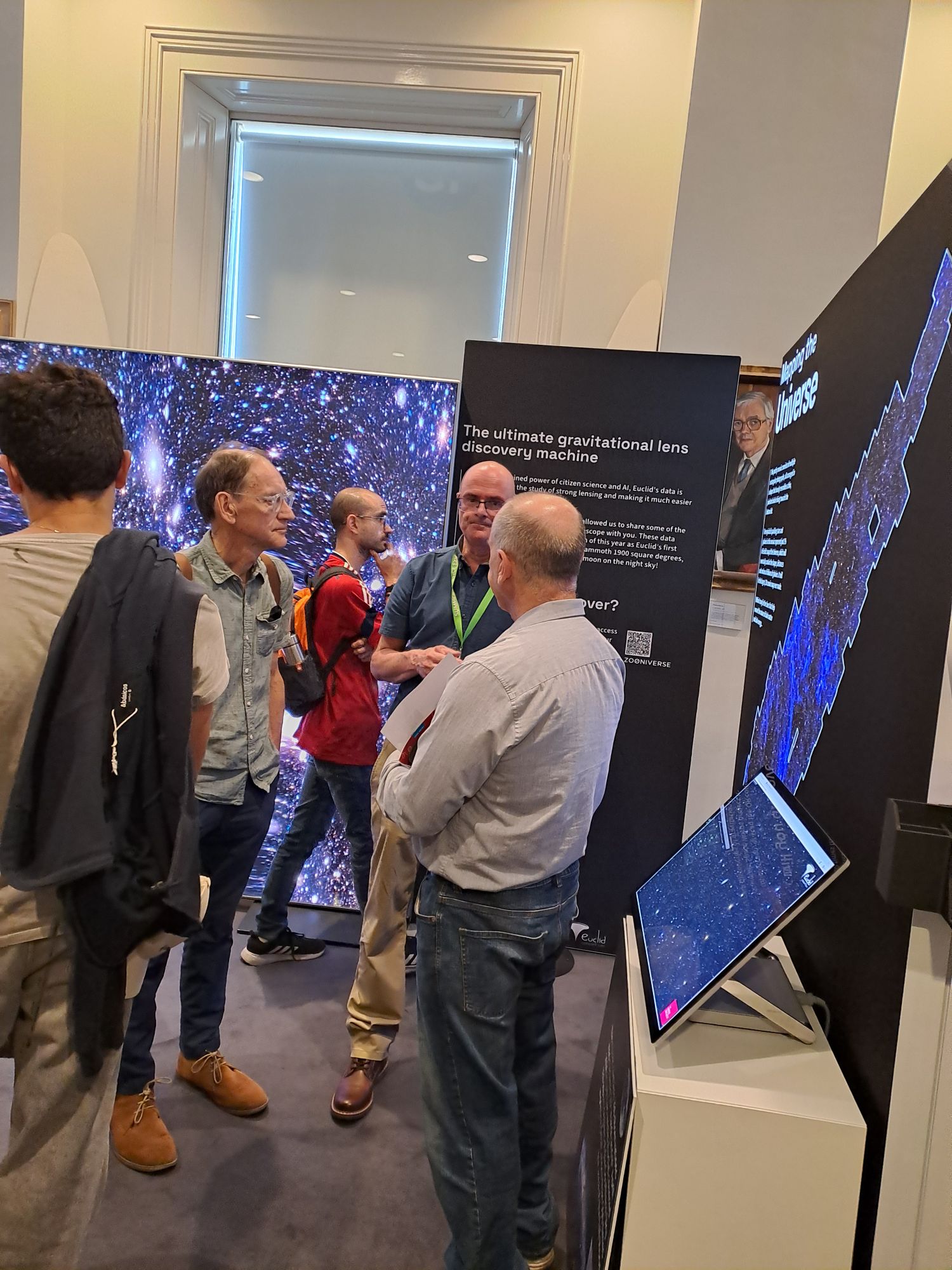
After Tate Modern I dropped in at the HQ of the Elon Musk Appreciation Society Royal Society in Carlton House Terrace. This is the time of year for the annual Summer Science Exhbition. Note the Pride Progress flag flying outside. Inside was another lot of kiddies but quite a few adults too. Out of the thirteen exhibits, three were directly relevant to my own science area: one from the Simons Observatory, one from Durham University about galaxy formation simulations, and also one from Euclid. Here is Andy Taylor from Edinburgh at the latter, explaining B-modes to visitors:

The Pride Progress flag reminds me to explain, as if you hadn’t realized, that tomorrow (4th July) is the day of the Pride in London parade. Having a meeting to attend this week and another thing to do in London next week, it proved impossible to resist staying over the weekend. Now I’ll have to finish this blog as I have to meet a certain person off the train who is coincidentally flying in especially tonight to stay with me for this very special weekend.

P.S. It was very warm today, and set to get even warmer going into next week…

Structures on Gigaparsec Scales?

Posted in Astrohype, The Universe and Stuff with tags , , , , , , , on July 2, 2026 by telescoper

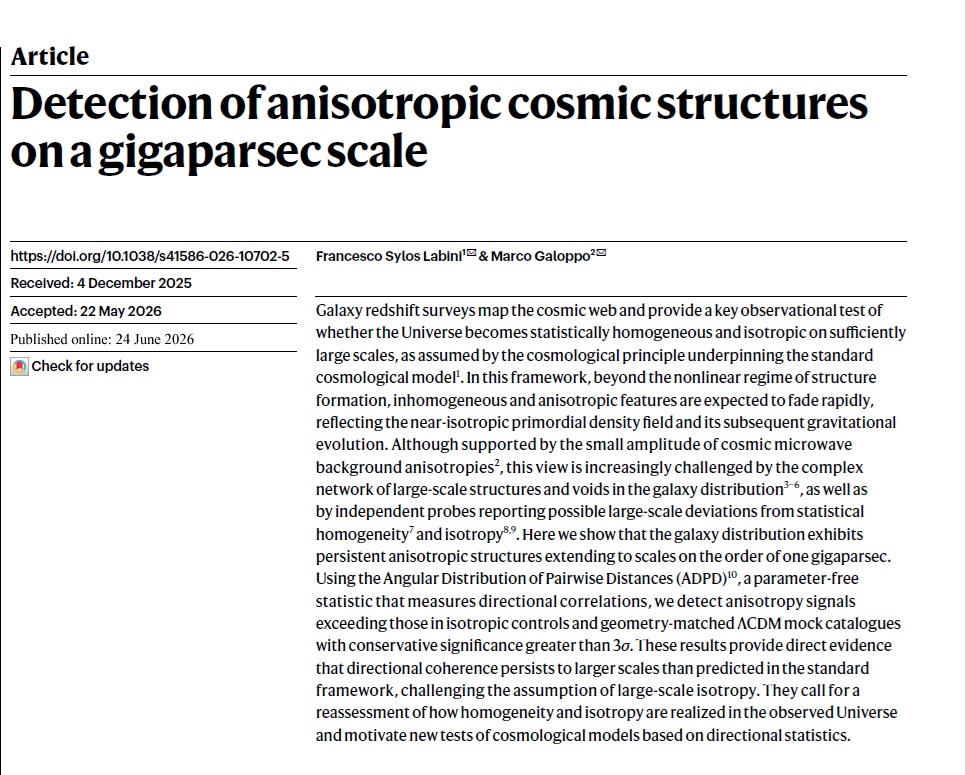
The latest in a sequence of claims of very large scale structures in the distribution that violate the cosmological principle emerged a week or so ago with a paper in Nature. The paper is behind a paywall but here is the abstract:

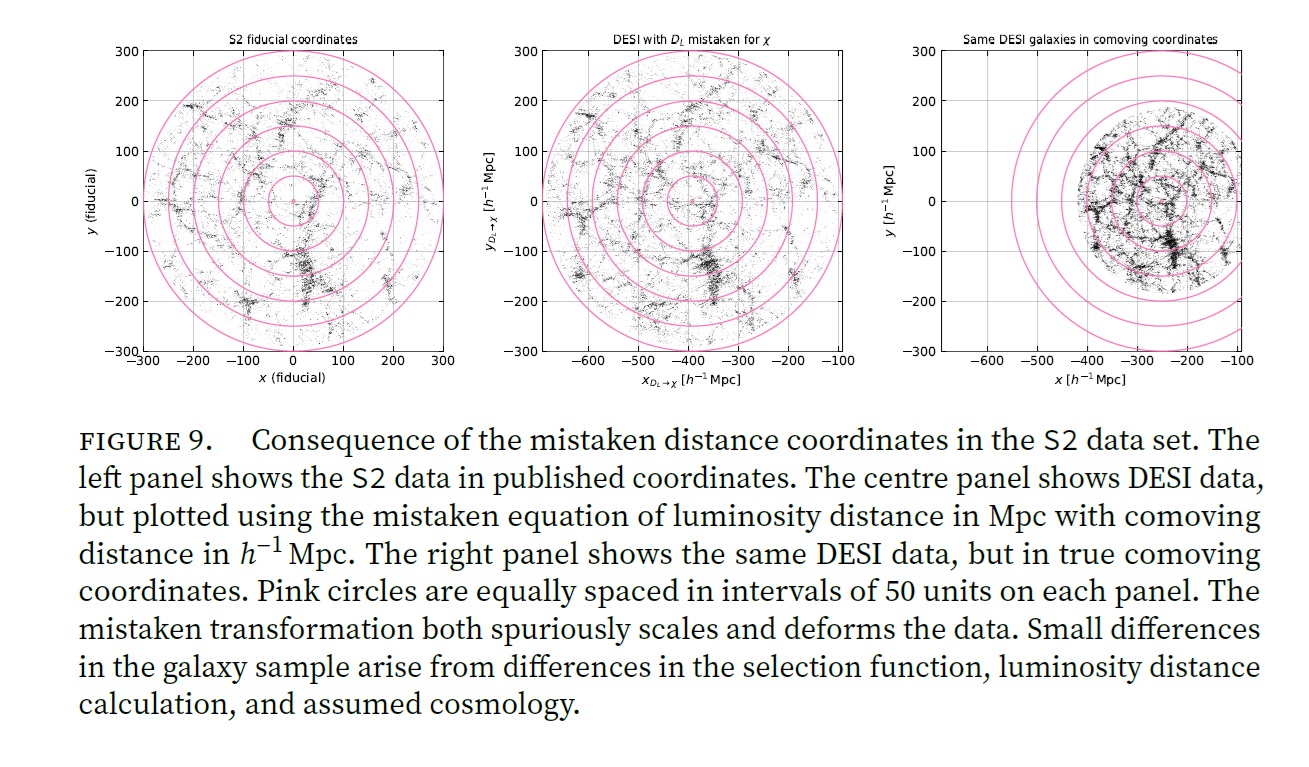
I’ve been nudged a few times by various people to comment on that but I’ve been busy recently and didn’t have time to look at the paper in detail. I had a quick look today and the thing that immediately struck me was that I didn’t understand the mock catalogues they used to compare the ΛCDM model with the observations. I still don’t understand that but I’ve stopped worrying about it because today I received a preprint (not behind a paywall, but on arXiv) from Till Sawala with the title The local galaxy distribution does not violate the cosmological principle and the (rather devastating) abstract:

The cosmological principle, which states that the Universe is statistically homogeneous and isotropic on sufficiently large scales, is a foundational assumption of the standard cosmological model. A recent analysis of DESI DR1 galaxy samples reported coherent anisotropic features in the local galaxy distribution extending to gigaparsec scales. If correct, this result would directly contradict the cosmological principle and motivate inhomogeneous cosmologies. Here I analyse the same data and compare them with galaxy distributions predicted by the FLAMINGO cosmological hydrodynamic simulation, performed in the standard ΛCDM paradigm. I show that the apparent anomaly disappears when the correct comoving distance scale is used. I also show that, rather than violating the cosmological principle, the observed structures are consistent with those expected in a ΛCDM Universe.

Here’s Figure 9 of the Sawala paper.

It seems that the authors of the Nature paper, Francesco Sylos Labini and Marco Galoppo, misinterpreted the distances of galaxies in the DESI DR1 sample in a way which boils down to an error of a factor (1+z)/h, where z is the redshift and h represents the Hubble constant. This hugely increases the scale and distorts the pattern of galaxy clustering. Using the correct comoving distance the measured structures are completely consistent with ΛCDM.

Oops!

P.S. I’ve stopped worrying about the mock surveys…