Archive for galaxy formation

Weekly Update from the Open Journal of Astrophysics – 14/02/2026

Posted in OJAp Papers, Open Access, The Universe and Stuff with tags , , , , , , , , , , , , , , , , , , , , , , , , , , , , , , on February 14, 2026 by telescoper

It’s Saturday once more so time for another update of activity at the Open Journal of Astrophysics. Since the last update we have published a further six papers, bringing the number in Volume 9 (2026) to 30 and the total so far published by OJAp up to 478.

I will continue to include the posts made on our Mastodon account (on Fediscience) to encourage you to visit it. Mastodon is a really excellent service, and a more than adequate replacement for X/Twitter (which nobody should be using); these announcements also show the DOI for each paper.

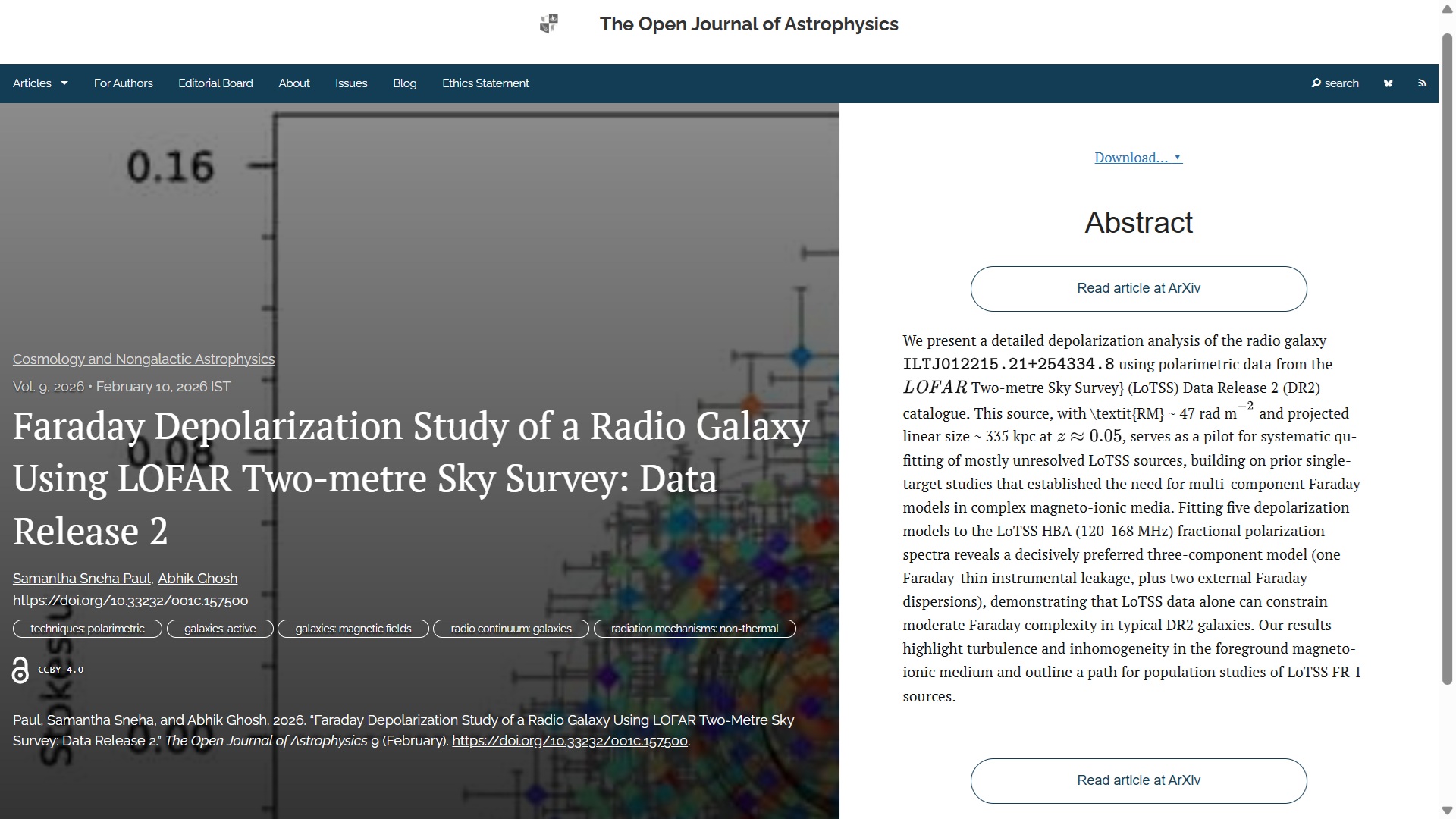
The first paper to report this week is “Faraday Depolarization Study of a Radio Galaxy Using LOFAR Two-metre Sky Survey: Data Release 2” by Samantha Sneha Paul and Abhik Ghosh (Banwarilal Bhalotia College, India). This was published on Tuesday February 10th in the folder Cosmology and Nongalactic Astrophysics. The paper analyzes the depolarization of radio galaxy ILTJ012215.21+254334.8 using LOFAR’s Sky Survey data, revealing a preferred three-component model and highlighting turbulence in the magneto-ionic medium.

The overlay is here:

You can find the officially accepted version on arXiv here and the announcement on Fediverse here:

Open Journal of Astrophysics

New Publication at the Open Journal of Astrophysics: "Faraday Depolarization Study of a Radio Galaxy Using LOFAR Two-metre Sky Survey: Data Release 2" by Samantha Sneha Paul and Abhik Ghosh (Banwarilal Bhalotia College, India)

doi.org/10.33232/001c.157500

February 10, 2026, 6:25 am 0 boosts 1 favorites

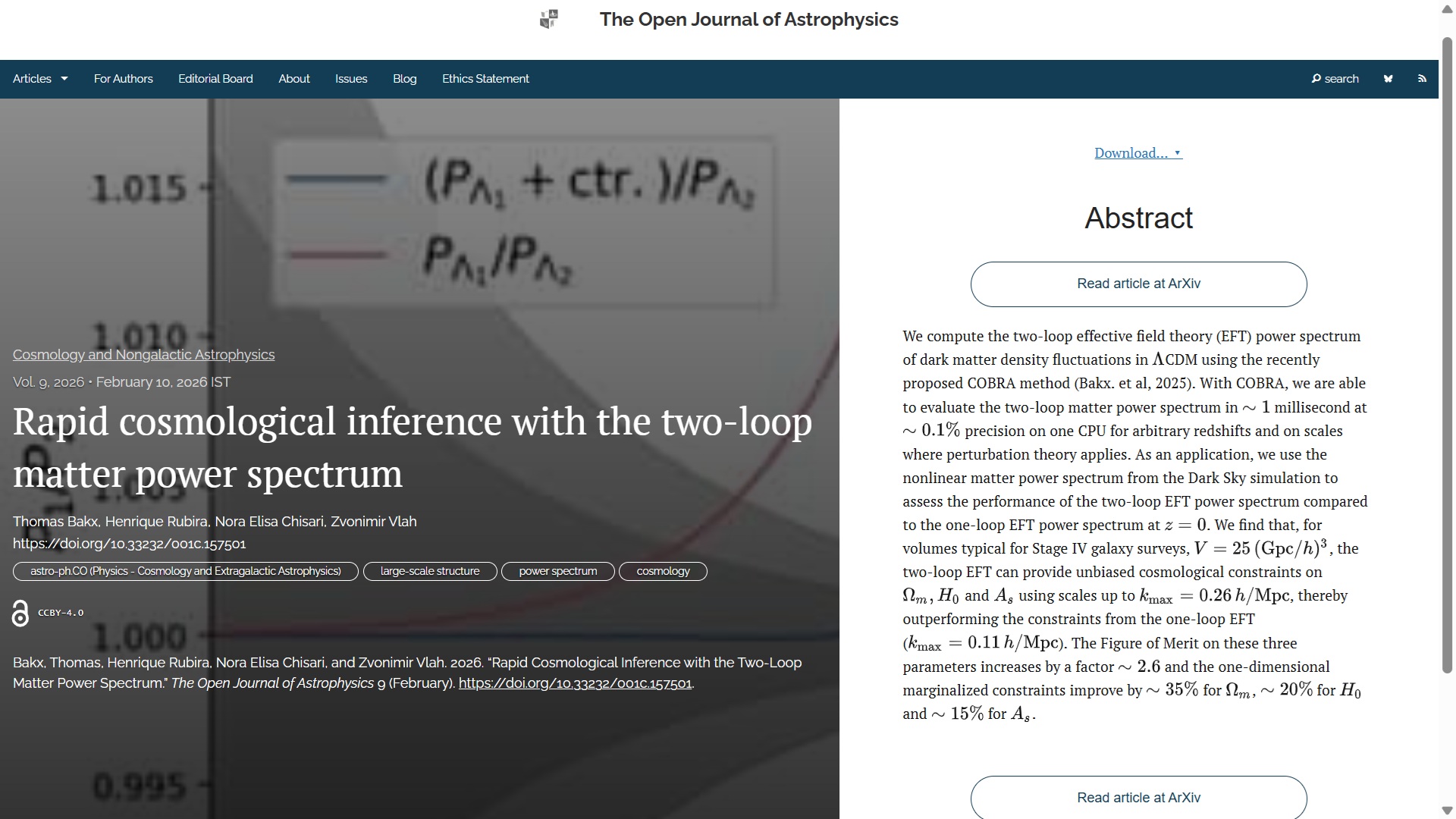
The second paper is “Rapid cosmological inference with the two-loop matter power spectrum” by Thomas Bakx (Utrecht U., NL), Henrique Rubira (Ludwig-Maximilians-Universität, DE), Nora Elisa Chisari (Utrecht) and Zvonimir Vlah (Ruđer Bošković Institute, Croatia). This was also published on Tuesday February 10th in the folder Cosmology and Nongalactic Astrophysics. This paper uses the COBRA method to compute the two-loop effective field theory power spectrum of dark matter density fluctuations, providing more precise cosmological constraints than the one-loop EFT.

The overlay for this one is here:

The official version of the paper can be found on arXiv here and the Fediverse announcement here:

Open Journal of Astrophysics

New Publication at the Open Journal of Astrophysics: "Rapid cosmological inference with the two-loop matter power spectrum" by Thomas Bakx (Utrecht U., NL), Henrique Rubira (Ludwig-Maximilians-Universität, DE), Nora Elisa Chisari (Utrecht) and Zvonimir Vlah (Ruđer Bošković Institute, Croatia)

doi.org/10.33232/001c.157501

February 10, 2026, 6:41 am 0 boosts 0 favorites

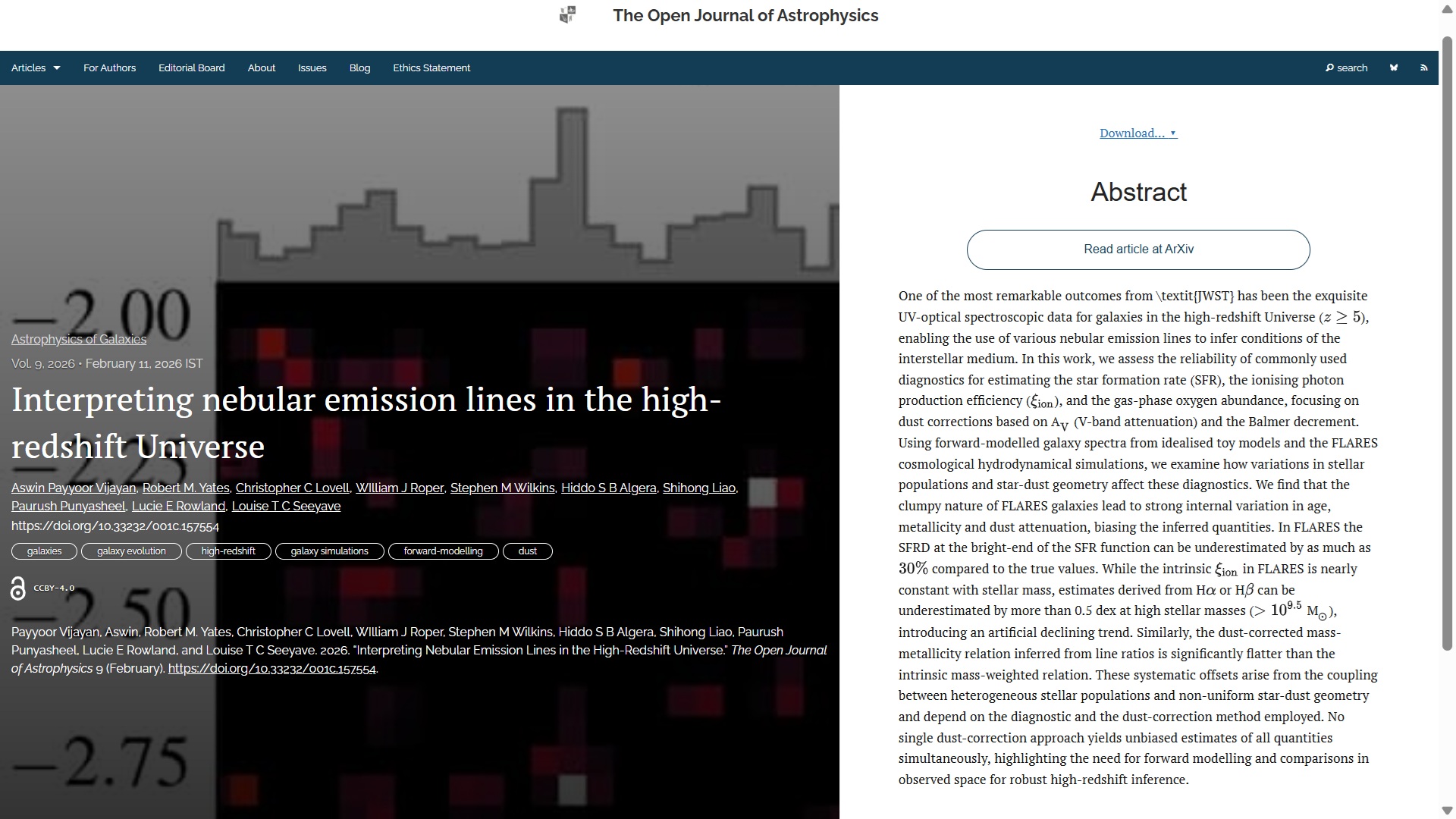
Next, published on Wednesday 11th February in the folder Astrophysics of Galaxies, is “Interpreting nebular emission lines in the high-redshift Universe” by Aswin P. Vijayan (U. Sussex, UK) and 9 others based in the UK, Taiwan, China and The Netherlands. This article examines the reliability of diagnostics used to estimate star formation rate and gas-phase oxygen abundance in high-redshift galaxies. It finds that variations in stellar populations and star-dust geometry. The overlay is here:

The official version can be found on arXiv here and the Fediverse announcement is here:

Open Journal of Astrophysics

New Publication at the Open Journal of Astrophysics: "Interpreting nebular emission lines in the high-redshift Universe" by Aswin P. Vijayan (U. Sussex, UK) and 9 others based in the UK, Taiwan, China and The Netherlands

doi.org/10.33232/001c.157554

February 11, 2026, 8:21 am 0 boosts 0 favorites

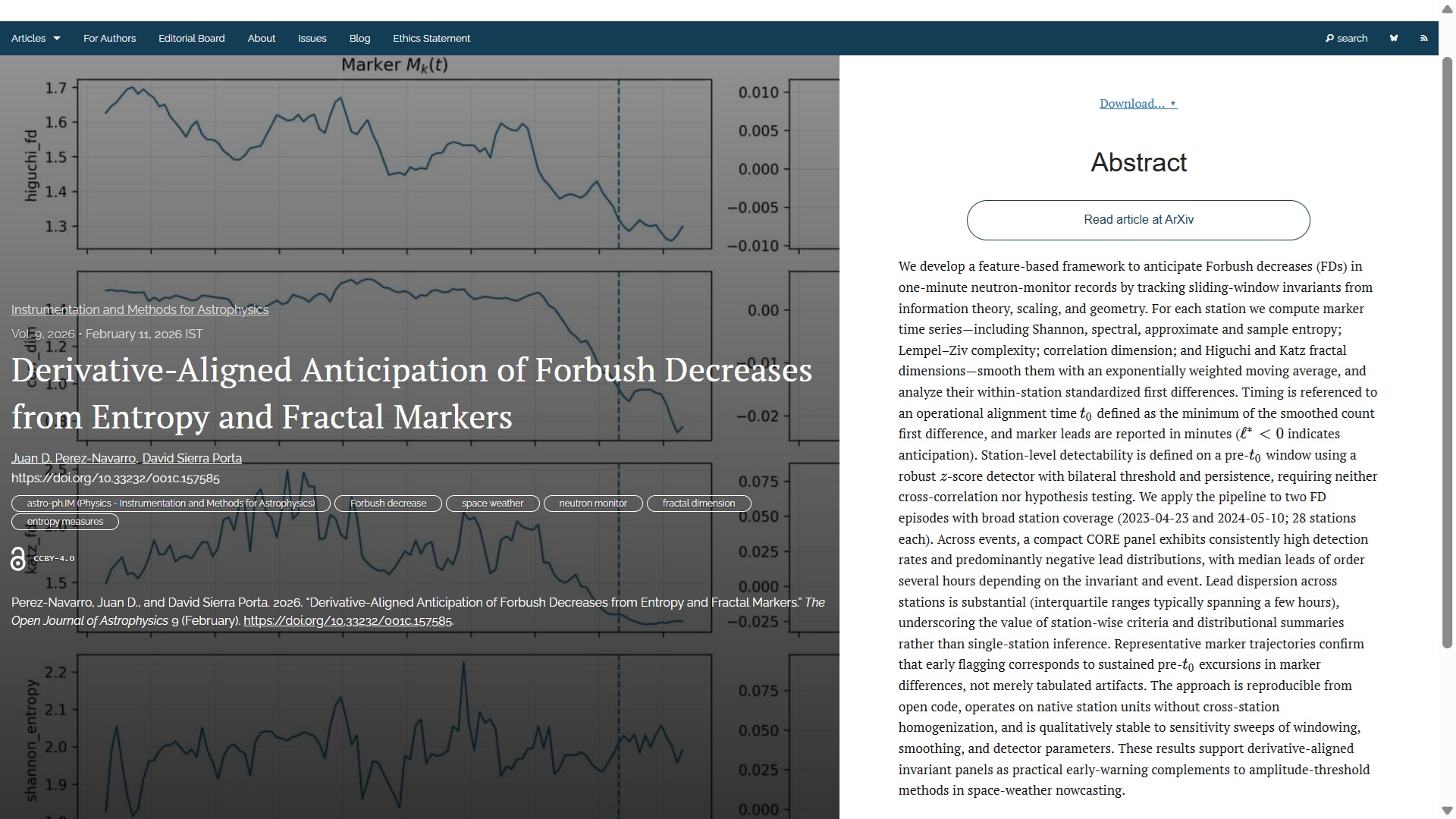
The fourth paper this week, also published on Wednesday 11th February, but in the folder Instrumentation and Methods for Astrophysics is “Derivative-Aligned Anticipation of Forbush Decreases from Entropy and Fractal Markers” by Juan D. Perez-Navarro & David Sierra Porta (Universidad Tecnológica de Bolívar, Colombia). The paper presents a feature-based framework for predicting Forbush decreases, i.e. rapid, temporary drops in galactic cosmic ray (GCR) intensity (up to tens of percent) caused by solar wind disturbances, typically Coronal Mass Ejections (CMEs) or high-speed streams from coronal holes, in neutron-monitor records using various computational methods. The approach is reproducible, operates on native station units, and is stable.

Here is the overlay:

The official version can be found on arXiv here and the Fediverse announcement is here:

Open Journal of Astrophysics

New Publication at the Open Journal of Astrophysics: "Derivative-Aligned Anticipation of Forbush Decreases from Entropy and Fractal Markers" by Juan D. Perez-Navarro & David Sierra Porta (Universidad Tecnológica de Bolívar, Colombia)

doi.org/10.33232/001c.157585

February 11, 2026, 5:19 pm 0 boosts 0 favorites

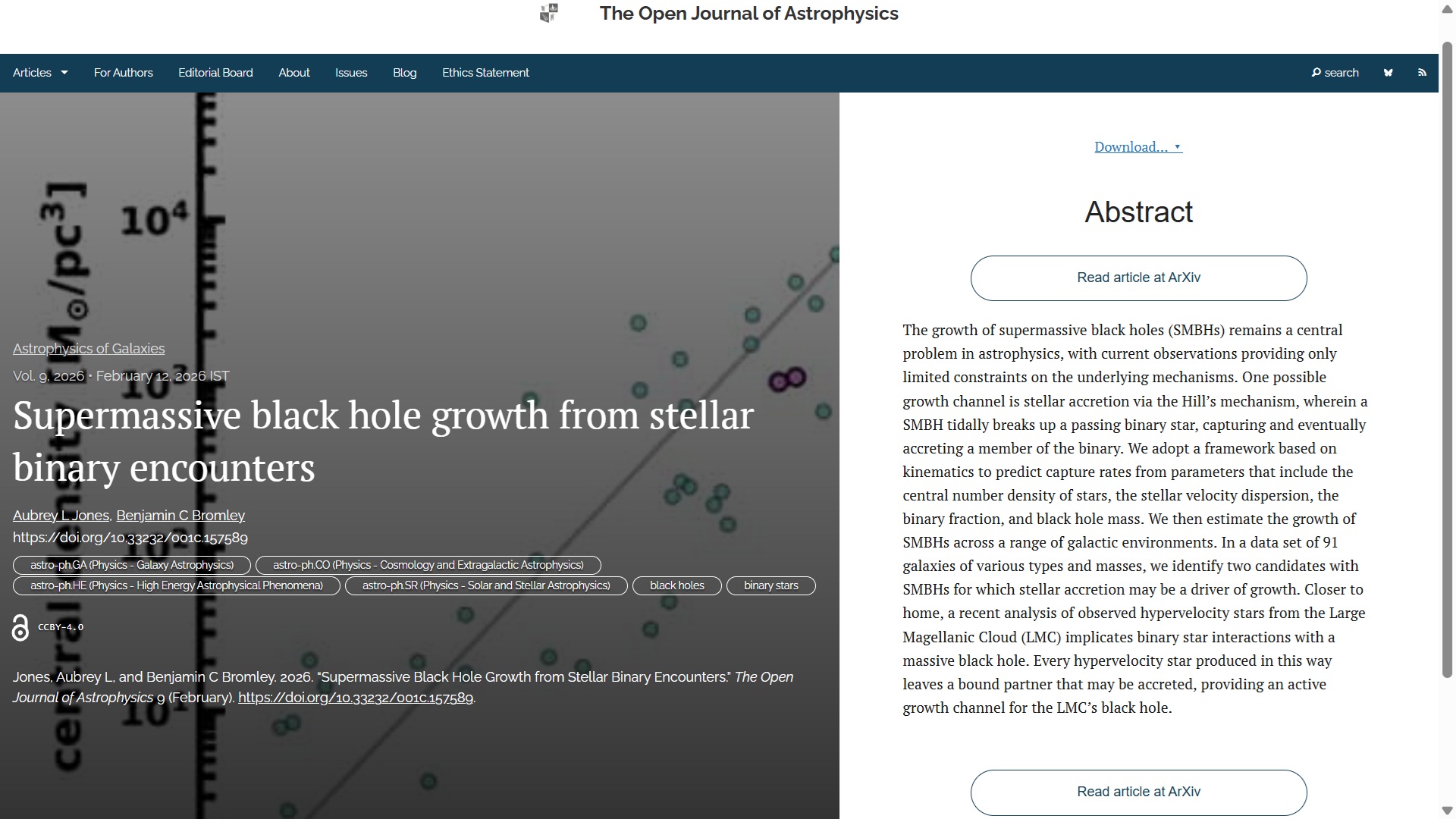
The fifth paper, the penultimate for this week, is “Supermassive black hole growth from stellar binary encounters” by Aubrey L Jones and Benjamin C Bromley (University of Utah, USA). This paper explores the growth of supermassive black holes (SMBHs) through stellar accretion via the Hill’s mechanism, predicting capture rates and identifying potential growth drivers in 91 galaxies. It was published on Thursday 11th February 2026 in the folder Astrophysics of Galaxies.

The overlay is here:

The accepted version can be found on arXiv here, and the fediverse announcement is here:

Open Journal of Astrophysics

New Publication at the Open Journal of Astrophysics: "Supermassive black hole growth from stellar binary encounters" by Aubrey L Jones and Benjamin C Bromley (University of Utah, USA)

doi.org/10.33232/001c.157589

February 12, 2026, 7:31 am 1 boosts 2 favorites

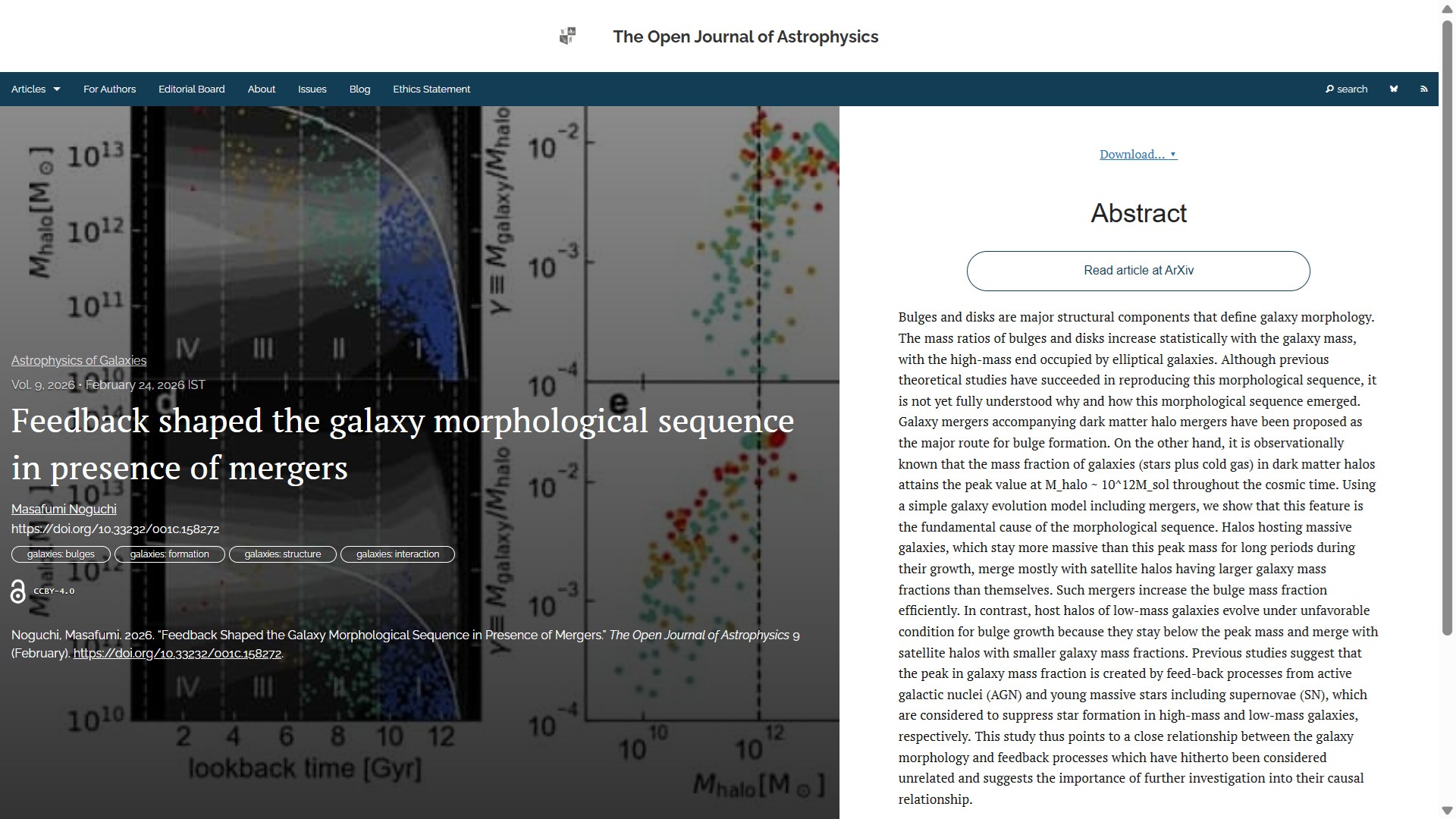
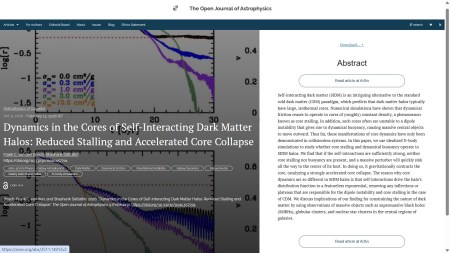
Finally for this week we have “Dynamics in the Cores of Self-Interacting Dark Matter Halos: Reduced Stalling and Accelerated Core Collapse” by Frank C. van den Bosch and Shashank Dattathri (Yale University, USA). This study uses simulations to explore core dynamics in self-interacting dark matter (SIDM) halos. Findings suggest strong self-interactions prevent core stalling and buoyancy, leading to accelerated core collapse. This was published yesterday, on Friday 13th February 2026, in the folder Astrophysics of Galaxies.

The overlay is here:

You can find the published version of the article here, and the Mastodon announcement is here:

Open Journal of Astrophysics

New Publication at the Open Journal of Astrophysics: "Dynamics in the Cores of Self-Interacting Dark Matter Halos: Reduced Stalling and Accelerated Core Collapse" by Frank C. van den Bosch and Shashank Dattathri (Yale University, USA)

doi.org/10.33232/001c.157701

February 13, 2026, 8:27 am 1 boosts 2 favorites

And that concludes this week’s update. I will do another next Saturday.

Weekly Update from the Open Journal of Astrophysics – 07/02/2026

Posted in OJAp Papers, Open Access, The Universe and Stuff with tags , , , , , , , , , , , , , , , , , , , , , , , , , , , , , , , , , , , on February 7, 2026 by telescoper

It’s Saturday once more so time for another update of activity at the Open Journal of Astrophysics. Since the last update we have published a further six papers, bringing the number in Volume 9 (2026) to 24 and the total so far published by OJAp up to 472.

I will continue to include the posts made on our Mastodon account (on Fediscience) to encourage you to visit it. Mastodon is a really excellent service, and a more than adequate replacement for X/Twitter which nobody should be using; these announcement also show the DOI for each paper.

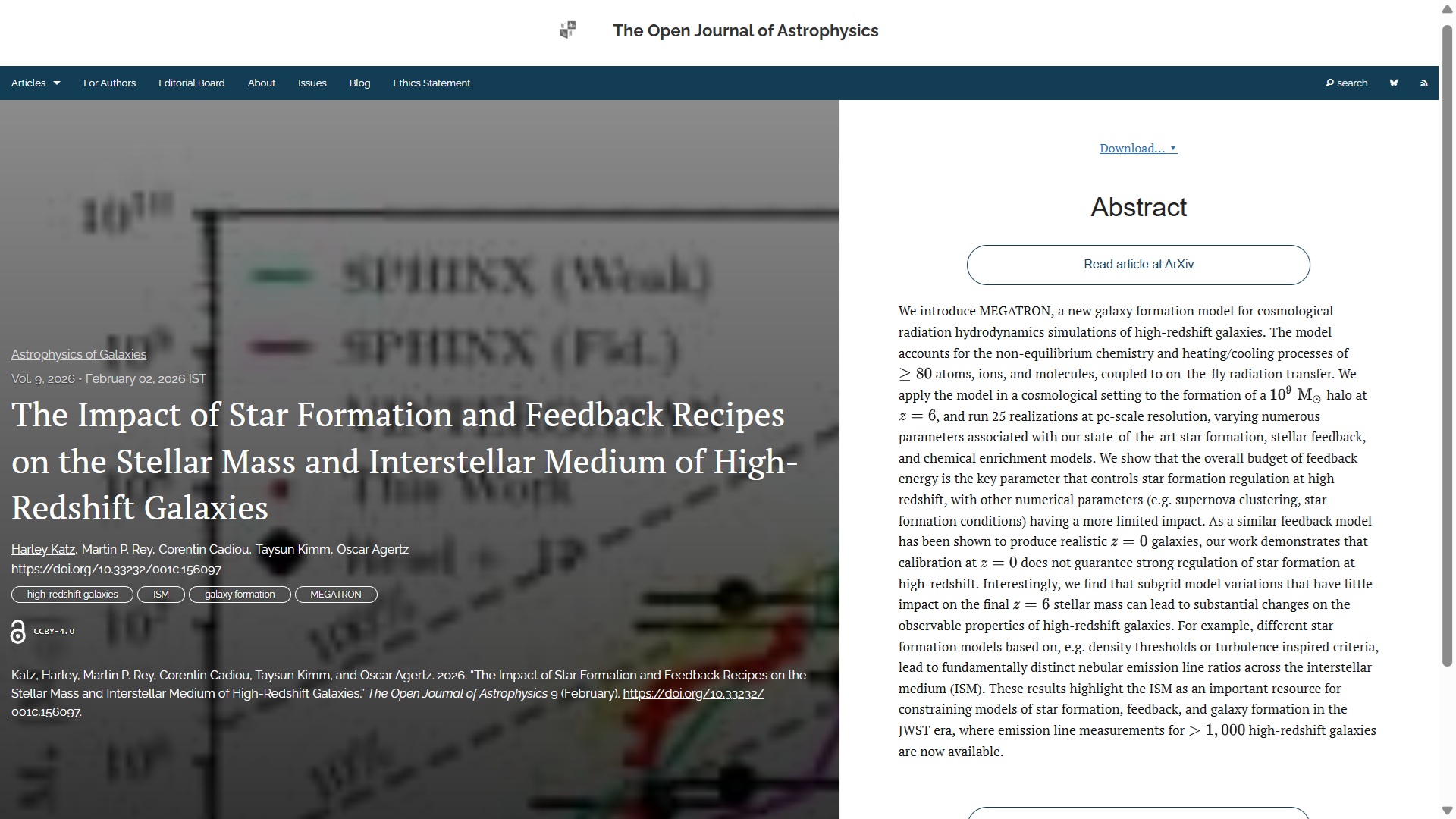
The first paper to report this week is “The Impact of Star Formation and Feedback Recipes on the Stellar Mass and Interstellar Medium of High-Redshift Galaxies” by Harley Katz (U. Chicago, USA), Martin P. Rey (U. Oxford, UK), Corentin Cadiou (Lund U., Sweden) Taysun Kimm (Yonsei U., Korea) and Oscar Agertz (Lund). This paper was published on Monday 2nd February 2026 in the folder Astrophysics of Galaxies. It introduces MEGATRON, a new model for galaxy formation simulations, highlighting that feedback energy controls star formation at high redshift and highlighting the importance of the interstellar medium.

The overlay is here:

You can find the officially accepted version on arXiv here and the announcement on Fediverse here:

Open Journal of Astrophysics

New Publication at the Open Journal of Astrophysics: "The Impact of Star Formation and Feedback Recipes on the Stellar Mass and Interstellar Medium of High-Redshift Galaxies" by Harley Katz (U. Chicago, USA), Martin P. Rey (U. Oxford, UK), Corentin Cadiou (Lund U., Sweden) Taysun Kimm (Yonsei U., Korea) and Oscar Agertz (Lund)

doi.org/10.33232/001c.156097

February 2, 2026, 11:02 am 1 boosts 1 favorites

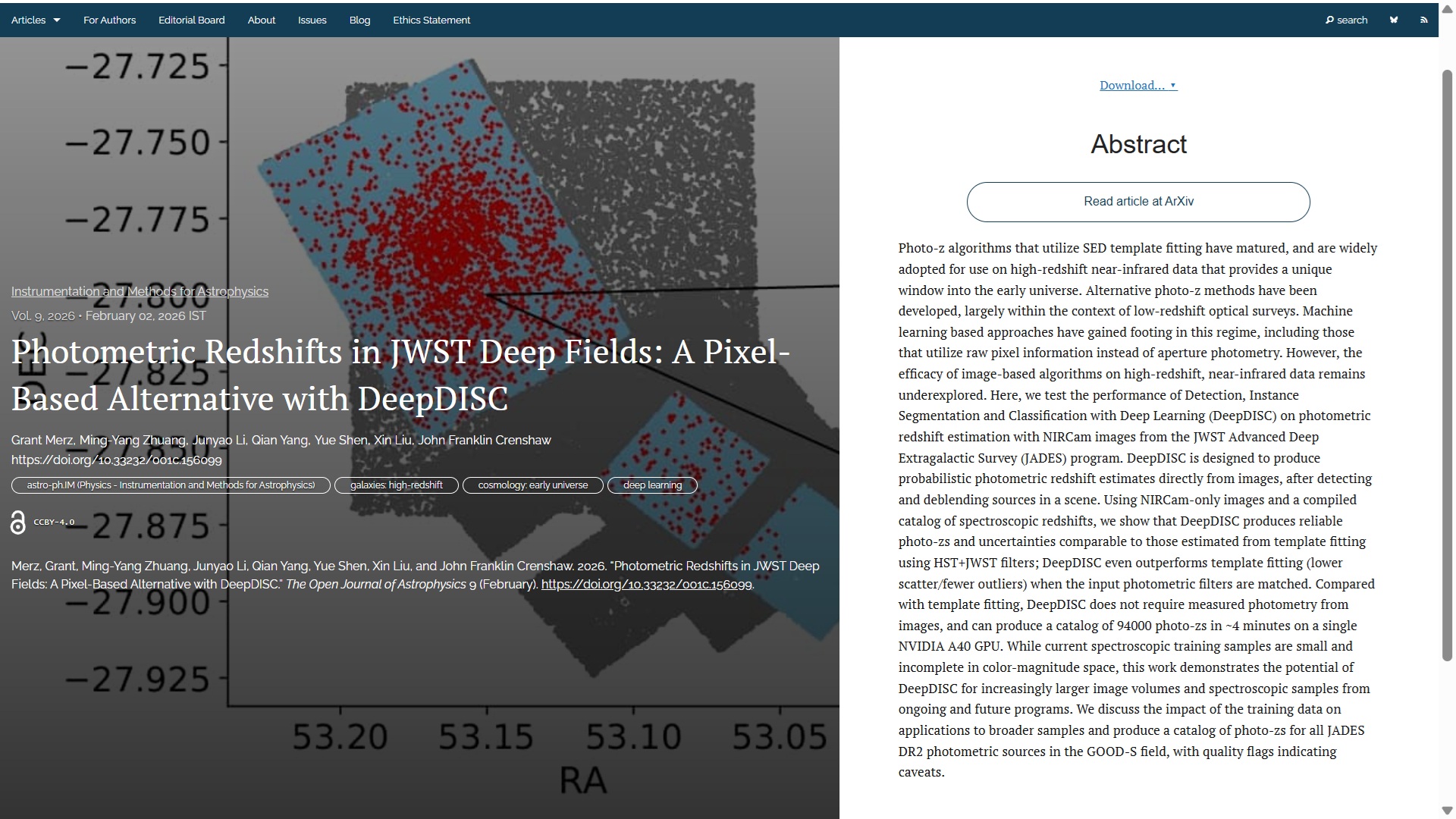
The second paper is “Photometric Redshifts in JWST Deep Fields: A Pixel-Based Alternative with DeepDISC” by Grant Merz (U. Illinois at Urbana-Champaign) and 6 others, all based in the USA. This paper was published on Monday February 2nd 2026 in the folder Instrumentation and Methods for Astrophysics. This paper explores the effectiveness of the DeepDISC machine learning algorithm in estimating photometric redshifts from near-infrared data, demonstrating its potential for larger image volumes and spectroscopic samples

The overlay for this one is here:

The official version of the paper can be found on arXiv here and the Fediverse announcement here:

Open Journal of Astrophysics

New Publication at the Open Journal of Astrophysics: "Photometric Redshifts in JWST Deep Fields: A Pixel-Based Alternative with DeepDISC" by Grant Merz (U. Illinois at Urbana-Champaign) and 6 others, all based in the USA

doi.org/10.33232/001c.156099

February 2, 2026, 11:23 am 1 boosts 0 favorites

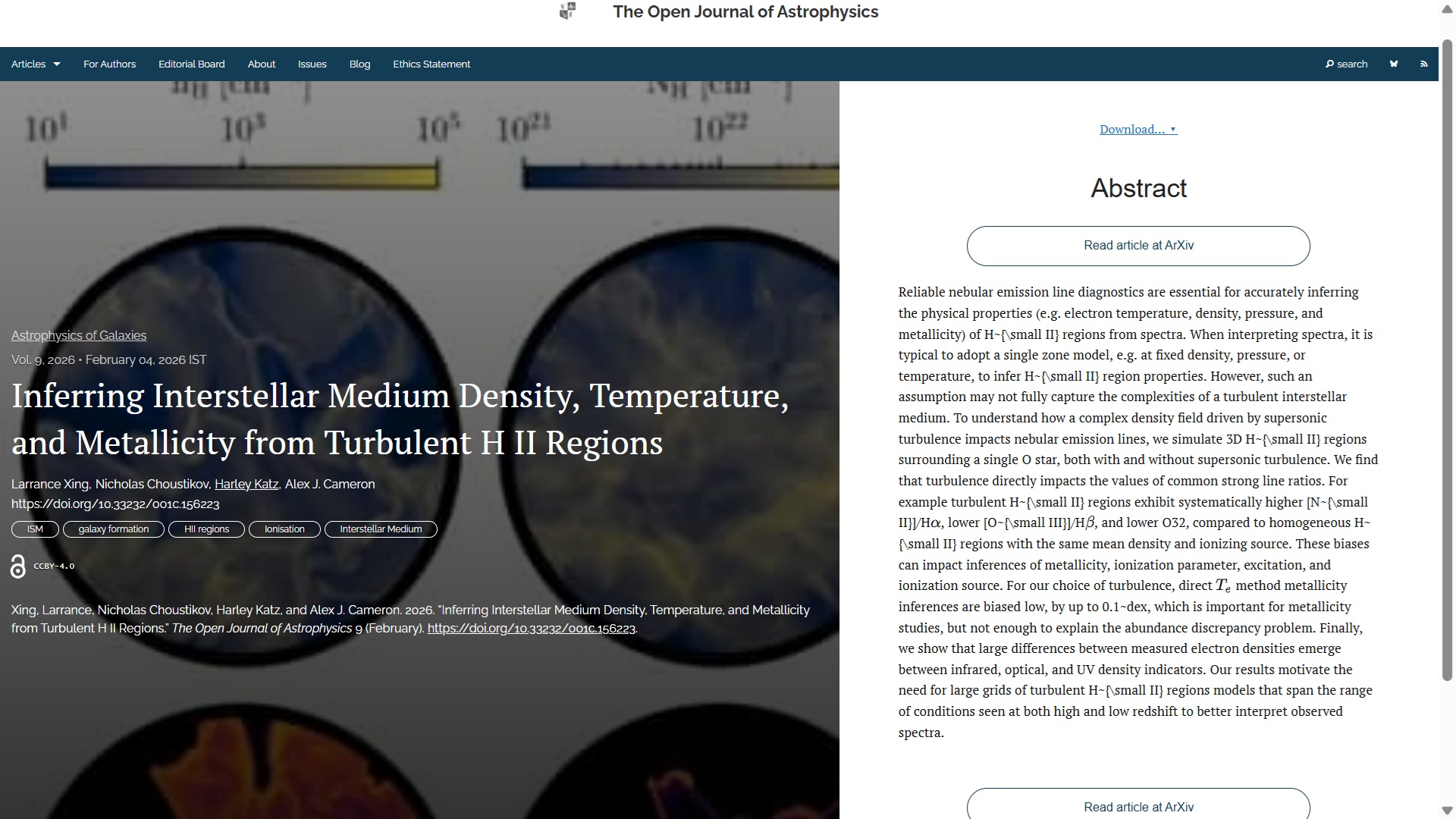
Next, published on Wednesday 4th February in the folder Astrophysics of Galaxies, is “Inferring Interstellar Medium Density, Temperature, and Metallicity from Turbulent H II Regions” by Larrance Xing (U. Chicago, USA), Nicholas Choustikov (U. Oxford, UK), Harley Katz (U. Chicago) and Alex J. Cameron (DAWN, Denmark). This paper argues that supersonic turbulenc affects the interpretation of H II region properties, potentially impacting inferred metallicity, ionization, and excitation from in nebular emission lines, motivating more extensive modelling.

The overlay is here:

The official version can be found on arXiv here and the Fediverse announcement is here:

Open Journal of Astrophysics

New Publication at the Open Journal of Astrophysics: "Inferring Interstellar Medium Density, Temperature, and Metallicity from Turbulent H II Regions" by Larrance Xing (U. Chicago, USA), Nicholas Choustikov (U. Oxford, UK), Harley Katz (U. Chicago) and Alex J. Cameron (DAWN, Denmark)

doi.org/10.33232/001c.156223

February 4, 2026, 8:20 am 1 boosts 0 favorites

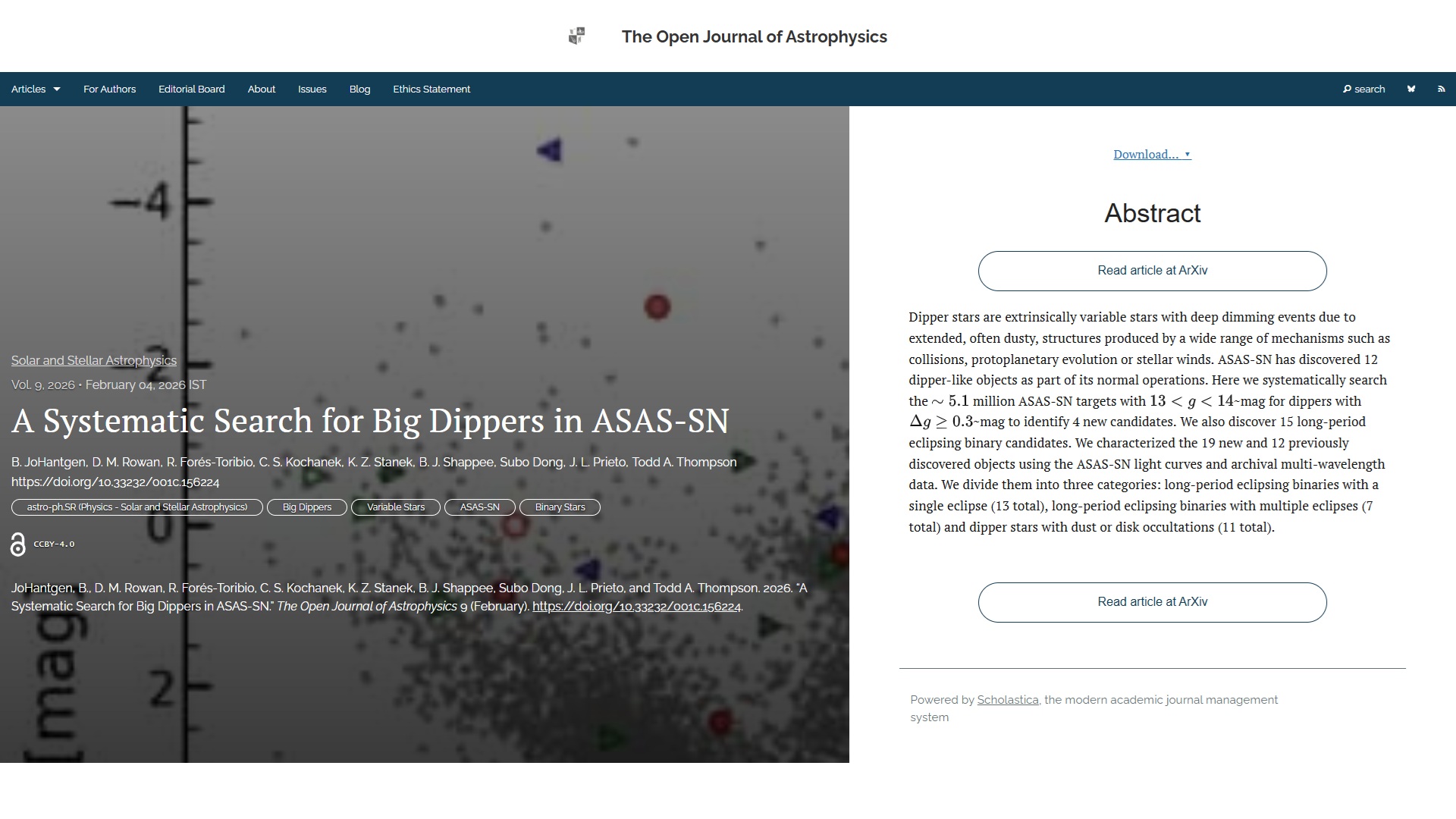
The fourth paper this week, also published on Wednesday 4th February, but in the folder Solar and Stellar Astrophysics, is “A Systematic Search for Big Dippers in ASAS-SN” by B. JoHantgen, D. M. Rowan, R. Forés-Toribio, C. S. Kochanek, & K. Z. Stanek (Ohio State University, USA), B. J. Shappee (U. Hawaii, USA), Subo Dong (Peking University), J. L. Prieto Universidad Diego Portales, Chile) and Todd A. Thompson (Ohio State). This study identifies 4 new dipper stars and 15 long-period eclipsing binary candidates using ASAS-SN light curves and multi-wavelength data, categorizing them based on their characteristics.

Here is the overlay:

The official version can be found on arXiv here and the Fediverse announcement is here:

Open Journal of Astrophysics

New Publication at the Open Journal of Astrophysics: "A Systematic Search for Big Dippers in ASAS-SN" by B. JoHantgen , D. M. Rowan, R. Forés-Toribio, C. S. Kochanek, & K. Z. Stanek (Ohio State University, USA), B. J. Shappee (U. Hawaii, USA), Subo Dong (Peking University), J. L. Prieto Universidad Diego Portales, Chile) and Todd A. Thompson (Ohio State)

doi.org/10.33232/001c.156224

February 4, 2026, 8:40 am 1 boosts 0 favorites

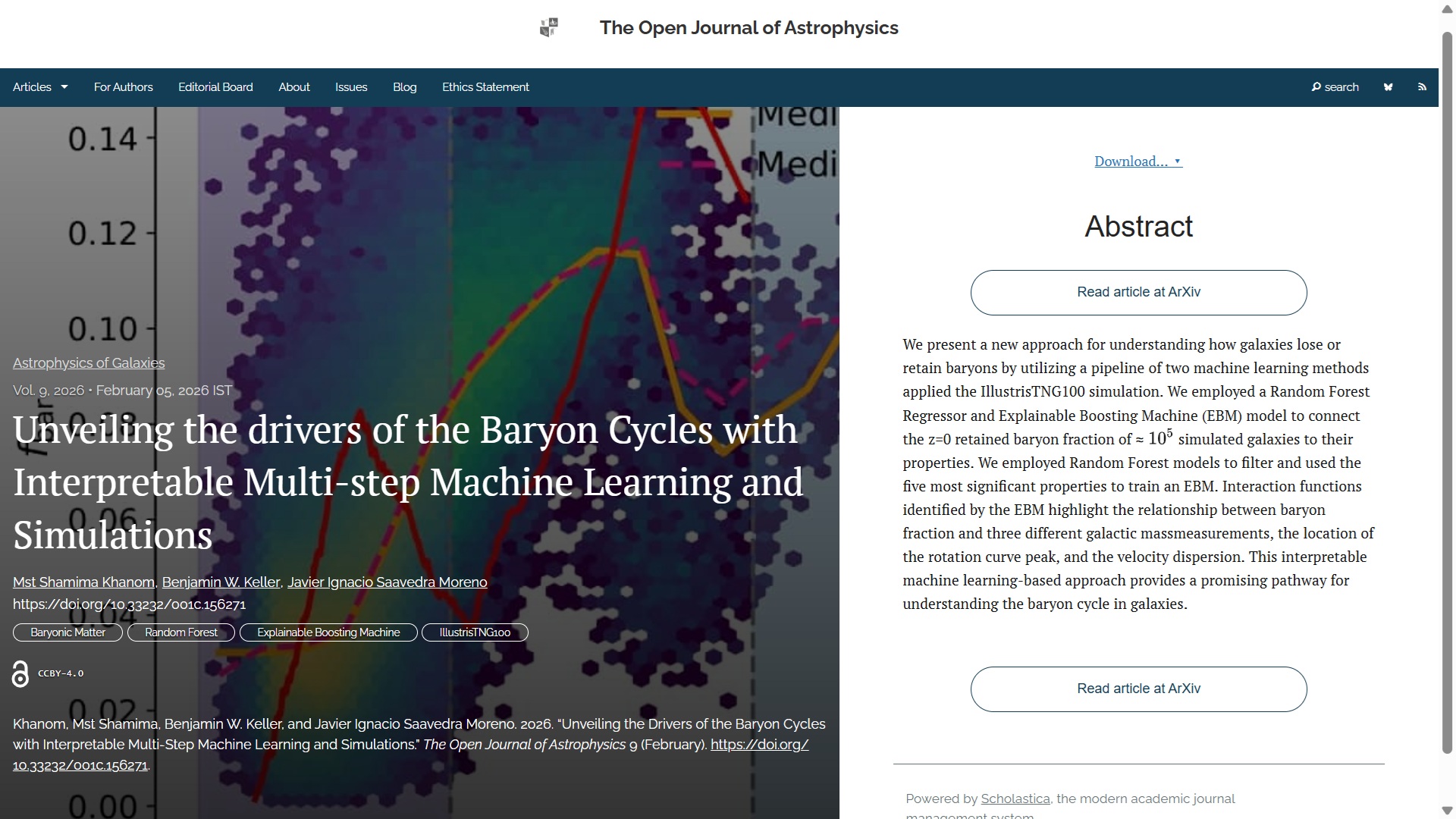
Fifth, and next to last this week we have “Unveiling the drivers of the Baryon Cycles with Interpretable Multi-step Machine Learning and Simulations” by Mst Shamima Khanom, Benjamin W. Keller and Javier Ignacio Saavedra Moreno (U. Memphis, USA). This paper was published on Thursday 5th February 2026 in the folder Astrophysics of Galaxies. This study uses machine learning methods to understand how galaxies lose or retain baryons, highlighting the relationship between baryon fraction and various galactic measurements.

The overlay is here:

The accepted version can be found on arXiv here, and the fediverse announcement is here:

Open Journal of Astrophysics

New Publication at the Open Journal of Astrophysics: "Unveiling the drivers of the Baryon Cycles with Interpretable Multi-step Machine Learning and Simulations" by Mst Shamima Khanom, Benjamin W. Keller and Javier Ignacio Saavedra Moreno (U. Memphis, USA)

doi.org/10.33232/001c.156271

February 5, 2026, 7:39 am 1 boosts 1 favorites

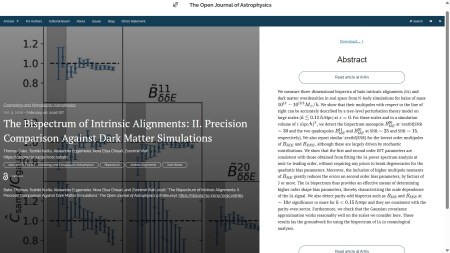
Finally for this week we have “The Bispectrum of Intrinsic Alignments: II. Precision Comparison Against Dark Matter Simulations” by Thomas Bakx (Utrecht U., Netherlands), Toshiki Kurita (MPA Garching, Germany), Alexander Eggemeier (U. Bonn, Germany), Nora Elisa Chisari (Utrecht) and Zvonimir Vlah (Ruđer Bošković Institute, Croatia). This paper was accepted in December, but publication got delayed by the Christmas effect so was published on February 6th 2026, in the folder Cosmology and Nongalactic Astrophysics. This study uses N-body simulations to accurately measure three-dimensional bispectra of halo intrinsic alignments and dark matter overdensities, providing a method to determine higher order shape bias parameters.

The overlay is here:

You can find the published version of the article here, and the Mastodon announcement is here:

Open Journal of Astrophysics

New Publication at the Open Journal of Astrophysics: "The Bispectrum of Intrinsic Alignments: II. Precision Comparison Against Dark Matter Simulations" by Thomas Bakx (Utrecht U., Netherlands), Toshiki Kurita (MPA Garching, Germany), Alexander Eggemeier (U. Bonn, Germany), Nora Elisa Chisari (Utrecht) and Zvonimir Vlah (Ruđer Bošković Institute, Croatia)

doi.org/10.33232/001c.156361

February 6, 2026, 7:43 am 1 boosts 0 favorites

And that concludes this week’s update. I will do another next Saturday.

Weekly Update from the Open Journal of Astrophysics – 31/01/2026

Posted in OJAp Papers, Open Access, The Universe and Stuff with tags , , , , , , , , , , , , , , , , , , , , , , , , , , , on January 31, 2026 by telescoper

It’s Saturday once more so time for another update of activity at the Open Journal of Astrophysics. Since the last update we have published a further four papers, bringing the number in Volume 9 (2026) to 18 and the total so far published by OJAp up to 466.

I will continue to include the posts made on our Mastodon account (on Fediscience) to encourage you to visit it. Mastodon is a really excellent service, and a more than adequate replacement for X/Twitter which nobody should be using; these announcement also show the DOI for each paper.

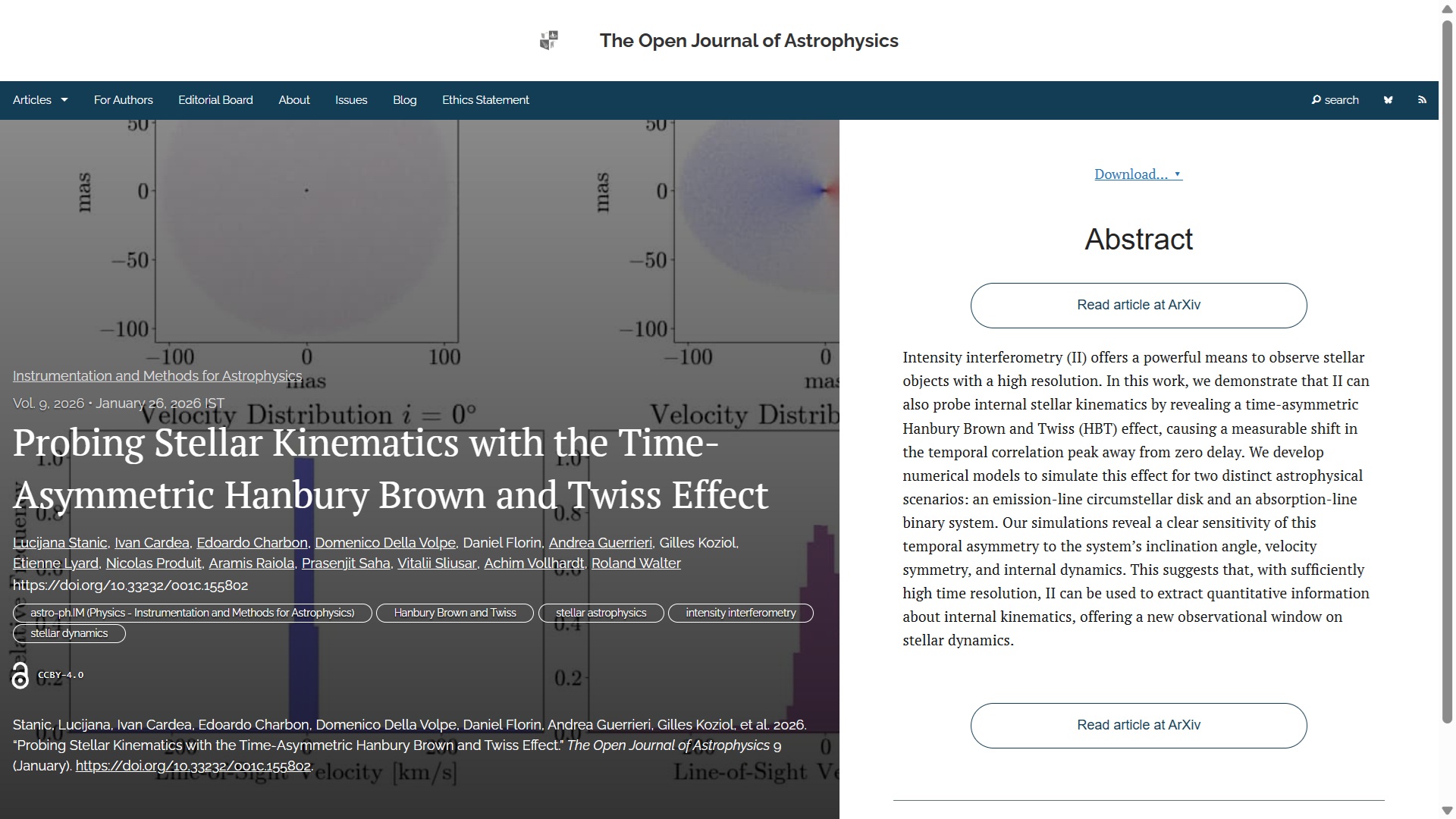
The first paper to report this week is “Probing Stellar Kinematics with the Time-Asymmetric Hanbury Brown and Twiss Effect” by Lucijana Stanic (University of Zurich, Switzerland) and 13 others based in Zurich, Lausanne and Geneva (all in Switzerland). This was published on Monday 26th January 2026 in the folder Instrumentation and Methods for Astrophysics. This research demonstrates that intensity interferometry can reveal internal stellar kinematics, providing a new way to observe stellar dynamics with high time resolution.

The overlay is here:

You can find the officially accepted version on arXiv here and the announcement on Fediverse here:

Open Journal of Astrophysics

New Publication at the Open Journal of Astrophysics: "Probing Stellar Kinematics with the Time-Asymmetric Hanbury Brown and Twiss Effect" by Lucijana Stanic (University of Zurich, Switzerland) and 13 others based in Zurich, Lausanne and Geneva.

doi.org/10.33232/001c.155802

January 26, 2026, 11:46 am 0 boosts 1 favorites

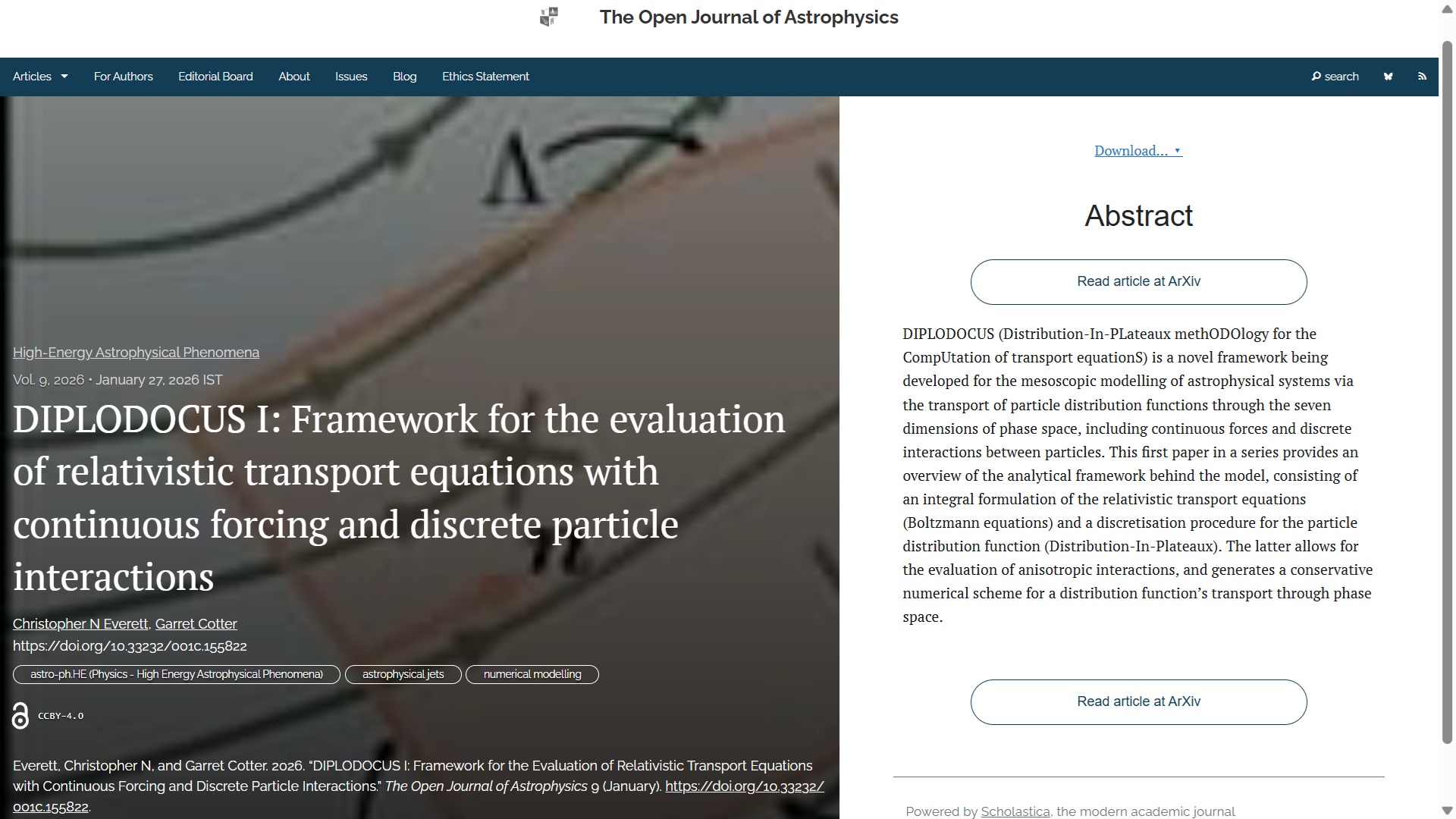
The second paper is “DIPLODOCUS I: Framework for the evaluation of relativistic transport equations with continuous forcing and discrete particle interactions” by Christopher N Everett & Garret Cotter (University of Oxford, UK). This was published on Tuesday January 27th 2026 in the folder High-Energy Astrophysical Phenomena. DIPLODOCUS is a new framework for mesoscopic modelling of astrophysical systems, using an integral formulation of relativistic transport equations and a discretisation procedure for particle distributions.

The overlay for this one is here:

The official version of the paper can be found on arXiv here and the Fediverse announcement here:

Open Journal of Astrophysics

New Publication at the Open Journal of Astrophysics: "DIPLODOCUS I: Framework for the evaluation of relativistic transport equations with continuous forcing and discrete particle interactions" by Christopher N Everett & Garret Cotter (University of Oxford, UK)

doi.org/10.33232/001c.155822

January 27, 2026, 8:49 am 1 boosts 0 favorites

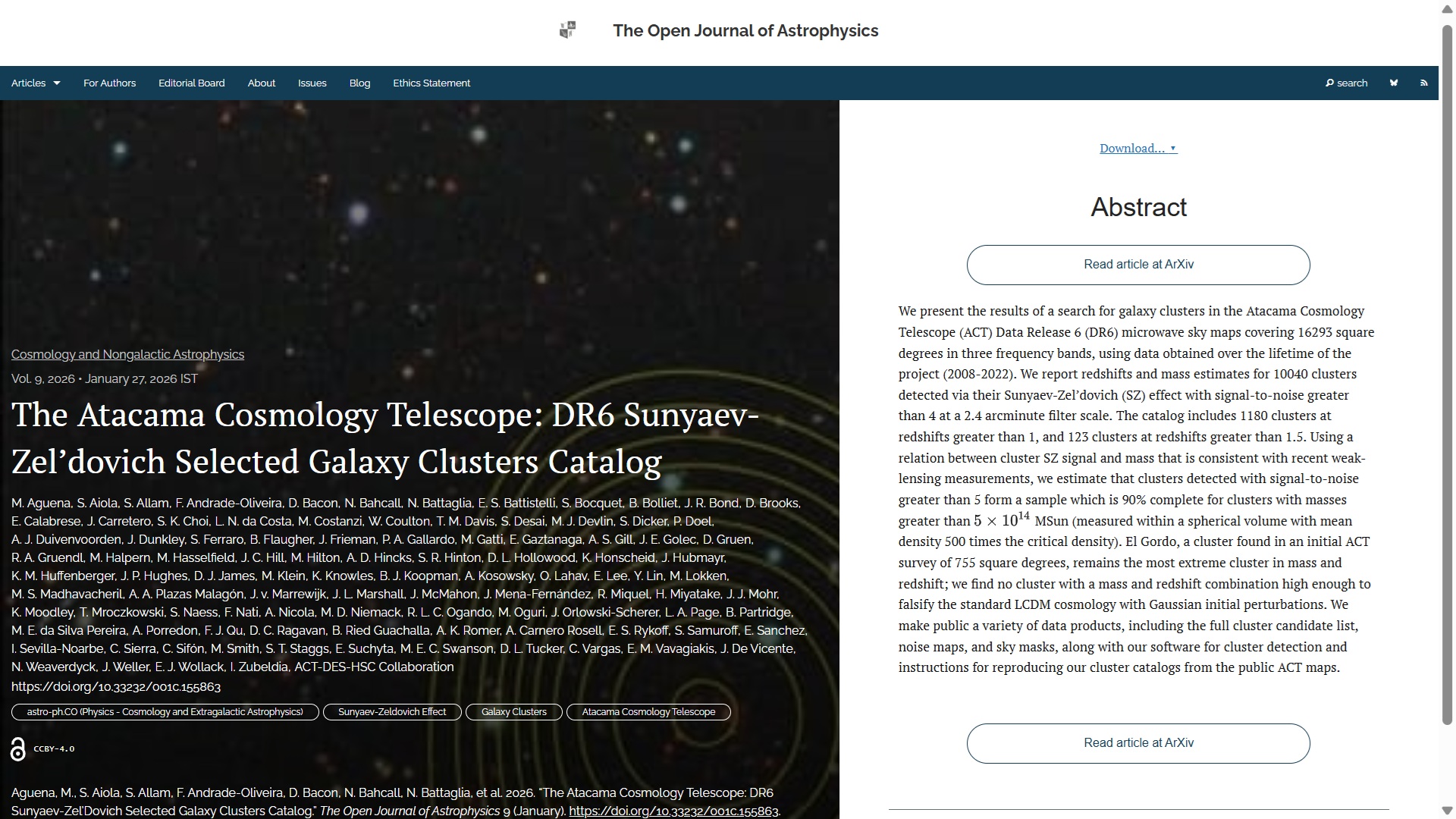
Next, also published on Tuesday January 27th but in the folder Cosmology and Nongalactic Astrophysics we have “The Atacama Cosmology Telescope: DR6 Sunyaev-Zel’dovich Selected Galaxy Clusters Catalog” by M. Aguena et al. (101 authors altogether), on behalf of the ACT-DES-HSC Collaboration. This article reports on the discovery of 10,040 galaxy clusters in the Atacama Cosmology Telescope data, including 1,180 clusters at high redshifts, using the Sunyaev-Zel’dovich effect.

The overlay is here:

The official version can be found on arXiv here and the Fediverse announcement is here:

Open Journal of Astrophysics

New Publication at the Open Journal of Astrophysics: "The Atacama Cosmology Telescope: DR6 Sunyaev-Zel’dovich Selected Galaxy Clusters Catalog" by M. Aguena et al. (101 authors altogether), on behalf of the ACT-DES-HSC Collaboration

doi.org/10.33232/001c.155863

January 27, 2026, 9:55 am 1 boosts 0 favorites

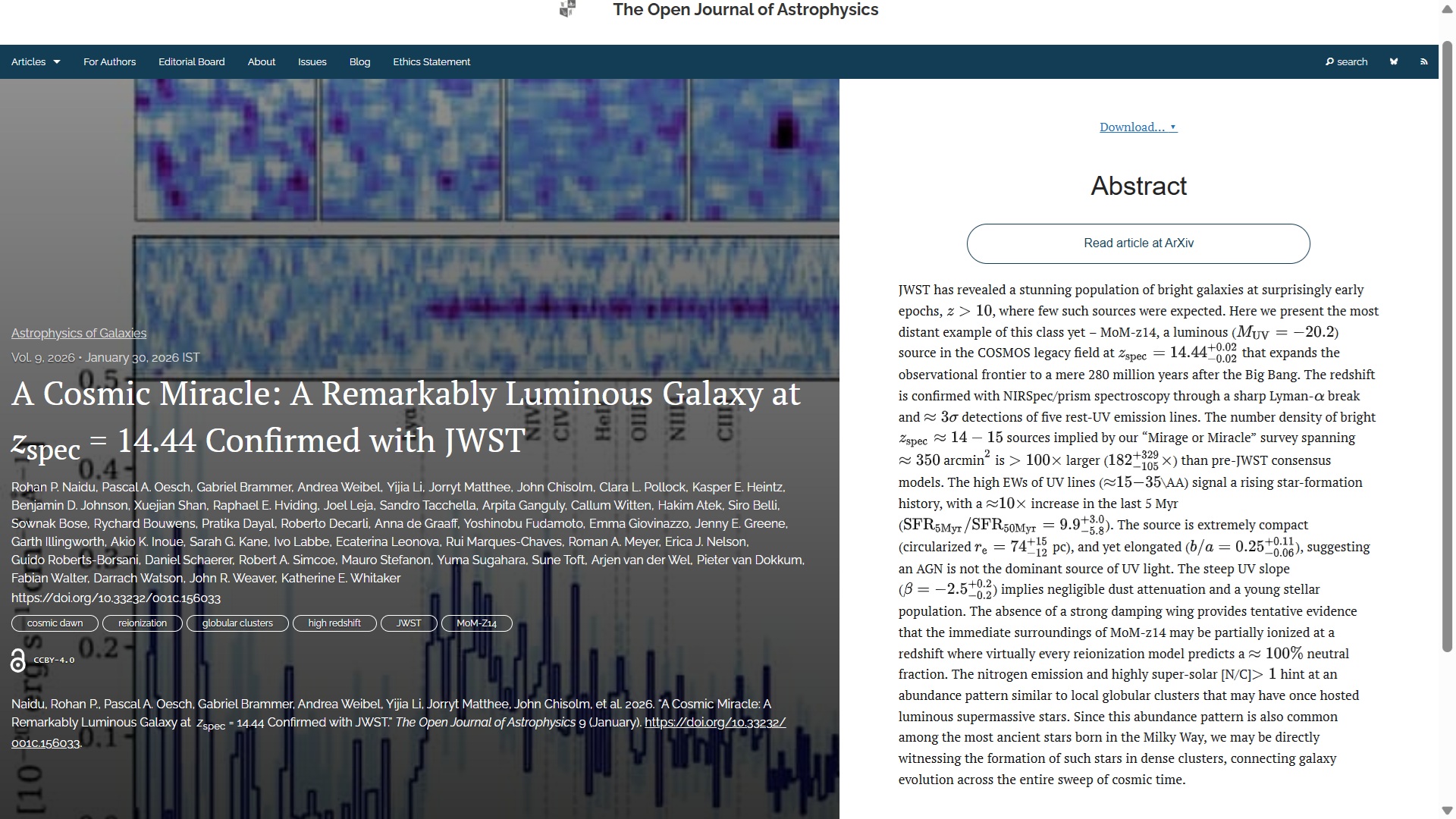
And finally for this week we have a paper published yesterday, Friday 30th January 2026, in the folder Astrophysics of Galaxies. This is the paper I blogged about yesterday: “A Cosmic Miracle: A Remarkably Luminous Galaxy at zspec = 14.44 Confirmed with JWST” by Rohan Naidu (MIT Kavli Institute) and an international cast of 45 others. This article reports on the discovery by the James Webb Space Telescope (JWST) of a bright galaxy, MoM-z14, located 280 million years post-Big Bang, that challenges models of galaxy formation and the star-formation history of early galaxies.

The overlay is here:

The accepted version can be found on arXiv here, and the fediverse announcement is here:

Open Journal of Astrophysics

New Publication at the Open Journal of Astrophysics: "A Cosmic Miracle: A Remarkably Luminous Galaxy at $z_{rm spec} = 14.44$ Confirmed with JWST" by Rohan Naidu (MIT Kavli Institute) and 45 others.

doi.org/10.33232/001c.156033

January 30, 2026, 7:20 am 2 boosts 1 favorites

And that concludes the update for this week. I will do another next Saturday.

A Cosmic Miracle?

Posted in OJAp Papers, The Universe and Stuff with tags , , , , , on January 30, 2026 by telescoper

A while ago (last May, in fact) I posted an article about a galaxy with an apparent spectroscopic redshift of 14.44. The paper to which that post related had been submitted to the Open Journal of Astrophysics and I haven’t mentioned that paper again until now as the paper was then, so to speak, sub judice. Well, as of today, the paper is now published and will feature in tomorrow’s traditional Saturday roundup of publications at the journal.

This paper was in fact accepted for publication before Christmas, but it took until this morning for the final accepted article to reach the arXiv. Rather awkwardly, the Space Telescope Science Institute issued a press release about this paper on 28th January 2026 stating that the paper was published in the Open Journal of Astrophysics, when that statement was not accurate. As Editor-in Chief of the Open Journal of Astrophysics, I was subsequently contacted by a number of journalists asking where they could find the paper on the OJAp platform. Since it hadn’t been published then I had to say they couldn’t, so a number of pieces (including, for example, this one in Scientific American) have appeared based on the STSCi press release without links to the final version of the paper. It would have been far better, in my opinion, to have delayed the press release until the paper was actually published. It’s better to wait until the ball is in the back of the net before you start celebrating!
Anyway, thanks to me getting up at 6am today, it’s now published so there’s no real harm done.

The fediscience announcement is here:

Open Journal of Astrophysics

New Publication at the Open Journal of Astrophysics: "A Cosmic Miracle: A Remarkably Luminous Galaxy at $z_{rm spec} = 14.44$ Confirmed with JWST" by Rohan Naidu (MIT Kavli Institute) and 45 others.

doi.org/10.33232/001c.156033

January 30, 2026, 7:20 am 1 boosts 0 favorites

For reference, here is the key plot showing the spectrum from which the galaxy’s redshift is determined. It is rather noisy, but the Lyman break seems convincing and there are some emission lines that offer corroborative evidence:

Weekly Update from the Open Journal of Astrophysics – 17/01/2026

Posted in OJAp Papers, Open Access, The Universe and Stuff with tags , , , , , , , , , , , , , , , , , , , , , , , , , , , , on January 17, 2026 by telescoper

It’s Saturday once more so time for another update of activity at the Open Journal of Astrophysics. Since the last update we have published seven papers, bringing the number in Volume 9 (2026) to 11 and the total so far published by OJAp up to 459. This week has been quite busy; for only the second time in recorded history we published at least one paper each working day.

I will continue to include the announcements made on our Mastodon account (on Fediscience) to encourage you to visit it. Mastodon is a really excellent service, and a more than adequate replacement for X/Twitter which nobody should be using.

The first three papers this week were all published on Monday January 12th in the folder Astrophysics of Galaxies.

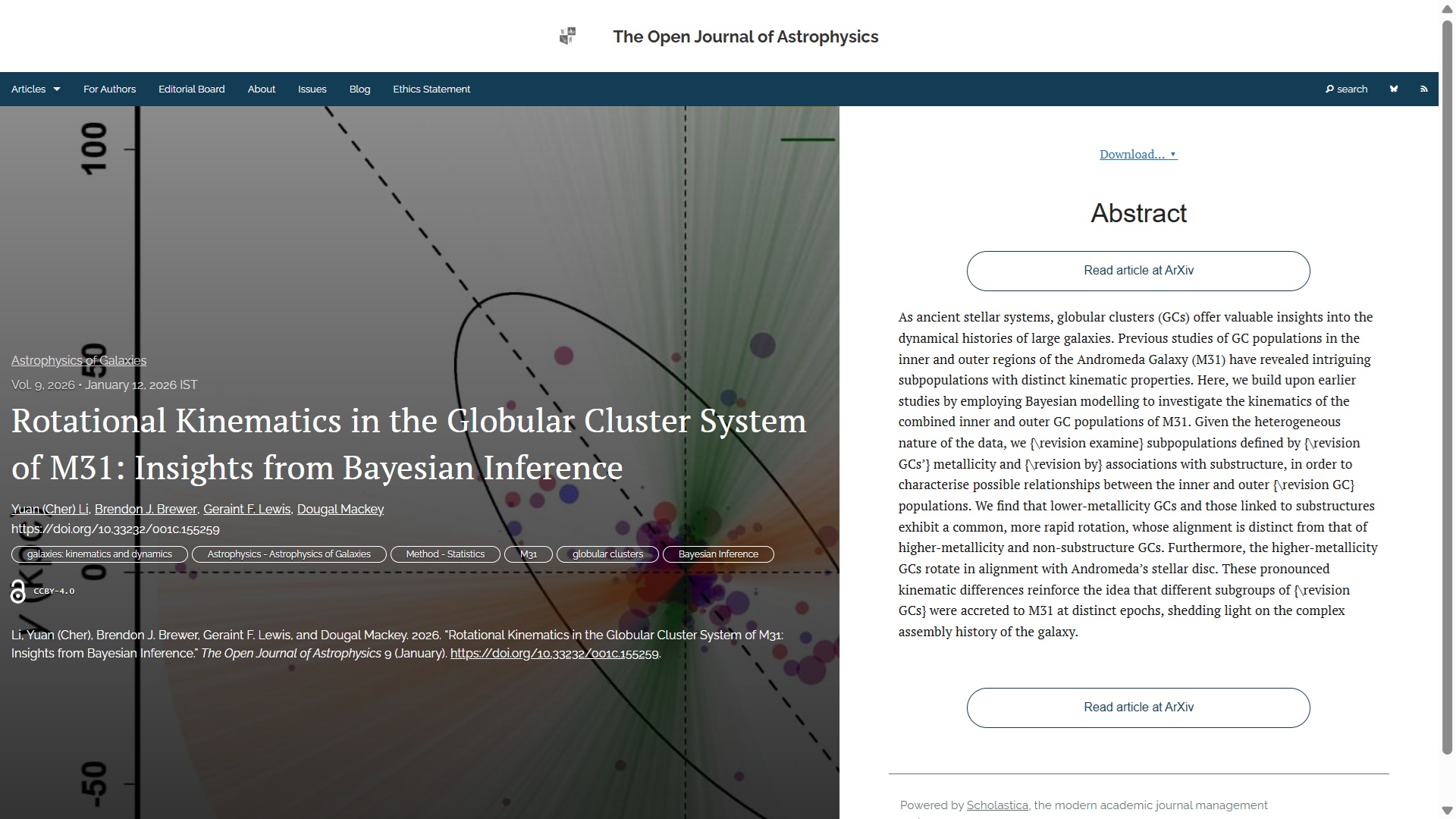
The first paper to report this week is “Rotational Kinematics in the Globular Cluster System of M31: Insights from Bayesian Inference” by Yuan (Cher) Li & Brendon J. Brewer (U. Auckland, New Zealand), Geraint F. Lewis (U. Sydney, Australia) and Dougal Mackey (independent researcher, Australia). This study uses Bayesian modelling to explore the kinematics of globular clusters in the Andromeda Galaxy, revealing distinct rotation patterns that suggest different subgroups were added at separate times.

The overlay is here:

You can find the officially accepted version on arXiv here and the announcement on Fediverse here:

Open Journal of Astrophysics

New Publication at the Open Journal of Astrophysics: "Rotational Kinematics in the Globular Cluster System of M31: Insights from Bayesian Inference" by Yuan (Cher) Li & Brendon J. Brewer (U. Auckland, New Zealand), Geraint F. Lewis (U. Sydney, Australia) and Dougal Mackey

doi.org/10.33232/001c.155259

January 12, 2026, 9:55 am 1 boosts 1 favorites

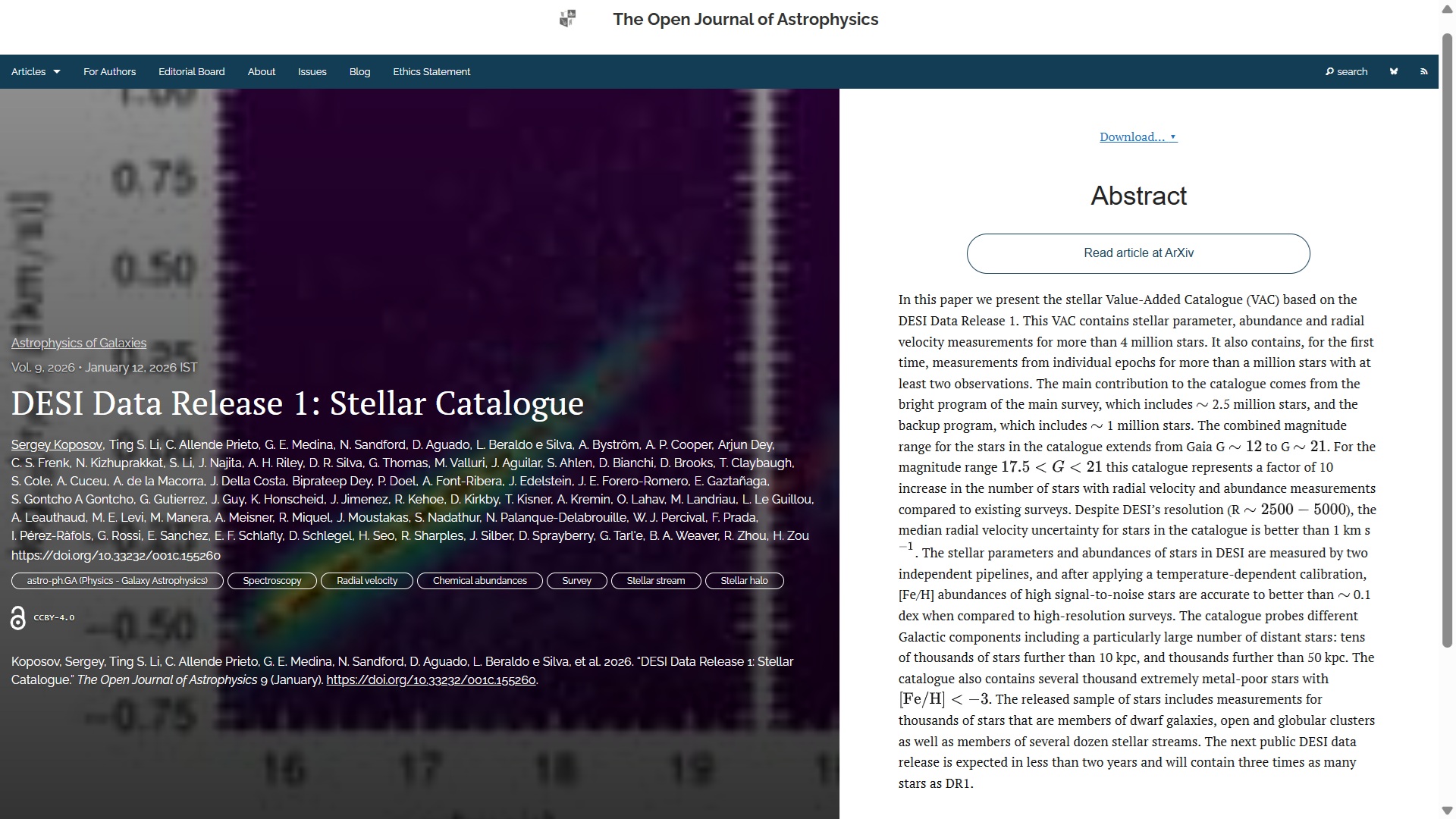
The second paper is “DESI Data Release 1: Stellar Catalogue” by Sergey Koposov (U. Edinburgh, UK) and an international cast of 67 other authors. This paper introduces and describes the stellar Value-Added Catalogue (VAC) based on DESI Data Release 1, providing measurements for over 4 million stars, including radial velocity, abundance, and stellar parameters.

The overlay for this one is here:

The official version of the paper can be found on arXiv here and the Fediverse announcement here:

Open Journal of Astrophysics

New Publication at the Open Journal of Astrophysics: "DESI Data Release 1: Stellar Catalogue" by Sergey Koposov (U. Edinburgh, UK) and an international cast of 67 other authors.

doi.org/10.33232/001c.155260

January 12, 2026, 10:11 am 2 boosts 1 favorites

Next we have “On the origins of oxygen: ALMA and JWST characterise the multi-phase, metal-enriched, star-bursting medium within a ‘normal’ z>11 galaxy” by Joris Witstok (Cosmic Dawn Centre, Copenhagen, Denmark) and 37 others in locations dotted around the world. This paper presents new ALMA observations of the JADES-GS-z11-0 galaxy confirm the presence of the [O III] 88 µm line, suggesting it consists of two low-mass components undergoing star formation and enriched in metals.

The overlay is here:

The official version can be found on arXiv here and the Fediverse announcement is here:

Open Journal of Astrophysics

New Publication at the Open Journal of Astrophysics: "On the origins of oxygen: ALMA and JWST characterise the multi-phase, metal-enriched, star-bursting medium within a ‘normal’ z>11 galaxy" by Joris Witstok (Cosmic Dawn Centre, Copenhagen, Denmark) and 37 others dotted around the world

doi.org/10.33232/001c.155261

January 12, 2026, 10:30 am 1 boosts 2 favorites

The fourth paper this week is also in the folder Astrophysics of Galaxies. but was published on Tuesday 13th January. It is entitled “Accelerated calibration of semi-analytic galaxy formation models” by Andrew Robertson and Andrew Benson (Carnegie Observatories, USA). This paper presents a faster calibration framework for galaxy formation models, using fewer simulations for each evaluation. However, the model shows discrepancies suggesting the model needs to be made more flexible.

The overlay is here:

You can find the officially accepted version on arXiv here and the Mastodon announcement here:

Open Journal of Astrophysics

New Publication at the Open Journal of Astrophysics: "Accelerated calibration of semi-analytic galaxy formation models" by Andrew Robertson and Andrew Benson (Carnegie Observatories, USA)

doi.org/10.33232/001c.155306

January 13, 2026, 9:41 am 1 boosts 1 favorites

Next one up, published on Wednesday 14th January in the folder Cosmology and Nongalactic Astrophysics, is “Constraints from CMB lensing tomography with projected bispectra” by Lea Harscouet & David Alonso (U. Oxford), UK), Andrina Nicola (U. Manchester, UK) and Anže Slosar (Brookhaven National Laboratory, USA). This study presents angular power spectra and bispectra of DESI luminous red galaxies, finding that the galaxy bispectrum can constrain the amplitude of matter fluctuations and the non-relativistic matter fraction. The overlay is here:

You can find the officially accepted paper on arXiv here and the Mastodon announcement here:

Open Journal of Astrophysics

New Publication at the Open Journal of Astrophysics: "Constraints from CMB lensing tomography with projected bispectra" by Lea Harscouet & David Alonso (U. Oxford, UK), Andrina Nicola (U. Manchester, UK) and Anže Slosar (Brookhaven National Laboratory, USA)

doi.org/10.33232/001c.155341

January 14, 2026, 2:00 pm 2 boosts 0 favorites

The sixth paper this week is “Universal numerical convergence criteria for subhalo tidal evolution” by Barry T. Chiang & Frank C. van den Bosch (Yale U., USA) and Hsi-Yu Schive (National Taiwan University, Taiwan). This was published on Thursday 15th January in the folder Cosmology and Nongalactic Astrophysics; it presents an analysis of a simulation suite that addresses the ‘overmerging’ problem in cosmological simulations of dark matter subhalos, showing that up to 50% of halos in state-of-the art simulations are unresolved. The overlay is here:

The final accepted version of this paper can be found on arXiv here. The Mastodon announcement follows:

Open Journal of Astrophysics

New Publication at the Open Journal of Astrophysics: "Universal numerical convergence criteria for subhalo tidal evolution" by Barry T. Chiang & Frank C. van den Bosch (Yale U., USA) and Hsi-Yu Schive (National Taiwan University, Taiwan)

doi.org/10.33232/001c.155367

January 15, 2026, 9:11 am 1 boosts 0 favorites

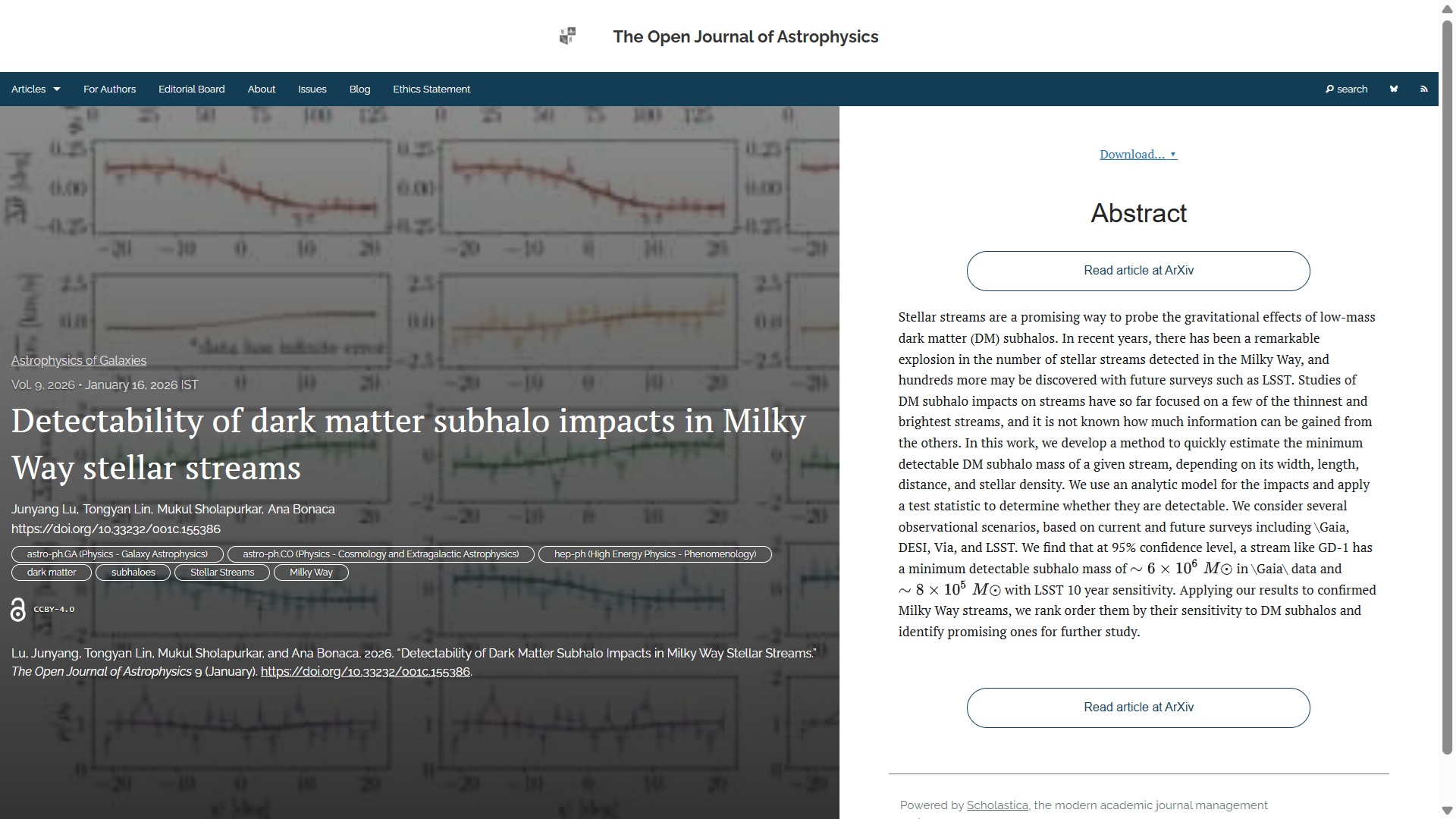
Finally for this week we have “Detectability of dark matter subhalo impacts in Milky Way stellar streams” by Junyang Lu , Tongyan Lin & Mukul Sholapurkar (UCSD, USA) and Ana Bonaca (Carnegie Observatories, USA). This was published on Friday 16th January (i.e. yesterday) in the folder Astrophysics of Galaxies. The study develops a method to estimate the minimum detectable dark matter subhalo mass in stellar streams, ranking them by sensitivity and identifying promising lines for further research.

The overlay is here:

The officially accepted version can be found on arXiv here and the Fediverse announcement here:

Open Journal of Astrophysics

New Publication at the Open Journal of Astrophysics: "Detectability of dark matter subhalo impacts in Milky Way stellar streams" by Junyang Lu , Tongyan Lin & Mukul Sholapurkar (UCSD, USA) and Ana Bonaca (Carnegie Observatories, USA)

doi.org/10.33232/001c.155386

January 16, 2026, 9:32 am 0 boosts 0 favorites

That concludes the update for this week. I will do another next Saturday.

How magnetism might make galaxies…

Posted in Biographical, The Universe and Stuff with tags , , on December 16, 2025 by telescoper

I saw mention of paper recently published in Nature Astronomy by Karsten Jedamzik, Levon Pogosian and Tom Abel with the title Hints of primordial magnetic fields at recombination and implications for the Hubble tension. It’s behind a paywall but there is a version available on the arXiv here. The abstract of the Nature Astronomy version looks like this:

This paper reminded me of a paper I wrote a long time ago (in 1991, when I was at Queen Mary) about primordial magnetic fields and galaxy formation. It had its origins in a lunchtime talk I gave which was based on an old paper from the 1970s by Ira Wasserman. All I did was go through the paper and add a few small comments to update it, including some more recent observational constraints and mentions of dark non-baryonic matter; the Wasserman paper was framed in a model in which all the matter in the Universe was baryonic.

Anyway, the talk went down quite well and I was encouraged to write it up. I did so, and submitted it to a journal (MNRAS). Not unreasonably, it was rejected on the grounds that it didn’t have sufficient original content. I therefore expanded the discussion and submitted it as a review article to Comments on Astrophysics. That journal is now defunct, but the paper can be found on NASA/ADS here. It’s even got some citations!

Here’s the title and abstract:

You can find the whole paper here:

You will see I was advocating a larger magnetic field than in the recent one, with a view to affecting galaxy formation directly rather than larger scale features of the Universe. An important point is that primordial magnetic fields can have a large effect soon after recombination, so they might play a role in the formation of galaxies at high redshift which we are struggling to explain. At least – unlike some of the more exotic explanations that have been proposed – we know that magnetic fields actually exist…

Weekly Update from the Open Journal of Astrophysics – 15/11/2025

Posted in OJAp Papers, Open Access, The Universe and Stuff with tags , , , , , , , , , , , , , , , , , , , , , , , , , , , , , on November 15, 2025 by telescoper

It’s Saturday again, so it’s time for the usual update of the week’s new papers at the Open Journal of Astrophysics. It has been quite a busy week. Since the last update we have published another seven papers, which brings the number in Volume 8 (2025) up to 175, and the total so far published by OJAp up to 410.

First on the menu for this week is “Dynamical friction and measurements of the splashback radius in galaxy clusters” by Talia M. O’Shea (U. Wisconsin-Madison, USA), Josh Borrow & Stephanie O’Neil (U. Pennsylvania, USA) and Mark Vogelsberger (MIT, USA). Published on Tuesday 11th November in the folder Cosmology and NonGalactic Astrophysics, this one presents a study suggesting that dynamical friction does not play a major role in reducing the radius of the splashback feature in real data compared to numerical simulations.

The overlay is here:

You can find the officially accepted version on arXiv here.

The Fediverse announcement is here:

Open Journal of Astrophysics

New Publication at the Open Journal of Astrophysics: "Dynamical friction and measurements of the splashback radius in galaxy clusters" by Talia M. O'Shea (U. Wisconsin-Madison, USA), Josh Borrow & Stephanie O'Neil (U. Pennsylvania, USA) and Mark Vogelsberger (MIT, USA)

doi.org/10.33232/001c.147125

November 11, 2025, 8:36 am 3 boosts 1 favorites


The second paper of the week is “Microlensing of lensed supernovae Zwicky & iPTF16geu: constraints on the lens galaxy mass slope and dark compact object fraction” by Nikki Arendse (Stockholm University, Sweden) and and international cast of 11 others based in Sweden, UK and France. This one was published on 11th November 2025 in the folder Astrophysics of Galaxies. It is about combining observations of two supernovae, iPTF16geu and SN Zwicky, with microlensing magnification maps to probe the properties of the lens galaxy.

The overlay is here:


You can find the official version of this one on arXiv here. The federated announcement on Mastodon is here:

Open Journal of Astrophysics

New Publication at the Open Journal of Astrophysics: "Microlensing of lensed supernovae Zwicky & iPTF16geu: constraints on the lens galaxy mass slope and dark compact object fraction" by Nikki Arendse (Stockholm University, Sweden) and 11 others based in Sweden, UK and France

doi.org/10.33232/001c.147126

November 11, 2025, 8:53 am 1 boosts 1 favorites


Next one up is “Neutrino Constraints on Black Hole Formation in M31” by Yudai Sawa (U. Tokyo, Japan) and 11 others all based in Japan. This was published on Tuesday 11th November in the folder High-Energy Astrophysical Phenomena. It presents a calculation of the neutrino emission expected from the collapse of massive stars and its use in constraining black hole formation using neutrino detectors.


The overlay is here:

You can find the official accepted version on arXiv here. The fediverse announcement is here:

Open Journal of Astrophysics

New Publication at the Open Journal of Astrophysics: "Neutrino Constraints on Black Hole Formation in M31" by Yudai Sawa (U. Tokyo, Japan) and 11 others all based in Japan

doi.org/10.33232/001c.147127

November 11, 2025, 9:04 am 0 boosts 1 favorites

The fourth paper this week is “Redshift Drift in Relativistic N-Body Simulations” by Alexander Oestreicher (U. Southern Denmark, DK), Chris Clarkson (QMUL, UK), Julian Adamek (U. Zürich, CH) and Sofie Marie Koksbang (U. Southern Denmark, DK). This one was published on Wednesday 12th November in the folder marked Cosmology and NonGalactic Astrophysics. It presents numerical calculations of the cosmological redshift drift effect for comparison with future surveys.

The overlay is here:


You can find the official published version on arXiv here. The Fediverse announcement follows:

Open Journal of Astrophysics

New Publication at the Open Journal of Astrophysics: "Redshift Drift in Relativistic N-Body Simulations" by Alexander Oestreicher (U. Southern Denmark, DK), Chris Clarkson (QMUL, UK), Julian Adamek (U. Zürich, CH) and Sofie Marie Koksbang (U. Southern Denmark, DK)

doi.org/10.33232/001c.147178

November 12, 2025, 8:35 am 1 boosts 0 favorites


The fifth paper for this week is “Attributing the point symmetric structure of core-collapse supernova remnant N132D to the jittering jets explosion mechanism” by Noam Soker (Technion, Haifa, Israel). This one, published on Wednesday November 12th in the folder High-Energy Astrophysical Phenomena, presents a discussion of the morphology of a supernova remnant and possible explanation for it in terms of the explosion mechanism.

The overlay is here:


The officially accepted version can be found on arXiv here. The Fediverse announcement is here:

Open Journal of Astrophysics

New Publication at the Open Journal of Astrophysics: "Attributing the point symmetric structure of core-collapse supernova remnant N132D to the jittering jets explosion mechanism" by Noam Soker (Technion, Haifa, Israel)

doi.org/10.33232/001c.147183

November 12, 2025, 8:46 am 1 boosts 0 favorites

The sixth paper to report this week is “Witnessing downsizing in the making: quiescent and breathing galaxies at the dawn of the Universe” by Emiliano Merlin (Osservatorio Astronomico di Roma, Italy) and an international cast of 20 others based in Italy, Germany, UK, USA, Switzerland, Spain and China. This one was published on Friday November 14th in the folder Astrophysics of Galaxies.

You can find the officially-accepted version on arXiv here. The fediverse announcement is here:

Open Journal of Astrophysics

New Publication at the Open Journal of Astrophysics: "Witnessing downsizing in the making: quiescent and breathing galaxies at the dawn of the Universe" by Emiliano Merlin (Osservatorio Astronomico di Roma, Italy) and 20 others based in Italy, Germany, UK, USA, Switzerland, Spain and China

doi.org/10.33232/001c.147267

November 14, 2025, 8:38 am 1 boosts 1 favorites

And finally (for this week) we have “Beyond No No Tension: JWST z > 10 Galaxies Push Simulations to the Limit” by Joe McCaffrey (NUI Maynooth, Ireland), Samantha Hardin & John Wise (Georgia Institute of Technology, USA) and John Regan (Maynooth). This one was also published on Friday 14th November, in the folder marked Astrophysics of Galaxies. It asks the question whether newly-discovered high redshift galaxies are consistent with simulations of galaxy formation. The overlay is here:

You can find the officially acceopted version on arXiv here. The fediverse announcement is here:

Open Journal of Astrophysics

New Publication at the Open Journal of Astrophysics: "Beyond No No Tension: JWST z > 10 Galaxies Push Simulations to the Limit" by Joe McCaffrey (NUI Maynooth, Ireland), Samantha Hardin & John Wise (Georgia Institute of Technology, USA) and John Regan (Maynooth)

doi.org/10.33232/001c.147278

November 14, 2025, 9:02 am 2 boosts 0 favorites

And that concludes the update for this week. There will be another next Saturday.

Weekly Update from the Open Journal of Astrophysics – 08/11/2025

Posted in OJAp Papers, Open Access, The Universe and Stuff with tags , , , , , , , , , , , , , , , , , , , , , , on November 8, 2025 by telescoper

It’s Saturday again, so it’s time for the usual update of the week’s new papers at the Open Journal of Astrophysics. Since the last update we have published another five papers, which brings the number in Volume 8 (2025) up to 168, and the total so far published by OJAp up to 403.

The first paper this week is “Maximizing Ariel’s Survey Leverage for Population-Level Studies of Exoplanets” by Nicolas B. Cowan and Ben Coull-Neveu (McGill University, Canada). This article was published in the folder Earth and Planetary Astrophysics on Tuesday 4th November 2025; it discusses various different schemes to select the mission reference sample for a notional three year transit spectroscopy survey with the European Space Agency’s Ariel mission

The overlay is here:


You can find the officially accepted version on arXiv here.

The Fediverse announcement is here:

Open Journal of Astrophysics

New Publication at the Open Journal of Astrophysics: "Maximizing Ariel’s Survey Leverage for Population-Level Studies of Exoplanets" by Nicolas B. Cowan and Ben Coull-Neveu (McGill University, Canada)

doi.org/10.33232/001c.146656

November 4, 2025, 5:08 pm 1 boosts 3 favorites


The second paper of the week is “A substellar flyby that shaped the orbits of the giant planets” by Garett Brown (U. Toronto at Scarborough, Canada), Renu Malhotra (U. Arizona, USA) and Hanno Rein (U. Toronto at Scarborough, Canada). This article was published on Wednesday 5th November 2025, also in the folder Earth and Planetary Astrophysics. It argues that an ancient close encounter with a substellar object offers a plausible explanation for the origin of the moderate eccentricities and inclinations of the giant planets.

The overlay is here:

You can find the official version of this one on arXiv here. The federated announcement on Mastodon is here:

Open Journal of Astrophysics

New Publication at the Open Journal of Astrophysics: "A substellar flyby that shaped the orbits of the giant planets" by Garett Brown (U. Toronto at Scarborough, Canada), Renu Malhotra (U. Arizona, USA) and Hanno Rein (U. Toronto at Scarborough, Canada)

doi.org/10.33232/001c.146688

November 5, 2025, 8:34 am 3 boosts 3 favorites

Next one up is “The Potential Impact of Primordial Black Holes on Exoplanet Systems” by Garett Brown (U. Toronto at Scarborough), Linda He (Harvard U., USA),  and James Unwin (U. Illinois Chicago, USA). This one was also published on Wednesday 5th November 2025, but in the folder Astrophysics of Galaxies. This one is an exploration of the possibility that primordial black holes (PBHs) in our Galaxy, might impact the orbits of exoplanets. The overlay is here:

You can find the official accepted version on arXiv here. The fediverse announcement is here:

Open Journal of Astrophysics

New Publication at the Open Journal of Astrophysics: "The Potential Impact of Primordial Black Holes on Exoplanet Systems" by Garett Brown (U. Toronto at Scarborough), Linda He (Harvard U., USA), James Unwin (U. Illinois Chicago, USA)

doi.org/10.33232/001c.146689

November 5, 2025, 8:49 am 3 boosts 1 favorites

The fourth paper to report is “The Unhurried Universe: A Continued Search for Long Term Variability in ASAS-SN” by Sydney Petz, C. S. Kochanek & K. Z. Stanek (Ohio State U., USA), Benjamin J. Shappee (U. Hawaii, USA), Subo Dong (Peking University, China), J. L. Prieto (Universidad Diego Portales, Chile) and Todd A. Thompson (Ohio State U., USA). This one was also published on Wednesday November 5th 2025, but in the folder Solar and Stellar Astrophysics.  It describes the discovery and investigation of slowly-varying sources in the All Sky Automated Survey for SuperNovae (ASAS-AN) leading to the identification of 200 new variable stars. The overlay is here:


You can find the official published version on arXiv here. The Fediverse announcement follows:

Open Journal of Astrophysics

New Publication at the Open Journal of Astrophysics: "The Unhurried Universe: A Continued Search for Long Term Variability in ASAS-SN" by Sydney Petz, C. S. Kochanek & K. Z. Stanek (Ohio State U., USA), Benjamin J. Shappee (U. Hawaii, USA), Subo Dong (Peking University, China), J. L. Prieto (Universidad Diego Portales, Chile) and Todd A. Thompson (Ohio State U., USA)

doi.org/10.33232/001c.146690

November 5, 2025, 9:08 am 1 boosts 0 favorites

The fifth and final paper for this week is “Measuring the splashback feature: Dependence on halo properties and history” by Qiaorong S. Yu (Oxford U., UK) and 9 others based in the UK and USA. This was published on Friday 7th November 2025 in the folder Cosmology and Nongalactic Astrophysics. It discusses how the properties of “splashback” features in halo profiles relate to the halo’s assembly history (e.g. mass accretion rate and most recent merger time). The overlay is here:

The officially accepted version can be found on arXiv here. The Fediverse announcement is here:

Open Journal of Astrophysics

New Publication at the Open Journal of Astrophysics: "Measuring the splashback feature: Dependence on halo properties and history" by Qiaorong S. Yu (Oxford U., UK) and 9 others based in the UK and USA.

doi.org/10.33232/001c.146824

November 7, 2025, 9:12 am 0 boosts 0 favorites

That’s all the papers for this week. I’ll do another report next Saturday.

Weekly Update from the Open Journal of Astrophysics – 11/10/2025

Posted in OJAp Papers, Open Access, The Universe and Stuff with tags , , , , , , , , , , , , , , , , , , , , , on October 11, 2025 by telescoper

It’s time once again for the usual Saturday update of the week’s new papers at the Open Journal of Astrophysics. Since the last update we have published six  more papers, which brings the number in Volume 8 (2025) up to 152, and the total so far published by OJAp up to 387. Not only have we passed the 150 mark for the year, but this week saw another record for the Journal, in that it was the first week in which we published at least one paper on every day.

Anyway, here are this week’s papers:

The first paper is “Mapping the Nearest Ancient Sloshing Cold Front in the Sky with XMM-Newton” by Sheng-Chieh Lin (University of Kentucky) and 10 others based in the USA, Spain and Germany. This article, published on Monday 6th October 2025, in the section High-Energy Astrophysical Phenomena discusses cold fronts in the Virgo Cluster, their importance in shaping the thermal dynamics of the intracluster medium beyond the cluster core, and their implications for cluster cosmology.

The overlay is here:


The officially accepted version of this paper can be found on the arXiv here.

The second paper this week, also published on Monday 6th October, is “Testing gravitational physics by combining DESI DR1 and weak lensing datasets using the E_G estimator” by S.J. Rauhut (Swinburne University of Technology, Australia) and an international cast of 63 others. This one is in the folder Cosmology and NonGalactic Astrophysics, and it presents a comparison of  Baryon Acoustic Oscillation (BAO) measurements from BOSS, DESI with weak lensing from KiDS, DES and HSC showing that the results are altogether consistent with the standard cosmological model.

The overlay is here:

You can find the officially accepted version of this paper on arXiv here.

Next one up is “Analysis of Galaxies at the Extremes: Failed Galaxy Progenitors in the MAGNETICUM Simulations” by Jonah S. Gannon (Swinburne University, Australia), Lucas C. Kimmig (Ludwig-Maximilians-Universität, Germany; LMU), Duncan A. Forbes (Swinburne), Jean P. Brodie (Swinburne), Lucas M. Valenzuela (LMU), Rhea-Silvia Remus (LMU), Joel L. Pfeffer (Swinburne) and Klaus Dolag (LMU). This paper, published on Tuesday 7th October 2025, in the folder Astrophysics of Galaxies, discusses the business of identifying the possible high-redshift progenitors of low-redshift ultra-diffuse galaxies in cosmological simulations.

The corresponding overlay is here:

You can find the officially accepted version on arXiv here.

The fourth paper this week, published on Wednesday 8th October 2025 in the folder Astrophysics of Galaxies,  is
What Sets the Metallicity of Ultra-Faint Dwarfs?” by Vance Wheeler, Andrey Kravtsov, Anirudh Chiti & Harley Katz (U. Chicago) and Vadim A. Semenov (CfA Harvard), all based in the USA.

The overlay is here:

You can find the officially-accepted version on arXiv here.

Next, and fifth, we have our 150th publication of 2025, “Synthesizer: a Software Package for Synthetic Astronomical Observables” by Christopher C. Lovell (Cambridge, UK), William J. Roper, Aswin P. Vijayan & Stephen M. Wilkins (Sussex, UK), Sophie Newman (Portsmouth, UK) and Louise Seeyave (Sussex). This paper presents a suite of software tools for creating synthetic astrophysical observables for use in mock galaxy catalogues. It was published on Thursday 9th October 2025 in the folder Instrumentation and Methods for Astrophysics.

The overlay is here:

You can find the officially accepted version on arXiv here.

And finally for this week we have “Introducing the THESAN-ZOOM project: radiation-hydrodynamic simulations of high-redshift galaxies with a multi-phase interstellar medium” by Rahul Kannan (York University, Canada) and 13 others based in the USA, Germany, Japan, Italy and the UK. This one was published on Friday 10th October (i.e. yesterday) in the folder Astrophysics of Galaxies. It describes a comprehensive suite of high-resolution zoom-in simulations of high-redshift galaxies, encompassing a diverse range of halo masses, selected from the THESAN simulation volume.

The corresponding overlay is here:

You can find the officially accepted version of this one on arXiv here.

That concludes the papers for this week. I will, however, add a short postscript. This week saw the announcement of this year’s list of MacArthur Fellows. among them Kareem El-Badry who has published quite a few papers with the Open Journal of Astrophysics. His biography on the MacArthur Foundation page includes this:

He has published articles in Monthly Notices of the Royal Astronomical SocietyThe Astrophysical Journal, and The Open Journal of Astrophysics, among other leading scientific journals.

I’m pleased to see us listed with the established names. I mention this just in case there are still people out there who think it might damage their career if they publish with a non-mainstream journal. I guess we are mainstream now…

Weekly Update from the Open Journal of Astrophysics – 04/10/2025

Posted in OJAp Papers, Open Access, The Universe and Stuff with tags , , , , , , , , , , , , , , , , , , , , , , , , on October 4, 2025 by telescoper

It’s Saturday again, so it’s time for a summary of the week’s new papers at the Open Journal of Astrophysics. Since the last update we have published five more papers, which brings the number in Volume 8 (2025) up to 146, and the total so far published by OJAp up to 381. At this rate Volume 8 will contain around 190 by the end of 2025.

Anyway, here are this week’s papers, starting with three published on Monday 29th September 2025.

The first paper is “Cosmic Multipoles in Galaxy Surveys II: Comparing Different Methods in Assessing the Cosmic Dipole” by Vasudev Mittal, Oliver T. Oayda and Geraint F. Lewis (U. Sydney, Australia). This is in the folder Cosmology and Nongalactic Astrophysics. It presents a comparison of methods for determining the number count dipole from cosmological surveys with a discussion of the implications for the known discordance with the CMB diple.

The overlay is here:

You can make this larger by clicking on it.  The officially accepted version of this paper can be found on the arXiv here.

The second paper this week, also published on Monday 29th September, is “SDSS-C4 3028: the Nearest Blue Galaxy Cluster Devoid of an Intracluster Medium” by Shweta Jain (University of Kentucky, USA) and 11 others based in the USA, Australia and Korea. This describes a galaxy cluster with an unusually high fraction (about 63%) of star-forming galaxies which may be a result of ram pressure stripping; the article is in the folder Astrophysics of Galaxies.

The corresponding overlay is here:


You can find the officially accepted version on arXiv here.

The third one this week, published on also published on Monday 29th September but in the folder Earth and Planetary Astrophysics, is “Comparing the Architectures of Multiplanet Systems from Kepler, K2, and TESS Data” by Robert L Royer and Jason H. Steffen (University of Nevada, USA).  This paper explores the trends seen in exoplanet survey data, including Kepler, TESS, and K2 including many planetary systems with multiple planets.

The overlay is here:


You can find the officially-accepted version on arXiv here.

The next one up is “Seeding Cores: A Pathway for Nuclear Star Clusters from Bound Star Clusters in the First Billion Years” by Fred Angelo Batan Garcia (Columbia University, USA), Massimo Ricotti (University of Maryland, USA) and Kazuyuki Sugimura (Hokkaido University, Japan). This paper was published on Thursday 2nd October in the folder Astrophysics of Galaxies. This is about modelling the formation of Nuclear Star Clusters using cosmological radiation-hydrodynamic simulations, with discussion of the implications for seeding supermassive black holes and the little red dots seen by JWST.

The corresponding overlay is here:

You can find the officially accepted version of this one on arXiv here.

The fifth and last one for this week, published on Friday 3rd October 2025, is “Efficient semi-analytic modelling of Pop III star formation from Cosmic Dawn to Reionization” by Sahil Hegde and Steven R. Furlanetto (University of Californi Los Angeles, USA).  This is also in the folder marked Astrophysics of Galaxies. It uses a self-consistent analytic model to trace the formation of the first stars from their birth through the first billion years of the universe’s history. complementing semi-analytic and computational methods.


You can find the officially-accepted version of this paper on arxiv here.

That concludes the report for this week. I’ll post another update next Saturday.