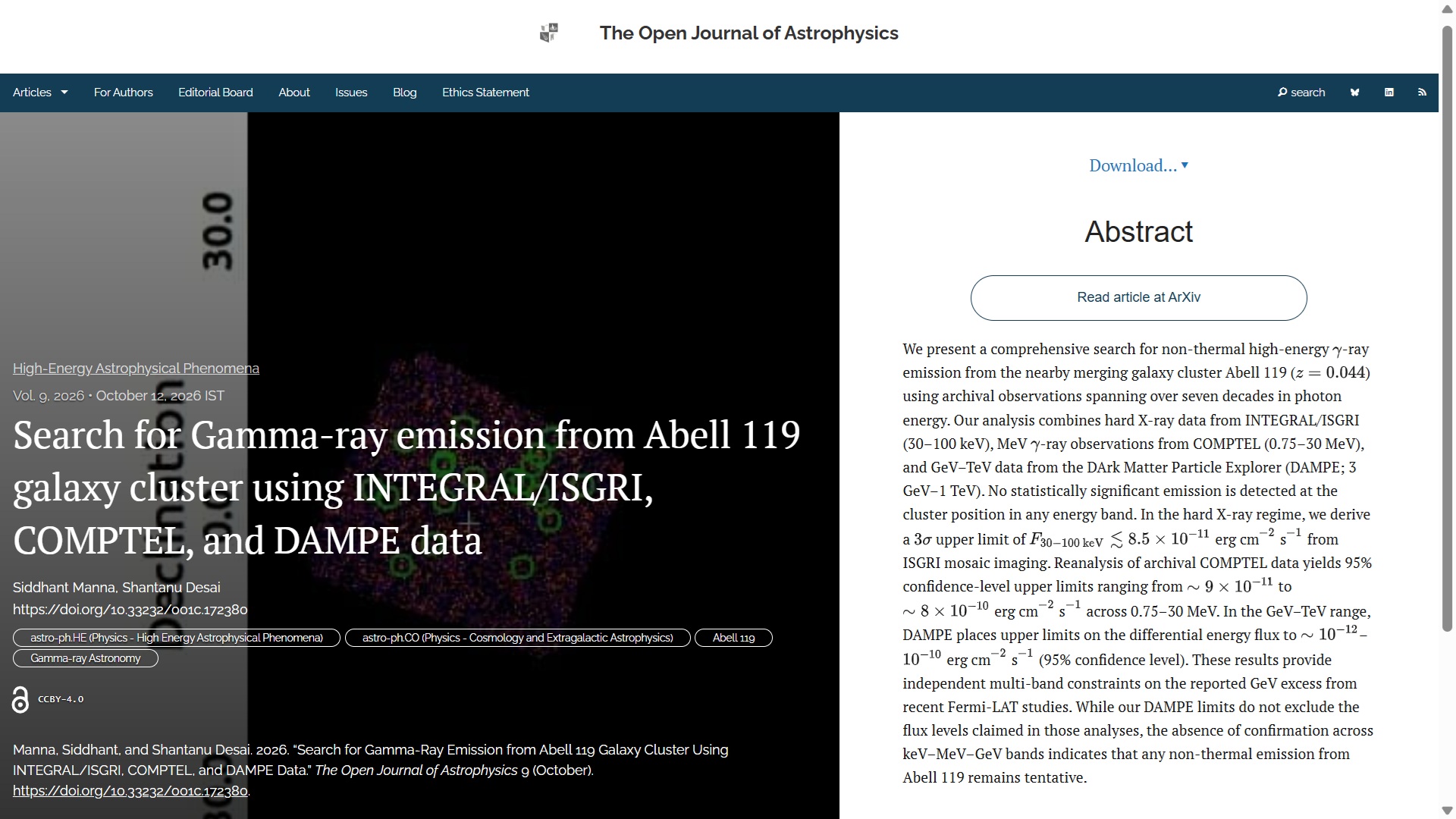
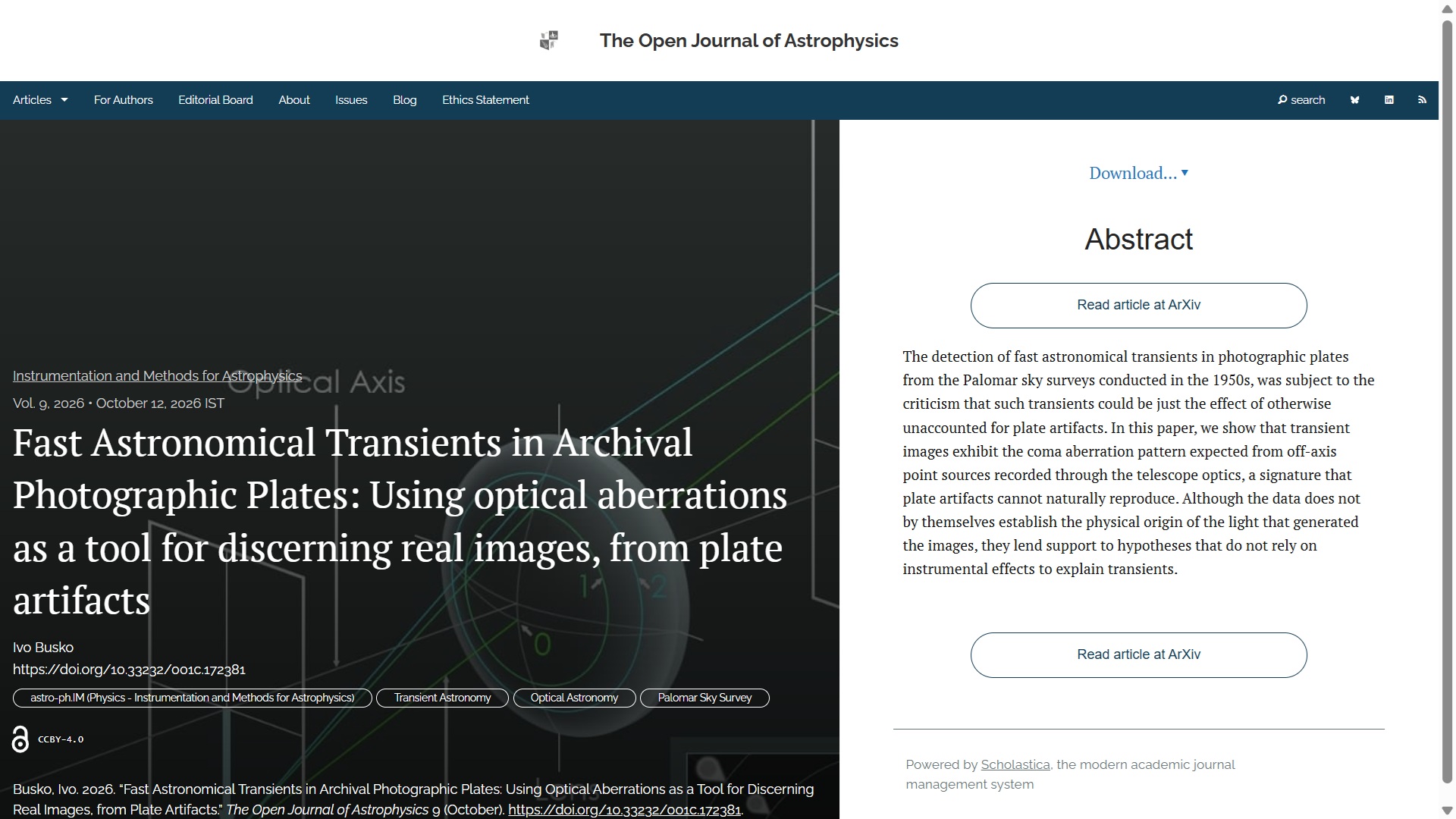
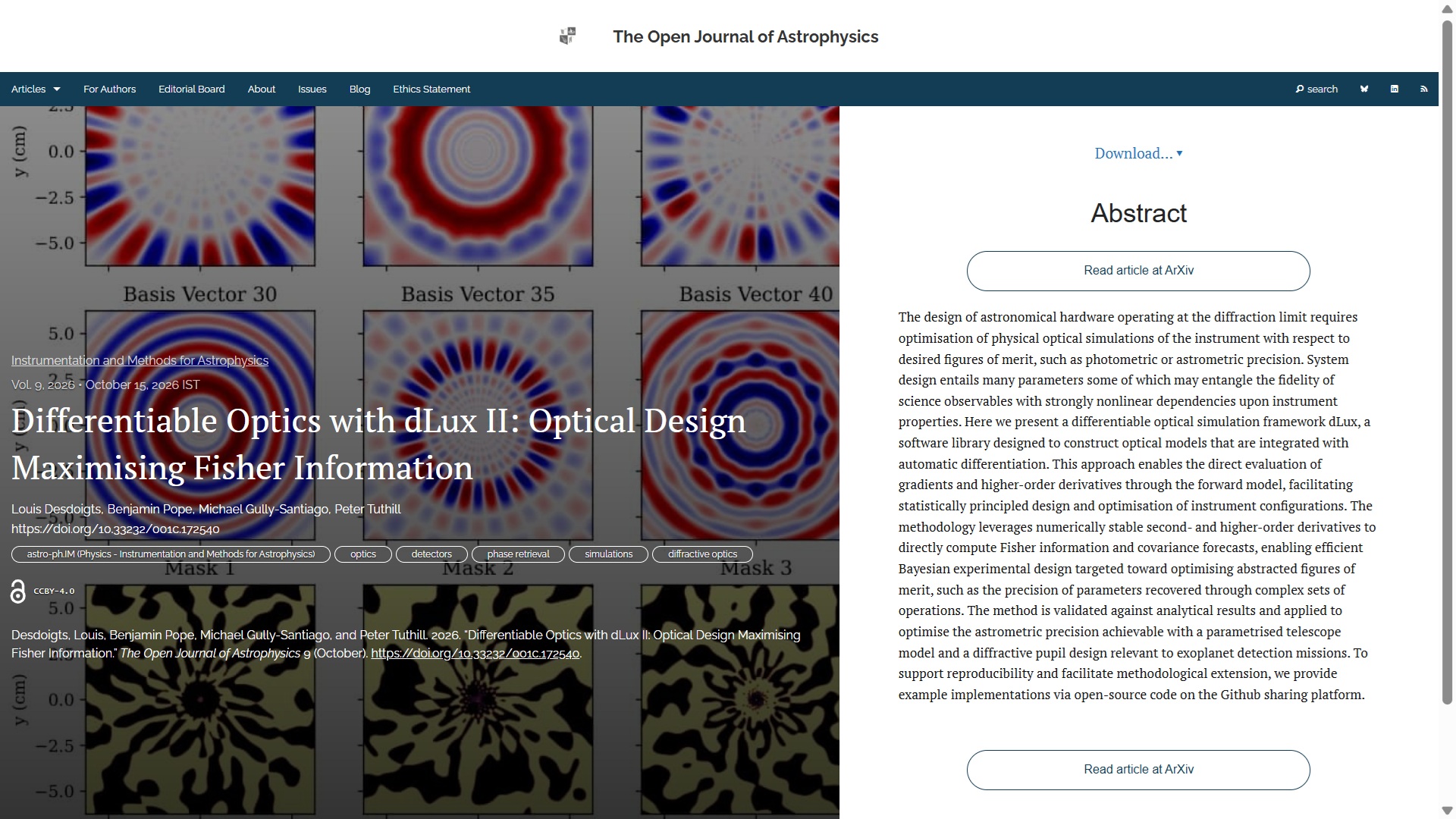
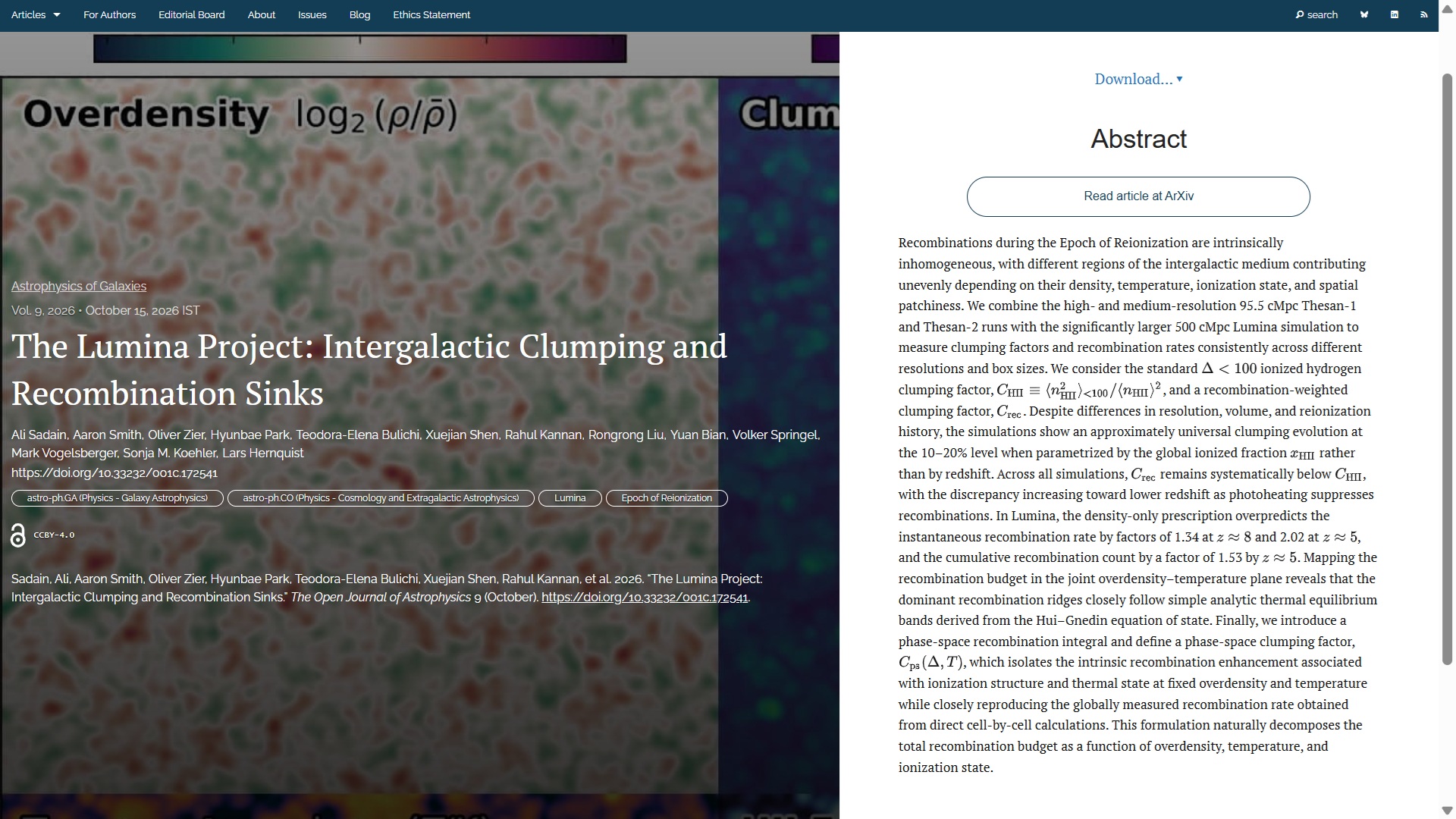
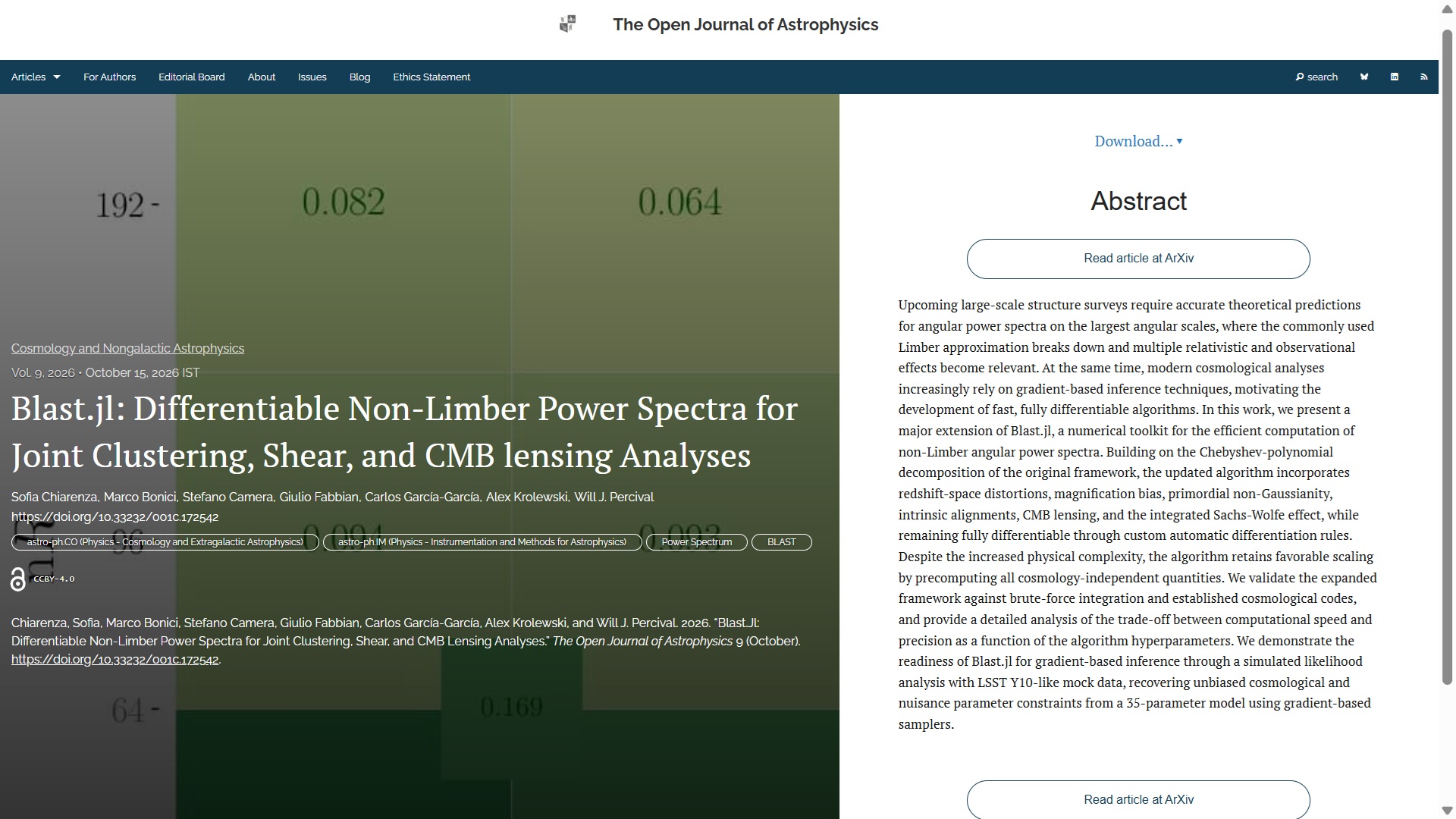
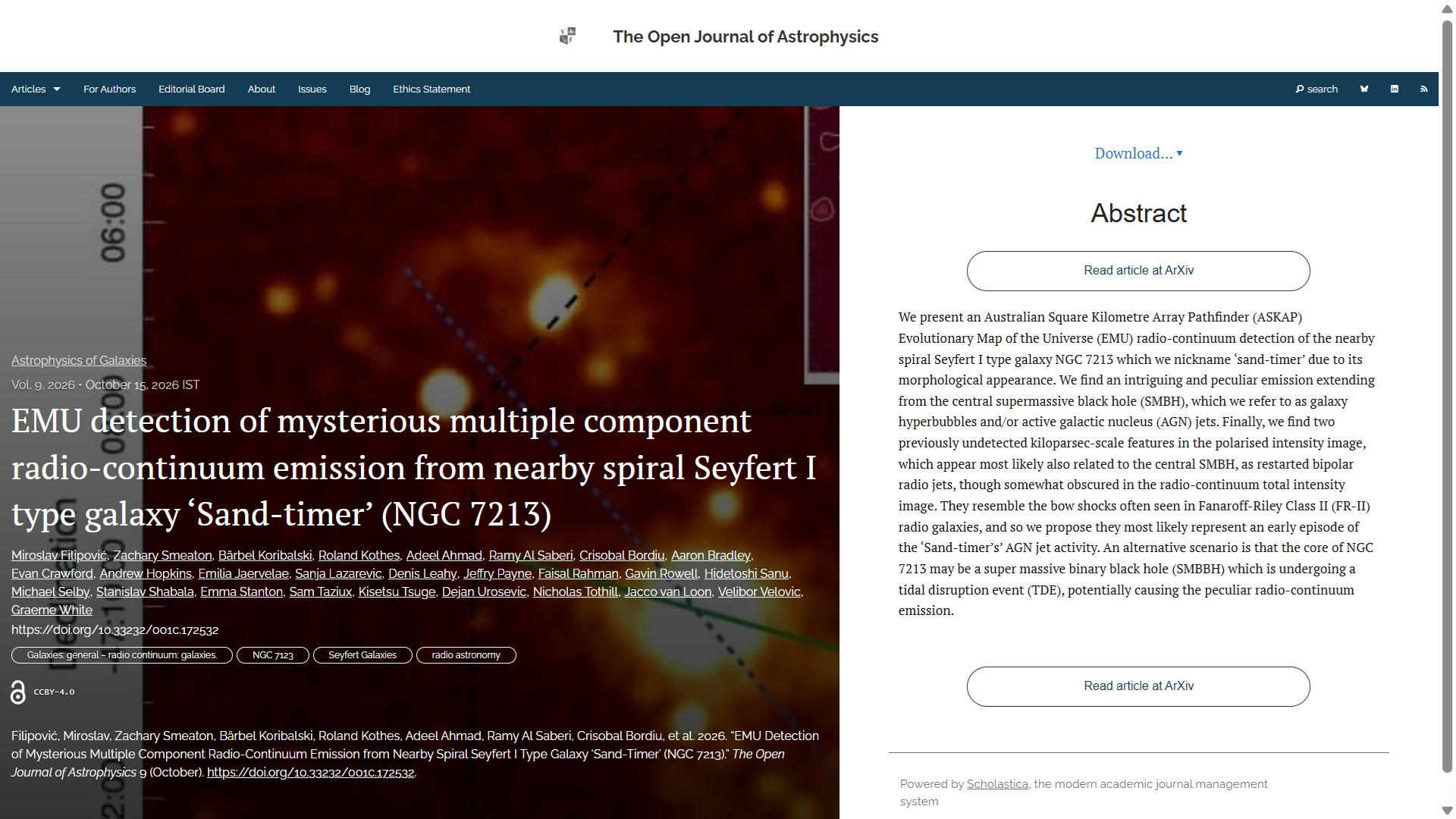
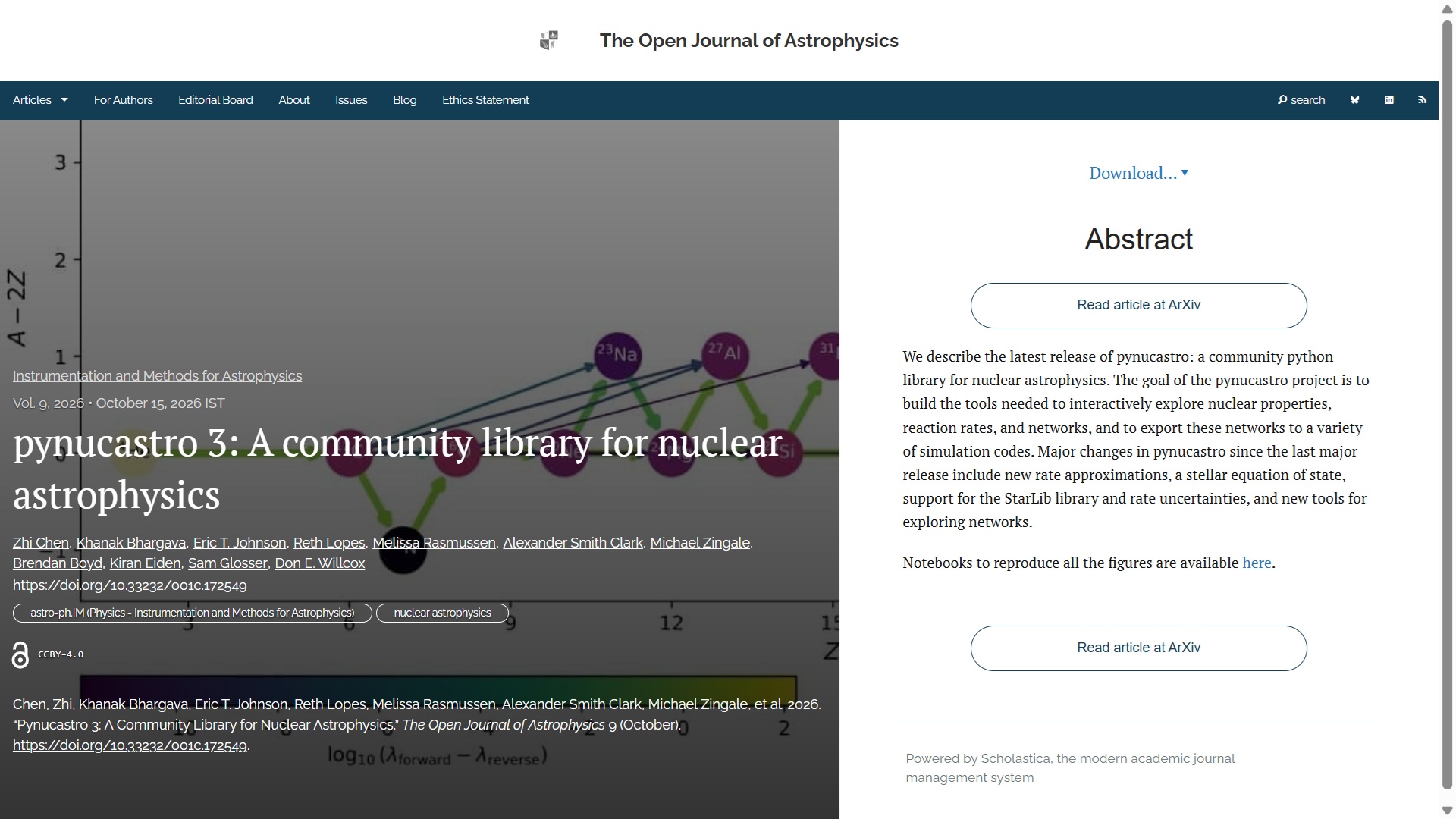
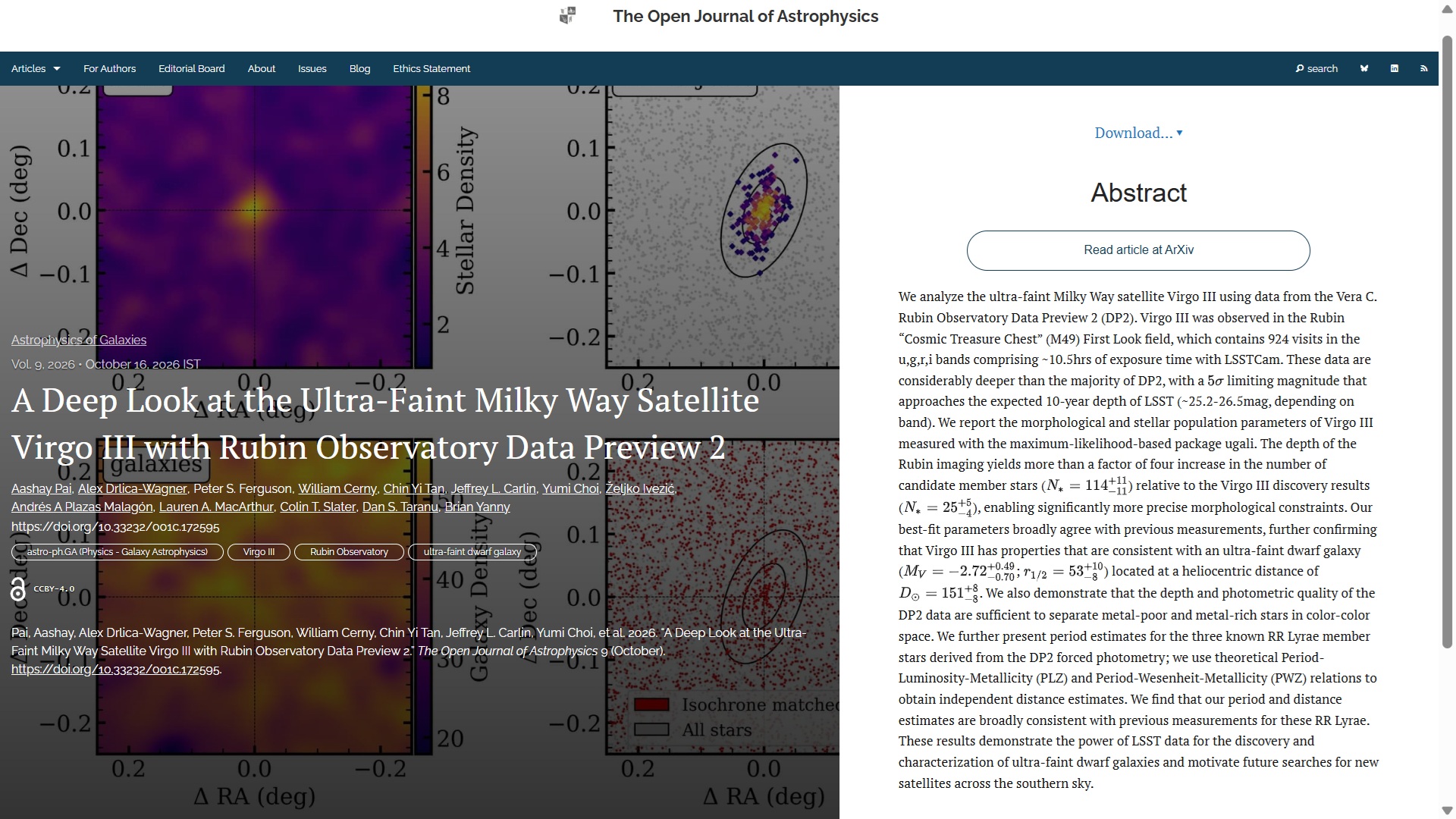
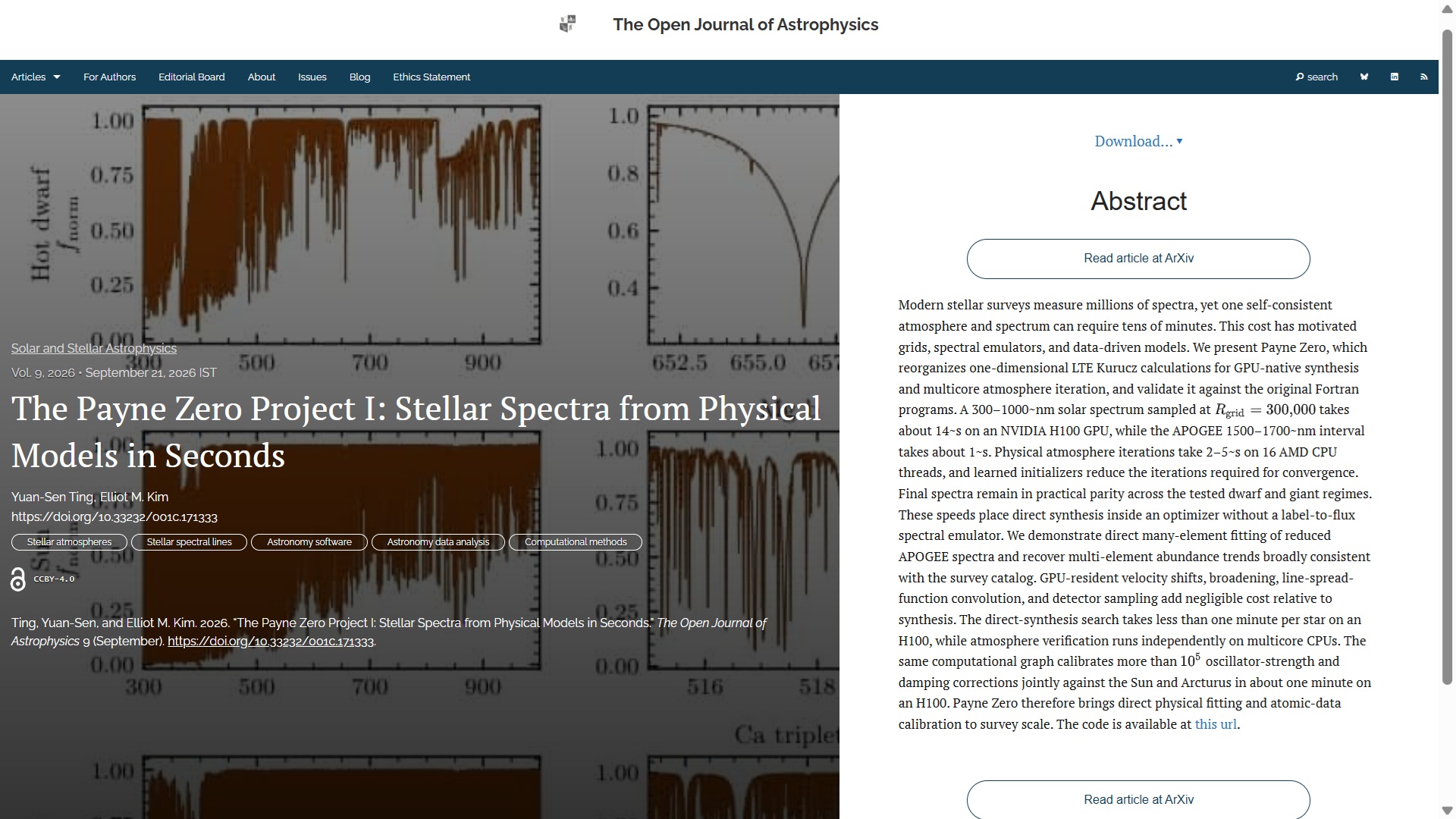
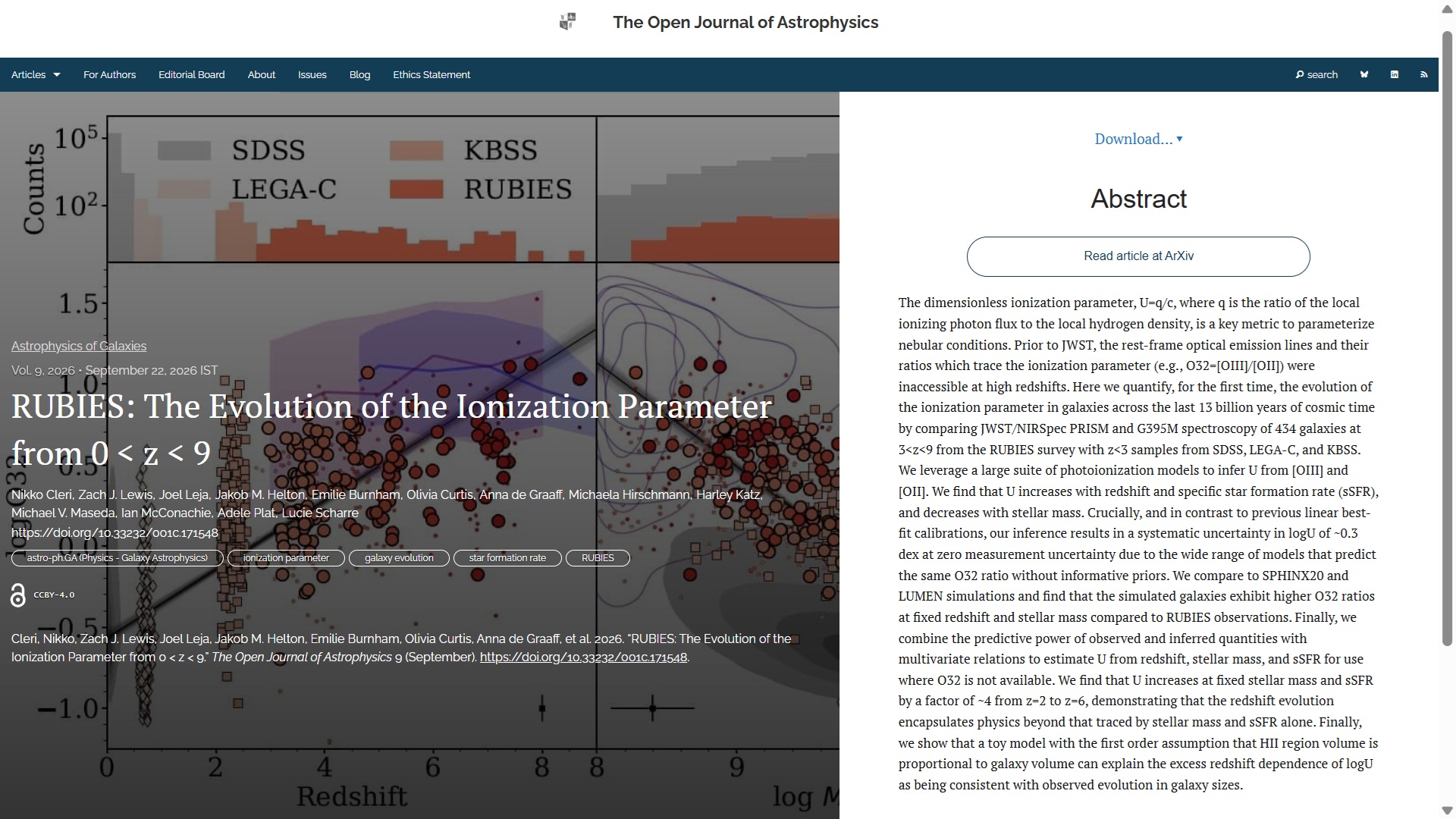
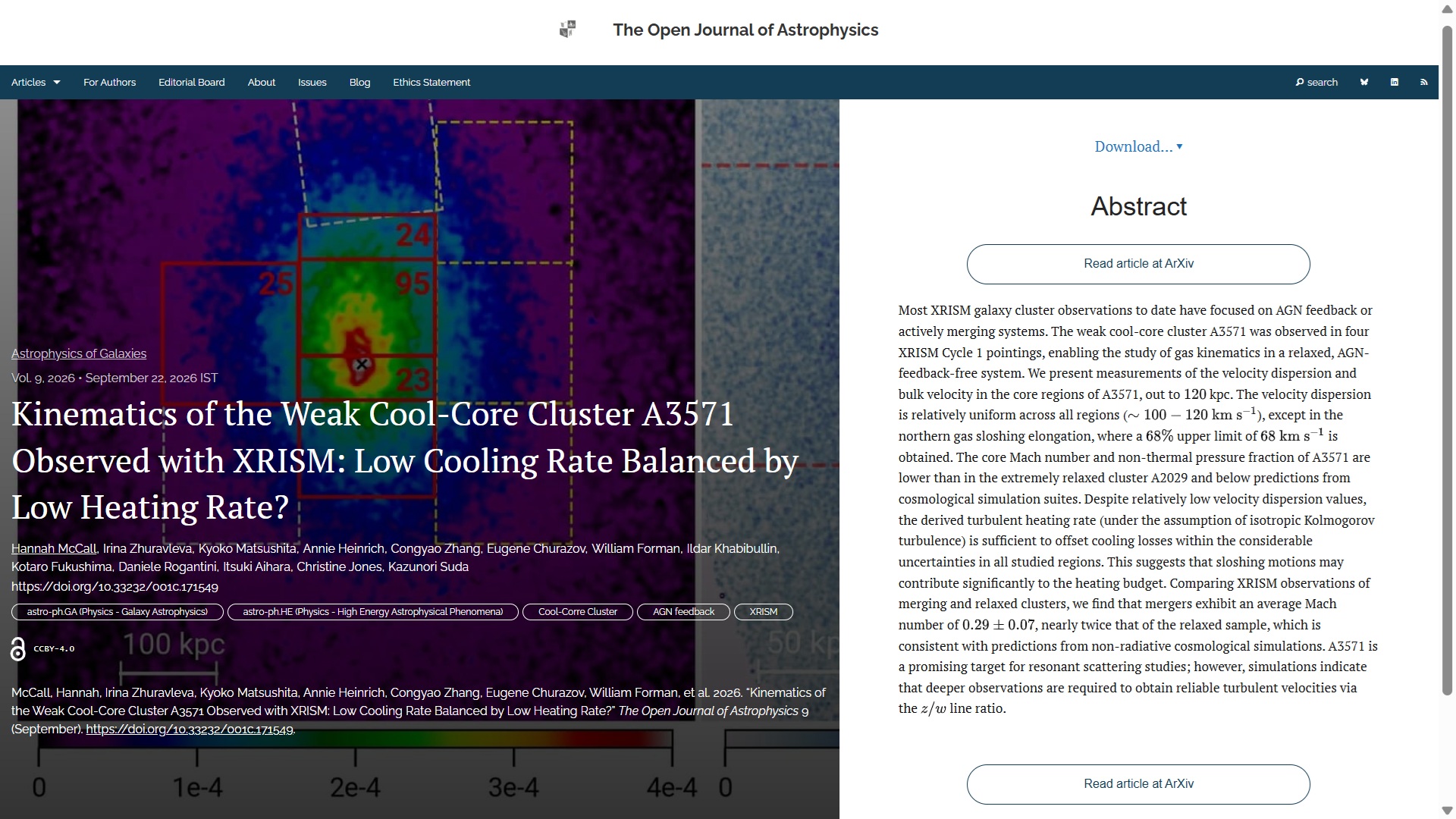
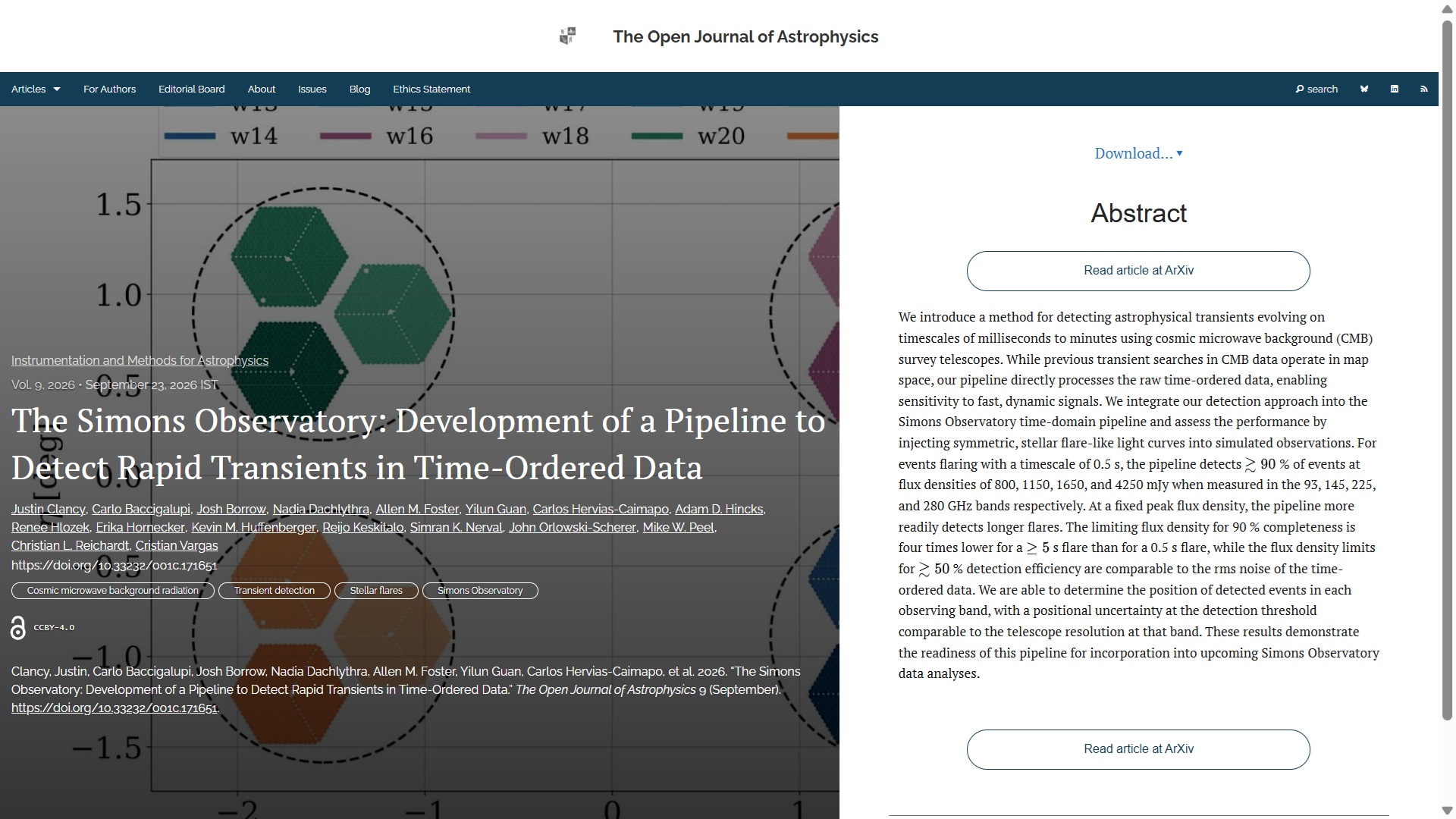
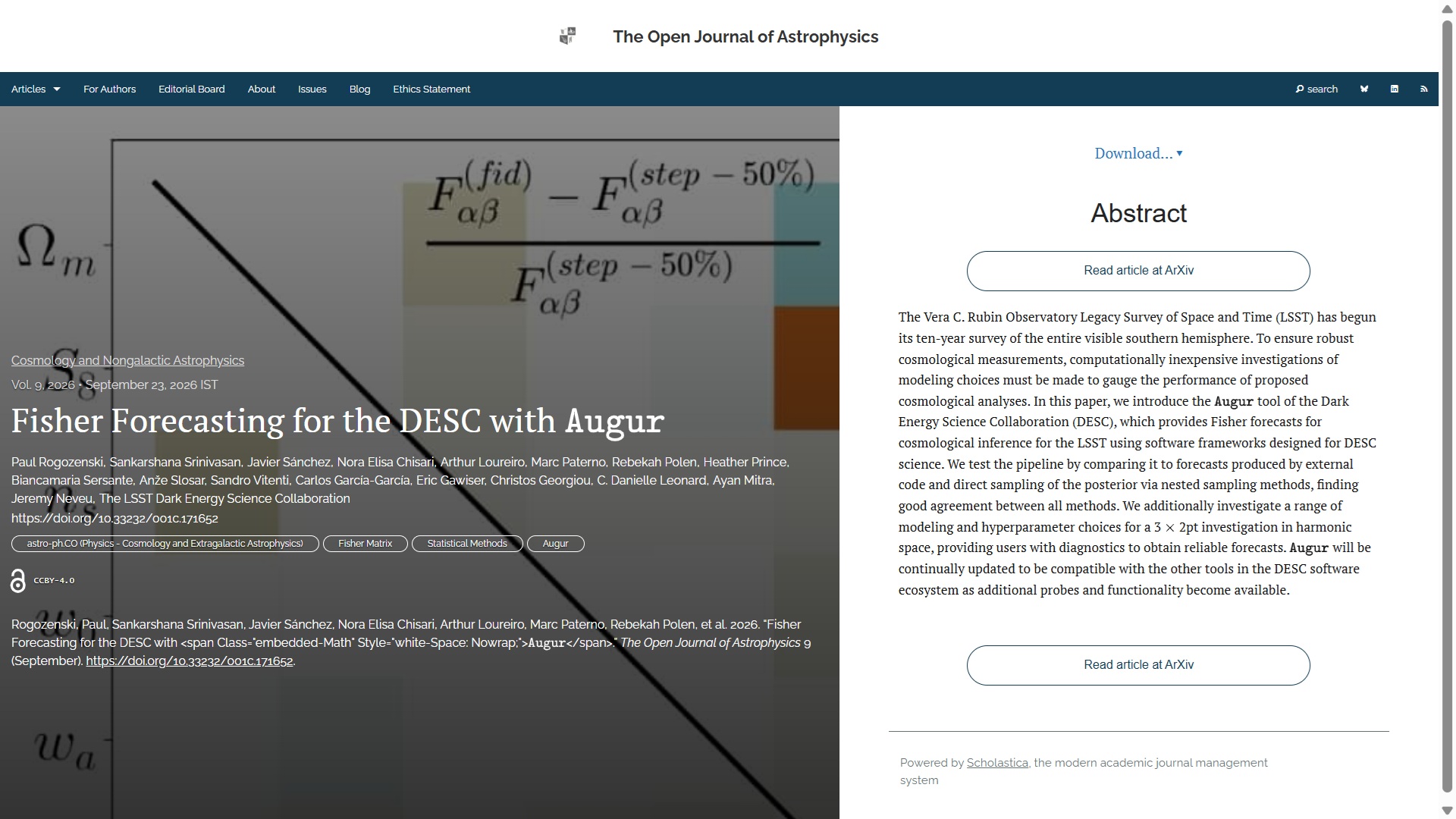
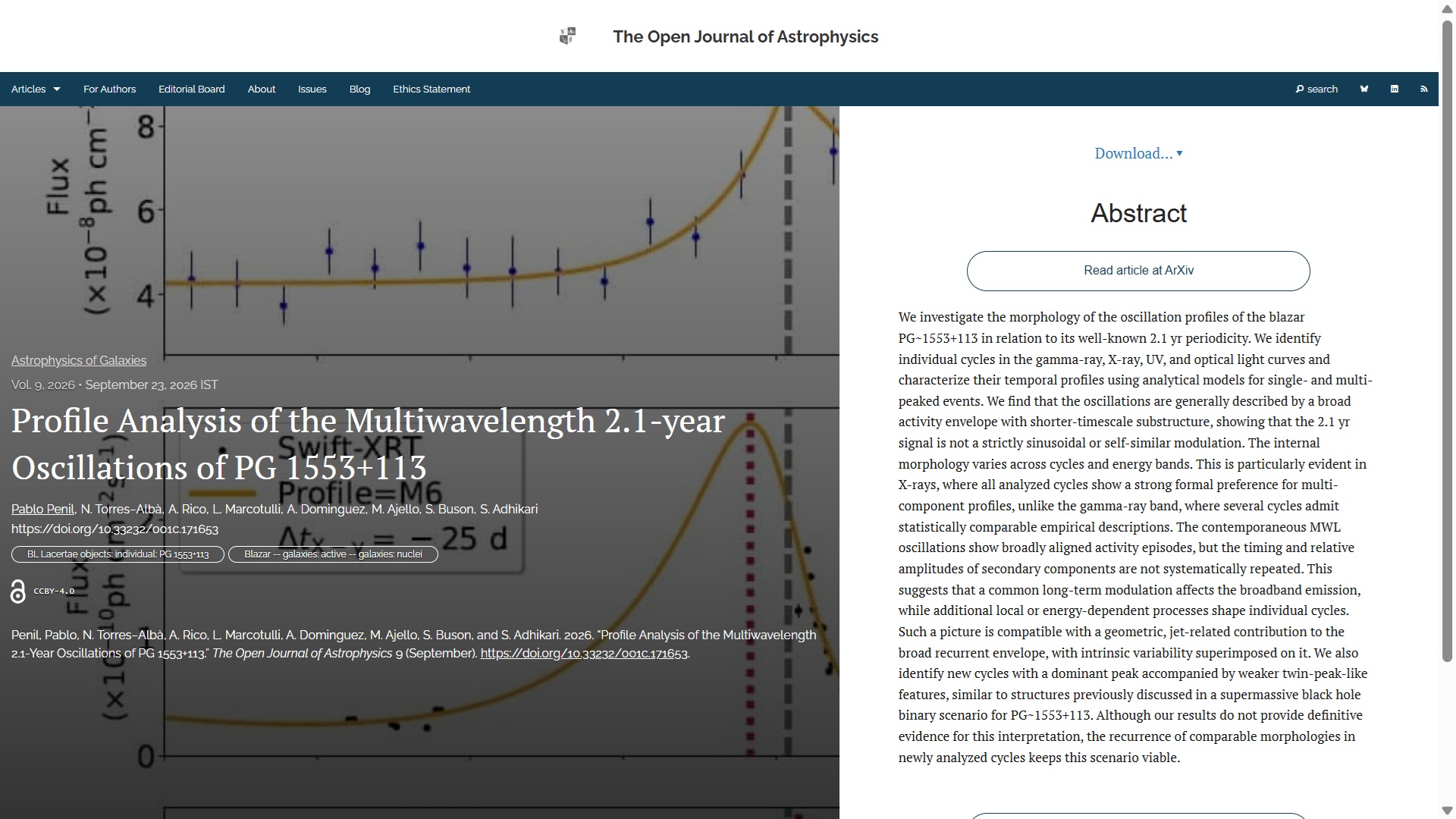
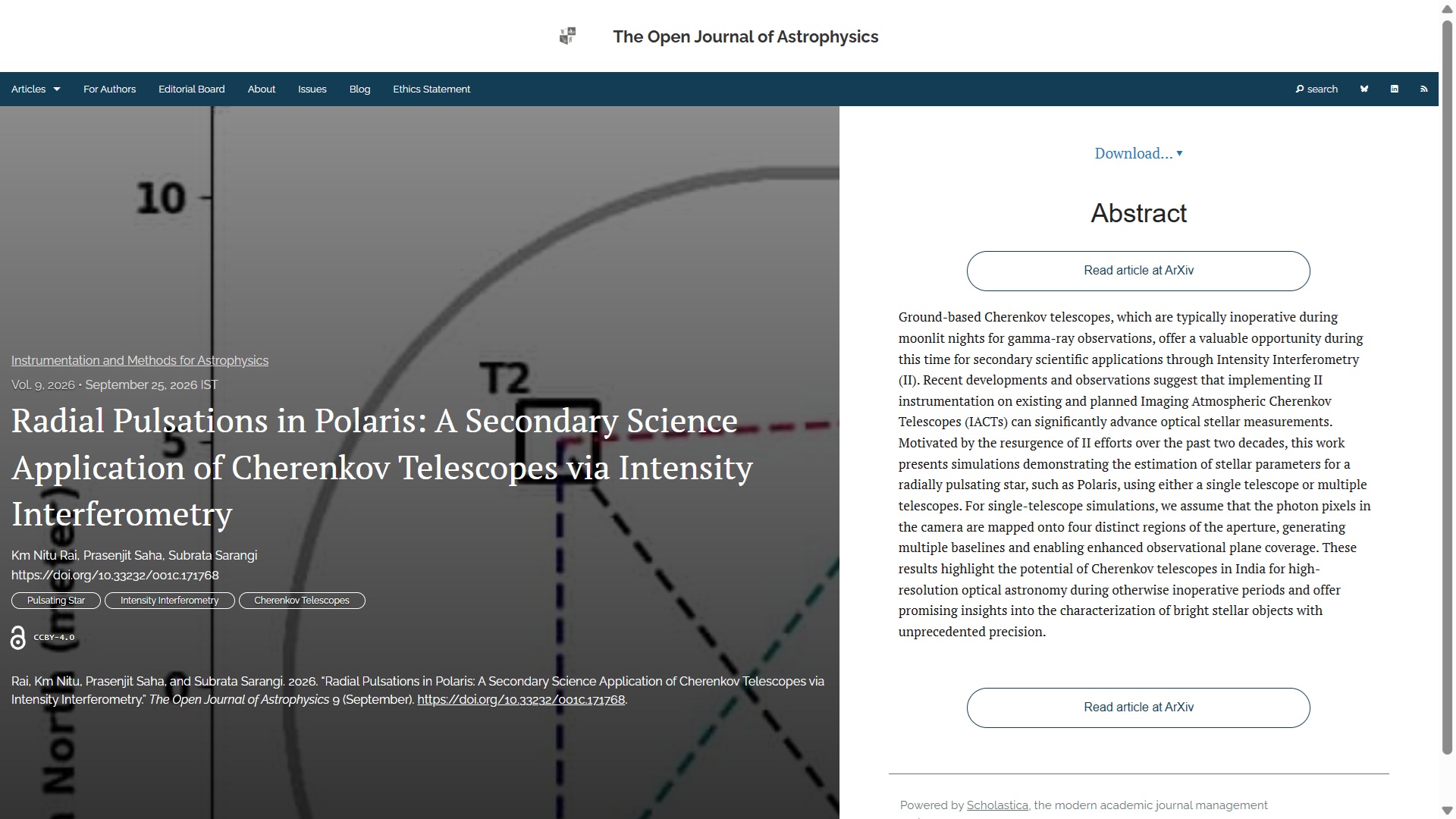
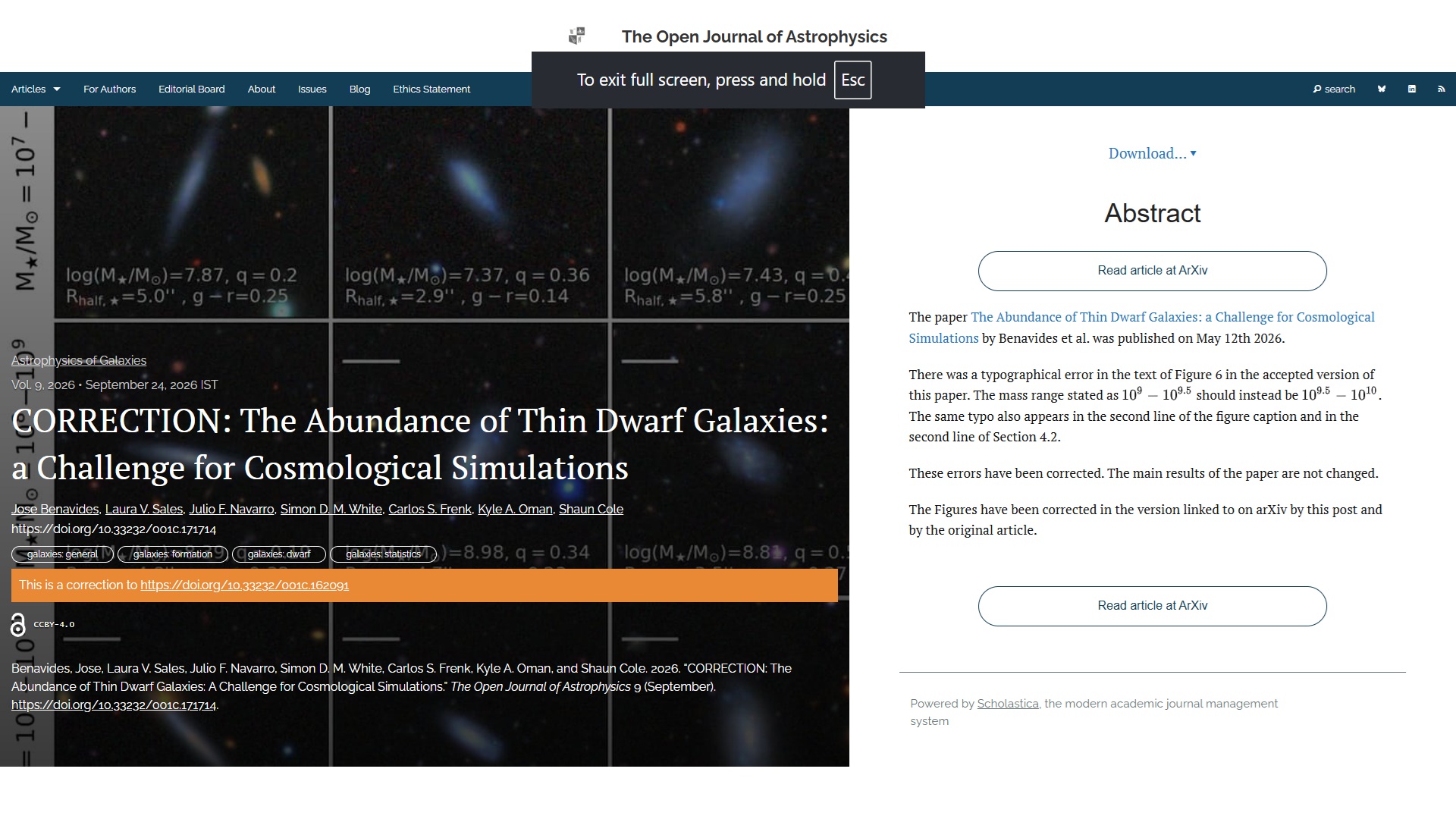
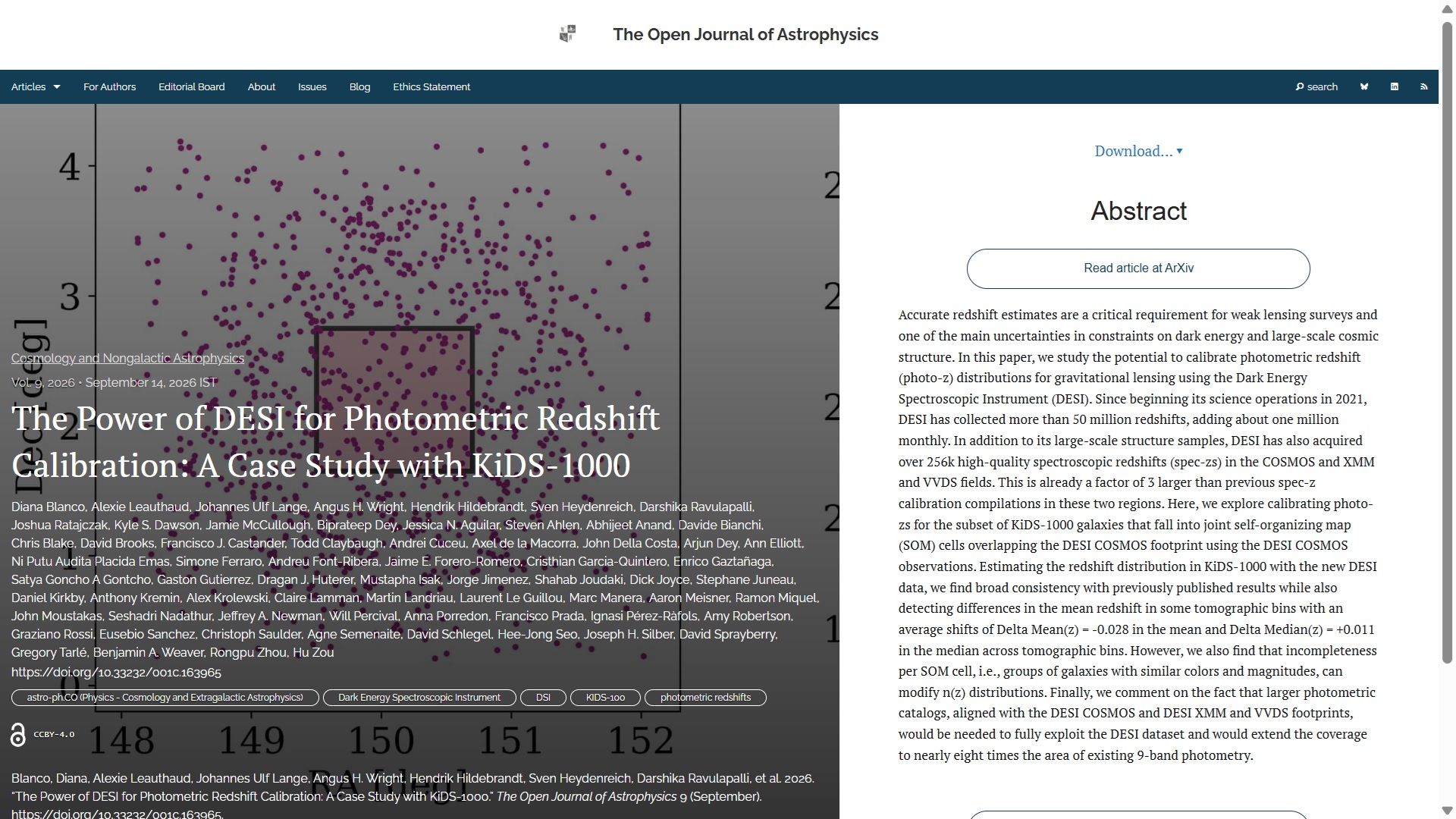
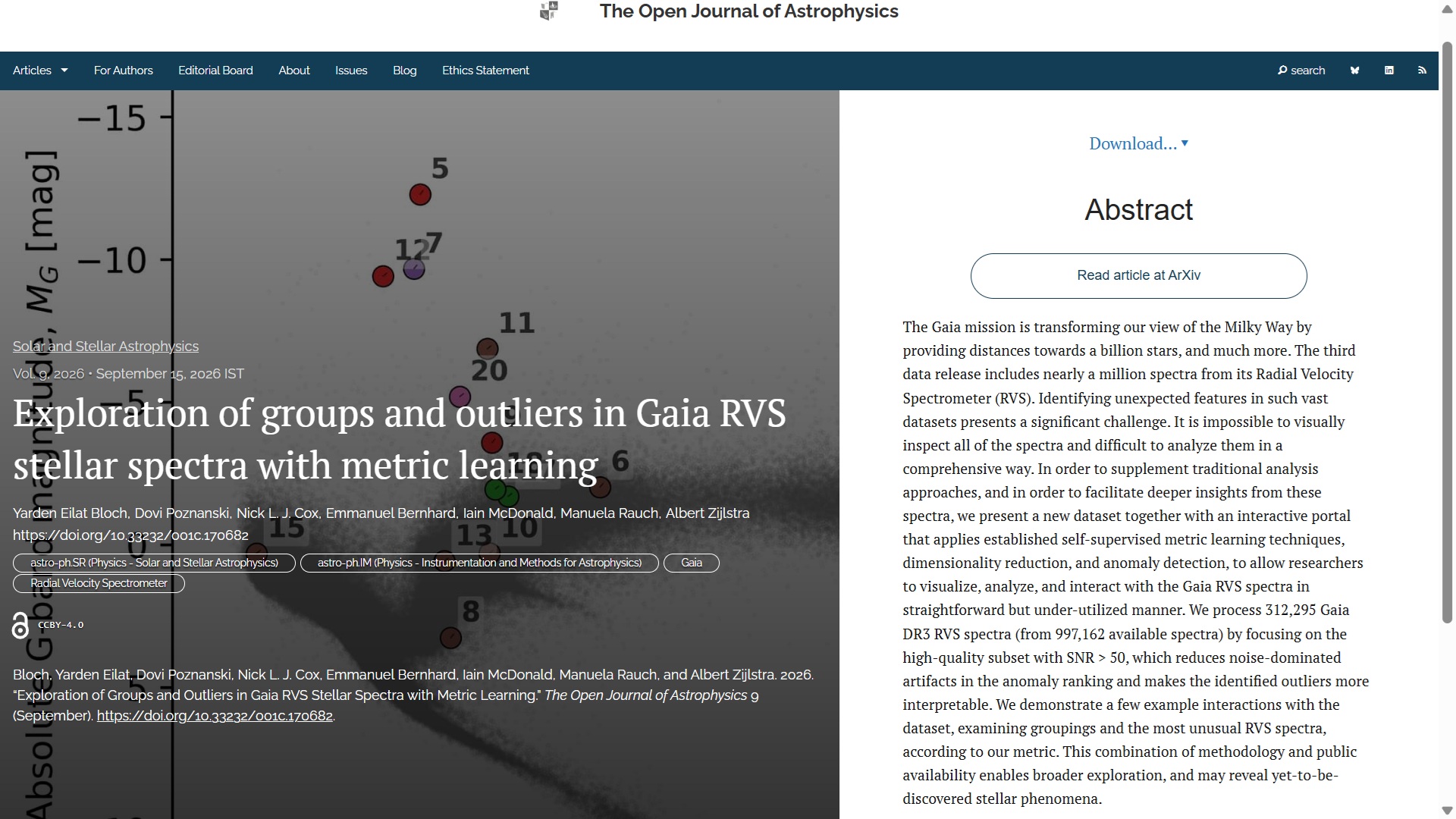
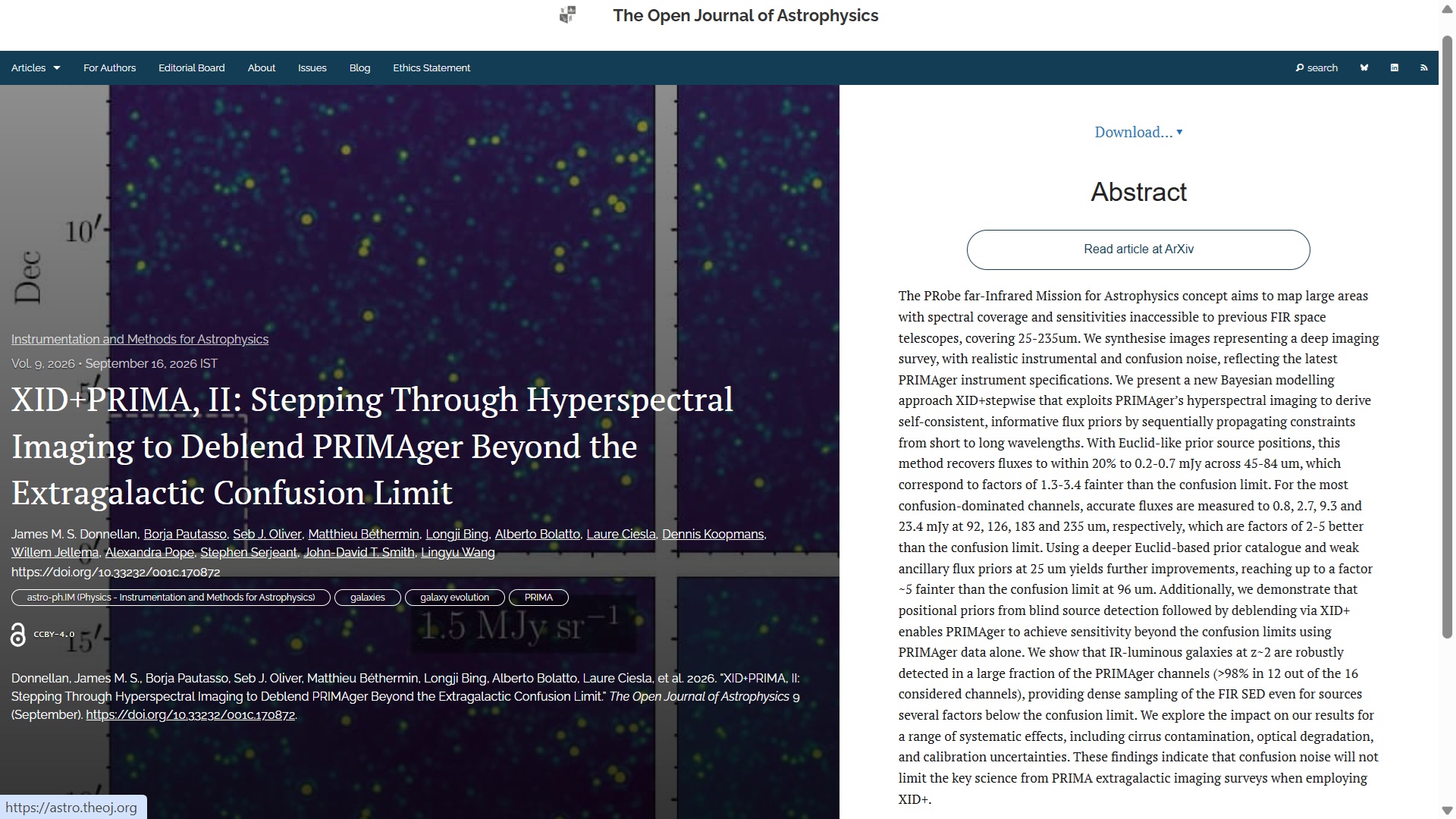
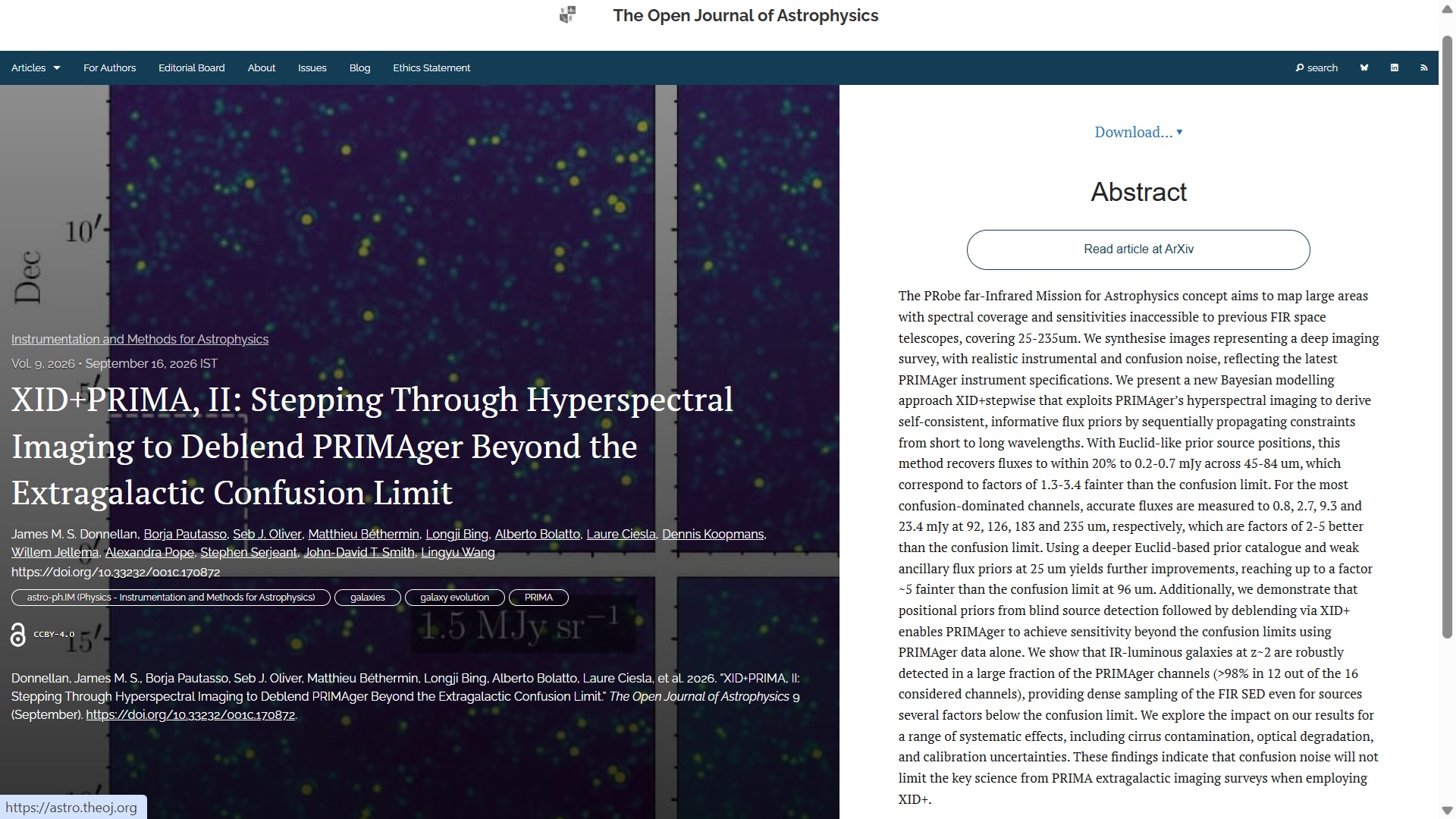
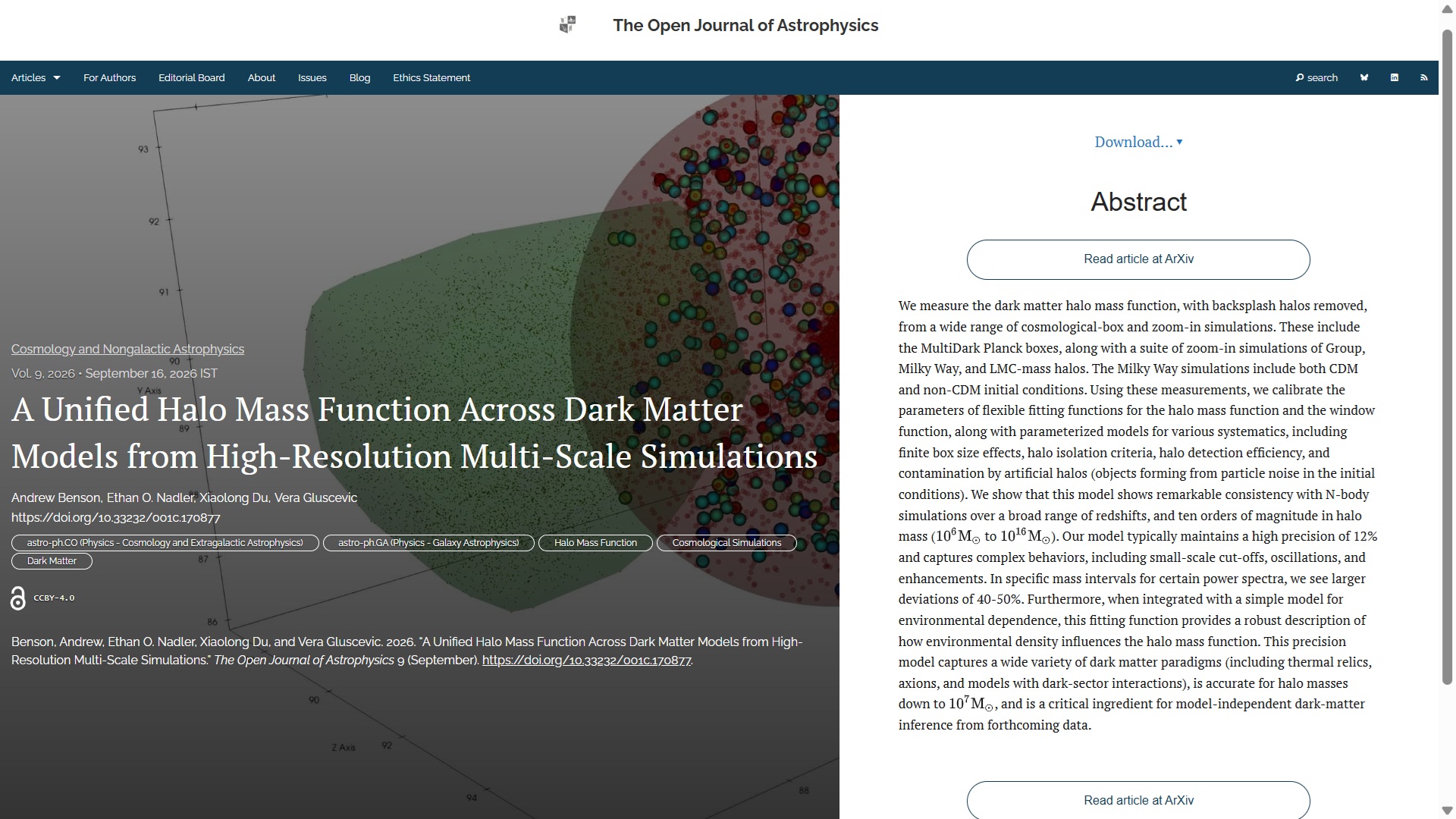
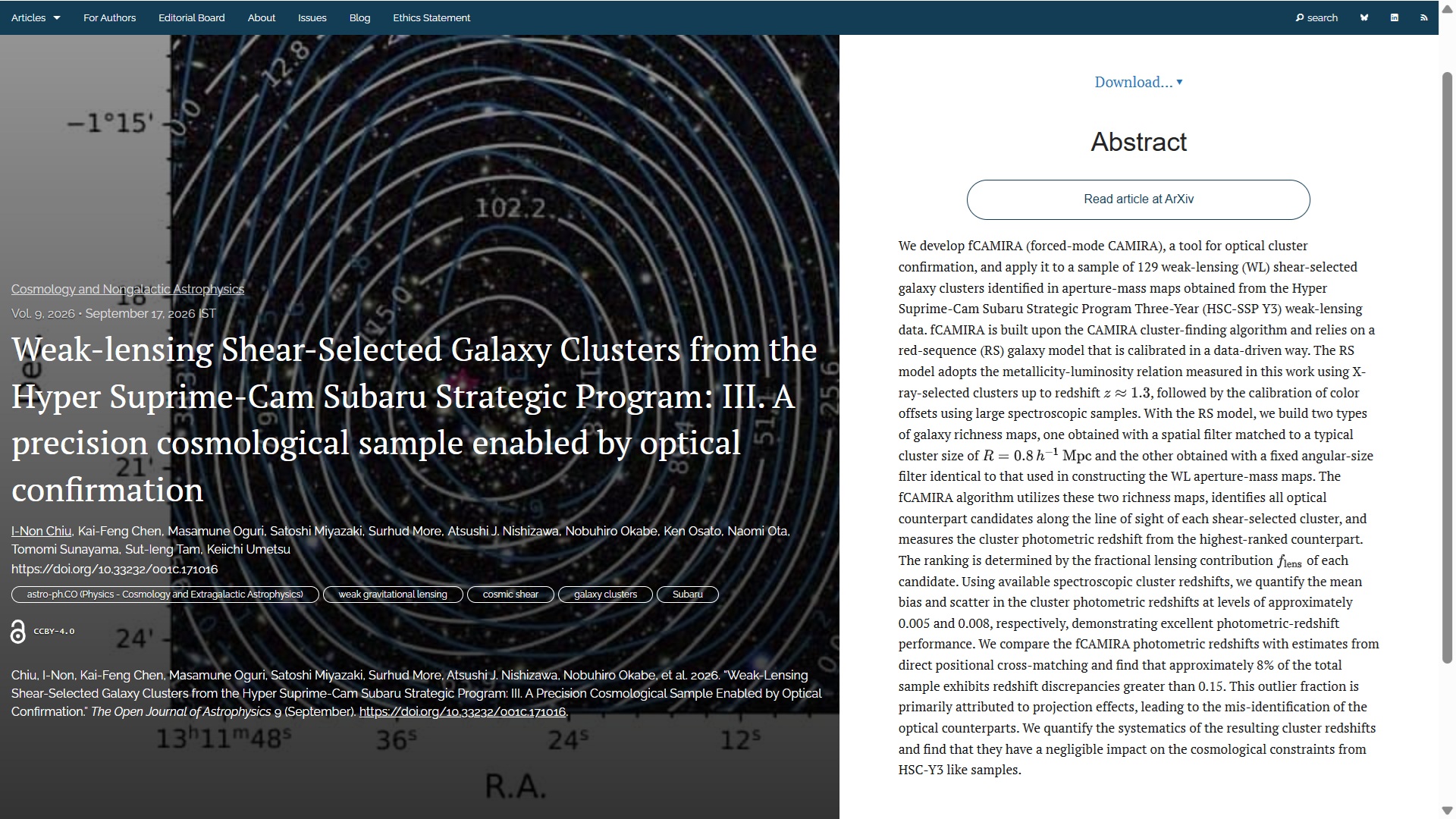
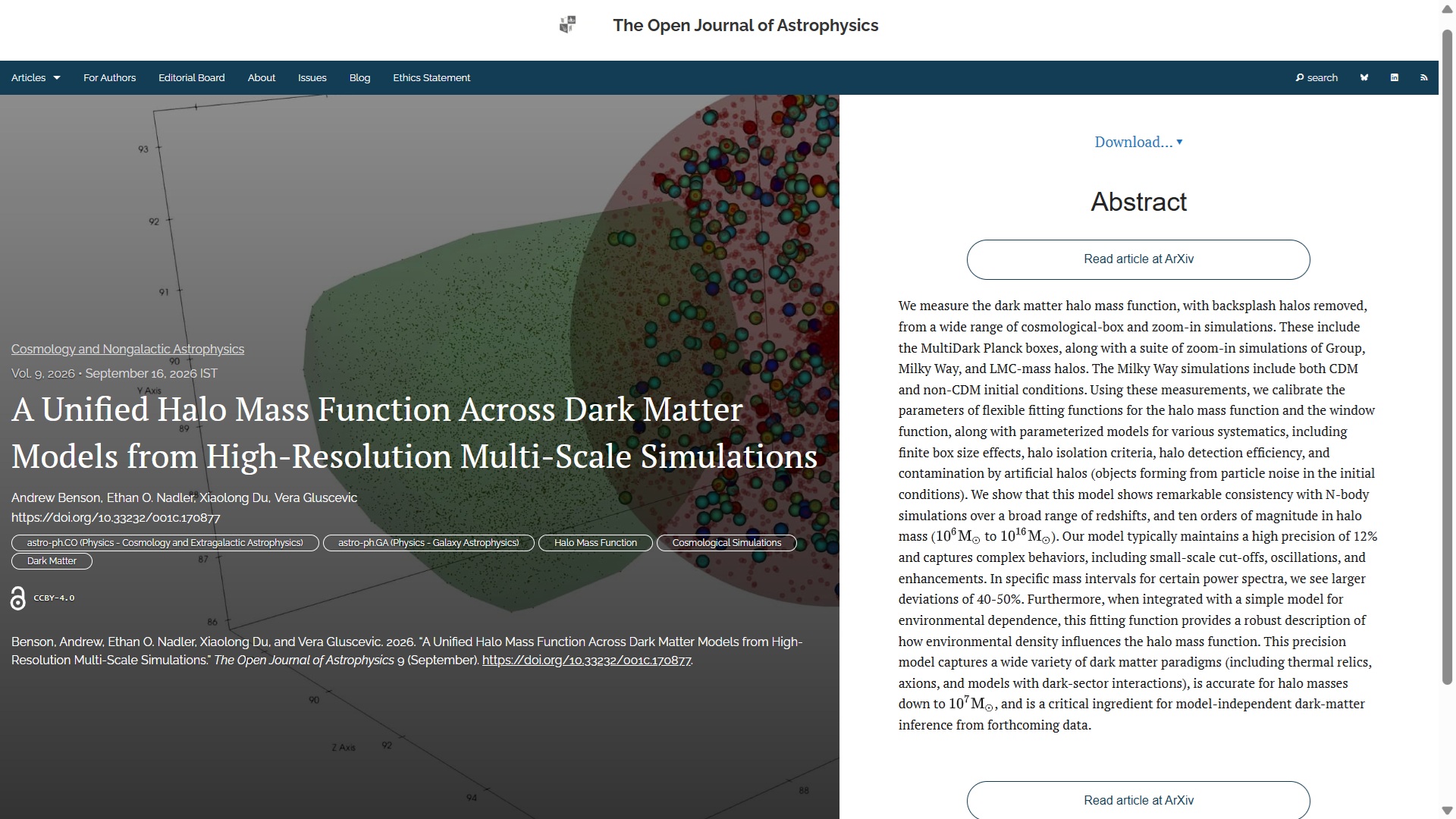
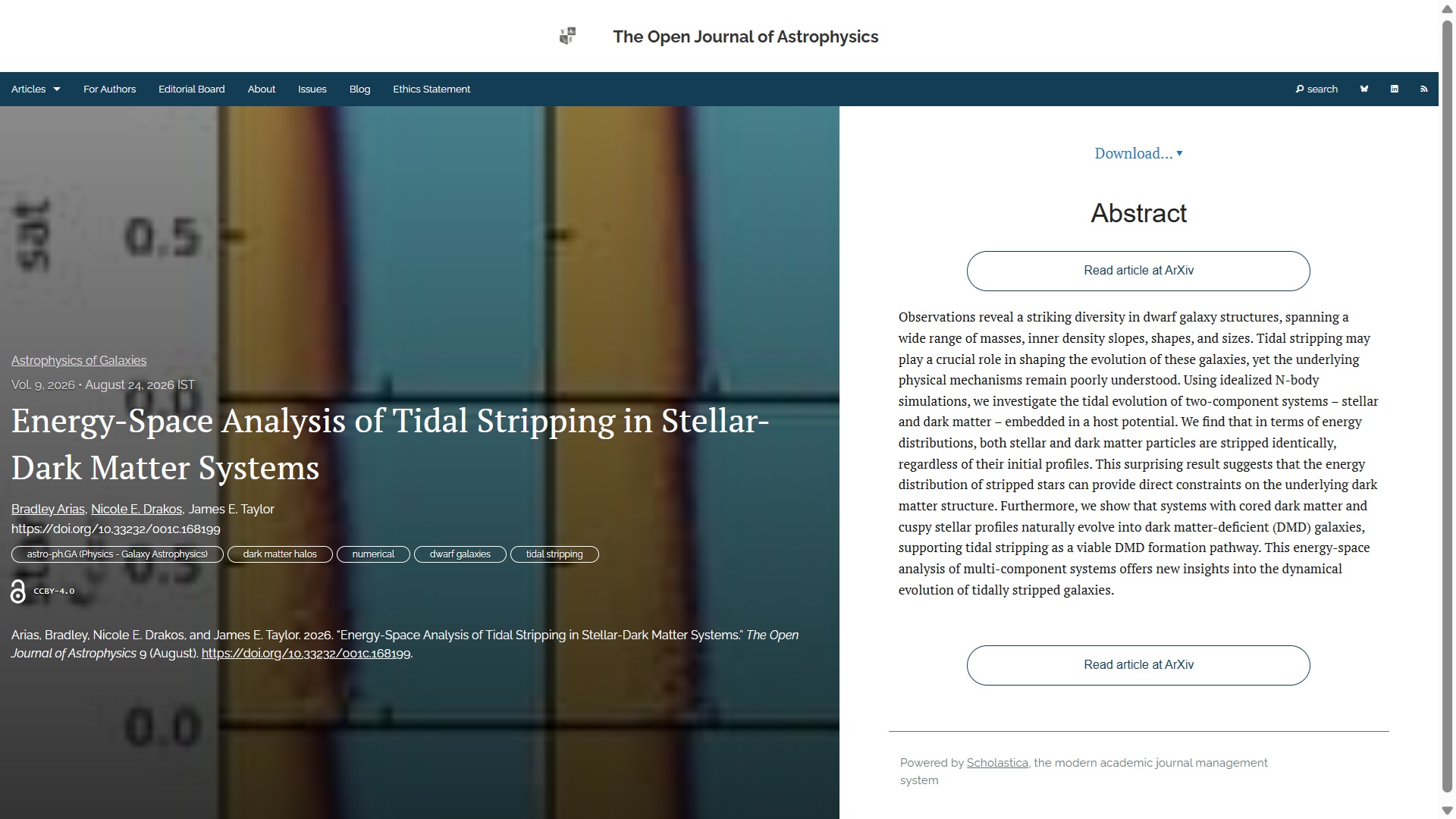
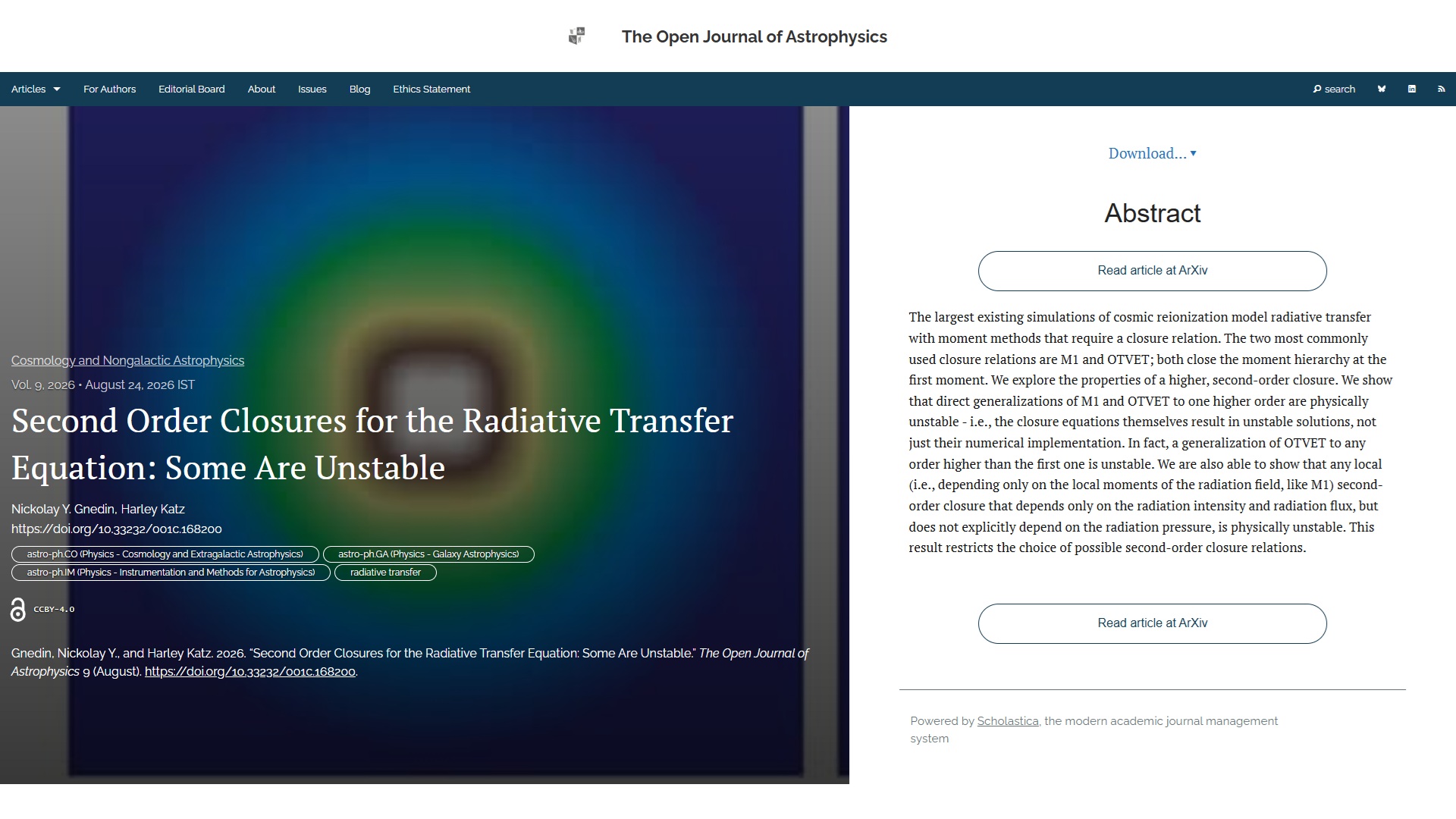
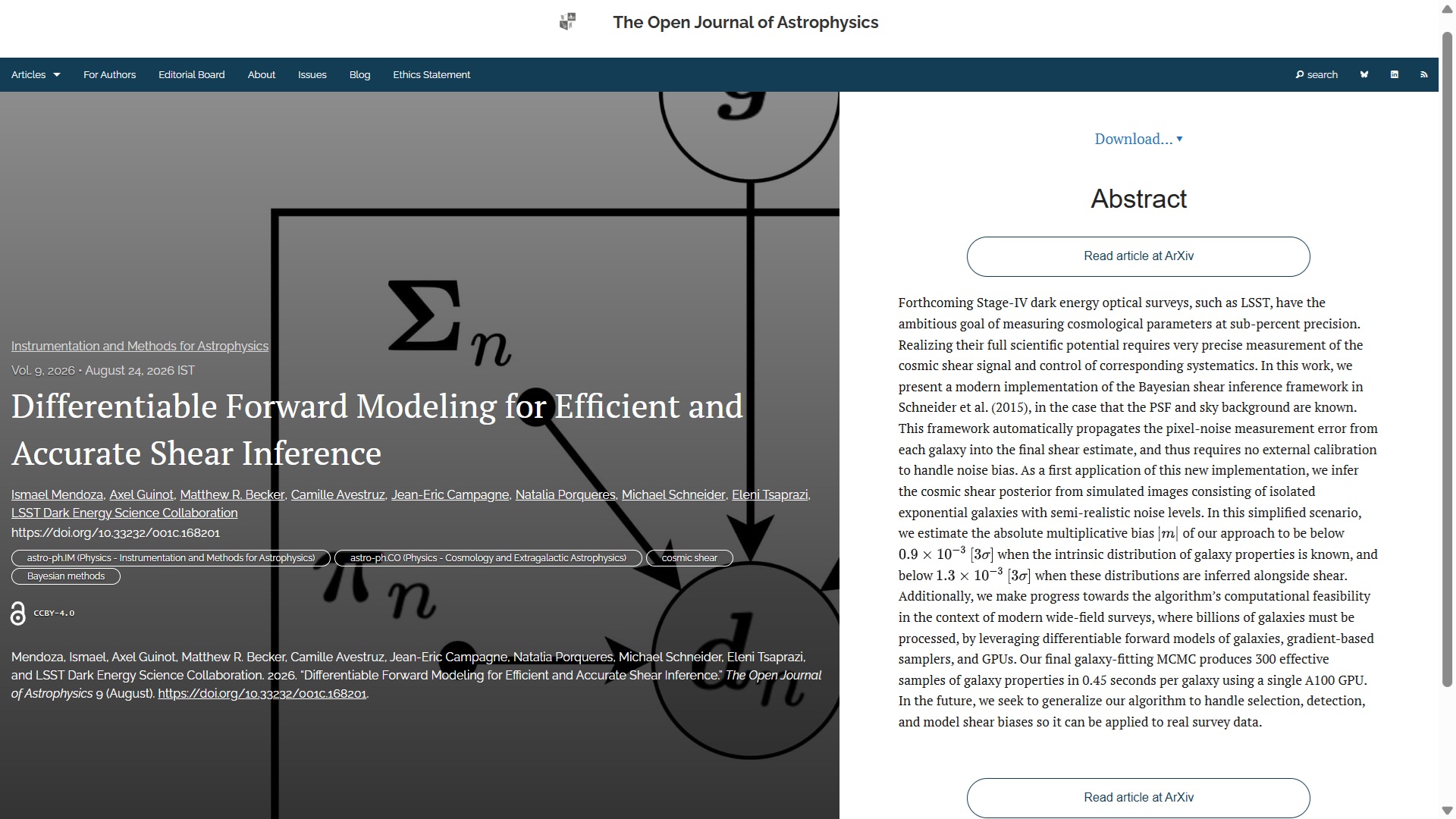
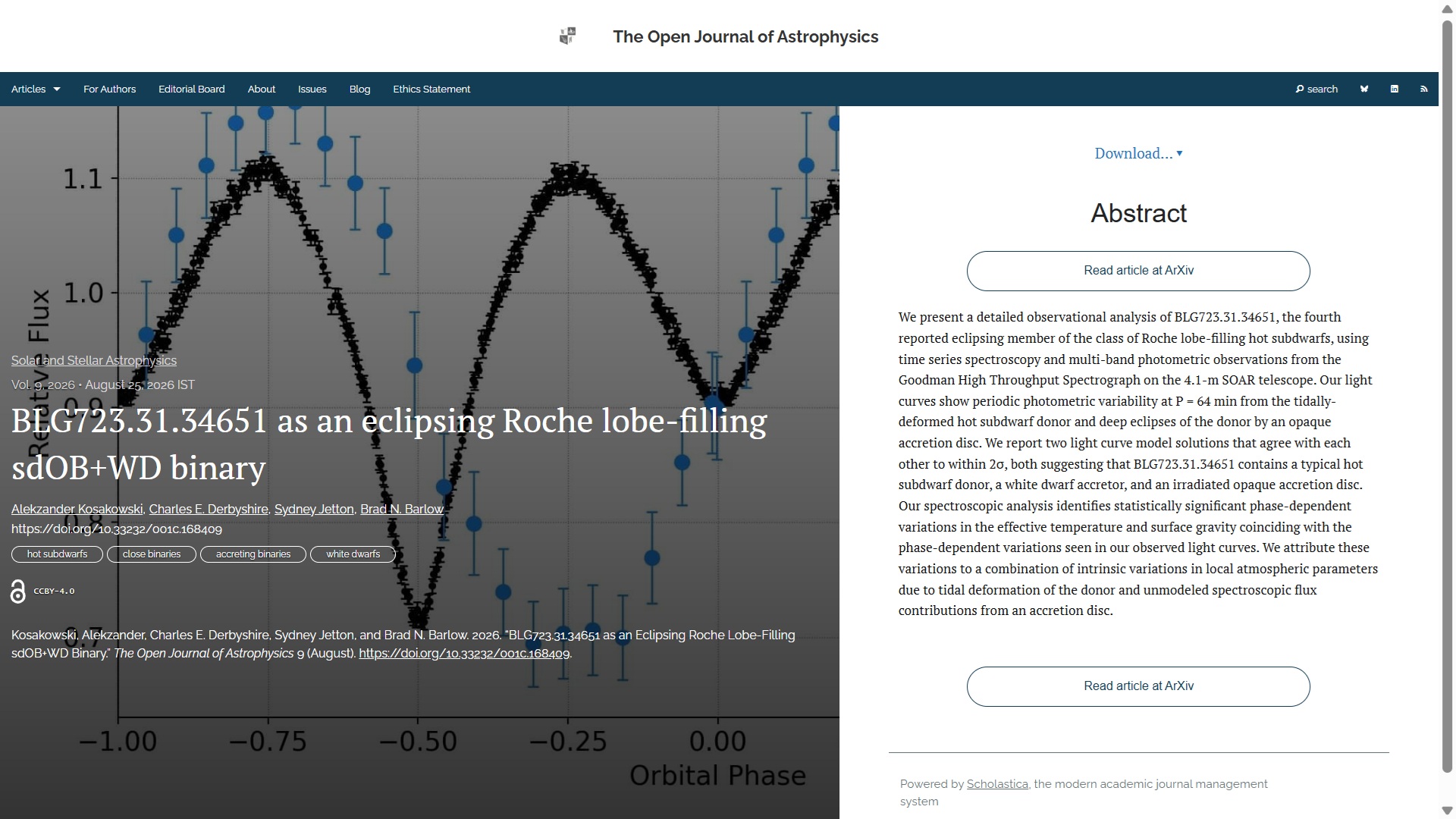
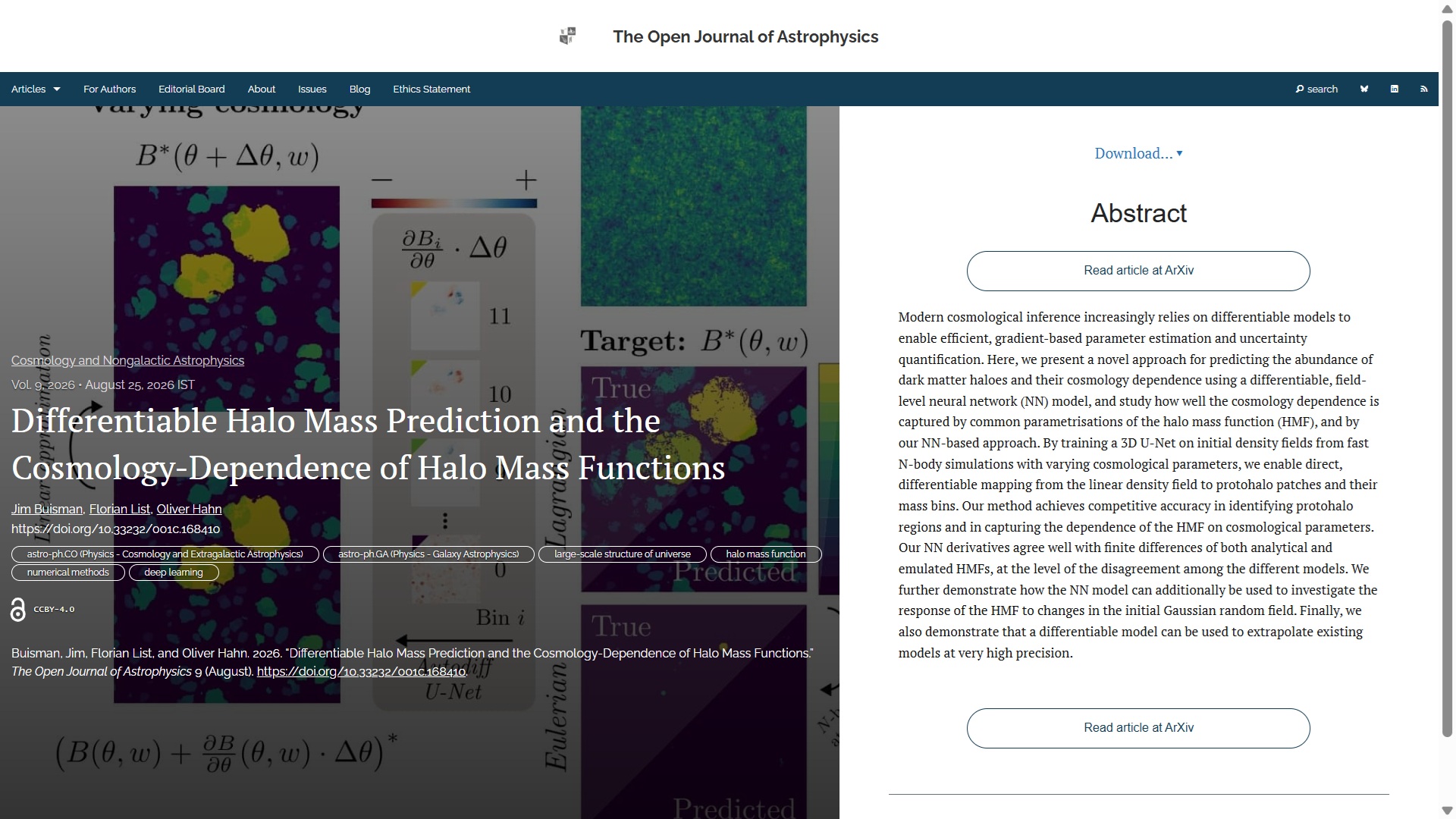
Although it’s holiday season for some, it’s time once more for another Saturday update of activity at the Open Journal of Astrophysics. Since the last update we have published a further four papers, bringing the number in Volume 9 (2026) to 167 and the total so far published by OJAp up to 615.
I continue to include the posts made on our Mastodon account (on Fediscience); these announcements also show the DOI for each paper.
New Publication at the Open Journal of Astrophysics: "Small-scale turbulence alongside large-scale turbulence in a z=1.87 star-forming galaxy with an outflowing wind, revealed by multi-point structure functions" by Itzhak Goldman (Afeka College, Israel)
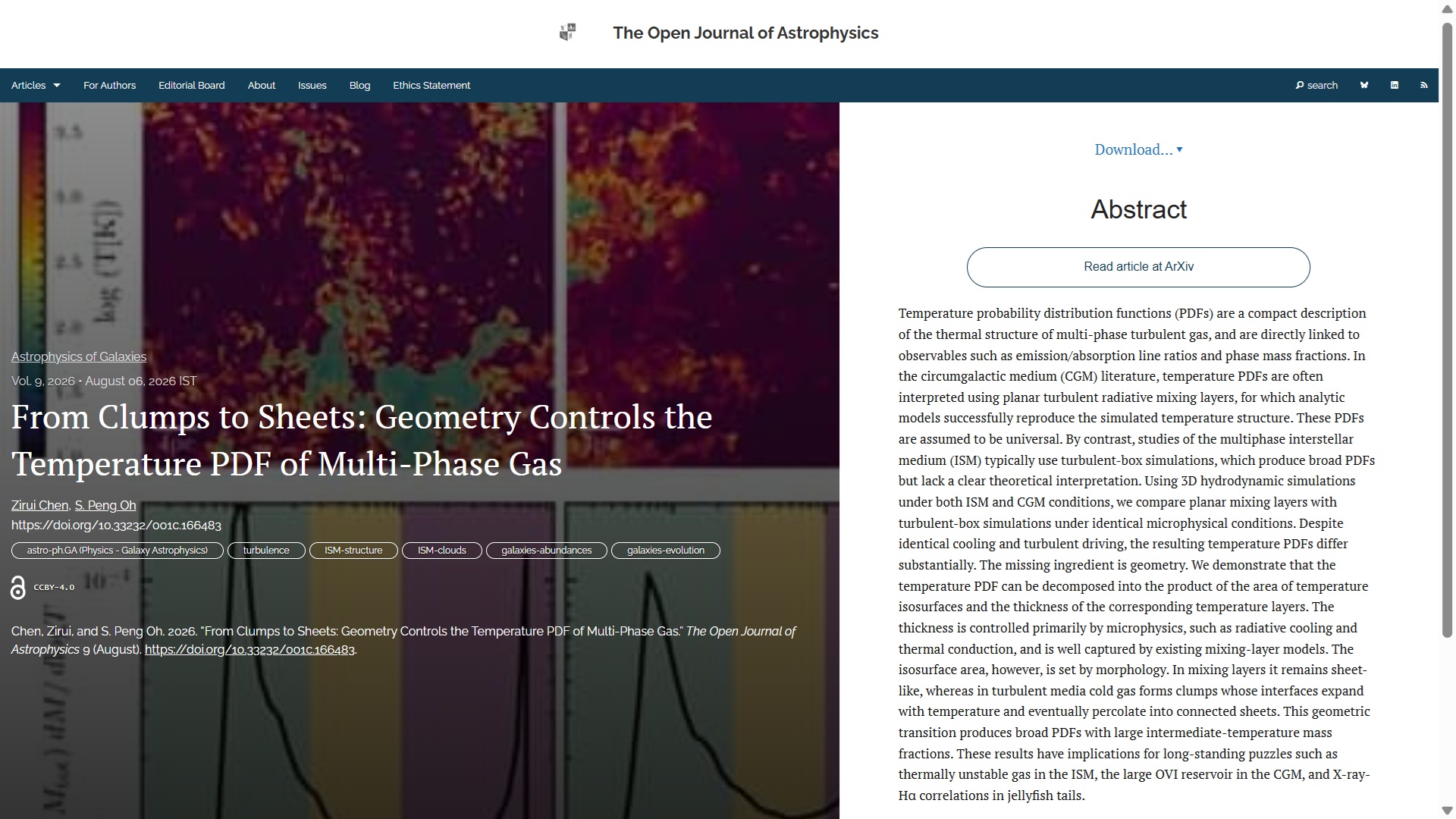
The second paper for this week, published on Thursday 6th August in the folder Astrophysics of Galaxies, is “From Clumps to Sheets: Geometry Controls the Temperature PDF of Multi-Phase Gas” by Zirui Chen and S. Peng Oh (UC Santa Barbara, USA). This study uses 3D hydrodynamic simulations to show that the temperature probability distribution functions (PDFs) of multi-phase turbulent gas differ significantly under interstellar medium (ISM) and circumgalactic medium (CGM) conditions.
The overlay looks like this:
The official version of the paper can be found on arXiv here and the Fediverse announcement here:
New Publication at the Open Journal of Astrophysics: "From Clumps to Sheets: Geometry Controls the Temperature PDF of Multi-Phase Gas" by Zirui Chen and S. Peng Oh (UC Santa Barbara, USA)
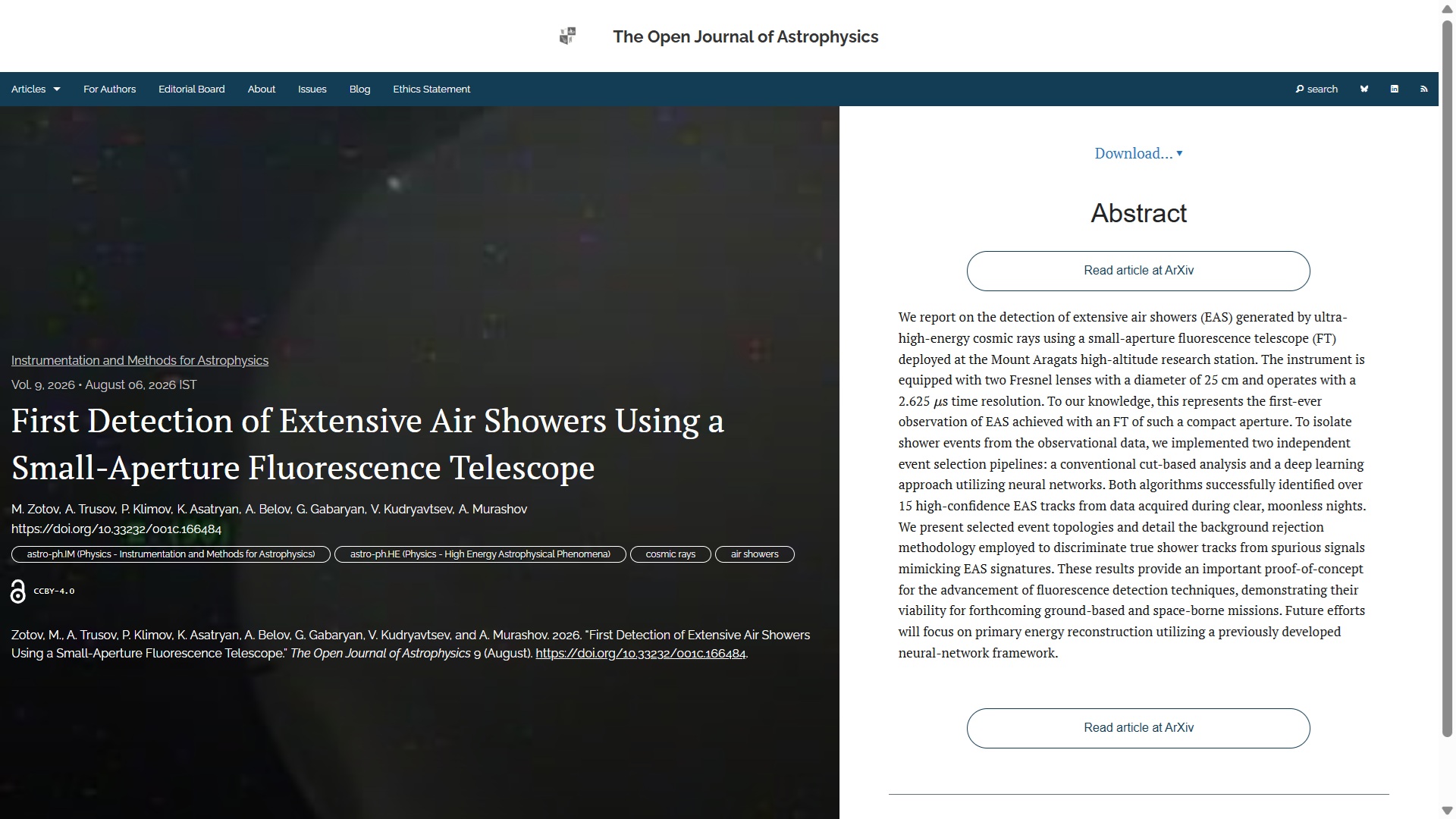
New Publication at the Open Journal of Astrophysics: "First Detection of Extensive Air Showers Using a Small-Aperture Fluorescence Telescope" by M. Zotov (M.V. Lomonosov Moscow State University, Russia) and 7 others based in Russia and Armenia
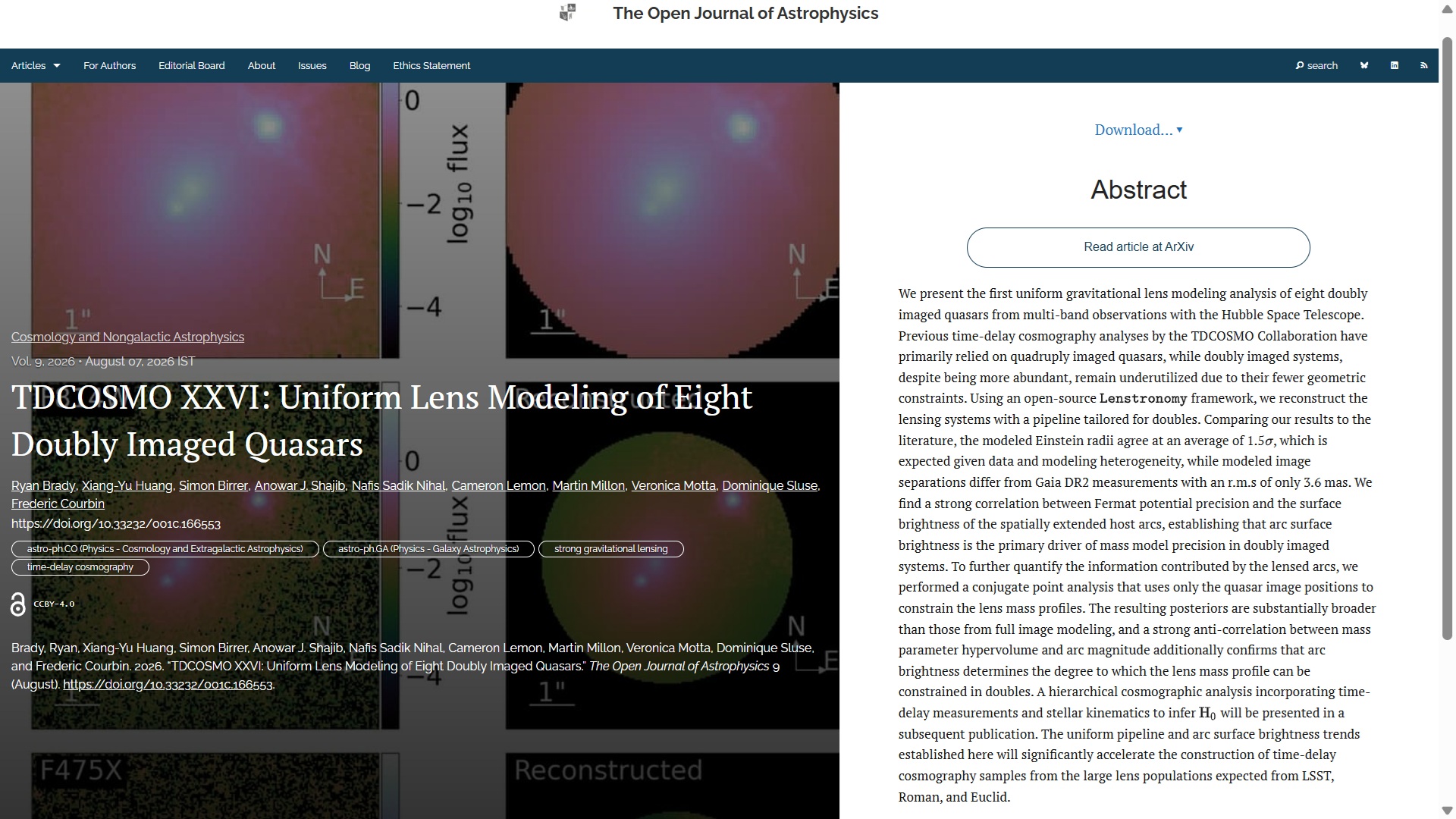
The fourth and final paper of the week was published on Friday 7th August in the folder Cosmology and Nongalactic Astrophysics: “TDCOSMO XXVI: Uniform Lens Modeling of Eight Doubly Imaged Quasars“, by Ryan Brady (Stony Brook University, USA) and 9 others based all around the world, presents a new method for analyzing doubly imaged quasars using the Hubble Space Telescope, revealing that arc surface brightness is key to precision in mass model measurements.
The overlay is here:
The officially-accepted version of the paper can be found on arXiv here and the Fediverse announcement here:
New Publication at the Copen Journal of Astrophysics: "TDCOSMO XXVI: Uniform Lens Modeling of Eight Doubly Imaged Quasars" by Ryan Brady (Stony Brook University, USA) and 9 others based around the world.
That’s all for this week. We have about a dozen more papers accepted and waiting for the authors to put the final version on arXiv, which they will presumably do when they’re back from holiday. I’ll do an update next weekend and we’ll see!
It’s time once more for another Saturday update of activity at the Open Journal of Astrophysics. Since the last update we have published a further three papers, bringing the number in Volume 9 (2026) to 163 and the total so far published by OJAp up to 611.
I continue to include the posts made on our Mastodon account (on Fediscience); these announcements also show the DOI for each paper.
The first paper to report this week was published on Tuesday 28th July in the folder Cosmology and Nongalactic Astrophysics. “The Origins of the Bulk Flow” by Richard Watkins & Trajan Clark (Willamett U., USA) and Hume A Feldman (U. Kansas, USA) analyzes the origin of large-scale bulk flow using the CosmicFlows-4 catalog, finding that it is largely influenced by structures beyond 200 h-1 Mpc, challenging previous assumptions.
The overlay for this paper is here
You can find the officially accepted version on arXiv here and the announcement on Fediverse here:
New Publication at the Open Journal of Astrophysics: "The Origins of the Bulk Flow" by Richard Watkins & Trajan Clark (Willamett U., USA) and Hume A Feldman (U. Kansas, USA).
The second paper for this week, also published on Tuesday 28th July in the folder Cosmology and Nongalactic Astrophysics is: “Enhancing weak lensing redshift distribution characterization by optimizing the Dark Energy Survey Self-Organizing Map Photo-z method” by A. Campos (Carnegie Mellon U., USA) and the DES collaboration (113 authors). This study improves the Self-Organizing Map methodology for estimating redshift distribution in galaxies, notably reducing overlap between redshift bins, in preparation for the Dark Energy Survey Year 6 data.Abstractfor Enhancing weak lensing redshift distribution characterization by optimizing the Dark Energy Survey Self-Organizing Map Photo-z method.
The overlay looks like this:
The official version of the paper can be found on arXiv here and the Fediverse announcement here:
New Publication at the Open Journal of Astrophysics: "Enhancing weak lensing redshift distribution characterization by optimizing the Dark Energy Survey Self-Organizing Map Photo-z method" by A. Campos (Carnegie Mellon U., USA) and the DES collaboration (113 authors)
New Publication at the Open Journal of Astrophysics: "The Ray Tracing Sampler: Bayesian Sampling of Neural Networks for Everyone" by Peter Behroozi (U. Arizona, USA)
It’s time once more for another Saturday update of activity at the Open Journal of Astrophysics. Since the last update we have published a further nine papers, bringing the number in Volume 9 (2026) to 160 and the total so far published by OJAp up to 608.
I will continue to include the posts made on our Mastodon account (on Fediscience); these announcements also show the DOI for each paper.
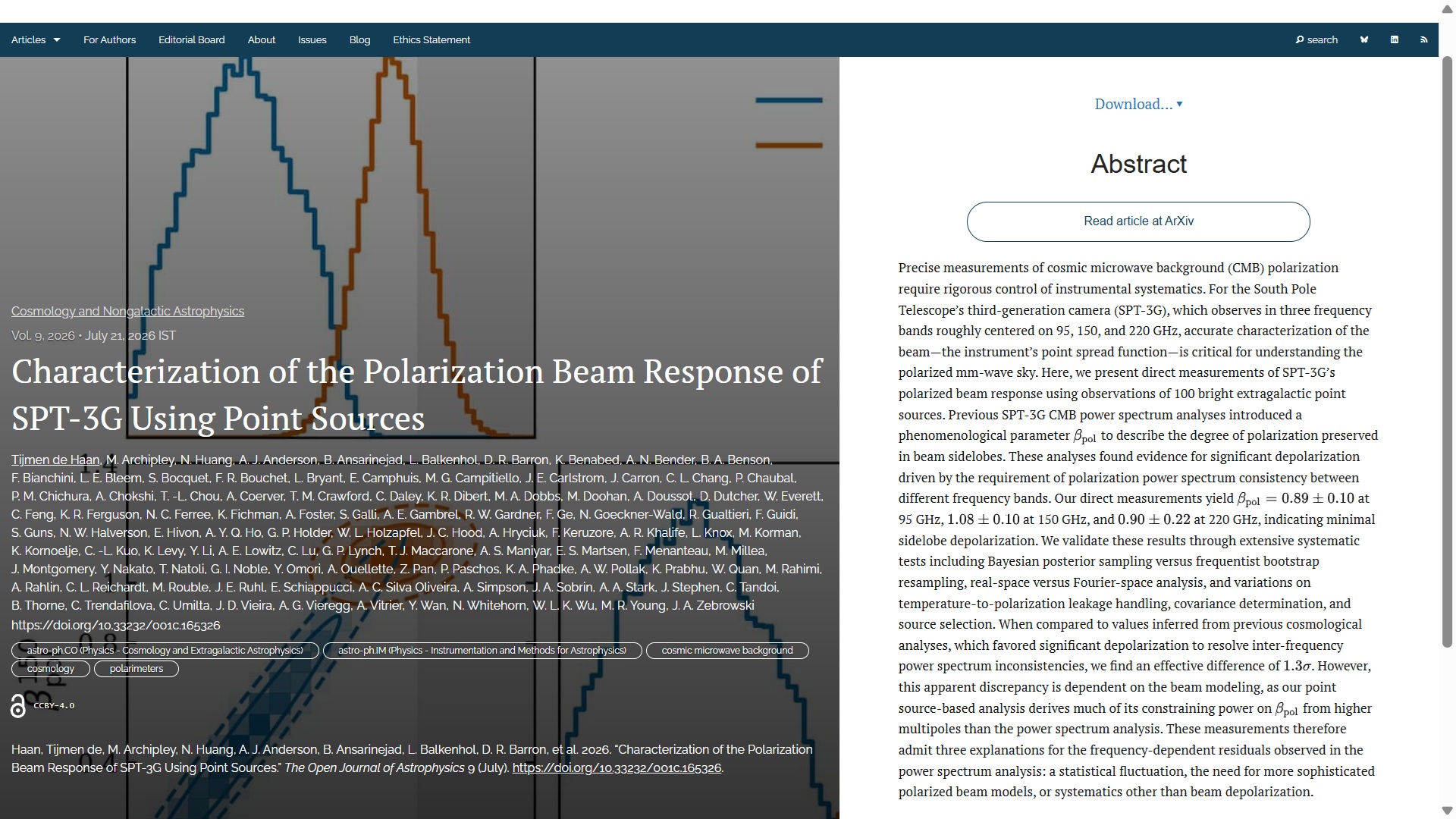
The first paper to report this week was published on Tuesday 21st July in the folder Cosmology and Nongalactic Astrophysics. The title is “Characterization of the Polarization Beam Response of SPT-3G Using Point Sources” by Tijmen de Haan (Institute of Particle and Nuclear Studies, Ibaraki, Japan) and an international cast of 101 others. This study presents measurements of the South Pole Telescope’s polarized beam response, indicating minimal sidelobe depolarization. The findings suggest potential explanations for frequency-dependent residuals in power spectrum analysis.
The overlay for this paper is here
You can find the officially accepted version on arXiv here and the announcement on Fediverse here:
New Publication at the Open Journal of Astrophysics: "Characterization of the Polarization Beam Response of SPT-3G Using Point Sources" by Tijmen de Haan (Institute of Particle and Nuclear Studies, Ibaraki, Japan) and 101 others from around the world
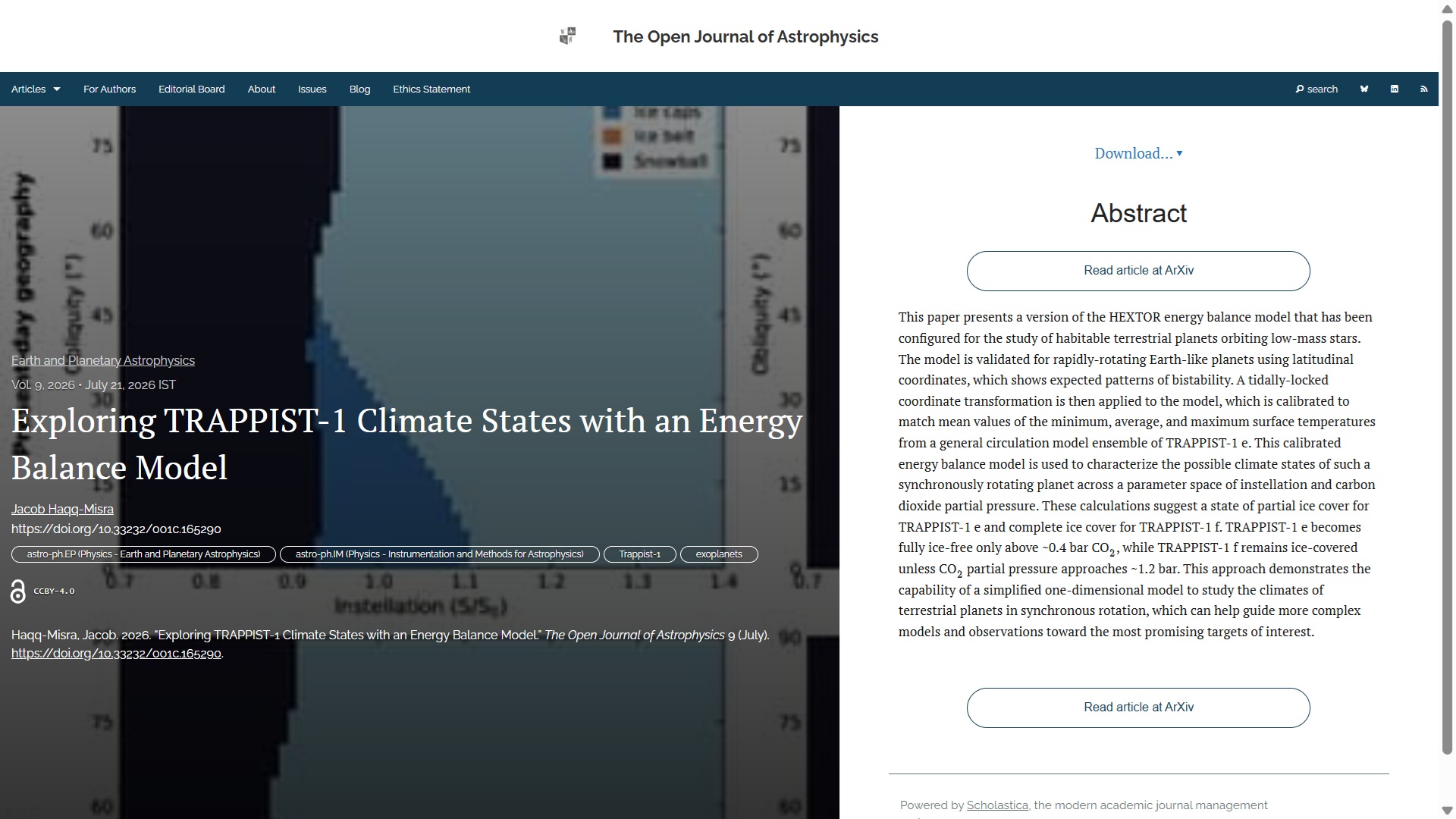
The second paper for this week, also published on Tuesday 21st July but in the folder Earth and Planetary Astrophysics is: “Exploring TRAPPIST-1 Climate States with an Energy Balance Model” by Jacob Haqq-Misra (Blue Marble Space, USA). The study uses a modified HEXTOR energy balance model to predict climate states of terrestrial planets orbiting low-mass stars, suggesting partial to complete ice cover for TRAPPIST-1 e and f.Abstractfor Exploring TRAPPIST-1 Climate States with an Energy Balance Model.
The overlay looks like this:
The official version of the paper can be found on arXiv here and the Fediverse announcement here:
New Publication at the Open Journal of Astrophysics: "Exploring TRAPPIST-1 Climate States with an Energy Balance Model" by Jacob Haqq-Misra (Blue Marble Space, USA)
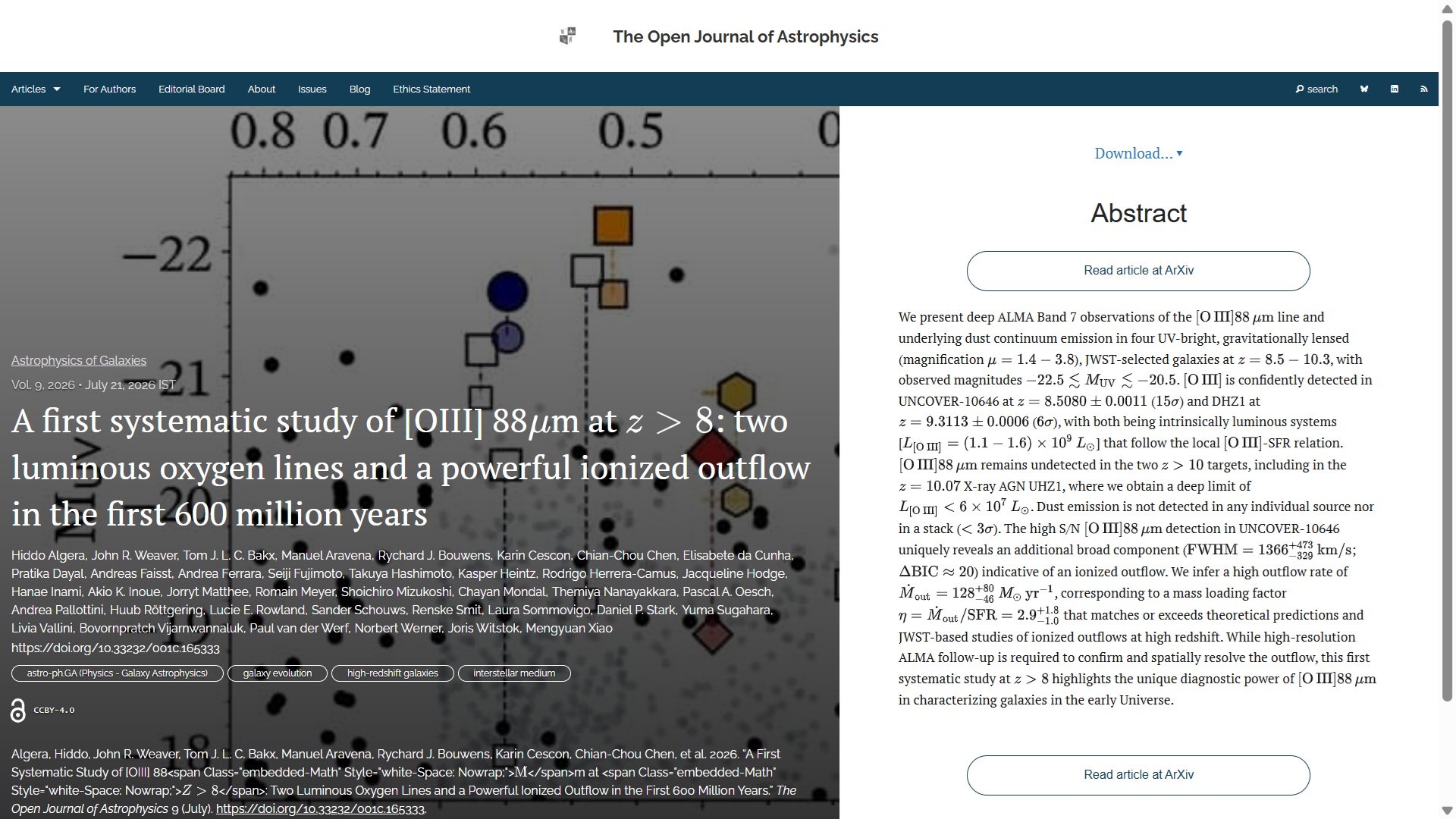
New Publication at the Open Journal of Astrophysics: "A first systematic study of [OIII] 88μm at z>8: two luminous oxygen lines and a powerful ionized outflow in the first 600 million years" by Hiddo Algera (Institute of Astronomy and Astrophysics, Taipei, Taiwan) and 37 others from all around the world.
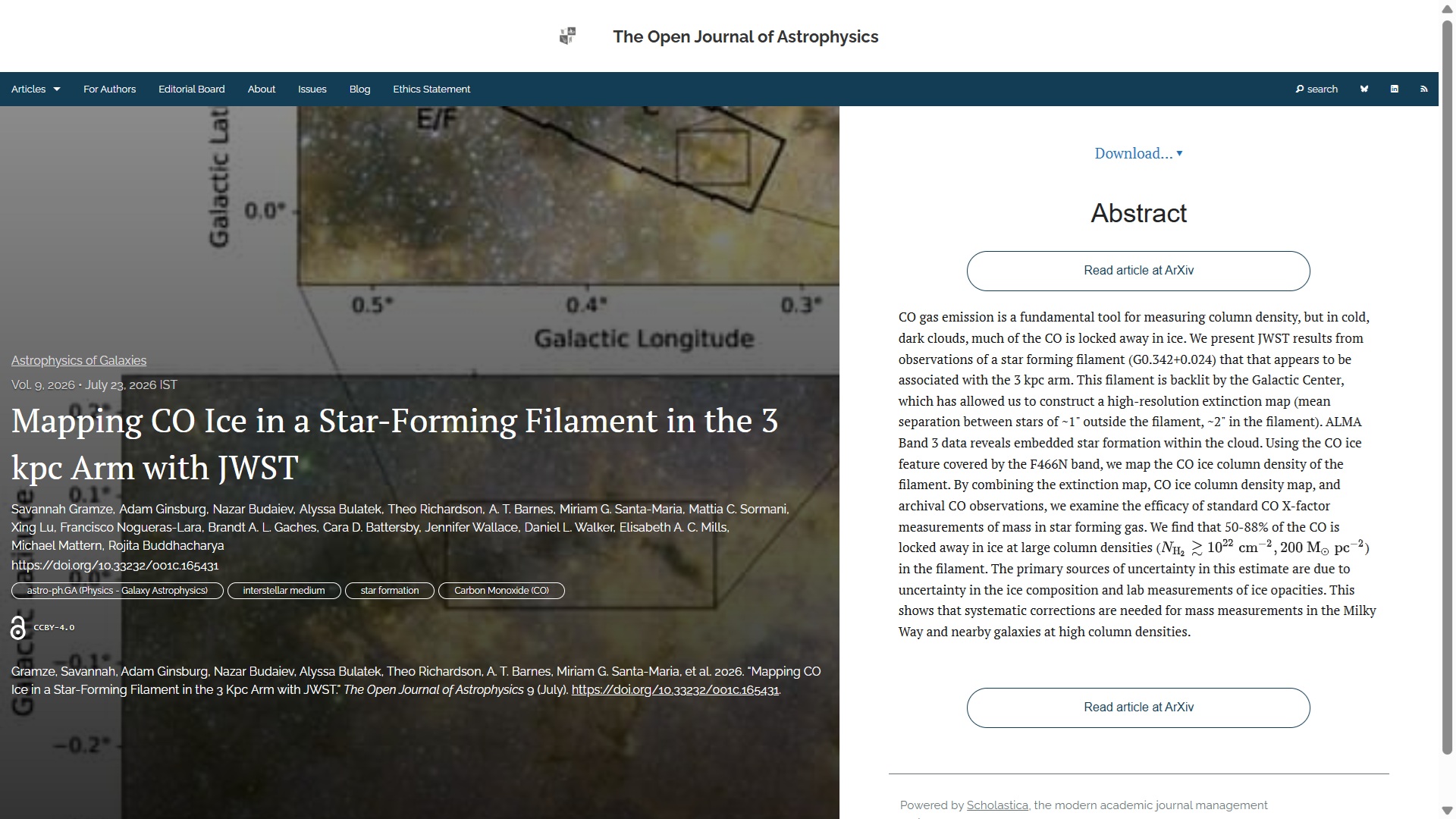
The fourth paper of the week, published on Thursday 23rd July in the folder Astrophysics of Galaxies, is “Mapping CO Ice in a Star-Forming Filament in the 3 kpc Arm with JWST” by Savannah Gramze (U. Florida, USA) and 16 others based all around the world. This paper shows that JWST observations and ALMA Band 3 data reveal that 50-88% of CO gas in a star-forming filament is locked in ice; corrections are needed for mass measurements in such systems.
The overlay for this one is here:
You can read the final version of this one on arXiv here and the Mastodon announcement is here:
New Publication at the Open Journal of Astrophysics: "Mapping CO Ice in a Star-Forming Filament in the 3 kpc Arm with JWST" by Savannah Gramze (U. Florida, USA) and 16 others based all around the world.
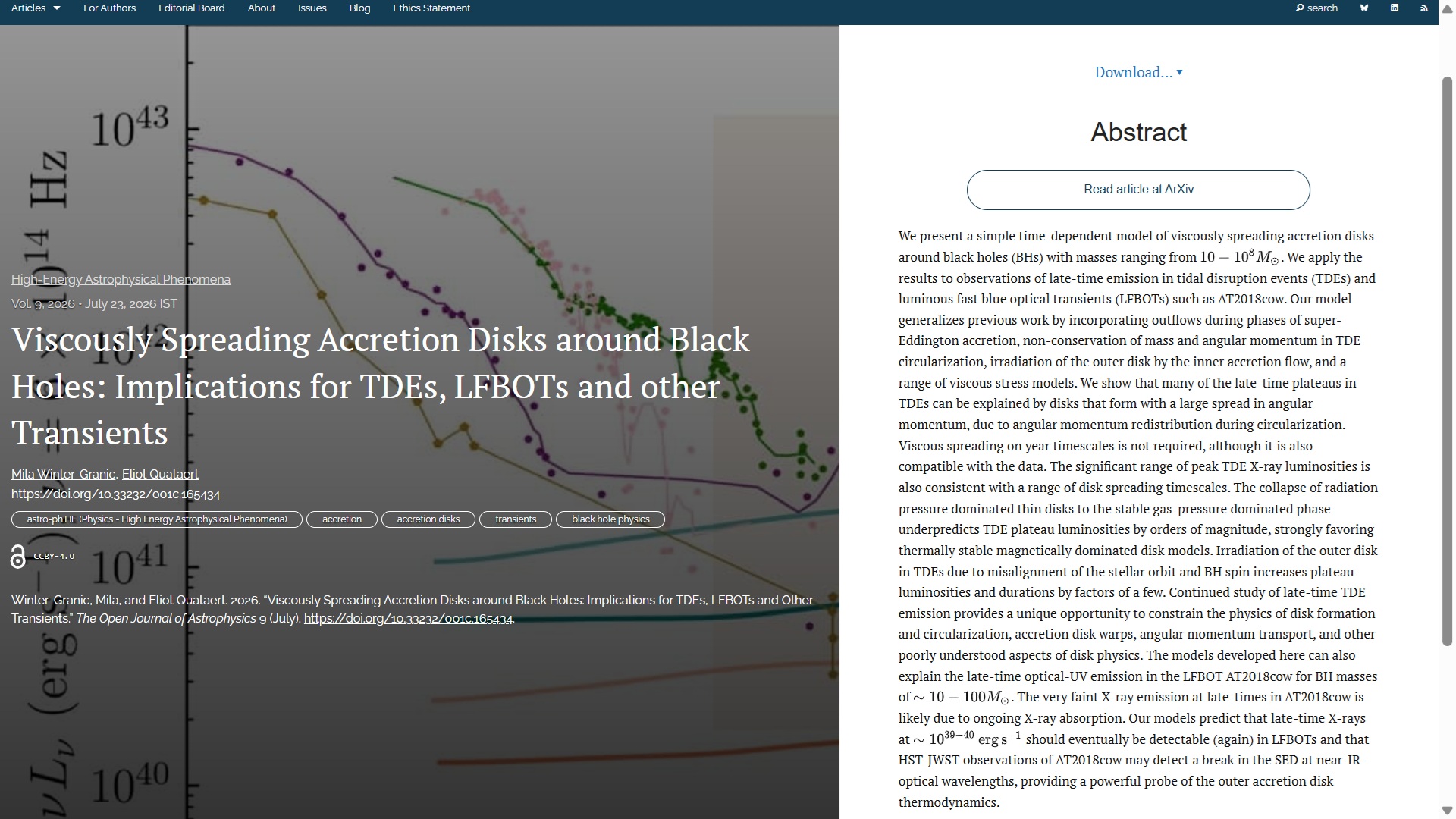
New Publication at the Open Journal of Astrophysics: "Viscously Spreading Accretion Disks around Black Holes: Implications for TDEs, LFBOTs and other Transients" by Mila Winter-Granic and Eliot Quataert (Princeton University, USA)
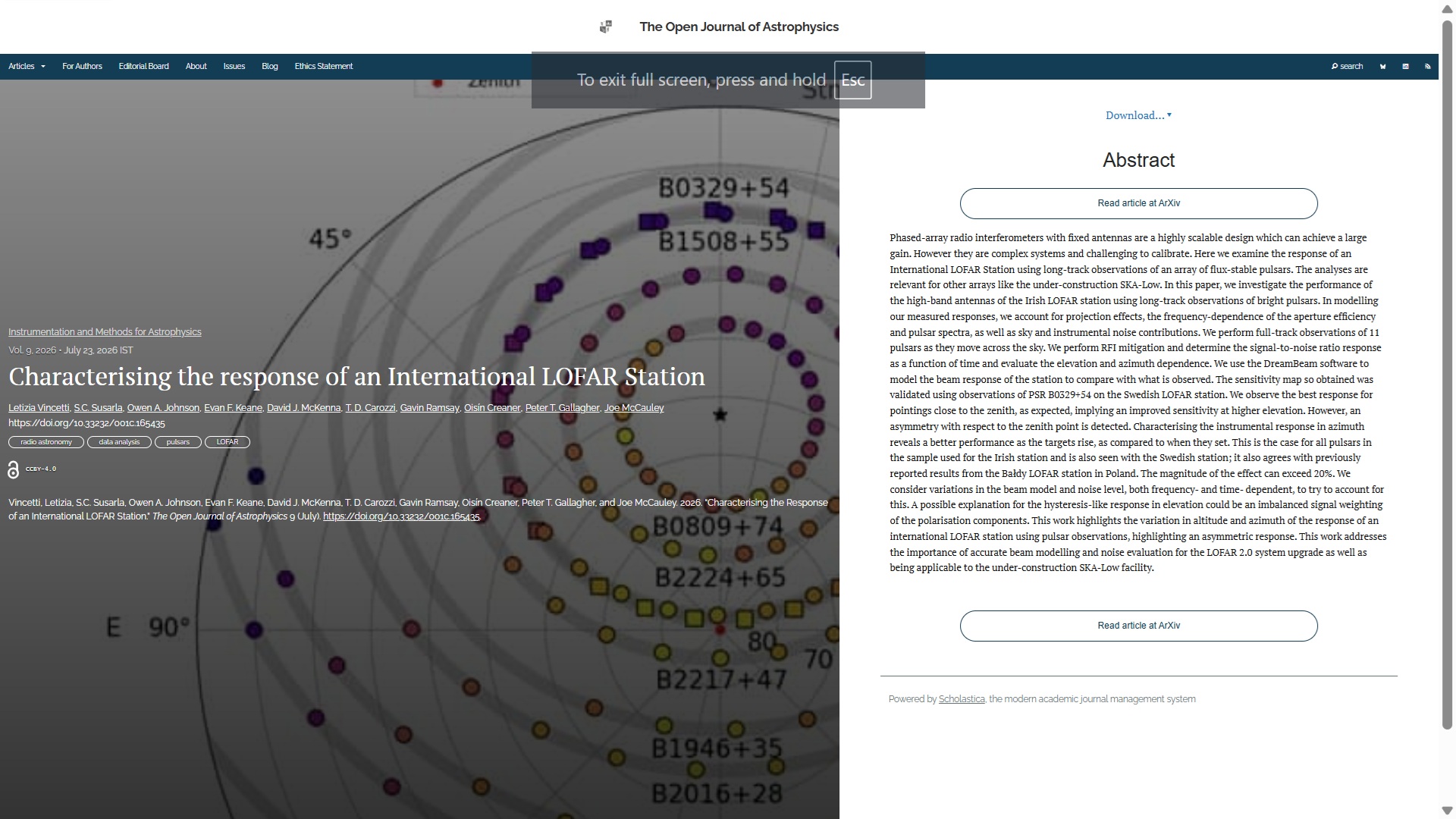
The sixth paper of this week is “Characterising the response of an International LOFAR Station” by Letizia Vincetti (Trinity Collge Dublin, Ireland) and 9 others based in Ireland, USA, The Netherlands and Sweden. This was also published on Thursday July 23rd and is in the folder Instrumentation and Methods for Astrophysics. The article presents an investigation of the performance and calibration challenges of phased-array radio interferometers, using the Irish LOFAR station as a case study, highlighting the importance of accurate beam modelling, etc.
The overlay for this one is here:
You can find the final accepted version on arXiv here and the Mastodon announcement is here:
New Publication at the Open Journal of Astrophysics: "Characterising the response of an International LOFAR Station" by Letizia Vincetti (Trinity Collge Dublin, Ireland) and 9 others based in Ireland, USA, The Netherlands and Sweden
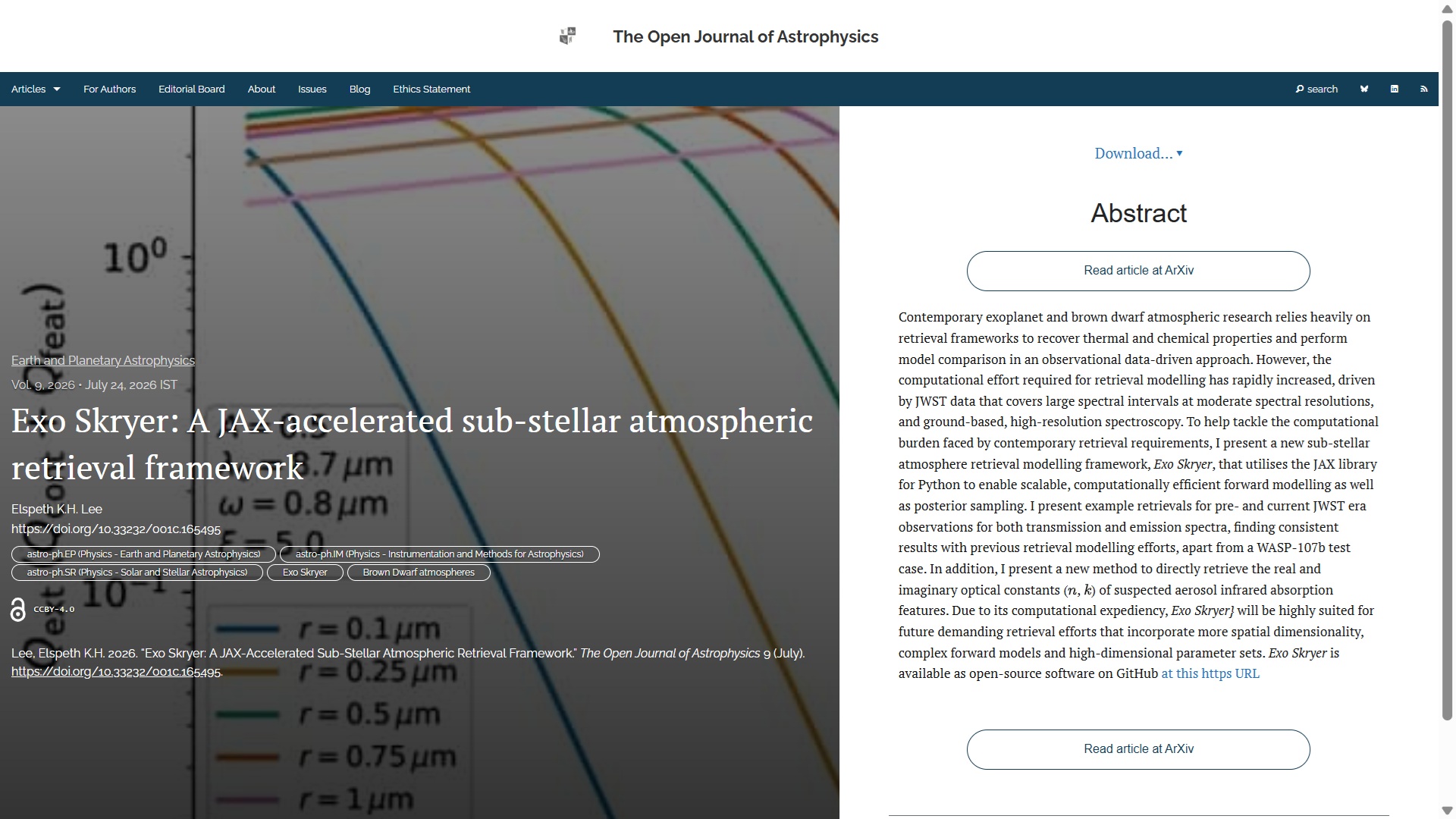
New Publication at the Open Journal of Astrophysics: "Exo Skryer: A JAX-accelerated sub-stellar atmospheric retrieval framework" by Elspeth K.H. Lee (U. Bern, Switzerland)
New Publication at the Open Journal of Astrophysics: "GCR Spectra Reconstructed with Neutron Monitor Yield Function and Artificial Neural Networks: Comparison of Two Methods" by Stepan A. Siruk (Moscow Engineering Physics Institute MEPhI, Russia) and four others based in Russia
And finally for this week we have “The failed failed-supernova scenario of M31-2014-DS1” by Noam Soker (Technion, Israel), a paper which challenges the failed-supernova theory for the fading of the yellow supergiant event M31-2014-DS1, suggesting it requires unlikely parameters and supports an alternative scenario involving violent binary interaction. This was published on Friday 24th July in the folder High-Energy Astrophysical Phenomena.
The overlay for this one is here:
You can find the final accepted version on arXiv here and the Mastodon announcement is here:
And that concludes the update of this week’s business. As it was foretold, the total number of publications at OJAp has now passed the 600 mark, and the likely number for 2026 is around 300. We published a paper in five of the six astro-ph categories this week, but still haven’t had a week when we’ve published a full house with at least one in all six…
Back home to Maynooth, just in time for another Saturday update of activity at the Open Journal of Astrophysics. Since the last update we have published a further nine papers, bringing the number in Volume 9 (2026) to 145 and the total so far published by OJAp up to 593.
I will continue to include the posts made on our Mastodon account (on Fediscience); these announcements also show the DOI for each paper.
The first paper to report this week, published on Tuesday 7th July, is “The Information Content of Quasar Variability Light Curves: How Well Can we Infer Stochastic Model Parameters?” by Brendon Brewer (U. Auckland, NZ), Geraint F. Lewis (U. Sydney, AU), Xiang Yu & Yuan Li (Auckland). Published in the folder Astrophysics of Galaxies, this study suggests that quasar variability studies should focus on the short term volatility parameter, as it’s more informative than the variability timescale. Volatility decreases with redshift suggesting intrinsic effects.
The overlay for this paper is here
You can find the officially accepted version on arXiv here and the announcement on Fediverse here:
New Publication at the Open Journal of Astrophysics: "The Information Content of Quasar Variability Light Curves: How Well Can we Infer Stochastic Model Parameters?" by Brendon Brewer (U. Auckland, NZ), Geraint F. Lewis (U. Sydney, AU), Xiang Yu & Yuan Li (Auckland)
The second paper for this week, also published on Tuesday 7th July, but in the folder High-Energy Astrophysical Phenomena, is “Cygnus X-3 as a PeVatron and the LHAASO 2025 data” by Michael Kachelriess & E. Lammert (NTNU, Trondheim, Norway). This paper suggests that the high-mass X-ray binary Cygnus X-3 can accelerate cosmic rays beyond PeV energies, contributing to a photon flux peaking around PeV energies.
The overlay looks like this:
The official version of the paper can be found on arXiv here and the Fediverse announcement here:
New Publication at the Open Journal of Astrophysics: "Cygnus X-3 as a PeVatron and the LHAASO 2025 data" by Michael Kachelriess & E. Lammert (NTNU, Trondheim, Norway)
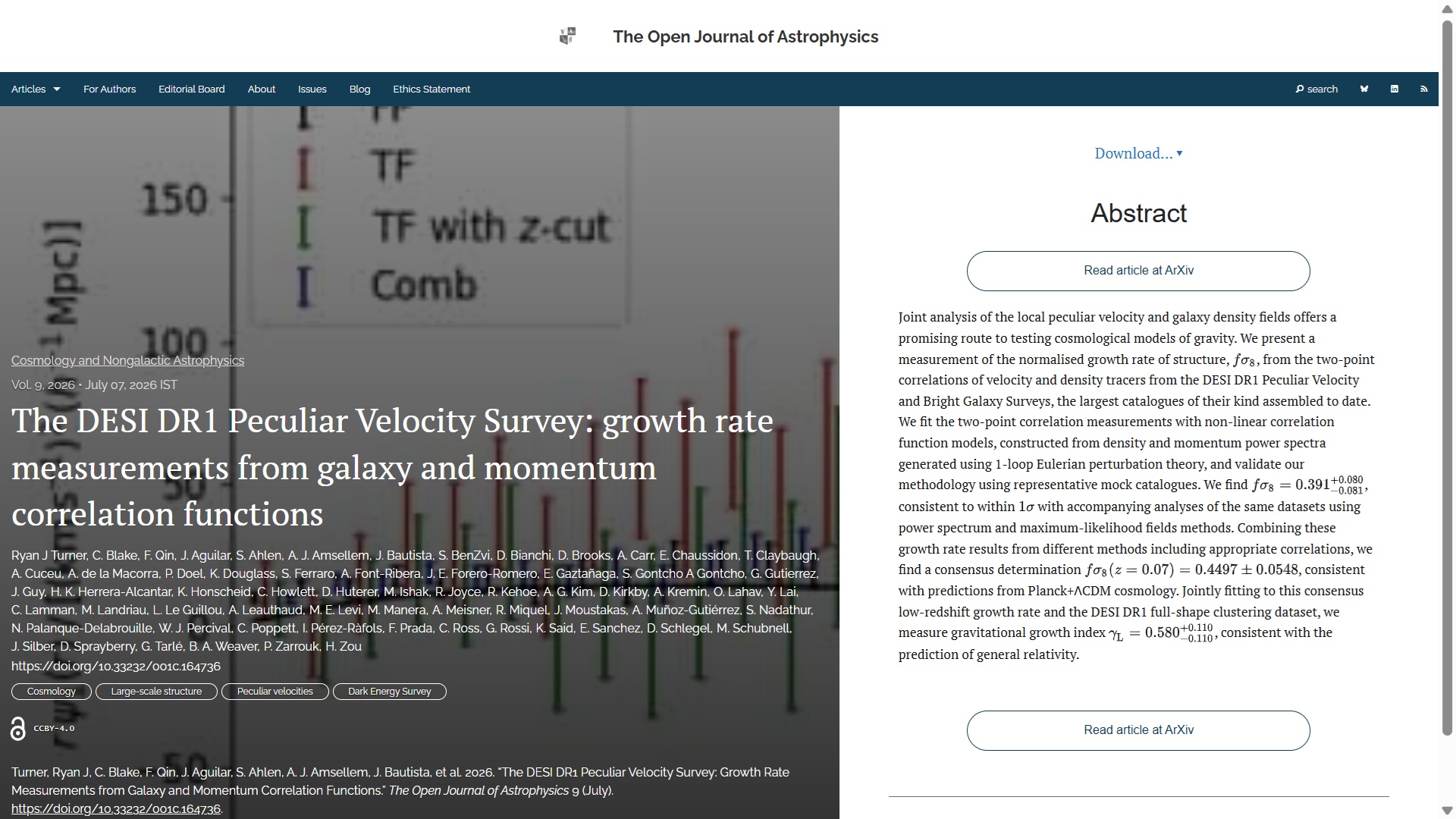
New Publication at the Open Journal of Astrophysics: "The DESI DR1 Peculiar Velocity Survey: growth rate measurements from galaxy and momentum correlation functions" by Ryan J Turner (Swinburne Institute of Technology, Australia) and 63 others from around the world.
New Publication at the Open Journal of Astrophysics: "On the effective spin-mass ratio relation of binary black hole mergers that evolved in isolation" by Sambaran Banerjee (Helmholtz-Instituts für Strahlen und Kernphysik, Germany) and Aleksandra Olejak (MPA Garching, Germany)
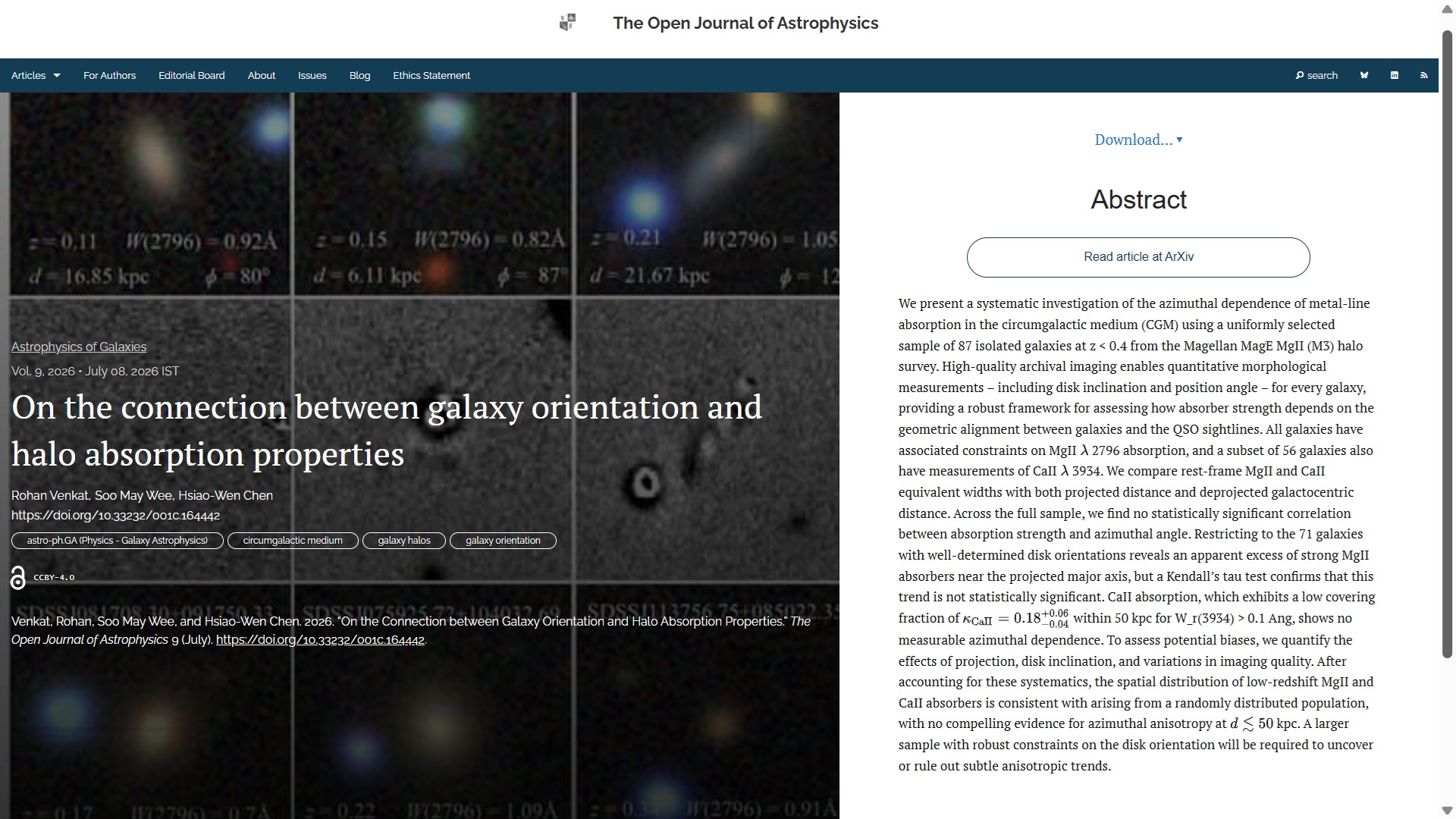
The fifth paper of the week, also published on Wednesday 8th July but in the folder Astrophysics of Galaxies, is “On the connection between galaxy orientation and halo absorption properties” by Rohan Venkat, Soo May Wee, and Hsiao-Wen Chen (U. Chicago, USA). This article investigates the azimuthal dependence of metal-line absorption in the circumgalactic medium of 87 isolated galaxies. The results show no significant correlation between absorption strength and azimuthal angle.
The overlay for this one is here:
You can read the final version of this one on arXiv here and the Mastodon announcement is here:
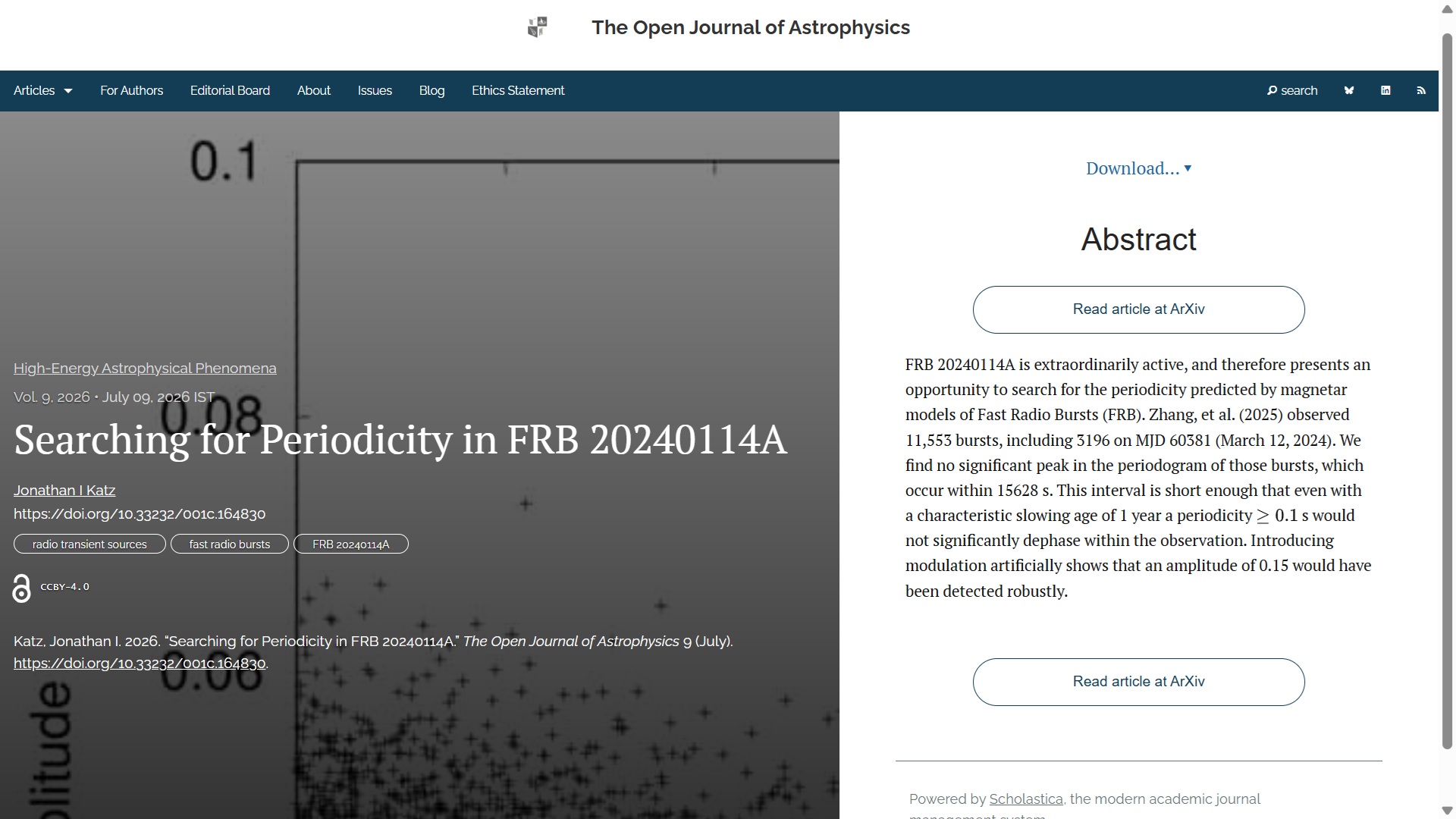
The sixth paper of this week is “Searching for Periodicity in FRB 20240114A” by Jonathan I Katz (Washington U., USA). This was published on Thursday 9th July in the folder High-Energy Astrophysical Phenomena. The study described in this paper observed FRB 20240114A, an active Fast Radio Burst, but found no significant periodicity in its bursts, contradicting magnetar models predictions.
The overlay for this one is here:
You can find the final accepted version on arXiv here and the Mastodon announcement is here:
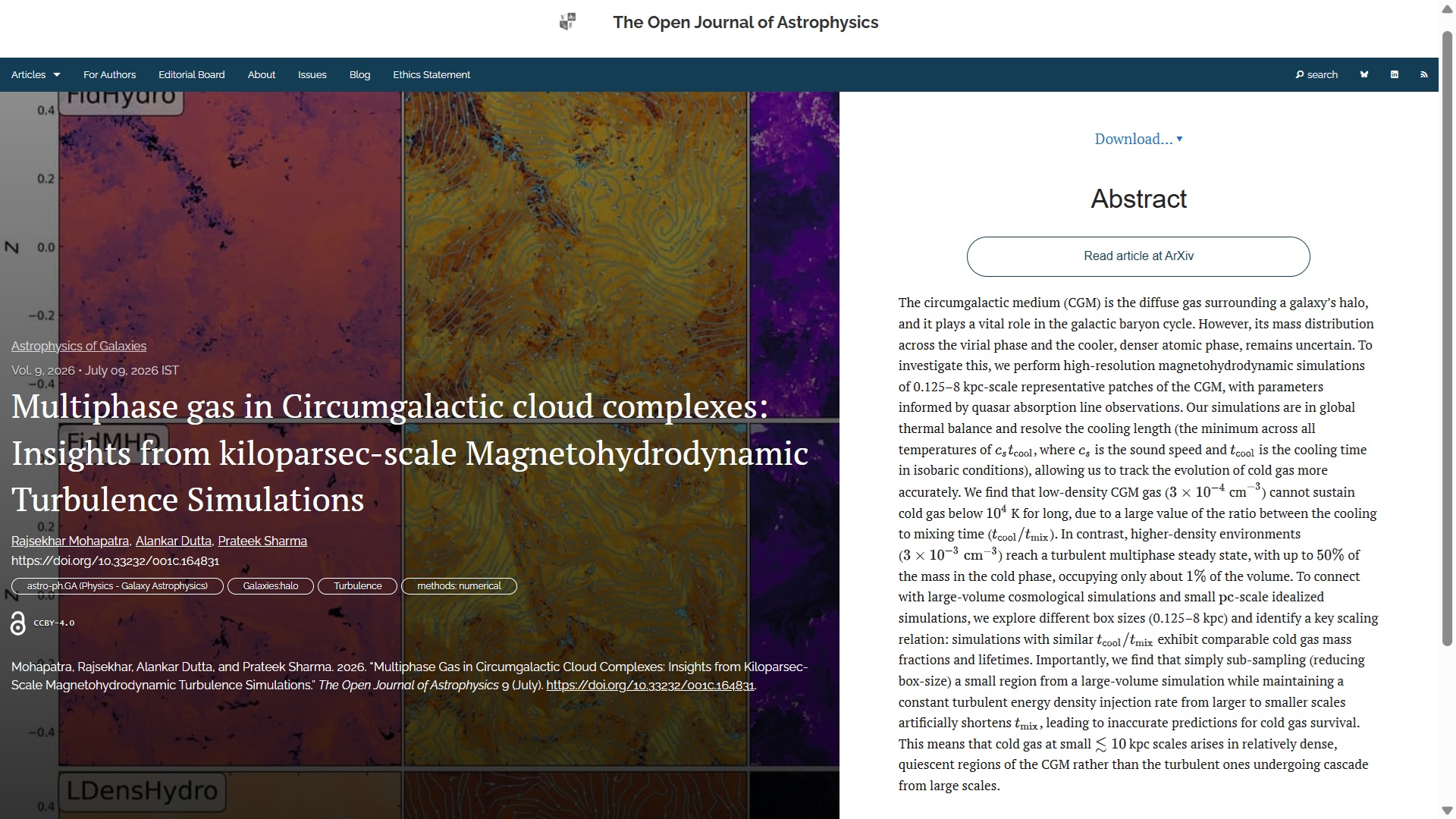
The seventh article for this week is “Multiphase gas in Circumgalactic cloud complexes: Insights from kiloparsec-scale Magnetohydrodynamic Turbulence Simulations” by Rajsekhar Mohapatra (Princeton U., USA), Alankar Dutta (MPA Garching, Germany) and Prateek Sharma (Indian Institute of Science, Bangalore). This -paper was also published on Thursday 9th July, in the folder Astrophysics of Galaxies. This paper uses high-resolution simulations to investigate the mass distribution of the circumgalactic medium (CGM), a diffuse gas surrounding a galaxy’s halo with small-scale clumps of cold gas forming in quiescent regions.
The overlay for this one is here:
You can find the final accepted version of this one on arXiv here and the Mastodon announcement is here:
New Publication at the Open Journal of Astrophysics: "Multiphase gas in Circumgalactic cloud complexes: Insights from kiloparsec-scale Magnetohydrodynamic Turbulence Simulations" by Rajsekhar Mohapatra (Princeton U., USA), Alankar Dutta (MPA Garching, Germany) and Prateek Sharma (Indian Institute of Science, Bangalore)
The (penultimate) eighth article for this week is “Line-of-sight shear in SLACS strong lenses I: shear and mass model parametrisations” by Natalie B. Hogg (U. Cambridge, UK), Daniel Johnson (U. Montpellier, France), Anowar J. Shajib (U. Chicago, USA) and Julien Larena (Montpellier). This was also published on Thursday 9th July, but in the folder Cosmology and Nongalactic Astrophysics. This article studies models of 23 strong gravitational lenses to measure line-of-sight shear for the first time, providing potential new constraints on cosmological parameters.
The overlay for this one is here:
You can find the final accepted version on arXiv here and the Mastodon announcement is here:
New Publication at the Open Journal of Astrophysics: "Line-of-sight shear in SLACS strong lenses I: shear and mass model parametrisations" by Natalie B. Hogg (U. Cambridge, UK), Daniel Johnson (U. Montpellier, France), Anowar J. Shajib (U. Chicago, USA) and Julien Larena (Montpellier)
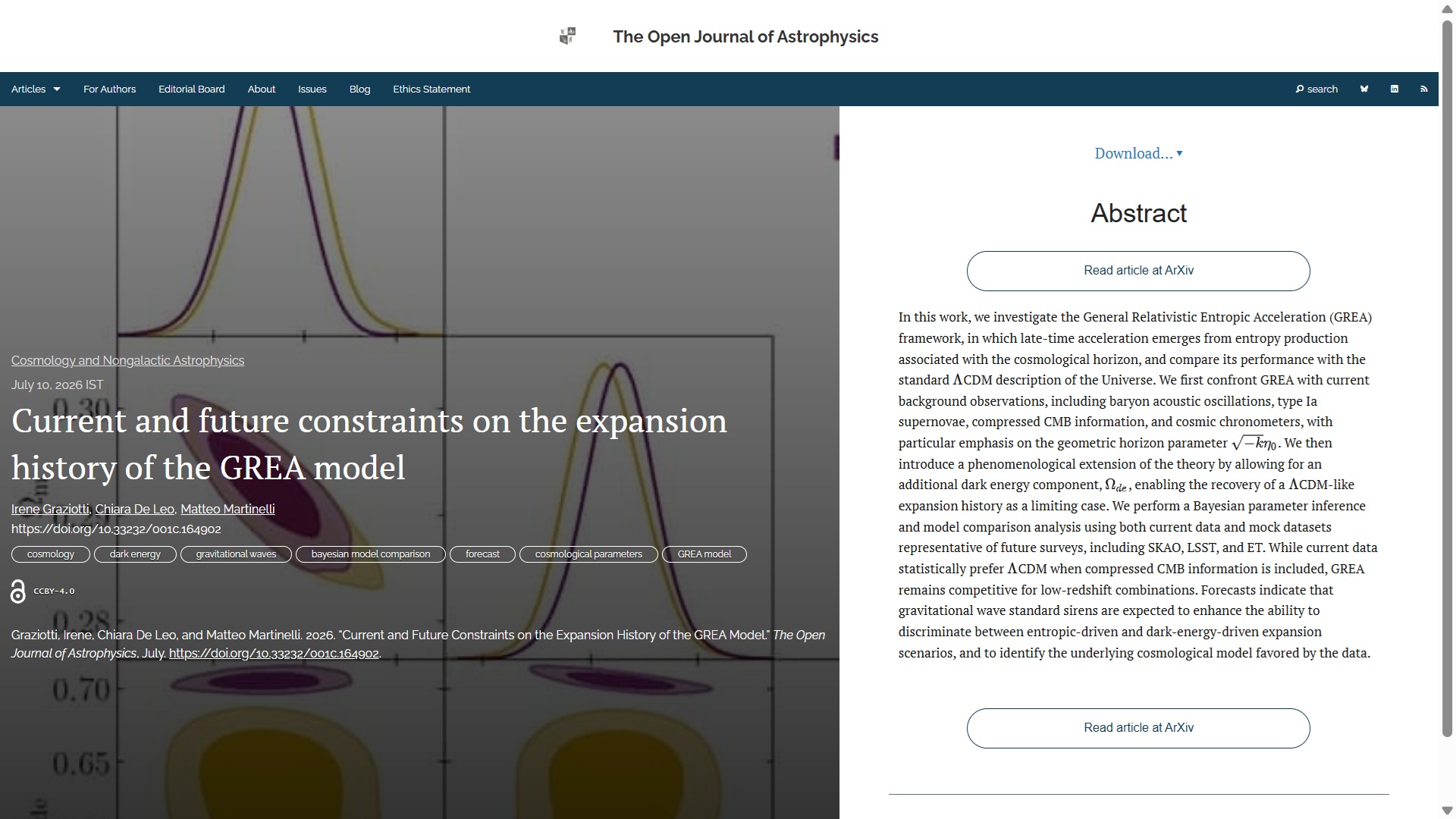
The ninth and last article for this week is “Current and future constraints on the expansion history of the GREA model” by Irene Graziotti (INAF-Osservatorio Astronomico di Capodimonte, Italy), Chiara De Leo (Sapienza University of Rome, Italy) and Matteo Martinelli (INAF-Osservatorio Astronomico di Roma, Italy). This study explores the General Relativistic Entropic Acceleration (GREA) framework, comparing it to the standard description of the universe. Current data favors the standard model, but GREA remains competitive.
The overlay for this one is here:
You can find the officially-accepted version on arXiv here and the Mastodon announcement here:
New Publication at the Open Journal of Astrophysics: "Current and future constraints on the expansion history of the GREA model" by Irene Graziotti (INAF-Osservatorio Astronomico di Capodimonte, Italy), Chiara De Leo (Sapienza University of Rome, Italy) and Matteo Martinelli (INAF-Osservatorio Astronomico di Roma, Italy)
As you can see, it has been a bumper week, especially when you consider that there was no arXiv mailing om Monday July 6th owing to the July 4th holiday in the USA. I should have known this would happen while I was travelling!
It’s Saturday once again, so time for another update of activity at the Open Journal of Astrophysics. Since the last update we have published a further six papers, bringing the number in Volume 9 (2026) to 110 and the total so far published by OJAp up to 558.
I will continue to include the posts made on our Mastodon account (on Fediscience); these announcements also show the DOI for each paper.
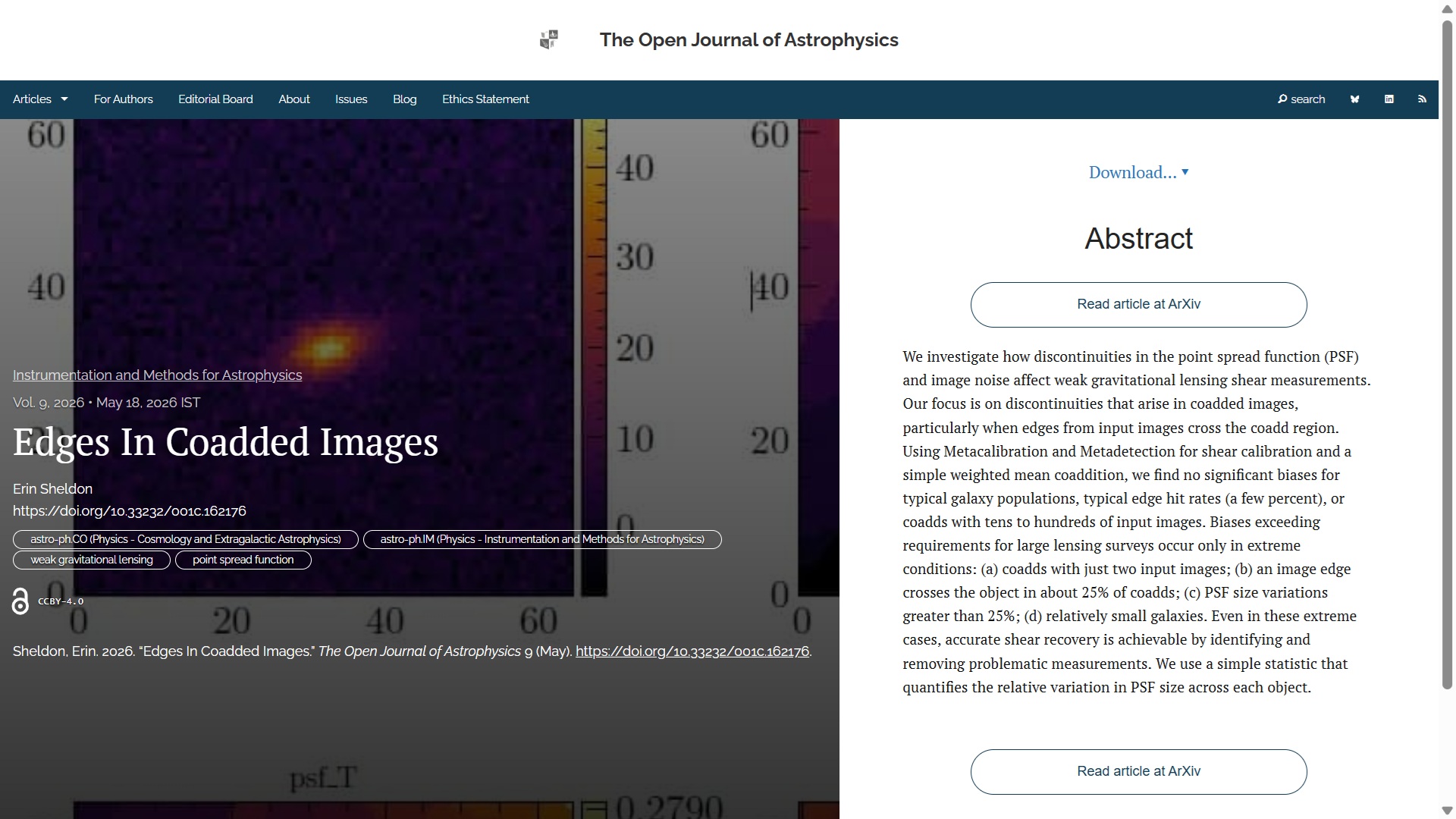
The first paper to report this week, published on Monday 18th May in the folder Instrumentation and Methods for Astrophysics is “Edges In Coadded Images” by Erin Sheldon (Brookhaven National Laboratory, USA). This paper describes a study exploring how image discontinuities and noise impact weak gravitational lensing measurements, finding no significant biases under typical conditions. Biases occur only in extreme cases, but can be mitigated.
The overlay for this paper is here
You can find the officially accepted version on arXiv here and the announcement on Fediverse here:
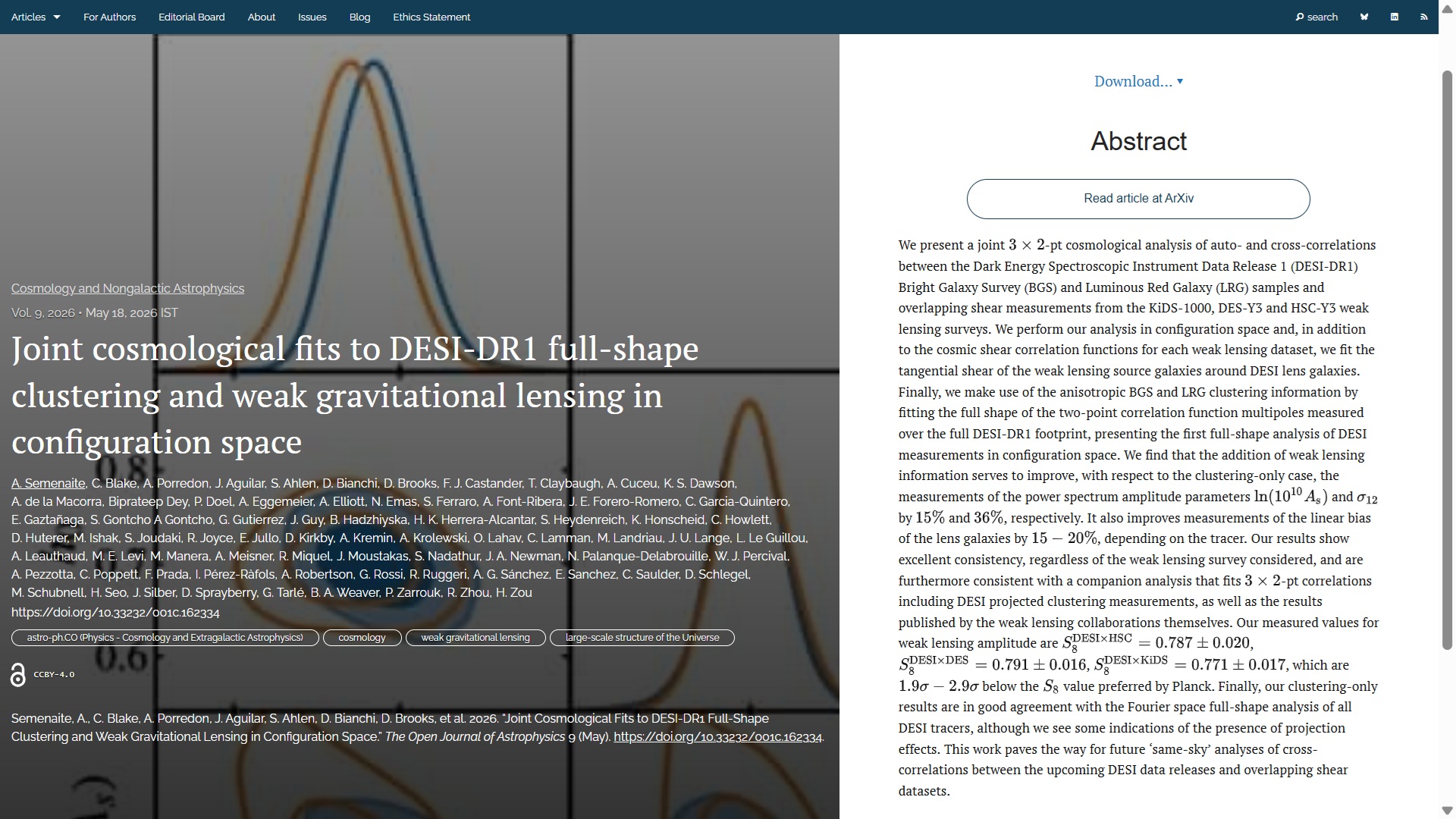
New Publication at the Open Journal of Astrophysics: "Joint cosmological fits to DESI-DR1 full-shape clustering and weak gravitational lensing in configuration space " by A. Semenaite (Swinburne Institute of Technology, Australia) and 72 others from all round the world.
Next one up, the third paper of the week, and the third published on Monday 18th May, and in the folder Cosmology and Nongalactic Astrophysics is “Probing Dark Energy Microphysics with kSZ Tomography” by Julius Adolff, Selim Hotinli and Neal Dalal (all of the Perimeter Institute, Canada). This paper explores how kinetic Sunyaev-Zel’dovich tomography and galaxy clustering can enhance our understanding of dark energy and its effects, potentially revealing its microphysical properties in future surveys.
The overlay for this one is here:
The final, accepted version can be found on arXiv here and the Mastodon announcement is here:
New Publication at the Open Journal of Astrophysics: "Probing Dark Energy Microphysics with kSZ Tomography" by Julius Adolff, Selim Hotinli and Neal Dalal (Perimeter Institute, Canada)
The fourth paper this week, published on Wednesday May 20th is “A Census of Variable Radio Sources at 3 GHz” by Yjan A. Gordon, Peter S. Ferguson, Michael N. Martinez and Eric J. Hooper (all of the University of Wisconsin, USA). This article, published in the folder Astrophysics of Galaxies, uses data from the Very Large Array Sky Survey to analyze variability in the radio sky, finding most changes consistent with blazars and quasars.
The overlay is here:
The officially accepted version can be found on arXiv here and here is the Mastodon announcement:
New Publication at the Open Journal of Astrophysics: "A Census of Variable Radio Sources at 3 GHz" by Yjan A. Gordon, Peter S. Ferguson, Michael N. Martinez & Eric J. Hooper (U. Wisconsin, USA)
The fifth article of this week was published on Friday 22nd May in the folder Instrumentation and Methods for Astrophysics. The title is “Uncovering the Next Galactic Supernova with the Vera C. Rubin Observatory” by John Banovetz (Lawrence Berkeley Lab., USA), Claire-Alice Hebert & Peter B. Denton (Brookhaven National Lab., USA), Dan Scolnic (Duke University, USA), Anze Slosar (Brookhaven) and Chris Walter (Duke). The paper presents a study simulating how effectively the Vera C. Rubin Observatory can localize supernovae using neutrino triggers, finding a 57-97% success rate based on stellar mass density predictions.
The overlay is here:
You can find the authorized version of this paper on arXiv here and the Fediverse announcement is here:
New Publlication at the Open Journal of Astrophysics: "Uncovering the Next Galactic Supernova with the Vera C. Rubin Observatory" by John Banovetz (Lawrence Berkeley Lab., USA), Claire-Alice Hebert & Peter B. Denton (Brookhaven National Lab., USA) , Dan Scolnic (Duke U., USA) , Anze Slosar (Brookhaven), and Chris Walter (Duke)
Last, but by no means least, this week we have “Pulsar timing solutions for 17 pulsars at 150 MHz from the Irish LOFAR station” by David J. McKenna (ASTRON, The Netherlands), Evan F. Keane (Trinity College Dublin, Ireland), Peter T. Gallagher (DIAS, Ireland) and Joe McCauley (Trinity). This was published on Friday 22nd May in the folder High-Energy Astrophysical Phenomena. It presents a demonstration of the use of international Low Frequency Array (LOFAR) stations in tracking and characterizing pulsars, providing new insights into these neutron stars’ emission properties.
The overlay for this one is here:
You can find the authorized version of this paper on arXiv here and the Fediverse announcement is here:
New Publication at the Open Journal of Astrophysics: "Pulsar timing solutions for 17 pulsars at 150 MHz from the Irish LOFAR station" by David J. McKenna (ASTRON, The Netherlands), Evan F. Keane (Trinity College Dublin, Ireland), Peter T. Gallagher (DIAS, Ireland) and Joe McCauley (Trinity)
It’s Saturday once again, so time for another update of activity at the Open Journal of Astrophysics. Since the last update we have published a further five papers, bringing the number in Volume 9 (2026) to 99 and the total so far published by OJAp up to 547. We didn’t quite make it to a hundred for the year last week, but will do so with the next paper.
I will continue to include the posts made on our Mastodon account (on Fediscience) to encourage you to visit it. Mastodon is a really excellent service, and a more than adequate replacement for X/Twitter (which nobody should be using); these announcements also show the DOI for each paper.
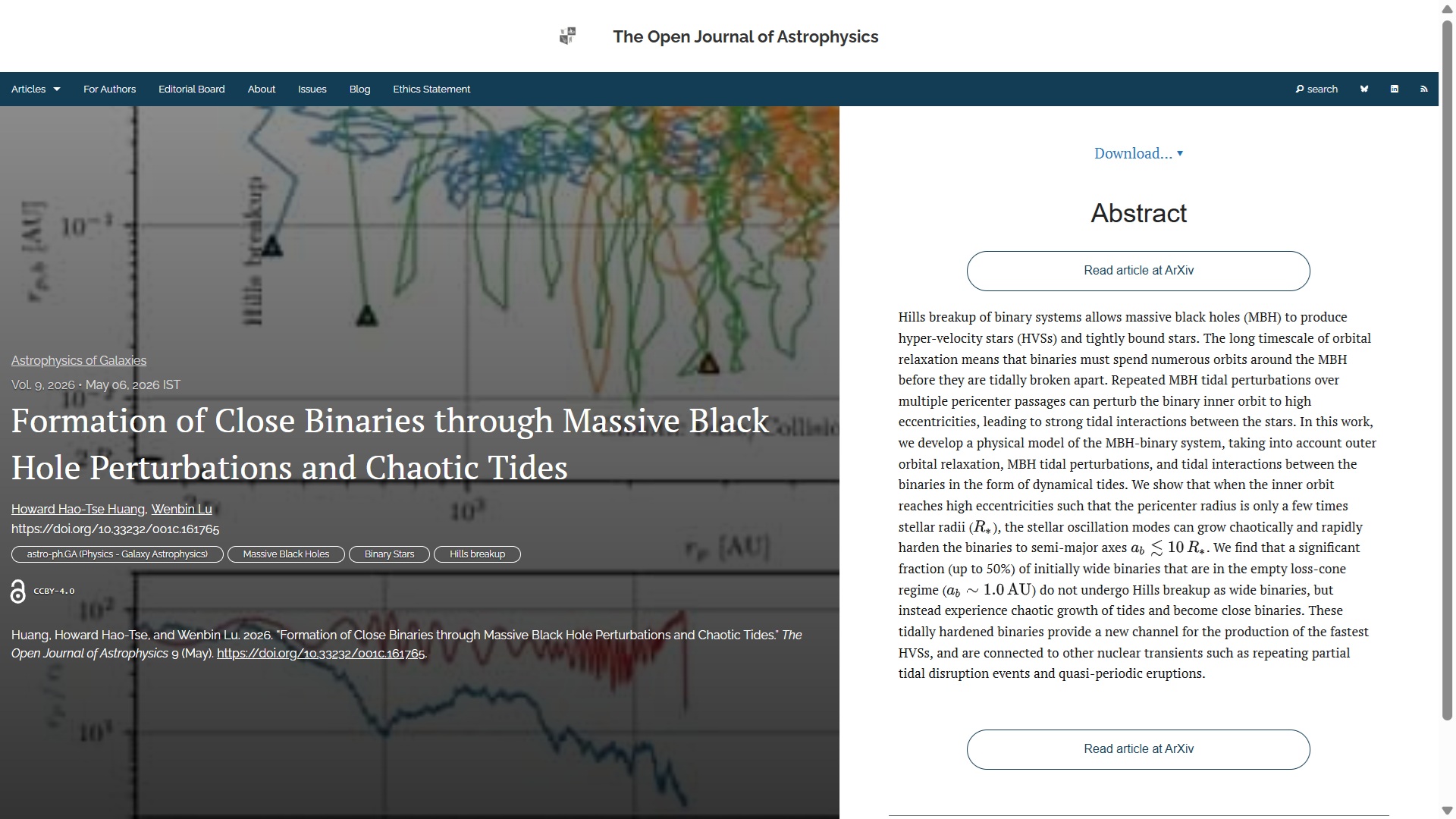
The first paper to report this week is “Formation of Close Binaries through Massive Black Hole Perturbations and Chaotic Tides” by Howard Hao-Tse Huang and Wenbin Lu (University of California at Berkeley, USA). This one was published on Wednesday 6th May 2026 in the folder Astrophysics of Galaxies. The paper presents a model of massive black hole-binary systems, showing that repeated tidal interactions can lead to the creation of hyper-velocity stars and other nuclear transients.
The overlay for this paper is here
You can find the officially accepted version on arXiv here and the announcement on Fediverse here:
New Publication at the Open Journal of Astrophysics: "Formation of Close Binaries through Massive Black Hole Perturbations and Chaotic Tides" by Howard Hao-Tse Huang & Wenbin Lu (U. California Berkeley, USA)
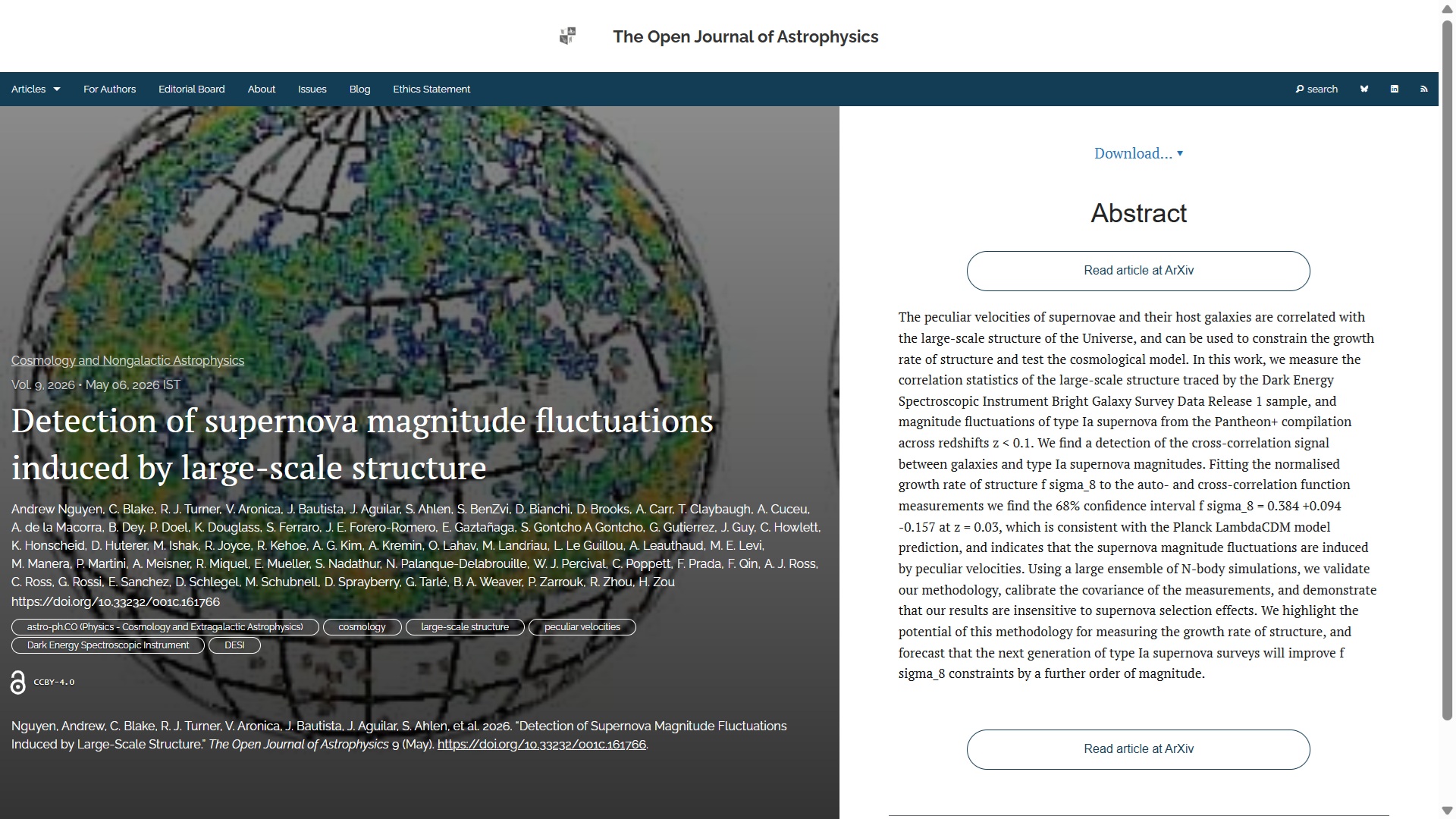
The second paper for this week, also Wednesday 6th May, but in the folder Cosmology and Nongalactic Astrophysics is “Detection of supernova magnitude fluctuations induced by large-scale structure” by Andrew Nguyen (Swinburne Institute of Technology, Australia) and 58 others based all around the world. This study uses supernovae and galaxy velocities to measure the universe’s structure growth rate, confirming the Planck LambdaCDM model prediction. The methodology is validated and shows potential for future research.
The overlay for this one is here:
The official version of the paper can be found on arXiv here and the Fediverse announcement here:
New Publication at the Open Journal of Astrophysics: "Detection of supernova magnitude fluctuations induced by large-scale structure" by Andrew Nguyen (Swinburne Institute of Technology, Australia) and 58 others based all around the world.
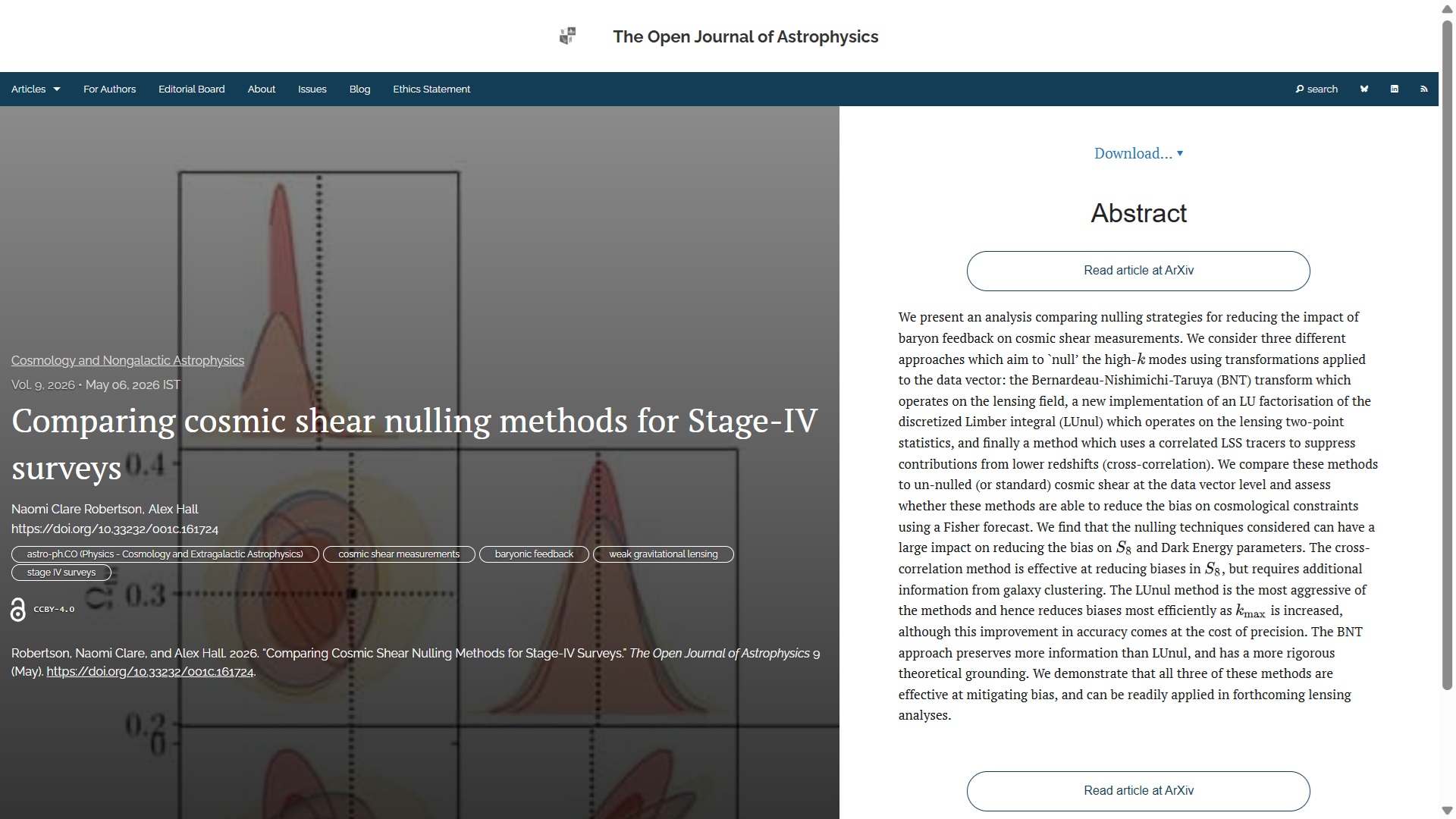
Next one up, the third paper of the week, also published on Wednesday 6th May in the folder Cosmology and Nongalactic Astrophysics is “Comparing cosmic shear nulling methods for Stage-IV surveys” by Naomi Clare Robertson and Alex Hall (University of Edinburgh, UK). This study compares three strategies for reducing baryon feedback impact on cosmic shear measurements. All methods effectively mitigate bias, with varying degrees of efficiency and information preservation.
The overlay for this one is here:
The final, accepted version can be found on arXiv here and the Mastodon announcement is here:
New Publication at the Open Journal of Astrophysics: "Comparing cosmic shear nulling methods for Stage-IV surveys" by Naomi Clare Robertson & Alex Hall (U. Edinburgh, UK)
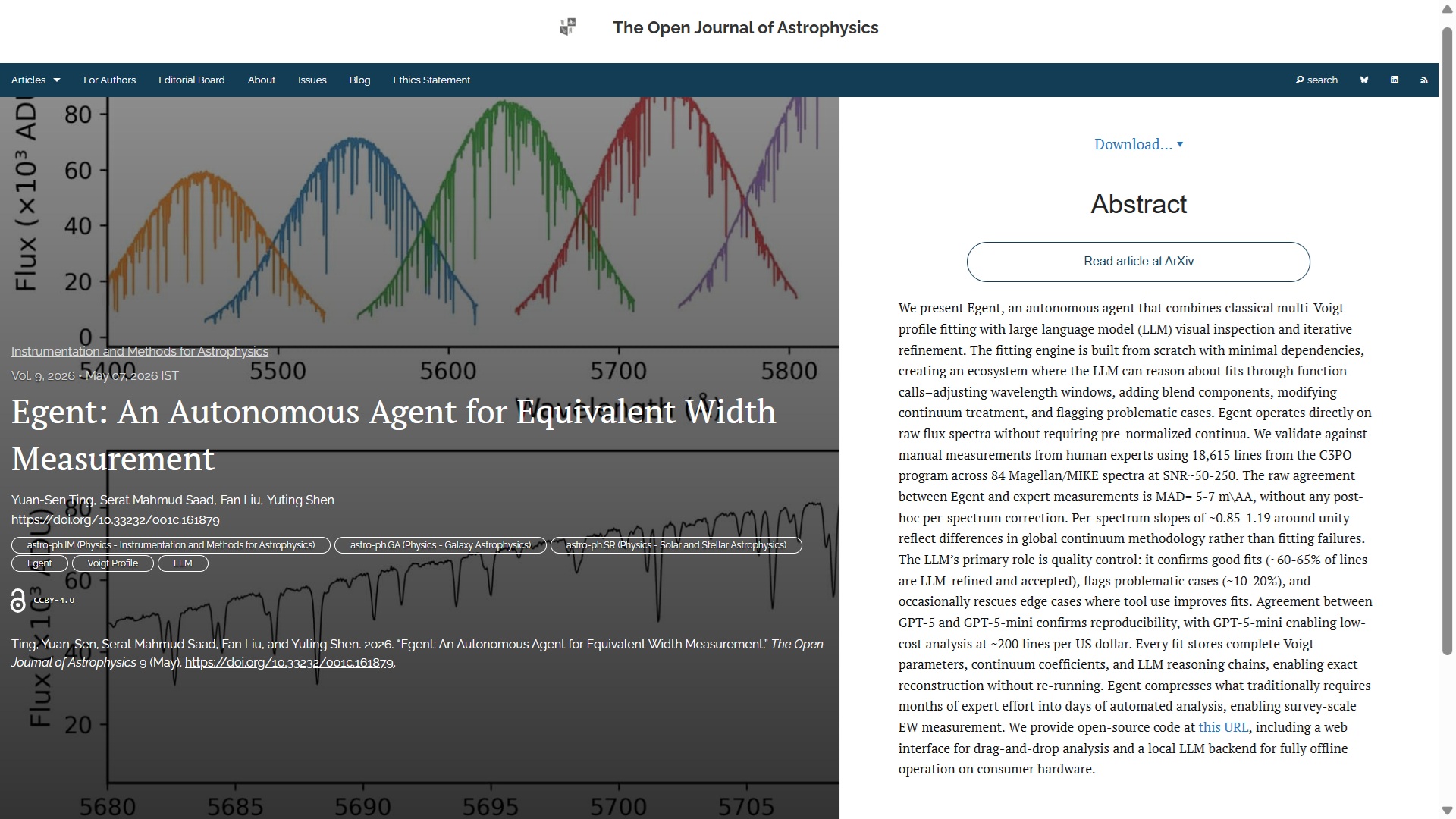
The fourth paper this week, published on Thursday May 7th, is “Egent: An Autonomous Agent for Equivalent Width Measurement” by Yuan-Sen Ting & Serat Mahmud Saad (Ohio State University, USA), Fan Liu (National Astronomical Observatories, Beijing, China), and Yuting Shen (Georgia Institute of Technology, USA). Egent is an autonomous agent that combines multi-Voigt profile fitting with large language model visual inspection for efficient, automated analysis of raw flux spectra, validated against expert measurements. This one is in the folder Instrumentation and Methods for Astrophysics. The associated software can be found here.
The overlay is here:
The officially accepted version can be found on arXiv here and here is the Mastodon announcement:
New Publication at the Open Journal of Astrophysics: "Egent: An Autonomous Agent for Equivalent Width Measurement" by Yuan-Sen Ting & Serat Mahmud Saad (Ohio State U., USA), Fan Liu (National Astronomical Observatories, China) and Yuting Shen (Georgia Institute of Technology, USA)
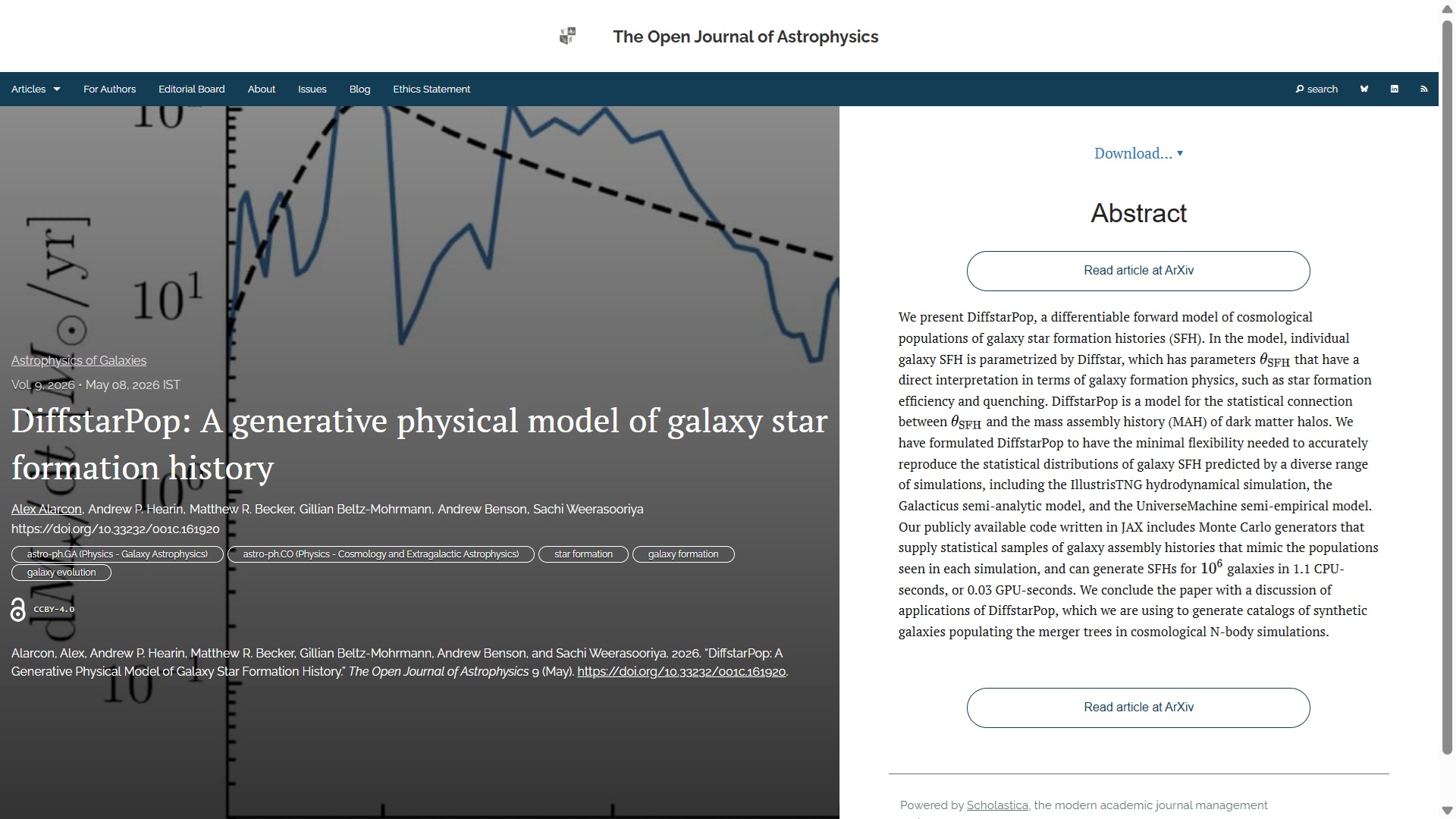
The fifth and final article of this week was published on Friday 8th May in the folder Astrophysics of Galaxies. The title is “DiffstarPop: A generative physical model of galaxy star formation history” and it is by Alex Alarcon (Institute of Space Sciences, Barcelona, Spain), Andrew P. Hearin , Matthew R. Becker & Gillian Beltz-Mohrmann (Argonne National Laborarory, USA), and Andrew Benson & Sachi Weerasooriya (Carnegie Observatories, USA). DiffstarPop is a model that accurately and rapidly reproduces statistical distributions of galaxy star formation histories (SFH), using parameters related to galaxy formation physics.
The overlay is here:
You can find the authorized version of this paper on arXiv here and the Fediverse announcement is here:
New Publication at the Open Journal of Astrophysics: "DiffstarPop: A generative physical model of galaxy star formation history" by Alex Alarcon (Institute of Space Sciences, Barcelona, Spain), Andrew P. Hearin , Matthew R. Becker & Gillian Beltz-Mohrmann (Argonne National Laborarory, USA), and Andrew Benson & Sachi Weerasooriya (Carnegie Observatories, USA)
Here we are, on schedule, with another update of activity at the Open Journal of Astrophysics. Since the last update we have published a further seven papers, bringing the number in Volume 9 (2026) to 94 and the total so far published by OJAp up to 542. I checked the corresponding update for last year (on 3rd May 2025), and we’ve had an increase from 54 to 94 in papers published (about 74%) between the first four months of 2025 and the first four months of 2026.
I will continue to include the posts made on our Mastodon account (on Fediscience) to encourage you to visit it. Mastodon is a really excellent service, and a more than adequate replacement for X/Twitter (which nobody should be using); these announcements also show the DOI for each paper.
The first paper to report this week is “DESI-DR1 3 × 2-pt analysis: consistent cosmology across weak lensing surveys” by Anna Porredon (CIEMAT, Madrid, Spain) and 72 others (DESI Colllaboration). This paper was published on Tuesday 28th April in the folder Cosmology and Nongalactic Astrophysics. This paper presents a joint cosmological analysis of galaxy clustering and gravitational lensing observations, providing consistent constraints on cosmological parameters. The analysis also introduces a new blinding procedure to prevent confirmation bias. See this post for news of an important DESI milestone.
The overlay for this paper is here
You can find the officially accepted version on arXiv here and the announcement on Fediverse here:
New Publication at the Open Journal of Astrophysics: "DESI-DR1 3 × 2-pt analysis: consistent cosmology across weak lensing surveys" by Anna Porredon (CIEMAT, Madrid, Spain) and 72 others (DESI Colllaboration)
The second paper for this week, also published on Tuesday 28th April but in the folder High-Energy Astrophysical Phenomena is “Masers and Broad-Line Mapping Favor Magnetically-Dominated AGN Accretion Disks” by Philip F. Hopkins (Caltech, USA), Dalya Baron (Stanford U., USA) and Joanna M. Piotrowska (Caltech). This one presents a new constraint on supermassive black hole accretion disks physics, suggesting that outer regions are likely in a ‘hyper-magnetized’ state, as thermal or radiation pressure models appear inconsistent.
The overlay for this one is here:
The official version of the paper can be found on arXiv here and the Fediverse announcement here:
New Publication at the Open Journal of Astrophysics: "Masers and Broad-Line Mapping Favor Magnetically-Dominated AGN Accretion Disks" by Philip F. Hopkins (Caltech, USA), Dalya Baron (Stanford U., USA) and Joanna M. Piotrowska (Caltech)
Next one up, the third paper of the week, is “Galaxy mergers and disk angular momentum evolution: stellar halos as a critical test” by Eric F. Bell (U. Michigan, Ann Arbor, USA), Richard D’Souza (Vatican Observatory), Monica Valluri & Katya Gozman (U. Michigan). This was published on Wednesday 29th April in the folder Astrophysics of Galaxies. The paper argues that satellite accretion impacts the angular momentum evolution of galaxies, often causing significant reorientation. This process is detectable in Milky Way-mass galaxies so the idea is testable observationally.
The overlay for this one is here:
The final, accepted version can be found on arXiv here and the Mastodon announcement is here:
New Publication at the Open Journal of Astrophysics: "Galaxy mergers and disk angular momentum evolution: stellar halos as a critical test" by Eric F. Bell (U. Michigan, Ann Arbor, USA), Richard D'Souza (Vatican Observatory), Monica Valluri & Katya Gozman (U. Michigan)
The fourth paper this week, published on Thursday April 30th, is “Time-Dilation Methods for Extreme Multiscale Timestepping Problems” by Philip F. Hopkins and Elias R. Most (Caltech, USA). This paper is in the folder Instrumentation and Methods for Astrophysics: it presents a new method for astrophysical simulations that modulates time evolution with a variable dilation/stretch factor, improving efficiency and accuracy in modeling processes across different scales.
The overlay is here:
The finally accepted version of this paper can be found here and the Mastodon announcement follows:
New Publication at the Open Journal of Astrophysics: "Time-Dilation Methods for Extreme Multiscale Timestepping Problems" by Philip F. Hopkins and Elias R. Most (Caltech, USA)
The fifth article of this week was also published on Thursday 30th April, but in the folder Astrophysics of Galaxies. The title is “Cosmic Rays on Galaxy Scales: Progress and Pitfalls for CR-MHD Dynamical Models” and the author is Philip F. Hopkins (Caltech, USA) who has three papers featured this week. The paper presents an overview of cosmic ray (CR) modeling, highlighting its influence on galactic physics and star formation. It addresses previous modeling errors and presents new methods for full-spectrum dynamics.
The overlay is here:
You can find the authorized version of this paper on arXiv here and the Fediverse announcement is here:
New Publication at the Open Journal of Astrophysics: "Cosmic Rays on Galaxy Scales: Progress and Pitfalls for CR-MHD Dynamical Models" by Philip F. Hopkins (Caltech, USA)
New Publication at the Open Journal of Astrophysics: "Baryonification III: An accurate analytical model for the dispersion measure probability density function of fast radio bursts" by MohammadReza Torkamani (Universität Bonn, Germany) and 8 others based in Germany, Switzerland, UK and Sweden
New Publication at the Open Journal of Astrophysics: "The stellar and dark matter distributions in early-type galaxies measured by stacked weak gravitational lensing" by Momoka Fujikawa & Masamune Oguri (Chiba University, Japan)
So here we are again, on a Saturday morning, with another update of activity at the Open Journal of Astrophysics. Since the last update we have published a further five papers, bringing the number in Volume 9 (2026) to 87 and the total so far published by OJAp up to 535.
I will continue to include the posts made on our Mastodon account (on Fediscience) to encourage you to visit it. Mastodon is a really excellent service, and a more than adequate replacement for X/Twitter (which nobody should be using); these announcements also show the DOI for each paper.
The first paper to report this week is “Bayesian Cosmic Void Finding with Graph Flows” by Leander Thiele (U. Tokyo, Japan). This was published on Monday 20th April in the folder Cosmology and Nongalactic Astrophysics. The paper presents a method using a deep graph neural network to identify cosmic voids in sparse galaxy surveys, improving upon traditional deterministic algorithms by considering the problem’s probabilistic nature. The overlay is here:
You can find the officially accepted version on arXiv here and the announcement on Fediverse here:
The second paper for this week, published on Wednesday 22nd April in the folder Astrophysics of Galaxies, is “Sifting for a Stream: The Morphology of the 300S Stellar Stream” by Benjamin Cohen (U. Chicago, USA) and 20 others distributed around the world. This study analyzes the morphology of the $300S$ stellar stream, revealing three density peaks, a possible gap, and a kink, suggesting significant influence from the Large Magellanic Cloud on its structure.
The overlay for this one is here:
The official version of the paper can be found on arXiv here and the Fediverse announcement here:
New Publication at the Open Journal of Astrophysics: "Sifting for a Stream: The Morphology of the 300S Stellar Stream" by Benjamin Cohen (U. Chicago, USA) and 20 others distributed around the world.
New Publication at the Open Journal of Astrophysics: "IRMaGiC: Extending Luminous Red Galaxy Selection into the Infrared with Joint Rubin Observatory’s Large Survey of Space Time and Roman’s High Latitude Imaging Survey" by Zhiyuan Guo & Chris. W. Walter (Duke U., USA) and Eli S. Rykoff (Stanford U., USA) on behalf of the LSST Dark Energy Science Collaboration
New Publication at the Open Journal of Astrophysics: "The Diagnostic Temperature Discrepancy as Evidence for Non-Maxwellian Coronal Electrons" by Victor Edmonds (Final Stop Consulting, USA)
The fifth and final paper for this week was published on Friday 24th April in the folder Astrophysics of Galaxies. The title is “Galaxy evolution in the post-merger regime. IV – The long-term effect of mergers on galactic stellar mass growth and distribution” by Sara L. Ellison (U. Victoria, Canada) and Leonardo Ferreira (Universidade Federal do Rio Grande, Brazil). This study uses a large sample of post-merger galaxies to demonstrate that galaxy mergers trigger significant and extended stellar mass growth in their central regions, independent of stellar population modelling.
The overlay is here:
You can find the authorized version of this paper on arXiv here and the Fediverse announcement is here:
New Publication at the Open Journal of Astrophysics: "Galaxy evolution in the post-merger regime. IV – The long-term effect of mergers on galactic stellar mass growth and distribution" by Sara L. Ellison (U. Victoria, Canada) and Leonardo Ferreira (Universidade Federal do Rio Grande, Brazil)
It is Saturday morning, and therefore time for yet another update of activity at the Open Journal of Astrophysics. Since the last update we have published a further six papers, bringing the number in Volume 9 (2026) to 82 and the total so far published by OJAp up to 530.
I will continue to include the posts made on our Mastodon account (on Fediscience) to encourage you to visit it. Mastodon is a really excellent service, and a more than adequate replacement for X/Twitter (which nobody should be using); these announcements also show the DOI for each paper.
New Publication at the Open Journal of Astrophysics: "Beyond Spherical geometry: Unraveling complex features of objects orbiting around stars from its transit light curve using deep learning" by Ushasi Bhowmick & Shivam Kumaran (ISRO, Ahmedabad, India)
The second paper for this week, also published on Monday 13th April but in the folder Astrophysics of Galaxies, is “statmorph-lsst: Quantifying and correcting morphological biases in galaxy surveys” by Elizaveta Sazonova (U. Waterloo, Canada) and an international cast of 18 others. This paper presents an investigation of potential biases in quantitative morphology metrics used in galaxy evolution studies, proposing two new measurements to resolve biases, and provides a related Python package (statmorph-lsst), which can be found here on github.
The overlay for this one is here:
The official version of the paper can be found on arXiv here and the Fediverse announcement here:
New Publication at the Open Journal of Astrophysics: "statmorph-lsst: Quantifying and correcting morphological biases in galaxy surveys" by Elizaveta Sazonova (U. Waterloo, Canada) and an international cast of 18 others.
Next one up, the third paper of the week, one of four published on Friday 17th April, is “Disentangling the galactic and intergalactic components in 313 observed Lyman-alpha line profiles between redshift 0 and 5” by Siddhartha Gurung-López (Universitat de València, Spain) and 7 others based in Spain and Germany. Published in the folder Astrophysics of Galaxies, this paper uses the zELDA package to analyze Lyman-alpha photons from star-forming galaxies, revealing IGM effects dominate Lyman-alpha observability at high redshifts, while galactic outflows become more important at lower z.
The overlay for this one is here:
The final, accepted version can be found on arXiv here and the Mastodon announcement is here:
New Publication at the Open Journal of Astrophysics: "Disentangling the galactic and intergalactic components in 313 observed Lyman-alpha line profiles between redshift 0 and 5" by Siddhartha Gurung-López (Universitat de València, Spain) and 7 others based in Spain and Germany.
New Publication at the Open Journal of Astrophysics: "Using Symbolic Regression to Emulate the Radial Fourier Transform of the Sérsic Profile for Fast, Accurate and Differentiable Galaxy Profile Fitting" by Tim B. Miller (Northwestern University, USA) and Imad Pasha (Yale University, USA)
The fifth paper for this week is “The THESAN project: Lyman-alpha emitters as probes of ionized bubble sizes” by Meredith Neyer (MIT, USA) and 6 others based in the USA, Colombia, Canada, Japan and UK. The study uses THESAN simulations to explore how Lyman-alpha emitters (LAEs) trace ionized bubble sizes during the Epoch of Reionization, providing a framework for interpreting LAE surveys. This was published on Friday 17th April in the folder Astrophysics of Galaxies.
The overlay for this one is here:
You can find the authorized version of this paper on arXiv here and the Fediverse announcement is here:
New Publication at the Open Journal of Astrophysics: "The THESAN project: Lyman-alpha emitters as probes of ionized bubble sizes" by Meredith Neyer (MIT, USA) and 6 others based in the USA, Colombia, Canada, Japan and UK.
New Publication at the Open Journal of Astrophysics: "Closed-Form Statistical Relations Between Projected Separation, Semimajor Axis, Companion Mass, and Host Acceleration" by Timothy D Brandt (Space Telescope Science Institute, USA)
With permission, I have time for yet another Saturday morning update of activity at the Open Journal of Astrophysics. Since the last update we have published a further five papers, bringing the number in Volume 9 (2026) to 76 and the total so far published by OJAp up to 524.
I will continue to include the posts made on our Mastodon account (on Fediscience) to encourage you to visit it. Mastodon is a really excellent service, and a more than adequate replacement for X/Twitter (which nobody should be using); these announcements also show the DOI for each paper.
The first paper to report this week is “Lagrangian versus Eulerian Methods for Toroidally-Magnetized Isothermal Disks” by Yashvardhan Tomar and Philip F. Hopkins (California Institute of Technology, USA). This study re-evaluates previous research on toroidally-magnetized disks, using two Lagrangian methods. The results suggest that sustained midplane toroidal fields in recent simulations are not a numerical artefact. It was published on Tuesday April 7th 2026 in the folder High-Energy Astrophysical Phenomena.
The overlay is here:
You can find the officially accepted version on arXiv here and the announcement on Fediverse here:
New Publication at the Open Journal of Astrophysics: "Lagrangian versus Eulerian Methods for Toroidally-Magnetized Isothermal Disks" by Yashvardhan Tomar and Philip F. Hopkins (Caltech, USA)
The second paper for this week, published on Wednesday 8th Apil in the folder Instrumentation and Methods for Astrophysics, is “Teaching Astronomy with Large Language Models” by Yuan-Sen Ting and Teaghan O’Briain (Ohio State University, USA). The paper introduces AstroTutor, an AI-enhanced astronomy tutoring system, to improve undergraduate astronomy education and AI literacy. It found that structured AI integration can enhance learning and critical evaluation skills. The primary classification on arXiv for this paper is physics.ed-ph but it is cross-listed on astro-ph which qualifies it for consideration.
The overlay for this one is here:
The official version of the paper can be found on arXiv here and the Fediverse announcement here:
New Publication at the Open Journal of Astrophysics: "Teaching Astronomy with Large Language Models" by Yuan-Sen Ting and Teaghan O'Briain (Ohio State University, USA)
Next one up, the third paper of the week, also published on Wednesday 8th April, is “Statistical Predictions of the Accreted Stellar Halos around Milky Way-Like Galaxies” by J. Sebastian Monzon & Frank C. van den Bosch (Yale University, USA) and Martin P. Rey (University of Bath, UK). This one was published in the section Astrophysics of Galaxies; it describes new model to track formation of stellar halos in Milky Way-like galaxies, revealing their sensitivity to the fate of the largest satellite and whether accretion is early or late.
The overlay for this one is here:
The final, accepted version can be found on arXiv here and the Mastodon announcement is here:
New Publication at the Open Journal of Astrophysics: "A Tale of Tails: Star Formation and Stripping in Jellyfish Galaxies in the Strong Lensing Cluster MACS J0138.0-2155" by Catherine C. Gibson, Jackson H. O'Donnell and Tesla E. Jeltema (UC Santa Cruz, USA)
The fifth and final paper for this week is “Investigating ionising sources and the complex interstellar medium of GHZ2 at z=12.3” by M. Castellano (INAF Osservatorio Astronomico di Roma, Italy) and 29 others based all around the world. This was also published on Thursday 9th April in the folder Astrophysics of Galaxies. The paper uses deep observations of galaxy GHZ2 to explore the sources of ionising radiation and interstellar medium properties at cosmic dawn. Findings suggest a stratified environment and a hard ionising radiation component.
The overlay for this one is here:
The officially-accepted version of this one can be found on arXiv here and the Mastodon announcement is here
New Publication at the Open Journal of Astrophysics: "Investigating ionising sources and the complex interstellar medium of GHZ2 at z=12.3" by M. Castellano (INAF Osservatorio Astronomico di Roma, Italy) and 29 others based around the world.
The views presented here are personal and not necessarily those of my employer (or anyone else for that matter).
Feel free to comment on any of the posts on this blog but comments may be moderated; anonymous comments and any considered by me to be vexatious and/or abusive and/or defamatory will not be accepted. I do not necessarily endorse, support, sanction, encourage, verify or agree with the opinions or statements of any information or other content in the comments on this site and do not in any way guarantee their accuracy or reliability.