Archive for supernovae

Weekly Update from the Open Journal of Astrophysics 25/07/2026

Posted in OJAp Papers, Open Access, The Universe and Stuff with tags , , , , , , , , , , , , , , , , , , , , , , , , , , , , , , , , , , , , on July 25, 2026 by telescoper

It’s time once more for another Saturday update of activity at the Open Journal of Astrophysics. Since the last update we have published a further nine papers, bringing the number in Volume 9 (2026) to 160 and the total so far published by OJAp up to 608.

I will continue to include the posts made on our Mastodon account (on Fediscience); these announcements also show the DOI for each paper.

The first paper to report this week was published on Tuesday 21st July in the folder Cosmology and Nongalactic Astrophysics. The title is “Characterization of the Polarization Beam Response of SPT-3G Using Point Sources” by Tijmen de Haan (Institute of Particle and Nuclear Studies, Ibaraki, Japan) and an international cast of 101 others. This study presents measurements of the South Pole Telescope’s polarized beam response, indicating minimal sidelobe depolarization. The findings suggest potential explanations for frequency-dependent residuals in power spectrum analysis.

The overlay for this paper is here
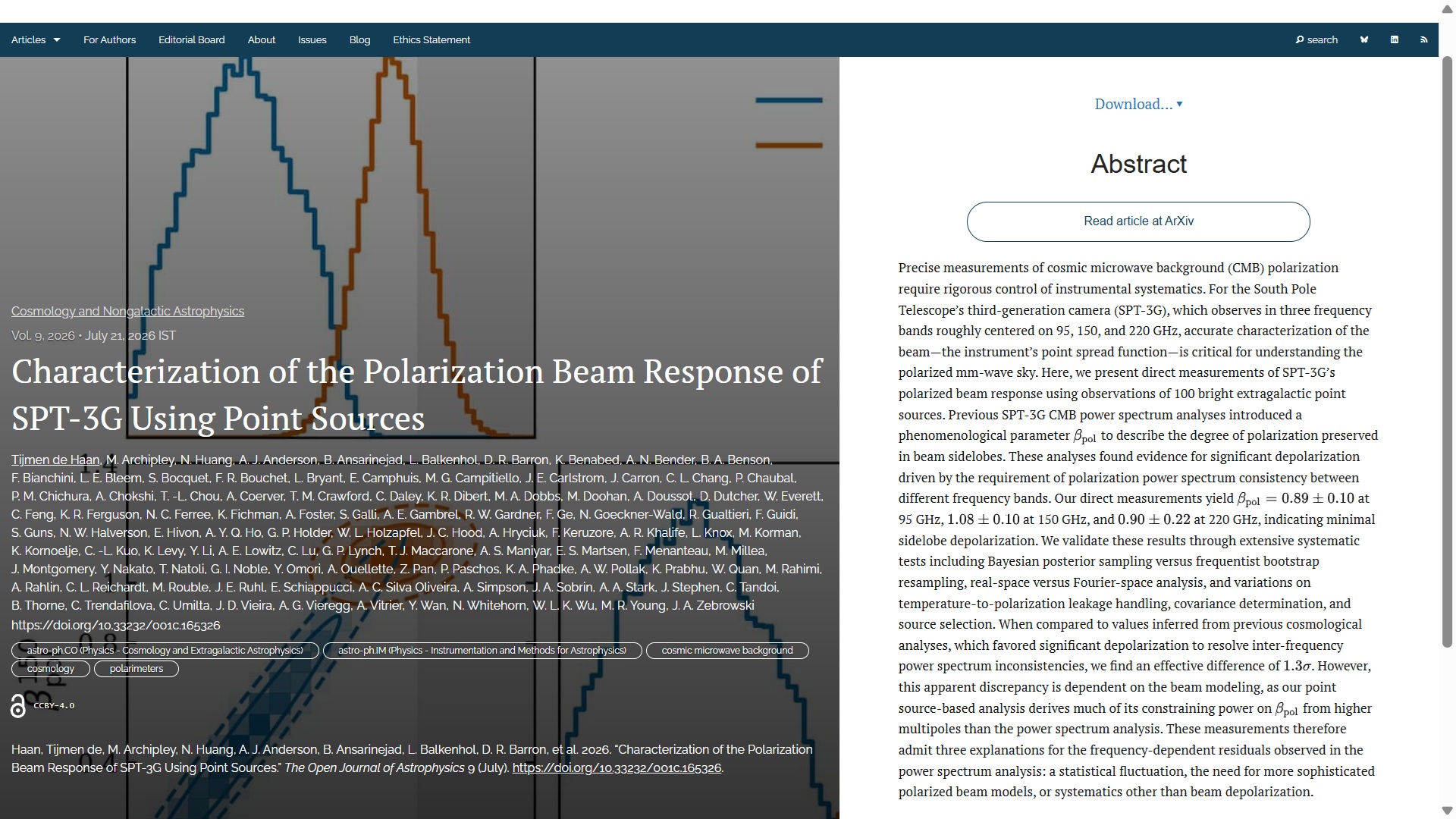
You can find the officially accepted version on arXiv here and the announcement on Fediverse here:

Open Journal of Astrophysics

New Publication at the Open Journal of Astrophysics: "Characterization of the Polarization Beam Response of SPT-3G Using Point Sources" by Tijmen de Haan (Institute of Particle and Nuclear Studies, Ibaraki, Japan) and 101 others from around the world

doi.org/10.33232/001c.165326

July 21, 2026, 7:02 am 1 boosts 1 favorites

The second paper for this week, also published on Tuesday 21st July but in the folder Earth and Planetary Astrophysics is: “Exploring TRAPPIST-1 Climate States with an Energy Balance Model” by Jacob Haqq-Misra (Blue Marble Space, USA). The study uses a modified HEXTOR energy balance model to predict climate states of terrestrial planets orbiting low-mass stars, suggesting partial to complete ice cover for TRAPPIST-1 e and f.Abstractfor Exploring TRAPPIST-1 Climate States with an Energy Balance Model.

The overlay looks like this:
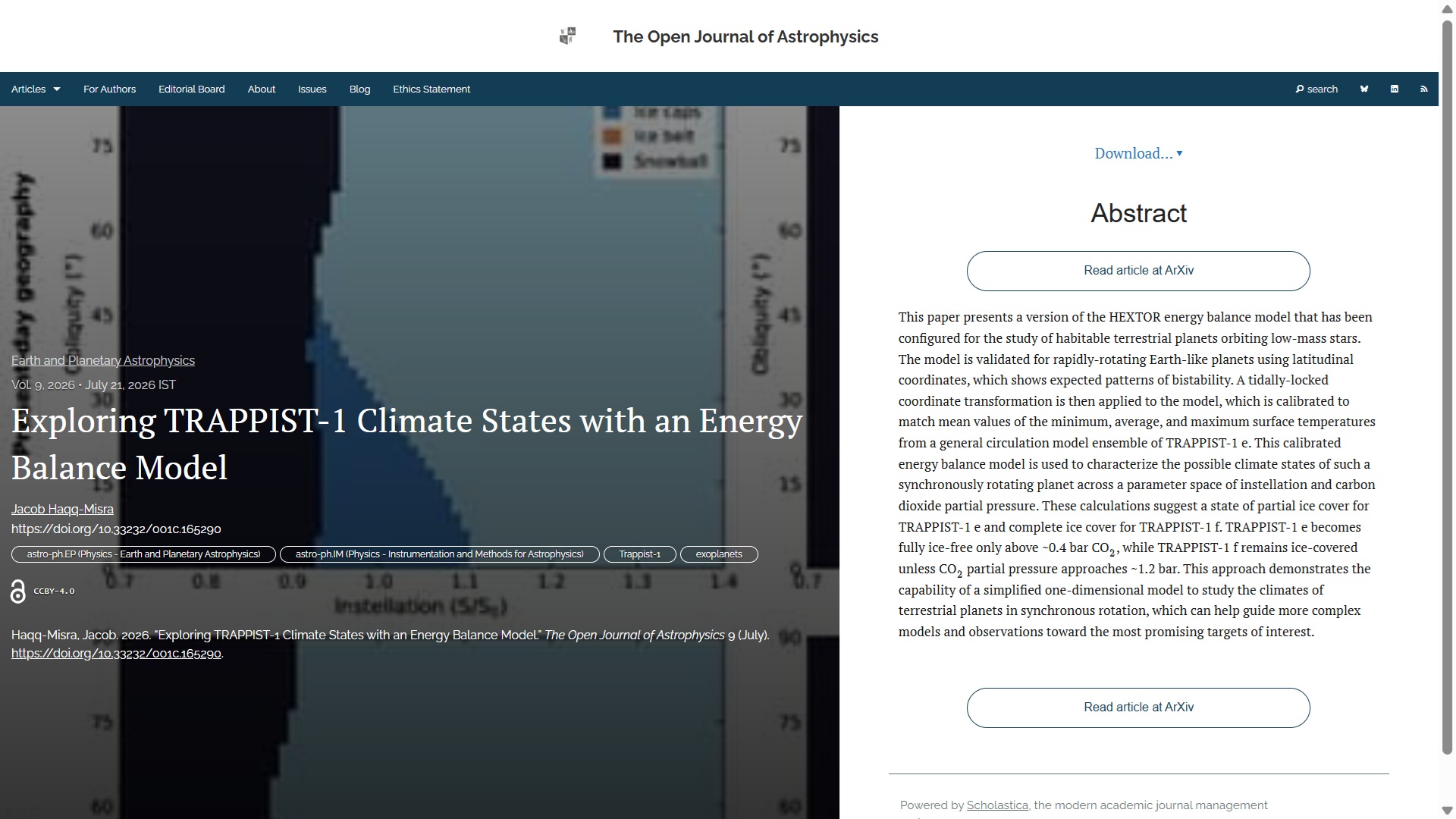
The official version of the paper can be found on arXiv here and the Fediverse announcement here:

Open Journal of Astrophysics

New Publication at the Open Journal of Astrophysics: "Exploring TRAPPIST-1 Climate States with an Energy Balance Model" by Jacob Haqq-Misra (Blue Marble Space, USA)

doi.org/10.33232/001c.165290

July 21, 2026, 7:38 am 2 boosts 1 favorites

The third paper of the week, also published on Tuesday 21st July, but in the folder Astrophysics of Galaxies is “A first systematic study of [OIII] 88μm at z>8: two luminous oxygen lines and a powerful ionized outflow in the first 600 million years” by Hiddo Algera (Institute of Astronomy and Astrophysics, Taipei, Taiwan) and 37 others from all around the world. This paper presents deep observations of four UV-bright, gravitationally lensed galaxies, revealing an ionized outflow in one and highlighting the diagnostic power of [O III]88 μm in studying galaxies in the early Universe.

The overlay for this one is here:
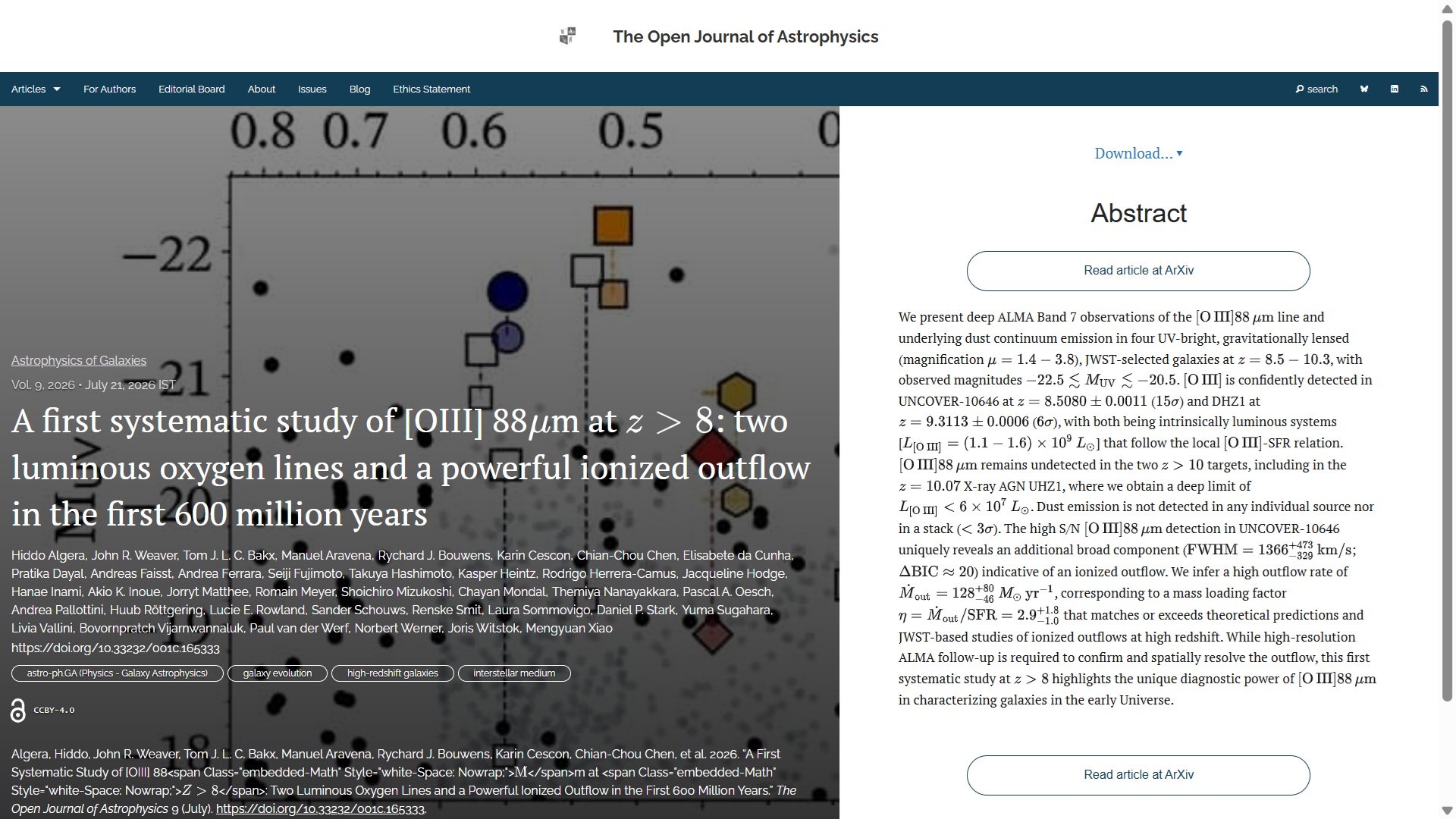
The final, accepted version can be found on arXiv here and the Mastodon announcement is here:

Open Journal of Astrophysics

New Publication at the Open Journal of Astrophysics: "A first systematic study of [OIII] 88μm at z>8: two luminous oxygen lines and a powerful ionized outflow in the first 600 million years" by Hiddo Algera (Institute of Astronomy and Astrophysics, Taipei, Taiwan) and 37 others from all around the world.

doi.org/10.33232/001c.165333

July 21, 2026, 7:52 am 1 boosts 1 favorites

The fourth paper of the week, published on Thursday 23rd July in the folder Astrophysics of Galaxies, is “Mapping CO Ice in a Star-Forming Filament in the 3 kpc Arm with JWST” by Savannah Gramze (U. Florida, USA) and 16 others based all around the world. This paper shows that JWST observations and ALMA Band 3 data reveal that 50-88% of CO gas in a star-forming filament is locked in ice; corrections are needed for mass measurements in such systems.

The overlay for this one is here:
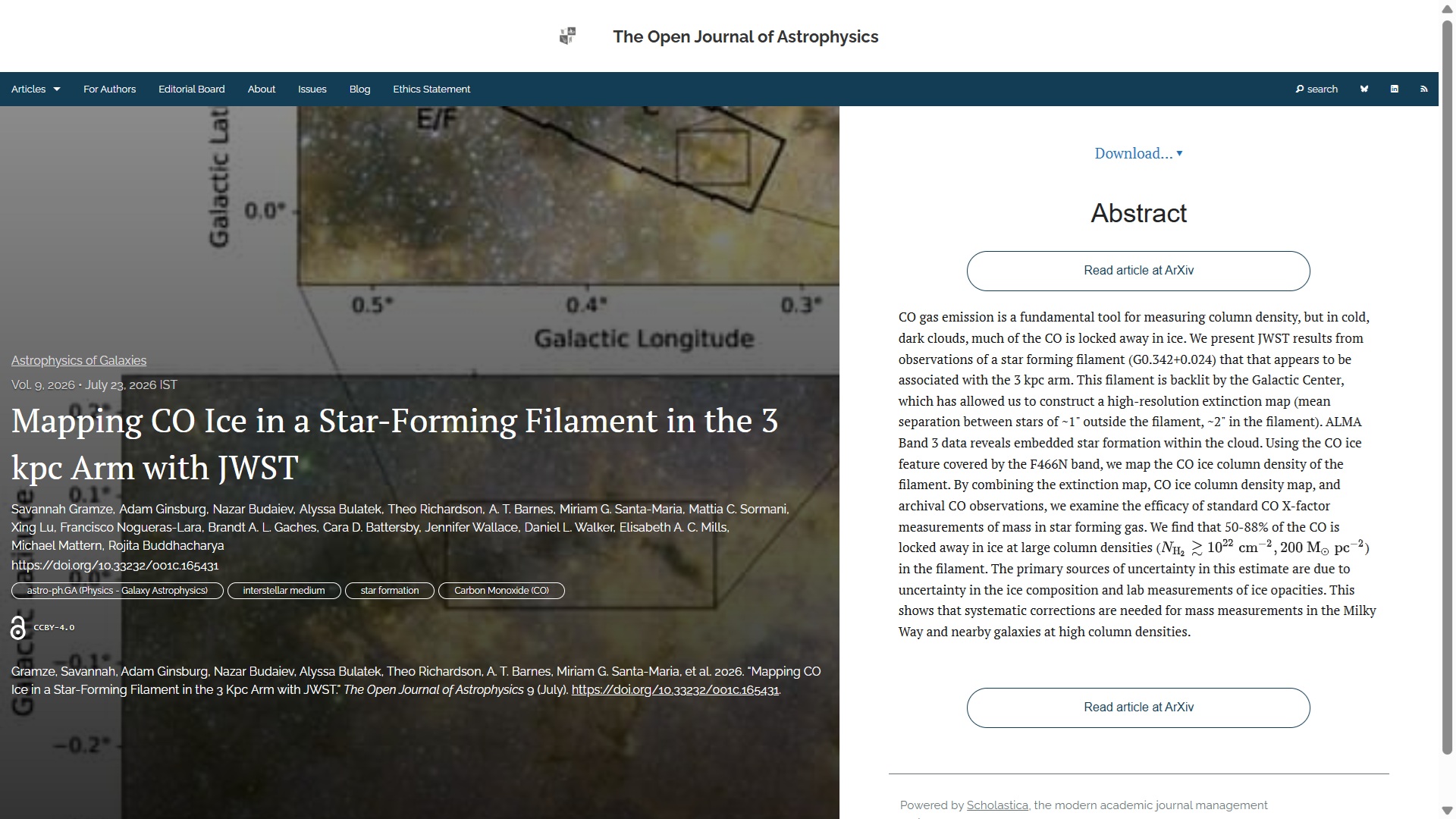
You can read the final version of this one on arXiv here and the Mastodon announcement is here:

Open Journal of Astrophysics

New Publication at the Open Journal of Astrophysics: "Mapping CO Ice in a Star-Forming Filament in the 3 kpc Arm with JWST" by Savannah Gramze (U. Florida, USA) and 16 others based all around the world.

doi.org/10.33232/001c.165431

July 23, 2026, 7:08 am 1 boosts 0 favorites

The fifth paper of the week, also published on Thursday 23rd July but in the folder High-Energy Astrophysical Phenomena, is “Viscously Spreading Accretion Disks around Black Holes: Implications for TDEs, LFBOTs and other Transients“. This article presents a time-dependent model of accretion disks around black holes, explaining late-time emission in tidal disruption events and luminous fast blue optical transients and future detectability of such events.

The overlay for this one is here:
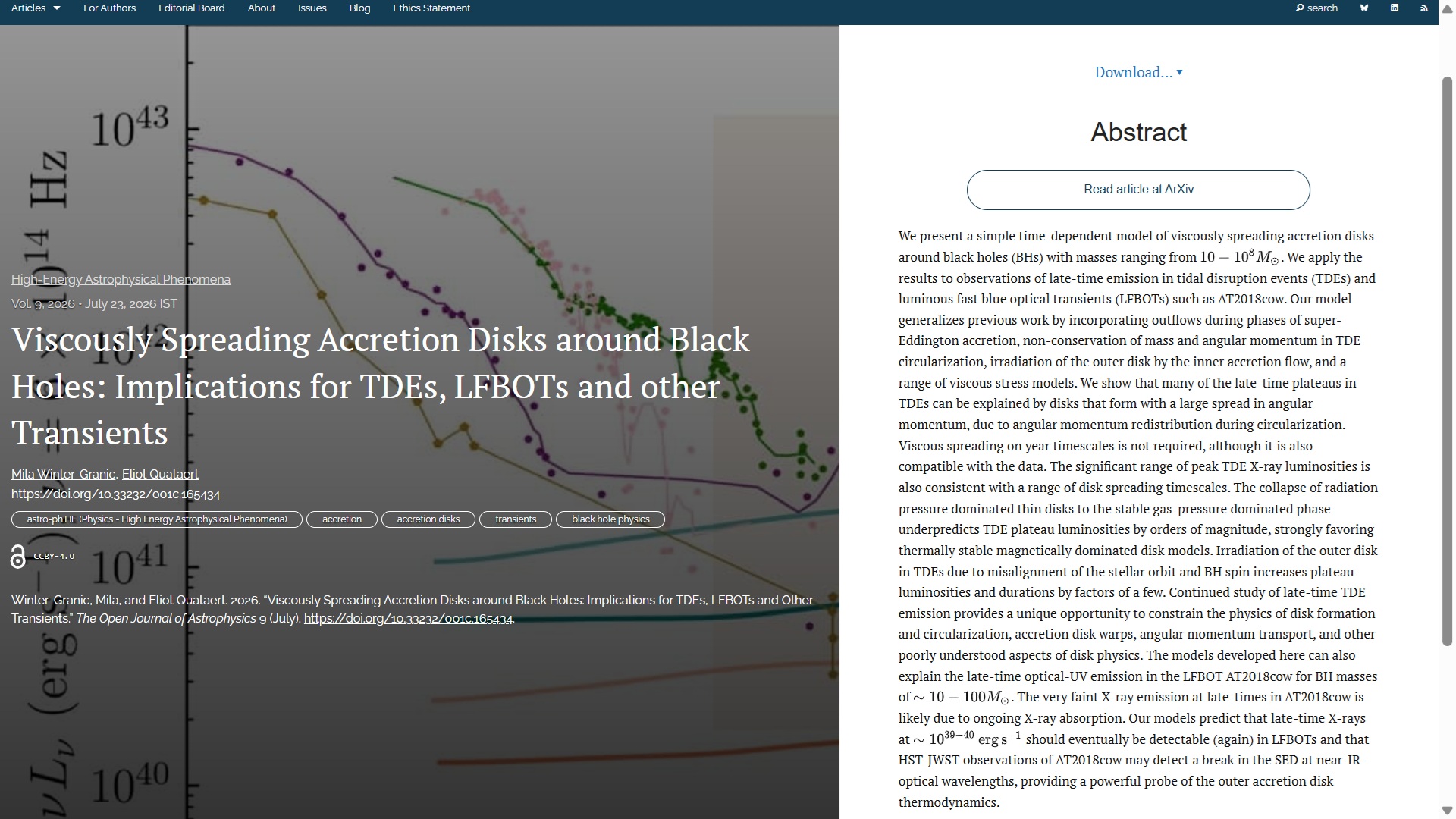
You can read the final version of this one on arXiv here and the Mastodon announcement is here:

Open Journal of Astrophysics

New Publication at the Open Journal of Astrophysics: "Viscously Spreading Accretion Disks around Black Holes: Implications for TDEs, LFBOTs and other Transients" by Mila Winter-Granic and Eliot Quataert (Princeton University, USA)

doi.org/10.33232/001c.165434

July 23, 2026, 7:20 am 1 boosts 0 favorites

The sixth paper of this week is “Characterising the response of an International LOFAR Station” by Letizia Vincetti (Trinity Collge Dublin, Ireland) and 9 others based in Ireland, USA, The Netherlands and Sweden. This was also published on Thursday July 23rd and is in the folder Instrumentation and Methods for Astrophysics. The article presents an investigation of the performance and calibration challenges of phased-array radio interferometers, using the Irish LOFAR station as a case study, highlighting the importance of accurate beam modelling, etc.

The overlay for this one is here:
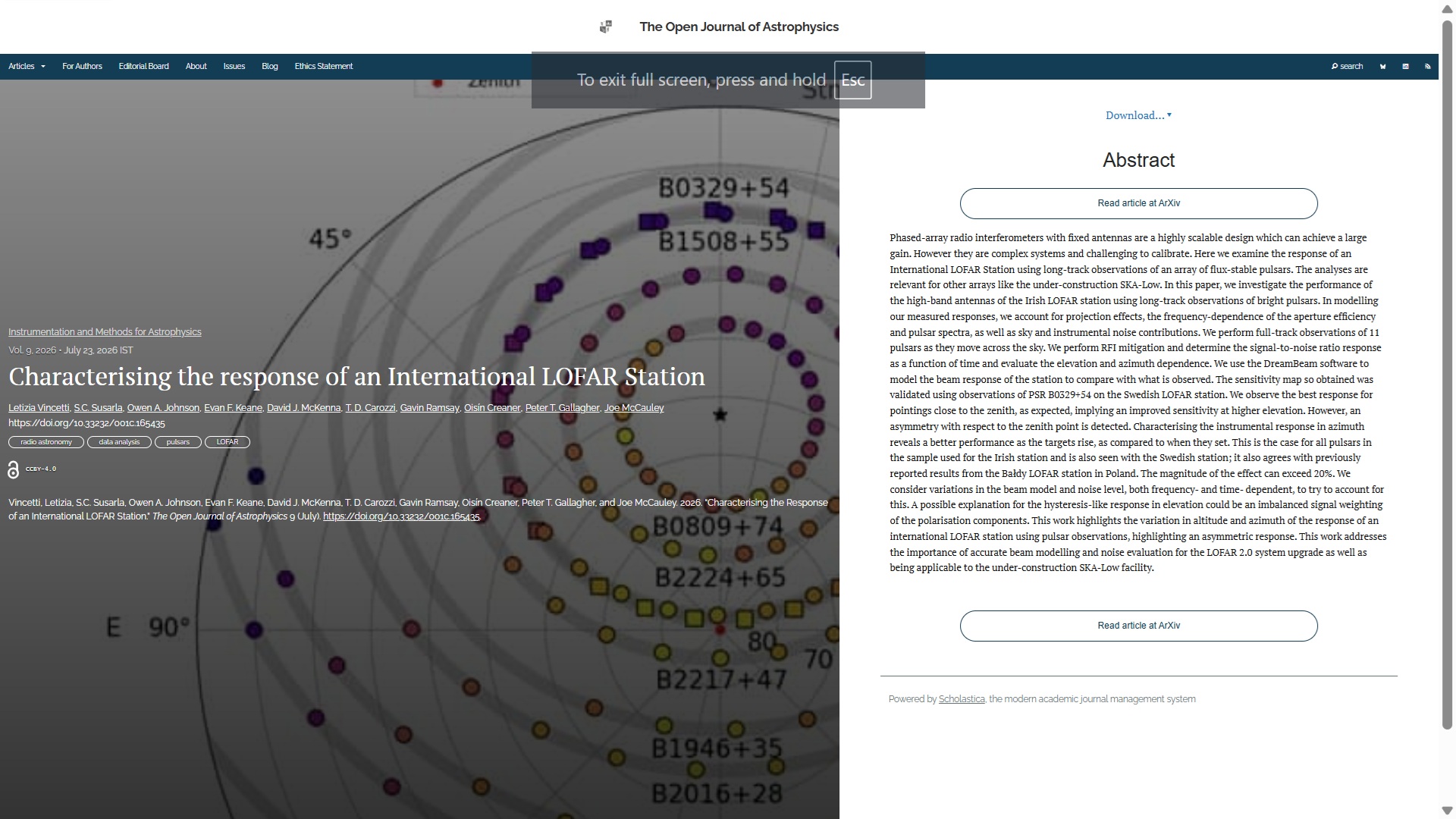
You can find the final accepted version on arXiv here and the Mastodon announcement is here:

Open Journal of Astrophysics

New Publication at the Open Journal of Astrophysics: "Characterising the response of an International LOFAR Station" by Letizia Vincetti (Trinity Collge Dublin, Ireland) and 9 others based in Ireland, USA, The Netherlands and Sweden

doi.org/10.33232/001c.165435

July 23, 2026, 7:34 am 1 boosts 0 favorites

The seventh paper of this week is “Exo Skryer: A JAX-accelerated sub-stellar atmospheric retrieval framework” by Elspeth K.H. Lee (U. Bern, Switzerland). Published on Friday 24th July in the folder Earth and Planetary Astrophysics, this article introduces “Exo Skryer”, a new, efficient framework for exoplanet and brown dwarf atmospheric research, capable of handling large data sets and complex models.

The overlay for this one is here:
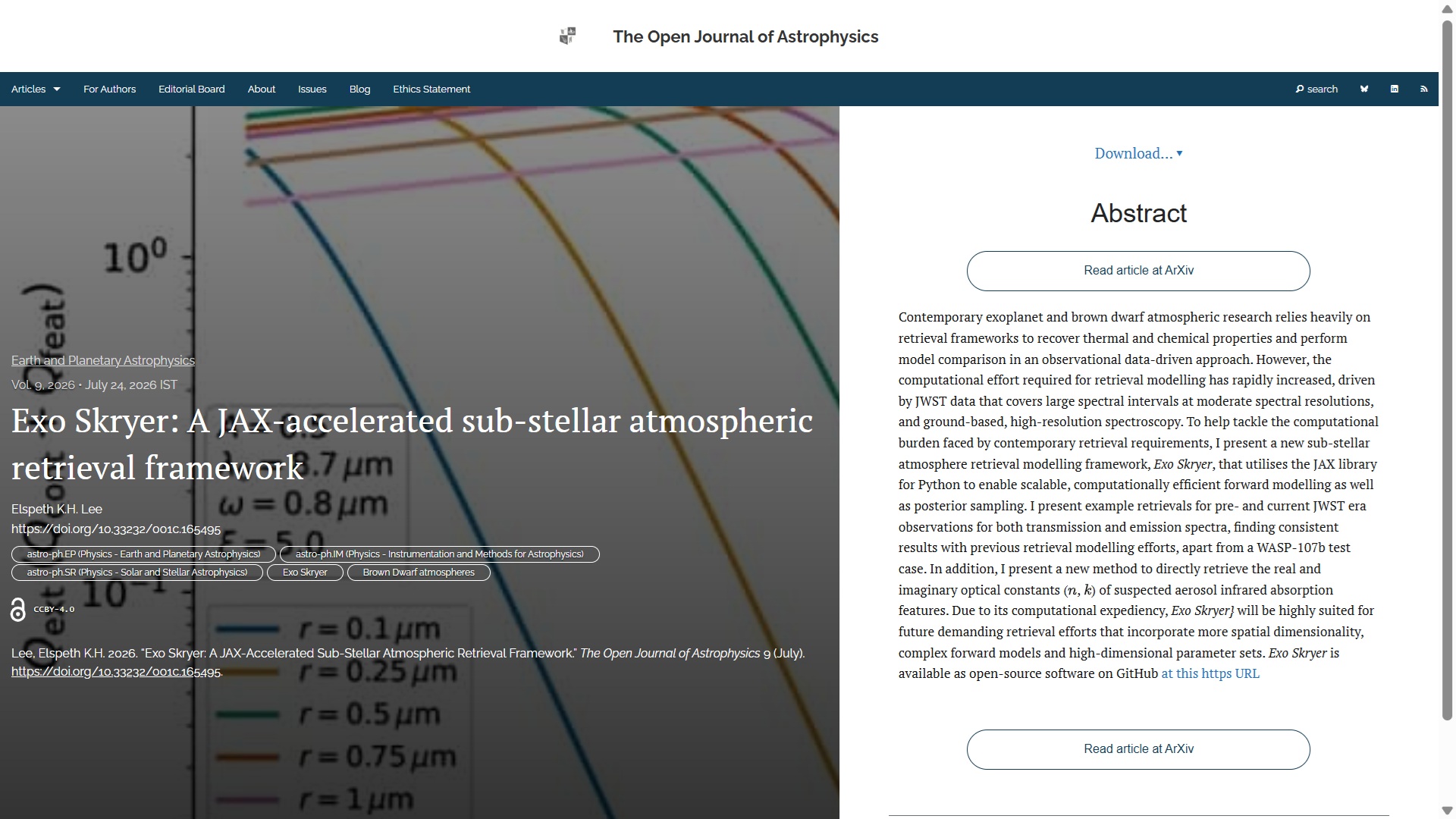
You can find the final accepted version on arXiv here and the Mastodon announcement is here:

Open Journal of Astrophysics

New Publication at the Open Journal of Astrophysics: "Exo Skryer: A JAX-accelerated sub-stellar atmospheric retrieval framework" by Elspeth K.H. Lee (U. Bern, Switzerland)

doi.org/10.33232/001c.165495

July 24, 2026, 8:29 am 0 boosts 1 favorites

The (penultimate) eighth paper of this week is “GCR Spectra Reconstructed with Neutron Monitor Yield Function and Artificial Neural Networks: Comparison of Two Methods” by Stepan A. Siruk (Moscow Engineering Physics Institute MEPhI, Russia) and four others, all based in Russia. Published on Friday 24th July in the folder Instrumentation and Methods for Astrophysics, this article presents a framework using artificial neural networks and neutron monitors to reconstruct cosmic-ray energy spectra, providing data even in the absence of direct satellite observations.

The overlay for this one is here:
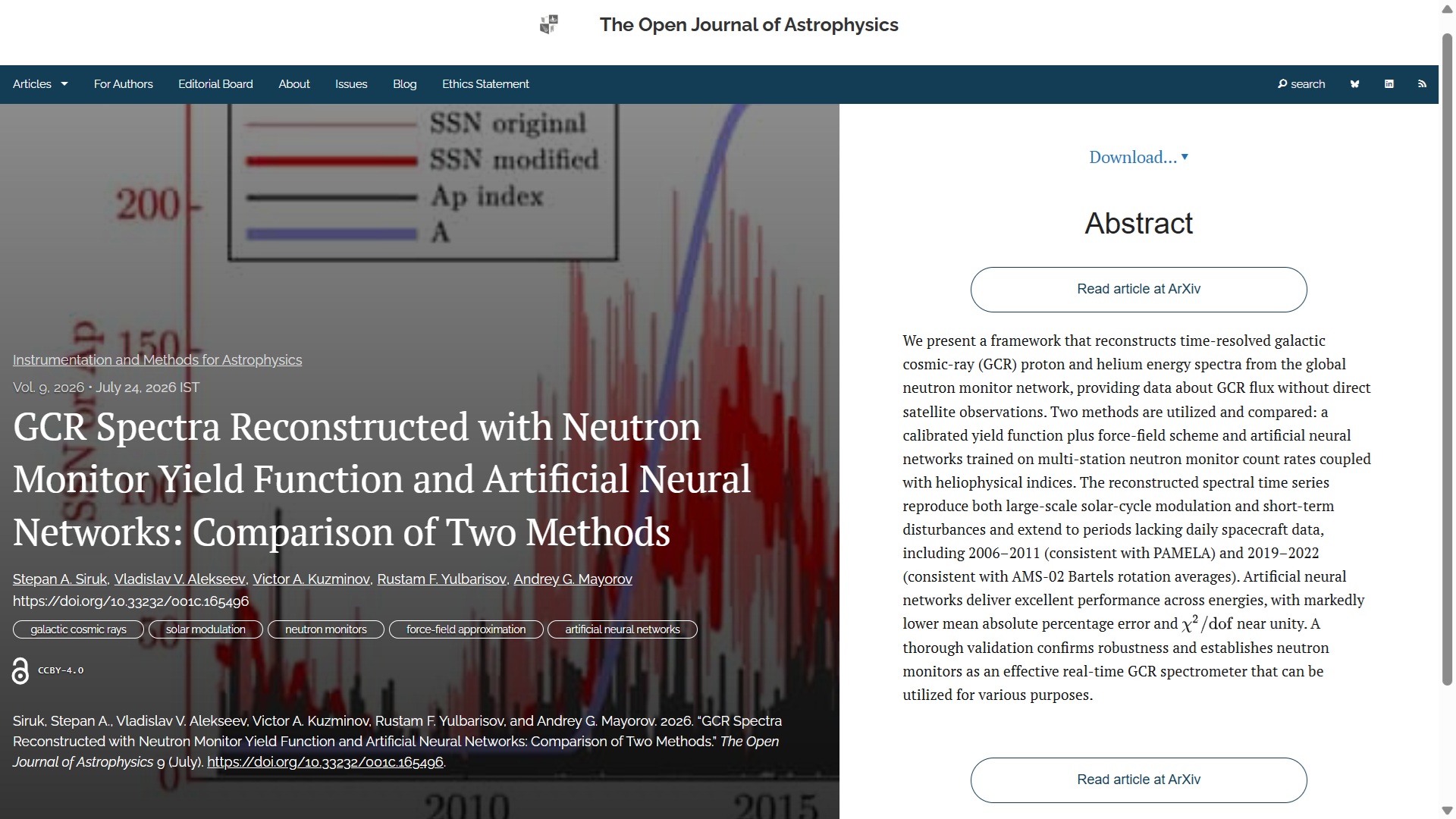
You can find the final accepted version on arXiv here and the Mastodon announcement is here:

Open Journal of Astrophysics

New Publication at the Open Journal of Astrophysics: "GCR Spectra Reconstructed with Neutron Monitor Yield Function and Artificial Neural Networks: Comparison of Two Methods" by Stepan A. Siruk (Moscow Engineering Physics Institute MEPhI, Russia) and four others based in Russia

doi.org/10.33232/001c.165496

July 24, 2026, 8:38 am 1 boosts 2 favorites

And finally for this week we have “The failed failed-supernova scenario of M31-2014-DS1” by Noam Soker (Technion, Israel), a paper which challenges the failed-supernova theory for the fading of the yellow supergiant event M31-2014-DS1, suggesting it requires unlikely parameters and supports an alternative scenario involving violent binary interaction. This was published on Friday 24th July in the folder High-Energy Astrophysical Phenomena.

The overlay for this one is here:
You can find the final accepted version on arXiv here and the Mastodon announcement is here:

Open Journal of Astrophysics

New Publication at the Open Journal of Astrophysics: "The failed failed-supernova scenario of M31-2014-DS1" by Noam Soker (Technion, Israel)

doi.org/10.33232/001c.165498

July 24, 2026, 8:47 am 0 boosts 2 favorites

And that concludes the update of this week’s business. As it was foretold, the total number of publications at OJAp has now passed the 600 mark, and the likely number for 2026 is around 300. We published a paper in five of the six astro-ph categories this week, but still haven’t had a week when we’ve published a full house with at least one in all six…
Weekly Update from the Open Journal of Astrophysics – 23/05/2026

Posted in OJAp Papers, Open Access, The Universe and Stuff with tags , , , , , , , , , , , , , , , , , , , , , , , , , , , , , , , , , , on May 23, 2026 by telescoper

It’s Saturday once again, so time for another update of activity at the Open Journal of Astrophysics. Since the last update we have published a further six papers, bringing the number in Volume 9 (2026) to 110 and the total so far published by OJAp up to 558.

I will continue to include the posts made on our Mastodon account (on Fediscience); these announcements also show the DOI for each paper.

The first paper to report this week, published on Monday 18th May in the folder Instrumentation and Methods for Astrophysics is “Edges In Coadded Images” by Erin Sheldon (Brookhaven National Laboratory, USA). This paper describes a study exploring how image discontinuities and noise impact weak gravitational lensing measurements, finding no significant biases under typical conditions. Biases occur only in extreme cases, but can be mitigated.

The overlay for this paper is here

You can find the officially accepted version on arXiv here and the announcement on Fediverse here:

Open Journal of Astrophysics

New Publication at the Open Journal of Astrophysics: "Edges In Coadded Images" by Erin Sheldon (Brookhaven National Laboratory, USA)

doi.org/10.33232/001c.162176

May 18, 2026, 6:43 am 1 boosts 0 favorites

The second paper for this week, also published on Monday 18th May but in the folder Cosmology and Nongalactic Astrophysics, is “Joint cosmological fits to DESI-DR1 full-shape clustering and weak gravitational lensing in configuration space” by A. Semenaite (Swinburne Institute of Technology, Australia) and 72 other authors from all round the world. This paper presents a cosmological analysis of correlations between the DESI-DR1 Bright Galaxy Survey and Luminous Red Galaxy samples and overlapping shear measurements from various weak lensing surveys.

The overlay for this one is here:

The official version of the paper can be found on arXiv here and the Fediverse announcement here:

Open Journal of Astrophysics

New Publication at the Open Journal of Astrophysics: "Joint cosmological fits to DESI-DR1 full-shape clustering and weak gravitational lensing in configuration space " by A. Semenaite (Swinburne Institute of Technology, Australia) and 72 others from all round the world.

doi.org/10.33232/001c.162334

May 18, 2026, 6:52 am 1 boosts 1 favorites

Next one up, the third paper of the week, and the third published on Monday 18th May, and in the folder Cosmology and Nongalactic Astrophysics is “Probing Dark Energy Microphysics with kSZ Tomography” by Julius Adolff, Selim Hotinli and Neal Dalal (all of the Perimeter Institute, Canada). This paper explores how kinetic Sunyaev-Zel’dovich tomography and galaxy clustering can enhance our understanding of dark energy and its effects, potentially revealing its microphysical properties in future surveys.

The overlay for this one is here:

The final, accepted version can be found on arXiv here and the Mastodon announcement is here:

Open Journal of Astrophysics

New Publication at the Open Journal of Astrophysics: "Probing Dark Energy Microphysics with kSZ Tomography" by Julius Adolff, Selim Hotinli and Neal Dalal (Perimeter Institute, Canada)

doi.org/10.33232/001c.162336

May 18, 2026, 7:04 am 1 boosts 0 favorites

The fourth paper this week, published on Wednesday May 20th is “A Census of Variable Radio Sources at 3 GHz” by Yjan A. Gordon, Peter S. Ferguson, Michael N. Martinez and Eric J. Hooper (all of the University of Wisconsin, USA). This article, published in the folder Astrophysics of Galaxies, uses data from the Very Large Array Sky Survey to analyze variability in the radio sky, finding most changes consistent with blazars and quasars.

The overlay is here:

The officially accepted version can be found on arXiv here and here is the Mastodon announcement:

Open Journal of Astrophysics

New Publication at the Open Journal of Astrophysics: "A Census of Variable Radio Sources at 3 GHz" by Yjan A. Gordon, Peter S. Ferguson, Michael N. Martinez & Eric J. Hooper (U. Wisconsin, USA)

doi.org/10.33232/001c.162407

May 20, 2026, 2:52 pm 0 boosts 2 favorites

The fifth article of this week was published on Friday 22nd May in the folder Instrumentation and Methods for Astrophysics. The title is “Uncovering the Next Galactic Supernova with the Vera C. Rubin Observatory” by John Banovetz (Lawrence Berkeley Lab., USA), Claire-Alice Hebert & Peter B. Denton (Brookhaven National Lab., USA), Dan Scolnic (Duke University, USA), Anze Slosar (Brookhaven) and Chris Walter (Duke). The paper presents a study simulating how effectively the Vera C. Rubin Observatory can localize supernovae using neutrino triggers, finding a 57-97% success rate based on stellar mass density predictions.

The overlay is here:

You can find the authorized version of this paper on arXiv here and the Fediverse announcement is here:

Open Journal of Astrophysics

New Publlication at the Open Journal of Astrophysics: "Uncovering the Next Galactic Supernova with the Vera C. Rubin Observatory" by John Banovetz (Lawrence Berkeley Lab., USA), Claire-Alice Hebert & Peter B. Denton (Brookhaven National Lab., USA) , Dan Scolnic (Duke U., USA) , Anze Slosar (Brookhaven), and Chris Walter (Duke)

doi.org/10.33232/001c.162454

May 22, 2026, 8:31 am 0 boosts 1 favorites

Last, but by no means least, this week we have “Pulsar timing solutions for 17 pulsars at 150 MHz from the Irish LOFAR station” by David J. McKenna (ASTRON, The Netherlands), Evan F. Keane (Trinity College Dublin, Ireland), Peter T. Gallagher (DIAS, Ireland) and Joe McCauley (Trinity). This was published on Friday 22nd May in the folder High-Energy Astrophysical Phenomena. It presents a demonstration of the use of international Low Frequency Array (LOFAR) stations in tracking and characterizing pulsars, providing new insights into these neutron stars’ emission properties.

The overlay for this one is here:

You can find the authorized version of this paper on arXiv here and the Fediverse announcement is here:

Open Journal of Astrophysics

New Publication at the Open Journal of Astrophysics: "Pulsar timing solutions for 17 pulsars at 150 MHz from the Irish LOFAR station" by David J. McKenna (ASTRON, The Netherlands), Evan F. Keane (Trinity College Dublin, Ireland), Peter T. Gallagher (DIAS, Ireland) and Joe McCauley (Trinity)

doi.org/10.33232/001c.162455

May 22, 2026, 8:59 am 0 boosts 0 favorites

And that concludes this week’s update. I’ll do another one next Saturday.

Weekly Update from the Open Journal of Astrophysics – 04/04/2026

Posted in OJAp Papers, Open Access, The Universe and Stuff with tags , , , , , , , , , , , , , , , , , , , , , on April 4, 2026 by telescoper

It may be the Easter weekend, but it’s still time for a Saturday morning update of activity at the Open Journal of Astrophysics. Since the last update we have published a further four papers, bringing the number in Volume 9 (2026) to 71 and the total so far published by OJAp up to 519. This update coimpletes the first quarter of 2026, which suggests that if we continue to publish at the same rate we’ll reach about 280 for the year.

I will continue to include the posts made on our Mastodon account (on Fediscience) to encourage you to visit it. Mastodon is a really excellent service, and a more than adequate replacement for X/Twitter (which nobody should be using); these announcements also show the DOI for each paper.

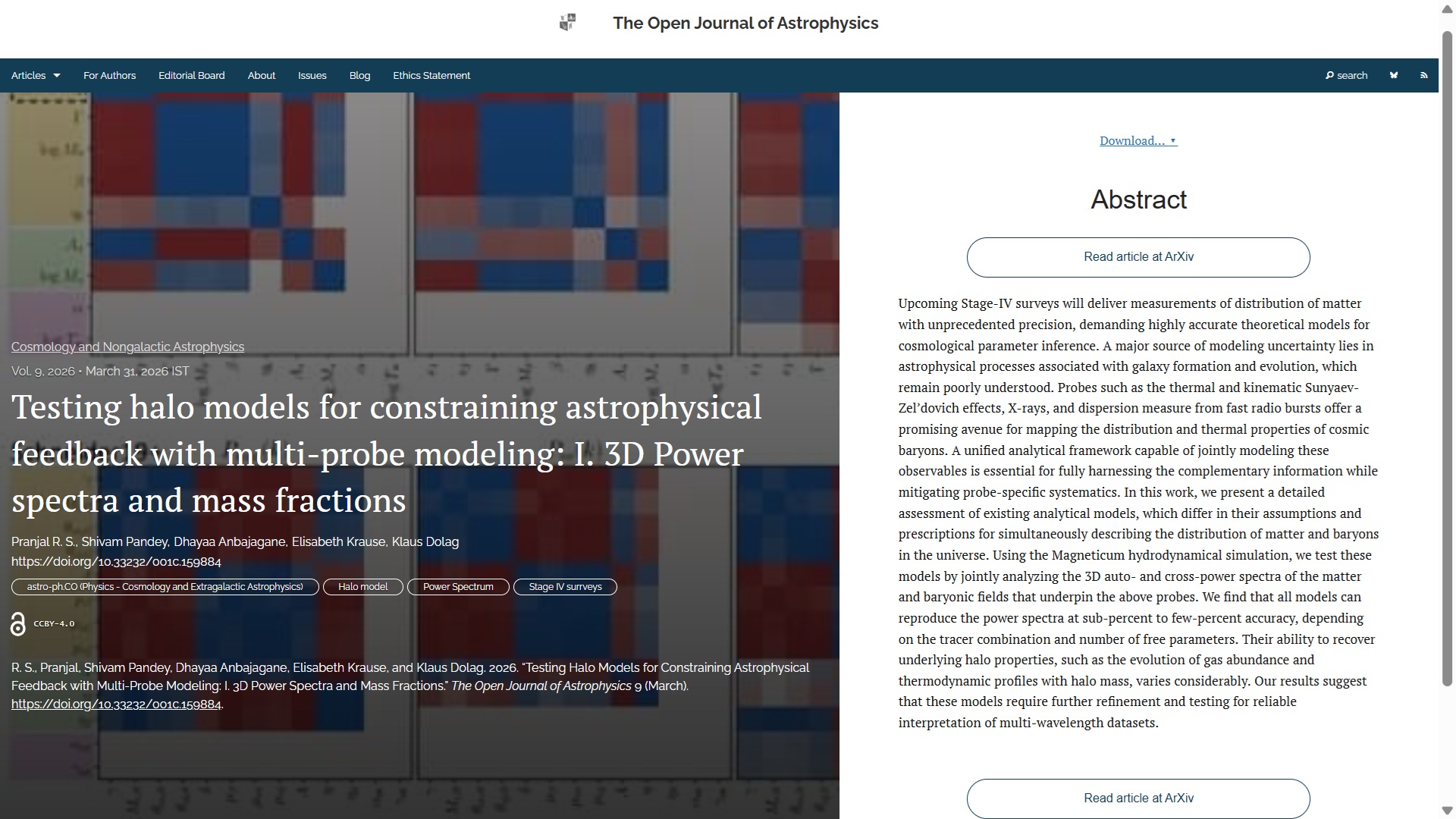
The first paper to report this week is “Testing halo models for constraining astrophysical feedback with multi-probe modeling: I. 3D Power spectra and mass fractions” by Pranjal R. S. (U. Arizona, USA), Shivam Pandey Johns Hopkins U., USA), Dhayaa Anbajagane (U. Chicago, USA), Elisabeth Krause (U. Arizona) and Klaus Dolag (Max Planck Institute for Astrophysics, Germany). This paper was published on Tuesday March 31st in the folder Cosmology and Nongalactic Astrophysics.

The overlay is here:

You can find the officially accepted version on arXiv here and the announcement on Fediverse here:

Open Journal of Astrophysics

New Publication at the Open Journal of Astrophysics: "Testing halo models for constraining astrophysical feedback with multi-probe modeling: I. 3D Power spectra and mass fractions" by Pranjal R. S. (U. Arizona, USA), Shivam Pandey Johns Hopkins U., USA), Dhayaa Anbajagane (U. Chicago, USA), Elisabeth Krause (U. Arizona) and Klaus Dolag (Max Planck Institute for Astrophysics, Germany)

doi.org/10.33232/001c.159884

March 31, 2026, 6:09 am 1 boosts 0 favorites

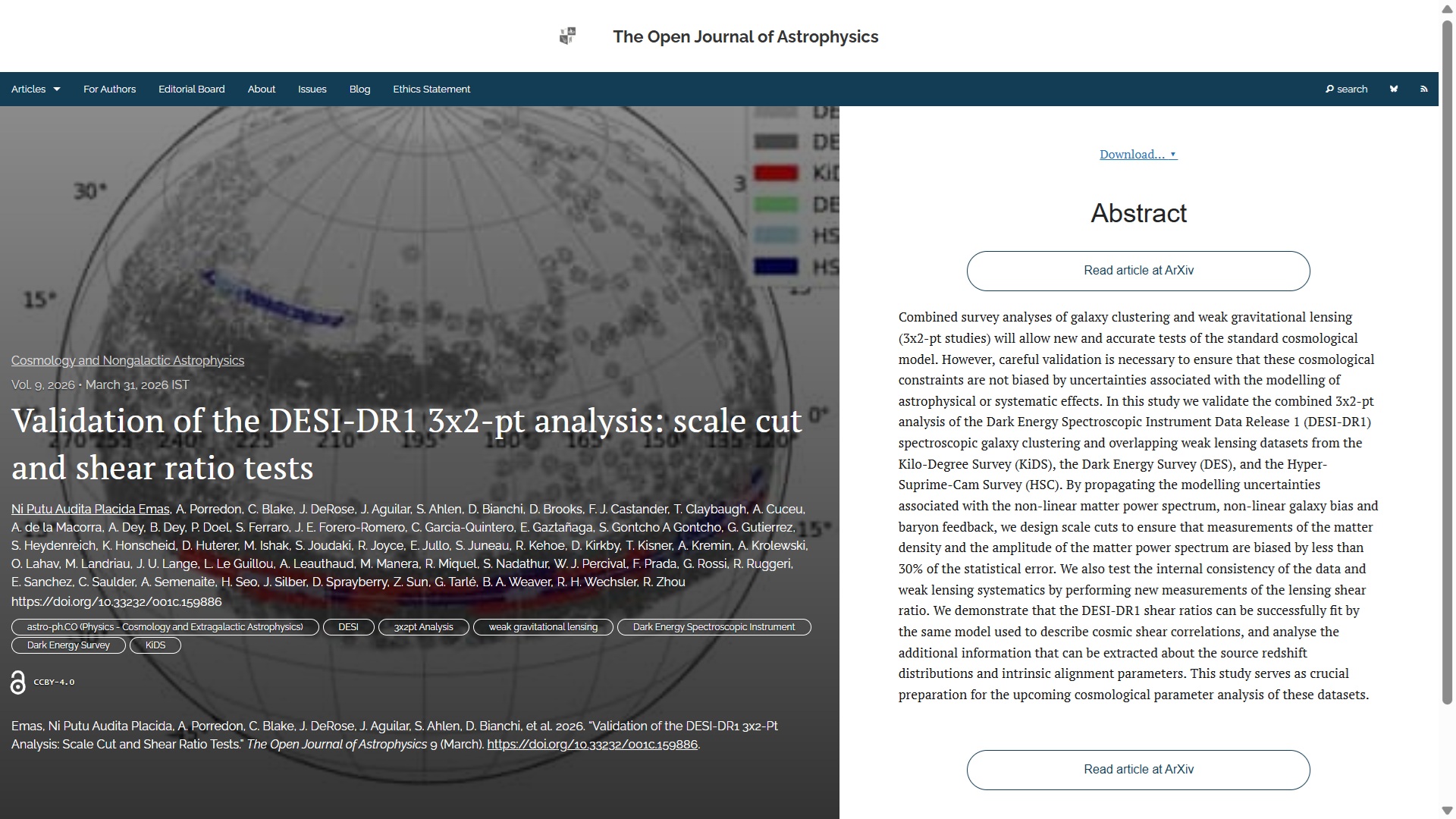
The second paper for this week, also published on Tuesday March 31st in the folder Cosmology and Nongalactic Astrophysics, is “Validation of the DESI-DR1 3×2-pt analysis: scale cut and shear ratio tests” by Ni Putu Audita Placida Emas (Swinburne University of Technology, Australia) and an international cast of 56 others. This study validates the combined analysis of galaxy clustering and weak gravitational lensing data from various surveys, ensuring accurate tests of the standard cosmological model using future Stage-IV surveys

The overlay for this one is here:

The official version of the paper can be found on arXiv here and the Fediverse announcement here:

Open Journal of Astrophysics

New Publication at the Open Journal of Astrophysics: "Validation of the DESI-DR1 3×2-pt analysis: scale cut and shear ratio tests" by Ni Putu Audita Placida Emas (Swinburne University of Technology, Australia) and an international cast of 56 others.

doi.org/10.33232/001c.159886

March 31, 2026, 6:23 am 2 boosts 2 favorites

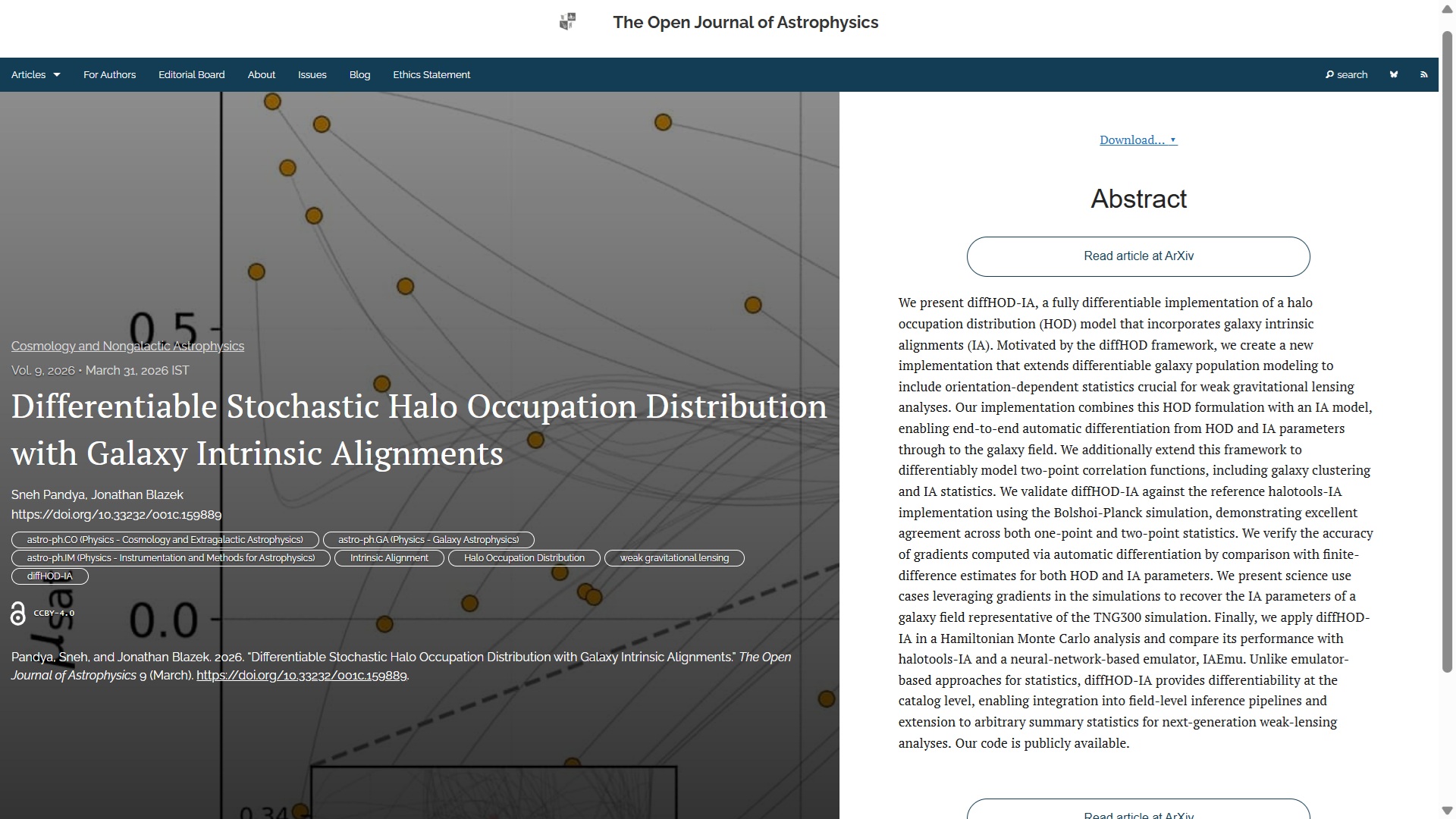
Next one up, the third paper of the week, also published on Tuesday March 31st in the folder Cosmology and Nongalactic Astrophysics, is “Differentiable Stochastic Halo Occupation Distribution with Galaxy Intrinsic Alignments” by Sneh Pandya and Jonathan Blazek (both of Northeastern University, USA). This is a paper introducing diffHOD-IA, a differentiable model for galaxy population analysis that incorporates intrinsic alignments and halo occupation distribution. It’s validated against existing models and can be used in next-generation weak-lensing analyses.

The overlay for this one is here:

The final, accepted version can be found on arXiv here and the Mastodon announcement is here:

Open Journal of Astrophysics

New Publication at the Open Journal of Astrophysics: "Differentiable Stochastic Halo Occupation Distribution with Galaxy Intrinsic Alignments" by Sneh Pandya and Jonathan Blazek (Northeastern U., USA)

doi.org/10.33232/001c.159889

March 31, 2026, 6:36 am 1 boosts 0 favorites

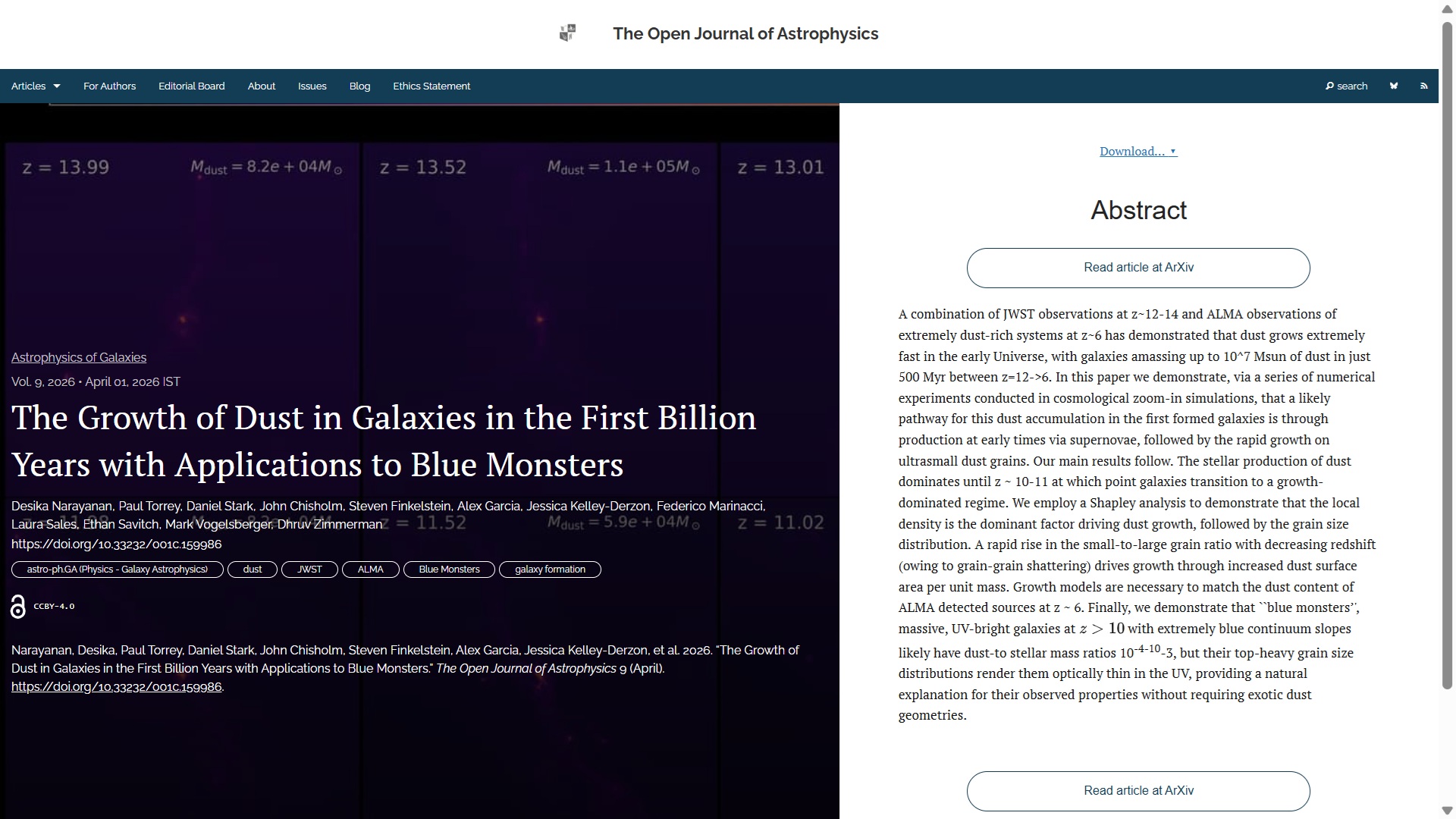
The fourth and final paper this week, published on Wednesday April 1st (but not a joke), is “The Growth of Dust in Galaxies in the First Billion Years with Applications to Blue Monsters” by Desika Narayanan (U. Florida, USA) and 11 others based in the USA and Europe. This one is in the folder Astrophysics of Galaxies; it presents a simulation-based study of dust accumulation in early galaxies via supernovae production and rapid growth on tiny dust grains, with local density and grain size being important factors.

The overlay is here:

The finally accepted version of this paper can be found here and the Mastodon announcement is here:

Open Journal of Astrophysics

New Publication at the Open Journal of Astrophysics: "The Growth of Dust in Galaxies in the First Billion Years with Applications to Blue Monsters" by Desika Narayanan (U. Florida, USA) and 11 others based in the USA and Europe.

doi.org/10.33232/001c.159986

April 1, 2026, 6:57 am 1 boosts 0 favorites

And that concludes the update for this week. I’ll do another next week, but I’m expecting a fairly low number of papers owing to the Easter vacation.

Weekly Update from the Open Journal of Astrophysics – 28/03/2026

Posted in OJAp Papers, Open Access, The Universe and Stuff with tags , , , , , , , , , , , , , , , , , , , , , , , , , , , , , , , on March 28, 2026 by telescoper

Once again it’s time for the usual Saturday morning update of activity at the Open Journal of Astrophysics. Since the last update we have published a further eight papers, bringing the number in Volume 9 (2026) to 67 and the total so far published by OJAp up to 515.

I will continue to include the posts made on our Mastodon account (on Fediscience) to encourage you to visit it. Mastodon is a really excellent service, and a more than adequate replacement for X/Twitter (which nobody should be using); these announcements also show the DOI for each paper.

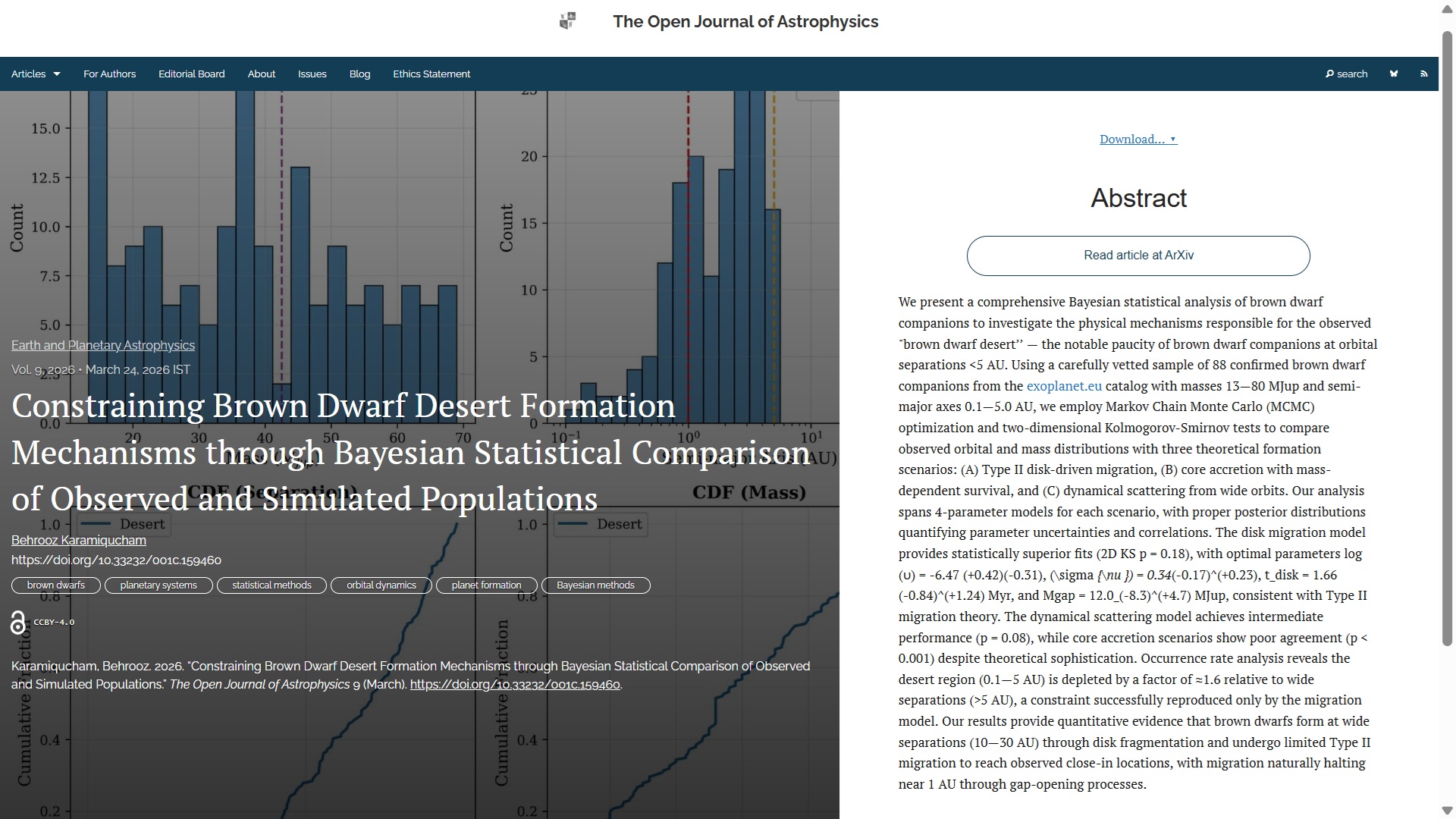
The first paper to report this week is”Constraining Brown Dwarf Desert Formation Mechanisms through Bayesian Statistical Comparison of Observed and Simulated Populations” by Behrooz Karamiqucham (College of Charleston, USA). This paper was published on Tuesday March 24th in the folder Earth and Planetary Astrophysics. It presents a Bayesian statistical analysis exploring why brown dwarf companions are rarely found at orbital separations <5 AU. The results suggest that brown dwarfs form at wider separations then migrate.

The overlay is here:

You can find the officially accepted version on arXiv here and the announcement on Fediverse here:

Open Journal of Astrophysics

New Publication at the Open Journal of Astrophysics: "Constraining Brown Dwarf Desert Formation Mechanisms through Bayesian Statistical Comparison of Observed and Simulated Populations" by Behrooz Karamiqucham (College of Charleston, USA)

doi.org/10.33232/001c.159460

March 24, 2026, 7:10 am 1 boosts 1 favorites

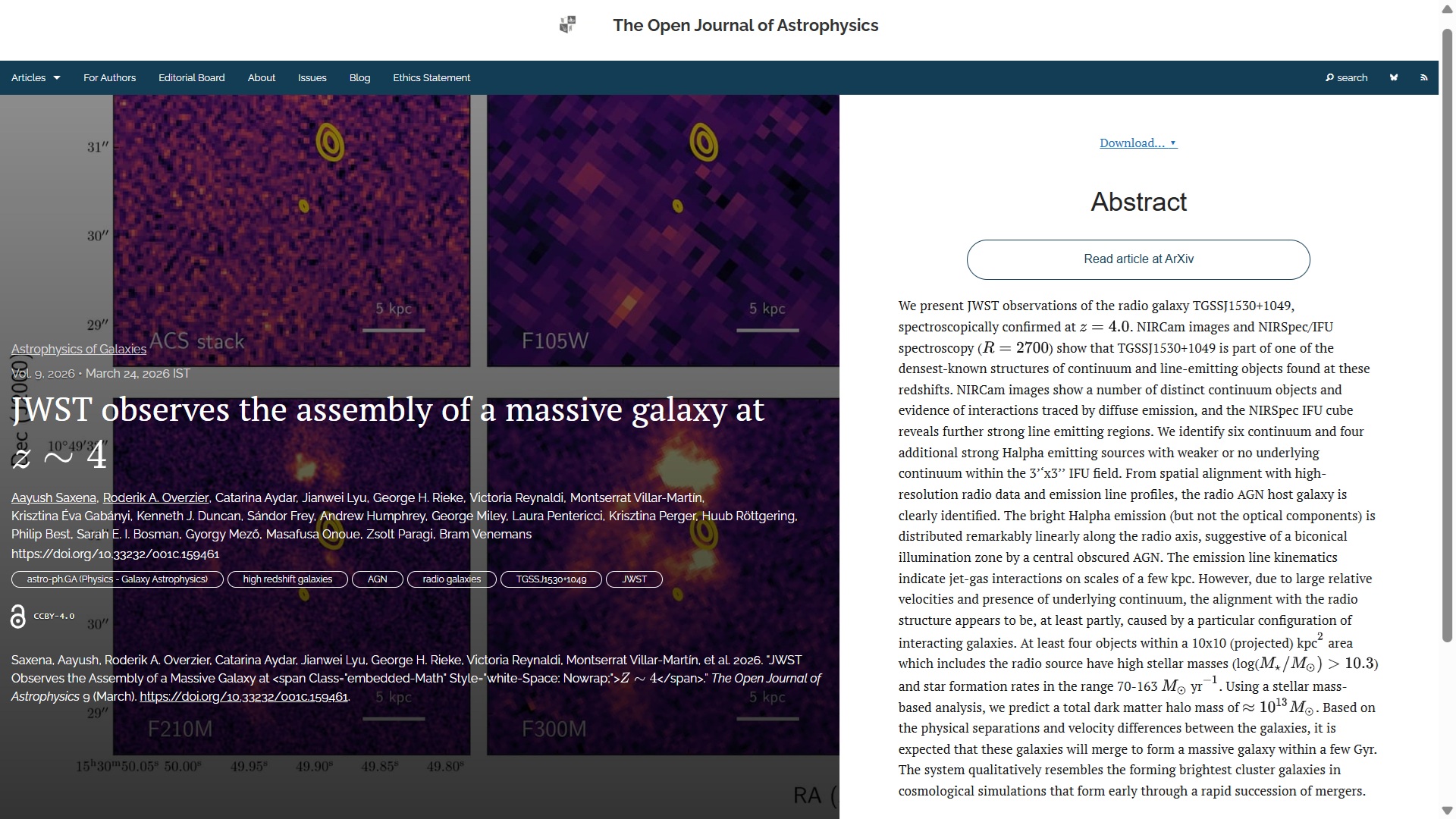
The second paper for this week, also published on Tuesday March 24th, but in the folder Astrophysics of Galaxies, is “JWST observes the assembly of a massive galaxy at z ~ 4” by Aayush Saxena (University of Oxford, UK) and 20 others (based in the UK, Europe, USA, Brazil, Japan and China). The paper presents observations of radio galaxy TGSSJ1530+1049, revealing it as part of a dense structure of emitting objects likely to merge to form a massive galaxy within a few Gyr.

The overlay for this one is here:

The official version of the paper can be found on arXiv here and the Fediverse announcement here:

Open Journal of Astrophysics

New Publication at the Open Journal of Astrophysics: "JWST observes the assembly of a massive galaxy at z ~ 4" by Aayush Saxena (University of Oxford, UK) and 20 others (based in the UK, Europe, USA, Brazil, Japan and China)

doi.org/10.33232/001c.159461

March 24, 2026, 7:25 am 1 boosts 1 favorites

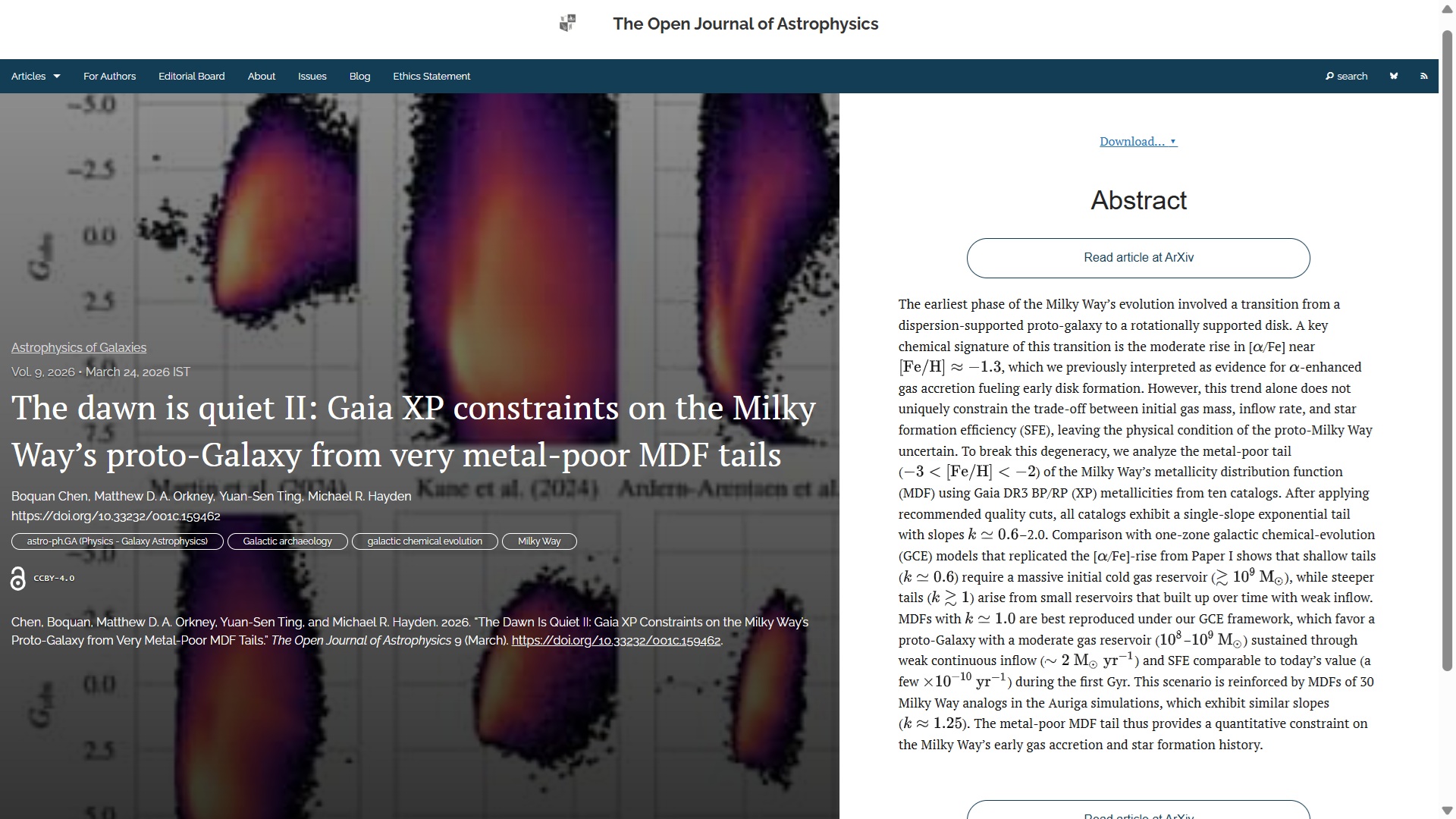
Next one up, the third paper of the week, also published on Tuesday March 24th in the folder Astrophysics of Galaxies, is “The dawn is quiet II: Gaia XP constraints on the Milky Way’s proto-Galaxy from very metal-poor MDF tails” by Boquan Chen (Ohio State U., USA), Matthew D. A. Orkney (Universitat de Barcelona, Spain), Yuan-Sen Ting (Ohio State U.) & Michael R. Hayden (U. Oklahoma, USA). The paper aegues that the Milky Way’s metallicity distribution suggests that its early evolution involved a moderate gas reservoir, sustained by weak continuous inflow, and star formation efficiency similar to the present value.

The overlay for this one is here:

The final, accepted version can be found on arXiv here and the Mastodon announcement is here:

Open Journal of Astrophysics

New Publication at the Open Journal of Astrophysics: "The dawn is quiet II: Gaia XP constraints on the Milky Way’s proto-Galaxy from very metal-poor MDF tails" by Boquan Chen (Ohio State U., USA), Matthew D. A. Orkney (Universitat de Barcelona, Spain), Yuan-Sen Ting (Ohio State U.) & Michael R. Hayden (U. Oklahoma, USA)

doi.org/10.33232/001c.159462

March 24, 2026, 7:41 am 1 boosts 1 favorites

The fourth paper this week, published on Wednesday 25th March 2026 in the folder High-Energy Astrophysical Phenomena is “Shaping the diffuse X-ray sky: Structure, Variability and Visibility” by Philipp Girichidis (Heidelberg U., Germany) and 7 others based in Germany, USA, Austria and Italy. The paper argues that the X-ray properties of the Local Bubble (LB), a low-density cavity in the solar neighborhood reveal that supernova events significantly influence X-ray emissions, which show pronounced temporal variability

The overlay is here:

The finally accepted version of this paper can be found here and the Mastodon announcement is here:

Open Journal of Astrophysics

New Publication at the Open Journal of Astrophysics: "Shaping the diffuse X-ray sky: Structure, Variability and Visibility" by Philipp Girichidis (Heidelberg U., Germany) and 7 others based in Germany, USA, Austria and Italy

doi.org/10.33232/001c.159505

March 25, 2026, 8:40 am 1 boosts 0 favorites

The fifth paper this week, also published on Wednesday 25th March 2026, is “Graph-Based Light-Curve Features for Robust Transient Classification” by Jesús D. Petro-Ramos David J. Ruiz-Morales, David Sierra Porta (Universidad Tecnológica de Bolívar, Colombia). This paper, which is in the folder Instrumentation and Methods for Astrophysics, uses graph-based representations of astronomical light curves for transient classification, achieving competitive multiclass performance, highlighting the potential of visibility graphs as a survey-agnostic tool for classifying time series.

This is the overlay:

The officially accepted version can be found on arXiv here and the Mastodon announcement follows:

Open Journal of Astrophysics

New Publication at the Open Journal of Astrophysics: "Graph-Based Light-Curve Features for Robust Transient Classification" by Jesús D. Petro-Ramos David J. Ruiz-Morales, David Sierra Porta (Universidad Tecnológica de Bolívar, Colombia)

doi.org/10.33232/001c.159506

March 25, 2026, 8:57 am 1 boosts 1 favorites

The sixth paper this week is “Redshift-Frame Systematics and Their Impact on the Hubble Constant from Pantheon+ Supernovae” by Said Laaroua (Santa Rosa Junior College, USA)This was published on Thursday 26th March in the folder Cosmology and Nongalactic Astrophysics. The study analyzes redshift-frame transformations in the Pantheon+ Type Ia supernova sample, finding a negligible shift in the Hubble constant, thus limiting redshift-frame systematics.

The overlay is here:

The officially accepted version of this paper can be found on arXiv here, and the Mastodon announcement is here:

Open Journal of Astrophysics

New Publication at the Open Journal of Astrophysics: "Redshift-Frame Systematics and Their Impact on the Hubble Constant from Pantheon+ Supernovae" by Said Laaroua (Santa Rosa Junior College, USA)

doi.org/10.33232/001c.159558

March 26, 2026, 7:22 am 1 boosts 0 favorites

The penultimate, that is to say the seventh, paper for this week is “Why Machine Learning Models Systematically Underestimate Extreme Values II: How to Fix It with LatentNN” by Yuan-Sen Ting (Ohio State University, USA). The paper introduces LatentNN, a method that reduces attenuation bias in neural networks by optimizing network parameters and latent input values, improving inference in low signal-to-noise astronomical data; the code is available here. This article was published on Thursday 26th March 2026 in the folder Instrumentation and Methods for Astrophysics

The overlay for this one is here:

The official version of this paper can be found here. This is the Mastodon announcement:

Open Journal of Astrophysics

New Publication at the Open Journal of Astrophysics: "Why Machine Learning Models Systematically Underestimate Extreme Values II: How to Fix It with LatentNN" by Yuan-Sen Ting (Ohio State University, USA)

doi.org/10.33232/001c.159559

March 26, 2026, 7:36 am 2 boosts 1 favorites

And finally for this week, published yesterday (Friday 27th March 2026) in the folder Astrophysics of Galaxies, we have “Catalog of Mock Stellar Streams in Milky Way-Like Galaxies” by Colin Holm-Hansen, Yingtian Chen and Oleg Y. Gnedin (University of Michigan, USA).

Here is the overlay for this one:

The officially accepted version can be found on arXiv here and the Mastodon announcement is here:

Open Journal of Astrophysics

New Publication at the Open Journal of Astrophysics: "Catalog of Mock Stellar Streams in Milky Way-Like Galaxies" by Colin Holm-Hansen, Yingtian Chen and Oleg Y. Gnedin (University of Michigan, USA)

doi.org/10.33232/001c.159598

March 27, 2026, 8:44 am 1 boosts 1 favorites

And that concludes the update for this week.

You will have observed that this week’s papers cover five of the six main categories on astro-ph. We haven’t yet managed to cover all six in a week – we only missed Solar and Stellar Astrophysics this time!

Weekly Update from the Open Journal of Astrophysics – 14/03/2026

Posted in OJAp Papers, Open Access, The Universe and Stuff with tags , , , , , , , , , , , , , , , , , , , , on March 14, 2026 by telescoper

It’s Saturday once more, so it’s time for another update of activity at the Open Journal of Astrophysics. Since the last update we have published a further four papers, bringing the number in Volume 9 (2026) to 51 and the total so far published by OJAp up to 499. I hoped we would reach 500 this week, but that milestone will have to wait. We have however passed the 50 mark for this year, so we have now published more papers so far in 2026 than we published in all of 2023.

I will continue to include the posts made on our Mastodon account (on Fediscience) to encourage you to visit it. Mastodon is a really excellent service, and a more than adequate replacement for X/Twitter (which nobody should be using); these announcements also show the DOI for each paper.

The first paper to report this week is “Effect of temperature on the structure of porous dust aggregates formed by coagulation” by Lucas Kolanz, Davide Lazzati and Job Guidos (Oregon State University, USA). This study uses 3D simulations to examine how temperature and monomer size distribution affect the structure of dust formed in supernovae at high redshift. It was published on Monday March 9th in the folder Astrophysics of Galaxies.

The overlay is here:

You can find the officially accepted version on arXiv here and the announcement on Fediverse here:

Open Journal of Astrophysics

New Publication at the Open Journal of Astrophysics: "Effect of temperature on the structure of porous dust aggregates formed by coagulation" by Lucas Kolanz, Davide Lazzati and Job Guidos (Oregon State University, USA)

doi.org/10.33232/001c.158771

March 9, 2026, 8:16 am 2 boosts 0 favorites

The second paper for this week is “Intrinsic alignment of disks and ellipticals across hydrodynamical simulations” by M. L. van Heukelum and N. E. Chisari (Utrecht University, The Netherlands). This is one of two papers published on Tuesday 10th March. This one is in the folder Astrophysics of Galaxies: it examines the inconsistent correlations between galaxy positions and shapes, comparing disk and elliptical shapes in different simulations. The results highlight the importance of sub-grid physics at non-linear scales.

The overlay for this one is here:

The official version of the paper can be found on arXiv here and the Fediverse announcement here:

Open Journal of Astrophysics

New Publication at the Open Journal of Astrophysics: "Intrinsic alignment of disks and ellipticals across hydrodynamical simulations" by M. L. van Heukelum and N. E. Chisari (Utrecht University, The Netherlands)

doi.org/10.33232/001c.158824

March 10, 2026, 7:26 am 0 boosts 0 favorites

Next one up is “A Comparison of Galacticus and COZMIC WDM Subhalo Populations” by Jack Lonergan (U. Southern California), Andrew Benson (Carnegie Observatories) and Xiaolong Du (UCLA), all based in the USA. This paper was published on 10th March 2026 in the folder Cosmology and Nongalactic Astrophysics. The study compares warm dark matter subhalo populations using the Galacticus model and COZMIC simulations, finding both can reliably reproduce these distributions, with Galacticus offering computational efficiency.Abstractfor A Comparison of Galacticus and COZMIC WDM Subhalo Populations.

The overlay for this one is here:

The final, accepted version can be found on arXiv here and the Mastodon announcement is here:

Open Journal of Astrophysics

New Publication at the Open Journal of Astrophysics: "A Comparison of Galacticus and COZMIC WDM Subhalo Populations" by Jack Lonergan (U. Southern California), Andrew Benson (Carnegie Observatories) and Xiaolong Du (UCLA), all based in the USA.

doi.org/10.33232/001c.158826

March 10, 2026, 7:52 am 0 boosts 0 favorites

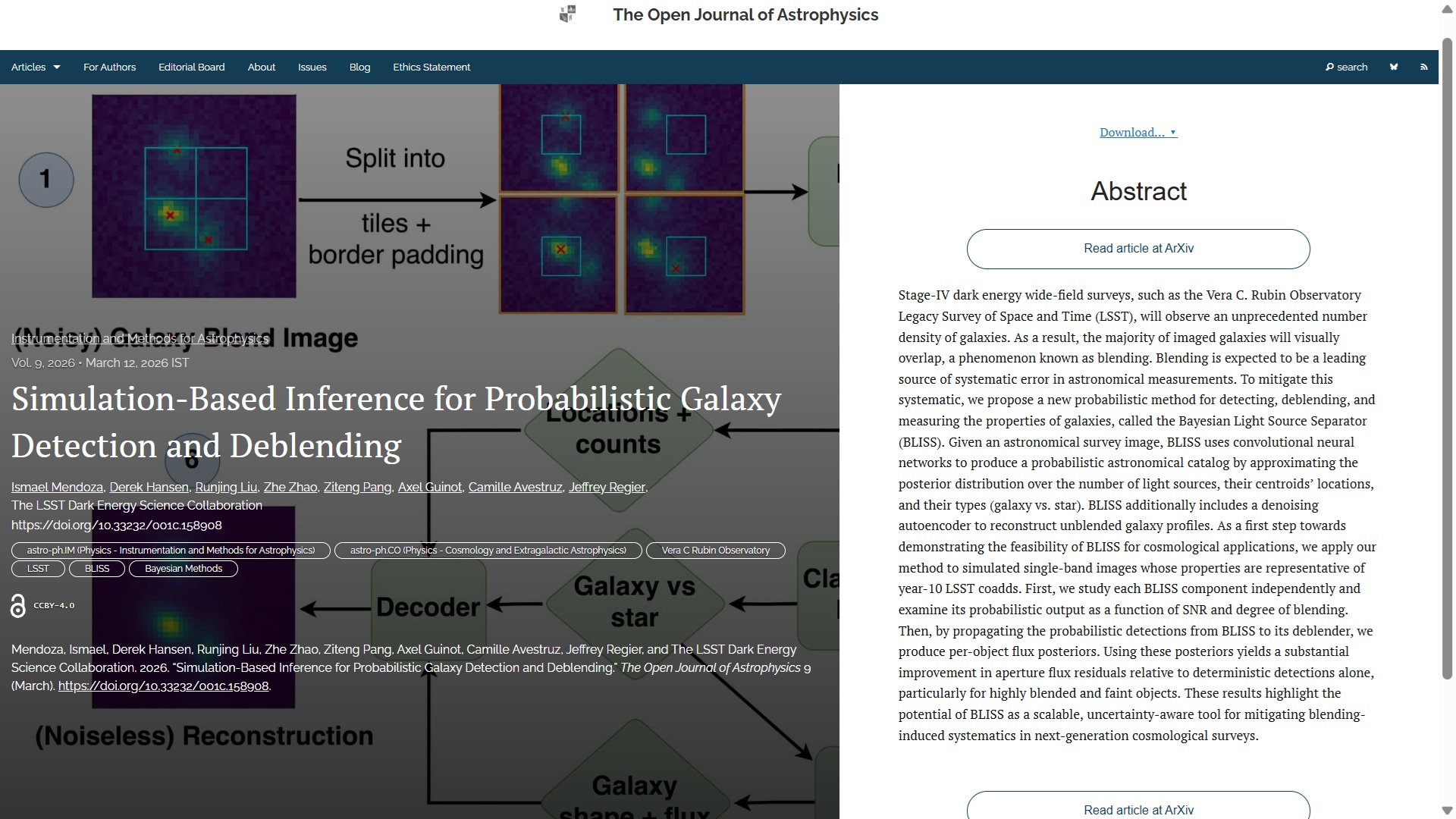
And finally for this week we have “Simulation-Based Inference for Probabilistic Galaxy Detection and Deblending” by Ismael Mendoza (U. Maryland, USA) and 7 others (all based in the USA) on behalf of the LSST Dark Energy Science Collaboration. This was published on Thursday March 12th in the folder Instrumentation and Methods for Astrophysics. The article introduces the Bayesian Light Source Separator (BLISS), for detecting and measuring galaxy properties in wide-field cosmological surveys. BLISS demonstrates improved performance, particularly for faint and blended objects.

The overlay is here:

The finally accepted version of this paper can be found here and the Mastodon announcement is here:

Open Journal of Astrophysics

New Publication at the Open Journal of Astrophysics: "Simulation-Based Inference for Probabilistic Galaxy Detection and Deblending" by Ismael Mendoza (U. Maryland, USA) and 7 others (all based in the USA) on behalf of the LSST Dark Energy Science Collaboration

doi.org/10.33232/001c.158908

March 12, 2026, 7:27 am 3 boosts 1 favorites

And that concludes this week’s update.

P.S. Thank you once again to the many people who have responded to the latest call for editors. I’ve been sending out invitations and getting people onboard as quickly as I can, but I still have a number to get to, so please bear with me!

Weekly Update from the Open Journal of Astrophysics – 15/11/2025

Posted in OJAp Papers, Open Access, The Universe and Stuff with tags , , , , , , , , , , , , , , , , , , , , , , , , , , , , , on November 15, 2025 by telescoper

It’s Saturday again, so it’s time for the usual update of the week’s new papers at the Open Journal of Astrophysics. It has been quite a busy week. Since the last update we have published another seven papers, which brings the number in Volume 8 (2025) up to 175, and the total so far published by OJAp up to 410.

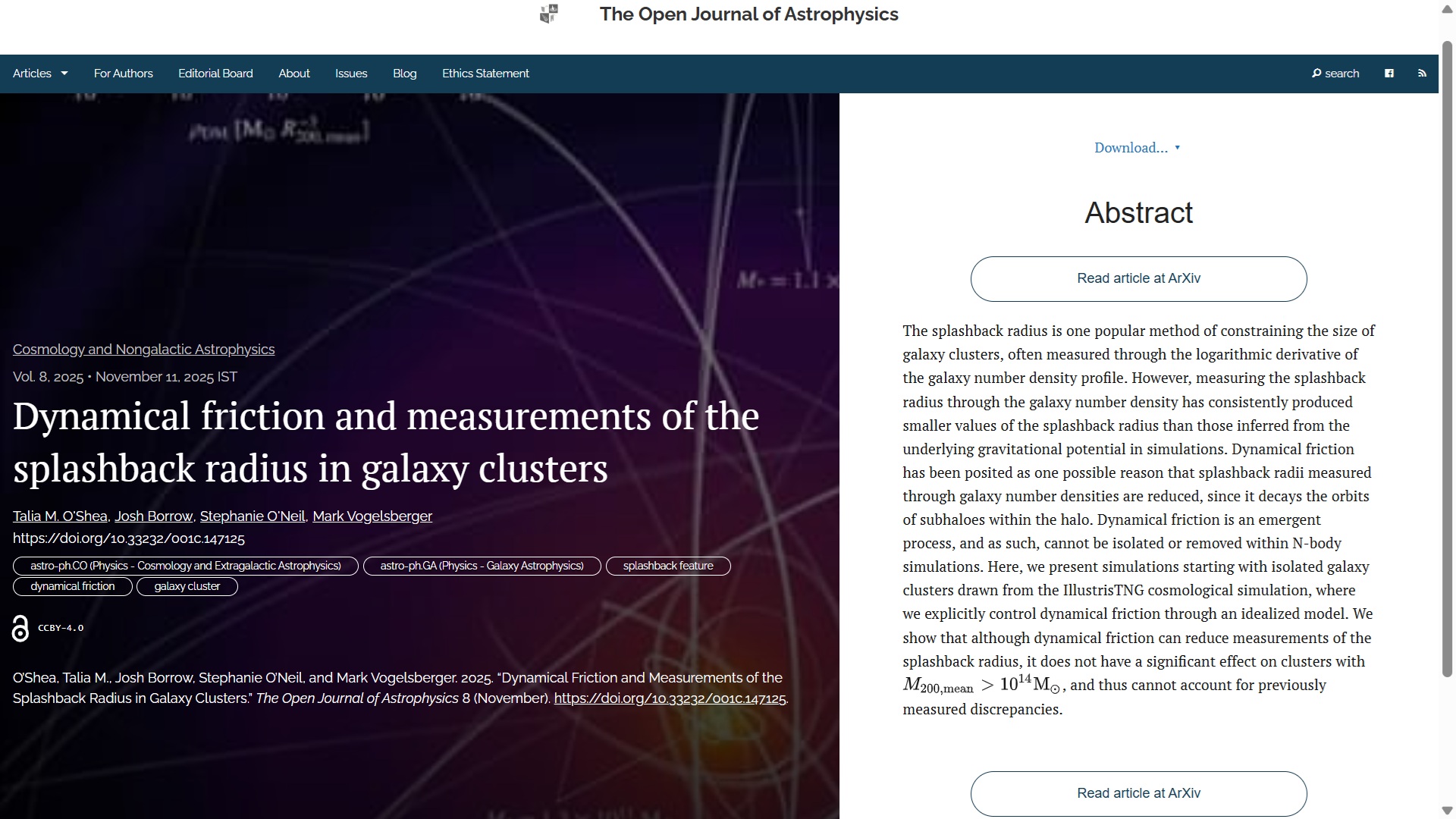
First on the menu for this week is “Dynamical friction and measurements of the splashback radius in galaxy clusters” by Talia M. O’Shea (U. Wisconsin-Madison, USA), Josh Borrow & Stephanie O’Neil (U. Pennsylvania, USA) and Mark Vogelsberger (MIT, USA). Published on Tuesday 11th November in the folder Cosmology and NonGalactic Astrophysics, this one presents a study suggesting that dynamical friction does not play a major role in reducing the radius of the splashback feature in real data compared to numerical simulations.

The overlay is here:

You can find the officially accepted version on arXiv here.

The Fediverse announcement is here:

Open Journal of Astrophysics

New Publication at the Open Journal of Astrophysics: "Dynamical friction and measurements of the splashback radius in galaxy clusters" by Talia M. O'Shea (U. Wisconsin-Madison, USA), Josh Borrow & Stephanie O'Neil (U. Pennsylvania, USA) and Mark Vogelsberger (MIT, USA)

doi.org/10.33232/001c.147125

November 11, 2025, 8:36 am 3 boosts 1 favorites


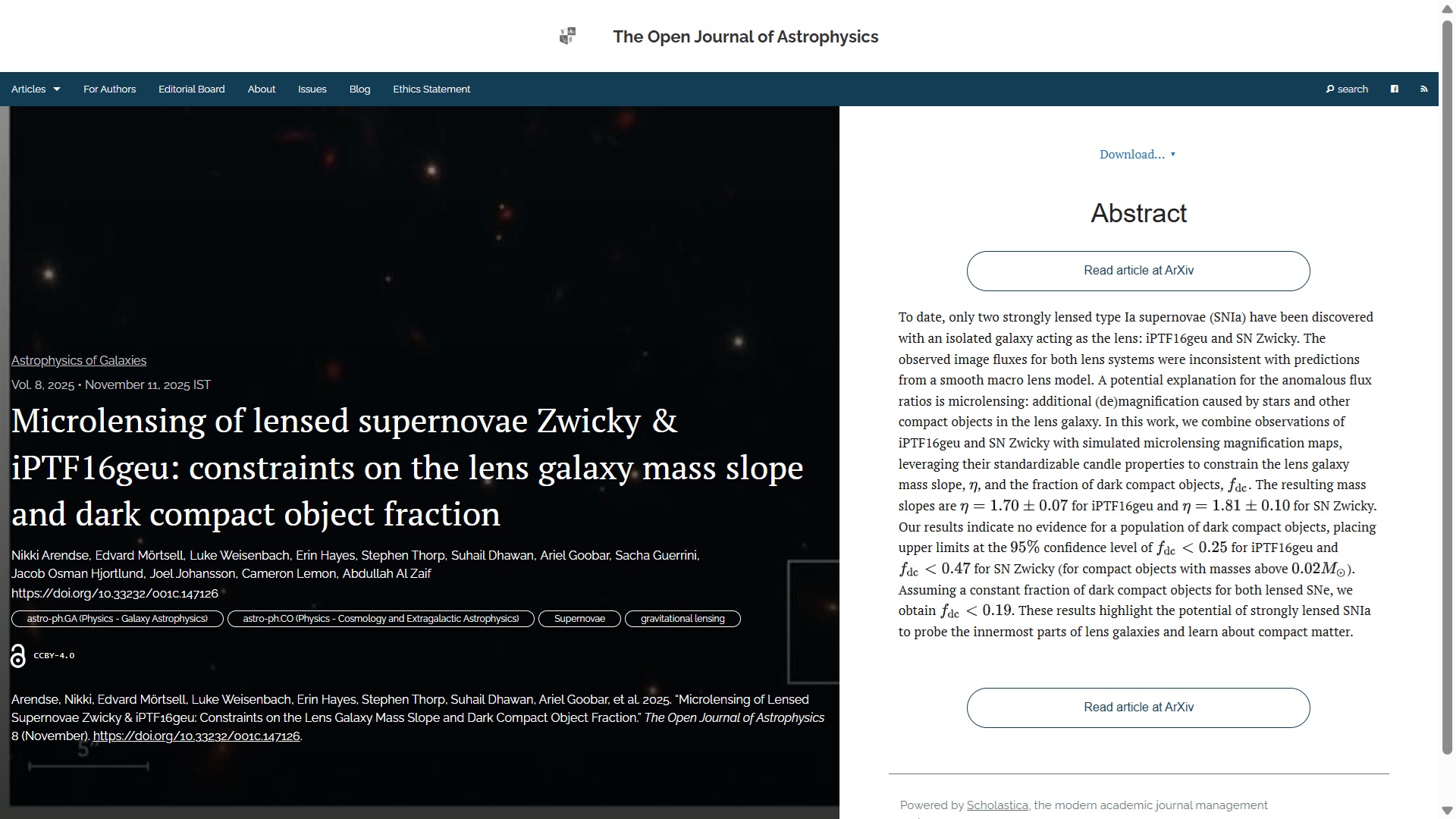
The second paper of the week is “Microlensing of lensed supernovae Zwicky & iPTF16geu: constraints on the lens galaxy mass slope and dark compact object fraction” by Nikki Arendse (Stockholm University, Sweden) and and international cast of 11 others based in Sweden, UK and France. This one was published on 11th November 2025 in the folder Astrophysics of Galaxies. It is about combining observations of two supernovae, iPTF16geu and SN Zwicky, with microlensing magnification maps to probe the properties of the lens galaxy.

The overlay is here:


You can find the official version of this one on arXiv here. The federated announcement on Mastodon is here:

Open Journal of Astrophysics

New Publication at the Open Journal of Astrophysics: "Microlensing of lensed supernovae Zwicky & iPTF16geu: constraints on the lens galaxy mass slope and dark compact object fraction" by Nikki Arendse (Stockholm University, Sweden) and 11 others based in Sweden, UK and France

doi.org/10.33232/001c.147126

November 11, 2025, 8:53 am 1 boosts 1 favorites


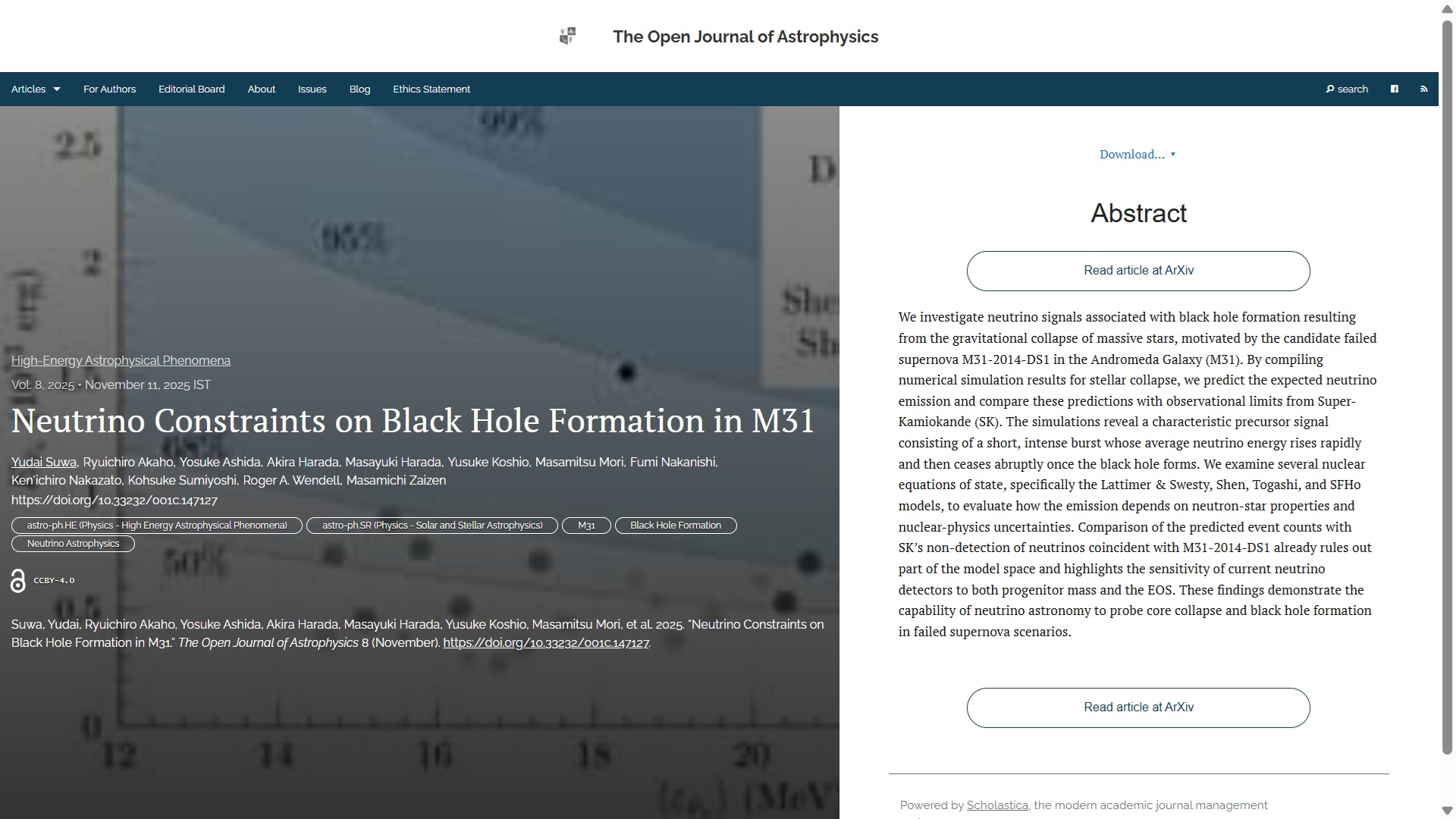
Next one up is “Neutrino Constraints on Black Hole Formation in M31” by Yudai Sawa (U. Tokyo, Japan) and 11 others all based in Japan. This was published on Tuesday 11th November in the folder High-Energy Astrophysical Phenomena. It presents a calculation of the neutrino emission expected from the collapse of massive stars and its use in constraining black hole formation using neutrino detectors.


The overlay is here:

You can find the official accepted version on arXiv here. The fediverse announcement is here:

Open Journal of Astrophysics

New Publication at the Open Journal of Astrophysics: "Neutrino Constraints on Black Hole Formation in M31" by Yudai Sawa (U. Tokyo, Japan) and 11 others all based in Japan

doi.org/10.33232/001c.147127

November 11, 2025, 9:04 am 0 boosts 1 favorites

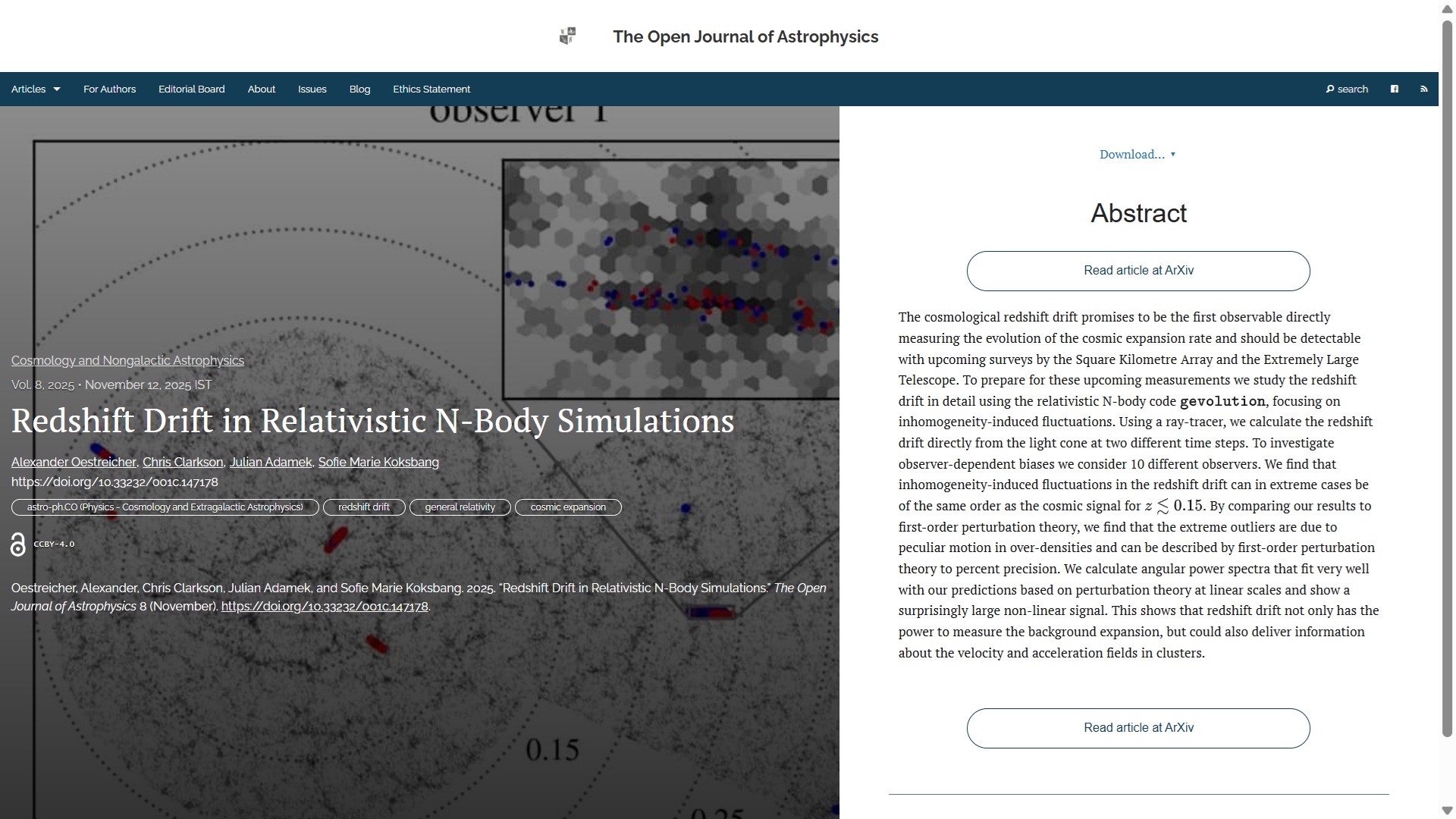
The fourth paper this week is “Redshift Drift in Relativistic N-Body Simulations” by Alexander Oestreicher (U. Southern Denmark, DK), Chris Clarkson (QMUL, UK), Julian Adamek (U. Zürich, CH) and Sofie Marie Koksbang (U. Southern Denmark, DK). This one was published on Wednesday 12th November in the folder marked Cosmology and NonGalactic Astrophysics. It presents numerical calculations of the cosmological redshift drift effect for comparison with future surveys.

The overlay is here:


You can find the official published version on arXiv here. The Fediverse announcement follows:

Open Journal of Astrophysics

New Publication at the Open Journal of Astrophysics: "Redshift Drift in Relativistic N-Body Simulations" by Alexander Oestreicher (U. Southern Denmark, DK), Chris Clarkson (QMUL, UK), Julian Adamek (U. Zürich, CH) and Sofie Marie Koksbang (U. Southern Denmark, DK)

doi.org/10.33232/001c.147178

November 12, 2025, 8:35 am 1 boosts 0 favorites


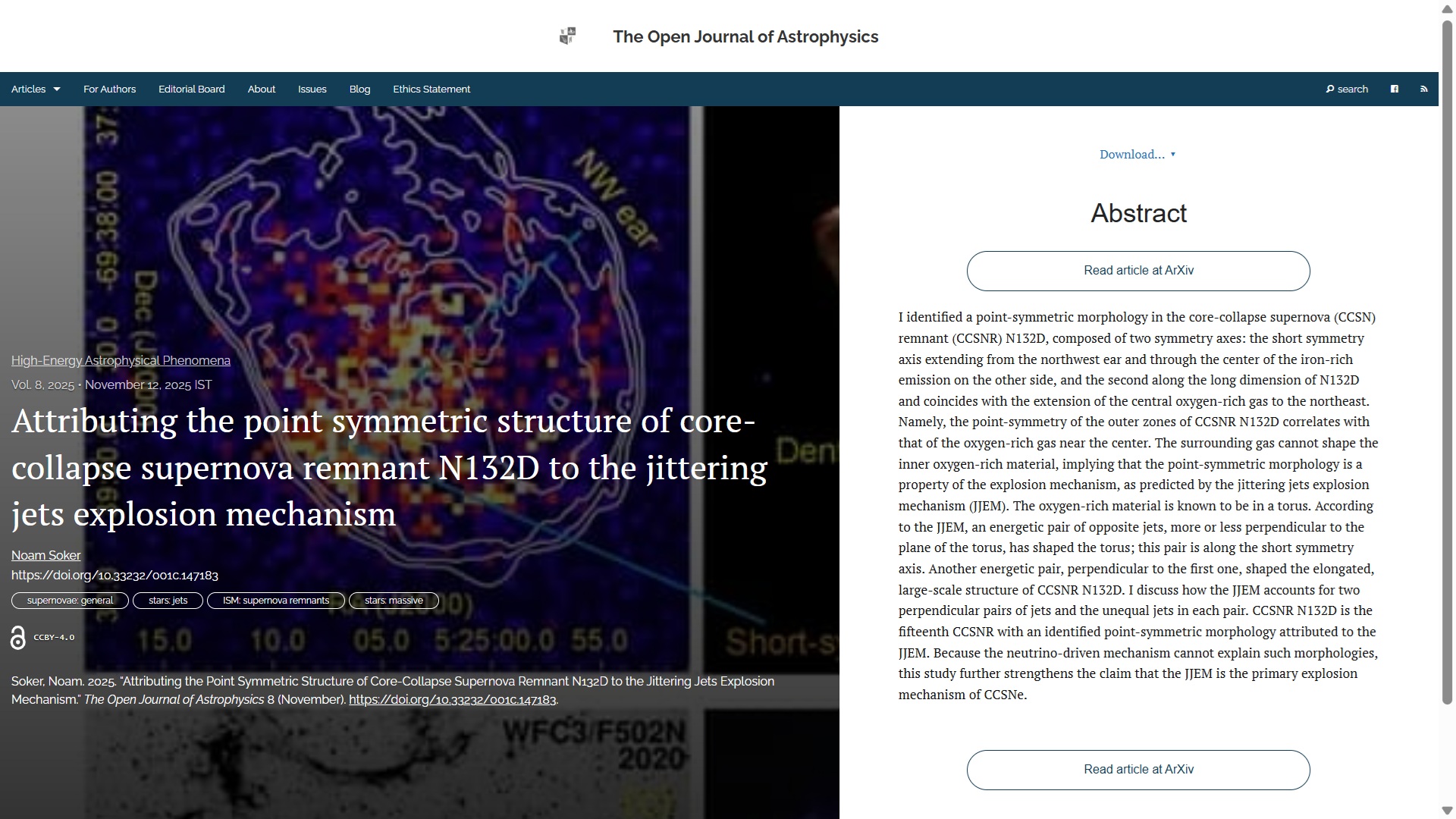
The fifth paper for this week is “Attributing the point symmetric structure of core-collapse supernova remnant N132D to the jittering jets explosion mechanism” by Noam Soker (Technion, Haifa, Israel). This one, published on Wednesday November 12th in the folder High-Energy Astrophysical Phenomena, presents a discussion of the morphology of a supernova remnant and possible explanation for it in terms of the explosion mechanism.

The overlay is here:


The officially accepted version can be found on arXiv here. The Fediverse announcement is here:

Open Journal of Astrophysics

New Publication at the Open Journal of Astrophysics: "Attributing the point symmetric structure of core-collapse supernova remnant N132D to the jittering jets explosion mechanism" by Noam Soker (Technion, Haifa, Israel)

doi.org/10.33232/001c.147183

November 12, 2025, 8:46 am 1 boosts 0 favorites

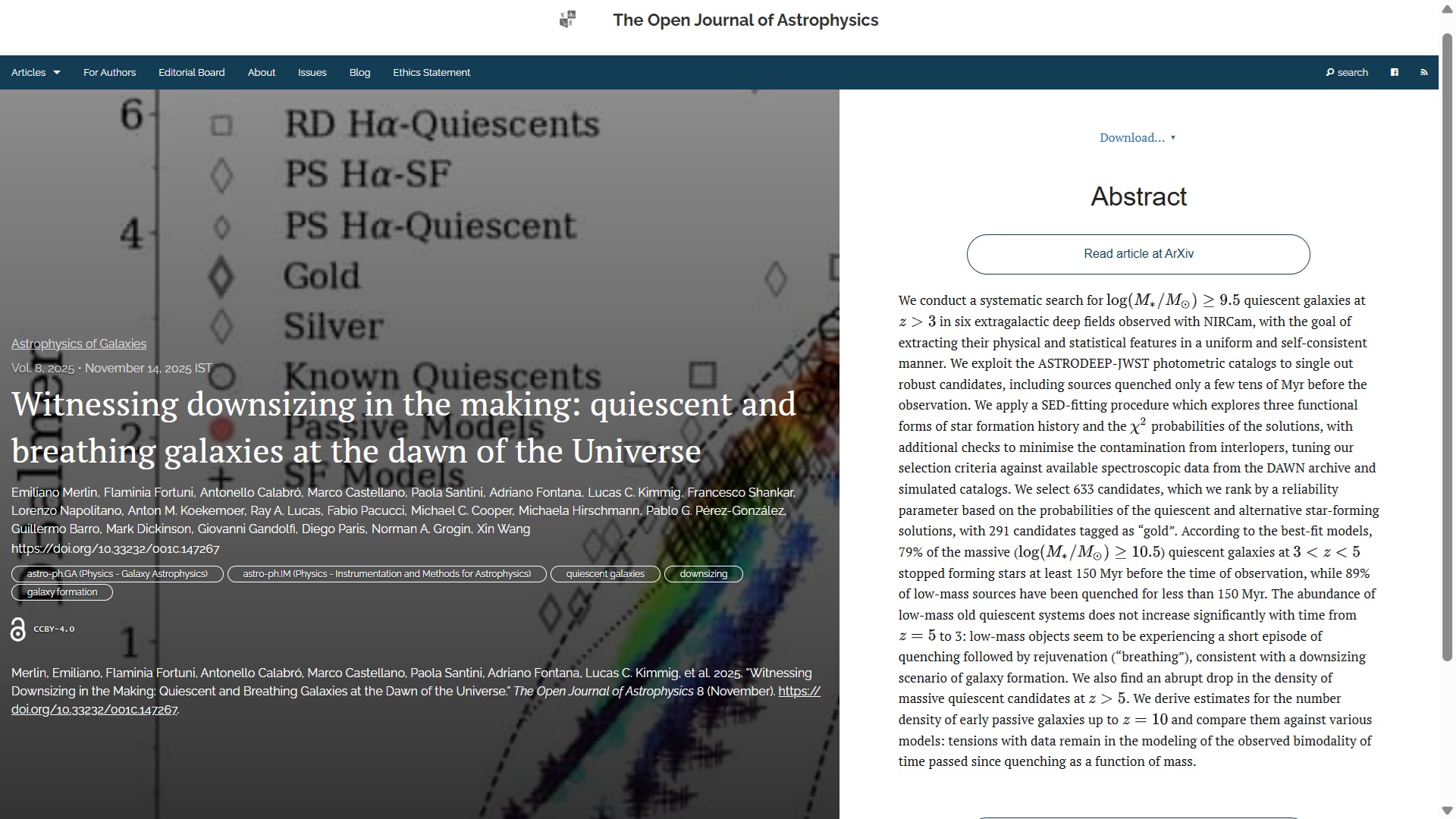
The sixth paper to report this week is “Witnessing downsizing in the making: quiescent and breathing galaxies at the dawn of the Universe” by Emiliano Merlin (Osservatorio Astronomico di Roma, Italy) and an international cast of 20 others based in Italy, Germany, UK, USA, Switzerland, Spain and China. This one was published on Friday November 14th in the folder Astrophysics of Galaxies.

You can find the officially-accepted version on arXiv here. The fediverse announcement is here:

Open Journal of Astrophysics

New Publication at the Open Journal of Astrophysics: "Witnessing downsizing in the making: quiescent and breathing galaxies at the dawn of the Universe" by Emiliano Merlin (Osservatorio Astronomico di Roma, Italy) and 20 others based in Italy, Germany, UK, USA, Switzerland, Spain and China

doi.org/10.33232/001c.147267

November 14, 2025, 8:38 am 1 boosts 1 favorites

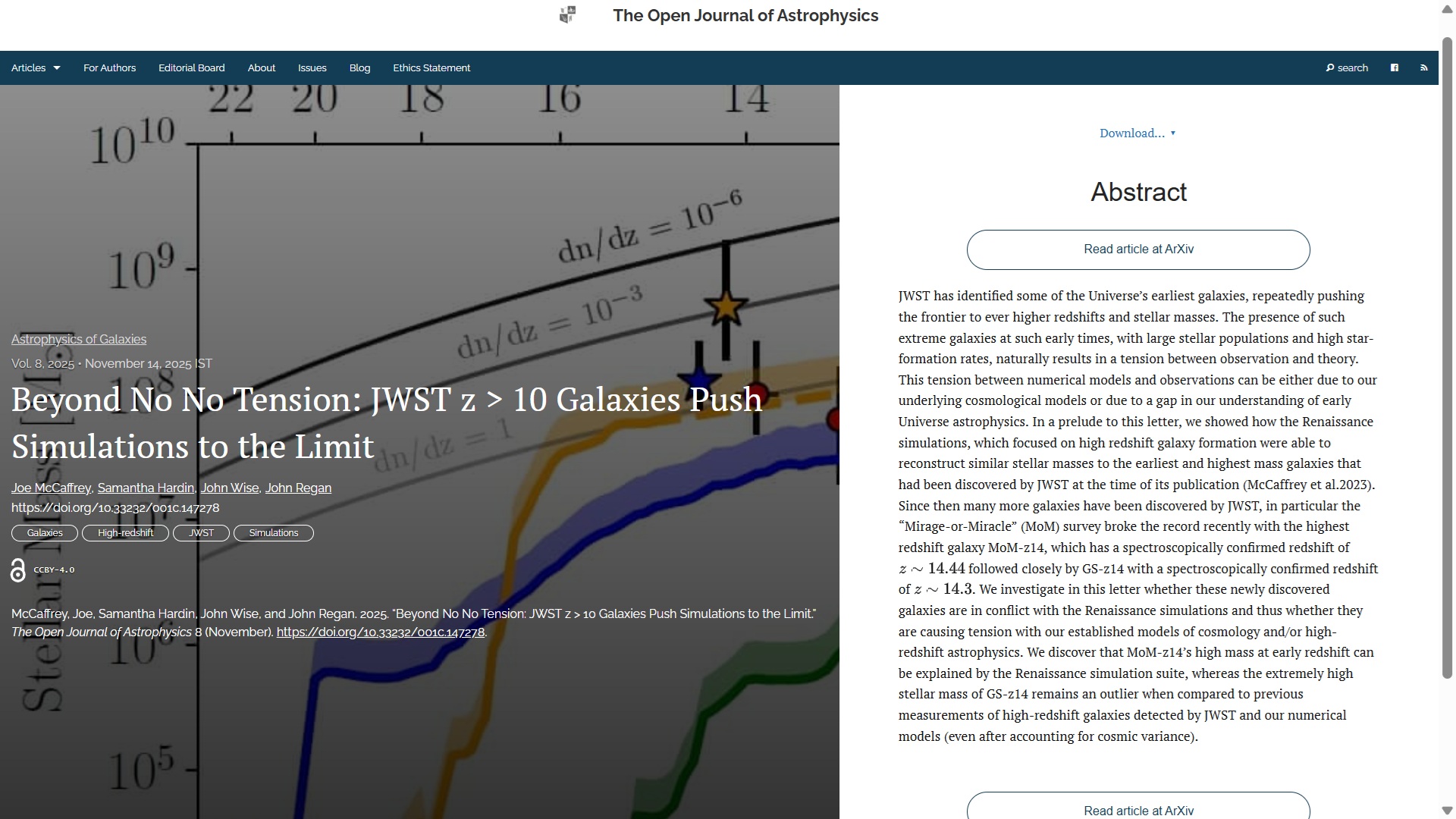
And finally (for this week) we have “Beyond No No Tension: JWST z > 10 Galaxies Push Simulations to the Limit” by Joe McCaffrey (NUI Maynooth, Ireland), Samantha Hardin & John Wise (Georgia Institute of Technology, USA) and John Regan (Maynooth). This one was also published on Friday 14th November, in the folder marked Astrophysics of Galaxies. It asks the question whether newly-discovered high redshift galaxies are consistent with simulations of galaxy formation. The overlay is here:

You can find the officially acceopted version on arXiv here. The fediverse announcement is here:

Open Journal of Astrophysics

New Publication at the Open Journal of Astrophysics: "Beyond No No Tension: JWST z > 10 Galaxies Push Simulations to the Limit" by Joe McCaffrey (NUI Maynooth, Ireland), Samantha Hardin & John Wise (Georgia Institute of Technology, USA) and John Regan (Maynooth)

doi.org/10.33232/001c.147278

November 14, 2025, 9:02 am 2 boosts 0 favorites

And that concludes the update for this week. There will be another next Saturday.

Weekly Update from the Open Journal of Astrophysics: 05/07/2025

Posted in OJAp Papers, Open Access, The Universe and Stuff with tags , , , , , , , , , , , , , , , , , on July 5, 2025 by telescoper

It’s Saturday so, once again, it’s time for the weekly update of papers published at the Open Journal of Astrophysics. Since the last update we have published three new papers, which brings the number in Volume 8 (2025) up to 85, and the total so far published by OJAp  up to 320.

The three papers published this week, with their overlays, are as follows. You can click on the images of the overlays to make them larger should you wish to do so.

The first paper to report is “Stellar reddening map from DESI imaging and spectroscopy” by Rongpu Zhou (Lawrence Berkeley National Laboratory, USA) and an international case of 56 others too numerous to mention individually. This paper was published on 1st July 2025 in the folder marked Astrophysics of Galaxies. It describes maps of stellar reddening by Galactic dust inferred from observations obtained using the Dark Energy Spectroscopic Instrument, and a comparison with previous such maps. The overlay is here:

You can find the final, accepted, version on arXiv here.

Next one up is “On inertial forces (indirect terms) in problems with a central body” by Aurélien Crida (Université Côte d’Azur, France) and 17 others – again too numerous to be listed individually – based in France, Italy, Germany, Mexico and the USA. This paper discusses the indirect terms that arise the Newtonian dynamics of multi-body systems dominated by a central massive body, upon which other bodies exert a gravitational pull, when the massive body is treated as the origin of the coordinate system. This one, also published on July 1st 2025, is in the folder marked Earth and Planetary Astrophysics.

The overlay is here:

You can find the officially accepted version on arXiv here.

The last paper of this batch is “Stellar ejection velocities from the binary supernova scenario: A comparison across population synthesis codes” by Tom Wagg (U. Washington, USA), David D. Hendriks (U. Surrey, UK), Mathieu Renzo (U. Arizona, USA) and Katelyn Breivik (Carnegie Mellon U., USA). It was published on July 2nd 2025 in the folder Solar and Stellar Astrophysics and it presents comparison of the ejection velocities of stars ejected from binary systems by supernova explosions predicted in three different population synthesis codes.

The overlay is here:

You can read the final accepted version on arXiv here.

That’s all the papers for this week. I’ll post another update next weekend.

Weekly Update from the Open Journal of Astrophysics – 28/06/2025

Posted in OJAp Papers, Open Access, The Universe and Stuff with tags , , , , , , , , , , , , , , , , , , , , , , , , on June 28, 2025 by telescoper

It’s Saturday morning again so time for an update of papers published at the Open Journal of Astrophysics. Since the last update we have published eight new papers, which brings the number in Volume 8 (2025) up to 82, and the total so far published by OJAp  up to 317. With about half the year gone, we’re on target to published around 160 papers this year.

The papers published this week, with their overlays, are as follows.  You can click on the images of the overlays to make them larger should you wish to do so.

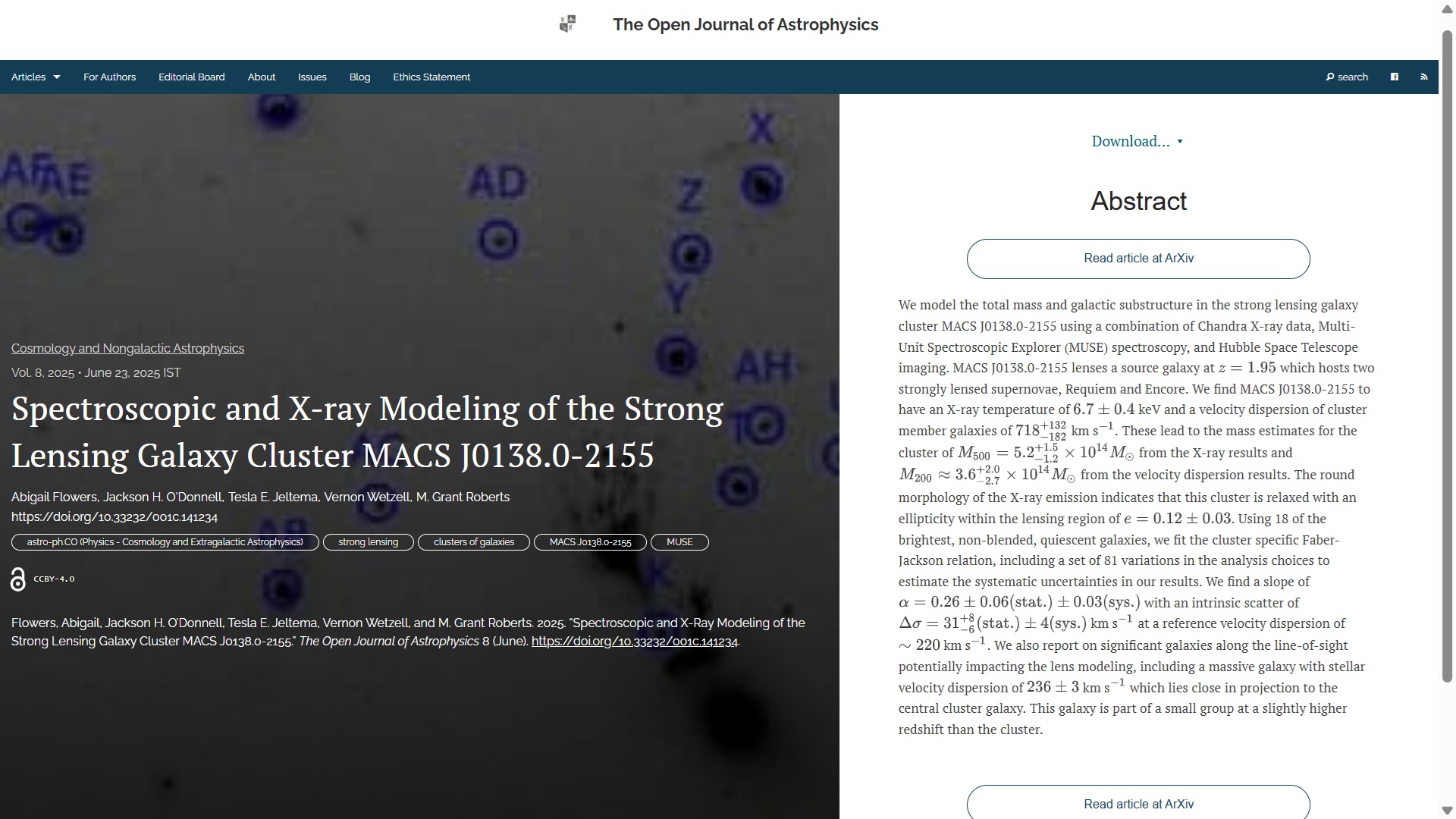
The first paper to report is “Spectroscopic and X-ray Modeling of the Strong Lensing Galaxy Cluster MACS J0138.0-2155” by Abigail Flowers (University of California at Santa Cruz; UCSZ), Jackson H. O’Donnell (UCSZ), Tesla E. Jeltema (UCSZ), Vernon Wetzell (U. Pennsylvania) & M. Grant Roberts (UCSZ). This artticle, which is in the folder marked Cosmology and NonGalactic Astrophysics, presents a study of the mass distribution and substructure of a galaxy cluster that acts as a gravitational lens for a source galaxy at z=1.95 that contains two supernovae. It was published on 23rd June 2025. The overlay is here:

The officially-accepted version can be found on arXiv here.

Illuminating the Physics of Dark Energy with the Discovery Simulations” by Gillian D. Beltz-Mohrmann (Argonne National Laboratory, USA) and 12 others based in the USA and Spain. This describes new high-resolution cosmological simulations providing a testbed for alternative cosmological probes that may offer additional constraining power beyond Baryon Accoustic Oscillations. It is filed in the folder marked Cosmology and NonGalactic Astrophysics.

The overlay is here:

You can read the final accepted version on arXiv here.

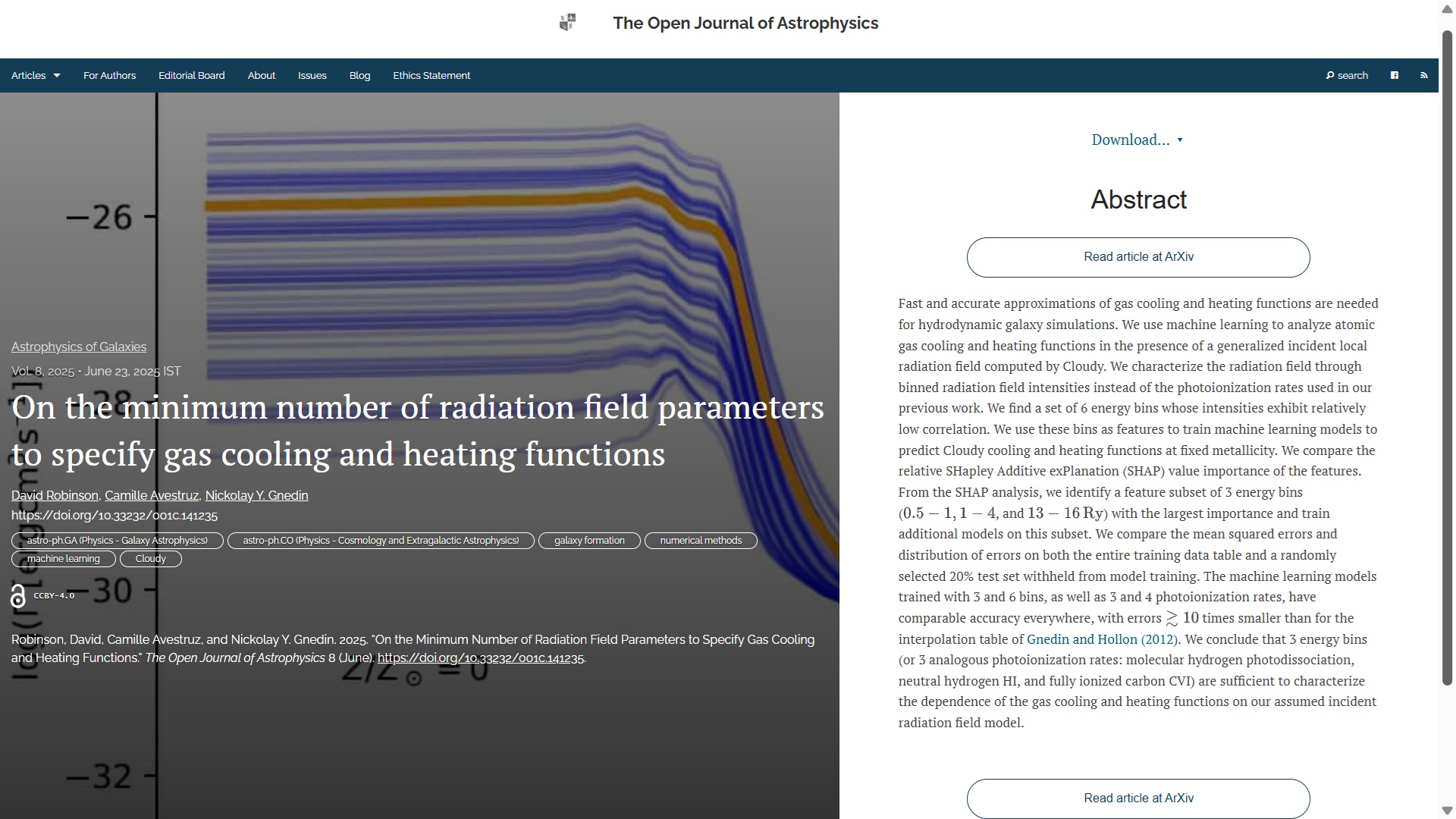
Next one up is in the folder marked Astrophysics of Galaxies. The title is “On the minimum number of radiation field parameters to specify gas cooling and heating functions” and it is by David Robinson & Camille Avestruz (U. Michigan) and Nickolay Y. Gnedin (U.Chicago) and was published on 23rd June 2025. It presents an analysis using machine learning of atomic gas cooling and heating functions computed by the spectral synthesis code Cloudy.

The overlay is here:


You can find the officially-accepted version of the paper on arXiv here.

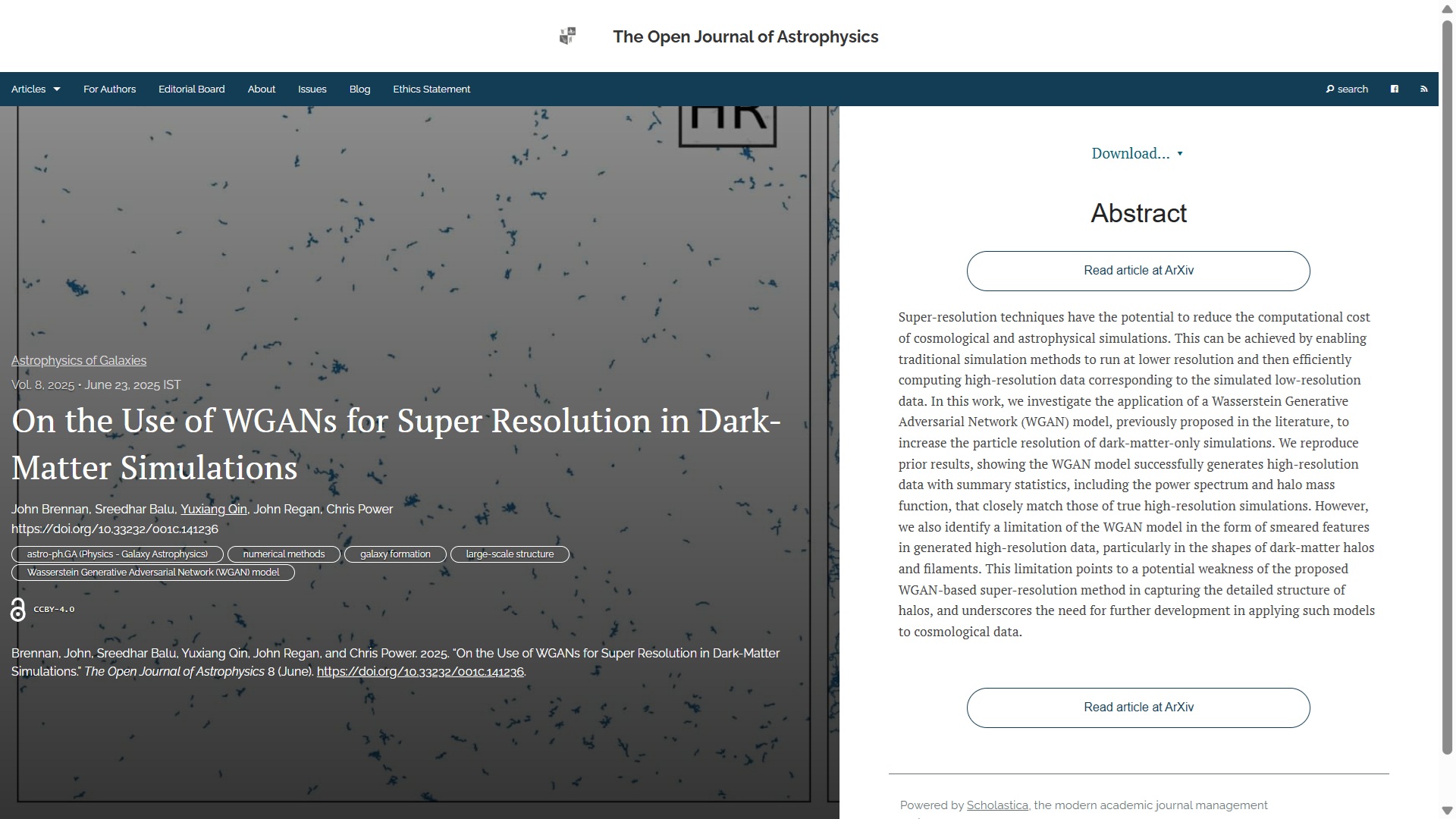
The thirtd paper is “On the Use of WGANs for Super Resolution in Dark-Matter Simulations” by John Brennan (Maynooth), Sreedhar Balu (U. Melbourne), Yuxiang Qin (ANU), John Regan (Maynooth) and Chris Power (U. Western Australia). This one is also in the folder marked Astrophysics of Galaxies and was also published on Monday 23rd June. It is about using the Wasserstein Generative Adversarial Network (WGAN) model to increase the particle resolution of dark-matter-only simulations of galaxy formation. The overlay is here:

You can find the officially-accepted version of the paper on arXiv here.

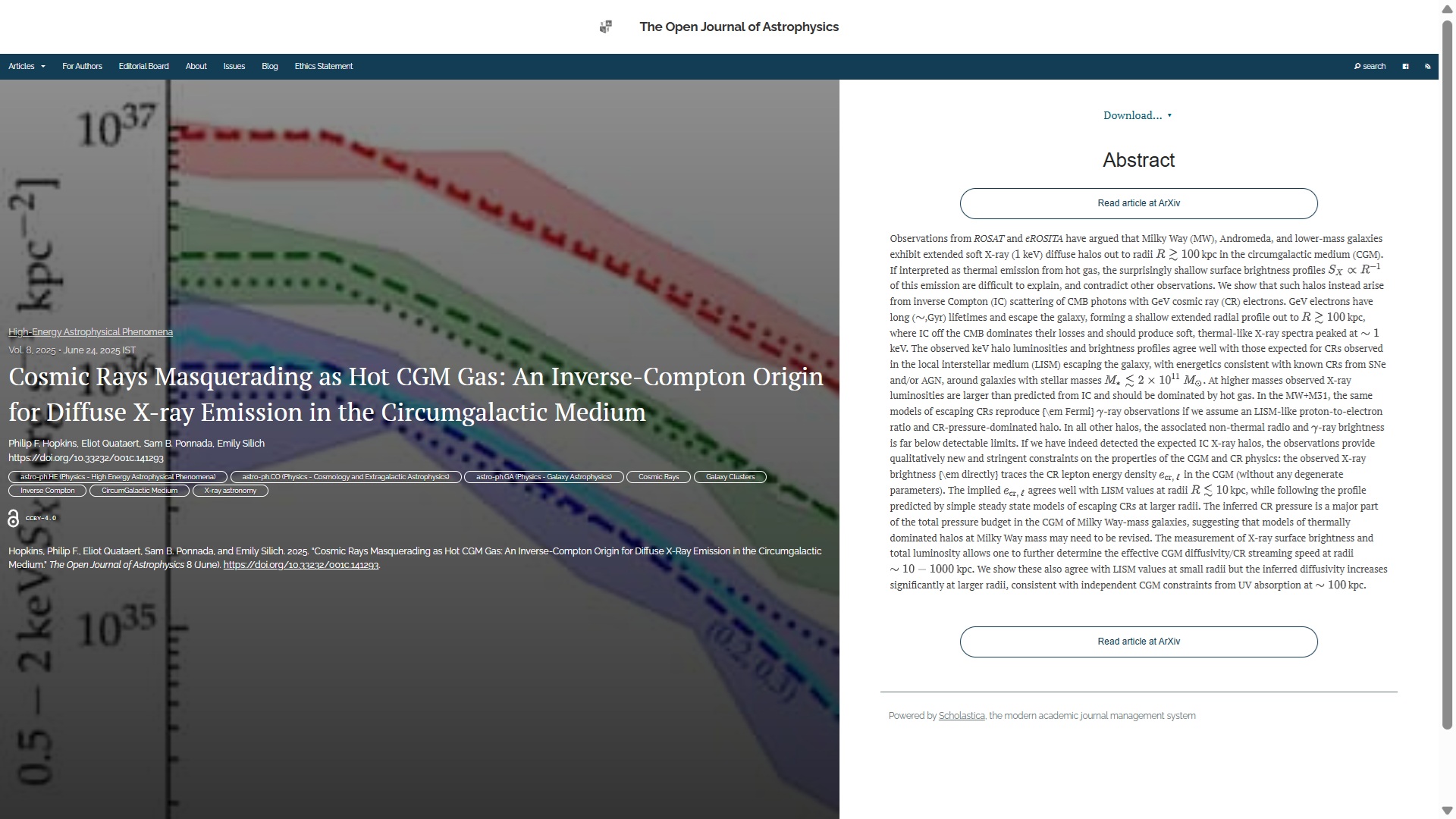
Next we have “Cosmic Rays Masquerading as Hot CGM Gas: An Inverse-Compton Origin for Diffuse X-ray Emission in the Circumgalactic Medium” by Philip F. Hopkins (Caltech), Eliot Quataert (Princeton), Sam B. Ponnada (Caltech) and Emily Silich (Caltech), all based in the USA.  This one was published on 24th June 2025 in the folder High-Energy Astrophysical Phenomena

You can find the officially-accepted version on arXiv here.

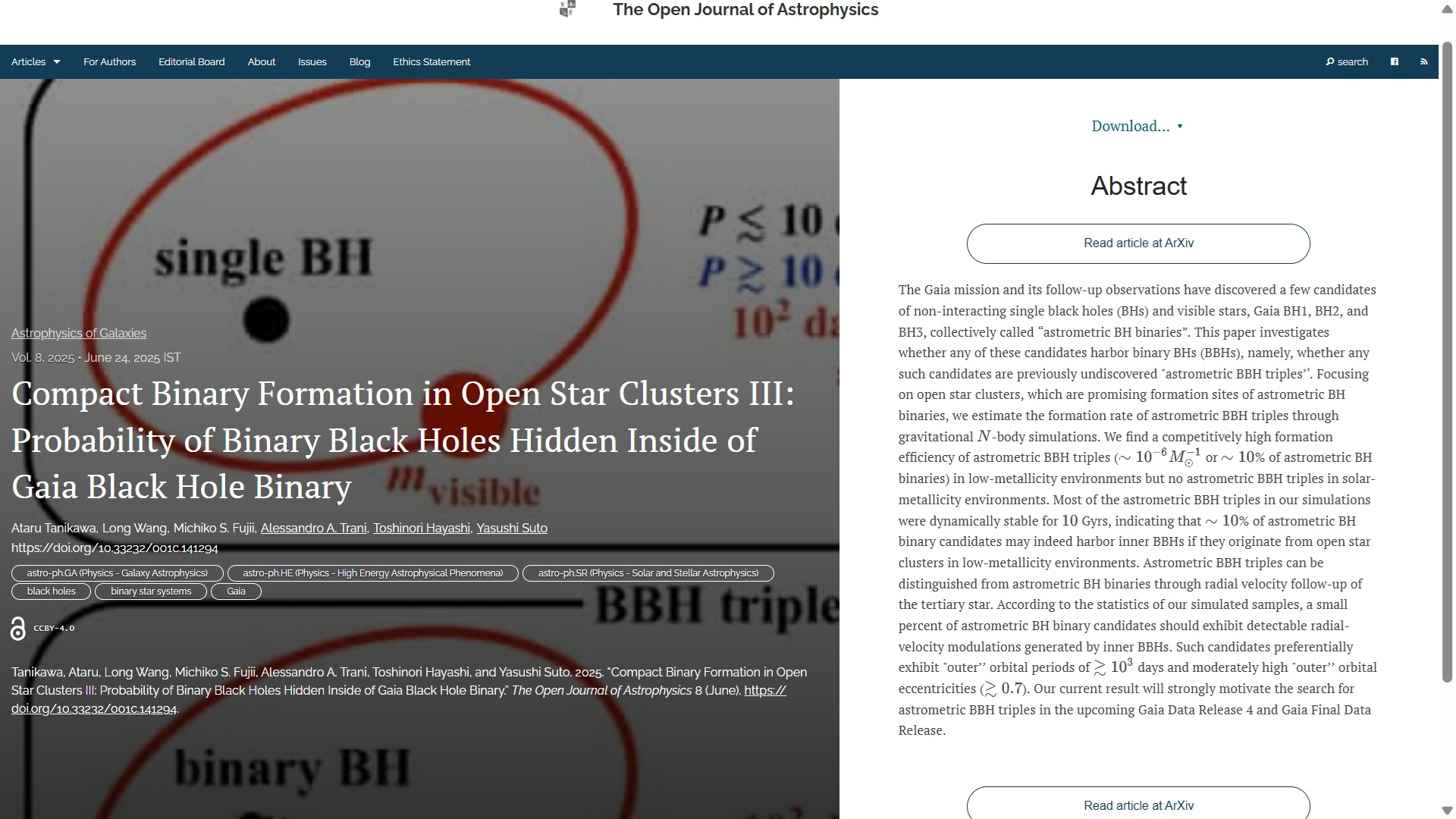
The fifth paper this week is “Compact Binary Formation in Open Star Clusters III: Probability of Binary Black Holes Hidden Inside of Gaia Black Hole Binary” by Ataru Tanikawa (Fukui Prefectural University, Japan), Long Wang (Sun Yat-sen University, China), Michiko S. Fujii (University of Tokyo, Japan), Alessandro A. Trani (Niels Bohr Institute, Denmark), Toshinori Hayashi (Kyoto University, Japan) and Yasushi Suto (Kochi University of Technology, Japan).  This one is in the folder marked Astrophysics of Galaxies and was published on Tuesday 24th June. It presents an investigation into whether some Gaia black hole binary systems may in fact involve three black holes, including a pair too compact to be resolved astrometrically. Here is the overlay:

You can find the officially-accepted paper on arXiv here.

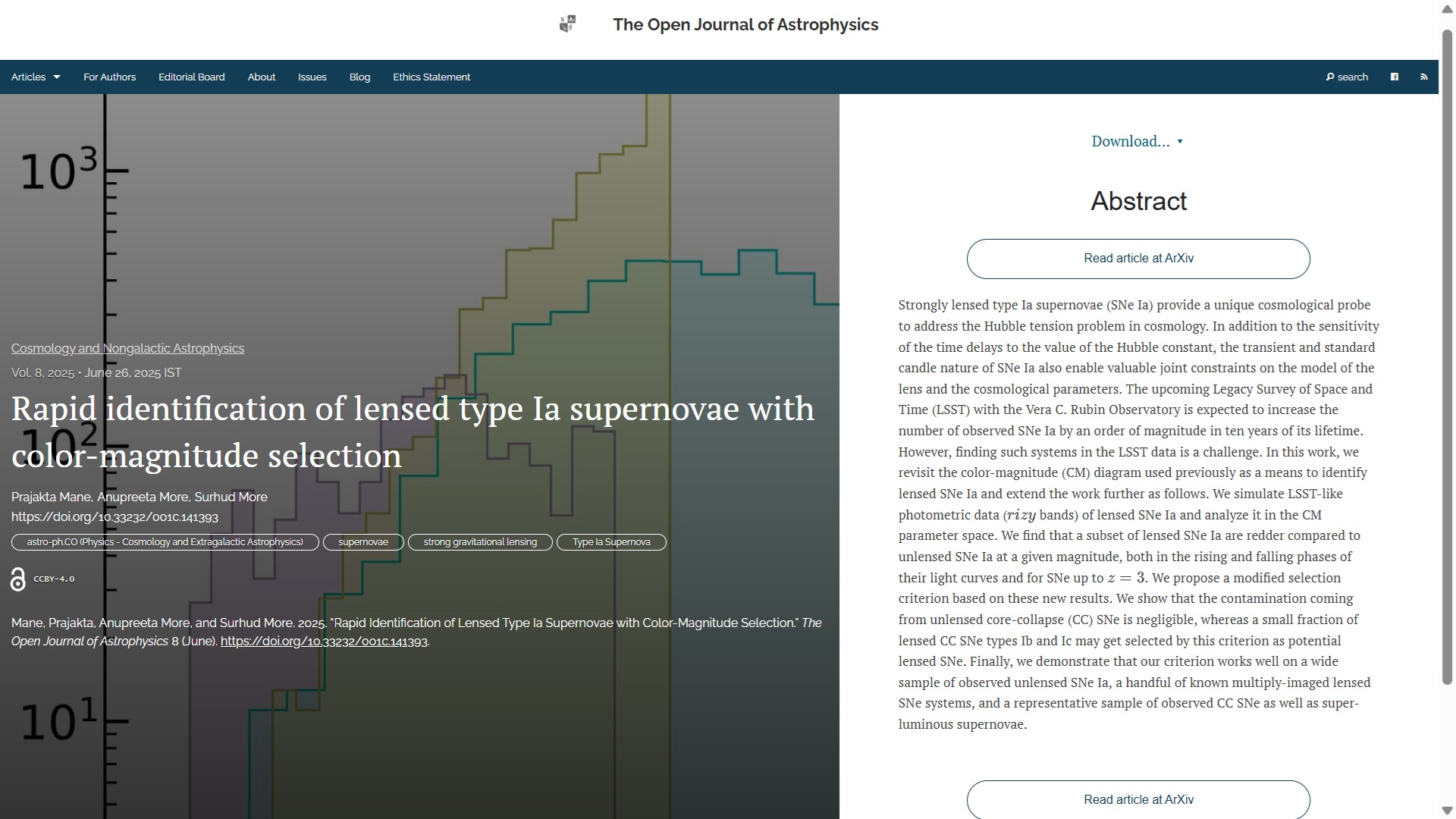
Next we have “Rapid identification of lensed type Ia supernovae with color-magnitude selection” by Prajakta Mane (IISER) and Anupreeta More & Surhud More (IUCAA), all based in India. This paper presents an  extension of the use of color-magnitude diagrams, used previously as a means to identify lensed supernovae, with applications to LSST-like photometric data. It is in the folder marked Astrophysics of Galaxies and was published on Thursday 26th June.

The officially-accepted version of the article can be found on arXiv here.

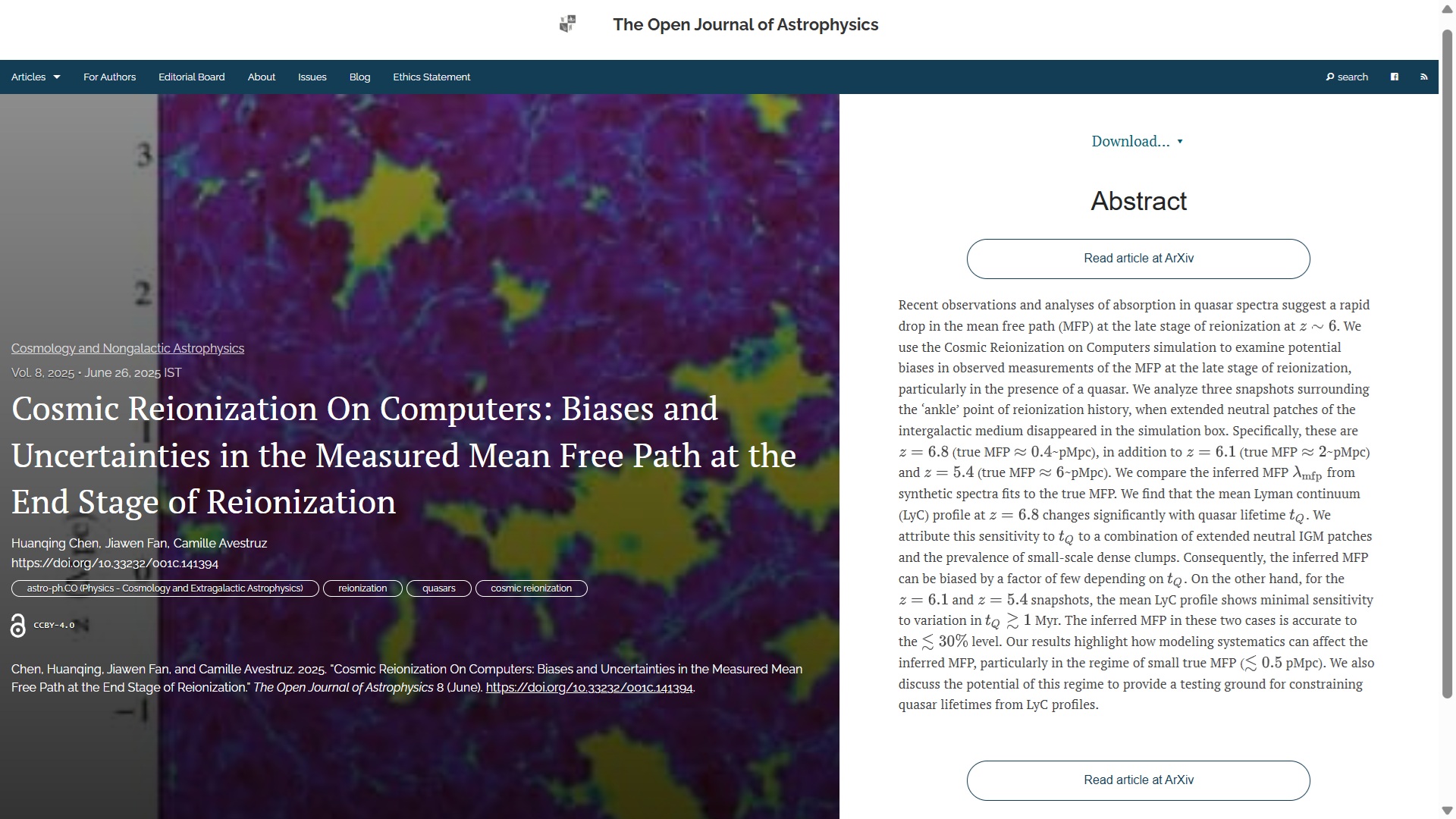
The penultimate article this week is: “Cosmic Reionization On Computers: Biases and Uncertainties in the Measured Mean Free Path at the End Stage of Reionization” by Huanqing Chen (U. Alberta, Canada), and Jiawen Fan & Camille Avestruz (U. Michigan, USA). This one is in the folder Cosmology and Nongalactic Astrophysics and was published on 26th June 2025.  This paper studies possible systematic effects in computer simulations of cosmic reionization especially when it results from quasar radiation.

The overlay is here:

You can find the officially-accepted version on arXiv here.

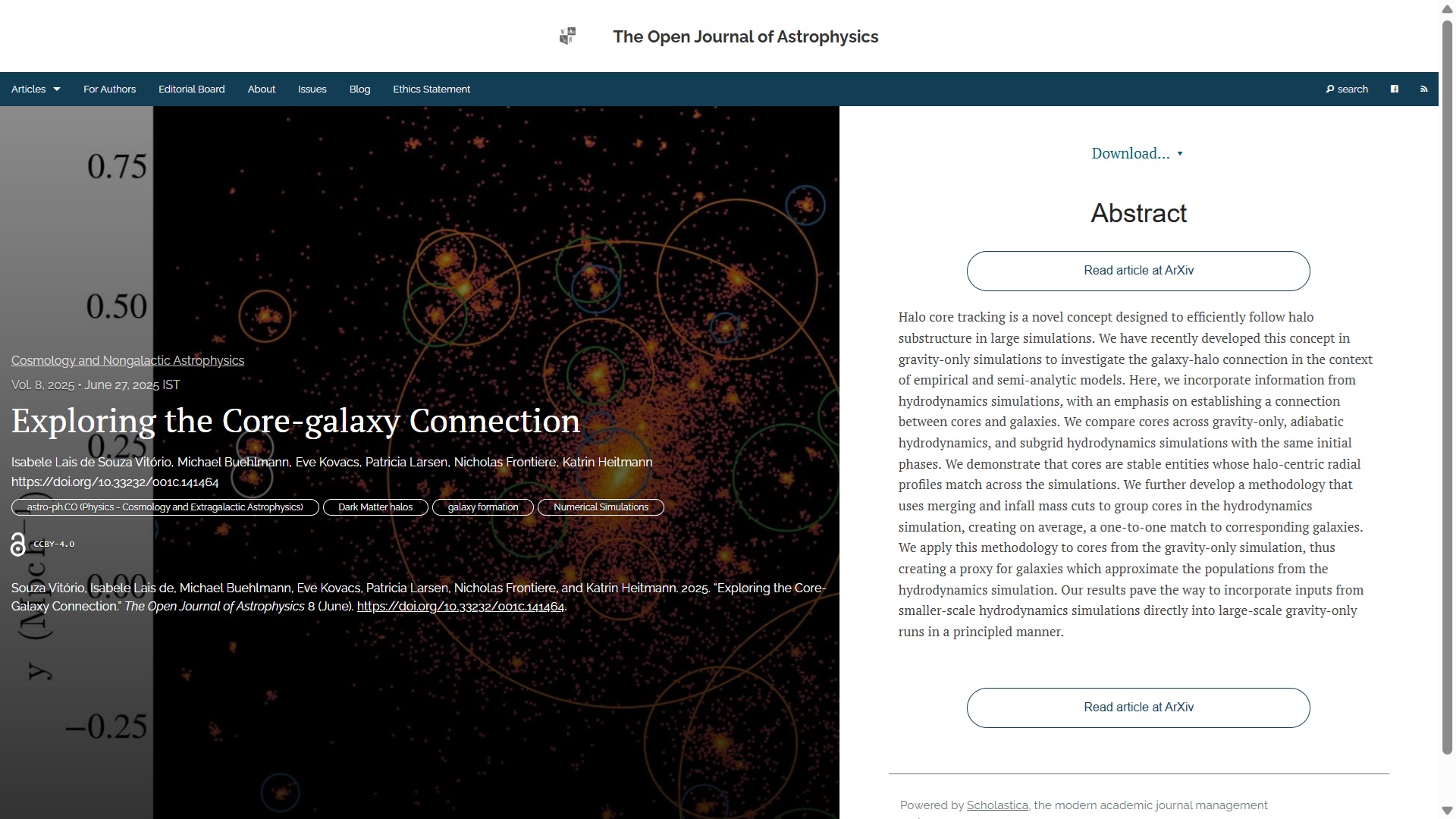
Eighth and last paper this week is “Exploring the Core-galaxy Connection” by Isabele Lais de Souza Vitório (U. Michigan) and Michael Buehlmann, Eve Kovacs, Patricia Larsen, Nicholas Frontiere & Katrin Heitmann (Argonne National Laboratory, USA).  This one is in the folder Cosmology and Nongalactic Astrophysics and was published on Friday 27th June 2025 (i.e. yesterday).

The overlay is here:


You can find the officially-accepted version on arXiv here.

And that’s all the papers for this week. I do, however, have some more news to pass on. We are delighted to welcome two new recruits to our Editorial Board,  Dr Foteini Oikonomou of the Norwegian University of Science and Technology, who specializes in the application of particle physics theories to  high-energy astrophysical phenomena, and Dr Heloise Stevance of Oxford University (UK), who specializes in the interface between Machine Learning and Astrophysics.

Timescape versus Dark Energy?

Posted in Astrohype, Open Access, The Universe and Stuff with tags , , , , , , , on January 2, 2025 by telescoper

Just before the Christmas break I noticed a considerable amount of press coverage claiming that Dark Energy doesn’t exist. Much of the media discussion is closely based on a press release produced by the Royal Astronomical Society. Despite the excessive hype, and consequent initial scepticism, I think the paper has some merit and raises some interesting issues.

The main focus of the discussion is a paper (available on arXiv here) by Seifert et al. with the title Supernovae evidence for foundational change to cosmological models. This paper is accompanied by a longer article called Cosmological foundations revisited with Pantheon+ (also available on arXiv) by a permutation of the same authors, which goes into more detail about the analysis of supernova observations. If you want some background, the “standard” Pantheon+ supernova analysis is described in this paper. The reanalysis presented in the recent papers is motivated an idea called the Timescape model, which is not new. It was discussed by David Wiltshire (one of the authors of the recent papers) in 2007 here and in a number of subsequent papers; there’s also a long review article by Wiltshire here (dated 2013).

So what’s all the fuss about?

Simulation of the Cosmic Web

In the standard cosmological model we assume that, when sufficiently coarse-grained, the Universe obeys the Cosmological Principle, i.e. that it is homogeneous and isotropic. This implies that the space-time is described by a Friedmann–Lemaître–Robertson–Walker metric (FLRW) metric. Of course we know that the Universe is not exactly smooth. There is a complex cosmic web of galaxies, filaments, clusters, and giant voids which comprise the large-scale structure of the Universe. In the standard cosmological model these fluctuations are treated as small perturbations on a smooth background which evolve linearly on large scales and don’t have a significant effect on the global evolution of the Universe.

This standard model is very successful in accounting for many things but only at the expense of introducing dark energy whose origin is uncertain but which accounts for about 70% of the energy density of the Universe. Among other things, this accounts for the apparent acceleration of the Universe inferred from supernovae measurements.

The standard cosmology’s energy budget

The approach taken in the Timescape model is to dispense with the FLRW metric, and the idea of separating the global evolution from the inhomogeneities. The idea instead is that the cosmic structure is essentially non-linear so there is no “background metric”. In this model, cosmological observations can not be analysed within the standard framework which relies on the FLRW assumption. Hence the need to reanalyse the supernova data. The name Timescape refers to the presence of significant gravitational time-dilation effects in this model as distinct from the standard model.

I wrote before in the context of a different paper:

….the supernovae measurements do not directly measure cosmic acceleration. If one tries to account for them with a model based on Einstein’s general relativity and the assumption that the Universe is on large-scales is homogeneous and isotropic and with certain kinds of matter and energy then the observations do imply a universe that accelerates. Any or all of those assumptions may be violated (though some possibilities are quite heavily constrained). In short we could, at least in principle, simply be interpreting these measurements within the wrong framework…
So what to make of the latest papers? I have to admit that I didn’t follow all the steps of the supernova reanalysis. I hope an expert can comment on this! I will therefore restrict myself to some general comments.

  • My attitude to the standard cosmological model is that it is simply a working hypothesis and we should not elevate it to a status any higher than that. It is based not only on the Cosmological Principle (which could be false), but on the universal applicability of general relativity (which might not be true), and on a number of other assumptions that might not be true either.
  • It is important to recognize that one of the reasons that the standard cosmology is the front-runner is that it provides a framework that enables relatively straightforward prediction and interpretation of cosmological measurements. That goes not only for supernova measurements but also for the cosmic microwave background, galaxy clustering, gravitational lensing, and so on. This is much harder to do accurately in the Timescape model simply because the equations involved are much more complex; there are few exact solutions of Einstein’s equations that can help. It is important that people work on alternatives such as this.
  • Second, the idea that inhomogeneities might be much more important than assumed in the standard model has been discussed extensively in the literature over the last twenty years or so under the heading “backreaction”. My interpretation of the current state of play is that there are many unresolved questions, largely because of technical difficulties. See, for example, work by Thomas Buchert (here and, with many other collaborators here) and papers by Green & Wald (here and here). Nick Kasiser also wrote about it here.
  • The new papers under discussion focus entirely on supernovae measurements. It must be recognized that these provide just one of the pillars supporting the standard cosmology. Over the years, many alternative models have been suggested that claim to “fix” some alleged problem with cosmology only to find that it makes other issues worse. That’s not a reason to ignore departures from the standard framework, but it is an indication that we have a huge amount of data and we’re not allowed to cherry-pick what we want. We have to fit it all. The strongest evidence in favour of the FLRW framework actually comes from the cosmic microwave background (CMB) with the supernovae provide corroboration. I would need to see a detailed prediction of the anisotropy of the CMB before being convinced.
  • The Timescape model is largely based on the non-linear expansion of cosmic voids. These are undoubtedly important, and there has been considerable observational and theoretical activity in understanding them and their evolution in the standard model. It is not at all obvious to me that the voids invoked to explain the apparent acceleration of the Universe are consistent with what we actually see in our surveys. That is something else to test.
  • Finally, the standard cosmology includes a prescription for the initial conditions from which the present inhomogeneities grew. Where does the cosmic web come from in the Timescape model?

Anyway, I’m sure there’ll be a lot of discussion of this in the next few weeks as cosmologists return to the Universe from their Christmas holidays!

Comments are welcome through the box below, especially from people who have managed to understand the cos.